Narrow Is What Quartersawing Produces
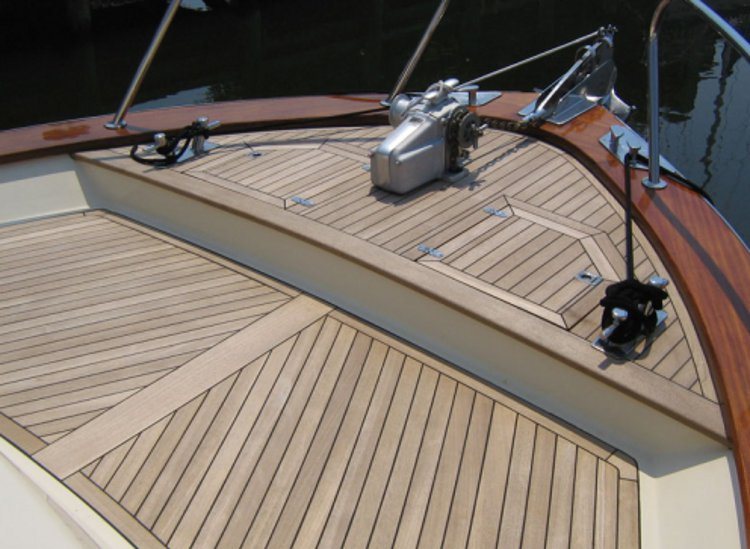
A vertical grain teak deck plank leaves the saw narrow because the radius of the log sets the ceiling on its width, not because anyone decided to rip a wide board down. Quarter the log, then saw radially off each quarter face, and the growth rings stand close to perpendicular to the finished face. Every board in that run is bounded by how far the saw can travel from the pith toward the bark. A wide vertical grain board needs a large diameter log with that much clear radius to give up, and that log is a different animal from the one yielding 3, 4 and 5 inch stock all day.
Narrow widths and vertical grain are one supply story told twice. Boatbuilders did not land on narrow deck planking by taste. They landed on it because the sawing pattern that puts the rings on edge and keeps the grain running straight along the length also produces boards in the single digit inches. The Forest Products Laboratory Wood Handbook lays out the geometry and the dimensional consequences of each sawing pattern, and none of it is specific to teak.
Plainsawn stock is the alternative, and it is the worse one on a deck. The rings run close to tangent to the face and the grain runs out across the surface instead of along it. Ring orientation is why a 4 inch vertical grain plank wears like a deck plank and a wide plainsawn board wears like outdoor furniture.
Width Sets How Much a Board Moves
Wood moves far more tangentially than radially, and the movement you have to absorb across a board scales with the width of that board. That is the whole arithmetic of a narrow deck. A 4 inch board moves roughly half as much across its face as an 8 inch board of the same species and the same grain orientation, exposed to the same swing in humidity. The species did not change. The orientation did not change. Only the width changed, and the width is what the joint has to live with.
Put a vertical grain board into the same calculation and the number drops again. Radial movement is the small axis, which is why quartersawn and rift stock holds a flatter face than plainsawn through a wet season.
None of this makes a narrow board immune to anything. It makes the number smaller. On a deck laid tight to a caulk seam, a smaller number per board is the difference between a seam that holds for decades and one that opens in the third summer.
What the Seam Count Buys You

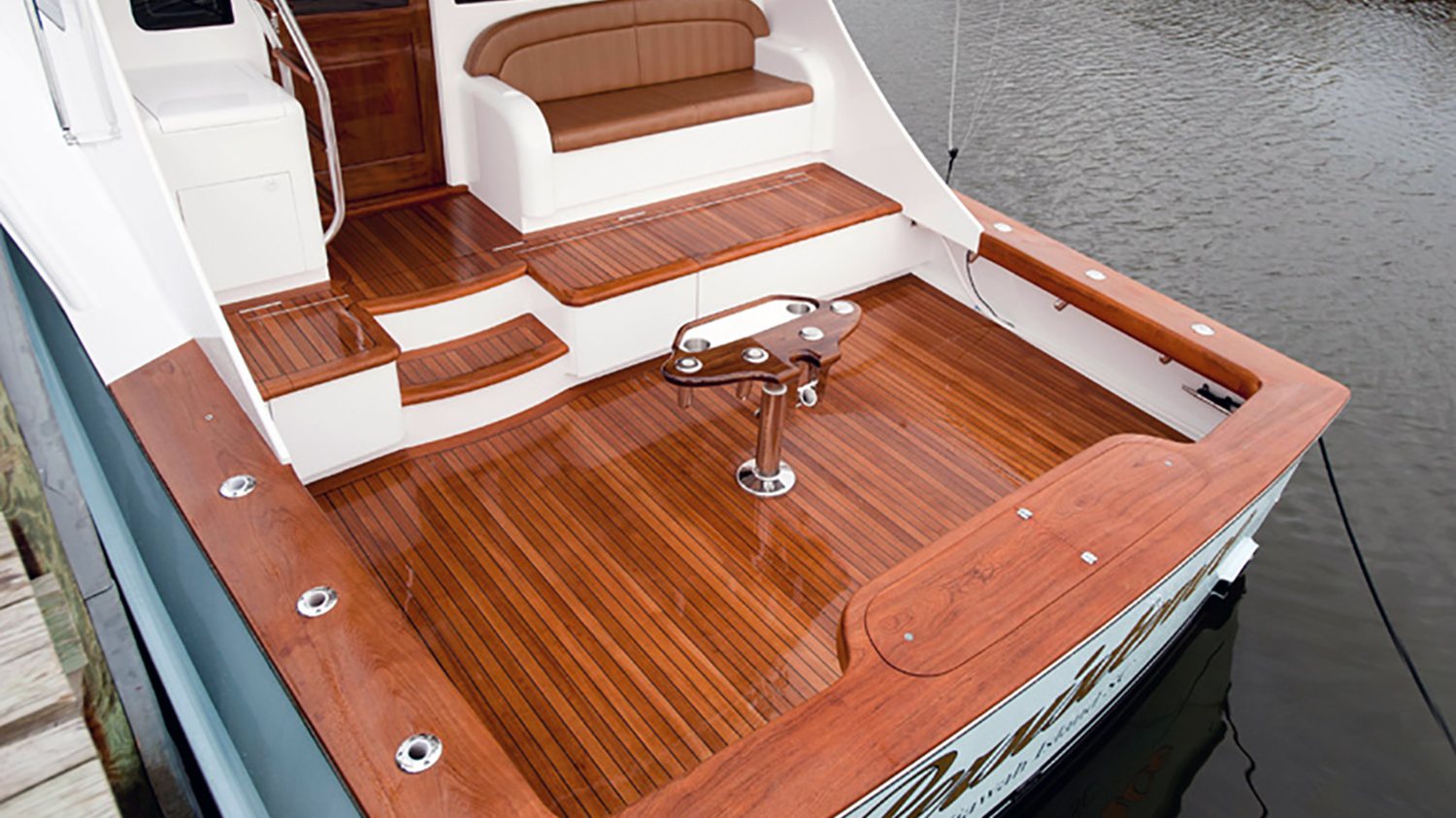
More seams, each one moving less, is a more stable laid surface than fewer seams each moving more. That is the trade the seam count buys, and it is why laid decks and caulked strip decks run narrow by convention rather than by fashion. Divide a 48 inch run of deck into twelve 4 inch planks instead of six 8 inch planks and you have doubled the seams while roughly halving what each one is asked to absorb.
The seam is the weak link on a laid deck, not the plank. A caulk line has a working range. Push past it and the bond fails at one edge, water gets under the plank, and the failure travels along the seam rather than staying where it started. Spreading the same total movement across more joints keeps every joint inside its range.
Fastening follows the same logic. Narrow planking gives more fastening lines per square foot, so the hold down load per line drops and no single line carries the deflection of a wide board. The same geometry lets a damaged plank be lifted and replaced without opening half the deck, which matters on a surface that gets repaired rather than replaced.
There is a cost, and it is honest to name it. More planks means more layout and more linear feet of seam to prepare. The buyer pays in installation labor for a surface that moves less, and on any deck where the seam is the detail holding water out, that trade was settled a long time ago.
Cupping Is an Installation Problem, Not a Species Problem
Cupping is driven by installation and back ventilation, not by species, and a narrow board has less width across which to cup in the first place. A board cups when one face takes on or gives off moisture faster than the other. Trap the underside against a substrate with no path for air or drainage, leave the top face in sun and rain, and the two faces sit at different moisture contents. The board responds the only way it can.
Fix the assembly and the problem mostly disappears. Give the underside a drainage path and a way to dry, and detail the edges so water leaves instead of sitting in the seam. Building Science Corporation's work on rain control in buildings covers the same drying and drainage principles that govern a deck surface, a rainscreen cladding and a soffit.
Width is the second lever. Cup is a curve across the width, so cutting the width cuts the sag at the center and the lift at the edges. A 4 inch plank carrying a little cup still reads flat underfoot. An 8 inch plank with the same curvature per inch of width does not.
Plantation Teak and the Shorter Rotation
Plantation teak runs on shorter rotations and smaller logs, which caps both width and length, and the narrow widths are the part of that supply that stays consistent and repeatable. A shorter rotation means a smaller diameter log at harvest. Smaller diameter caps the radius available for a vertical grain cut, and it caps the clear length between knots and branch scars. That is arithmetic, not a judgment on the material.
For a buyer the practical consequence is matching. A job that runs in phases, a refit that will be finished next season, or a program that has to look identical across three hulls all need the second release to read like the first. Narrow widths in a plantation grown species are the part of the supply where that is realistic.
J. Gibson McIlvain matches a run across phases so the second release reads like the first, and it rips teak to one consistent width on straight line and gang rip saws rather than shipping a mixed bundle and leaving the rip to a shop without the saws for it. J. Gibson McIlvain has worked as a family run importer and miller since 1798 and is now in its seventh generation, which is how a width, a length and a profile stay on record long enough to be matched years later.
"A buyer calling about a deck almost never starts with a width. They describe the seam they want and the vessel it is going on, and the width falls out of that conversation. Our job is to cut every plank in the order to the same number and to keep that number on file for the next phase."
Norm Moton, Director of Sales, J. Gibson McIlvain
Oils, Silica and the Millwork Palette
Teak is Tectona grandis, and the natural oils and silica that make it a deck species also dull tooling and complicate adhesion, so narrow stock needing fewer glue lines per square foot of finished surface is a genuine advantage on a glued assembly. Silica is abrasive. It takes the edge off knives and saw teeth faster than a domestic hardwood of similar density does, which is why a teak run gets its own tooling plan.
The oils matter at the glue line. Surface preparation, open time and adhesive choice all tighten up on an oily tropical species, and every joint in a laminated cap rail or a staved top is another place that can go wrong. A narrow plank laid as a plank has no glue line at all, and a staved top built from 4 inch stock carries fewer joints per square foot than one built from 2 inch stock.
Teak sits in the millwork palette alongside Sapele, Iroko, Afrormosia and Utile, which is sold as Sipo. Those are the species a millwork shop reaches for when the part has to be machined, glued or moulded. Sapele runs roughly 1,410 lbf on the Janka scale, and the Janka hardness reference at the Wood Database carries the comparative figures for the rest, including teak.
The tropical decking species are a different group with a different job. Ipe, which is Tabebuia spp, along with Cumaru, Garapa, Jatoba and Red Balau, are extremely hard and carry high oil content, which makes them difficult to glue. They are legitimate decking stock and nothing here argues otherwise. They are the wrong first call for a milled, glued or machined component, which is why a specification written around seams, cap rails and staved assemblies keeps coming back to teak.
Grade Describes Yield, Not Looks
Hardwood grading in North America runs on the National Hardwood Lumber Association rules, which grade a board by the yield of clear face cuttings it gives up rather than by how it looks on the pile. FAS is the top grade and requires a minimum board of 6 inches wide by 8 ft long yielding 83 and 1/3 percent clear face cuttings. FAS One Face, written F1F, meets FAS on the better face. Selects meet FAS on the better face at a smaller minimum size. No. 1 Common requires 66 and 2/3 percent and a minimum board of 3 inches by 4 ft. No. 2A Common requires 50 percent.
Read those minimums against a 3 or 4 inch deck plank and something useful falls out. A 4 inch board cannot meet the FAS width minimum at all, by definition, however clear it is. Narrow deck stock is specified by what the plank has to do, which is to run a given clear length at a given width with the rings on edge, rather than by reaching for the name of a grade written around wider boards. The NHLA rules are the reference for the domestic hardwood conversation, and an imported species gets bought on the specifying language of the order.
A No. 1 Common board is not a defective board. It yields smaller clear cuttings, which makes it the economical grade for short parts and the wrong grade for long clear runs. On a deck where planks run the length of a cockpit, clear length governs and the grade name sits downstream of it.
Thickness is quoted in quarters of an inch of rough thickness, so 4/4 is a nominal 1 inch rough board, 8/4 is 2 inches and 16/4 is 4 inches. Surfaced dimensions come off those rough numbers, which is why a deck plank thickness belongs on the order as a finished number rather than a quarter call.
Moisture Targets for Deck Stock and Cabin Soles
Exterior work runs near 12 to 16 percent moisture content and interior work near 6 to 8 percent, and neither target changes because the board got narrower. Width changes how much dimensional movement a given moisture swing produces across the face. It does not change where the wood needs to start. A deck surface, a swim platform tread and a toe rail all belong in the exterior band. A cabin sole, an interior slat wall and a stair tread assembly belong in the interior band.
J. Gibson McIlvain mills exterior teak to a 12 to 16 percent in-service moisture content and interior stock to 6 to 8 percent, which is the most common place a deck order goes wrong before it ever reaches the dock. Air dried stock settles near the local equilibrium and is not a substitute for kiln dried material where an interior tolerance matters. A plank milled at the wrong end of the range will move once it reaches its service environment, and on a caulked deck that movement shows up in the seam.
One job can legitimately need both numbers. A vessel with an exposed deck above and a finished sole below is two environments, and one moisture target for both is a mistake. State the target per application and let the shop split the run. The American Wood Council codes and standards library is the reference for the engineering side of in-service moisture assumptions in wood assemblies.
Where 3, 4 and 5 Inch Teak Is the Right Call
Narrow teak is not a compromise width looking for a job, it is the correct engineering answer for a specific and fairly long list of components. Laid and caulked deck surfaces lead the list. Cabin and cockpit soles follow, then swim platforms and boarding steps, grating and duckboard, bench and chair slats, toe rails and rub rails, handrail caps and cap rail, brightwork trim, transom and coaming repair stock, interior wall slats, ceiling boards and shower or wet room duckboard.
Two deserve a note. Staved assemblies, meaning a tabletop or a stair tread built up from several narrow pieces instead of cut from one wide board, use narrow stock on purpose, since alternating the orientation and shortening the movement path per piece keeps the finished surface flatter. Grating and duckboard are narrow by function, because the point is a slatted surface with drainage between the members.
| Nominal width | Movement across the face | Where it belongs | Specification note |
|---|---|---|---|
| 3 inch | The smallest movement per board of the three, and the highest seam count per square foot | Caulked deck surfaces on smaller vessels, grating and duckboard, bench and chair slats, repair stock let into an existing deck | Highest labor per square foot to lay. State the finished width and the seam width together so the layout closes on the centerline |
| 4 inch | Roughly half the movement of an 8 inch board of the same species and orientation | Laid and caulked decks, cockpit soles, swim platforms and boarding steps, staved tops and stair treads, interior wall slats | The common default for a laid deck. Specify vertical grain explicitly rather than assuming it follows from the width |
| 5 inch | More movement per board than 4 inch and fewer seams to absorb it | Soffit boards, narrow exterior cladding and rainscreen boards, ceiling boards, cap rail and handrail cap blanks, wider sole boards in a protected interior | Best where the surface is sheltered or back ventilated. Confirm the back ventilation detail before choosing the wider board |
ICD, the architectural millwork division of J. Gibson McIlvain, builds the custom assembly planned around a specific space, which is the route for an interior slat wall or a sole surround that has to fit one room and one set of obstructions rather than a standard module. Its working process starts from the space instead of from a catalog of parts.
Fastening, Seams and the Finish Schedule
The fastening method and the bedding compound belong to the installer, and the lumber order has to be cut to suit the method before the first plank goes down. A deck laid with screws and bungs needs a plank thickness that can carry a counterbore and still leave wood under it. A deck bonded and blind fastened needs a clean, consistent back face and a predictable thickness across the whole run. Those are different orders, even at the same width.
Seam width is part of the same decision. The caulk line has to be wide enough to flex and narrow enough to look right, and plank width and seam width together decide whether the layout closes evenly at the centerline and the margin planks. Work that out on paper first. Changing a number on a cut list costs nothing next to ripping planks on site.
Finish is where narrow teak surprises people. Open-grained and oily species absorb a great deal of finish, so the first coats of any sealer or film finish largely disappear into the wood before a surface film starts to build. A deck left to weather needs a cleaning regime instead. A brightwork cap rail needs a coating schedule with a stated number of coats and a maintenance interval, planned before the material arrives rather than after.
J. Gibson McIlvain grinds the knife when a cap rail or a trim profile has to match an existing section, working from a library of thousands of ground knives with new ones ground every week, so a repair section matches the original instead of approximating it. On an existing vessel that is usually the whole job, since a cap rail that is close but not identical reads as a repair from across the dock.
One limit is worth stating plainly. Warranties exist on modified wood products and on nothing else, and it is not possible to warranty solid unmodified wood, an organic material responding to its environment. Teak is solid unmodified wood. What a buyer can hold a supplier to is the width, the thickness, the grain orientation, the clear length and the moisture content on the order, which is exactly why those five numbers belong in writing.
How J. Gibson McIlvain Would Specify This
A narrow teak deck order is five numbers and one grain call, and an order carrying all six rarely goes wrong. State the finished width, not a nominal range. State the finished thickness as a finished number rather than a quarter call. State the minimum clear length, since that is what governs on a plank running the length of a cockpit. State the in-service moisture target, 12 to 16 percent for exterior and 6 to 8 percent for interior. State the seam width the installer is working to. Then state vertical grain, in writing, because it does not follow automatically from a narrow width.
Split the order by environment when a job has two. One line for the exposed deck at the exterior target and a separate line for the sole or interior slat work at the interior target beats one bundle that satisfies neither. J. Gibson McIlvain mills, rips and resaws the two lines to their own targets on moulders, straight line and gang rip saws and band resaws.
Keep the matching requirement in the specification rather than in a phone call. If phase two lands next season, say so on phase one, and have the width and the profile recorded against the job. J. Gibson McIlvain ships nationwide and delivers regularly to California, which matters on a coast where the hull being rebuilt is not going to travel to the material.
The buyer's own shop or installer handles the layout, the bedding, the fastening and the seam work on the vessel. The lumber side is the width, the orientation, the length, the moisture content and the match. J. Gibson McIlvain supplies and mills and does not install or field measure, so the cut list comes from whoever is holding the tape on the boat.
To specify narrow teak for a deck, a sole, a cap rail or a staved assembly, see the J. Gibson McIlvain millwork services page or call 800-638-9100 with the five numbers and the grain call in hand. The Wood Moulding and Millwork Producers Association is a useful second reference on profile and millwork terminology when the order includes a moulded cap.
Frequently Asked Questions
Why is teak decking sold in 3, 4 and 5 inch widths instead of wider planks?
Two reasons, and both are physical rather than commercial. Quartersawing bounds the width of every board by the radius of the log, so vertical grain teak comes off narrow by geometry, and a wide vertical grain board requires a large diameter log. The second reason is movement. Dimensional change across a board scales with width, so a narrow plank asks less of every seam and every fastening line on a laid deck. Narrow is the width the surface wants.
Does a 4 inch board really move half as much as an 8 inch board?
Across the face, roughly yes, assuming the same species, the same grain orientation and the same humidity swing. Movement across the grain is proportional to the dimension across the grain, so halving the width halves the dimensional change the joint has to absorb. Vertical grain cuts the number again, since radial movement is the smaller of the two axes. None of this stops wood from moving. It makes the number each seam has to carry smaller.
Can I buy FAS grade teak in a 4 inch width?
No, and not because of availability. FAS requires a minimum board of 6 inches wide by 8 ft long yielding 83 and 1/3 percent clear face cuttings, so a 4 inch board falls outside the width minimum by definition. Narrow deck stock gets specified by what the plank has to do, which is to run a stated clear length at a stated width with the rings on edge. Grade names describe yield from a board, not the quality of a deck plank.
Is plantation teak acceptable for a deck surface?
For narrow widths it is the part of the supply that behaves most predictably. Shorter rotations mean smaller logs, which caps width and clear length, so a plantation log will not yield a wide vertical grain board. It will yield consistent 3, 4 and 5 inch stock, and consistency is what a job running in phases actually needs. If the drawing calls for a wide single piece, that is a different conversation about log diameter rather than about plantation versus natural growth.
What moisture content should teak deck planks be milled to?
Exterior work runs near 12 to 16 percent in-service moisture content and interior work near 6 to 8 percent, and the width of the board does not change either target. A vessel with an exposed deck above and a finished sole below needs both numbers on the same order, split by line. J. Gibson McIlvain mills exterior teak to the exterior band and interior stock to the interior band. Air dried material settles near the local equilibrium and is not a substitute where an interior tolerance matters.
Would Ipe or Cumaru work instead of teak on a yacht deck?
They are legitimate decking species on a terrace or a dock. Ipe, which is Tabebuia spp, along with Cumaru, Garapa, Jatoba and Red Balau, are extremely hard and carry high oil content, which makes them difficult to glue. A marine deck package usually includes bonded, machined and moulded parts such as cap rail, staved tops and coaming trim, and a millwork shop reaches for Sapele, Iroko, Afrormosia, Teak or Utile, which is sold as Sipo, for that work.
Will narrow planks cup less than wide ones?
Cupping is driven by installation and back ventilation, not by species, so the first fix is always the assembly. Give the underside a drainage path and a way to dry, keep water from sitting in the seam, and most cupping never starts. Width is the second lever. Cup is a curve across the width of a board, so a narrower plank has less width across which to cup and a small amount of curvature still reads flat underfoot.
Where do I buy teak decking in the widths a yacht deck needs?
Call J. Gibson McIlvain at 800-638-9100 with six things in hand. The finished width, the finished thickness as a finished number rather than a quarter call, the minimum clear length, the in-service moisture target, the seam width the installer is working to, and a written vertical grain call. J. Gibson McIlvain rips teak to one consistent width on straight line and gang rip saws and keeps that width on record for a later phase. The layout, bedding and seam work stay with the installer.
Sources and Standards Referenced
- Wood Handbook: Wood as an Engineering Material (FPL-GTR-282), USDA Forest Products Laboratory
- National Hardwood Lumber Association
- Teak (Tectona grandis), The Wood Database
- Janka Hardness Explained, The Wood Database
- Rain Control in Buildings (BSD-013), Building Science Corporation
- Codes and Standards, American Wood Council
- Wood Moulding and Millwork Producers Association
- J. Gibson McIlvain Millwork Services