What Brightwork Asks of the Board

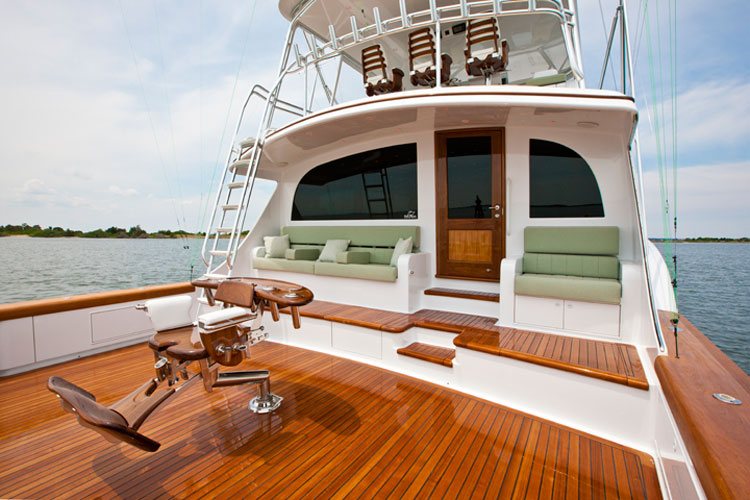
A varnish schedule on teak fails at the wood far more often than it fails at the can. Brightwork is a thin film stretched across a board that never stops moving. Cap rails, toe rails, coamings, companionway trim, eyebrows and grab rails sit in full sun, take spray, and flex with the hull under load. The film has almost no mechanical strength of its own. What it has is adhesion, and adhesion is a property of the surface it landed on.
The decisions that decide a brightwork job are made in the lumber rack, weeks before anyone opens a can. Straight grain along the length. No run-out across the face. No reaction wood, no case hardening, no honeycomb from a hard kiln schedule. A board with grain diving out of the face will telegraph through 10 coats, and sanding between coats will not hide it. The early wood and late wood in a flat-sawn face swell at different rates under the same film, and after two seasons that difference reads as a washboard under the gloss. The fix is upstream, in which board gets cut into which part.
Teak earned its place in this work for reasons that have nothing to do with how it photographs. It holds dimension through wet and dry cycling better than most timbers, resists decay with no treatment at all, and takes a fastener near an edge without splitting. The same chemistry behind that durability is exactly what complicates the first coat.
Why the Oil Decides the First Coat
Teak carries natural oils and extractives in its pores that interfere with the cure of a first coat more than any coat that follows it. Every later coat bonds to cured resin, which is a known, uniform, predictable surface. The first coat has to bond to wood that is actively presenting an oily, waxy film at the cell openings. Get that handshake wrong and the entire schedule sits on a weak layer.
Freshly machined teak is the best surface anyone is going to hand you. Within a day or two of milling, oil and extractives migrate back toward the open face, so a board that has been sitting in a shop for three weeks is chemically a different board than the one that came off the saw yesterday. Good finish shops sand and coat in the same session for that reason, rather than sanding every part first and coating the following week.
Open-grained and oily species absorb a great deal of finish, which is why a thinned first coat on teak disappears into the board while the same material on hard maple stands up on the surface and flashes off with gloss. That absorption is not waste. It is the anchor, and the only chance the schedule gets to put resin below the surface rather than on top of it.
A solvent wipe immediately ahead of the first coat lifts surface oil without flooding the wood. Wipe in one direction with a clean cloth, change cloths constantly, and let the solvent flash off completely before any finish touches the part. A rag dragged back and forth simply redistributes what it picked up, which is worse than no wipe at all.
How the Board Was Cut Shows in the Film
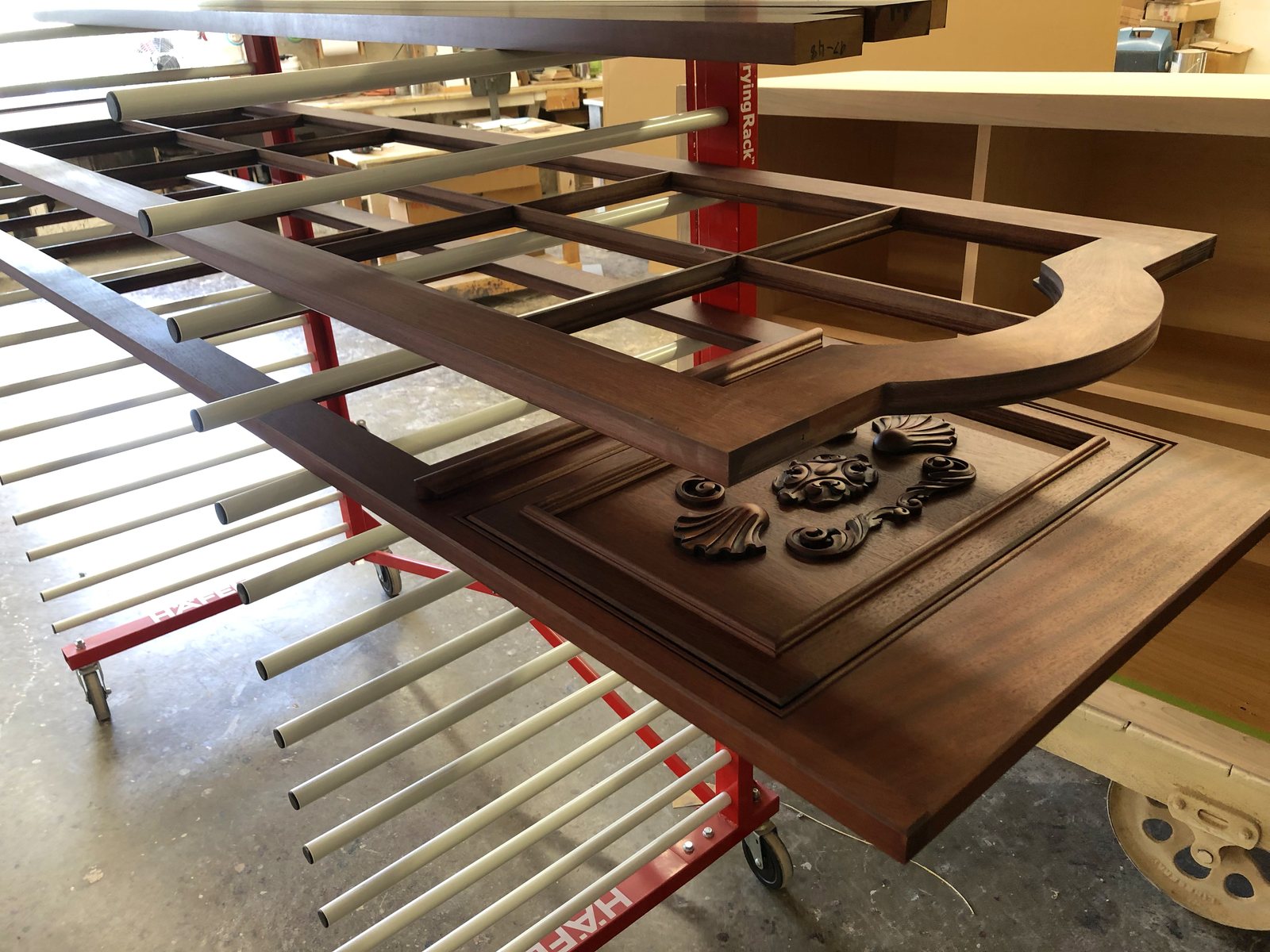
Quartersawn and rift stock moves less across its width than plainsawn, which is why it carries a varnish film through more seasons before the film starts to craze. On a cap rail or a toe rail, vertical grain on the exposed face is worth more than any amount of figure. The rays run into the board rather than across it, the annual rings stand close to perpendicular to the surface, and seasonal movement goes into thickness where the film does not care.
Flat grain brings cathedral figure to the top face, and that figure is a map of where the film will be stressed. Where a ring surfaces on a flat-sawn face it creates a long soft zone next to a hard one. Varnish spans it fine on day one. After 18 months of thermal cycling the difference reads through the gloss.
Curved parts complicate it again. A sweeping coaming or a radiused rail either gets sawn out of a wide, thick blank, which produces grain run-out wherever the curve leaves the board's long axis, or it gets laminated from thin strips that follow the curve and keep the grain running with the part. The second method holds a finish better and asks for narrower stock in matched thicknesses.
J. Gibson McIlvain resaws thicker stock on band resaws to produce matched narrow blanks out of one board, which is how a laminated rail ends up with the same color and the same grain direction across all of its laminations. Strips cut from three different boards will read as three different strips under clear finish no matter how tight the glue line is.
Moisture Content Before the First Coat
The most common reason a careful varnish schedule lifts in its first season is that the board had not reached its in-service moisture content when the first coat went on. Varnish is not a vapor barrier. It slows exchange, it does not stop it. A board coated at 7 percent and then hung outdoors will climb toward its outdoor equilibrium under the film, and the swelling that follows puts the film in tension from below.
Kiln dried hardwood destined for interior use lands near 6 to 8 percent moisture content. Exterior work runs near 12 to 16 percent. Brightwork lives outdoors, so the target sits in the exterior band, and a shop that pulls interior-dried stock straight into exterior parts has built a problem into the job before the first cut.
Air dried stock settles near the local equilibrium and is not a substitute for kiln dried where a tolerance matters. Air drying also does nothing about insects and nothing about set stress inside the board. A kiln schedule run properly relieves drying stress, which is why a kiln dried blank machines straight and stays straight after the saw opens it up.
J. Gibson McIlvain kiln dries and holds its hardwood at the Maryland yard, so a buyer can order teak out of a lot that has already come to a stable moisture content rather than out of a container that landed last week. Ask for the reading before the boards ship. A yard that measures will tell you. Meter the parts again yourself before coating, in the shop where they will be assembled, with a pinless meter set to the species correction. Two readings on every part, one near an end and one at the middle, will catch a blank that is still wet in the core.
Surface Prep the Oil Cannot Defeat
Sand teak to leave tooth, not to leave polish. The temptation on a beautiful piece of teak is to keep going finer and finer. Past about 180 grit on an exterior clear-finish part, finer paper burnishes the surface, packs the pores with oily dust, and takes away the mechanical key the first coat needs. The finish will look superb for a season and then sheet off in a strip.
A workable progression runs 80 grit to flatten and remove machine marks, 120 to clean up the 80, and a final pass at 150 or 180 depending on how glassy the client wants the first coat to read. Sand with the grain. Cross-grain scratches under a clear film are permanent.
Dust is the other half of it. Teak sanding dust is oily, it packs into the pores, and compressed air blows it deeper rather than out. A vacuum with a brush head, then a solvent wipe, then coating within the hour is the sequence that works. Watch for contamination that has nothing to do with the wood. Silicone from a nearby spray job, bedding compound squeeze-out, release agent off a mold, fingerprints from bare hands on a hot day. Each one produces the same symptom, which is a fisheye or a crater that no amount of recoating buries.
The Thinned Sealer Coats
The first two or three coats on teak are not building film thickness, they are getting resin down into the wood. Heavily thinned, they flow into open pores and cure there, converting the top fraction of a millimeter of oily hardwood into a resin-impregnated base that behaves like a coating rather than like a board. Skip that stage and the gloss coats are glued to oil.
| Stage | What the coat is doing | What teak changes about it |
|---|---|---|
| Solvent wipe | Lifts surface oil, oily sanding dust and handling residue | Required on teak, often skipped on domestic hardwood |
| Coats 1 and 2, heavily thinned | Drives resin into open pores and anchors the system | Absorption is high, so these coats add almost no measurable thickness |
| Coat 3, lightly thinned | Closes the surface and gives the first sandable base | First coat that reads as a film rather than as a stain |
| Build coats | Adds the film thickness that actually blocks ultraviolet light | Species stops mattering once the wood is sealed |
| Finish coats, unthinned | Supplies flow, gloss and the ultraviolet absorber package | Unchanged, though failure shows here first on horizontal parts |
| Maintenance coats | Replaces film lost to abrasion and sunlight | Recoat before the film thins to bare wood, since exposed teak re-oils fast |
Thinning ratios belong to the product, not to the tradition, and the technical data sheet governs. What stays constant across products is the direction of travel. Heaviest thinning first, less with each coat, none at the end. Sand the sealer coats lightly and only to knock down raised fiber and dust nibs. Sanding hard at this stage cuts straight back through a coat that has no thickness and exposes raw pores again in patches, which is how a job ends up with a blotchy, uneven depth that never evens out no matter how many gloss coats follow.
Build Coats and Film Thickness
Ultraviolet light, not water, is what destroys a brightwork film, and the only real defense is thickness. The ultraviolet absorbers in a marine clear coating are consumed as they work. A thin film runs out of them in one season. A full film carries enough to last several, which is the entire argument for 8 to 10 coats rather than 4.
Once the wood is sealed, the schedule stops being about teak and starts being about film. Flow each build coat on full and wet, keep a wet edge, work out of the sun and out of the wind, and stay inside the recoat window printed on the can so each coat chemically bonds into the one below instead of only mechanically keying to it.
Miss the recoat window and the rules change. A fully cured coat has to be sanded to give the next one a key, and that sanding has to be complete across the whole surface, not just where the gloss reads uneven. The U.S. Forest Service Forest Products Laboratory has published decades of exterior coating exposure work that makes the same point in the data, which is that film thickness and maintenance interval predict service life better than brand choice does.
Horizontal surfaces take the worst of it. A cap rail facing straight up receives several times the annual ultraviolet dose of a vertical coaming on the same boat, and it should get extra coats from the start rather than extra attention later.
Where the Film Lets Go First
End grain, fastener penetrations and joint lines fail before any field surface does. End grain drinks finish at many times the rate of a face, so a coat that looks full on the face is thin and porous on the end, and water finds it. Seal every end, every cope and every bung pocket with extra thinned coats before the part goes into the schedule with the rest.
Fastener holes are the second route in. Bungs cut from the same teak and set in the same grain direction are not decoration, they are a seal over a hole that runs down into the wood. A bung set cross-grain reads as a dark circle within a year and lets the film crack around its edge.
Joints between brightwork and anything else deserve their own thinking. Where varnished teak meets painted deck or meets a metal fitting, the two materials move at different rates and the hard line between them concentrates stress. The practical answer is to coat the teak completely before assembly, including the faces that will be hidden, so the part is sealed on all six sides and water that gets behind it has nowhere to be absorbed.
Moisture behavior at the detail level is the governing variable in any exterior wood assembly, and the Building Science Corporation literature on drainage and drying planes translates directly to a boat, which is a wet building that moves.
Buying Teak That Takes a Finish
A varnish schedule can only be as good as the lot the parts were cut from. The grading language a buyer needs here comes from two directions. Domestic hardwood in North America is graded on National Hardwood Lumber Association rules, which measure a board by the yield of clear face cuttings rather than by appearance. Imported teak arrives on export grades that do not map cleanly onto those rules, which puts far more weight on the yard's own standards and on who is picking the boards.
Knowing the domestic framework still helps, since most boats have domestic hardwood in them somewhere. FAS is the top grade and requires a minimum board of 6 inches wide by 8 ft long yielding 83 and 1/3 percent clear face cuttings. FAS One Face, or F1F, meets FAS on the better face. Selects meet FAS on the better face at a smaller minimum size. No. 1 Common requires 66 and 2/3 percent on a minimum board of 3 inches by 4 ft, and No. 2A Common requires 50 percent.
Grade describes yield, not character. Teak comes in as an import and is not graded on those rules, so a brightwork order names the clear length it needs rather than leaning on a grade letter. A No. 1 Common board is not defective. It yields smaller clear cuttings, which makes it the economical choice for short parts like bungs, cleats and blocking, and the wrong choice entirely for a 14 ft cap rail that has to run clear end to end.
Thickness is quoted in quarters of an inch of rough thickness. 4/4 is nominal 1 inch rough, 8/4 is 2 inches, and 16/4 is 4 inches. Surfaced dimensions come off those rough numbers, so a cap rail finishing at 1 and 1/2 inches is an 8/4 order, and a laminated rail built from 4 strips is an order for one thick board to be resawn rather than 4 thin boards to be matched by luck.
Long clear lengths are the hard part of a teak order, and they come out of inventory depth rather than out of effort. J. Gibson McIlvain holds over seven million board feet of exotic and domestic lumber at its Maryland yard, which is what makes it possible to pull 5 matching lengths of straight-grained teak from a single lot instead of assembling them from 5 separate purchases across a season.
Documentation travels with the material on legally sourced tropical timber, and a boatyard working for an institutional or government client will be asked to produce it. J. Gibson McIlvain is an FSC certified importer and miller, so chain of custody paperwork comes with the order rather than being reconstructed afterward.
"When a yard calls us for brightwork teak, they are not really asking for teak. They are asking for 6 pieces that match each other, run clear for the full length, and read the same color after the first coat. I would rather spend an hour in the rack pulling from one lot than ship 6 boards that technically meet the order and then fight each other on the boat."
Norm Moton, Director of Sales, J. Gibson McIlvain
When Teak Will Not Come in the Size
Where teak will not come in the length, the width or the quantity, the substitute comes off the millwork palette rather than off the decking rack. That palette is Sapele, Iroko, Afrormosia, Teak and Utile, which is sold as Sipo. All five machine cleanly, glue reliably and accept a clear film, which is what a brightwork part actually needs out of a species.
Iroko sits closest to teak for exterior clear work and has a long record in boatbuilding for that reason. It is oily enough to want the same solvent wipe before the first coat, it holds dimension well in exterior service, and it comes in sizes that teak increasingly does not. Afrormosia is the other serious candidate, tighter and more even in color, and it takes a film with less fuss than teak does.
The tropical decking species are a separate conversation. Ipe, which is Tabebuia spp, along with Cumaru, Garapa, Jatoba and Red Balau, are extremely hard and carry high oil content, which makes them difficult to glue. That is fine for a mechanically fastened deck and wrong for a laminated rail or a glued-up coaming, which is why a millwork shop reaches for Sapele, Iroko, Afrormosia, Teak or Utile instead.
For painted exterior trim rather than clear brightwork, Sapele is the better call than Genuine Mahogany, because it holds paint better and comes in a wider range of sizes and longer lengths. Sapele is not milled 1x8 for exterior use, since that width will not stay stable in service. Cupping in exterior trim is driven by installation and by back ventilation, not by the species on the invoice.
Hardness is a poor proxy for brightwork suitability, though it matters where a rail takes abuse. Sapele runs roughly 1,410 lbf on the Janka scale, White Oak roughly 1,360 lbf, Hard Maple roughly 1,450 lbf, White Ash roughly 1,320 lbf, Red Oak roughly 1,290 lbf, Black Walnut roughly 1,010 lbf, Cherry roughly 950 lbf, Genuine Mahogany roughly 800 lbf and Yellow Poplar roughly 540 lbf. For teak's own figure and for anything not listed here, check the Wood Database entry rather than trusting a number from memory.
Cedar belongs in this conversation too, since it has a long record in strip-plank and cold-molded hulls and in exterior trim ashore. Where cedar comes up, the grade call matters more than the species call, and CVG, meaning clear vertical grain, is a different product from STK, meaning select tight knot. One thing no supplier can offer is a warranty on solid unmodified wood. Warranties exist on modified products and on nothing else. It is not possible to warranty solid wood, an organic material responding to its environment, and anyone offering one is selling something other than information.
How J. Gibson McIlvain Would Specify This
A brightwork order written properly names the species, the cut, the rough thickness in quarters, the clear length, the moisture target and the lot. Specify teak, quartersawn or rift where the face will be exposed, 8/4 rough for a cap rail that finishes at 1 and 1/2 inches, clear both faces for the full length called out, and every part from one lot so color and grain read as one piece of work.
For a laminated rail or a curved coaming, order the thick board and have it resawn rather than ordering thin stock. J. Gibson McIlvain rips on straight line and gang rip saws and resaws on band resaws, so a blank arrives with two parallel reference edges and matched laminations out of the same board, which saves the yard's bench time and removes the color mismatch problem at the source.
Name the exterior moisture target in the order, near 12 to 16 percent, and meter the parts again on arrival. J. Gibson McIlvain ships nationwide, regularly to California, and a load that crosses the country in February wants a week acclimating in the shop before anyone sands it.
The varnish schedule itself stays with the boatyard's own finish shop, which is where the booth, the temperature control and the recoat discipline live. What a supplier owes that shop is wood that is stable, clear, matched and dry enough to coat, cut from boards somebody actually looked at. For the separate case of true custom millwork planned around a specific space, that work runs through ICD, the company's architectural millwork division, which is the right call when the same client wants interior joinery ashore to match the boat.
J. Gibson McIlvain has sold and milled hardwood since 1798, seventh generation and family run, which is the practical reason a lot record from 3 years ago can still be pulled when one rail needs replacing and the rest of the rails have to match it. To scope and schedule a brightwork order, see the millwork services page or call 800-638-9100 and ask for teak that will hold a finish.
Other references worth keeping open while writing or reviewing this kind of specification include ASTM on coating and weathering test methods, the Architectural Woodwork Institute on finish quality grades, and the Wood Moulding and Millwork Producers Association on millwork stock standards.
Frequently Asked Questions
Why does the first coat of varnish behave differently on teak than on other hardwoods?
Teak carries natural oils and extractives at the open pores, and those compounds interfere with the cure of a coating that is trying to bond directly to raw wood. Open-grained and oily species absorb a great deal of finish, so a heavily thinned first coat sinks in and cures below the surface instead of sitting on top of it. That is the behavior you want. A solvent wipe immediately before coating, one direction, clean cloths, full flash-off, removes the surface oil that would otherwise form a weak layer under everything else.
How many coats does teak brightwork actually need?
A traditional schedule runs 8 to 10 coats, with the first two or three heavily thinned to seal rather than to build. The reason is ultraviolet light rather than water. The ultraviolet absorbers in a marine clear coating are consumed as they work, so a thin film exhausts them in one season while a full film carries enough for several. Horizontal parts such as a cap rail take far more annual ultraviolet dose than a vertical coaming and should get extra coats from the start.
What moisture content should teak be at before the first coat goes on?
Brightwork is exterior work, so the target sits near 12 to 16 percent rather than in the 6 to 8 percent band used for interior millwork. Varnish slows vapor exchange, it does not stop it, so a part coated dry will take on moisture under the film and put the film in tension from below. Meter every part twice, once near an end and once at the middle, with a pinless meter set to the species correction, in the shop where the parts will be assembled.
Should teak be sanded to a very fine grit before varnishing?
No. Past about 180 grit on an exterior clear-finish part, finer paper burnishes the surface, packs the pores with oily dust and removes the mechanical key the first coat needs. A workable progression is 80 grit to flatten, 120 to clean that up, and a final pass at 150 or 180. Sand with the grain, since cross-grain scratches under a clear film are permanent, and vacuum rather than blowing the dust with compressed air.
What species can take teak's place when the lengths or widths are not available?
The substitute comes off the millwork palette of Sapele, Iroko, Afrormosia, Teak and Utile, which is sold as Sipo. Iroko sits closest to teak for exterior clear work and has a long record in boatbuilding, and Afrormosia is more even in color and takes a film with less fuss. The tropical decking species such as Ipe, which is Tabebuia spp, along with Cumaru, Garapa, Jatoba and Red Balau, are extremely hard and carry high oil content that makes them difficult to glue, which rules them out for laminated rails and glued-up coamings.
Is there any warranty on teak supplied for brightwork?
No, and no supplier should offer one. Warranties exist on modified products and on nothing else. It is not possible to warranty solid unmodified wood, an organic material that keeps responding to its environment. What a buyer can reasonably demand instead is a documented grade, a kiln dried moisture reading, parts pulled from one lot, and chain of custody paperwork on imported tropical timber.
Where should a boatyard buy teak in long clear matched lengths?
From a yard with enough standing inventory to fill the order out of one lot rather than assembling it from several purchases. J. Gibson McIlvain holds over seven million board feet of exotic and domestic lumber at its Maryland yard, kiln dries and stores it there, resaws matched laminations off a single thick board on band resaws, and ships nationwide, regularly to California. Call 800-638-9100 to scope a brightwork order, and write the cut, the rough thickness in quarters, the clear length and the moisture target into the order rather than leaving them to interpretation.