Why Narrow Teak Exists in the First Place
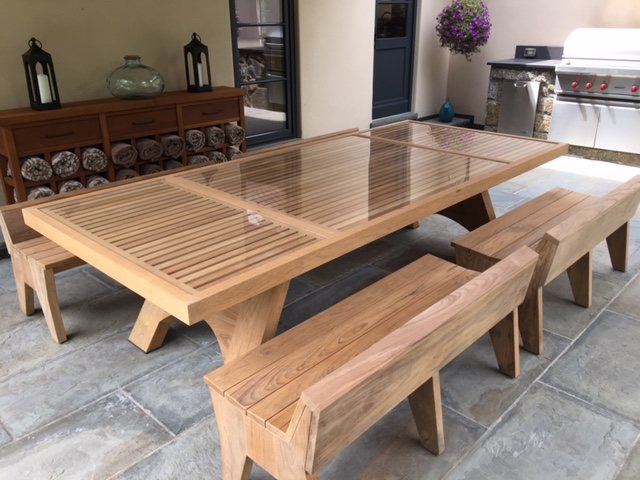
Narrow teak is what quartersawing a log produces, not what is left over after something better has been cut. Quarter the log, set it so the blade runs out along the radius, and the width of every board that comes off is capped by the distance from pith to bark. That is geometry, not grading. A 9 inch vertical grain board needs a log large enough to give up 9 inches of clean radius with the pith and the sapwood already discarded, and logs like that are not common in any species. The cut that delivers true vertical grain delivers it narrow.
Plantation Tectona grandis tightens that limit further. Managed rotations are shorter than the growth cycles behind the salvage timber the yacht trade grew up on, so the logs come in smaller in diameter and shorter in the bole. Width and length both take the hit. What stays repeatable across a plantation supply is the narrow end of the range, and repeatability is what a furniture producer is really buying when a run has to match across a second and a third release.
Narrow stock and vertical grain are the same supply story told twice. A shop that wants radial grain in a seat slat has already asked for a board under 6 inches wide. Asking for 4 inches is asking the log for the cut it wanted to give. J. Gibson McIlvain imports teak as an FSC certified importer and miller, so the sourcing record for a plantation lot travels with the material rather than being reconstructed after the fact.
How Width Drives Movement
Wood moves far more tangentially than radially, and the movement measured across a board scales with its width. Two boards of the same species, the same grain orientation and the same moisture history will not travel the same distance across their faces if one is twice as wide as the other. A 4 inch board moves roughly half as much across its face as an 8 inch board. Halve the width and you halve what the joint next to it has to absorb. The shrinkage and swelling coefficients behind that arithmetic are published by the Forest Products Laboratory, and they are species specific.
On a laid surface the consequence shows up at the seam. More seams, each one moving less, is a more stable surface than fewer seams each moving more. That is the whole reason traditional laid decks and caulked strip decks are narrow by convention. The convention was never about looks, it was about keeping each joint inside the range a sealant, a spline or a glue line could survive.
Cupping follows a different driver. It comes from installation and from back ventilation, from one face reaching a different moisture content than the other, and not from the species on the tag. A narrower board has less width across which to cup in the first place, which is why a 3 inch slat on a frame with air under it stays flatter than a 7 inch board on the same frame. Building Science Corporation has documented the same drying asymmetry in cladding, and the mechanism at a bench slat is identical.
Staves Versus Single Wide Boards
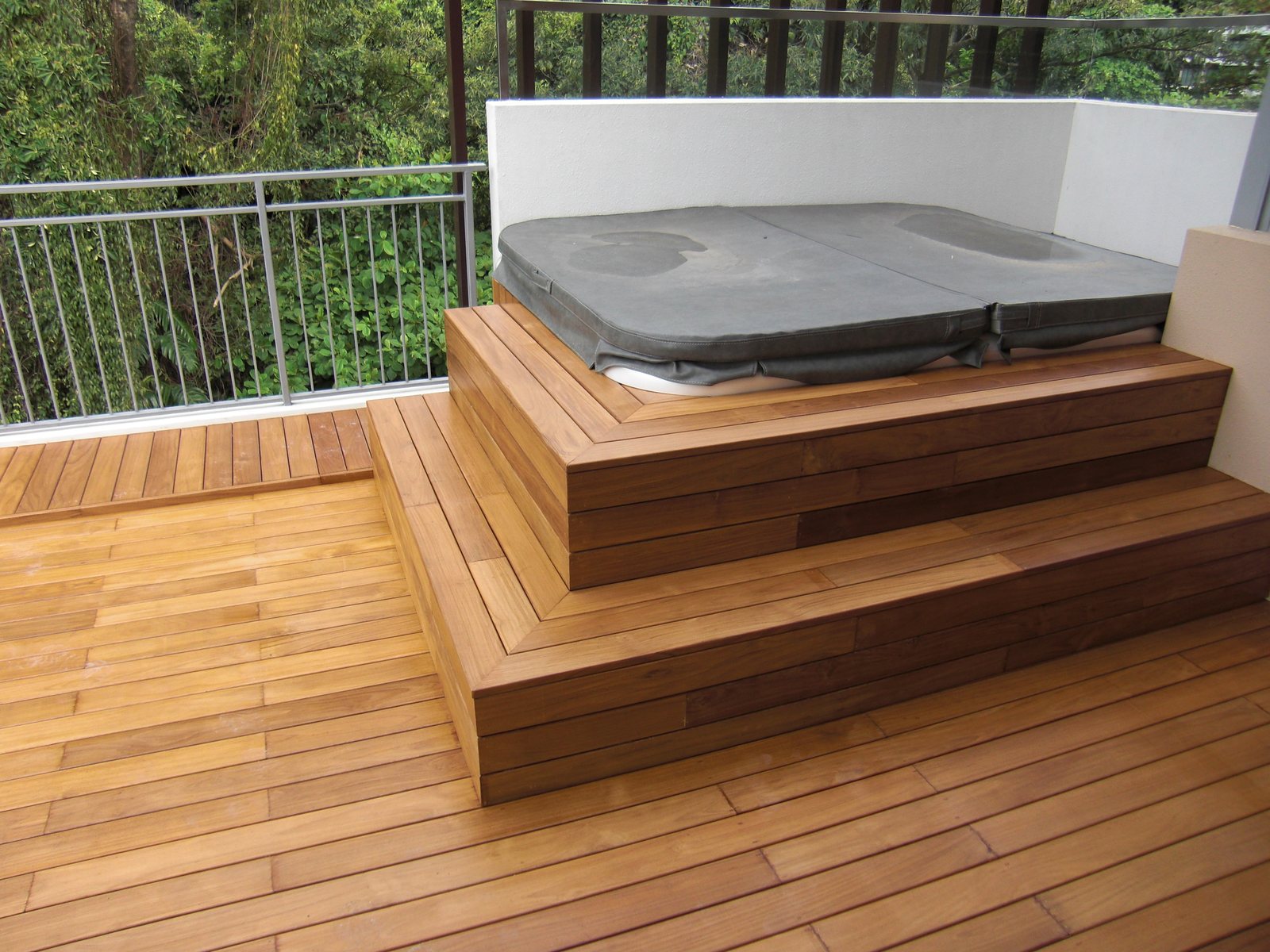
A stave built top lets you choose grain orientation piece by piece, while a wide board forces whatever orientation the log handed it. A stave is a narrow strip ripped to one consistent width, its edges square to its faces, assembled either edge glued into a panel or spaced into a slatted frame. Rip four 4 inch staves, orient each one deliberately, and the resulting 16 inch top is a surface you engineered. Buy a 16 inch board and you inherit a plainsawn center, a pair of flatsawn edges and a cupping axis you did not pick.
That control is the real argument, and it holds harder outdoors than anywhere inside. A table top in the weather sees a wet face and a dry face through every rain cycle. Alternating the staves, keeping each one in or near radial orientation, and distributing the movement across several glue lines turns one large deflection into several small ones. Each joint then has a job it can actually do.
Length follows the same logic. A 20 inch seat slat or a 30 inch stave does not need a long clear board, it needs a board that yields repeatable clear cuttings at that length. J. Gibson McIlvain rips teak to one consistent width on straight line and gang rip saws, so stave edges arrive square and parallel rather than being jointed twice in the buyer's shop.
"When a shop calls about a teak bench top, the first thing I ask is how wide the staves are, not how wide the top is. A 30 inch top built from 4 inch staves has outlasted a 30 inch top built from three wide boards every time I have seen it, and the difference was never the finish."
Norm Moton, Director of Sales, J. Gibson McIlvain
Teak Oils, Silica and the Glue Line
Teak carries natural oils and silica, which dull tooling and work against adhesion, so every glue line in a teak assembly has to be made on a freshly machined surface. The oils migrate back to a cut face over hours, not weeks. A stave edge jointed on Monday and clamped on Thursday is not the same substrate it was when it came off the knife. Shops that build teak well machine and glue in the same shift, or they skim the edge again before glue up.
Silica is the tooling problem. It is abrasive, it takes the edge off a knife and a saw plate faster than density alone would explain, and it is why a teak run needs sharper tooling and more frequent changes than a Sapele run of the same footage. The species data at The Wood Database records that gluing and tooling behavior alongside the mechanical numbers.
Narrow staves help a difficult adhesive in a way that is easy to miss. They give an assembly more joints, each one carrying less stress, which is exactly what a marginal bond needs. A wide board glued to a wide board puts the entire seasonal movement of two wide pieces into a single teak glue line, and that is the joint that opens first.
Table Tops Built From Staves
An exterior teak table top is a stave layup with a movement allowance, not a panel glued flat and screwed down. Lay the top up from 3 to 5 inch staves, keep the orientation consistent, and the field of the top behaves. The failure almost always happens where the top meets the frame. Fix a stave built top rigidly to an apron and the top wins, the fastener elongates its own hole or the apron splits.
So the detail that matters is the attachment. Slotted cleats, figure eight fasteners, buttons in a groove, any method that lets the top travel across its width while holding it down vertically. Stainless hardware throughout, since teak's extractives stain under ferrous metal and the stain goes deeper than a sanding will reach. The Architectural Woodwork Institute quality standards carry the tolerance language most commercial specifications reference for a panel like this.
Breadboard ends deserve a decision rather than a habit. On an interior top they are traditional and they work when the tongue is pinned at the center and slotted outboard. On an exterior top in a climate with a wide humidity swing, an unfixed end or a simple applied edge gives the top fewer chances to argue with itself. Either way, the end grain on an exterior top wants sealing before assembly, not after.
Bench and Chair Slats
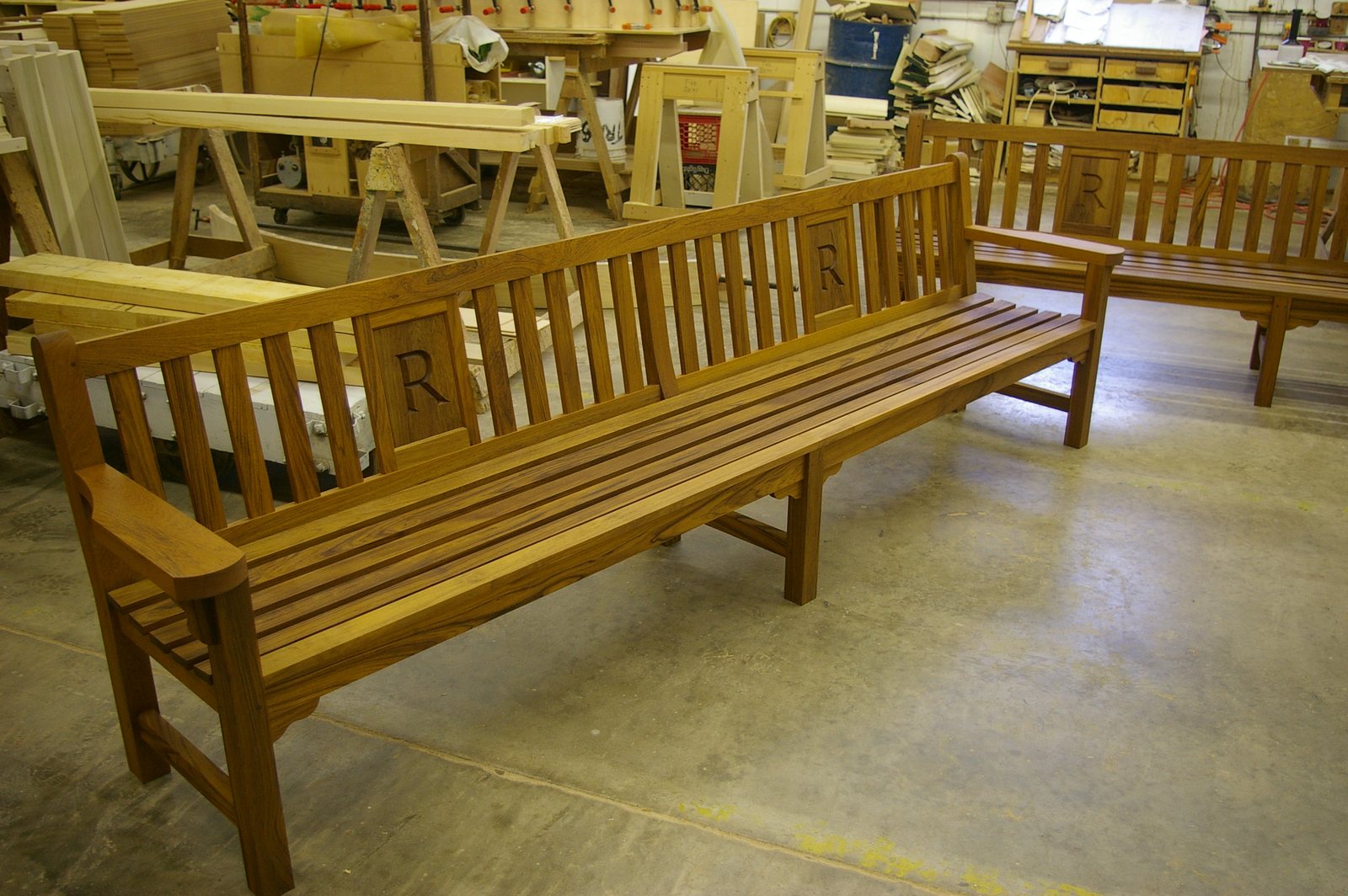
Slat width sets the reveal, and the reveal is the only movement allowance a slatted seat has. Space 3 inch slats across a bench with a consistent gap and each slat grows and shrinks a small amount into a gap that was sized for it. Build the same bench from 6 inch slats and every gap has to carry twice the travel, which is how a seat ends up pinched tight in August or gapped wide in February.
Thickness is a structural call driven by span and seat loading, not by width. Seat slats in 4/4 and 5/4 rough are both common, with the span between frame rails doing most of the deciding. Back slats can run thinner than seat slats, since nobody sits on them. Chair slats on a curve want vertical grain for a separate reason, since a radial face takes a bend with less tearout and holds a finish more evenly across the arc.
Drainage and the edge detail finish the job. A square edge on a seat slat holds water in the corner and wears a sharp arris into something ragged. A small radius, an eased edge or a light chamfer sheds water and survives traffic. The same reasoning carries into grating and duckboard, where narrow teak slats on a frame with air beneath them have been the standard answer in wet rooms and on boats for well over a century.
Grade, Thickness and Width in Narrow Stock
Grade describes the yield of clear cuttings a board gives up, not how a board looks, and narrow short parts are the one place that distinction pays directly. North American hardwood grading runs on the National Hardwood Lumber Association rules, none of which grade teak itself, since teak comes in as an import. A stave order borrows the language and then names the yield it wants. FAS is the top grade and requires a minimum board of 6 inches wide by 8 ft long yielding 83 and 1/3 percent clear face cuttings. FAS One Face, written F1F, meets FAS on the better face. Selects meet FAS on the better face at a smaller minimum size. No. 1 Common requires 66 and 2/3 percent with a minimum board of 3 inches by 4 ft, and No. 2A Common requires 50 percent.
A No. 1 Common board is not a defective board. It yields smaller clear cuttings, which makes it the economical grade for short parts and the wrong grade for a long clear run. A bench seat slat at 20 inches and a table stave at 30 inches are short parts. A 14 ft cap rail is not, and specifying one grade for both wastes material at one end of the list and creates a shortfall at the other.
Thickness is quoted in quarters of an inch of rough thickness. 4/4 is a nominal 1 inch rough, 8/4 is 2 inches, 16/4 is 4 inches, and every surfaced dimension comes off those rough numbers rather than off the finished size you want. Order a 3/4 inch finished slat and you are buying 4/4 rough. Order a 1 and 1/2 inch finished bench rail and you are into 8/4.
| Rough width | Where it earns the specification | Movement and seam behavior | Milling note |
|---|---|---|---|
| 3 inch | Chair and bench seat slats, back slats, grating and duckboard infill, interior wall slats | Least cross grain travel per piece, so a tight reveal between slats stays near its layout dimension through a season | Straight line ripping keeps the edge square to the face, which matters when the gap is the allowance |
| 4 inch | Staves for edge glued table and bench tops, stair tread blanks, cap rail blanks | Roughly half the cross face travel of an 8 inch board of the same orientation | The workhorse stave width, since the glue line count stays sane while each line carries little stress |
| 5 inch | Wider bench slats, soffit boards, narrow exterior cladding and rainscreen boards, toe rails | More travel per piece and fewer seams to absorb it, which is the trade the detail has to allow for | At the upper end of what a plantation log yields in true vertical grain, so orientation is confirmed before layup |
Moisture Content for Furniture Stock
Width does not change the target moisture content, and the target is set by where the finished piece will live. Interior millwork is milled to an in service moisture content near 6 to 8 percent. Exterior work runs near 12 to 16 percent. A teak dining table on a covered terrace in a humid climate and a teak bench in a conditioned lobby are not the same order, even when the parts list reads identically.
Air dried stock settles near the local equilibrium and is no substitute for kiln dried material where an interior tolerance has to be held. That is the most common cause of a stave top that looked perfect at glue up and showed a ridge at every joint three months later. J. Gibson McIlvain mills exterior teak to a 12 to 16 percent in service moisture content and interior stock to 6 to 8 percent, so the stave arrives near where it is going to spend its life.
Acclimation still belongs to the fabricator. Narrow staves equalize faster than wide boards, a real advantage on a short production schedule, but they still need to be stickered and left alone in the shop before the first edge is jointed. Gluing a stack that came off a truck in January into a heated shop is a decision the top will remember.
Fasteners, Hidden Faces and the Finish Schedule
Every face that will be unreachable once the assembly closes has to be coated before it closes. On a slatted bench that means the underside of each slat and both edges. On a stave top it means the end grain and the perimeter of the underside. Skip it and you have built a panel that breathes from one side only, which produces cupping no matter how narrow the pieces are.
Open-grained and oily species absorb a great deal of finish, and a primer coat evens out the eventual painted surface. Sanding or buffing after priming knocks back the grain raising while keeping moulded detail crisp. J. Gibson McIlvain primes wood in three levels in both oil based and water based systems, with a fungicide additive on exterior primed trim, which covers the painted frame members and the trim around a built in bench even where the teak slats themselves are left to go silver or kept under a penetrating oil.
Fasteners are a materials question, not a hardware store question. Stainless steel throughout for teak, bedded in sealant where a screw passes through a wet face, and no ferrous contact anywhere. Teak's extractives react with iron and leave a black stain that follows the grain down into the board. The fastener and corrosion guidance published by the American Wood Council covers the general case, and teak chemistry makes it the strict case.
Warranty expectations have to be set at the same time. Warranties exist on modified wood products and on nothing else. It is not possible to warranty solid unmodified wood, an organic material responding to its environment, and that holds for teak exactly as it holds for every other solid species.
When Another Species Is the Better Answer
Teak is the right call for exterior furniture when a part has to glue well, machine cleanly and carry a seat load, and the millwork palette around it answers nearly everything else. That palette is Sapele, Iroko, Afrormosia, Teak and Utile, which sells as Sipo. Sapele comes in near 1,410 lbf on the Janka scale and holds paint better than Genuine Mahogany at roughly 800 lbf, which is why painted exterior trim around a built in bench goes to Sapele rather than to mahogany. Sapele is not milled 1x8 for exterior use, since that width will not stay flat in the weather.
The tropical decking species sit in a different category. Ipe, which is Tabebuia spp, along with Cumaru, Garapa, Jatoba and Red Balau, is extremely hard and carries high oil content, which makes it difficult to glue. Those species belong on a deck surface, fastened and spaced. They do not belong in a stave layup or a glued chair frame, and that is the plain reason a millwork shop reaches for Sapele, Iroko, Afrormosia, Teak or Utile when a part has to be machined and bonded.
Cedar remains a legitimate default for a great deal of exterior work, and on cedar the grade call carries more weight than the species call. CVG, clear vertical grain, and STK, select tight knot, behave differently in a slat and read entirely differently across a run. A cedar bench specified STK is not a compromise, it is a different design intent.
Where a project wants dimensional stability from a modified product instead, Thermory and Abodo Vulcan are both carried. Modified products top out around 16 ft, with most sold on metric lengths just under 16 ft because of kiln size, and thermally modified Ash is not available wider than 8 inches, so a wide board in a modified product means Accoya at roughly 1,600 lbf or Abodo Vulcan. The acetylation behind Accoya is documented at Accoya and the thermal process at Thermory. Domestic comparisons are easy to check against White Ash near 1,320 lbf, Red Oak near 1,290 lbf, Black Walnut near 1,010 lbf and Yellow Poplar near 540 lbf.
How J. Gibson McIlvain Would Specify This
A teak slat and stave order should name width, thickness, grain orientation, length range, grade and in service moisture content, and leave nothing for the mill to guess. Write the width as a finished dimension and say whether it is critical, since a stave at a critical width is ripped differently than a stave at a nominal one. Name the orientation explicitly as vertical grain or rift where the part needs it, rather than assuming quartersawn will arrive because the species is teak.
State the length range the parts are cut from so the grade can be matched to the yield. Short slats and staves are where No. 1 Common does honest work. Long clear runs are not, and separating those two lines on the same purchase order is the cheapest thing a furniture producer can do for its own yield.
J. Gibson McIlvain resaws teak on band resaws to hold a thickness through a run and trims parts on trimming saws, so a production shop receives blanks rather than raw footage. J. Gibson McIlvain grinds the knife when a cap rail, a toe rail or an apron profile has to match an existing section. J. Gibson McIlvain has been in business since 1798, seventh generation and family run, and matches a run across phases so the second release reads like the first, which keeps a long build consistent. Where the piece is a built in rather than a loose one, ICD, the company's architectural millwork division, builds the custom assembly planned around a specific space.
Assembly, fastening and final fit belong to the buyer's own shop and its installer, so the drawing should mark which faces are coated before closure and which joints are made on freshly machined stock. The full range of millwork services is on the company site, and J. Gibson McIlvain ships the order nationwide, regularly to California. To specify narrow teak for a furniture run, call 800-638-9100 with the width, thickness, orientation, length range and in service moisture content ready.
Frequently Asked Questions
Where should a furniture producer source teak for exterior production runs?
Buy from an importer and miller that can state grain orientation, grade, thickness in quarters and in service moisture content on the acknowledgement, not just the species and footage. For a production run the questions that matter are whether the stock is ripped to one consistent width, whether the moisture content is set for exterior or interior service, and whether a second release can be matched to the first. J. Gibson McIlvain rips teak to one consistent width on straight line and gang rip saws, mills exterior stock to a 12 to 16 percent in service moisture content and interior stock to 6 to 8 percent, and ships nationwide. Call 800-638-9100 with the width, thickness, orientation, length range and moisture content ready.
Why are teak bench slats narrow rather than wide?
Two reasons that point the same way. Wood moves far more tangentially than radially and movement across a board scales with its width, so a 4 inch slat moves roughly half as much across its face as an 8 inch slat. On a slatted seat the gap between slats is the only movement allowance there is, and narrow slats put less travel into each gap. The second reason is supply. Quartersawing caps board width at the log radius, so true vertical grain teak comes off narrow by geometry.
Is a table top built from narrow staves better than one made from wide boards?
For exterior use, yes, and the reason is control rather than strength. A stave layup lets you orient each piece deliberately and distribute seasonal movement across several glue lines instead of concentrating it in one or two wide joints. A wide board brings a plainsawn center and a cupping axis you did not choose. The attachment to the frame still has to allow the top to travel across its width, using slotted cleats, buttons in a groove or figure eight fasteners.
Does teak's oil content affect gluing a stave top?
It does. Teak carries natural oils and silica that work against adhesion, and the oils migrate back to a machined face within hours. Joint and glue in the same shift, or skim the edge again immediately before glue up. Narrow staves help here because they give the assembly more joints, each carrying less stress, which is what a marginal bond needs.
What grade should I order for short teak slats and staves?
Match the grade to the part length. No. 1 Common requires 66 and 2/3 percent clear face cuttings with a minimum board of 3 inches by 4 ft, which makes it an honest grade for a 20 inch seat slat or a 30 inch stave. FAS requires 83 and 1/3 percent and a minimum board of 6 inches by 8 ft, which is what a long clear cap rail needs. A No. 1 Common board is not defective, it simply yields smaller clear cuttings. Separate the short parts and the long clear runs into different lines on the purchase order.
Can I use Ipe instead of teak for a glued bench or table top?
It is the wrong tool for that job. Ipe, which is Tabebuia spp, along with Cumaru, Garapa, Jatoba and Red Balau, is extremely hard and carries high oil content, which makes it difficult to glue. Those species work on a deck surface where boards are fastened and spaced. For a part that has to be machined and bonded, the millwork palette of Sapele, Iroko, Afrormosia, Teak and Utile, which sells as Sipo, is the right place to look.
Is teak furniture stock warrantied against cupping or checking?
No. Warranties exist on modified wood products and on nothing else. It is not possible to warranty solid unmodified wood, an organic material responding to its environment. What can be controlled is the specification, the moisture content the stock is milled to, the grain orientation, and sealing every face that becomes unreachable once the assembly closes. Cupping is driven by installation and back ventilation, not by the species on the tag.
What moisture content should teak bench and table parts arrive at?
Interior millwork is milled to an in service moisture content near 6 to 8 percent and exterior work near 12 to 16 percent, and width does not change either target. Air dried stock settles near the local equilibrium and is no substitute for kiln dried material where an interior tolerance has to be held. Narrow staves equalize faster than wide boards once they reach the shop, but they still need to be stickered and left to settle before the first edge is jointed.
Sources and Standards Referenced
- USDA Forest Service, Forest Products Laboratory
- National Hardwood Lumber Association
- The Wood Database, Teak (Tectona grandis)
- Architectural Woodwork Institute
- Forest Stewardship Council
- American Wood Council, Codes and Standards
- Building Science Corporation
- Accoya, Acetylated Wood
- Thermory, Thermally Modified Wood