Tali is not a sound substitute for Ipe on a commercial restaurant patio, and the substitution fails on procurement grounds before the wood itself ever gets a vote.
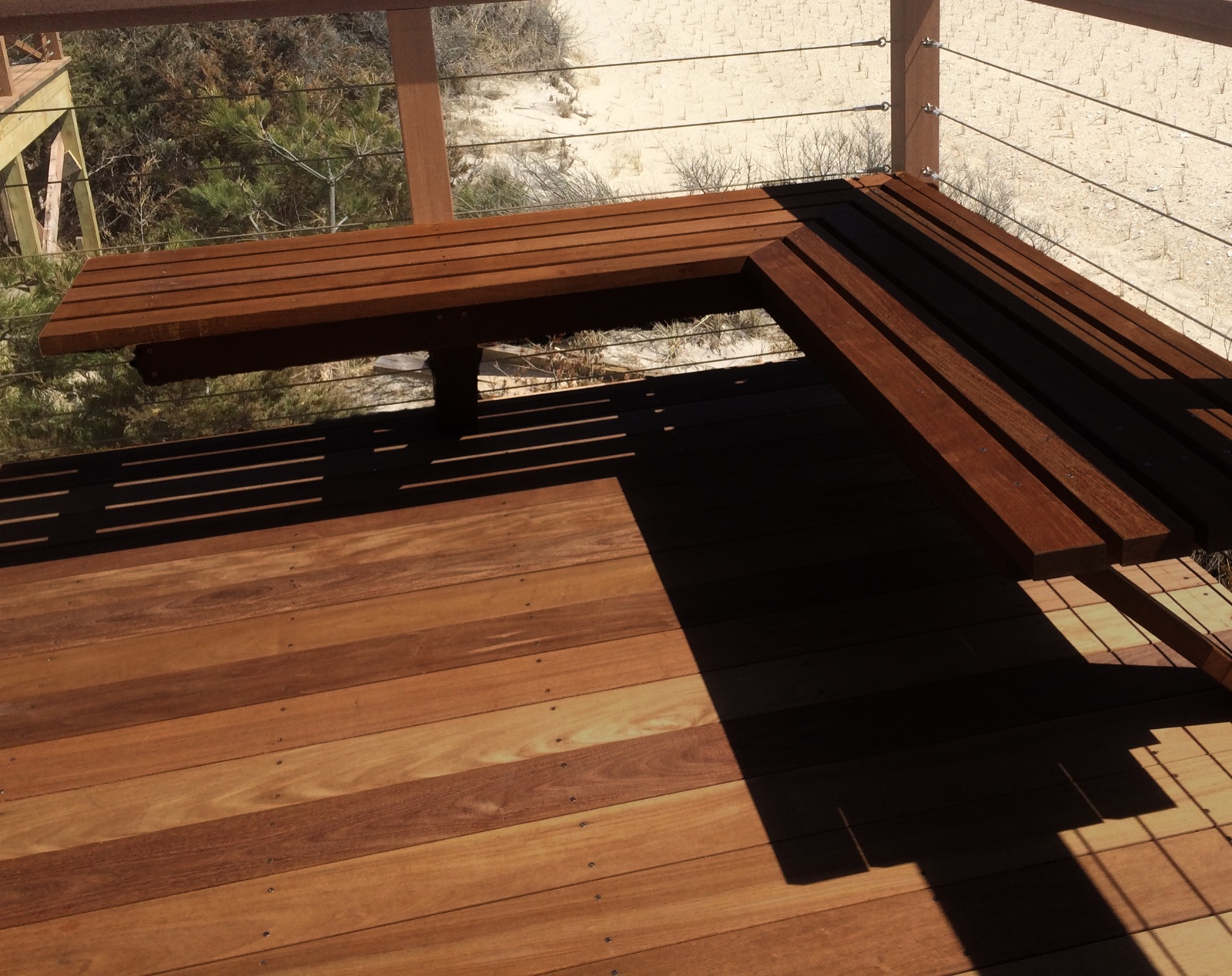
The request lands the same way every time. A general contractor or a purchasing agent forwards a supplier offer for Tali decking, sometimes labeled African Ipe, and asks whether it can replace the Ipe called out in the drawings. On a backyard deck that conversation is worth having. On a restaurant patio, a surface that serves the public every day and sits inside a permitted commercial project, the answer is no, and the reasons have less to do with hardness numbers than most people expect.
A commercial dining terrace enforces three screens that a residential deck never does. The board must be available in 2x thickness, consistently, for the life of the project and its future repairs. The species must arrive with a documentation trail an authority having jurisdiction will accept, including tested fire performance where the code demands it. And the supply line must still exist in year five when a section gets rebuilt around a new bar or a widened egress path. Ipe, from the genus Tabebuia, passes all three. Tali fails the first two outright and stumbles on the third. The rest of this article walks through each screen in the order a spec reviewer would apply them, then covers what to substitute instead when the budget genuinely cannot carry Ipe.
A restaurant patio punishes decking harder than almost any other commercial deck application, and the abuse is mechanical, chemical and thermal all at once.
Think about what the surface absorbs in one dinner service. Steel chair legs drag under load hundreds of times a night. Cast furniture concentrates weight on feet smaller than a quarter. Serving carts roll the same path from kitchen door to service station until a wear track forms. Then the closing crew arrives with degreaser and a hose, and the boards go from hot and dry to saturated in minutes. That wet and dry cycling repeats nightly, all season, and it drives surface stress no residential deck ever sees.
Density is the defense. Ipe runs about 3,680 lbf on the Janka scale at roughly 1,050 kg per cubic meter, dense enough to sink in water, and that mass is why twenty-year-old Ipe boardwalk decks still present a serviceable surface. Published hardness figures for Tali vary by source but cluster near 2,000 lbf. That is a respectable number. It beats domestic softwoods by a wide margin. It is also barely more than half of Ipe's resistance, and on a patio the difference shows up as chair-leg denting at the rail seats and a polished drag path at the server stations within a couple of seasons.
There is a compliance layer on top of the wear layer. A dining terrace is a public accommodation, and the U.S. Access Board's guidance on floor and ground surfaces requires the deck to stay firm, stable and slip resistant with openings no wider than a half inch. A surface that dents, raises grain or splinters under service traffic drifts out of compliance while it degrades, which turns a species choice into an operating liability.
The 2x thickness rule removes Tali from commercial consideration on availability alone, whatever its lab numbers say.
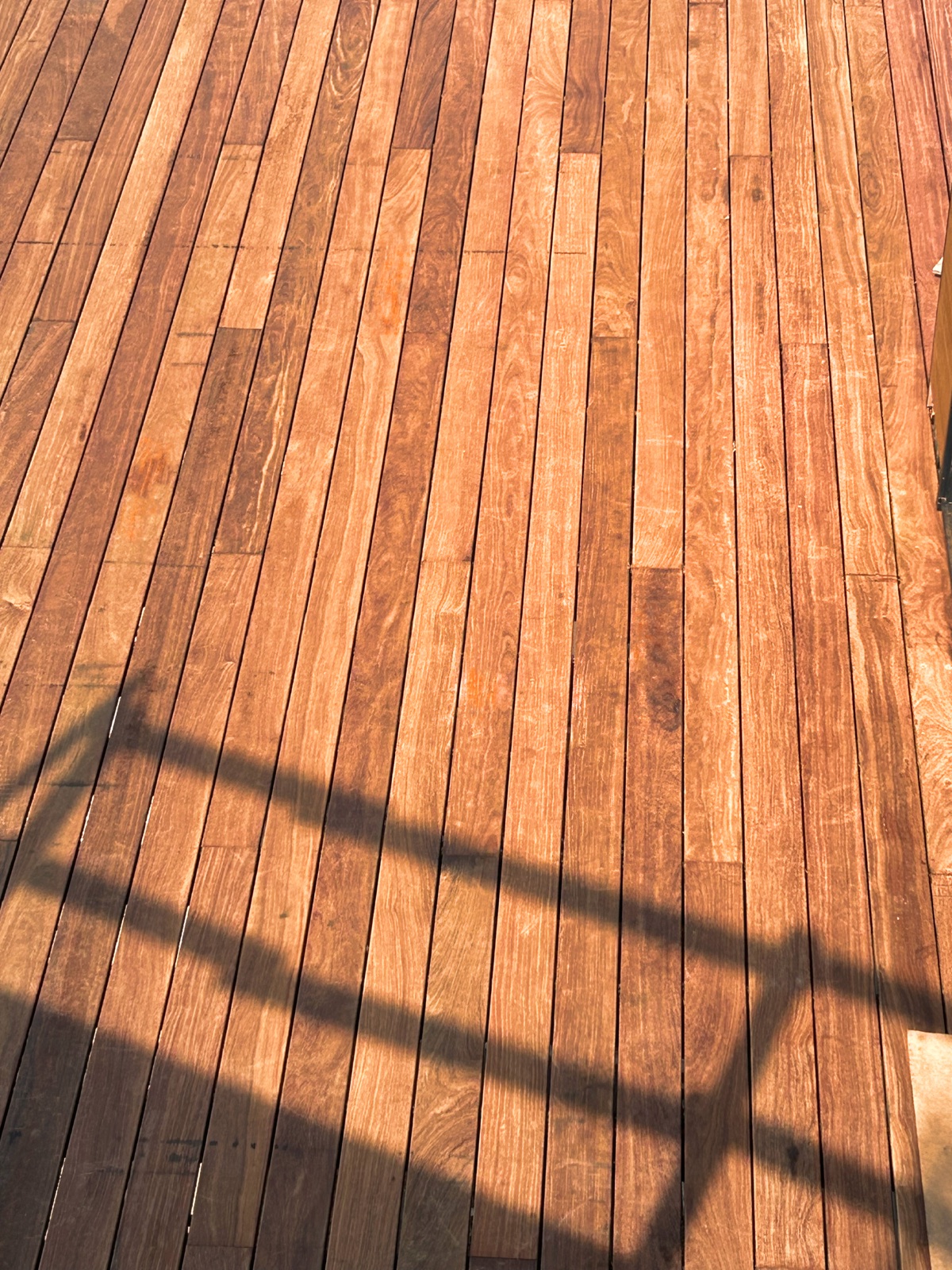
Commercial deck specifications call for 2x thickness. Boardwalks, piers, plazas and restaurant terraces all follow the same logic. The thicker section controls deflection between joists, resists cupping across the wide face and gives the maintenance crew sanding depth for decades of refinishing. Strength math on paper will sometimes justify 5/4 stock over tight joist spacing. No professional goes first with the thinner board on a public job, and no design team wants to defend that decision after a deflection complaint. The 2x spec is settled practice, not conservatism for its own sake.
Here is the filter that rule creates. Only three tropical decking species can be sourced consistently in 2x thickness with dependable grade and volume. Those are Ipe, Cumaru and Jatoba. Tali production runs on metric sizing out of West and Central African mills, and consistent 2x supply in the grades a commercial job needs does not exist in the American market. Red Balau and Garapa hit the same wall. They are honest residential decking species, well suited to 5/4 work where an engineer has approved the section, and they do not belong on a public dining deck for the same reason Tali does not.
| Species | Janka hardness (lbf) | Density (kg/m3) | EN 350 durability | Consistent 2x supply | Where it belongs |
|---|---|---|---|---|---|
| Ipe (Tabebuia spp.) | ~3,680 | ~1,050 | Class 1 | Yes, all standard and custom dimensions | Commercial patios, boardwalks, piers |
| Cumaru | ~3,540 | ~1,070 | Class 1 | Yes | Commercial patios when Ipe is ruled out |
| Jatoba | ~2,690 | ~910 | Class 1 to 2 | Yes | Commercial decks, covered dining terraces |
| Tali | ~2,000 (published values vary) | ~900 (reported) | Class 1 to 2 (reported) | No, metric 5/4 dominates | Residential decks with engineer sign-off |
| Red Balau | ~1,700 to 2,000 | ~850 to 900 | Class 2 | No | Residential and engineer-approved 5/4 work |
| Garapa | ~1,700 | ~830 | Class 1 to 2 (reported) | No | Residential decks, light-color designs |
| Massaranduba (comparison only) | ~3,190 | ~1,150 | Class 1 | No | Shown for comparison; movement in dry exposures keeps it off most U.S. spec lists |
Fire documentation and legality paperwork stall a Tali submittal even when the physical wood would survive review.
Commercial projects live and die on submittals. When a restaurant patio sits within a certain distance of the building, above occupied space or inside a wildland interface zone, the plan reviewer will ask for tested flame-spread data under ASTM E84. Ipe carries a Class A result, a flame-spread index of 25 or less, the same class as concrete, and that single line item is a large part of why Ipe keeps winning rooftop and streetside dining decks. Tali has no widely published E84 result an American reviewer can pull. Without the test report the substitution request dies in the fire marshal's inbox, and commissioning a burn test for one patio makes no schedule sense. The American Wood Council's codes and standards program is the right place to trace how these requirements flow from the model codes into your local amendment.
Legality runs parallel. Every tropical import into the United States falls under the Lacey Act, which puts due diligence on the buyer's side of the transaction, and a supplier who cannot show a clean chain of documentation transfers that risk straight to the project. Chain of custody certification through the Forest Stewardship Council answers the sourcing question when the owner or a green building program asks it. And when a species appears on a CITES appendix, export permits and additional documentation are required before the wood ships, which is paperwork an established importer manages as routine and a spot-market Tali offer may not manage at all.
Tali is a legitimately durable African hardwood with real virtues, and none of them are the virtues a commercial patio spec is testing for.
Tali comes from Erythrophleum species growing across West and Central Africa. The heartwood is genuinely resistant to decay and termites, reported at EN 350 Class 1 to 2, and in its home markets it has a long record in heavy construction, sleepers and marine work. The African Ipe nickname is marketing, but it is not an outrageous stretch on durability alone. The color runs red brown and darkens in service, close enough to weathered Ipe that photographs flatter it.
The working properties are where the comparison thins out. Tali grain interlocks heavily, which raises tearout in milling and makes ripped or profiled edges less predictable than Ipe's. Movement in service runs higher than the Janka number would suggest, and field reports on splinter behavior under barefoot and hand contact are mixed enough that a hospitality operator should pause. Grading is the quiet problem. Ipe reaching the American market moves through an established grading culture with decades of buyer pushback behind it. Tali parcels vary mill to mill, and the parcel you sampled is not a promise about the parcel that ships. On a residential deck a builder can cull the worst boards and move on. A commercial job that ordered to a takeoff has no slack for a twenty percent cull rate.
So place Tali honestly. It is a plausible residential decking value in 5/4 metric sizing for a builder who inspects what arrives. It is not a commercial patio species in the American market, and offering it as one confuses durability with availability.
Cumaru and Jatoba are the substitutions that actually clear a commercial spec, and they are the answer to give an owner who cannot carry Ipe.
Value engineering an Ipe patio is a fair exercise. The mistake is reaching outside the 2x species set to do it. Cumaru sits just under Ipe at about 3,540 lbf and 1,070 kg per cubic meter, holds EN 350 Class 1 durability, and ships in the same 2x commercial dimensions. Its tan and reddish brown tone runs slightly warmer and less uniform than Ipe, which some designers prefer for hospitality settings. Jatoba, at roughly 2,690 lbf, gives up hardness to the other two but still lands far above every domestic alternative, machines cleanly and reads deep red under a penetrating oil. Both cost less than Ipe. Both survive the same submittal review Ipe survives.
J. Gibson McIlvain stocks Ipe decking in a vast inventory across every standard and custom dimension, and mills Cumaru and Jatoba to the same 2x commercial profiles from its own yards. The company has imported tropical hardwood since long before tropical decking was a category, holds FSC chain of custody certification, and ships commercial volume nationwide, with regular freight into California. That matters for a restaurant group building the same patio detail in four states, since one supplier and one grading standard beats four regional yards guessing at each other's quality.
The Tali call comes in about once a month, and it is almost never really about Tali. It is a budget question wearing a species costume. When I walk the buyer through what the fire reviewer and the 2x spec will do to that submittal, we end up pricing Cumaru in the same dimensions instead, and the job stays on schedule. I have never once had an owner regret staying inside the species set we can resupply for the next twenty years.
Norm Moton, Director of Sales, J. Gibson McIlvain
The installation package decides whether any of these species performs, and a perfect board over a bad frame still becomes a callback.
No species is a silver bullet. Dense tropical decking succeeds or fails on the frame, the fasteners and the airflow underneath it, and a restaurant patio compresses every one of those variables. Set joists at 16 inches on center for dense hardwood decking, and tighten that for diagonal layouts. Leave real ventilation under the deck. A patio skirted to grade with no air movement will cup boards that would have stayed flat over an open frame, and planters, mats and service stations that trap standing moisture create the same problem from above.
Fasten from the face on a commercial deck. Two stainless screws per board at every joist is the detail that survives chair drag and thermal cycling, and within a mile of salt water those screws should be 316 stainless. If the design team insists on a fastener-free surface, tongue and groove is the only profile that takes hidden fasteners, and it belongs under a roof, not over open dining. Shiplap takes visible fasteners, full stop. Wherever a profiled board carries a drainage groove, the groove faces down.
Drilling is site work. Decking does not ship pre-drilled and no mill should offer to drill it, since layout and field cuts would invalidate any factory hole pattern the moment the first board gets trimmed. Pilot every hole with a self-centering combination bit, hold about three quarters of an inch of edge distance, drill full pilots near board ends where splitting risk peaks, and land butt joints on doubled bearing so both board ends get full support. The USDA Forest Products Laboratory publishes the mechanical and moisture data behind these practices in its Wood Handbook, and it is worth an estimator's shelf space.
Surface checking cannot be prevented in dense tropical decking, and any supplier promising a check-free patio is selling something other than wood.
Checking is tension release. The board's surface heats and dries faster than its core, the differential builds stress, and small checks open to relieve it. This is the material behaving normally. Checks of that scale do not weaken the board, and their appearance in the first hot season is a sign of dense, properly seasoned stock, not a defect claim. Owners should hear this before the deck goes down, not after.
Mitigation is real even though prevention is not. J. Gibson McIlvain factory coats its tropical decking with Cutek, a penetrating oil that stabilizes the wood surface and significantly reduces checking in the critical first seasons. Site practice does the rest. Verify moisture content at delivery against the 12 to 16 percent in-service range, seal every fresh end cut the day it is made, and keep the underside ventilated so the board dries evenly from both faces. Those steps keep checks small. Nothing eliminates them, in Ipe, in Cumaru, or in Tali for that matter.
The year-five board match is the argument nobody makes at bid time and everybody understands at renovation time.
Restaurant patios get rebuilt in pieces. A bar expansion takes out forty boards. A grease fire scorches a section. The health department flags a drainage change. Whoever maintains the deck will need boards that match the original in species, dimension and grade, years after the first purchase order closed. With Ipe from an importer holding deep inventory across every dimension, that reorder is a phone call. With a Tali parcel bought off a one-time offer, it is a search, and the replacement stock that turns up will differ in color, milling and grade from what is already down. A patched public deck that reads as a patchwork is a bad outcome the original spec quietly caused.
This is the procurement version of durability. The species that lasts is worthless if the supply line behind it does not, and supply continuity is exactly where an established importer earns its keep over a broker moving whatever parcel is cheap this quarter.
How J. Gibson McIlvain Would Specify This
Specify the patio around the 2x screen, the fire submittal and the resupply plan, and the species question answers itself.
Write the deck spec in this order. Call out 2x6 decking in Ipe as the basis of design, with Cumaru named as the approved alternate in identical dimensions, and state that substitutions must match 2x thickness, EN 350 Class 1 durability and documented ASTM E84 Class A performance where the fire code applies. That single sentence screens out Tali, Red Balau, Garapa and every composite that cannot produce the paperwork, without naming any of them.
Detail the frame at 16 inches on center with open ventilation below and positive drainage. Specify face fastening with two 316 stainless screws per board per joist, site-drilled pilots, sealed end cuts and butt joints on doubled bearing. Require factory Cutek coating on all decking and note in the owner's manual that small surface checks are normal behavior in dense hardwood. For lengths, plan the layout around the long stock Ipe makes available, since fewer butt joints on a dining deck means fewer trip edges and a cleaner sight line. If the project brief calls for a modified wood surface instead, Thermory and Abodo Vulcan are the pairing to evaluate, with the caveat that modified boards top out just under 16 feet due to kiln size.
Then close the supply question early. J. Gibson McIlvain ships commercial decking packages nationwide from its own Ipe inventory, takeoff-reviewed and factory coated, and its sales staff will pressure test a substitution request against the fire and dimension screens before it costs the schedule anything. Send the drawings or call 800-638-9100 and have the species argument once, on paper, before the first joist is set.
Frequently Asked Questions
Can Tali be ordered in 2x thickness for a commercial patio?
Not with the consistency a commercial job requires. Tali production runs on metric sizing, dominated by 5/4 equivalents, and no reliable American supply of commercial-grade 2x Tali exists. Only Ipe, Cumaru and Jatoba can be sourced consistently in 2x decking thickness, which is why commercial specifications keep resolving to those three species.
What is the right value-engineering move when an owner cannot afford Ipe?
Stay inside the 2x species set. Cumaru gives up almost nothing to Ipe in hardness and durability and costs less, and Jatoba sits below Cumaru while still far outperforming any domestic decking option. Both clear the same fire, durability and dimension screens Ipe clears, so the substitution survives plan review instead of stalling it.
Do nightly wash-downs and degreasers hurt tropical hardwood decking?
The cleaning chemicals themselves are not the main threat. The wet and dry cycling is. Boards that get saturated every night and bake dry every afternoon build surface stress, so the spec should require open ventilation under the deck, sealed end cuts and a penetrating oil finish rather than a film-forming coating that would peel under that regime. Dense Class 1 species like Ipe and Cumaru tolerate the cycle best.
Will replacement boards match the original deck five years from now?
Only if the supply line still exists. Ipe purchased from a high-volume importer with deep inventory across all dimensions can be reordered to matching dimension and grade years later. A Tali parcel bought on a one-time offer has no such continuity, and replacement stock sourced later will differ in color, milling and grade from the boards already in service.
Does the factory Cutek coating stop surface checking?
No, and nothing does. Checking is the wood relieving tension as its surface dries faster than its core, and small surface checks do not weaken the board. Factory-applied Cutek, a penetrating oil stabilizer, significantly reduces checking, and good site practice such as end sealing and under-deck ventilation keeps checks small. Prevention claims should be treated as a red flag on any supplier quote.
Should commercial decking arrive pre-drilled for fasteners?
No. Drilling is installation work done on site against the frame as built, because layout shifts and field cuts invalidate any factory hole pattern. Crews should pilot every hole with a self-centering combination bit, place two fasteners per board at every joist, hold about three quarters of an inch of edge distance, and drill full pilots near board ends where splitting risk is highest.
What fire documentation will a plan reviewer ask for on a dining deck?
Tested flame-spread data under ASTM E84 whenever the deck's location or the local code triggers a rating requirement. Ipe carries a documented Class A result, meaning a flame-spread index of 25 or less. Tali has no widely published E84 result an American reviewer can rely on, which is frequently the single point where a Tali substitution request ends.
Sources and Standards Referenced
- The Wood Database: Ipe
- The Wood Database: Cumaru
- The Wood Database: Jatoba
- U.S. Access Board, ADA Guide Chapter 3: Floor and Ground Surfaces
- ASTM E84, Standard Test Method for Surface Burning Characteristics of Building Materials
- American Wood Council, Codes and Standards
- Forest Stewardship Council
- CITES, Convention on International Trade in Endangered Species
- USDA Forest Products Laboratory