The short answer for a restaurant patio
Tali is a legitimate Ipe alternative for a commercial restaurant patio, and it fails in exactly one place Ipe does not. It is not the species to specify when the job needs documented Class A fire performance, boards over 14 feet, or the last increment of stiffness under a loaded service station. Everywhere else the gap is narrower than the Janka numbers suggest. Tali runs about 2,920 lbf on the Janka scale against roughly 3,680 lbf for Ipe. Both sit in the same natural durability bracket. Both will outlast the restaurant's lease.
The honest framing is not "is Tali as good as Ipe." It is "which of the two failure modes on a patio does this project actually have." Restaurant patios kill decking through four mechanisms. Chair-leg abrasion at the wear lanes. Standing water under planters and mats. Grease and food acid along the server path. A joist system that traps moisture against the underside of the board. Species addresses one and a half of those. The install addresses the rest.
What Tali actually is
Tali is the trade name for Erythrophleum ivorense and Erythrophleum suaveolens, two closely related West and Central African hardwoods sold interchangeably and shipped under a half dozen regional names. A specifier will see it called Missanda, Elondo, Elone, Sasswood, Red Ironwood, and occasionally "African Ipe" by sellers who want the association. That last name is marketing, not botany. Tali is a legume, in the same broad family as Cumaru and Jatoba. Ipe is a Handroanthus, a completely different lineage that arrives at similar performance by a different route.
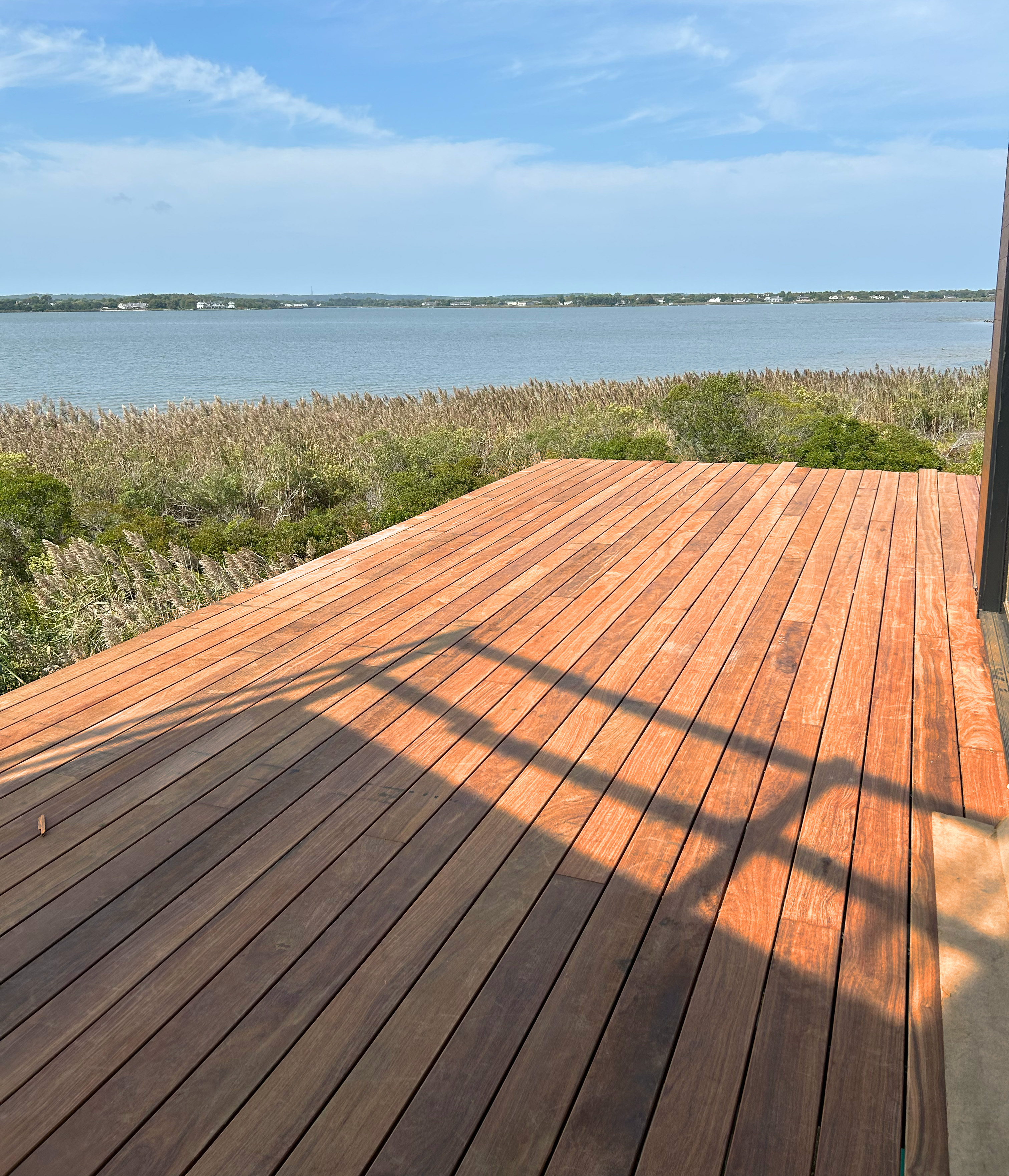
Color is where Tali makes its case. Fresh Tali runs orange to reddish brown and stays remarkably consistent board to board. Ipe does not. Anyone who has opened a bundle of Ipe knows the spread runs from olive to near black to a warm reddish tan, and on a patio where the client approved a sample chip, that spread turns into a sorting problem on install day. Tali arrives closer to the sample. For a designer who is going to keep the deck sealed and pigmented, that consistency has real value.
The grain is interlocked and the texture is coarse. This matters at the miller and at the jobsite. Interlocked grain means Tali does not plane as cleanly as Ipe under a dull knife, and it tears if a contractor rips a board with a general-purpose blade. It also means the boards resist splitting in a way straight-grained species do not.
Hardness, density, and durability against Ipe
Tali gives up roughly 20 percent of Ipe's surface hardness and about 10 percent of its density while holding the same EN 350 Class 1 durability rating, which is the tradeoff that decides most patio projects. Class 1 is the top natural durability bracket. It means the untreated heartwood resists fungal decay in ground contact for decades without chemical treatment, and both species earn it on their own chemistry. Tali also resists termites and dry wood borers without treatment.
Density at 12 percent moisture content lands around 900 to 950 kg/m3 for Tali against roughly 1,050 kg/m3 for Ipe. Worth flagging before any of these numbers reach a submittal: the Ipe values are drawn from long established published property data, while the Tali values are the figures quoted commercially by African hardwood suppliers rather than results from a United States laboratory test program. Treat the Tali numbers as indicative and confirm them against the mill's own data sheet for the parcel being bought. That difference shows up in three practical ways. Tali is easier to handle on a third-floor patio walkup. Tali takes a fastener with slightly less fight. And Tali is measurably less stiff, with published figures putting its modulus of elasticity near 2,600 ksi against roughly 3,100 ksi for Ipe, and its modulus of rupture in the low 20,000 psi range against roughly 26,000 psi for Ipe.
Hardness testing follows ASTM D143, and every specifier should understand what the Janka number does and does not tell them. It measures the force to embed a steel ball halfway into the wood. It predicts dent resistance under a point load. It says nothing about deflection between joists, nothing about how the board handles a wet-dry cycle, and nothing about how it holds a finish. A patio chair dragged 400 times a night is a Janka problem. A board that cups over a wet joist is not.
Tali sits in the upper-middle of the tropical decking field, above Jatoba and well above Garapa and Teak, below Ipe, Cumaru, and Massaranduba on raw hardness. The table below is the field a commercial patio actually gets specified from. Read the durability column before the hardness column. On a patio, decay outruns denting in almost every case.
| Species | Janka Hardness (lbf) | Density at 12% MC (kg/m3) | EN 350 Durability | Practical notes for patio work |
|---|---|---|---|---|
| Ipe | ~3,680 | ~1,050 | Class 1 | Documented ASTM E84 Class A test data. All standard and custom dimensions, long lengths available. |
| Cumaru | ~3,540 | ~1,070 | Class 1 to 2 | More color and grain movement than Tali. Strong warm tone. |
| Massaranduba | ~3,190 | ~1,150 | Class 1 | Heaviest of the group. Checks if it dries too fast in full sun. |
| Tali | ~2,920 | ~900 to 950 | Class 1 | Best color consistency of the group. Sold on metric lengths, commonly 10 to 14 feet, topping out just shy of 16 feet. Dust is a known irritant. |
| Jatoba | ~2,690 | ~910 | Class 2 to 3 | Interior flooring favorite. Needs more finish discipline outdoors than Tali. |
| Red Balau | ~1,700 to 2,000 | ~850 | Class 2 | Costs less than Ipe. Lighter duty. Fine for low-traffic terraces. |
| Garapa | ~1,700 | ~800 | Class 2 to 3 | Pale golden tone, runs cooler underfoot in sun. Softer surface. |
| Teak | ~1,070 | ~650 | Class 1 to 3 (heartwood) | Superb stability and weathering. Soft for a chair-heavy patio. |
Notice that Teak, the most respected exterior wood on the list, is the softest thing on it. That should end any argument that the Janka number alone picks a species. Baseline property data for tropical hardwoods traces back to the USDA Forest Products Laboratory Wood Handbook, and the Wood Database entry for Ipe and its Cumaru entry are useful cross-checks on the commercially quoted figures.
Fire rating is where the Tali substitution usually breaks
Ipe carries documented ASTM E84 Class A test reports, and Tali does not carry that same body of published test data, which makes Ipe the safer specification anywhere an authority having jurisdiction demands Class A on an elevated or attached commercial deck. This is the single most common reason a Tali substitution gets rejected late in a restaurant project.
Class A means a flame-spread index of 25 or less under ASTM E84. Many jurisdictions require it for elevated commercial decks, for roof-deck assemblies, for patios in wildland urban interface zones, and for any assembly attached to a building above a certain height or occupancy class. The requirement comes out of the building code adopted locally, and specifiers should confirm against the International Code Council family of documents and whatever local amendments apply. NFPA standards drive the fire side of the same question in many jurisdictions.
The trap is subtle. A restaurant patio at grade with no roof structure over it often has no Class A requirement at all, and Tali walks through plan review without a comment. Add a pergola, put the patio on a podium slab, or land the project inside a WUI county in California, and the same drawing set now needs test documentation that Tali cannot readily produce. Verify the fire requirement before the species conversation, not after. A dense tropical hardwood being hard to ignite is a physical intuition, not a test report, and plan reviewers accept test reports.
ADA, slip resistance, and the realities of a commercial patio surface
Neither Tali nor Ipe passes or fails a slip test as a species, because slip resistance on a wood deck is set by the surface profile, the finish, and the maintenance regime rather than by the wood itself. Restaurant patios are places of public accommodation. That brings the ADA Accessibility Standards into the drawing set, and they are specific in ways species data sheets never address.
Gaps between boards cannot exceed a half inch in the direction of travel, and elongated openings must run perpendicular to the dominant path. That single rule kills a lot of gapped hardwood patio details that were drawn for a residential deck. Changes in level over a quarter inch need beveling. The running surface has to be firm, stable, and slip resistant.
Dense tropical hardwoods get slick when wet and finished. Both Tali and Ipe do this. The fix is a lightly textured or brushed surface, a matte penetrating finish rather than a film-forming one, and a cleaning schedule that removes the biofilm that actually causes most slips. A patio that gets pressure washed at the wrong angle raises grain and creates the fuzz that holds water. Neither species solves that. A maintenance contract does.
"People come to us asking for Tali because they heard it is Ipe for less money, and that is only half true. What I tell them is that the color consistency is genuinely better than Ipe, and if the patio is at grade with no fire rating triggered and no board over fourteen feet, Tali is a smart specification and I will load a truck today. The minute a plan reviewer writes Class A on the drawings, or the architect wants a clean twenty-foot run with no butt joints, we are back to Ipe and I would rather have that conversation in the bid phase than after the material lands on site."
Norm Moton, Director of Sales, J. Gibson McIlvain
Movement, checking, and what Tali does in service
Tali moves modestly in service and is dimensionally stable for a wood of its density, but it shares Ipe's habit of end checking when a freshly milled board hits full sun before it has equilibrated. Both species need to arrive at 12 to 16 percent moisture content for exterior use and need to acclimate on site, stickered and shaded, before a fastener goes in.
The failure sequence on a hot patio is always the same. Boards land on a Tuesday, get stacked in a solid block on black asphalt, and the crew installs Friday. The outer boards have dried to 9 percent and the core of the stack is still at 15. Six weeks later the deck has a wave in it and everyone blames the species. Sticker the stack. Shade it. Let it come to the site.
Tali is tannin rich. So is Ipe. Both will bleed a rust colored stain onto a light concrete surround for the first several rain cycles, and both will react with ferrous metal and leave a black stain around any fastener that is not stainless. On a coastal patio, 316 stainless is the only correct fastener. Anything less will telegraph within a season. Plan for tannin runoff at the perimeter detail and warn the general contractor before the first rain lands on new cream colored pavers.
One Tali-specific item rarely makes it into a spec sheet. The dust is a known irritant. Erythrophleum species contain alkaloids, and installers who cut a lot of Tali without respiratory protection report throat and eye irritation. Ipe dust does the same thing to plenty of people. The difference is that most crews already know about Ipe. Put the dust note on the drawings so the sub is not surprised.
Lengths, dimensions, and the metric problem
Tali is sold on metric sizing and commonly runs 10 to 14 feet with the top of the range landing just shy of 16 feet, which is the availability ceiling that most often forces a patio layout back to Ipe. Ipe has no equivalent constraint. J. Gibson McIlvain holds a vast Ipe inventory across all standard and custom dimensions, and long lengths are a routine order rather than a hunt.
Work the math before committing. A 5/4x6 board covers roughly 2.1 linear feet per square foot of deck. A 900 square foot patio needs about 1,890 linear feet of decking. Whether that arrives as 14 foot boards or 20 foot boards changes the butt joint count, the blocking schedule, and the visual rhythm of the finished floor. Butt joints on a hardwood deck need blocking under both board ends, and every one of them is a future maintenance point where water sits.
For a long narrow patio running along a building face, the length question is the whole design. A 16 foot ceiling means a butt joint every 16 feet, and on a 40 foot run that is two joints per course whether the architect wanted them or not. Some designers turn that into a deliberate pattern with a picture frame border and a defined seam. Others fight it and lose. Decide in design development.
The install decides more than the species does
A Tali patio built on a properly ventilated joist system with correct fasteners will outlive an Ipe patio built badly, and this is not a close call. Species selection is one input among five, and the other four are where projects actually fail.
Set joists at 16 inches on center for dense hardwood decking. Tali's lower stiffness against Ipe means 16 inches on center is the working maximum rather than a comfortable one, and for a patio carrying service traffic, loaded bus carts, and heavy tables, 12 inches on center is worth the framing. Deflection under a bus cart is what guests notice, not Janka.
Material goes on furring strips or joists with airflow underneath. The underside of the board has to dry. A patio deck laid tight to a podium slab with no ventilation gap will rot from below regardless of durability class, and the Class 1 rating buys time rather than immunity. Building Science Corporation has published the assembly logic on this at length, and it applies to a deck as much as to a wall.
On profiles and fasteners the rules are not flexible. Shiplap takes visible fasteners. Only tongue and groove works with hidden fasteners, and grooves face down for drainage. Clip systems need the clip manufacturer's specific groove profile, not a generic tongue and groove. Pre-drill every hole in Tali and Ipe alike. Both species will snap a screw or split a board end without a pilot hole, and both will chew through a carbide blade faster than a crew estimates.
Connection and fastener design questions ultimately trace to American Wood Council standards, and WoodWorks maintains useful technical resources for commercial wood assemblies.
Sourcing, legality, and the FSC question
Tali is available from FSC-certified forests in West and Central Africa, which is a genuine advantage for a project chasing certification points, and neither Tali nor Ipe should ever land on a commercial site without a clean chain of custody. Restaurant groups with published sustainability commitments get asked about their patio decking more often than they expect.
FSC certification traces the material from a managed forest through every handler to the jobsite. The Forest Stewardship Council publishes the certification and chain of custody framework, and USGBC maintains the credit structures where certified wood contributes. Ask for the chain of custody documentation at the quote stage rather than at closeout, when nobody can produce it.
When using a CITES-listed species, documentation is required for legal import and for the material to move through the supply chain, and that paperwork needs to exist before the order rather than after. Several tropical decking species carry listings, and the requirements change as listings are updated. A supplier who imports directly handles this as routine. A broker who bought a container on the spot market may not be able to produce anything.
How J. Gibson McIlvain Would Specify This
Run the fire requirement and the length requirement first, and let those two answers decide between Tali and Ipe before anyone looks at a hardness chart. J. Gibson McIlvain stocks Tali decking and mills it to standard patio dimensions, and ships it nationwide alongside Ipe, including regular loads to California and the West Coast. Here is the sequence that actually resolves the question.
Step one. Confirm with the authority having jurisdiction whether the assembly triggers a Class A flame spread requirement. Elevated deck, podium slab, roof structure overhead, WUI zone, or attached to the building above a threshold height. If Class A is required, specify Ipe and stop. If it is not, Tali is live.
Step two. Lay out the deck and find the longest required board. If nothing exceeds 14 feet, Tali covers the job. If the design wants clean runs past 16 feet, Tali cannot deliver and Ipe can.
Step three. Set the framing. Joists at 16 inches on center for dense hardwood decking, tightened to 12 inches on center under service paths, bus stations, and anywhere a heavy table will live. Blocking under every butt joint. Ventilation gap under the boards, always.
Step four. Specify 5/4x6 in a smooth or lightly brushed face, gapped per the ADA half inch limit in the direction of travel, on 316 stainless fasteners for any coastal or pool-adjacent project. Pre-drill. Groove down if the detail uses tongue and groove.
Step five. Write acclimation into the contract. Material arrives stickered, stays shaded, and installs at 12 to 16 percent moisture content. Put a number in the spec so there is something to enforce.
Step six. Decide the finish before the first board goes down. A pigmented penetrating oil holds Tali's orange red tone and needs recoating on a schedule. Letting it silver is a legitimate design choice and costs nothing to maintain. What does not work is deciding after the deck has weathered unevenly for two seasons under the planters.
One note on the alternatives that come up in the same conversation. If a project wants a modified wood for stability and a manufacturer warranty, Thermory and Abodo Vulcan both fit that brief and both carry real product warranties, with the caveat that modification kiln size caps those products at metric lengths just under 16 feet. Accoya sits in the same category with the same length ceiling. Solid unmodified wood, Tali and Ipe included, carries no warranty, because it is an organic material and no honest supplier will pretend otherwise. Western Red Cedar remains the default standard for a reason and weathers freeze-thaw extremely well. CVG cedar and STK cedar are different products serving different markets, and neither one is competing with Tali on a high-traffic restaurant patio. Cedar is simply a different use case.
To price a Tali or Ipe patio package, get dimensions and lengths in front of the sales desk at 800-638-9100. Specifications, availability, and current stock on Tali decking and Ipe decking are on the product pages, and the team quotes commercial and contractor volume nationwide.
The verdict
Tali is a good Ipe alternative for a commercial restaurant patio when the project is at grade, needs no Class A documentation, has no board over 14 feet, and values color consistency, and it is the wrong answer the moment any one of those conditions flips. That is a narrower window than most substitution pitches admit and a wider one than Ipe loyalists concede.
What should not change between the two specifications is everything below the boards. Ventilated framing. Correct spacing. Stainless fasteners. Enforced acclimation. A finish decision made on purpose. Get those right and either species delivers a patio that outlasts three tenants. Get them wrong and the hardest wood on earth will still cup, check, and rot from the joist up.
Frequently Asked Questions
Is Tali really "African Ipe"?
No. That name is a sales label, not botany. Tali is Erythrophleum ivorense or Erythrophleum suaveolens, a West and Central African legume related to Cumaru and Jatoba. Ipe is a Handroanthus from South America. The two arrive at similar exterior performance through different chemistry. They share an EN 350 Class 1 durability rating, but Tali is about 2,920 lbf Janka against Ipe's 3,680 lbf, and it is less stiff. Treat the nickname as shorthand for "dense African hardwood," not as a promise of equivalence.
Will a Tali patio dent under restaurant chairs?
At roughly 2,920 lbf Janka, Tali resists chair-leg denting better than Jatoba, Garapa, Red Balau, and Teak, and slightly worse than Ipe, Cumaru, and Massaranduba. In practice the difference between 2,920 and 3,680 lbf is not what a guest notices on a finished patio. Deflection is. A Tali deck framed at 24 inches on center will feel bouncy under a loaded bus cart long before the surface shows dents. Tighten the joists to 12 inches on center under service paths and the hardness question mostly disappears.
Can Tali be used on an elevated or rooftop restaurant deck?
Only after confirming the fire requirement. Elevated commercial decks, podium slabs, roof-deck assemblies, and projects in wildland urban interface zones frequently require ASTM E84 Class A, meaning a flame-spread index of 25 or less. Ipe carries documented Class A test reports. Tali does not carry that same body of published test data, so a plan reviewer who asks for documentation will not accept it. Check with the authority having jurisdiction during design development, not after the material ships.
What is the longest Tali decking board available?
Tali is sold on metric sizing and commonly runs 10 to 14 feet, with the top of the range landing just shy of 16 feet. That ceiling is the most common practical reason a patio layout goes back to Ipe, which is available in all standard and custom dimensions including genuinely long lengths. On a 40 foot run along a building face, a 16 foot ceiling forces two butt joints per course, and every butt joint needs blocking under both board ends and becomes a future maintenance point.
Does Tali need different fasteners than Ipe?
The same discipline applies to both. Tali is tannin rich, so any ferrous fastener will react and leave a black stain around the hole within a season. Use 316 stainless for coastal and pool-adjacent work. Pre-drill every hole in either species. On profiles, shiplap takes visible fasteners only, tongue and groove is the only profile that works with hidden fasteners, and grooves install facing down for drainage. Clip systems need the clip manufacturer's specific groove profile rather than a generic tongue and groove.
Is Tali more sustainable than Ipe?
Tali is available from FSC-certified forests in West and Central Africa, which helps a project chasing certification credits. That is a sourcing fact rather than a species virtue. Ipe is also available with FSC certification. What matters is the chain of custody documentation, which traces material from a managed forest through every handler to the jobsite. Ask for it at the quote stage, when a direct importer can produce it, rather than at closeout. Separately, when using a CITES-listed species, documentation is required for legal import and must exist before the order rather than after.
Does Tali carry a warranty?
No, and neither does Ipe. Solid unmodified wood is an organic material and cannot honestly be warrantied. Only modified and manufactured products carry real warranties. If a project needs a manufacturer warranty alongside dimensional stability, Thermory and Abodo Vulcan both fit that brief, as does Accoya, with the caveat that modification kiln size caps all of those products at metric lengths just under 16 feet.
How much Tali does a patio need?
A 5/4x6 board covers roughly 2.1 linear feet per square foot of deck surface. A 900 square foot patio therefore needs about 1,890 linear feet of decking before waste and pattern allowances. Run that math against the available length range before committing to a layout, since the board length drives the butt joint count, the blocking schedule, and the visual rhythm of the finished floor. Call the J. Gibson McIlvain sales desk at 800-638-9100 with dimensions and lengths for a commercial quote.
Sources and Standards Referenced
- Wood Handbook: Wood as an Engineering Material (General Technical Report FPL-GTR-190) - USDA Forest Products Laboratory
- ASTM E84: Standard Test Method for Surface Burning Characteristics of Building Materials
- ASTM D143: Standard Test Methods for Small Clear Specimens of Timber
- ADA Accessibility Standards - U.S. Access Board
- Ipe - The Wood Database
- Cumaru - The Wood Database
- Codes and Standards - American Wood Council
- BSD-144: Increasing the Durability of Building Constructions - Building Science Corporation
- Forest Stewardship Council
- Technical Resources - WoodWorks Wood Products Council
- International Code Council
- Tali Wood Decking - J. Gibson McIlvain