What a Flute Is and What a Reed Is
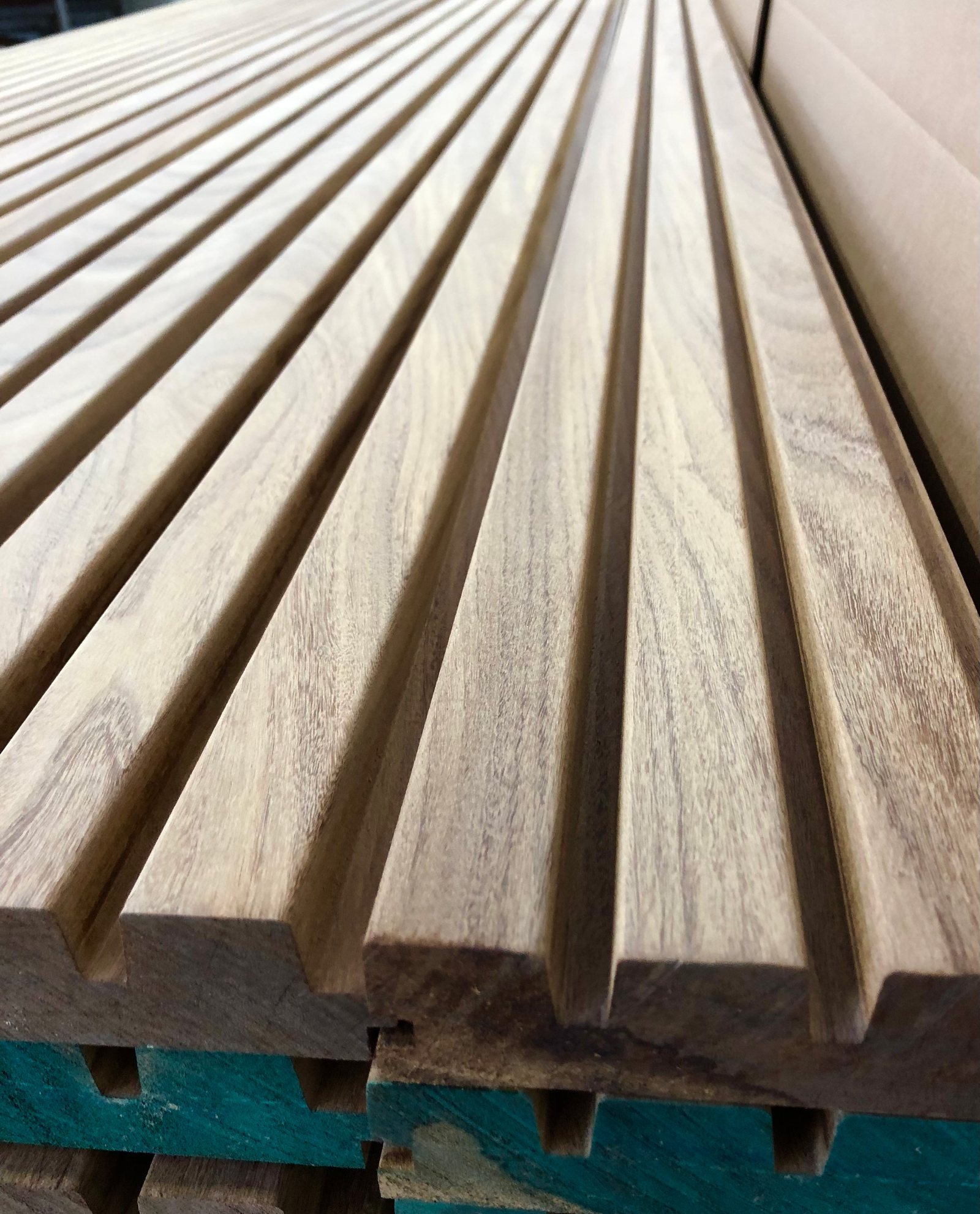
A flute is a concave channel milled into the face of a board and a reed is the convex bead standing proud between channels, and that one difference drives how the wall reads under light, how it survives contact, and what has to happen where the run ends. Both profiles follow the grain. Both are cut by a ground knife riding a moulder head, which means both repeat exactly down the length of a board and both stop dead at the end of it.
The vocabulary matters on a submittal. The flat strip of original face left standing between two flutes is the land, sometimes called the fillet. The sharp line where a reed's curve meets flat stock is the arris. A quirk is the narrow groove cut at the base of a reed to sharpen the shadow line. Draw those on a full scale section and a millwork shop has what it needs to grind a knife. Write "fluted, 3 inch on center" on a drawing and you have described about a third of the profile.
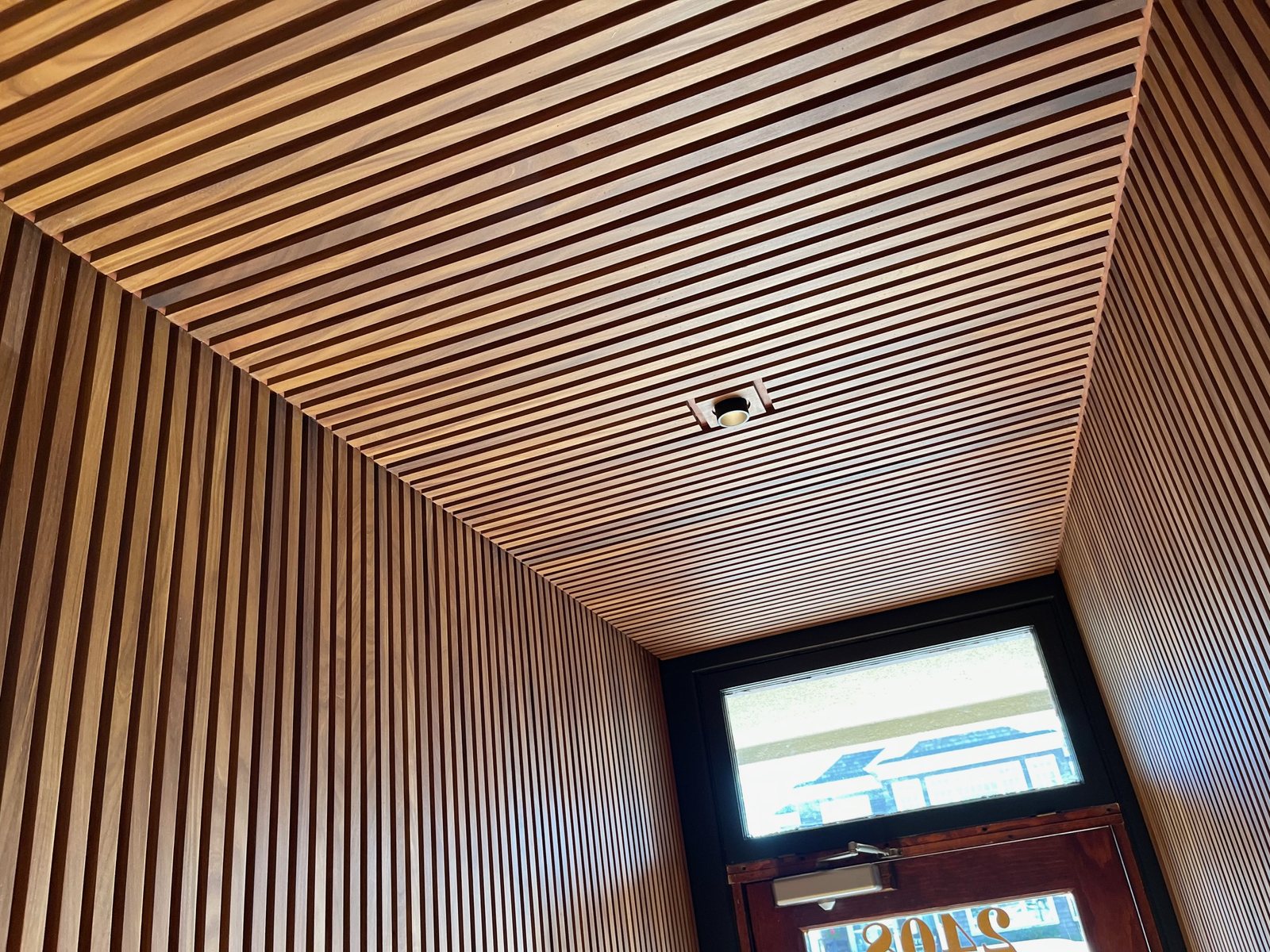
Flutes and reeds behave differently in a room. A flute collects shadow in its valley and reads as a dark line, so the wall looks quieter and the eye travels vertically. A reed catches light on its crown and reads as a bright line with shadow on both flanks, which gives more contrast and more visible texture from an angle. Reeds also take the abuse. The crown of a reed sits at the finished face, and anything that hits the wall hits the arris first.
Profile Depth, Pitch and the Stock Behind It
Flute depth and pitch are not styling choices made in isolation, they are limits set by the thickness of the panel behind them and by how much material a moulder can safely take out of one face. A 3/4 inch panel carrying a 3/16 inch flute has 9/16 inch of stock left in the valley. Take the same profile to a 1/4 inch deep flute and the remaining web starts to drive cupping, because you have removed material from one face and left the other face intact.
Pitch is the flute width plus the land, measured center to center. That number decides the rhythm of the wall and it decides whether the last flute at the corner lands where you want it. A 2 inch pitch across a 96 inch field gives 48 repeats and no remainder. A 2 1/4 inch pitch across the same field leaves a fraction of a flute at one edge, which looks like a milling error whether or not it is one.
Deep reeds want thicker stock. A reed with real projection, say 1/2 inch of relief with a quirk at the base, belongs on 5/4 or 6/4 material rather than 4/4. J. Gibson McIlvain mills the panel blanks to thickness before the profile is run, so the finished face and the back reference surface are both machined and the flute depth is consistent from the first board to the last.
Where the Profile Stops
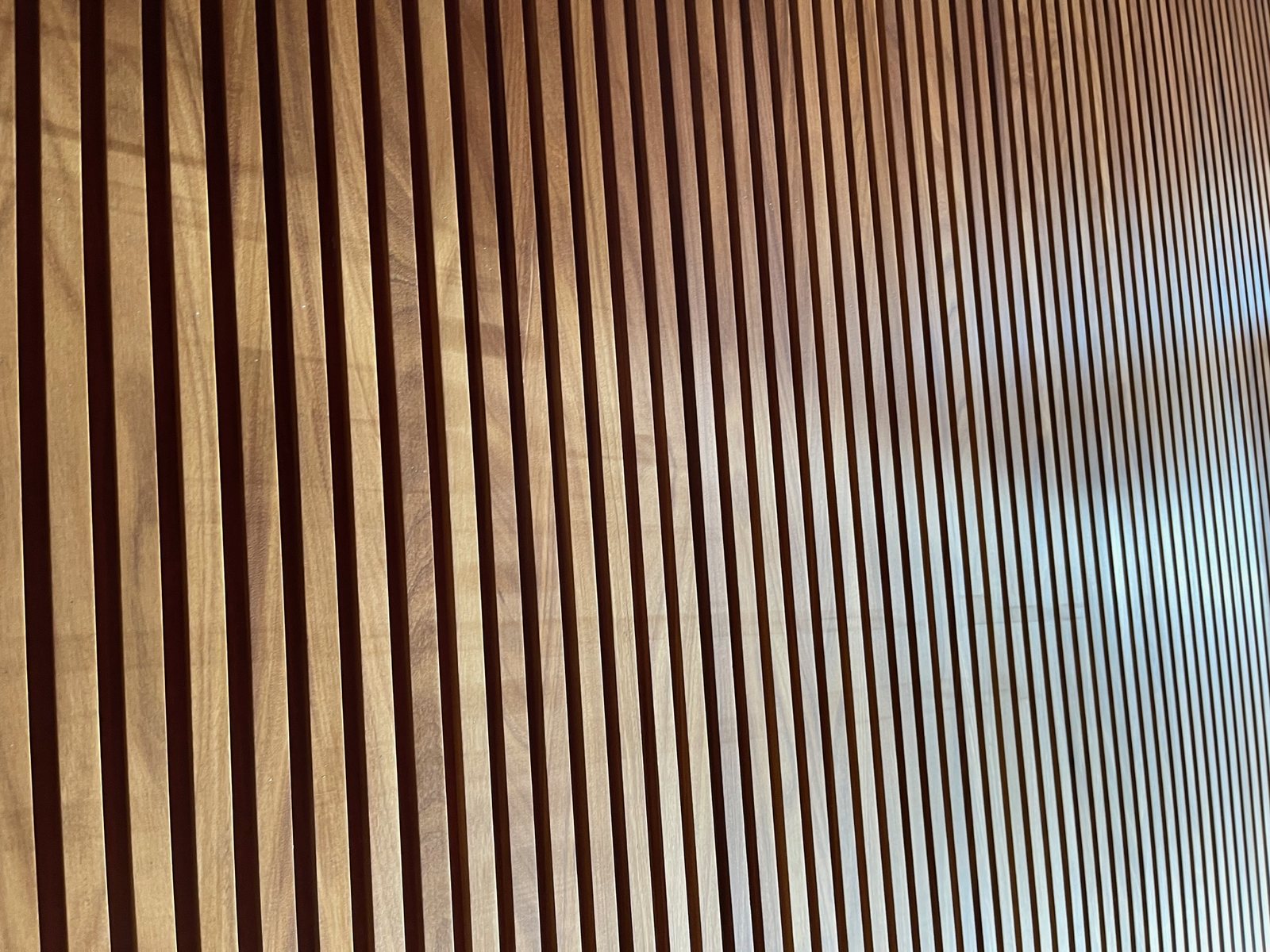
A moulder cuts a through profile, which means a flute or a reed runs the full length of the board and ends at the cut end, so the question is never how to stop the profile in the middle of a panel but what piece you put there instead. This is the detail that most often gets drawn without being resolved, and it is the one that decides whether the wall looks designed or looks unfinished.
The clean answers are all additive. A head rail or cap at the top and a base or plinth at the bottom give the run a square land to die into, and the joint between the fluted field and the flat rail hides in a reveal or a shadow gap. A frame of stiles and rails around a fluted field does the same thing horizontally and vertically at once. A flat band at chair rail height breaks a tall wall into two runs and lets each one terminate against something solid.
The classical run out, where a flute ramps back to the face in a rounded stop partway up a pilaster, is a carving operation rather than a moulding operation. It cannot come off a moulder head and it is not part of what this shop runs. A buyer who wants that detail should plan on a fabricator handling the stops separately, or should design the termination as a rail. The rail is the honest detail anyway, and it is the one that survives seasonal movement without opening a hairline at the stop.
Length is the other half of the stop question. Solid hardwood panel stock runs long, and a floor to ceiling flute with no horizontal break is achievable in most millwork species. Modified woods are the exception. Thermory and Abodo Vulcan both top out around 16 ft, most of it sold on metric lengths just under 16 ft, because the kiln sets the limit. Thermally modified Ash is not available wider than 8 inches, so a wide modified panel component means Accoya or Abodo Vulcan.
How the Corner Turns
An outside corner on a fluted wall is a joinery decision before it is a design decision, and the choice among a butt joint, a dado and a lock miter decides whether the corner shows a seam, shows end grain, or shows nothing at all. The same three options that govern a box beam govern a fluted corner post, for the same reason. Both are hollow assemblies wrapping a corner.
A lock miter carries the face of one leg around to the other with no visible seam and no end grain, and it is the strongest of the three. That matters more on a fluted post than on a plain one. A seam that falls in the middle of a land is a line running parallel to every other line on the wall, and the eye finds it immediately. Put the corner in a lock miter and the flute rhythm can continue around the corner uninterrupted.
The alternative that avoids the problem entirely is a plain corner. Run the fluted field to a flat stile at each end of the wall and let the corner be square and unprofiled. That reads as deliberate, it takes the abuse better than a reed arris does, and it removes the layout constraint that a continuous corner imposes on the pitch.
| Corner treatment | Seam and end grain | Strength and site assembly | Effect on flute rhythm |
|---|---|---|---|
| Lock miter corner post | No visible seam, no exposed end grain | Strongest of the three joints, large glue surface, parts key together and align themselves | Profile can run continuously around the corner if the pitch is set out from the corner |
| Dado corner post | Seam visible at the corner, end grain visible | Strong and straightforward to assemble on site | Seam usually has to fall in a land, which forces the layout |
| Butt jointed corner post | Seam and end grain both visible | Weakest of the three, fastest to produce, easiest on site | Works only where the corner is meant to read as a separate element |
| Flat corner stile | No mitered joint to fail, joint falls at a reveal | Simple, tolerant of an out of plumb corner, takes impact well | Profile stops at the stile, so the field pitch is free of the corner |
| Applied pilaster at the corner | Joints hidden behind the applied element | Assembled flat in the shop, set as one piece | Breaks the field into panels and gives a place to absorb remainder |
Inside Corners and the Last Flute
An inside corner never needs a mitered profile, it needs a reveal and a scribe, and the last flute before that corner should be a full flute or no flute at all. Partial flutes at a termination are the single most common reason a finished fluted wall looks wrong in photographs. Nobody can name what is off. Everybody sees it.
There are two ways to absorb the remainder. Widen the land at the two outer flutes so the leftover distributes across the field without changing the apparent rhythm, which works when the remainder is small. Or give the wall a flat stile at each end, sized to swallow the difference, and scribe that stile to the adjacent surface. The second is more forgiving on a renovation where the corner is not plumb and not square.
Set out the layout before the knife is ground, not after. Shop drawings that fix the pitch, the land width and the position of the first full flute relative to the corner let the whole wall come off one setup. The Architectural Woodwork Institute publishes the quality standards most commercial specifications reference for this kind of submittal, and a fluted panel drawing that satisfies them will carry the profile section, the layout dimension and the joint detail on the same sheet.
Species That Hold a Crisp Arris
The millwork palette for fluted and reeded panels is Sapele, Utile, Iroko, Afrormosia and Teak, and the deciding property is not hardness alone but whether the species holds a sharp arris off the knife without crumbling or fuzzing. These five machine predictably, come in the widths and lengths a panel wall needs, and take a finish evenly across a profiled face.
Sapele is the workhorse at roughly 1,410 lbf on the Janka scale. Quartersawn Sapele brings ribbon figure, and ribbon under a flute is worth seeing before you commit, because the stripe and the shadow line interact. Some clients love it. Some want it gone, and the answer there is rift or plainsawn stock rather than a different species.
Utile, sold as Sipo, machines much like Sapele with less pronounced figure and a slightly warmer tone. Iroko and Afrormosia both hold an arris beautifully and both carry mineral deposits that dull knives faster than the others. Teak machines clean and takes a flute well, and its oil content changes the finishing schedule rather than the milling.
The domestic options behave differently. Hard Maple at roughly 1,450 lbf gives the crispest reed arris of any species in common use and shows every machining flaw in return. White Oak at roughly 1,360 lbf wants rift or quartered stock so the flutes do not cross cathedral grain. Cherry at roughly 950 lbf and Genuine Mahogany at roughly 800 lbf both cut like butter and both bruise at the arris, which is why they suit flutes better than reeds.
For a fluted soffit or ceiling panel under a covered exterior, cedar remains a legitimate default and a good one. Specify clear vertical grain rather than select tight knot when the profile is fine, since CVG gives straight grain for the knife to follow and STK puts knots where the flute valley wants clean material.
Sawing, Moisture and Where the Glue Line Goes
Quartersawn and rift stock move less across the width than plainsawn, which is why a wall of parallel flutes that has to stay parallel gets specified that way. A flute is a reference line. Any cupping or crowning in the board under it becomes visible as a wandering shadow, and grazing light makes the wander obvious from across the room.
Interior millwork is milled to an in service moisture content near 6 to 8 percent. Exterior work runs near 12 to 16 percent. Getting that wrong on a fluted panel is worse than getting it wrong on flat trim, since the profile adds surface area on one face and the two faces then exchange moisture at different rates. The Forest Products Laboratory Wood Handbook is the reference for the shrinkage coefficients behind that math.
Panel width forces a glue up on anything wide, and the glue line placement is a detail worth calling out. Put the joint in the valley of a flute and the shadow line hides it. Put it in the middle of a land and it sits in the brightest part of the face. J. Gibson McIlvain lays up the blanks with the joints falling where the profile will bury them, which takes coordinating the layup with the flute layout rather than gluing to a width and hoping.
Grade affects what you can do with the layup. The National Hardwood Lumber Association grading rules govern the clear cutting yield in the rough lumber, and a fluted face with no tolerance for defect in the valley needs the upper grades and needs the shop to cut around what is there.
Machining Interlocked Grain Without Tearout
Sapele, Utile, Iroko and Afrormosia all carry interlocked grain, which reverses direction every few growth rings and will tear out at the arris if the knife is dull or the feed is wrong. The fix is not exotic. Sharp knives, a slower feed on the finish pass, and a light final cut that removes thousandths rather than sixteenths.
J. Gibson McIlvain grinds new knives every week and holds a moulding profile library of thousands of ground profiles, which covers most of what arrives on a drawing. A flute or reed section that is not in the library gets ground to match, including historical restoration profiles where the replacement has to match surviving original work. The National Park Service Technical Preservation Services guidance on repairing and replacing historic millwork is the standard most preservation reviews apply, and it turns on exactly that kind of section match.
"When a client sends a photo of a flute they saw somewhere, I ask for a section before I ask for anything else. We grind the knife to the section, run a sample in the actual species the job is using, and put that sample in the client's hands before the wall gets run."
Norm Moton, Director of Sales, J. Gibson McIlvain
Sample first is not ceremony. A profile that looks right at 1 to 1 on paper can read shallow in a dark species and harsh in a pale one, and the only way to know is to hold the milled piece under the light the room will actually have. The Wood Moulding and Millwork Producers Association maintains the standard profile numbering that gives a starting point when a client has no section at all.
Paint Grade Flutes and What the Primer Does
Paint on a fluted face fails in the valley first, and the reason is almost always that the profile went to the painter bare and the first coat pooled where the shadow line is deepest. Priming at the shop, on a flat table, with controlled film build, produces a different result than priming a wall vertically after it is hung.
Open-grained and oily species absorb a great deal of finish, so a primer coat evens out the eventual painted surface instead of leaving the valley duller than the land. J. Gibson McIlvain primes in three levels, in both oil based and water based systems, and primed exterior trim carries a fungicide additive for work that sees weather.
Sanding or buffing after priming is the step that matters most on a profile. It knocks back the grain raising the first coat causes while keeping the moulded detail crisp, which is the whole point of specifying a machined profile rather than a routed one. Skip it and the arris on every reed goes soft under the topcoat.
Grazing Light and Running the Wall in One Setup
A fluted wall lit by a wall washer is the least forgiving surface in a finished interior, since grazing light turns a 0.002 inch variation in flute depth into a visible band. Lighting designers specify that effect deliberately. The millwork has to be produced knowing it is coming.
One knife, one setup, one lot of lumber, run in sequence and labeled in sequence. Change knives in the middle of a wall and the change shows. Mix two lots of Sapele and the color break shows at whatever panel joint it happens to land on, which is why the boards for a single wall get selected together and kept together. Building enclosure work on how assemblies handle moisture and light is well covered at Building Science Corporation, and the same discipline about controlled conditions applies to a profiled interior face.
Phasing is the other argument for a shop that keeps the knife. A lobby runs in one phase and the elevator lobbies on floors 2 through 9 run 18 months later. The knife stays on file, so phase two comes off the same ground profile rather than off a new grind that is close but not identical.
How J. Gibson McIlvain Would Specify This
A fluted or reeded panel wall specified correctly carries five things on the drawing set, and a shop can quote and build from those five without a single clarification request. Everything else is detail that follows from them.
One, a full scale section of the profile showing flute width, depth, radius and land, with the quirk called out if there is one. Two, the elevation layout dimension that fixes the first full flute relative to the corner and states how the remainder is absorbed. Three, the termination detail at head and base, naming the rail or reveal that the run dies into. Four, the corner detail naming the joint, lock miter where the profile has to continue and a flat stile where it does not. Five, species, cut and finish, including whether the panels arrive primed.
J. Gibson McIlvain mills the panel blanks to an in service moisture content near 6 to 8 percent for interior work, runs the profile on a moulder from a knife ground to the submitted section, lays the panels up so the glue lines fall in the flute valleys, and ships the work primed where the finish schedule calls for it. Linear trimwork, finished cladding and primed trim all come off the millwork service at the lumber yard. Where the panel wall involves true custom work planned around a specific space, radius trimwork, custom doors, benches or railings alongside the fluted field, that work goes through ICD, the company's architectural millwork division, whose trim profile work covers exactly this kind of originated section.
J. Gibson McIlvain ships milled panel stock nationwide, and the pieces are labeled in run sequence so the crew setting the wall works in the order the boards came off the machine. To start a profile, send the section and the elevation and call 800-638-9100.
Frequently Asked Questions
Can a flute stop partway up a panel instead of running the full height?
Not off a moulder. A moulder cuts a through profile, so the flute runs the full length of the board and ends where the board is cut. The classical stopped flute with a rounded run out is a carving operation, and it would have to be handled by the buyer's own fabricator as a separate step. The detail that works within a milled package is a termination piece. A head rail, a base or plinth, a chair rail band or a surrounding frame of stiles and rails gives the run something square to die into, and the joint hides in a reveal.
How do I pick a flute pitch so the last flute at the corner comes out full?
Start from the finished field dimension and divide. Pitch is the flute width plus the land, measured center to center, so a 2 inch pitch across a 96 inch field gives 48 full repeats with no remainder. When the room dimension will not divide cleanly, absorb the difference one of two ways. Widen the land on the two outermost flutes so the leftover spreads across the field, or add a flat stile at each end sized to swallow the difference and scribed to the adjacent wall. Fix that layout on the shop drawing before the knife is ground.
What is the real difference between a lock miter corner and a flat corner stile?
A lock miter lets the profile continue around the outside corner with no visible seam and no exposed end grain, and it is the strongest of the joinery options for a hollow corner post. It also constrains the layout, since the pitch has to be set out from the corner for the rhythm to carry. A flat corner stile stops the profile short of the corner and leaves the corner square and unprofiled. It is more tolerant of an out of plumb corner, it takes impact better than a reed arris, and it frees the field pitch entirely. Both read as deliberate. Only a half flute at the corner reads as a mistake.
Which species should I specify for a reeded wall that will get handled?
Reeds put the arris at the finished face, so hardness at the edge matters. Hard Maple at roughly 1,450 lbf gives the crispest arris and the best resistance to bruising, though it shows every machining flaw. Among the millwork palette, Sapele at roughly 1,410 lbf, Utile, Iroko and Afrormosia all hold a sharp arris well. Cherry at roughly 950 lbf and Genuine Mahogany at roughly 800 lbf machine beautifully but bruise, so they are better suited to flutes, where the damage-prone edge is set below the face rather than standing on it.
How deep can a flute go in 3/4 inch panel stock?
A 3/16 inch flute in a 3/4 inch panel leaves 9/16 inch of material in the valley, which is a sensible working limit. Going to 1/4 inch deep starts to drive cupping, since material has been removed from one face and the other face is untouched, so the two faces exchange moisture at different rates. For deeper relief, move to thicker stock rather than cutting harder into thin stock. A reed with 1/2 inch of projection and a quirk at the base belongs on 5/4 or 6/4 material.
Should fluted panels arrive primed or should the painter prime them on site?
Primed at the shop, on a flat table, with controlled film build. Paint on a profiled face fails in the valley first, and priming a hung wall vertically encourages the first coat to pool exactly where the shadow line is deepest. Open-grained and oily species absorb a great deal of finish, so the primer evens out the eventual painted surface rather than leaving the valley duller than the land. The step that makes or breaks it is sanding or buffing after priming, which knocks back grain raising while keeping the moulded detail crisp.
Can a fluted panel run floor to ceiling without a horizontal joint?
In solid hardwood, generally yes. Sapele, Utile, Iroko, Afrormosia and Teak all come in lengths that cover typical floor to ceiling runs without a break. Modified woods are the limiting case. Thermory and Abodo Vulcan top out around 16 ft, most of it sold on metric lengths just under 16 ft, because kiln size sets the ceiling, and thermally modified Ash is not available wider than 8 inches. A wide modified panel component means Accoya or Abodo Vulcan. Note also that no warranty exists on solid unmodified wood, since it is an organic material responding to its environment.
Sources and Standards Referenced
- Wood Handbook: Wood as an Engineering Material, USDA Forest Products Laboratory
- Architectural Woodwork Institute, Quality Standards and Resources
- Wood Moulding and Millwork Producers Association
- National Hardwood Lumber Association, Rules for the Measurement and Inspection of Hardwood Lumber
- National Park Service, Technical Preservation Services
- The Wood Database, Sapele
- Building Science Corporation
- J. Gibson McIlvain Millwork Service