What the Nosing Line Actually Is
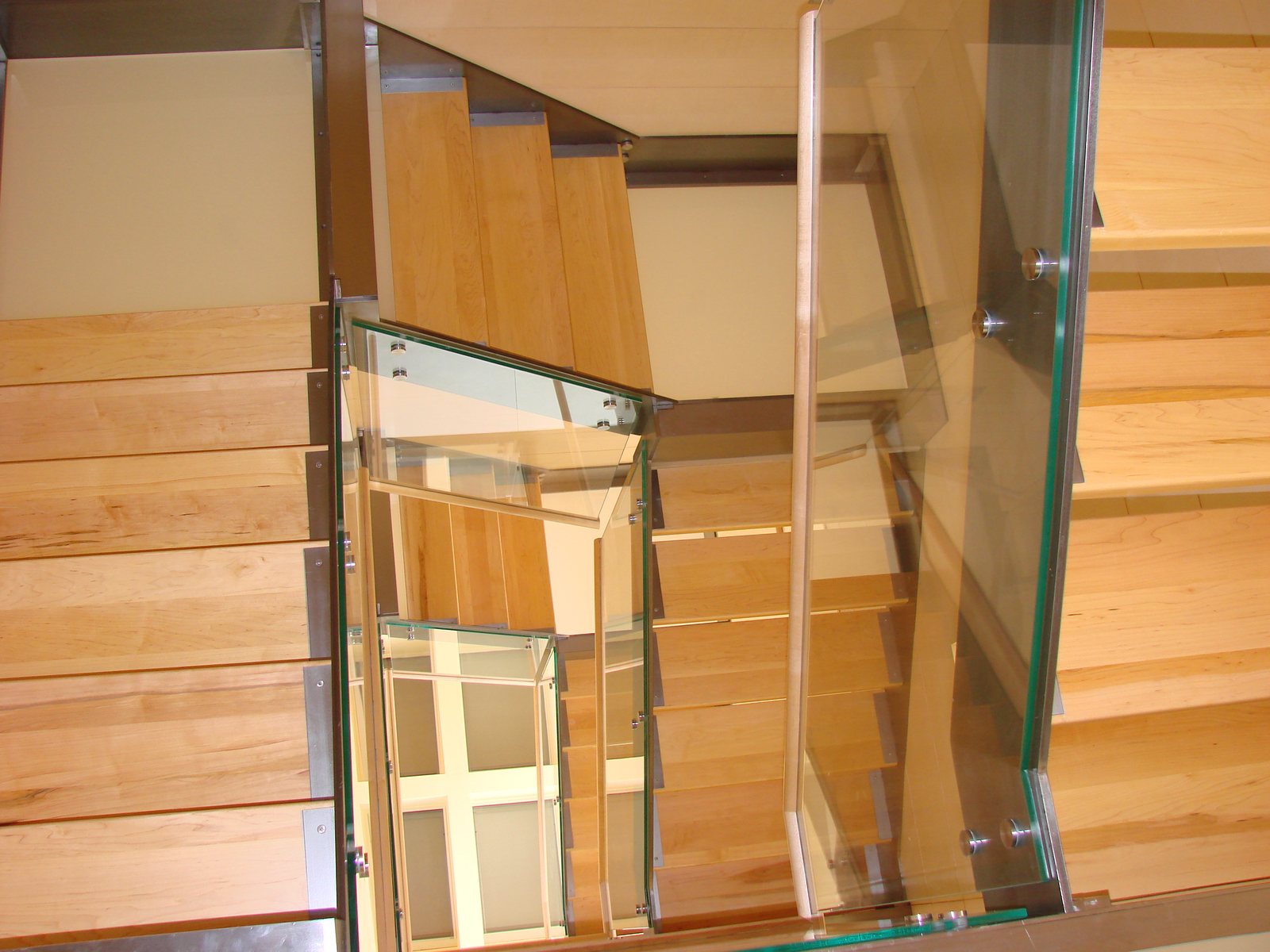
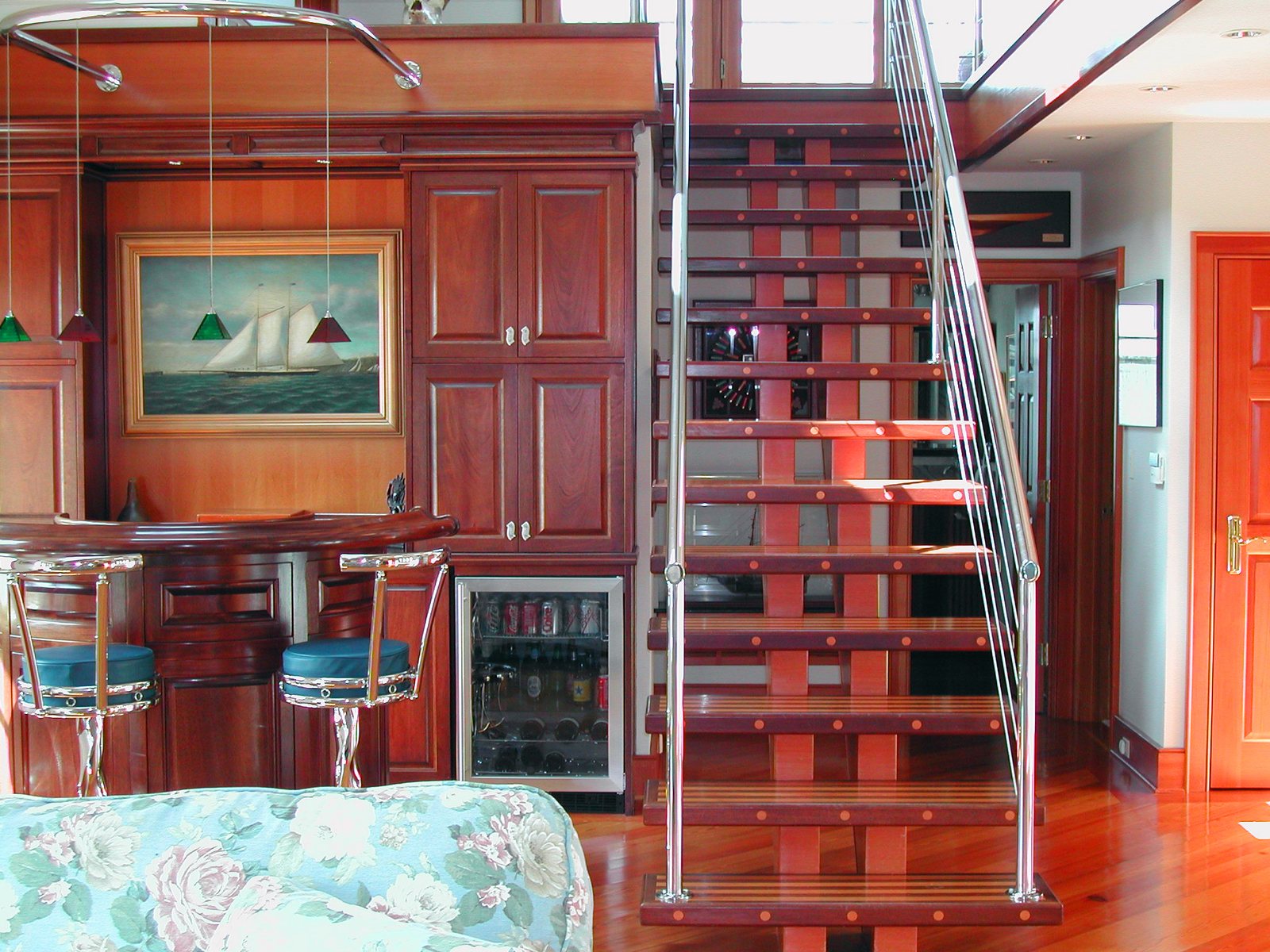
A stair is judged on one continuous line, the leading edge of every tread, and every part that meets that line has to come off the same profile record. Stand at the bottom of a flight and look up the rake. Nobody reads the treads as separate boards. What registers is a stack of identical edges climbing at a fixed angle, and the eye finds an edge that sits proud, shy or slightly differently shaped long before it finds a scratch in the finish.
Error on a stair does not average out. It repeats. A nosing radius ground a sixteenth flatter than the rest shows once per tread, and on a 14 riser flight it shows 13 more times before anyone reaches the landing.
That single line is carried by more parts than most specifications account for. The tread nose carries it. The mitered return carries it around the open end. The landing nosing carries it across the floor above. The skirtboard carries its shadow, since the top edge of the skirt and the cut of the tread against it set the reveal that the eye reads as a clean rake. Get one of those four out of agreement and the whole flight looks like a repair.
Skirtboards Do the Hardest Work on a Stair
The skirtboard is the only part of a stair milled as one long piece that has to agree with every tread and riser it passes. Treads and risers are short. They forgive. A skirtboard runs the full diagonal of the flight and lands on a single line of scribes, so any cup, twist or thickness variance in that board becomes a gap somewhere along a dozen cut lines.
Width comes first. A skirt has to cover the triangle formed by the tread run and the riser height with enough material left above the nosings to read as a board rather than a strip. A 10 inch run on a 7 and 1/2 inch rise usually wants something in the 11 and 1/4 to 13 and 1/2 inch range, and a stair with a deep bullnose or a heavy landing detail wants more. Once a skirt passes about 11 inches in width, seasonal movement across that width stops being theoretical.
Length comes second. A 14 riser flight at a 37 degree rake needs a blank in the 16 to 18 ft range to run without a splice, and a splice in a skirtboard is visible forever because it crosses the one surface in the room nobody stops looking at. J. Gibson McIlvain mills skirtboard blanks long enough to run a full flight in one piece, which is the difference between a scribed skirt and a patched one.
Thickness is the quiet variable. Skirt stock milled a hair thin relative to the base it meets at the top and bottom leaves a step that has to be caulked, and caulk on a stair reads as a repair within one heating season. A specification should call the finished thickness, not a nominal one, and it should call the same finished thickness for the skirt, the base it dies into and any plinth at the bottom riser.
Mitered Tread Returns and the End Grain Beneath Them
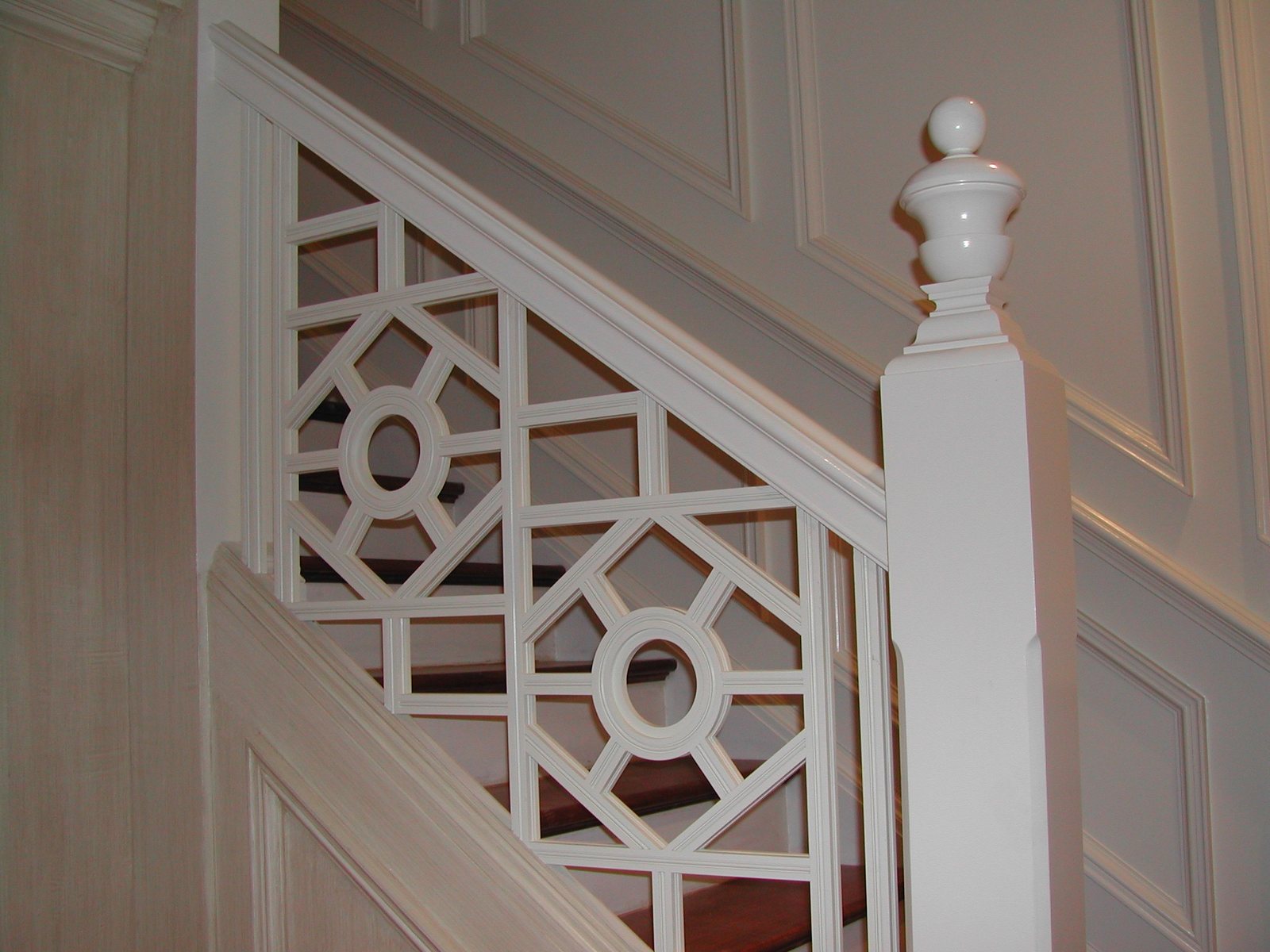
A mitered return is the only honest way to carry a nosing profile around the open end of a tread, and it works only if the return stock was moulded on the same setup as the tread nose. On an open stair the outboard end of every tread is exposed end grain. End grain takes stain darker, sands differently and telegraphs every seasonal move, so it gets covered by a return piece mitered at 45 degrees with the nosing profile running continuously through the corner.
The miter is where matching becomes unforgiving. If the front nosing ran off one grind and the return stock ran off another that is nominally the same, the two profiles meet at the corner with a step in the cove or a flat spot at the crown of the radius. Sanding it out rounds the arris and makes it worse. J. Gibson McIlvain runs the return blanks off the same knife setup as the tread nosing so the profile walks through the miter without a correction.
Grain direction is the second problem. The tread moves across its width while the return piece sits with its length running the other way, so the two parts answer a humidity swing in different directions. Keeping the return short, splining or biscuiting the joint rather than relying on glue surface alone, and delivering both parts at the same moisture content are what keep that miter closed. A return glued to a tread that arrived at 11 percent and dried to 7 percent in service will open at the heel of the miter no matter how well it was cut.
Reading an Old Profile Before a Knife Is Ground
Matching an existing stair or wainscot profile starts with a physical piece of the original, not a photograph and not a dimension called off a tape. The best sample is a 4 to 6 inch cutoff taken from a scrap tread return, a section of skirt behind a newel or a length of cap pulled from a closet run. Second best is a 1 to 1 trace taken with a profile gauge and confirmed with a lead tape rubbing. A photograph flattens a cove into a chamfer and is worth nothing at the grinder.
Paint and finish buildup distort what gets measured. Eighty years of coating on an original skirt cap can add a full sixteenth to a quirk and soften every arris on the profile, which is why the reading gets taken where the profile was protected, behind a return, under a rail seat or on the back side of a removed section. Stripping a two inch window on the sample is faster than arguing later about why the new run looks fat.
A match rarely starts from zero. J. Gibson McIlvain holds a profile library of thousands of ground knives and grinds new knives every week, so the usual path is to pull the nearest existing grind, lay it against the trace and correct from there. Historical restoration profiles and contemporary profiles are handled the same way, and work that goes before a historic district review board usually needs the like for like evidence that the National Park Service Preservation Briefs describe for character defining interior features.
Continuity matters more on renovation than on new construction. A stair hall rebuilt in phases, or a house where the second floor wainscot goes in 18 months after the first, needs the same grind both times. Seventh generation and family run since 1798, J. Gibson McIlvain keeps the knife and the order record on file, so phase two runs off the same steel that cut phase one rather than off a fresh interpretation of the same drawing.
"Send us a piece of the original and we will get you a match. Send us a photo and a note that says it is a one inch cove and we will get you something that looks close in the shop and wrong on the wall. The stair is the one place in the house where close is not a match."
Norm Moton, Director of Sales, J. Gibson McIlvain
Every Place the Profile Has to Repeat
One stair and its wainscot carry the same two or three profiles across at least eight different parts, and each one fails in its own way. Specifying the profile once at the tread and assuming the rest will follow is how a package arrives with four parts that match and three that do not.
| Location | What has to repeat | How it is milled | Where a mismatch shows |
|---|---|---|---|
| Tread nosing | Nosing radius or cove, projection past the riser face | Moulder, one knife setup for the whole flight | At every tread, read from the bottom of the run |
| Landing and balcony nosing | Same nosing profile at a different stock thickness | Moulder, profile height set to the floor buildup | At the transition where the rake meets level |
| Mitered tread return | Continuous profile through a 45 degree corner | Same knife setup as the tread nosing | Step or flat spot at the miter, one per open tread |
| Skirtboard top edge | Eased edge or applied cap, consistent reveal above the nosings | Linear moulder run, full flight length | Wandering reveal line along the rake |
| Skirt to riser junction | Thickness and squareness of the skirt face | Milled to a called finished thickness | Gaps at scribe lines, caulk beads that crack |
| Rake wainscot cap | Cap profile cut at the stair angle | Same grind as the level cap, sprung to the rake | Apparent profile change at the transition block |
| Level wainscot cap | Cap profile on the upper and lower level runs | Same grind, square cuts and coped returns | At the miter where level meets rake |
| Curved or winder skirt | Profile held around a radius | Radius millwork on a laminated or bricked blank | Flattened profile where the curve tightens |
The last row is the one that gets underestimated. A curved skirt at a winder or a landing turn cannot be run through a straight moulder, so the profile has to be reproduced on a curved blank. ICD, the architectural millwork division of J. Gibson McIlvain, builds that curved skirt as radius millwork planned to the specific stair rather than bending a straight run and hoping the profile survives the curve.
Code Limits the Nosing Line Cannot Cross
The repeating nosing line is not only an aesthetic question, since the model codes put hard tolerances on how much tread depth, riser height and nosing projection may vary within one flight. The International Code Council residential provisions allow a maximum variation of 3/8 inch between the largest and smallest riser height or tread depth in a single flight, and set a nosing projection window of roughly 3/4 inch to 1 and 1/4 inch where treads are solid and risers are closed.
That tolerance is where millwork and framing collide. A carpenter who trims the bottom riser to absorb a subfloor discrepancy can blow the 3/8 inch limit in one cut, and parts milled to a consistent nosing projection will no longer sit at a consistent projection once he does. Milled stair parts get ordered against measured riser heights taken after the rough stair is set, never against the drawing alone.
Structural questions belong to a different set of documents. Load path, stringer sizing and connection detail sit with the framing and the engineer, and the American Wood Council codes and standards library is the right reference for that side of the work. Skirtboards, nosings and caps are finish material applied over a structure that has already been sized.
Species That Take a Nosing Profile and Keep It
A nosing profile survives on species that machine cleanly and hold an arris under traffic, which is why a millwork shop reaches for Sapele, Utile, Iroko and Teak rather than for the hardest woods on the yard. Sapele runs roughly 1,410 lbf on the Janka scale and is the usual first call for stair and wainscot work that will be stained or clear finished, with its interlocked grain handled by sharp knives and a controlled feed rate. Utile behaves similarly with a slightly more open grain. Iroko and Teak both machine well and take a crisp edge, and Teak in particular shrugs off the hand traffic a nosing and a cap rail see.
Domestic species carry most interior stairs in the mid Atlantic. White Oak at roughly 1,360 lbf is the default for a stained stair, and its open grain needs attention where a waterborne finish will raise it. Hard Maple at roughly 1,450 lbf takes the crispest arris of the group and burnishes if the feed rate drops. Cherry at roughly 950 lbf is the softest of the three and will dent at the nosing, which is a fair trade for the color rather than a defect.
The tropical decking species are a different tool. Ipe, botanically Tabebuia spp, along with Cumaru, Garapa, Jatoba and Red Balau, is extremely hard and carries high oil content, which makes it difficult to glue. A mitered tread return is a glue joint under traffic and a wainscot panel is a glue up, so a millwork shop uses those species far less than the decking side does and specifies Sapele, Iroko, Afrormosia, Teak or Utile wherever parts have to be machined and bonded.
Sawing pattern does more for a wide skirtboard than species selection does. Quartersawn and rift stock moves less across its width than plainsawn, which is why a 13 inch painted skirt or a panelized wainscot field gets specified quartersawn where the budget allows. The published shrinkage figures for Sapele and the movement data in the USDA Forest Products Laboratory Wood Handbook show the difference plainly, with tangential movement running close to double radial movement in most species.
Moisture, Movement and the Miter That Opens
Every open tread return miter and every gap at a skirt scribe traces back to a moisture content that changed after the parts were fitted. Interior millwork is milled to an in service moisture content near 6 to 8 percent, which matches the range a conditioned building holds through the year. Exterior work sits near 12 to 16 percent, and stair parts that came off an exterior schedule have no business inside a finished house.
The failure sequence is ordinary. Parts land on a job that is closed in but not yet under mechanical conditioning, the interior sits above 60 percent relative humidity through a wet month, the stock picks up two or three points of moisture and swells, the trim carpenter fits everything tight, and the first heating season pulls it all back down. The miters open at the heel. The skirt shows a line at every scribe. Nothing was cut wrong.
The fix is scheduling rather than craft. Stair and wainscot packages should be released to a site that is under HVAC control or at minimum under dehumidification, and the stock should sit in the space long enough to equilibrate before it is cut. Building Science Corporation publishes the indoor humidity guidance that makes this practical, and the short version is that a house held between 30 and 50 percent relative humidity keeps 6 to 8 percent millwork where it was milled.
Species choice changes the size of the move slightly, never the direction of it. There are no warranties on solid unmodified wood, and there cannot be, since it is an organic material responding to the building it lives in. Warranties exist on modified products, which belong to exterior work rather than to a stair hall.
Wainscot Cap Where It Dies Into the Skirt
Rake wainscot and level wainscot have to be milled from one grind, because a cap profile cut at the stair angle changes its apparent shape and will not read as the same moulding if it came off a second knife. The cap that climbs the rake is cut through at 37 or 38 degrees at every transition, and an asymmetric profile sliced on that angle presents a stretched version of itself. Two grinds that measure within a few thousandths of each other still look different once one of them is raked.
The junction specified last and failing first is where the rake cap lands on the skirtboard or dies into a level cap at the landing. The usual resolutions are an easement worked into the cap itself, a transition block sized to absorb the angle change, or a pair of compound miters cut on site from stock wide enough to take them. All three depend on the cap being milled thick enough and wide enough to survive the cut, which is a decision made at the order rather than at the wall.
ICD mills the rake cap, the level cap and the transition block from one grind and one lot of stock, so the parts that have to agree at a single corner were never in doubt. The same logic governs the panel stiles and rails in a rake field, where the distorted panel shapes only look right if the sticking profile is identical to the level runs. The Architectural Woodwork Institute standards set the quality grades a specification should name for panelized work of this kind.
Priming and Sanding Before the Parts Ship
Paint grade stair trim that arrives primed on all faces stays flatter and finishes cleaner than trim primed after it is installed. J. Gibson McIlvain primes millwork in three levels, in both oil based and water based systems, so a painted skirtboard, a painted wainscot cap and a painted plinth leave the shop with the back and the ends sealed rather than exposed.
Absorption is why the first coat happens in the shop. Open-grained and oily species absorb a great deal of finish, and a primer coat evens out the eventual painted surface so the topcoat is not fighting different absorption rates across one board. Sanding or buffing after priming knocks back the grain raising while keeping the moulded detail crisp, which matters on a wainscot cap where a quirk or a fillet is only a sixteenth wide.
Sealed ends and a sealed back face also slow the moisture exchange that opens miters. A skirtboard primed on one face only absorbs and releases moisture faster on the raw side and cups toward the dry face, and the same asymmetry pulls a wide painted riser out of plane. Priming all six faces is the cheapest movement control available on a paint grade stair. Grade and quality expectations for moulded stock of this class are published by the Moulding and Millwork Producers Association.
How J. Gibson McIlvain Would Specify This
A stair and wainscot package should be ordered as a matched set of profiles tied to a physical sample, measured field conditions and one moisture specification, and it should come from one shop. The specification starts with the sample. Send a cutoff of the original nosing, skirt cap and wainscot cap, or a 1 to 1 gauge trace with a lead rubbing where no cutoff exists, and note where on the assembly each sample came from.
Call the species and the sawing pattern separately. Sapele, Utile, Iroko or Teak for stained and clear finished work, White Oak, Hard Maple or Cherry where a domestic is wanted, and quartersawn or rift on any skirtboard over about 11 inches wide and on any panelized wainscot field. Call the finished thickness of the skirt, the base and the plinth as one number rather than as three nominal sizes.
Call the nosing projection against measured riser heights taken after the rough stair is set, and confirm the flight holds the 3/8 inch maximum variation before any parts are run. Call an in service moisture content of 6 to 8 percent and a delivery window that lands after the building is under conditioning. Call the priming level and the system, oil based or water based, on every paint grade part, and call it on all six faces.
J. Gibson McIlvain mills the skirtboards, nosings, returns and wainscot caps to that specification, grinds the knife when the profile is not already in the library, primes the paint grade parts before they leave the shop and ships stair and wainscot packages nationwide. ICD takes the curved skirt, the radius cap and the railing or panelized work that has to be planned around one specific stair. The buyer's own trim carpenter scribes, cuts and fits the parts, so the package arrives with scribe allowance on the skirts and extra length on the caps rather than cut to a finished dimension.
To get a stair and wainscot package quoted, send the profile samples and the dimensions taken on site by your own carpenter to the J. Gibson McIlvain millwork service or call 800-638-9100. For curved skirtboards, radius caps and stair related millwork planned around a specific space, the work runs through ICD, the architectural millwork division.
Frequently Asked Questions
What does a shop actually need in order to match an existing stair nosing or skirt cap profile?
A physical piece of the original, ideally a 4 to 6 inch cutoff taken from a scrap tread return, a hidden length of skirt cap or a section of wainscot cap removed from a closet or behind a newel. If nothing can be removed, a 1 to 1 profile gauge trace confirmed with a lead tape rubbing will work. Note where on the assembly the sample came from and strip a small window through the paint buildup, since decades of coating can add a full sixteenth to a quirk and soften every arris. Photographs and verbal descriptions are not usable at the grinder. J. Gibson McIlvain holds a profile library of thousands of ground knives and grinds new knives every week, so most matches begin from the nearest existing grind and get corrected against the sample.
How wide and how long does a stair skirtboard blank need to be?
Width depends on the rake. A skirt has to cover the triangle formed by the tread run and the riser height and still leave enough board above the nosing line to read as a skirt rather than a strip, which usually puts a 10 inch run on a 7 and 1/2 inch rise somewhere in the 11 and 1/4 to 13 and 1/2 inch range. Deep bullnoses and heavy landing details push that wider. Length is set by the flight, and a 14 riser run at a 37 degree rake generally needs a blank in the 16 to 18 ft range to avoid a splice. Any skirt past about 11 inches wide should be quartersawn or rift, since that stock moves less across its width than plainsawn.
Why do mitered tread returns open at the heel after the first winter?
Two causes, and they compound. The first is moisture. Parts fitted at 10 or 11 percent on an unconditioned job site shrink when the heat comes on and the house settles toward 6 to 8 percent, and the miter is the joint that shows it. The second is grain direction, since the tread moves across its width while the return sits with its length running the other way. Short returns, a spline or biscuit rather than glue surface alone, and delivery of both parts at the same in service moisture content are what keep that joint closed. Holding the house between 30 and 50 percent relative humidity does the rest.
Can a curved skirtboard at a winder be matched to the straight runs?
Yes, but not on the same machine. A straight moulder cannot produce a profile on a curve, so the curved skirt and any curved cap have to be built on a laminated or bricked blank and the profile reproduced on that assembly. ICD, the architectural millwork division of J. Gibson McIlvain, handles that work as radius millwork planned around the specific stair, using the same profile record as the straight runs so the eased edge or applied cap carries through the turn without flattening where the radius tightens.
Should paint grade stair parts be primed at the shop or on site?
At the shop, on all six faces. A skirtboard primed on one face only exchanges moisture faster on the raw side and cups toward the dry face, and the same asymmetry pulls a wide painted riser out of plane. Open-grained and oily species absorb a great deal of finish, so the primer coat evens out the eventual painted surface instead of leaving the topcoat to fight different absorption rates across one board. Sanding or buffing after priming knocks back the grain raising while keeping the moulded detail crisp, which matters where a quirk or fillet on a wainscot cap is only a sixteenth wide. J. Gibson McIlvain primes in three levels, in both oil based and water based systems.
Which species hold a nosing profile best under traffic?
Sapele at roughly 1,410 lbf, Utile, Iroko and Teak are the millwork species that machine cleanly, take a crisp arris and glue reliably, which matters because a mitered tread return is a glue joint that gets walked on. Among domestics, Hard Maple at roughly 1,450 lbf holds the sharpest detail, White Oak at roughly 1,360 lbf is the usual stained choice and Cherry at roughly 950 lbf will dent at the nosing, which is a fair trade for its color. The tropical decking species such as Ipe, botanically Tabebuia spp, Cumaru, Garapa, Jatoba and Red Balau are extremely hard and high in oil, which makes them difficult to glue, so a millwork shop uses them far less than the decking side does.
How do code tolerances affect the way stair parts get ordered?
The model codes allow only 3/8 inch of variation between the largest and smallest riser height or tread depth within a single flight, and set a nosing projection window of roughly 3/4 inch to 1 and 1/4 inch on solid treads with closed risers. Those limits mean the nosing projection on milled parts has to be called against riser heights measured after the rough stair is set, not against the drawing. A single riser trimmed on site to absorb a subfloor discrepancy can put the flight out of tolerance and throw off every nosing that follows.
Sources and Standards Referenced
- Wood Handbook, Wood as an Engineering Material, USDA Forest Products Laboratory
- Preservation Briefs, Technical Preservation Services, National Park Service
- International Code Council, Codes and Standards
- American Wood Council, Codes and Standards
- Architectural Woodwork Institute, Standards and Quality Certification
- Moulding and Millwork Producers Association
- Sapele, The Wood Database
- Building Science Corporation, Indoor Humidity and Moisture Control
- J. Gibson McIlvain Millwork Service
- ICD, Architectural Millwork Division of J. Gibson McIlvain, Trim Profiles