The species that survive a permanently uncoated life
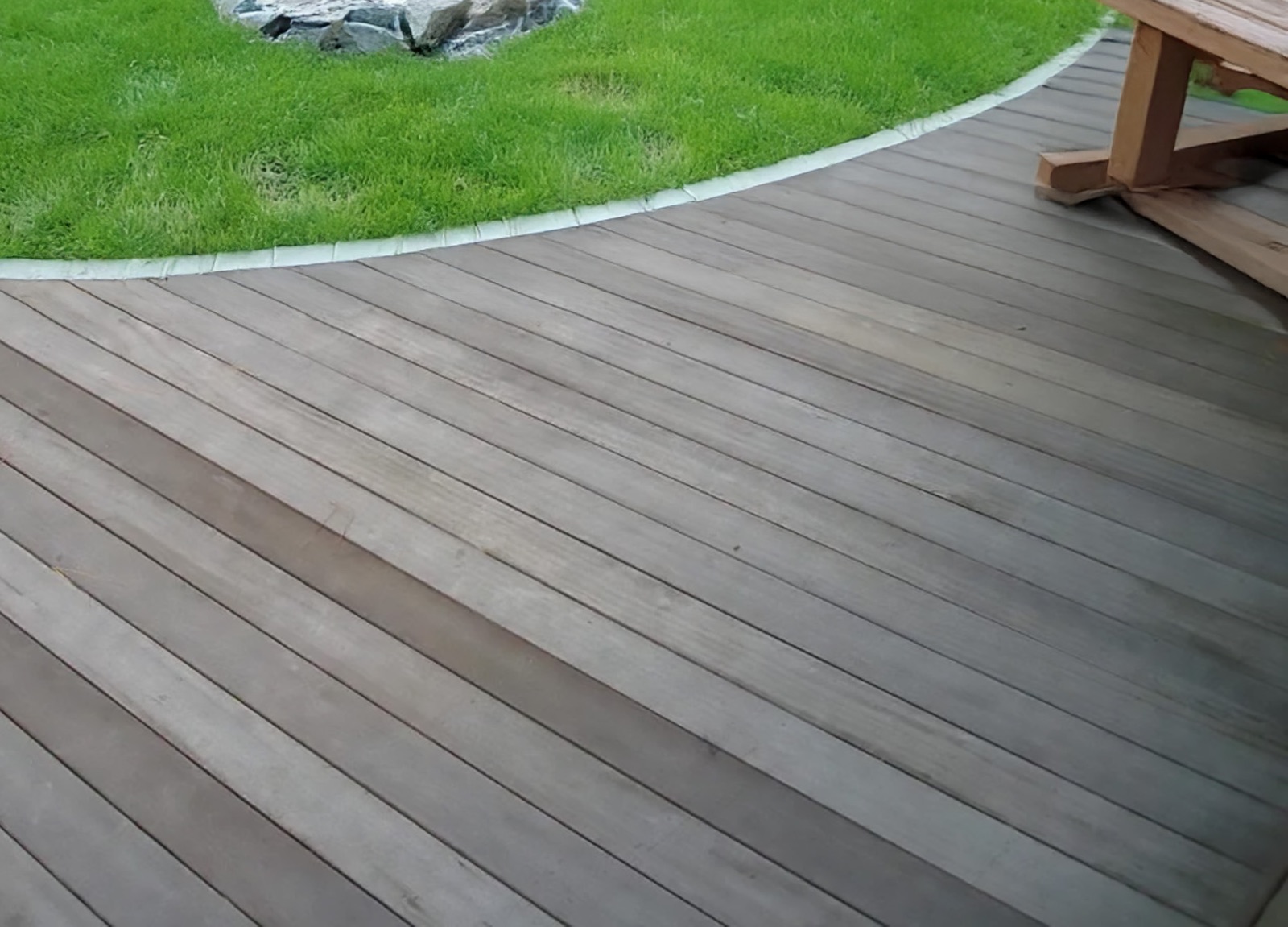
Ipe, Cumaru and Jatoba are the three tropical hardwoods worth specifying when a deck will never be refinished after handover, and Ipe reaches a clean silver with the fewest complications. Every uncoated wood on earth turns some shade of gray. That part is settled. The useful question for a specifier is narrower: which species still reads as a designed, uniform surface five and ten years into a no-maintenance service life, with no cupping, no splinter fields, no blotching, and no black streaks running down from the fasteners.
Density is the first filter. Ipe at roughly 3,680 lbf Janka and about 1,050 kg/m3 moves less across the grain than anything else in common decking use, and the same extractive chemistry behind its EN 350 Class 1 durability also slows the biological staining that turns a gray deck dirty instead of silver. Cumaru runs close behind at about 3,540 lbf and 1,070 kg/m3, with a warmer starting color and a more visible interlocked grain. Jatoba is lighter at roughly 2,690 lbf, sheds its red quickly, and lands in a mid gray.
Garapa and Red Balau both silver attractively. They are residential material. That has nothing to do with color and everything to do with what a commercial deck section demands, which is covered below.
Clean silver and dirty gray are two different chemistries
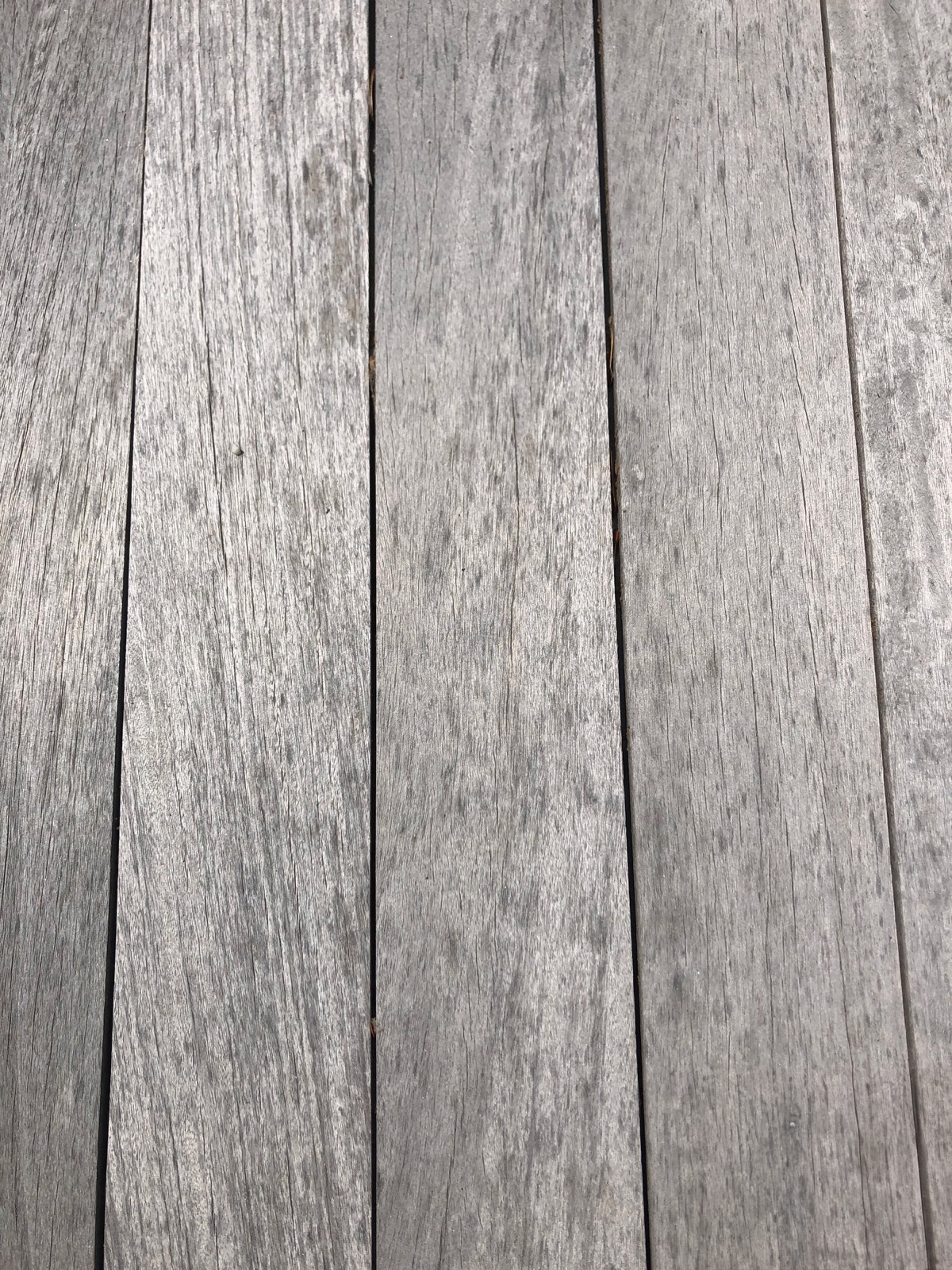
The gray a client wants comes from ultraviolet degradation of surface lignin; the gray they complain about comes from mold, mildew and trapped dirt sitting on top of that weathered layer. Confusing the two is the most common reason a well specified deck disappoints its owner in year three.
Sunlight breaks down lignin in roughly the top hundred microns of exposed wood. The degraded lignin washes away in rain and leaves a thin fuzz of bleached cellulose that scatters light. That is the silver. It is shallow, self limiting, and it does not weaken the board. The USDA Forest Products Laboratory has documented this surface weathering mechanism across decades of exterior exposure work, and the depth of attack in a dense tropical species after ten years is measured in fractions of a millimeter.
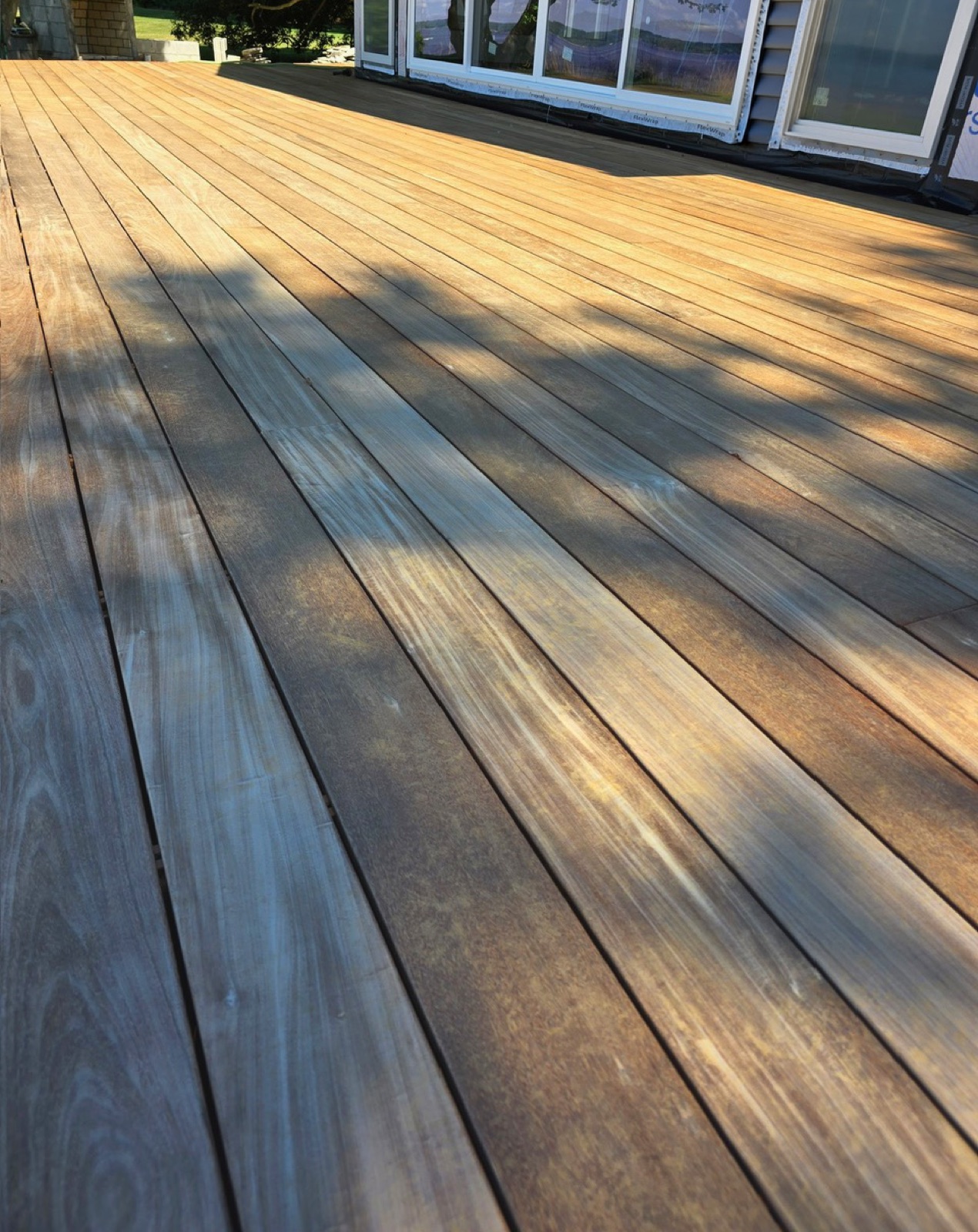
The other gray is alive. Airborne mildew spores colonize any damp, shaded, poorly drained surface, and they feed on the same degraded cellulose the sun just created. Put a solid skirt board around a north facing deck, cut off the airflow underneath, and you get blotchy charcoal patches instead of even silver within two seasons. Species choice helps at the margins. Ipe and Cumaru extractives suppress colonization better than the lighter species do. Detailing decides the outcome. Open the underside, hold gaps consistent, slope the substructure, and the same board that molded on one project silvers evenly on the next.
Commercial decks filter the species list before color is ever discussed
Boardwalks, piers, plazas and elevated public decks are specified at 2x nominal thickness for deflection control, and only Ipe, Cumaru and Jatoba can be sourced consistently in 2x decking. This constraint quietly ends most silvering debates on commercial work.
Structural math will sometimes say a 5/4 board carries the load at 16 inches on center. On a private residence with a known owner, that is a conversation. On a municipal pier carrying pedestrian traffic, service carts and a maintenance department that will never inspect the underside, no experienced designer of record goes first with the thinner board. The 2x section buys deflection margin. It buys tolerance for a joist that shrinks or a hanger that loosens. It buys wear depth for a surface that may be ground or sanded for slip resistance a decade later. Load path assumptions for exterior wood framing are set out in the American Wood Council standards the model codes reference.
Red Balau at roughly 1,700 to 2,000 lbf and Garapa at about 1,700 lbf are sound, handsome, well behaved decking species that weather to a pleasing pale silver. Neither belongs in a 2x commercial spec, and writing them into one creates a sourcing problem the general contractor discovers at buyout. Put them where they perform: residential decks, roof terraces on sleeper systems, and 5/4 applications an engineer has approved.
A factory oil coat changes the first two years, not the destination
J. Gibson McIlvain factory coats tropical decking with Cutek, a penetrating oil wood stabilizer that significantly reduces surface checking, and the deck still weathers to gray on schedule. Buyers hear the word coating and assume the color is being locked in. It is not. Cutek is a stabilizer first. It carries into the cell structure and slows the rate at which the outer few millimeters of a board gain and lose moisture relative to the core.
That rate difference is what causes checking. A 2x Ipe board on a July afternoon has a surface near 150 degrees and a core twenty degrees cooler and several percentage points wetter. The surface wants to shrink, the core does not, and the wood relieves the tension the only way it can. Small surface checks are normal in dense tropical decking. They indicate a properly seasoned dense board rather than a defect, and they do not reduce the strength of the section. Nobody can promise a check free tropical deck, and any supplier who does is selling something. What a factory Cutek coat does is measurably reduce how many checks open and how wide they get, which is why it goes on before the material ships rather than being left to a crew working around weather on site.
Site practice handles the rest. Take delivery at an in service moisture content of 12 to 16 percent, seal every field cut end within the hour, sticker anything not being installed that day, and never let a bundle sit shrink wrapped in the sun. The exterior moisture literature published by Building Science Corporation is the right mental model: control the wetting and drying cycle and the material behaves.
Compared on what actually governs an uncoated service life
The axes that decide a permanently uncoated deck are commercial thickness availability, resistance to biological staining, extractive bleed during the transition, and the tone the surface finally settles into. Janka appears in the table for reference. It is the weakest predictor in the group of how a gray deck looks in year seven.
| Species | Janka (lbf) | Available in 2x decking | Mildew and dirt holding | Extractive bleed, first seasons | Final silver tone | Where it belongs |
|---|---|---|---|---|---|---|
| Ipe (Tabebuia spp.) | ~3,680 | Yes | Low | Moderate, olive brown runoff | Even pewter silver | Commercial boardwalk, pier, plaza, high end residential |
| Cumaru | ~3,540 | Yes | Low | Moderate to high, warm tan runoff | Silver with a warm cast | Commercial and residential decks, docks |
| Jatoba | ~2,690 | Yes | Moderate | Moderate, red runoff early | Mid gray, slightly darker | Commercial decks, covered walkways |
| Red Balau | ~1,700 to 2,000 | No | Moderate | Low to moderate | Soft mid silver | Residential decks, engineer approved 5/4 work |
| Garapa | ~1,700 | No | Moderate | Low | Pale, close to driftwood | Residential decks, pool surrounds, roof terraces |
| Massaranduba (comparison only) | ~3,190 | Limited | Low | High, strong red runoff | Dark silver gray | Reference point only, not a J. Gibson McIlvain product |
The first two seasons stain everything downhill of the deck
Water soluble extractives leach out of every dense tropical species during the transition to gray, and they will discolor limestone, stucco, concrete, aluminum and light colored siding below and beside the deck. The bleeding is temporary. The complaint is not, and it lands on the contractor's desk. All of it is predictable at design time.
Plan the water. A deck built over a light stone terrace needs either a drainage plane that carries runoff to a drain instead of sheeting it across the stone, or an owner briefed in writing that the first two rainy seasons will require washing. Set the surface so water leaves the field quickly. Hold the deck off the wall with a proper standoff so runoff does not track down cladding. On plaza work over occupied space, detail the waterproofing membrane and drainage mat to move extractive laden water toward drains rather than weeping it across an architectural finish.
The same chemistry attacks the wrong fastener. Tropical extractives are acidic. They react with ordinary zinc and with plain steel and leave black streaks that never wash off. Use 316 stainless in coastal and near coastal work, and stay with quality stainless everywhere else. A deck built with the wrong screws does not turn silver. It turns silver with a permanent black tear under every fastener head, and cleaning will not fix it, because the stain is in the wood rather than on it.
Fastening and profile decisions read louder once the color is gone
Uncoated gray flattens color contrast, which leaves shadow lines, fastener patterns and gap consistency as the only visual information on the surface. A deck with wandering gaps looks fine in fresh brown Ipe. By year four it looks sloppy, because the gray has removed the grain figure that used to distract the eye.
Drill every hole on site. Layout gets set against the frame as it was actually built, field cuts move board ends, and any hole pattern applied at a mill would be wrong by the time the bundle opens. Pilot every fastener. Two per board per joist. Hold about three quarters of an inch of edge distance, and run full depth pilots near board ends where splitting risk peaks. Land butt joints on doubled bearing so both ends have full support. A self centering combination bit that drills, countersinks and centers in one motion is the difference between a crew that keeps a straight fastener line and one that does not.
Profile choice sets the fastening method. Square edge decking takes face screws, which is a legitimate and permanent look, and a practical one on commercial work where boards may need to come up for inspection. Grooved profiles allow hidden clip systems, and the clips set a consistent gap for you. On any adjacent wood cladding the rules hold: shiplap takes visible fasteners, only tongue and groove works with hidden fastening, the material runs on furring strips so the back face can dry, and grooves face down so water drains out instead of collecting in the joint. Joists at 16 inches on center for dense hardwood decking, tighter where the design calls for a diagonal or herringbone layout.
"Most of the gray deck problems that come back to us are not species problems. Somebody put a solid skirt around the perimeter and cut off the airflow, or they used the wrong screws and now there is a black tear under every fastener head. When a customer tells me the deck has to look right at year ten with nobody maintaining it, we spend more time on the substructure and the fastener schedule than on which board they pick." Norm Moton, Director of Sales, J. Gibson McIlvain
Code performance and sourcing paperwork outlast the color
Weathering changes the appearance of a tropical hardwood deck, not its fire classification, its accessible surface performance, or the documentation obligations that arrived with the material. Ipe carries an ASTM E84 Class A rating, meaning a flame spread index of 25 or less, which is what puts it into wildland urban interface zones and into elevated commercial construction where International Code Council provisions call for rated exterior surfaces. That rating belongs to the wood, not to a coating, and it does not wash away with the brown.
Slip resistance improves slightly with age. A fresh, oiled, dense tropical board is at its slickest the week it goes down, and wet traction tends to increase as the surface micro roughens under sun exposure. Public projects still verify surface characteristics against the ADA accessibility standards for stable, firm and slip resistant walking surfaces, and gap width matters as much as texture. Keep deck board gaps under half an inch, run boards perpendicular to the primary path of travel wherever wheels are involved, and name the test method in the submittal instead of assuming the installer picks one. Test method references sit with ASTM International.
An uncoated deck is a fifty year decision, so the paperwork proving the material was legally harvested is part of the specification rather than an afterthought at delivery. Chain of custody certification through FSC supports credits under USGBC rating systems and gives an owner a defensible answer on sourcing. Separately, when using a CITES-listed species, documentation is required at import and should be requested in the submittal package. The appendices are published by the CITES Secretariat and they change, so verify at the time of purchase rather than working from a memory of last year's list. For species level technical background, The Wood Database and the design guidance from WoodWorks are both reliable.
Geography sets the schedule, not the outcome
The same Ipe deck reaches full silver in roughly nine to twelve months on the southern California coast and takes two to three years in a shaded Pacific Northwest courtyard. Ultraviolet dose drives the clock. Latitude, altitude, orientation and hours of direct sun do more to set the timeline than anything a supplier controls.
Three regional patterns are worth designing around. High UV desert and mountain sites gray fast and evenly, and the risk there is checking rather than mildew, so the factory Cutek coat and disciplined end sealing carry more weight. Humid southeastern sites gray unevenly when airflow is poor, because the mildew arrives before the sun finishes its work, which makes ventilation clearance under the deck the controlling detail. Coastal sites everywhere need 316 stainless and should assume salt accelerates both the graying and the corrosion budget.
Mixed exposure on a single deck is the real trap. A pergola, a wing wall, a large planter or a neighboring building casts a permanent shadow, and the shaded field will lag the sunny field by many months. Sometimes years. Where a client cannot accept a two tone period, the honest options are to make the shade structure a deliberate boundary landing at a board seam, or to accept the longer transition and put it in writing before the first board goes down.
Modified wood grays too, under different dimensional limits
Thermory and Abodo Vulcan both weather to gray on the same ultraviolet mechanism, and both top out around 16 feet in length because of kiln size. Metric stock lands just under 16 feet. That single limit decides whether modified wood belongs on a project, particularly on long boardwalk runs where a designer wanted continuous boards.
The trade is real. Thermally modified and acetylated products come with manufacturer warranties, which no solid unmodified wood carries and no honest supplier will imply that it does. Accoya delivers exceptional dimensional stability and is the stronger choice where a coating actually is planned and needs to survive. Thermally modified softwoods are lighter to handle and easier to cut than Ipe, and installation crews notice. Against that, modified stock is more brittle under fastening and needs its own pilot discipline, and its path to gray runs through a browner intermediate stage than a fresh tropical hardwood does.
Western Red Cedar remains a legitimate uncoated choice on the right project and silvers beautifully. Specify the grade honestly. CVG, clear vertical grain, is stable, knot free and the right call for anything visually exposed or dimensionally demanding. STK, select tight knot, is a sound, attractive product with a rustic character that suits residential decks and screening well. These are different materials with different movement behavior, and writing cedar on a drawing without the grade is how a project ends up with the wrong one.
How J. Gibson McIlvain Would Specify This
Write the spec around the service life first, then choose the species, then detail the assembly so the gray arrives evenly. This is the sequence we walk architects and commercial contractors through on exactly this question.
Start with the section. Commercial, public or municipal deck, specify 2x nominal thickness and accept that this narrows the list to Ipe, Cumaru or Jatoba. Residential deck with a defined owner, 5/4 in Ipe, Cumaru, Jatoba, Red Balau or Garapa are all in play, and the decision becomes one of tone and budget rather than availability. Confirm joists at 16 inches on center for dense hardwood, tighter for diagonal patterns, and remember a 5/4x6 board covers roughly 2.1 linear feet per square foot when the takeoff gets built.
Pick the species by the gray you want, not the brown in the sample. Ipe lands on an even pewter. Cumaru holds a warmer cast. Jatoba finishes slightly darker. Garapa reaches the palest tone, closest to driftwood, which looks deliberate against white trim or light stone and washed out against pale stucco. Ask for weathered samples rather than fresh ones, and look at them outdoors in daylight.
Specify the material condition. Factory Cutek coating applied before shipment. In service moisture content of 12 to 16 percent at delivery. End sealing on all field cuts. No pre-drilling of any kind at the mill. Fasteners in 316 stainless within a few miles of salt water and quality stainless elsewhere, two per board per joist, roughly three quarters of an inch edge distance, full pilots near board ends, butt joints landing on doubled bearing.
Then detail the airflow, which is where most uncoated decks are won or lost. Open the perimeter or use continuous ventilated skirting. Keep real clearance and free air movement under the framing. Slope the substructure to drain and eliminate dead flat areas where water can sit. Route extractive runoff away from stone, stucco, concrete and light siding for the first two seasons.
J. Gibson McIlvain mills and ships Cutek coated Ipe decking in 5/4 and 2x thicknesses nationwide, including regular deliveries to California, along with Cumaru, Jatoba, Garapa and Red Balau, plus Thermory and Abodo Vulcan when a modified product suits the design. Our team works with commercial and contractor volume buyers on takeoffs, submittals and delivery scheduling rather than counter sales. Start with the Ipe decking inventory for available dimensions, or call 800-638-9100 with a drawing set. We will build the takeoff, confirm what is in the yard, and route the documentation your submittal package needs.
Frequently Asked Questions
Does the factory Cutek coating stop a tropical deck from turning gray?
No. Cutek is a penetrating oil wood stabilizer, not a film forming pigmented finish. Its job is to slow the moisture exchange between the surface of the board and its core, which significantly reduces surface checking. Ultraviolet light still breaks down surface lignin on the same schedule, so a Cutek coated deck still weathers to silver gray. Clear Cutek delays the color change slightly during the first months; it does not change the destination. If an owner wants brown held indefinitely, that requires a pigmented maintenance schedule and a commitment to recoating, which is the opposite of the uncoated spec discussed here.
What is the difference between the silver everyone wants and the blotchy gray that looks dirty?
Silver is photodegradation. Sunlight strips lignin from roughly the top hundred microns of the board and rain carries it away, leaving bleached cellulose that scatters light evenly. Blotchy gray is biological. Mildew colonies grow on damp, shaded, poorly ventilated surfaces and hold dirt. The fix is not a different species. It is airflow under the deck, consistent gaps, a sloped substructure, no solid skirting that traps humidity, and periodic washing on shaded elevations.
Can a public boardwalk be built from Garapa or Red Balau if the engineer approves a 5/4 board?
It should not be. Commercial boardwalks, piers and plazas are specified at 2x thickness for deflection control, and only Ipe, Cumaru and Jatoba are consistently available in 2x decking. Even where the strength calculation works for a thinner board, no experienced designer of record wants to be the first to go thin on a public deck that will see service carts, crowd loading and years of deferred inspection. Garapa and Red Balau belong on residential decks and on 5/4 work an engineer has signed off on.
Will galvanized or black coated screws stain a graying tropical deck?
Yes, and permanently. The extractives in dense tropical hardwoods are acidic and react with zinc and plain steel, leaving black bleed streaks under and around every fastener head. Those stains sit in the wood rather than on it, so cleaning does not remove them and they become far more visible once the board itself has gone silver. Specify 316 stainless within a few miles of salt water and quality stainless everywhere else, with two fasteners per board per joist and full pilot holes near board ends.
Does a weathered gray deck get more slippery than a freshly oiled one?
The opposite tends to be true in dry conditions. A new, oiled, extremely dense board is at its slickest the week it is installed. As ultraviolet exposure micro roughens the surface, wet traction usually improves. The risk on an aged deck is biological rather than textural: a mildew or algae film on a shaded, poorly drained section will be slick regardless of species. On public work, verify the surface against the ADA requirement for stable, firm and slip resistant walking surfaces and name the test method in the submittal.
How should the transition be handled where an uncoated gray deck meets coated railings or cladding?
Decide at design time whether the two systems age together or deliberately contrast. Uncoated tropical decking against a maintained painted railing will drift further apart in tone every year, which can look intentional if the contrast was designed and accidental if it was not. Practical measures: hold a shadow gap or a metal reveal at the junction, protect painted surfaces from extractive runoff during the first two seasons, and remember that for painted exterior trim Sapele is the better specification than Genuine Mahogany because it holds paint better and comes in longer lengths.
Can a gray deck be brought back to brown later?
Yes, within limits. The weathered layer is shallow, so a wood cleaner and brightener followed by a penetrating oil will restore much of the original color, and light sanding or a careful pressure wash at low pressure with a fan tip goes further. The result is rarely identical to new material, and the deck then enters a maintenance cycle that has to be repeated. Owners who genuinely intend to stay gray are better served by leaving the surface alone and washing it annually to keep mildew off.
How much does surface checking matter on an uncoated deck?
Small surface checks are normal in dense tropical decking and do not reduce the strength of the board. They are the wood releasing tension as the surface heats and dries faster than the core, and they indicate a properly seasoned dense board. They cannot be eliminated, only kept small. Factory Cutek coating significantly reduces how many open and how wide they get, and site practice does the rest: correct moisture content at delivery, immediate end sealing of field cuts, stickered storage out of direct sun, and ventilation under the finished deck.
Sources and Standards Referenced
- USDA Forest Products Laboratory
- American Wood Council Codes and Standards
- ADA Accessibility Standards, U.S. Access Board
- ASTM International
- International Code Council
- CITES Secretariat
- Forest Stewardship Council
- Building Science Corporation
- The Wood Database: Ipe
- WoodWorks Wood Products Council
- J. Gibson McIlvain Ipe Decking