Why a Specified Species Stops Being Available
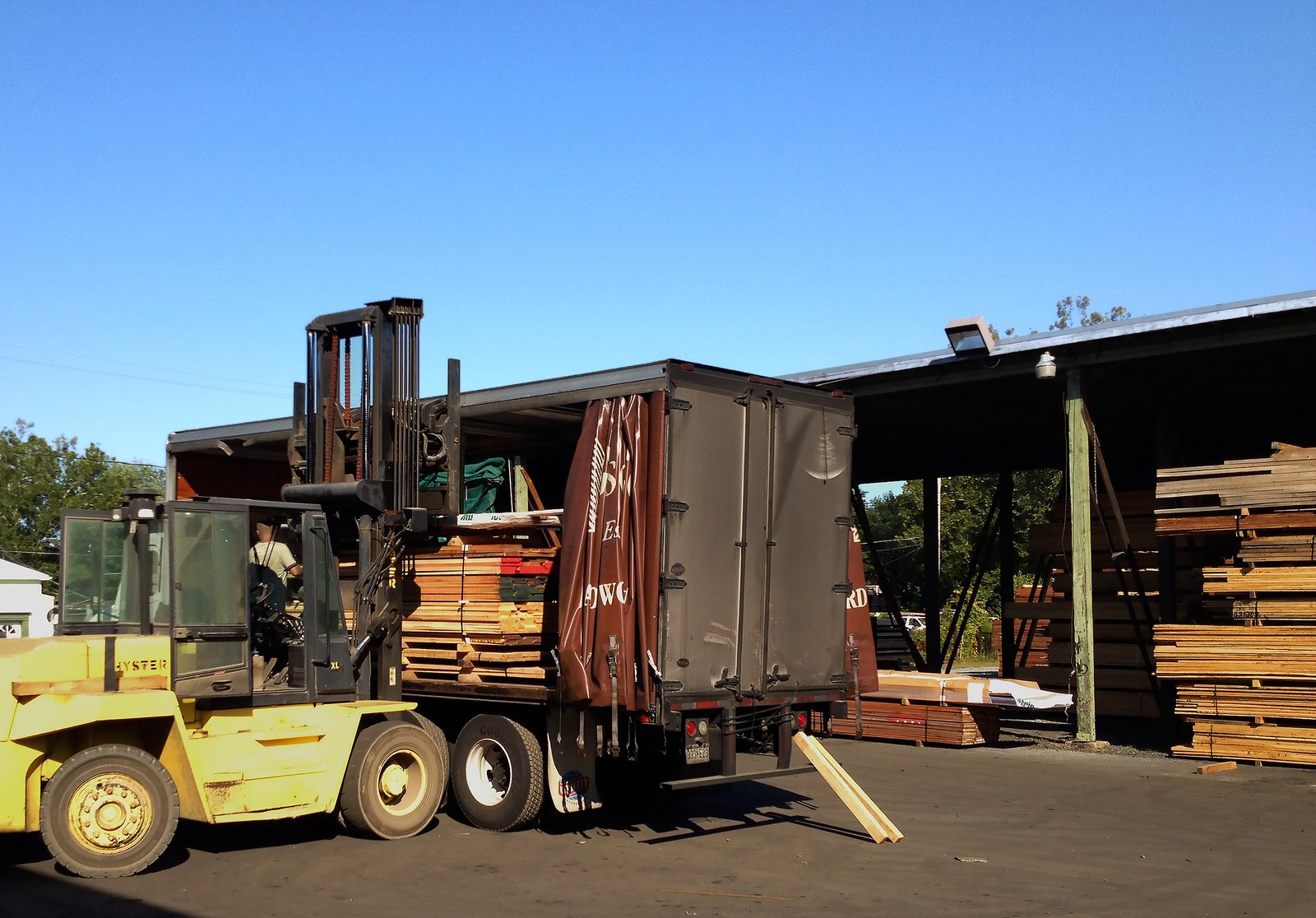
A species almost never vanishes outright, it vanishes in the length, width and grade the drawing asked for. Teak is still being cut. What runs short is clear Teak in 12 ft lengths at a consistent color. Afrormosia is still imported. What goes quiet is Afrormosia wide enough for a 10 inch stile without a glue line showing on a stained face.
Supply moves for ordinary reasons. An exporting country revises its permit rules. A mill in the producing region shuts down for a season of rain. Log quality drops and the clear yield drops with it, so the grade that was easy to buy last spring is on allocation by autumn. None of that reaches the architect until a submittal comes back with a lead time nobody can hold.
Phasing does the rest of the damage. A job that releases millwork over 14 months is buying from a market that will not be the same market at the end of it. The lobby elevation gets built out of one lot. The upper floors get built out of whatever the world has 10 months later, and a drawing that named a single species with no stated latitude has quietly made the fabricator responsible for a problem the specification created.
What a Species Swap Actually Changes
Color is the change everyone notices and the cheapest one to absorb, while machining behavior and glue behavior are the changes that break a shop drawing. Hardness shifts the knife geometry and the feed rate. Density shifts how a profile tears out on grain reversals. Oil content shifts whether a glue joint holds at all.
Run the numbers against each other and the spread is obvious. Sapele sits around 1,410 lbf on the Janka scale, Hard Maple around 1,450 lbf, White Oak around 1,360 lbf, Cherry around 950 lbf, Genuine Mahogany around 800 lbf. Accoya lands near 1,600 lbf, with acetylation giving dramatically reduced shrinkage and swelling. Swapping Cherry for Hard Maple on a stile and rail door is not a color decision. It changes the cut, the sanding sequence and how the panel field behaves inside a fixed frame.
The millwork palette here is Sapele, Iroko, Afrormosia, Teak and Utile. Those five machine predictably, glue predictably, and arrive in sizes a millwork house can build with. The tropical decking species are a different animal. Ipe, botanically Tabebuia spp, along with Cumaru, Garapa, Jatoba and Red Balau, are extremely hard and carry high oil content, which makes them difficult to glue. A decking yard reaches for them constantly. A millwork shop reaches for them far less, and never as the default for a milled, glued or machined component.
So the first question on any substitution is not which species looks closest. It is which species survives the operations on the cut list. A member that is sawn, moulded and installed as one solid piece tolerates a much wider range of substitutes than a member that is laminated, mitered, bent or glued up to width. Published working properties are where that check starts, not where it ends.
Writing the Substitution Allowance Into the Drawing
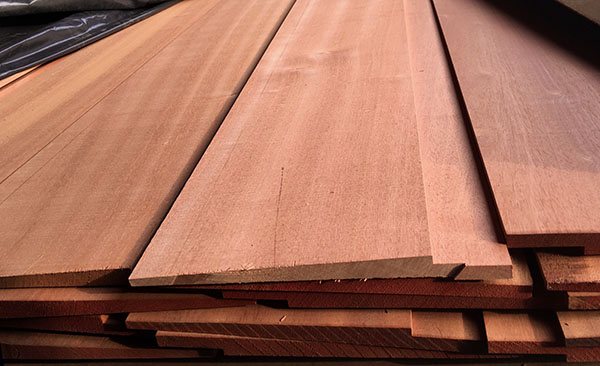
The phrase "or approved equal" is not an allowance, it is a deferred argument. Equal on what axis. Equal in color, in hardness, in available length, in how it takes a stain, in what paperwork travels with it. A drawing that leaves the axis unstated has handed the decision to whoever happens to be standing at the moulder on the day the material lands.
A drawing that survives a shortage does four things. It names a primary species and at least one named alternate instead of a vague category. It states which members may change species and which may not, since a door and the casing beside it can tolerate different answers. It fixes the grade and the in service moisture content separately from the species. And it says what happens to the profile, which is usually nothing at all, because a ground knife does not care what it is cutting.
Sequence matters just as much. Call out the elevations that have to read as one lot and the elevations that may be built later from a second lot. That one note is the difference between a substitution that costs a sample approval and a substitution that costs a tear out. The Architectural Woodwork Institute quality grades give you the vocabulary for the match requirement, and the Wood Moulding and Millwork Producers Association standards give it for the profile.
Substitution Paths and What Moves With Them
Every workable swap carries a second change the drawing has to absorb, and naming that second change up front is what keeps the job moving. The table below is how these get worked through on the floor rather than in a meeting.
| Species on the drawing | Nearest millwork substitute | What actually changes | What the drawing has to allow |
|---|---|---|---|
| Teak, interior stained | Afrormosia or Iroko | Color and figure shift, slightly less natural oil at the surface | A revised finish schedule and one newly approved sample before production |
| Genuine Mahogany, painted exterior trim | Sapele | Roughly 1,410 lbf against roughly 800 lbf, wider size range, longer lengths, better paint holding | No 1x8 in Sapele for exterior use, so anything over 6 inches wide redraws as narrower members |
| Sapele, interior stained | Utile | Similar machining, a different read on the ribbon figure | Sample re-approval and a stated plan for elevations built from two lots |
| Iroko, exterior | Afrormosia or Teak | Hardness and tone stay close, width availability does not | Lead time revision, and width limits confirmed before the shop drawing is sealed |
| Thermally modified Ash | Accoya or Abodo Vulcan | Modified Ash is not available wider than 8 inches, Accoya runs near 1,600 lbf | Board and panel widths redrawn, or the wide members moved to Accoya or Abodo Vulcan |
| Accoya, long exterior runs | Abodo Vulcan or Thermory | All modified stock tops out around 16 ft, most sold on metric lengths just under 16 ft | Joint locations drawn by the designer instead of left to the installer |
| Ipe, exterior decking | Stays a decking species | Extremely hard, high oil content, difficult to glue | Any milled or glued member moves to Sapele, Iroko, Afrormosia, Teak or Utile instead |
The Profile Usually Survives the Species Change
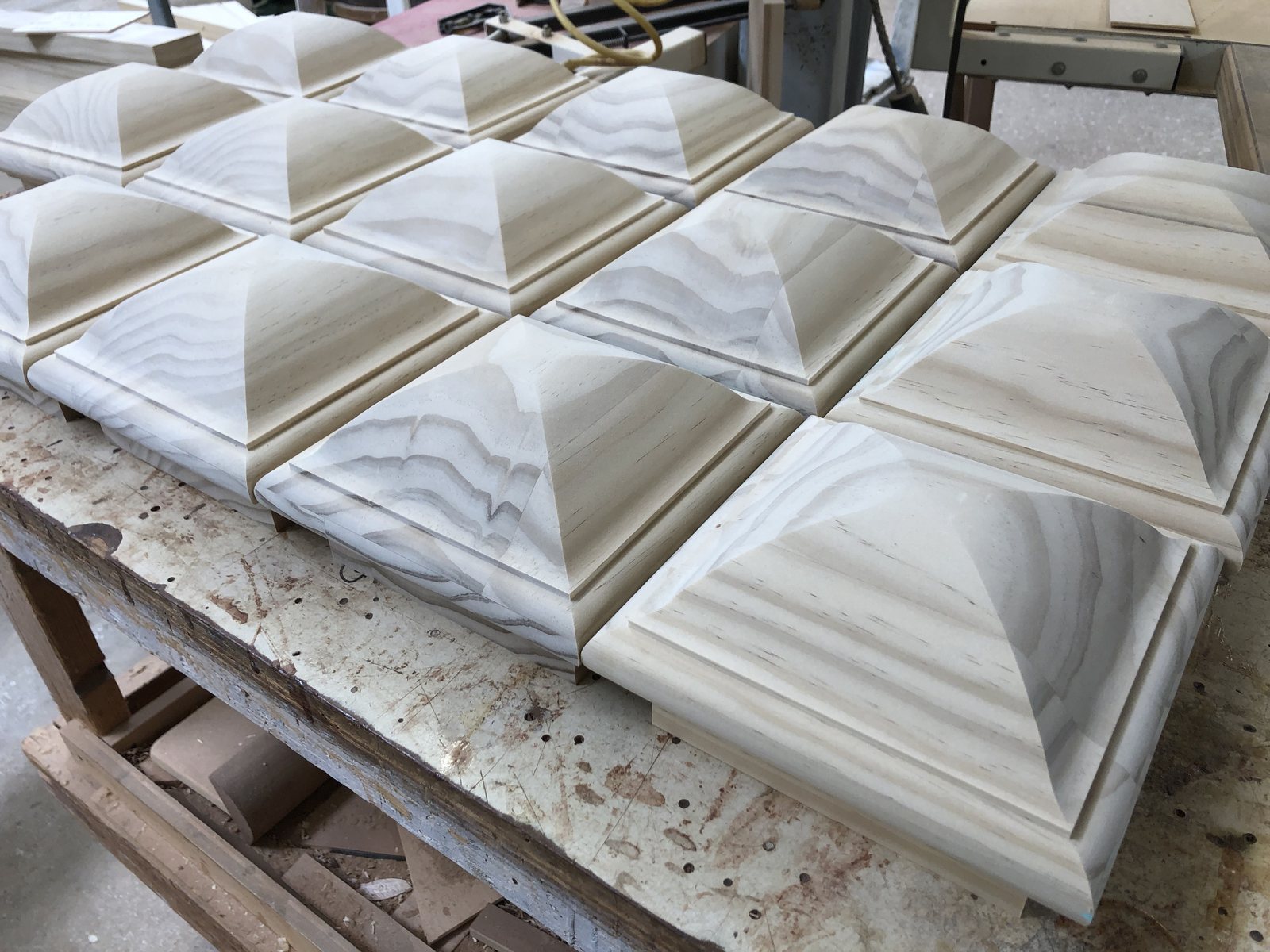
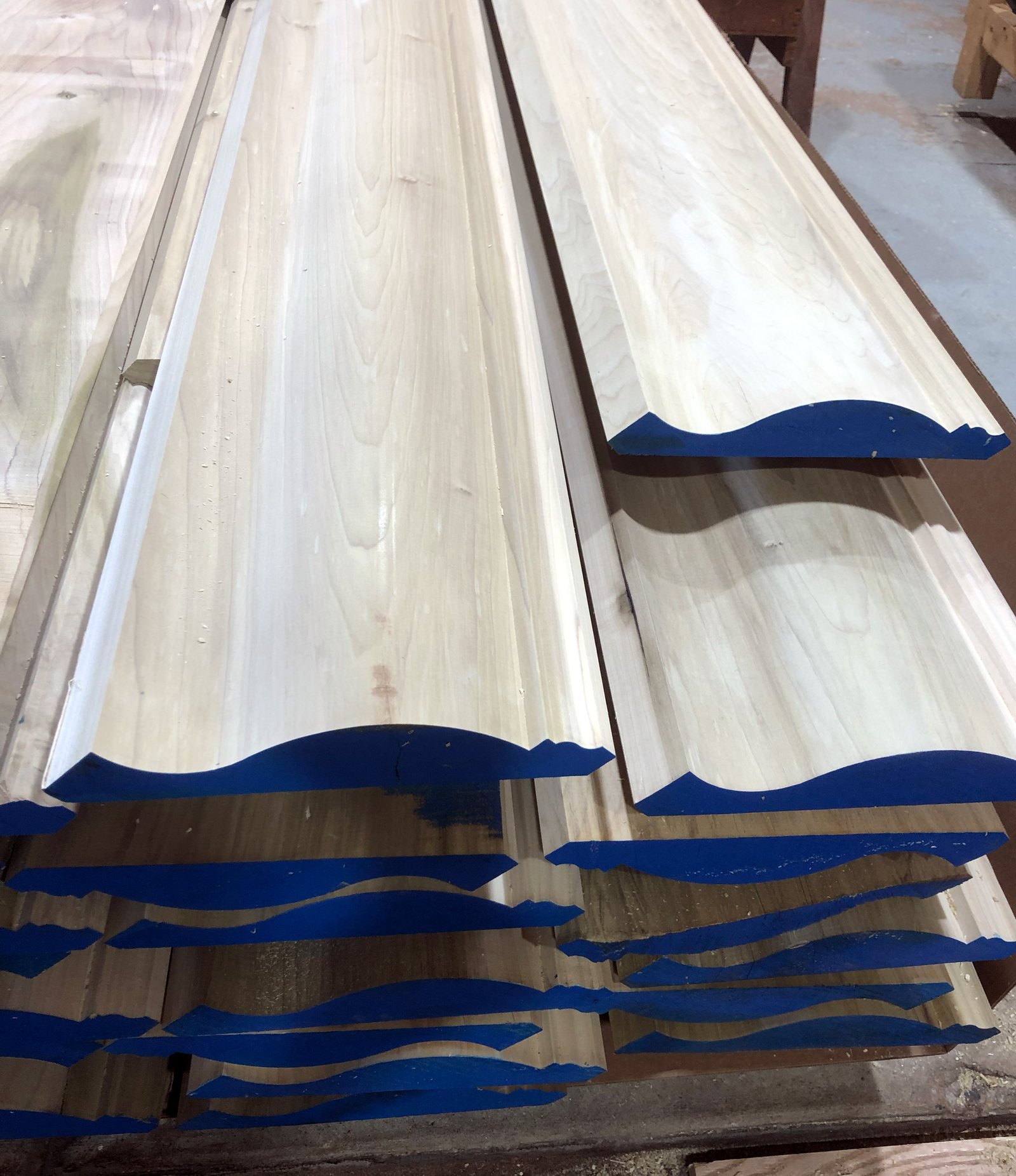
A knife ground for a 4 inch casing cuts that casing in Sapele, in Utile and in Iroko without modification, which is why a species change is rarely a profile change. J. Gibson McIlvain keeps a moulding profile library holding thousands of ground knives and grinds new ones every week, so a profile that ran in phase one is still on file when phase three shows up in a different species.
What changes is the setup, not the shape. Denser stock wants a slower feed and a lighter final pass. Interlocked grain in Iroko and Afrormosia will fuzz a crisp arris if the knife gets pushed, so the answer is a sample run in the substitute species before the whole order goes through. One sample piece settles arguments a drawing cannot.
Historical work raises the stakes without raising the difficulty. If a profile is not already in the library it gets ground to match, including restoration profiles taken off a removed piece and contemporary profiles that exist only as a detail on a sheet. In a regulated district the Secretary of the Interior standards govern what counts as like for like replacement, and that review turns on profile and dimension long before it turns on species.
Dimensional Limits That End a Substitution Early
Most substitutions fail on size rather than on species, so check length and width before anyone argues about color. These limits are hard, and no purchase order negotiates them away.
Modified woods top out around 16 ft. Thermory, Abodo Vulcan and Accoya are all constrained by kiln size, and most of that material is sold on metric lengths landing just under 16 ft. A 20 ft exterior run in any of them needs a joint, and the designer should locate that joint on the drawing rather than let it get discovered on site.
Width carries its own ceiling. Thermally modified Ash is not available wider than 8 inches. A wide board in a modified product means Accoya or Abodo Vulcan, and swapping into Thermory for a wide element will not work no matter how the rest of the elevation is detailed. Both Thermory and Abodo Vulcan are carried, which makes the width question answerable in one phone call instead of three.
Warranty coverage follows the same divide. Modified products carry warranties. Solid unmodified wood does not, and no supplier can issue one on an organic material that keeps responding to its environment. That matters on a substitution, because a swap out of a modified product into a solid species quietly removes a warranty the specification may have been leaning on.
Moisture, Movement and Two Lots on One Elevation
A substitute species delivered at the wrong moisture content will move more than the species change ever would. Interior millwork is milled to an in service moisture content near 6 to 8 percent. Exterior work sits near 12 to 16 percent. Drop a substitute milled to one target into an assembly built for the other and you get open joints that then get blamed on the species.
Grain orientation does more work than most specifications admit. Quartersawn and rift stock moves less across its width than plainsawn, which is why it gets specified wherever a painted or panelized surface has to stay flat. On a substitution that pushes toward a less stable species, shifting to quartersawn recovers a good share of the difference, and the shrinkage tables in the Forest Products Laboratory Wood Handbook show how much.
Cupping gets blamed on species constantly and almost always wrongly. Cupping is driven by installation and back ventilation, by whether the back face can dry at the same rate as the front. No substitution fixes a detail that traps moisture behind a board, and the assembly guidance from Building Science Corporation is worth reading before a species gets accused of something it did not do.
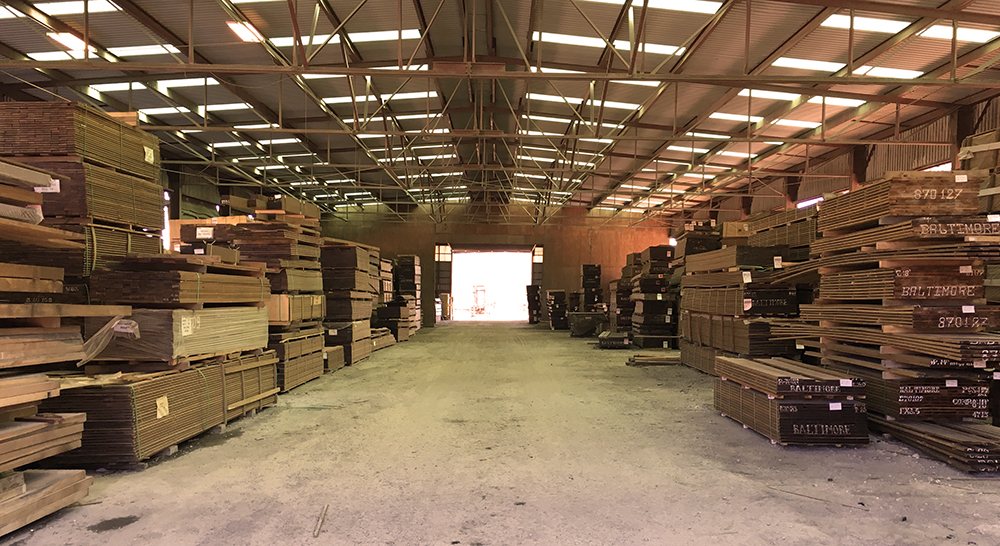
Two lots on one elevation is the real exposure in a phased job. J. Gibson McIlvain holds over seven million board feet of exotic and domestic lumber at its Maryland yard, which is what makes it possible to pull a phase three order out of material close to the phase one lot instead of out of whatever happens to be landing at port that month.
"When a species tightens up, the call I want is the one that comes before the submittal, not after it. Tell me which elevations have to match and which ones can read differently, and I can usually hold the drawing exactly as it was drawn. Wait until the material is due and the options get narrow fast."
Norm Moton, Director of Sales, J. Gibson McIlvain
Paint Grade Swaps and the Finish Schedule
A painted exterior substitution should move toward Sapele rather than toward Genuine Mahogany. Sapele holds paint better and comes in a wider range of sizes and longer lengths, which is what a long trim run needs. The one limit to respect is width. Sapele is not milled 1x8 for exterior use, since that width will not stay stable, so a wide painted band gets drawn as two narrower members.
Finish absorption is the part that catches people out. Open-grained and oily species absorb a great deal of finish, so a primer coat evens out the eventual painted surface instead of leaving a patchy field where the grain drinks unevenly. J. Gibson McIlvain primes trim before it ships, and sanding or buffing after priming knocks back grain raising while keeping moulded detail crisp, which is the whole difference between a sharp arris and a soft one once the topcoats go on.
When a substitution changes the species under the paint, the finish schedule needs re-checking even though the finish color will not change. A denser substitute takes less primer and can flash differently. An open-grained substitute takes more. The painter on site is working from a schedule written for the original species, and nobody tells him otherwise unless the shop drawing revision says so.
Custom Assemblies Absorb a Swap Differently Than Linear Runs
Linear trimwork tolerates a species change far better than a true custom assembly does, because a custom assembly has joinery that depends on the species. J. Gibson McIlvain mills linear trimwork, finished cladding and primed trim at the millwork shop on site at the lumber yard. ICD, the architectural millwork division of J. Gibson McIlvain, builds the true custom work planned around a specific space, including rafter tails, gates, box beams, custom doors, radius trimwork, radius millwork, pergolas, shutters, benches and railings.
Box beams make the point cleanly, since the joinery choice there is real and it interacts with the species. Butt joints give the most minimal profile, the fastest turnaround and the easiest on site assembly, but they leave visible seams and visible end grain and they are the weakest of the three. Dado joints are strong and still easy to assemble on site, though seams and end grain still show. Lock miter joints show no visible seams and are the strongest. A lock miter in an oily, hard to glue species is a different proposition than a lock miter in Sapele, which is one more reason the decking species stay off the millwork palette.
Radius work is tighter still. A bent or segmented radius member depends on how the substitute species takes a glue line and how it holds a laminated curve, so a radius elevation is the first place a substitution should get questioned and the last place it should be assumed. ICD builds custom trim profiles and curved work to the specific room, along with exterior millwork such as rafter tails and pergolas, where exposure narrows the species list further.
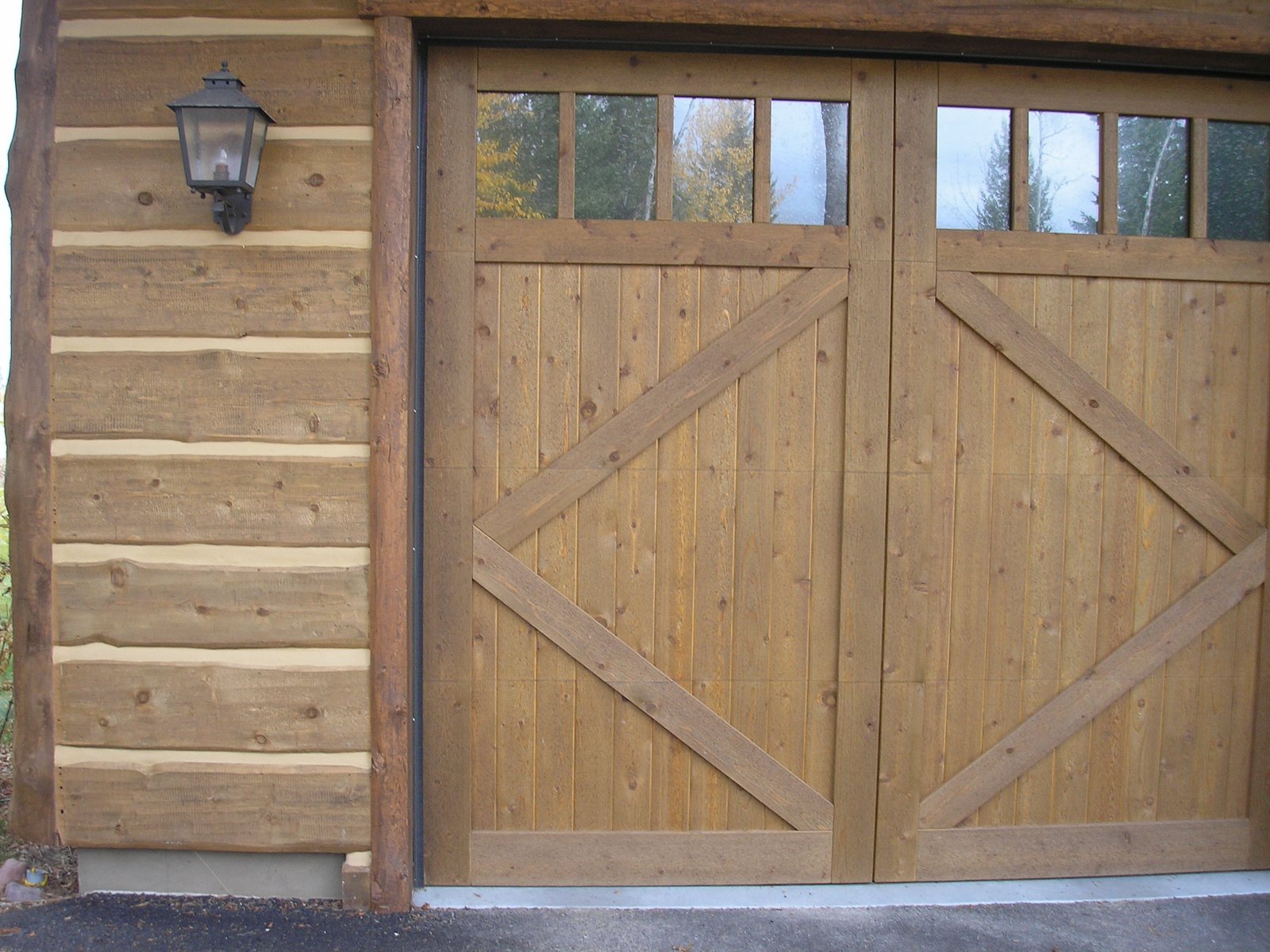
Shutters and gates carry constraints of their own. ICD builds wood shutters in louver and panel styles, including complete historical matching for both style and species, which is exactly what a historic district needs when like for like replacement is required and a substitution is not permitted at all. Custom gates run from pedestrian, garden and courtyard work up through estate entry and large driveway swing gates, and the large swing gates take engineering rather than only craftsmanship, since size and weight drive the design. Change the species on a gate leaf and you change its weight, and weight changes the hardware under it.
What the Shop Delivers and What the Installer Carries
A substitution handled in the shop costs a sample and a drawing revision, while the same substitution discovered in the field costs a schedule. Field work belongs to the buyer's own fabricator or installer, so the question worth settling early is what arrives and in what condition.
What arrives should be milled to the right in service moisture content, primed where the schedule calls for it, and cut to lengths the elevation can actually use. J. Gibson McIlvain ships nationwide, which means a substitution decision made in Maryland has to be right before the material leaves, since nobody wants to solve a width problem 2,000 miles from the yard.
What the installer carries is acclimation, back ventilation and joint placement. Those are field responsibilities on any species and they do not change when the species does. Grading language from the National Hardwood Lumber Association is the common ground for any argument about what was actually delivered, which is why the grade belongs on the drawing right next to the species.
How J. Gibson McIlvain Would Specify This
Name a primary species, name one acceptable alternate, state the property that actually matters, and let the knife stay the same. That is the whole method, and it survives a market that will not hold still for 14 months.
In practice the specification reads about like this. Primary species Sapele, acceptable alternate Utile for interior stained work, both at 6 to 8 percent in service moisture content. Exterior painted trim in Sapele at 12 to 16 percent, no 1x8, wide bands drawn as two members. Elevations 1 through 4 built from a single lot. Later elevations may be built from a second lot against a newly approved sample. Profile per the sheet, cut from a knife held on file so a later phase matches the first.
For modified products, put the length ceiling in the drawing rather than in a note nobody reads. Thermory and Abodo Vulcan are both carried, Accoya is carried, and all of them stop near 16 ft. Wide modified members go to Accoya or Abodo Vulcan, since thermally modified Ash is not available wider than 8 inches. Where sourcing documentation is part of the specification, that paperwork and the chain of custody travel with the material instead of being reconstructed after the fact.
The millwork shop at the yard runs the linear trimwork, finished cladding and primed trim, and ICD, the architectural millwork division, takes the custom assemblies planned around the room. Both come off one order, which is the practical reason a substitution gets resolved once instead of twice. See the J. Gibson McIlvain millwork service for the shop side and the ICD working process for how a custom assembly gets planned.
If a species on your drawing has gone quiet, call 800-638-9100 before the submittal goes out. Bring the elevation, the profile and the lengths you need, and the substitution conversation takes one call instead of a change order.
Frequently Asked Questions
What should a drawing say instead of "or approved equal"?
Name a primary species and at least one specific alternate, then state the property that governs. For interior stained work that usually reads as primary Sapele, alternate Utile, both at 6 to 8 percent in service moisture content, with grade stated separately. Add a note on which elevations must read as one lot and which may be built later from a second lot. Those two lines let J. Gibson McIlvain resolve a shortage without a change order.
Does a species substitution mean paying for a new moulding knife?
Rarely. A ground knife cuts the same profile in Sapele, Utile or Iroko without modification, and J. Gibson McIlvain keeps a profile library holding thousands of ground knives with new ones ground every week. What changes is the setup, so a denser substitute gets a slower feed and a lighter finish pass. The right step is a sample run in the substitute species before the full order goes through.
Can we substitute Ipe or Cumaru into a milled interior component?
No, and this is one of the few hard refusals. Ipe, botanically Tabebuia spp, along with Cumaru, Garapa, Jatoba and Red Balau, is extremely hard and carries high oil content, which makes it difficult to glue. Those species belong on exterior decking. A milled, glued or machined millwork member goes to Sapele, Iroko, Afrormosia, Teak or Utile instead.
Our drawing shows thermally modified Ash at 10 inches wide. What are the options?
Thermally modified Ash is not available wider than 8 inches, so either the width changes or the product changes. A wide board in a modified product means Accoya or Abodo Vulcan. Keep in mind that all modified stock tops out around 16 ft because of kiln size, with most of it sold on metric lengths just under 16 ft, so long runs need a joint located on the drawing rather than in the field.
Will a later phase in a substitute species match what we already installed?
Not exactly, and the drawing should decide in advance where an exact match is required. Color and figure shift between species and even between lots of the same species. J. Gibson McIlvain holds over seven million board feet at its Maryland yard, which makes it possible to pull a later phase from material close to the original lot, and the profile stays identical because the knife is on file.
Is the substituted material warranted?
Modified products carry warranties. Solid unmodified wood does not, and no supplier can issue one, since wood is an organic material that keeps responding to its environment. A substitution out of a modified product into a solid species removes that coverage, so check whether the specification was counting on it before the swap gets approved.
For painted exterior trim, is Sapele or Genuine Mahogany the better substitute?
Sapele. It holds paint better and comes in a wider range of sizes and longer lengths, with Janka hardness around 1,410 lbf against roughly 800 lbf for Genuine Mahogany. The limit to respect is width, since Sapele is not milled 1x8 for exterior use, so draw a wide painted band as two narrower members. Open-grained and oily species absorb a great deal of finish, which is why primed trim evens out the painted surface.
Sources and Standards Referenced
- Wood Handbook, Wood as an Engineering Material, USDA Forest Products Laboratory
- Architectural Woodwork Institute
- Wood Moulding and Millwork Producers Association
- National Hardwood Lumber Association
- The Secretary of the Interior's Standards for the Treatment of Historic Properties, National Park Service Technical Preservation Services
- Sapele, The Wood Database
- Accoya Modified Wood
- Thermory Thermally Modified Wood
- Building Science Corporation