Garapa Is the Lightest Tropical Hardwood Sold in Real Deck Volume, and the Gap Runs About Ten Pounds a Board
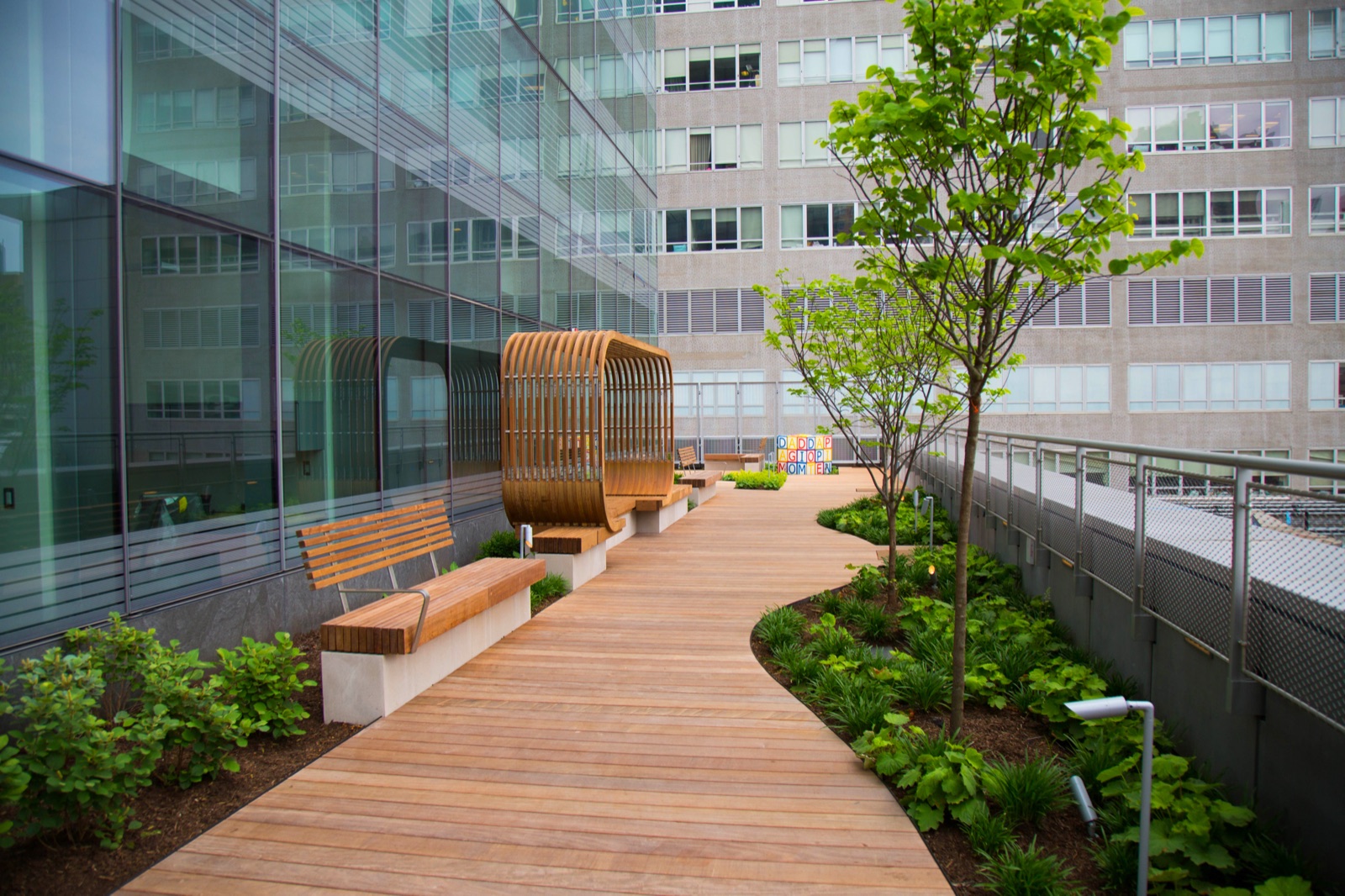
Garapa is the lightest tropical hardwood decking available in commercial quantity, at roughly 800 kg/m3 air dry against Ipe at about 1,050 kg/m3, which works out to close to ten pounds of difference on a single 16 foot 5/4x6 board. Red Balau sits just above Garapa. Jatoba comes next at roughly 910 kg/m3, and Jatoba earns more attention than its ranking suggests, since it is the lightest species that can be sourced consistently in 2x decking thickness. That one fact reorders the whole list the moment a roof deck turns public or commercial.
The species answer is short. The job is not. Weight on a roof is a moving target between the mill, the crane pick, the staging pile and the finished assembly, and the staging pile is usually the worst of those four by a wide margin. Roof decks get damaged during delivery and installation far more often than they fail a dead load calculation by half a pound.
Density Turns Into Two Numbers You Actually Order By
Air-dry density is only useful once you convert it into pounds per board and pounds per square foot of finished deck. Those two numbers run the entire rooftop conversation, from what the structural engineer signs off on to how many boards a two-person crew can carry off a hoist before they start dropping ends.
Start with the board. A dressed 5/4x6 measures about 1 inch by 5.5 inches net, so a 16 foot length contains roughly 0.61 cubic feet of wood. Ipe at 1,050 kg/m3 converts to about 65.5 pounds per cubic foot, which puts that board near 40 pounds. Garapa at about 50 pounds per cubic foot puts the same board near 30. Stretch it to 20 feet and the Ipe board lands close to 50 pounds while the Garapa board stays under 40. On a stair carry, that gap is the difference between a two-man lift and a four-man lift.
Then take the square foot. For any 5/4 board dressed to 1 inch net, divide pounds per cubic foot by twelve. Ipe comes in near 5.5 pounds per square foot of deck surface, Cumaru near 5.6, Jatoba near 4.7, Red Balau near 4.4 and Garapa near 4.2. Move to true 2x stock, which nets 1.5 inches, and multiply by 1.5. Ipe jumps to roughly 8.2 pounds per square foot and Jatoba to roughly 7.1. Thickness swings the number harder than species does, which is why a 2x requirement makes the light species question into a different question entirely.
One more figure keeps takeoffs honest. A 5/4x6 board covers about 2.1 linear feet for every square foot of deck, so a 900 square foot roof deck needs roughly 1,900 linear feet of decking before waste. Published density values from the USDA Forest Products Laboratory Wood Handbook and from the Wood Database entry for Garapa are stated at about 12 percent moisture content. Decking ships at 12 to 16 percent, and a stack that sits through three days of rain on an open roof weighs measurably more than the table says.
| Species | Air-dry density | Janka | One 5/4x6 at 16 ft | Deck weight at 5/4 | 2x availability and fit |
|---|---|---|---|---|---|
| Garapa | ~800 kg/m3 | ~1,700 lbf | ~30 lb | ~4.2 psf | Not sourced in 2x. Residential roof decks and engineer-approved 5/4 work. |
| Red Balau | ~800 to 880 kg/m3 | ~1,700 to 2,000 lbf | ~32 lb | ~4.4 psf | Not sourced in 2x. Residential roof decks and engineer-approved 5/4 work. |
| Jatoba | ~910 kg/m3 | ~2,690 lbf | ~35 lb | ~4.7 psf (~7.1 psf at 2x) | Available in 2x. Lightest option that clears a commercial 2x spec. |
| Ipe | ~1,050 kg/m3 | ~3,680 lbf | ~40 lb | ~5.5 psf (~8.2 psf at 2x) | Available in 2x. EN 350 Class 1 durability and ASTM E84 Class A. |
| Cumaru | ~1,070 kg/m3 | ~3,540 lbf | ~41 lb | ~5.6 psf (~8.4 psf at 2x) | Available in 2x. Heaviest of the practical commercial choices. |
| Massaranduba | ~1,150 kg/m3 | ~3,190 lbf | ~44 lb | ~6.0 psf | Listed for weight comparison only. Not carried by J. Gibson McIlvain. |
The Roof Carries Its Heaviest Load Before the Deck Exists
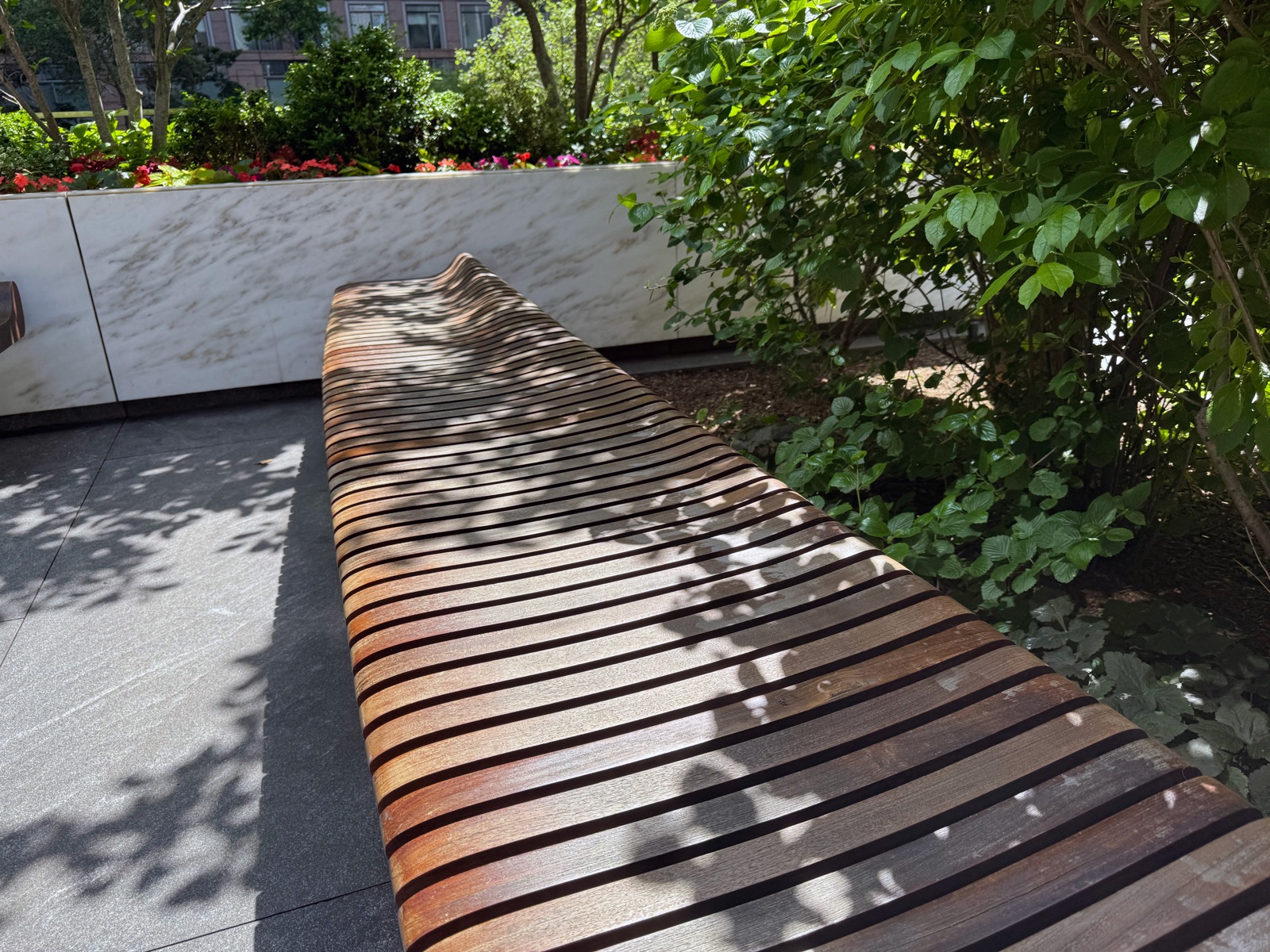
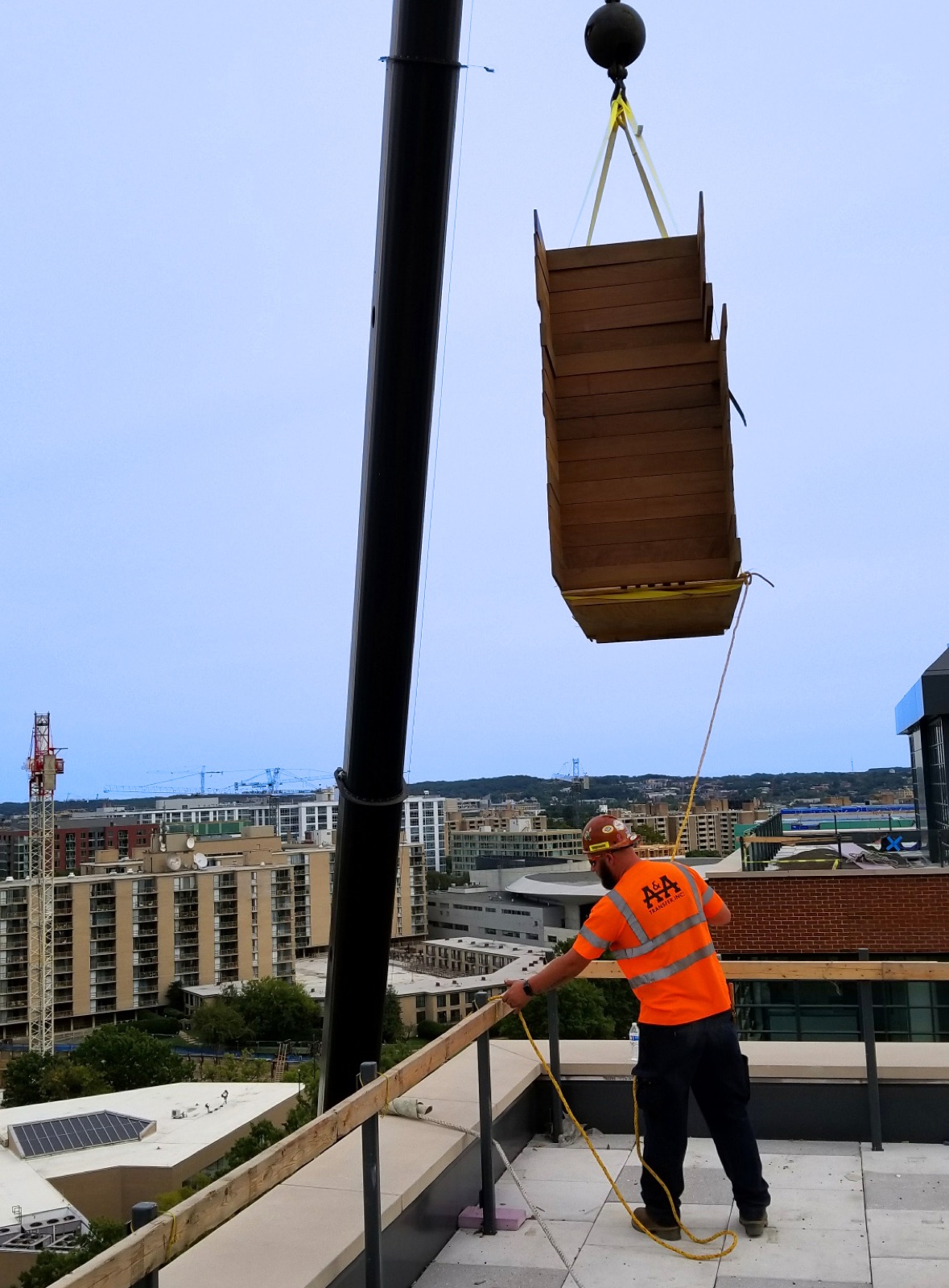
A staged lift of tropical decking puts more load on a roof structure in one afternoon than the finished deck will apply for the next forty years. Run the arithmetic once and the priority becomes obvious. Sixty boards of 16 foot 5/4x6 Ipe, six wide and ten courses high, weigh roughly 2,400 pounds. Spread perfectly over the 44 square feet the lift covers, that is about 55 pounds per square foot. Nothing spreads perfectly. The lift sits on two dunnage strips whose combined contact area is well under a square foot, so the real bearing pressure at those strips runs into the thousands of pounds per square foot.
Roof areas built for occupancy get designed to the live load of the use they serve, and assembly areas sit at 100 pounds per square foot under the International Building Code. Construction staging is not that load case. It is a concentrated bearing problem that no one accounted for during design unless somebody asked. The fix is procedural rather than structural. Break the delivery into small drops instead of one large stage. Land material over beams and column lines rather than at midspan. Run continuous dunnage across at least three bearing points, with protection board and a slip sheet between dunnage and membrane. Keep cart and buggy wheel loads off the field of the roof, because a loaded buggy concentrates weight harder than any stack of lumber.
The American Wood Council publishes the design standards behind the framing math, and the International Code Council publishes the load tables the engineer of record works from. Neither one covers what a pallet jack does to a warm membrane in July. That part belongs in the submittal and the pre-installation meeting.
How the Material Reaches the Roof Decides Length and Bundle Size
Order lengths to the path the material takes, not to the deck drawing, because a board that will not fit the hoist gets cut in the parking lot and every cut end becomes a butt joint you did not detail. Three access methods cover most jobs, and each one sets a different constraint.
A crane pick is the friendliest. Weight is rarely the limit at 2,400 pounds a lift, so long lengths ride up intact and butt joints stay at a minimum. Coordinate the pick point and the landing zone with the structural engineer and land it over bearing.
An exterior material hoist sets a hard ceiling on both length and lift weight. Check the platform dimension before the order goes in. Split units into half lifts and the crew moves more trips but never overloads a car.
A freight elevator sets the tightest limit of the three. A cab with an eight foot interior diagonal will not take a 16 foot board no matter how it gets angled, and passenger cabs are worse. When the elevator governs, specify shorter lengths deliberately and lay out the deck so butt joints fall on doubled bearing rather than wherever the boards run out. Thermally modified decking from Thermory and Abodo Vulcan tops out around 16 feet, with metric lengths landing just under that, since the modification kilns set the ceiling. Nobody should promise a 20 foot thermally modified board.
J. Gibson McIlvain mills and stocks Garapa decking in 5/4x6 alongside a vast Ipe inventory across every standard and custom dimension, and ships both nationwide, including regular deliveries into California. Tell the sales desk how the material gets to the roof and the packing list gets built around the pick instead of around the truck. Call 800-638-9100 to price a rooftop package by species, thickness and length, or start at the Ipe decking page.
"The first question I ask on a rooftop job is not which species. It is how the wood gets up there. I have watched a contractor order beautiful 20 foot Ipe for a fourteenth floor terrace with a freight elevator that tops out at ten feet of clear diagonal, and every one of those boards got cut short on the sidewalk. We would rather build the order around the hoist and the pick from the start. That conversation takes five minutes and saves a week." Norm Moton, Director of Sales, J. Gibson McIlvain
What You Trade Away When You Take Weight Out of the Board
Lower density buys load relief and costs durability, hardness and, on some jobs, the fire rating the code official expects. Every pound removed from the deck comes out of the cell wall structure that made the dense species worth importing.
Durability moves first. Ipe rates EN 350 Class 1 and holds it in ground contact. Garapa and Red Balau are durable woods that perform well above grade with maintenance, and they want a periodic coat where Ipe survives neglect. A rooftop assembly with airflow under the boards and no soil contact is a friendlier exposure than a grade level deck, so the durability gap narrows on a roof. It does not close.
Hardness matters on an amenity deck. Garapa at roughly 1,700 lbf on the Janka scale still outperforms most temperate decking, and it will show more traffic wear than Ipe at 3,680 under café chairs and rolling planters. Specify the lighter species where furniture is fixed or padded.
The fire rating is the item that stops jobs. Ipe carries an ASTM E84 Class A rating, meaning a flame spread index of 25 or less, which is what many high rise roof deck specifications require without ever saying so in plain language. Do not assume a lighter species carries the same rating. Ask for the test report before the substitution goes into a submittal. WoodWorks and the National Fire Protection Association both publish material on how those requirements apply to occupied roofs.
A Roof Is the Harshest Exposure the Board Will Ever See
Reflected heat, full sun, constant wind and zero shade make a rooftop the most aggressive drying environment a deck board can occupy, and surface checking is the visible result. Checking is the wood releasing tension as the surface heats and dries faster than the core. It does not weaken the board. Small surface checks are normal in dense tropical decking and are a sign the material was seasoned properly rather than a defect.
No supplier can promise a checking-free rooftop deck, and any that does is selling something. The real mitigation is a stabilizer in the wood before it ships. J. Gibson McIlvain factory coats tropical decking with Cutek, a penetrating oil wood stabilizer that slows the moisture exchange at the surface and significantly reduces checking. Coating all six faces before installation is worth far more than coating the top after.
Site practice keeps checks small. Take delivery at 12 to 16 percent moisture content and keep the stack covered and off the membrane until installation. Seal every field cut end the day it is cut. Leave real airflow under the deck, which on a pedestal system happens automatically and on a sleeper system requires the sleepers to run with the drainage rather than damming it. Hold the decking off parapets and curbs so the assembly can breathe on all sides. Building Science Corporation has published extensively on why drying potential beats moisture exclusion in exterior assemblies, and a rooftop deck is a clean case of that principle.
Fastening Above a Waterproofing Membrane
Nothing penetrates the membrane, which means the deck floats on sleepers or pedestal trays and every fastening decision happens above that plane. Set sleepers or joists at 16 inches on center for dense hardwood decking. Tighter spacing is fine and adds framing weight, which is worth checking against the load allowance before it gets treated as free.
Profile decides the fastener, and this trips up more submittals than it should. Shiplap takes visible face fasteners. Only a tongue and groove profile works with a hidden fastener system. Grooved boards go down with the grooves facing down so water drains out instead of collecting in the channel. Getting that backwards traps water against the fastener line and shows up as staining within a season.
Drilling is site work, not mill work. Never order decking pre-drilled or pre-countersunk, and no reputable mill will drill fastener holes before shipping, since layout shifts and field cuts invalidate any factory hole pattern the moment the frame gets built as built rather than as drawn. On site, pilot every hole. Two fasteners per board per joist, held about 3/4 inch from the edge. Use full-depth pilots near board ends where splitting risk is highest, and land butt joints on doubled bearing so both boards get full support. A self-centering combination bit that pilots and countersinks in one pass keeps a long roof deck consistent. Specify 316 stainless fasteners on any coastal roof, where salt aerosol reaches higher and stays longer than it does at grade.
The Paper a Rooftop Job Needs Before the First Board Lands
Submittal packages for occupied roof decks ask for more documentation than grade level decks, and the species choice affects what has to be in the binder. Assemble it before the order rather than after the delivery.
Chain of custody comes first on institutional and LEED-tracking work. FSC certification travels with the shipment and has to be requested at the time of order, not reconstructed later. When a project specifies a CITES-listed species, documentation is required at import and has to move with the material, so build lead time for it into the schedule. The CITES Secretariat maintains the current appendices.
Fire test reports belong in the same binder when the building official asks for a rated walking surface. So does a per-species weight statement for the structural engineer, stated in pounds per square foot at the specified thickness and moisture content rather than in generic species averages. On accessible routes, the ADA Accessibility Standards limit openings in the walking surface so they do not pass a half inch sphere, and elongated openings must run perpendicular to the dominant direction of travel. That drives board gap on a rooftop deck more than aesthetics do.
One note on warranties. Solid unmodified tropical hardwood does not carry a product warranty, from any supplier. Modified products are different. Accoya, Thermory and Abodo Vulcan are manufactured materials with published manufacturer warranties, and where a specification demands warranted performance, those are the products that can answer it.
How J. Gibson McIlvain Would Specify This
Match the species to the deck classification first, then order lengths to the access path, then stage the delivery so the roof never sees the load all at once. Here is how that resolves in practice.
On a private residential roof terrace with a tight allowance, Garapa 5/4x6 at about 4.2 pounds per square foot is the lightest defensible choice, factory coated with Cutek on all six faces, laid over sleepers or pedestal trays at 16 inches on center with 316 stainless fasteners. Red Balau is the near substitute when the color reads better against the building. Both belong in residential and engineer-approved 5/4 work.
On a commercial, public or amenity roof deck, the 2x rule governs. Boardwalk, pier and plaza decks are specified at 2x thickness to control deflection, and no professional goes first with a thinner board on a public job even where the strength math for 1x or 5/4 works. That filters Garapa and Red Balau out of the conversation. Jatoba 2x6 at roughly 7.1 pounds per square foot becomes the lightest species that can be sourced consistently at that thickness. Ipe at roughly 8.2 remains the specification when EN 350 Class 1 durability or ASTM E84 Class A is written into the requirements, and it is worth carrying the extra pound before redesigning the framing around a lighter board.
Where the allowance still will not close, look past the tropical list before compressing joist spacing. Western Red Cedar is a legitimate rooftop material and it is light. Clear vertical grain cedar gives the stable, knot-free surface that suits a visible amenity deck, while select tight knot cedar performs well in less formal settings at a lower material investment. Thermally modified decking from Thermory and Abodo Vulcan is another light, dimensionally stable route, with lengths capping around 16 feet.
Order lengths that fit the hoist or the elevator diagonal before they fit the drawing. Break the delivery into small drops landed over bearing. Confirm the fastening profile matches the fastener system, keep grooves facing down, and pilot every hole on site against the frame as built. J. Gibson McIlvain works with contractors and commercial buyers on volume rooftop packages nationwide and will build the load and length schedule alongside the takeoff. Call 800-638-9100 with the roof plan, the access method and the engineer's allowance, and the material list comes back matched to all three. More species detail is available at mcilvain.com.
Frequently Asked Questions
How much does one board of Ipe decking weigh compared to Garapa?
A 16 foot 5/4x6 board dressed to 1 inch by 5.5 inches contains about 0.61 cubic feet of wood. Ipe at roughly 65.5 pounds per cubic foot puts that board near 40 pounds. Garapa at roughly 50 pounds per cubic foot puts the same board near 30 pounds. At 20 feet the Ipe board approaches 50 pounds while Garapa stays under 40. Across a full unit of sixty boards that difference is around 600 pounds per lift, which matters more for the hoist and the crew than for the finished dead load.
Do I need a crane to get tropical hardwood decking onto a roof deck?
Not always, but the access method should be settled before the order is placed. A crane pick handles full lifts and long lengths intact, which keeps butt joints to a minimum. An exterior material hoist limits both platform length and lift weight, so units usually get split. A freight elevator is the tightest constraint of the three, since interior diagonal governs board length. Stair carries work on small terraces if the boards are short enough for a two-person lift. Whichever method applies, land the material over beams and column lines rather than at midspan.
Can I stack decking bundles on the roof before installation?
Only with the structural engineer's sign-off and proper dunnage. A single lift of sixty 16 foot 5/4x6 Ipe boards weighs roughly 2,400 pounds, and it bears on dunnage strips totaling well under a square foot of contact, which concentrates thousands of pounds per square foot at those strips. Break the delivery into small drops, spread the load across at least three bearing points with continuous dunnage, put protection board and a slip sheet between dunnage and membrane, and keep the stack over structure rather than in the middle of a span.
What length should I order when the only access is a freight elevator?
Measure the clear interior diagonal of the cab and order below it. A cab with an eight foot diagonal will not accept a 16 foot board at any angle. Choose the length deliberately and lay the deck out so every butt joint lands on doubled bearing, since shorter boards mean more joints and each one needs full support on both sides. Cutting long boards down in the parking lot produces the same joints without the layout control.
Is Garapa acceptable for a commercial rooftop amenity deck?
Usually not, and the reason is thickness rather than weight. Commercial, public and plaza decks are specified at 2x thickness to control deflection, and no professional goes first with a thinner board on a public job even where the strength math for 5/4 works. Garapa and Red Balau are not sourced consistently in 2x, which filters them out of commercial specs. Jatoba is the lightest species available in 2x, at roughly 7.1 pounds per square foot, with Ipe at roughly 8.2 when Class 1 durability or ASTM E84 Class A is required.
Does a rooftop location make surface checking worse, and can it be prevented?
A roof is the most aggressive drying exposure a deck board sees, with full sun, reflected heat off the membrane and constant wind, so checking shows up sooner there than at grade. It cannot be prevented in dense tropical decking. Checking is the wood releasing tension as the surface heats and dries faster than the core, it does not weaken the board, and small surface checks are normal. The meaningful mitigation is factory coating with Cutek, a penetrating oil wood stabilizer that significantly reduces checking. Correct moisture content at delivery, end sealing of field cuts and airflow under the deck keep checks small.
Can I order rooftop decking pre-drilled to speed up the install?
No. Drilling is installation work done on site against the frame as built, and no reputable mill drills fastener holes before shipping, since field cuts and layout shifts invalidate any factory hole pattern. On site, pilot every hole, run two fasteners per board per joist at about 3/4 inch edge distance, use full-depth pilots near board ends where splitting risk is highest, and land butt joints on doubled bearing. A self-centering combination bit that pilots and countersinks in one pass keeps the pattern consistent across a long deck.
Does switching to a lighter species change the fastener or joist spacing?
Joist or sleeper spacing stays at 16 inches on center for dense hardwood decking regardless of which tropical species is chosen. Fastener selection is driven by exposure and profile rather than density. Use 316 stainless on coastal roofs, face fasteners with a shiplap profile, and hidden clips only with a true tongue and groove profile. Grooves face down so water drains rather than collecting. Tightening spacing to 12 inches adds framing weight, which should be checked against the load allowance before it is assumed to be free.
Sources and Standards Referenced
- USDA Forest Products Laboratory, Wood Handbook: Wood as an Engineering Material
- The Wood Database: Garapa
- American Wood Council, Codes and Standards
- International Code Council, International Building Code
- ASTM E84, Standard Test Method for Surface Burning Characteristics of Building Materials
- US Access Board, ADA Accessibility Standards
- Forest Stewardship Council, FSC Standards
- WoodWorks, Wood Products Council Resources
- National Fire Protection Association
- Building Science Corporation