What a Recoat Window Is, and Why It Expires
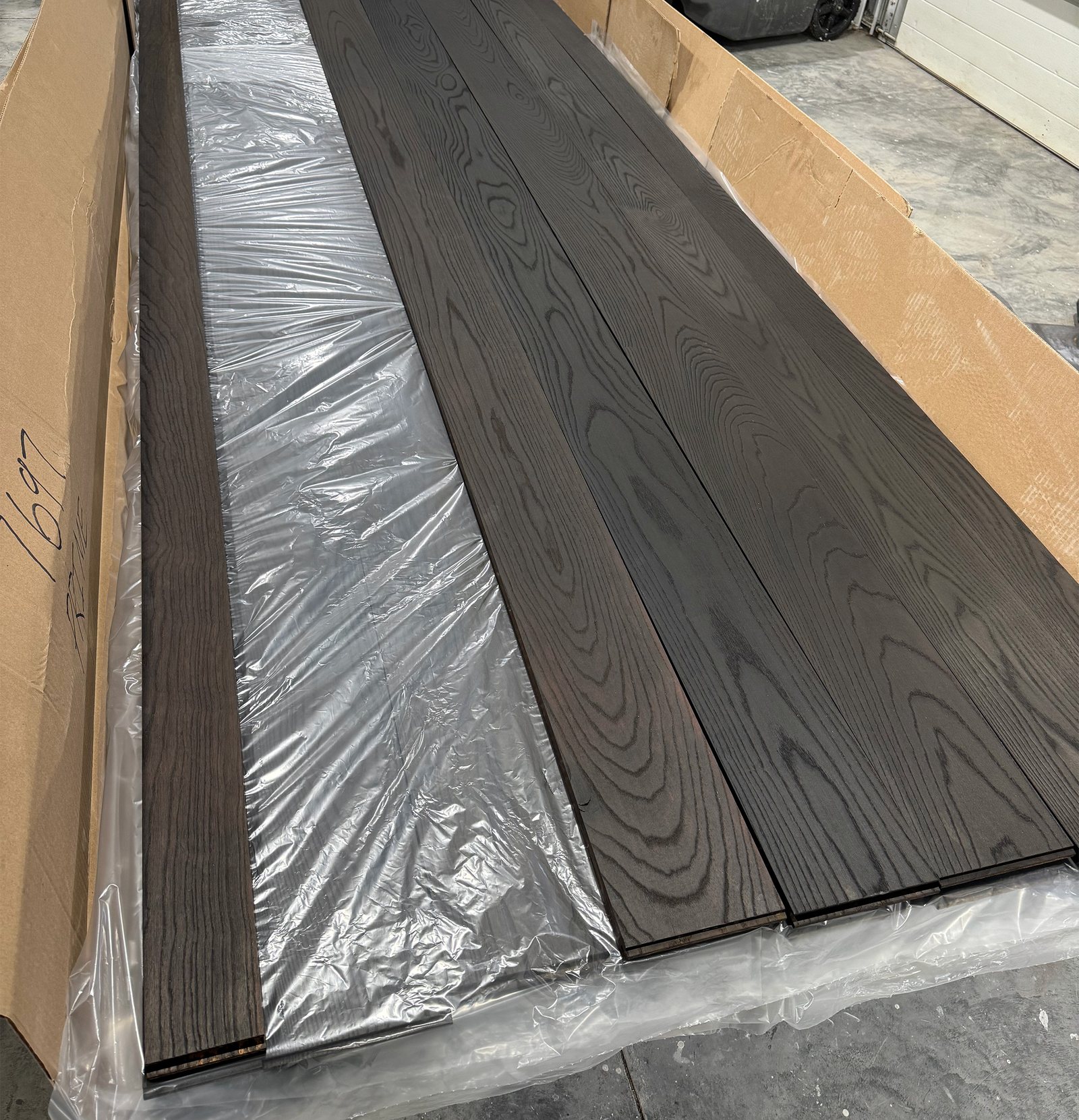
A primer data sheet carries two clocks, a minimum dry time before the topcoat can go on and a maximum period after which the coating manufacturer no longer stands behind adhesion. Painters read the first one. The second one is the one that costs money on a job. Primed trim that shipped in March and gets its finish coat in October has spent a summer collecting ultraviolet exposure, pollen, rain and temperature swings, and the film sitting on the wood in October is not the film that left the mill.
Coating manufacturers write that second number in different ways. Some print a flat outdoor exposure limit measured in weeks. Others allow a much longer period as long as the material stays covered, stickered and off the ground. A good many exterior acrylic and alkyd primers land somewhere between 30 and 90 days of real weather exposure before the sheet starts calling for cleaning, abrading or a fresh prime coat. Read the sheet for the product actually on the wood, not the one the painter usually buys.
The window exists for a mechanical reason. A primer is engineered to hand the topcoat a slightly porous, chemically receptive surface with a known profile. Sun, dirt and time take that surface away. Nothing dramatic happens on day 91, but the trend runs one direction, and a painter who topcoats a chalked face has built a bond line that will let go in a few seasons.
What Aging Does to a Primed Face
Three separate processes degrade primed millwork in storage, ultraviolet breakdown of the binder, surface contamination, and moisture cycling in the wood underneath. They run at different speeds and they leave different evidence, which is why a single glance at a bunk of primed trim tells you almost nothing.
Ultraviolet light attacks the resin holding the pigment. The pigment stays behind as loose powder, and that powder is what a painter finds when a dark rag comes away white after a hard rub. Chalk is not dirt. It is the primer coming apart at the surface, and any topcoat applied over it is bonded to dust rather than to the film.
Contamination is the quiet one. Pollen, tree sap, mill dust, road film from an open trailer, and mildew spores all settle on a primed face in a few weeks outdoors. Mildew in particular will grow straight through a fresh topcoat if it is painted over rather than killed and rinsed, and it shows up first on the shaded north elevation stock and on anything that sat under a tree.
Moisture cycling works from the back side. Wood that takes on water swells, raises grain through the primer, and opens hairline checks in the film at the sharp edges of a moulded profile. That is the damage that never fully reverses, because the raised grain has to be knocked back by hand before the topcoat goes on.
Oil Based and Water Based Primer Age Differently
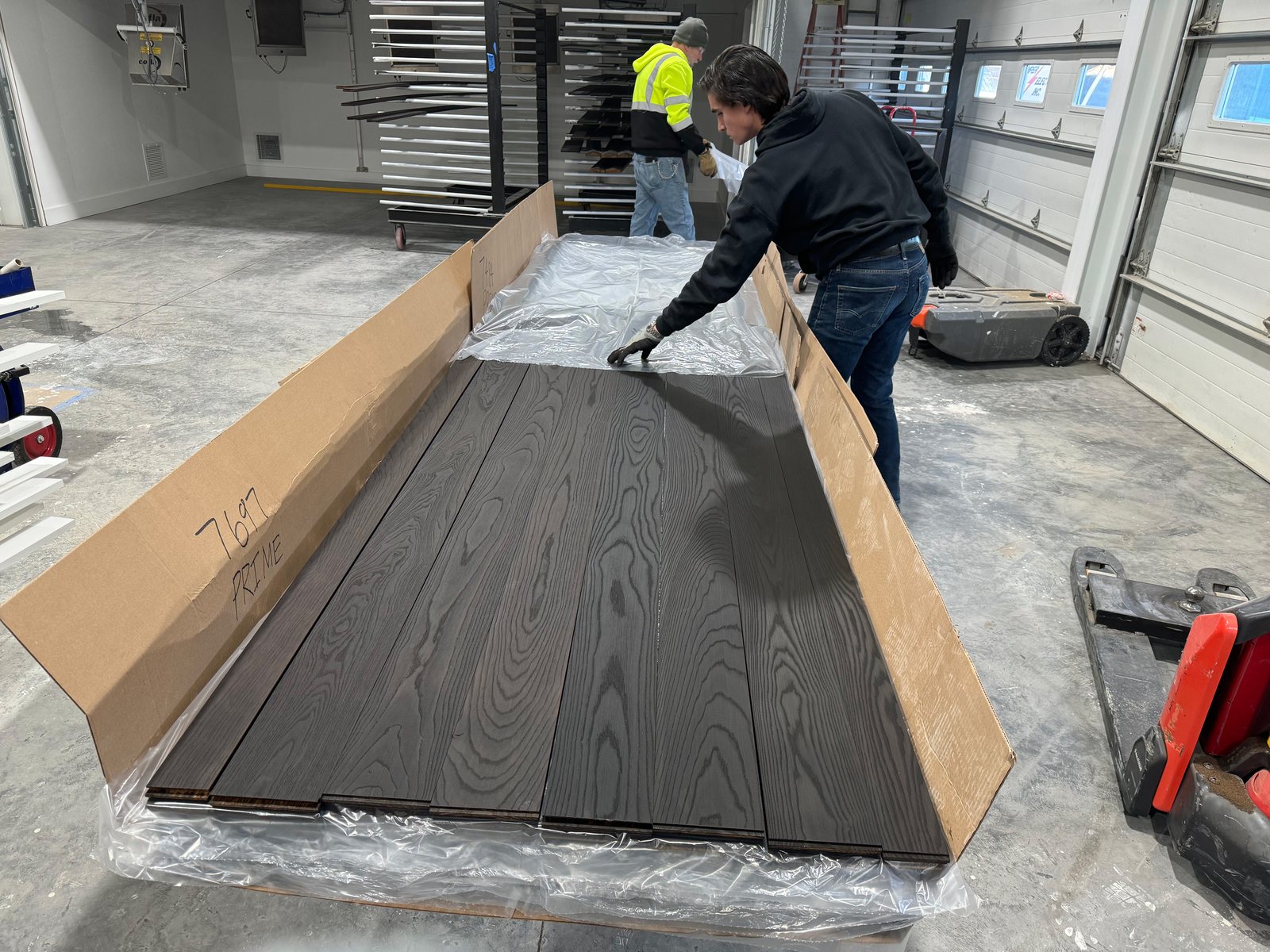
An alkyd primer keeps curing after it dries and gets harder, glossier and less receptive as the months pass, while an acrylic primer stays flexible and open but collects dirt faster. The two systems do not fail the same way, and they do not get rescued the same way.
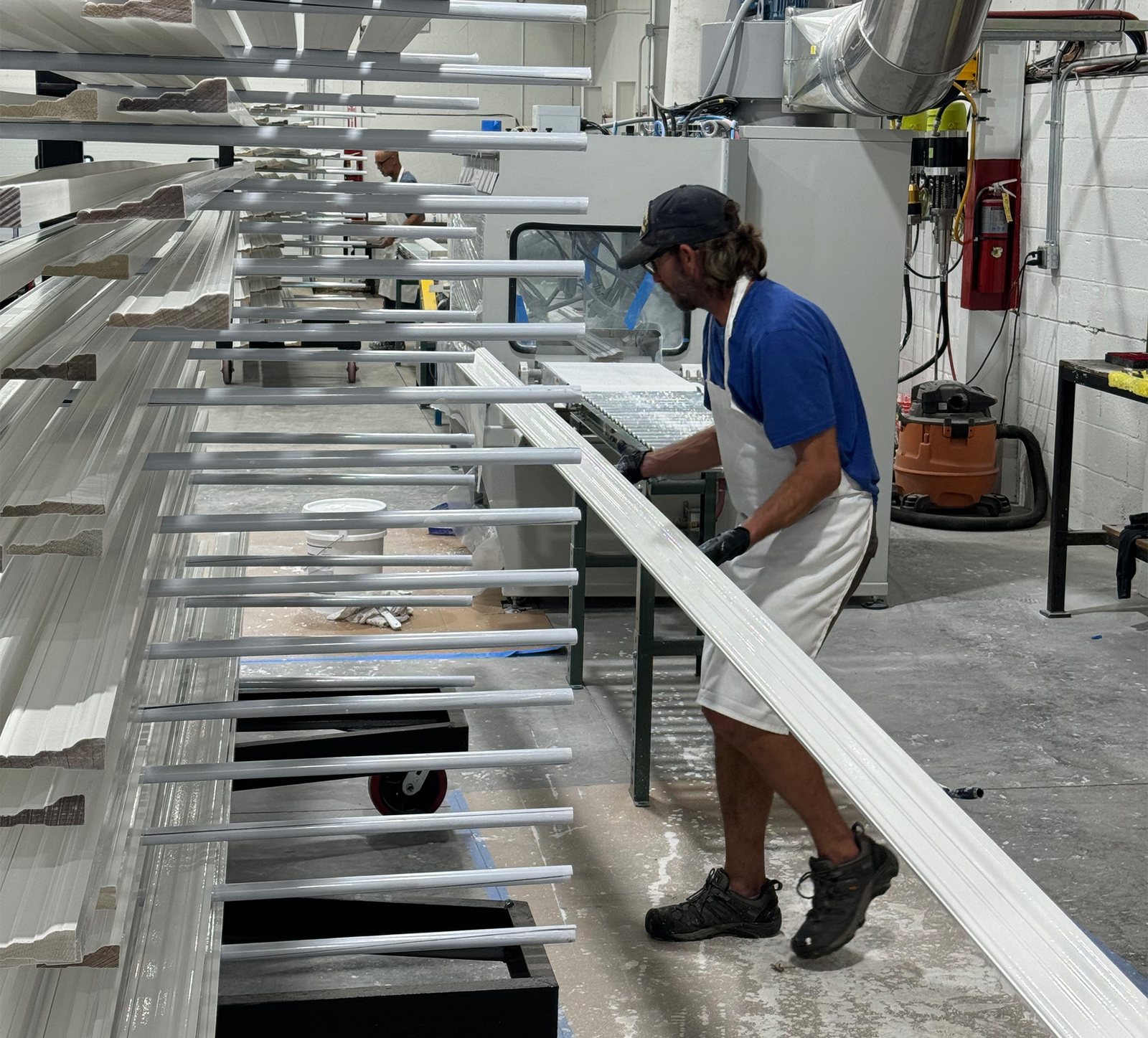
J. Gibson McIlvain primes in three build levels in both oil based and water based systems, and exterior primed trim leaves the mill with a fungicide additive in the coating. Knowing which system is on the wood is the first question to answer on delayed stock, because the remedy changes. Oil based film that has cured hard for six months needs mechanical abrasion to give the topcoat something to key into. Water based film that has been outside for the same six months is more likely to need washing and mildew treatment than sanding.
Cross system topcoating is common and it is fine, provided the prep is honest. A waterborne acrylic finish over a well cured alkyd primer holds if the surface is scuffed and clean. Dropping it onto a glossy, unsanded alkyd face is how a crew ends up peeling sheets of paint off a casing run two winters later.
Sanding a moulded profile is not the same operation as sanding a flat board. Flat faces take 180 to 220 grit paper. Coves, beads and fillets take a nylon abrasive pad worked along the length of the profile, which knocks back the gloss and the raised fiber without rounding the crisp arris that made the profile worth grinding in the first place.
Reading Primed Stock Before the Topcoat Goes On
Five checks, done in about ten minutes on a bunk, tell a painter whether the recoat window is still open. None of them require special equipment beyond a moisture meter, and skipping them is how a warranty claim against a coating manufacturer gets denied.
Start with the chalk rub. A clean dark cloth pulled firmly across a primed face picks up pigment if the binder has broken down. Then run a tape pull on a hidden face or an offcut, scoring a small cross hatch and lifting fast, which shows whether the primer is still gripping the wood or has been undercut by moisture. A cross hatch adhesion test of this kind is the standard way coating failures get characterized, and it takes two minutes.
Meter the wood next, on the back face and near an end, not just in the middle of the board. Look for mildew with a drop of household bleach on a suspect gray patch, since mildew bleaches out in under a minute and dirt does not. Last, walk the ends and the cut faces, because raw end grain that has been open to weather is already wicking water into the board.
Tannin or extractive bleed reads as tan, pink or brown ghosting coming up through a white primer. On stock that sat outdoors through rain cycles it shows up along the grain lines and around knots. A bleed blocking primer coat over the affected areas stops it. A topcoat alone does not.
Triage by Time Since Priming
What has to happen before the finish coat depends less on the calendar than on where the material sat and what it was exposed to. Two bunks primed the same week can need completely different prep if one stayed inside and the other lived under a tarp behind the trailer.
| Storage history since priming | What to check first | What it usually means | Prep before topcoat |
|---|---|---|---|
| Within the printed window, stored covered and stickered | Moisture meter and surface dust | Film is intact and still receptive | Wipe down, spot sand any handling marks, topcoat |
| Past the printed window, stored inside and dry | Gloss level and tape pull | Alkyd has cured harder than the sheet assumed | Scuff sand flats, abrasive pad on profiles, clean, topcoat |
| Past the window, exposed to weather under cover | Chalk rub and mildew spot test | Binder breakdown starting, contamination present | Wash, treat mildew, rinse, dry to spec, abrade, topcoat |
| A full season outdoors, uncovered | Chalk rub, raised grain, extractive bleed | Primer is no longer a sound base coat | Wash, dry, sand, re-prime the full face, then topcoat |
| Field cut ends and rips, any age | Bare end grain and exposed edges | Unprotected wood open to water uptake | Seal every cut with primer before the piece is fastened |
The bottom row is the one that gets argued about. It applies on day one as much as it applies after a year in a yard, because a saw cut removes every bit of protection the mill applied to that end.
Moisture Content Is the Other Clock
Primed millwork that sat too long has often gained or lost moisture, and topcoating over the wrong number seals the problem inside the board. The film goes on fine. The failure arrives a season later as blistering, grain raise or an open joint.
J. Gibson McIlvain mills interior millwork to an in service moisture content near 6 to 8 percent and exterior work near 12 to 16 percent, which are the numbers those pieces are meant to live at once they are installed. Material held in an unconditioned garage or a shrink wrapped bundle sitting in the sun drifts off those numbers quickly, and condensation under tight plastic is one of the more reliable ways to ruin a primed surface.
Meter before the topcoat and meter again if the stock has been moved between environments. The Forest Products Laboratory Wood Handbook lays out how wood equalizes with its surroundings and why finishing over an out of range board fails, and its finishing chapter is worth keeping on the truck. The National Park Service brief on paint problems in exterior woodwork catalogs what each failure mode looks like on a finished elevation.
Species That Punish a Late Topcoat
Open-grained and oily species absorb a great deal of finish, which is exactly why a delayed topcoat over a thin or weathered primer coat shows up as an uneven painted surface. The millwork palette runs to Sapele at roughly 1,410 lbf on the Janka scale, plus Utile, Iroko, Afrormosia and Teak. Those machine cleanly and glue well, which is why a millwork shop reaches for them rather than for the tropical decking species. Ipe, Tabebuia spp, along with Cumaru, Garapa, Jatoba and Red Balau, are extremely hard and carry high oil content that makes them difficult to glue, so they stay on the decking side of the business.
For painted exterior trim, Sapele is the better call than Genuine Mahogany at roughly 800 lbf. It holds paint better and it comes in a wider range of sizes and longer lengths. J. Gibson McIlvain does not mill Sapele as a 1x8 for exterior use, since that width is too wide to stay stable in an exterior application, and a cupped board is a defect the painter gets blamed for. Cupping is driven by installation and back ventilation rather than by species, a point the Building Science Corporation work on rain control and drainage planes makes in detail.
Cedar is a legitimate default for painted exterior work and always has been. Clear vertical grain cedar, CVG, gives a uniform face that primes evenly and stays flat. Select tight knot cedar, STK, is sound and serviceable stock, and its knots need a bleed blocking spot coat before the finish goes on or resin will telegraph through a light color. That is true on fresh primer and doubly true on primer that has weathered.
Quartersawn and rift stock moves less across its width than plainsawn, which is the reason a painted panel or a wide casing gets specified that way. On material that sat, the flat sawn pieces in the bunk are the ones showing raised grain first. Sort by that rather than by what the tag says.
Modified Wood Runs on the Coating Maker's Clock
Acetylated and thermally modified stock does not take the hardwood priming schedule, and its recoat window comes from the coating supplier's written guidance for that substrate rather than from general practice. Treating it like a kiln dried hardwood is how crews end up with adhesion trouble on the most dimensionally stable material on the job.
Accoya, at roughly 1,600 lbf, gains dramatically reduced shrinkage and swelling from acetylation, and that stability is what makes long term coating performance possible on it. The modified products also carry warranties. Solid unmodified wood does not, and cannot, because it is an organic material responding to its environment.
Thermory and Abodo Vulcan are both carried, and both top out around 16 ft, with most of the offering sold on metric lengths just under 16 ft because of kiln size. Thermally modified Ash is not available wider than 8 inches. When a specification calls for a wide board in a modified product, that means Accoya or Abodo Vulcan, and it is better to find that out at the takeoff than at the wall.
Storing Primed Millwork So the Window Stays Open
The recoat window is mostly a storage problem, and it is the cheapest problem on the job to solve correctly. Primed material wants to be flat, blocked well off the ground, stickered for air movement, covered on top and open at the sides, and out of direct sun.
Phasing is what pushes stock past its window. Trim that arrives with the framing package and waits for a painter who is scheduled after drywall, mechanical rough in and cabinets is sitting for months by definition. J. Gibson McIlvain stores finished millwork for inventory control, so a long run of primed trim can stay in the building where it was milled and be released against the schedule rather than aging in a job trailer.
"The calls we get about peeling paint almost never trace back to the primer itself. They trace back to where the material sat and how long it waited before anybody put a finish coat on it. Staged releases solve more coating problems than any change of product ever has."
Norm Moton, Director of Sales, J. Gibson McIlvain
When storage on site cannot be avoided, keep bundles off concrete slabs, which give off moisture for a long time after a pour. Leave the ends of a covered stack open so air moves. Do not wrap a bundle tight in plastic and leave it in the sun, and do not stand primed casing on end in a corner where the bottom inch sits in whatever water crosses the floor.
Field Cuts and the Faces Nobody Primes Twice
Every saw cut made on site creates raw end grain that the mill could not have protected, and end grain drinks water many times faster than a face. A miter, a scarf, a rip to width, a notch around a bracket, each one opens the board back up.
J. Gibson McIlvain primes all six faces when that is specified, including the back and both ends, and packages the material in a section of the mill dedicated to protecting finished surfaces in transit. What happens after the bundle is opened belongs to the installer. Keep a can of the matching primer and a brush on the saw station, seal each cut before the piece goes up, and let it flash off. That single habit does more for a painted exterior than a step up in topcoat quality.
The same logic applies to fastener holes, counterbores and any place where a plug was fit after the fact. On a delayed job those are the spots where water gets under an aging primer film and lifts it from beneath, and no amount of surface prep fixes a board that is wet from the inside. Professional guidance from the Architectural Woodwork Institute and profile standards published by the Wood Moulding and Millwork Producers Association both treat protection of the unexposed faces as part of the product, not as an optional extra.
How J. Gibson McIlvain Would Specify This
Specify the primer system by name, state the build level, require priming on all six faces, and write a staged release against the paint schedule rather than the framing schedule. Those four lines on a submittal prevent nearly every recoat window argument before it starts.
Call out the system, oil based or water based, and match it to the topcoat the painter is actually going to use. Name the build level rather than writing the word primed. Ask for the data sheet with the packing list so the recoat window travels with the material, and put the ship date on the bundle tag so nobody has to guess in October what happened in March.
Where the work is true custom, ICD, the architectural millwork division of J. Gibson McIlvain, builds shutters, custom doors, radius trimwork and gates planned around a specific opening, and those pieces carry the same priming and storage requirements as a linear run of casing. Details on that side of the shop are at ICD exterior millwork. Linear trimwork, finished cladding and primed trim run through the J. Gibson McIlvain millwork service, and material ships nationwide, including regularly to California, so a release schedule can be built around a paint crew three time zones away.
To set up a primed package with a release schedule that keeps the recoat window open, call 800-638-9100 and ask for the millwork desk with the paint schedule and the elevation takeoff in hand.
Frequently Asked Questions
How long can mill primed trim sit before the topcoat has to go on?
The number comes from the primer data sheet, not from a rule of thumb. A good many exterior acrylic and alkyd primers allow somewhere between 30 and 90 days of real weather exposure before they call for washing, abrading or a fresh prime coat, and covered, stickered storage out of direct sun stretches that a long way. The practical answer is that any primed stock past its printed window gets tested rather than trusted. Run a chalk rub, a tape pull and a moisture reading before a finish coat goes anywhere near it.
Can a weathered primer be topcoated without re-priming?
Sometimes. If the chalk rub comes back clean and a cross hatch tape pull shows the primer still gripping, washing, drying and scuff sanding is enough. If the rag comes away loaded with pigment, or the primer lifts on the tape, or grain has raised through the film, the primer is no longer a sound base coat and the face gets primed again after it is cleaned and dried. Painting a finish coat over chalk bonds the topcoat to powder.
Does it matter whether the wood was primed with an oil based or a water based system?
It changes the prep. An alkyd film keeps curing and becomes harder and glossier with age, so a delayed topcoat needs mechanical abrasion to key into it. An acrylic film stays more flexible and more porous, which means it collects dirt, pollen and mildew faster and usually needs washing and mildew treatment more than sanding. J. Gibson McIlvain primes in three build levels in both oil based and water based systems, so the submittal should name which one is on the wood.
What moisture content should primed millwork be at before the finish coat?
Interior millwork is milled to an in service moisture content near 6 to 8 percent and exterior work near 12 to 16 percent. Meter the back face and near an end rather than the middle of the board, since that is where water uptake shows first. Material that sat in an unconditioned space or in a tightly wrapped bundle in the sun drifts off those numbers, and a topcoat applied over a wet board traps the moisture and blisters later.
How do you sand aging primer off a moulded profile without ruining the detail?
Flat faces take 180 to 220 grit paper. Profiles take a nylon abrasive pad worked along the length of the run, which removes gloss and raised fiber while leaving the crisp edges of the profile intact. Sandpaper on a block rounds over coves, beads and fillets in a couple of passes, and a rounded profile on a restoration match is a bigger problem than the coating question that started the job.
Do Accoya, Thermory and Abodo Vulcan follow the same recoat window as primed hardwood?
No. Modified wood does not take the hardwood priming schedule, and its coating and recoat guidance comes from the coating supplier's written direction for that substrate. Accoya at roughly 1,600 lbf gains dramatically reduced shrinkage and swelling from acetylation, which is what allows long coating life on it, and the modified products carry warranties while solid unmodified wood does not. Thermory and Abodo Vulcan top out around 16 ft, most of it on metric lengths just under 16 ft because of kiln size, and thermally modified Ash is not available wider than 8 inches.
Which species holds up best for painted exterior trim that may wait for the painter?
Sapele, at roughly 1,410 lbf, is the better choice than Genuine Mahogany at roughly 800 lbf, because it holds paint better and comes in a wider range of sizes and longer lengths. Utile, Iroko, Afrormosia and Teak round out the millwork palette. Cedar is a legitimate default as well, with clear vertical grain, CVG, giving the most uniform primed face and select tight knot, STK, needing a bleed blocking spot coat at the knots. Sapele is not milled as a 1x8 for exterior use, since that width is too wide to stay stable outdoors.
Can primed millwork be held until the paint crew is actually ready?
Yes, and that is the single most effective fix for recoat window problems. J. Gibson McIlvain stores finished millwork for inventory control, so a primed run can be released in stages against the paint schedule instead of landing with the framing package and waiting out drywall and mechanical rough in on site. Ask for the ship date on the bundle tag and the primer data sheet with the packing list so the window travels with the material.
Sources and Standards Referenced
- Wood Handbook: Wood as an Engineering Material (FPL-GTR-282), USDA Forest Products Laboratory
- Preservation Brief 10: Exterior Paint Problems on Historic Woodwork, National Park Service
- BSD-013: Rain Control in Buildings, Building Science Corporation
- Sapele, The Wood Database
- Architectural Woodwork Institute
- Wood Moulding and Millwork Producers Association
- Accoya Acetylated Wood
- Thermory Thermally Modified Wood