
What Vertical Grain Means on a Teak Board
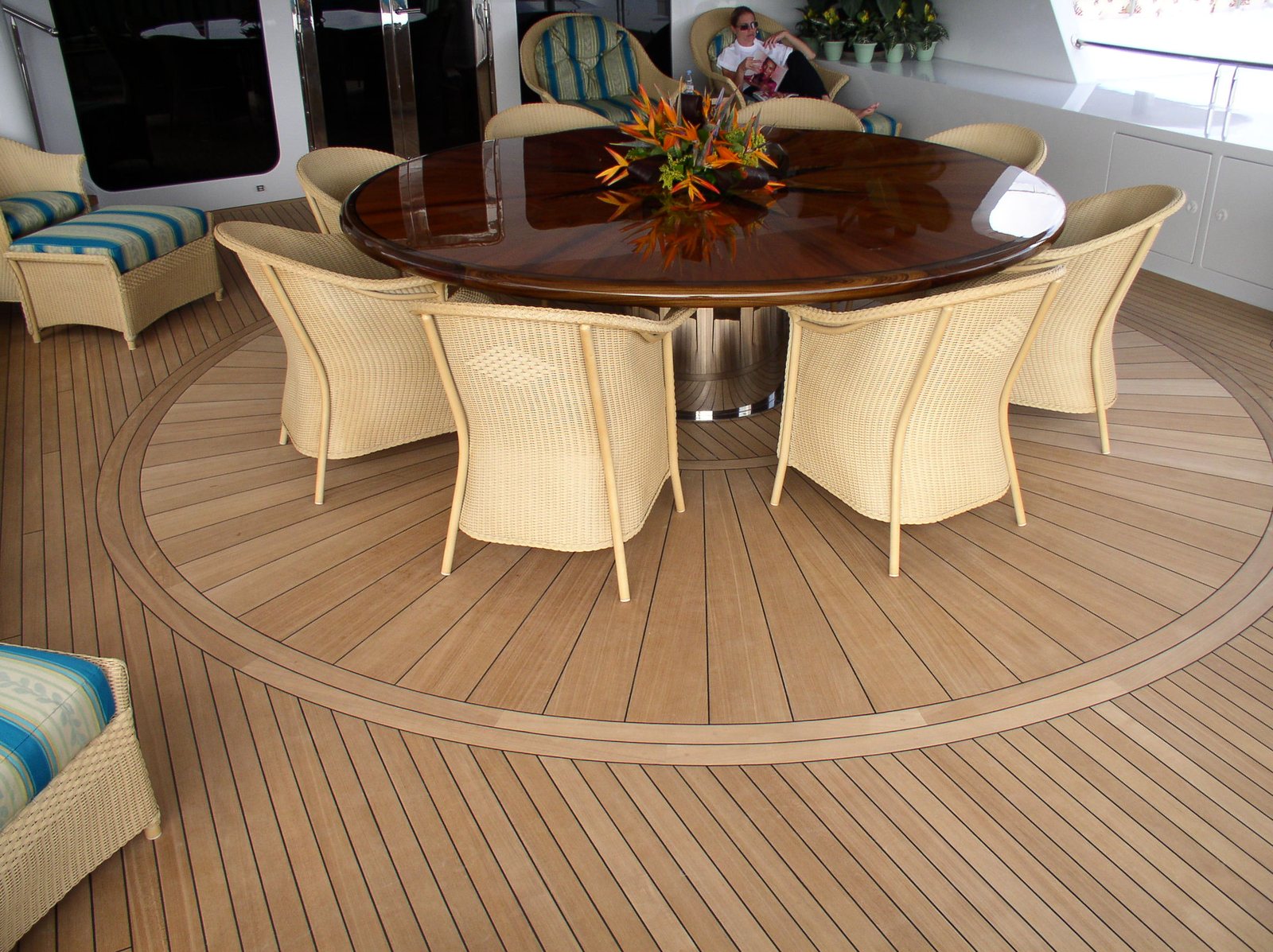
Vertical grain is a sawing call, not a species call and not a grade call, and on a deck it is the call that decides how the surface wears and how the seams behave. A quartersawn board carries its growth rings at roughly 60 to 90 degrees to the face. A plainsawn board carries them at 0 to 30 degrees. Rift stock sits between the two, cut radially off a quartered log, with the rings nearer 45 degrees. The face of a quartersawn board reads as tight parallel lines running the length of the piece. Plainsawn reads as arcs and cathedrals.
Teak is Tectona grandis. It is dense enough for foot traffic, high enough in natural oil to shed water, and about as dimensionally quiet as anything sold for exterior use. None of that makes a plainsawn teak strip behave like a quartersawn one. Ring angle is a separate variable, and on a horizontal wear surface it is the variable a client notices first. For the measured property set on the species, the figures published at The Wood Database are the reference rather than a number recalled from memory.
Buyers ask for quartersawn teak and get quoted teak. Those are two different orders. Nothing in the species name, nothing in the lumber grade and nothing printed on a packing list guarantees ring orientation unless somebody wrote it onto the order.
Why the Seam Fails Before the Board Does
A deck seam is a moving joint, and how far it has to move is set by how much the boards on either side of it change width. Wood moves far more tangentially than radially. Across the width of a plainsawn board, that movement is tangential. Across the width of a quartersawn board it is radial, which in most timbers runs near half the tangential figure. The shrinkage tables behind that comparison are published in the Wood Handbook from the USDA Forest Products Laboratory.
Put two strips of the same species and the same width side by side, one quartersawn and one plainsawn, and over a wet season they will open and close their shared seam by noticeably different amounts. On a caulked strip deck, the sealant bond at the seam edge takes that cycling. On an open gap deck, the gap width changes and the fasteners work. On a tight fit surface, swelling has nowhere to go and the strips press against each other.
Cupping is driven by installation and back ventilation, not by the species on the tag. What grain orientation changes is how much the installation detail has to absorb. A plainsawn section arrives with more differential movement built into it, so the same ventilation gap, the same fastener spacing and the same seam width have more work to do.
This is the whole argument for vertical grain on a deck, and it is a material argument rather than a visual one. The straight line figure is a side effect. The reason marine and high traffic decks have specified vertical grain teak for generations is that the seam stays where it was set.
Sawing Orientation and Deck Surface Behavior

Three orientations come off a log, and each one hands a deck a different surface and a different seam. The table below is the short version of what changes when the ring angle changes, with the species and the grade held constant.
| Orientation | Ring angle to the face | Movement across the width | Surface wear | Seam behavior |
|---|---|---|---|---|
| Quartersawn, vertical grain | Roughly 60 to 90 degrees | Radial, the lower of the two directions | Wears evenly across the exposed ring edges, resists shelling | Width cycles least, so a caulked or gapped seam holds its set |
| Rift | Nearer 45 degrees | Between radial and tangential | Even enough, straighter figure than plainsawn | Intermediate, acceptable where vertical grain yield runs short |
| Plainsawn, flat grain | Roughly 0 to 30 degrees | Tangential, the higher of the two directions | Softer earlywood erodes first, arcs can lift and shell | Width cycles most, so seams open and close through the season |
Shelling is the failure worth understanding before the order goes in. On a flat grain board the growth rings run nearly parallel to the wear surface, so traffic and weathering can lift a thin layer of earlywood away in sheets. Stand the rings up and traffic crosses them end on, which is why a vertical grain surface weathers to a uniform grey rather than a ribbed one.
Grade Rules Describe Yield, Not Ring Angle
Hardwood grading in North America sorts a board by the yield of clear face cuttings it will give up, and says nothing at all about whether the rings stand vertical. The rules come from the National Hardwood Lumber Association, and they are a yield measurement rather than an appearance ranking.
FAS is the top grade. It requires a minimum board of 6 inches wide by 8 ft long yielding 83 and 1/3 percent clear face cuttings. FAS One Face, written F1F, meets FAS on the better face. Selects meet FAS on the better face at a smaller minimum size. No. 1 Common requires 66 and 2/3 percent and a minimum board of 3 inches by 4 ft. No. 2A Common requires 50 percent.
Grade describes yield, not character. A No. 1 Common board is not a defective board. It yields smaller clear cuttings, which makes it the economical grade for short parts and the wrong grade for long clear runs. A deck strip is a long clear part, so the grade call and the orientation call both matter and they are answered separately.
Imported teak complicates this further, since much of it is sold on exporter trade descriptions rather than on the hardwood rules. A buyer will see terms that sound like grades and are actually market language. The practical response is to stop treating orientation as something a grade implies and write it onto the order as its own line, alongside thickness, width, length and moisture content.
Why Vertical Grain Teak Runs Narrow
Quartersawing is a low yield way to break down a log, and the widths that come off it are limited by geometry rather than by anybody's preference. Quarter the log, then saw radially, and the usable width of each board is bounded by the radius and by where the sawyer has to leave the pith and the sapwood behind. Wide vertical grain boards need large diameter logs, and large diameter logs are the part of the supply that is hardest to count on.
That constraint lines up with what a deck wants anyway. Narrow strips move less in absolute terms than wide ones, so a deck laid up in narrow vertical grain stock asks very little of each seam. The tradeoff is more seams and more linear footage of fastening, which is a labor question rather than a material one.
Thickness is quoted in quarters of an inch of rough thickness. 4/4 is nominal 1 inch rough, 8/4 is 2 inches, and 16/4 is 4 inches. Surfaced dimensions come off those rough numbers, so a 5/4 deck strip finishes well under 1 and 1/4 inches once it has been through a planer. Specify the finished thickness you need and let the rough thickness follow it.
J. Gibson McIlvain holds over seven million board feet of exotic and domestic lumber at its Maryland yard, which is what makes it possible to sort a vertical grain run out of teak already on the ground instead of placing an order and waiting on a mill to cut one. Depth of inventory is the only real answer to an orientation request, because orientation cannot be added to a board after the fact.
"Somebody calls and says teak decking, and my next question is always whether they need the rings standing up. If the answer is yes, we are sorting for it in the pack before anything gets pulled, and I would rather have that conversation at the quote than after a truck has already gone out."
Norm Moton, Director of Sales, J. Gibson McIlvain
Moisture Content a Deck Can Live With
Exterior work runs near 12 to 16 percent moisture content, and a deck built out of interior dry stock will spend its first year fighting its own seams. Interior millwork is milled to an in service moisture content near 6 to 8 percent. A deck is not interior millwork, and the target moves accordingly.
Deliver strips at 7 percent into a humid summer and they take on water, swell across the width and close whatever gap was set at layup. A caulked seam gets compressed. An open gap deck loses its drainage. Deliver strips too wet and the reverse happens, with gaps widening as the surface dries down toward its service condition.
Air dried stock settles near the local equilibrium moisture content and is not a substitute for kiln dried material where an interior tolerance matters. On an exterior deck the distinction is less severe, since the target range is close to where air dried stock lands in many regions, but the number still has to be known rather than assumed. Ask for it. Write it on the purchase order.
Movement does not stop after installation, and the assembly either lets the back of the board dry at the same rate as the face or it does not. The building enclosure reasoning behind that is laid out well by Building Science Corporation, and it applies to a deck surface as squarely as it applies to a wall.
Teak Oils and Anything Bonded to the Surface
The oil content that makes teak last outdoors is the same oil content that makes anything bonded to teak demand a freshly machined surface. Extractives migrate to a cut face over time and interfere with adhesion, so a seam sealant or any glued assembly wants wood that was machined recently rather than wood that has been sitting in a pack with a weathered face.
The tropical decking species sit at the far end of this problem. Ipe, which is Tabebuia spp, along with Cumaru, Garapa, Jatoba and Red Balau, are extremely hard and carry high oil content, which makes them difficult to glue. They are legitimate decking stock and they are not the palette a millwork shop reaches for when parts have to be milled, glued or machined. For that work the palette is Sapele, Iroko, Afrormosia, Teak and Utile, the last of which is sold as Sipo.
Finish behaves the same way. Open-grained and oily species absorb a great deal of finish, so the first coats on a teak deck largely disappear into the wood and the visible film does not start building until later. Buyers who budget coating by coverage rate on a closed grain species are routinely short on a teak job.
Clear Vertical Grain Cedar and the Same Question
Vertical grain is not a teak idea, and in cedar the same question arrives as a grade call rather than a species call. CVG, clear vertical grain, is the radial orientation argument applied to a domestic softwood. STK, select tight knot, is a different product with sound, tight knots and a different look.
Neither one is the lesser choice. Cedar is a legitimate default for exterior work, and the grade call matters more than the species call. A buyer who specifies cedar without specifying CVG or STK has left the most consequential part of the order open. Grade definitions and profile standards for this material come out of the Wood Moulding and Millwork Producers Association, and the species properties are set out at The Wood Database.
Cedar is softer underfoot than teak and wears differently, so the two are not interchangeable on a high traffic surface. The point is narrower than that. If vertical grain is what the seam detail needs, there is more than one species that can supply it, and the way you ask for it changes depending on which one you are buying.
Where Modified Decking Changes the Warranty Question
Warranties exist on modified products and on nothing else. It is not possible to warranty solid unmodified wood, an organic material responding to its environment. Quartersawn teak is remarkably stable and it still carries no warranty, and any supplier offering one on solid unmodified stock is describing something the material cannot deliver.
J. Gibson McIlvain stocks both Thermory and Abodo Vulcan for buyers who want that coverage behind an exterior surface. Thermal modification changes the wood chemistry so the board takes on far less water, and the result is a product a manufacturer will stand behind in writing.
Know the size limits before a layout gets drawn around them. Modified products top out around 16 ft, and most are sold on metric lengths just under 16 ft, because of kiln size. Thermally modified Ash is not available wider than 8 inches, so a wide board in a modified product means Accoya or Abodo Vulcan. Accoya runs roughly 1,600 lbf on the Janka scale, and acetylation gives it dramatically reduced shrinkage and swelling.
When Vertical Grain Teak Will Not Cover the Run
Teak supply is finite, and the right second answer is another species in the same millwork palette rather than a plainsawn substitution in teak. J. Gibson McIlvain carries Iroko, Afrormosia and Utile alongside Teak, and all three will supply a straight grained exterior part where a teak pack cannot fill the length or the width.
Iroko is the closest working match for exterior exposure. Afrormosia machines cleanly and holds an edge well. Utile, sold as Sipo, covers the wider and longer parts in the group. Where the surrounding work is painted exterior trim rather than a wear surface, Sapele is the better call than Genuine Mahogany, since it holds paint better and comes in a wider range of sizes and longer lengths. Sapele is not milled 1x8 for exterior use.
Sapele runs roughly 1,410 lbf on the Janka scale against roughly 800 lbf for Genuine Mahogany. Among the domestic species that come up in the same conversation, White Oak runs roughly 1,360 lbf, Hard Maple roughly 1,450 lbf, White Ash roughly 1,320 lbf, Red Oak roughly 1,290 lbf, Black Walnut roughly 1,010 lbf, Cherry roughly 950 lbf and Yellow Poplar roughly 540 lbf. Hardness is one input on a deck and it is not the controlling one, since orientation and moisture content decide what the seam does.
Exterior millwork for the structures that frame a deck comes out of ICD, the company's architectural millwork division, which builds true custom work planned around a specific space.
How J. Gibson McIlvain Would Specify This
A vertical grain teak deck order is five lines, and leaving any one of them off is how a deck ends up plainsawn. Name the species. Name the orientation as quartersawn or rift, with an acceptable ring angle range. Name the rough thickness in quarters and the finished thickness you need off it. Name the strip width and the shortest acceptable length. Name the moisture content range, which on exterior work means 12 to 16 percent.
J. Gibson McIlvain imports and mills as an FSC certified operation, so the sourcing documentation on a teak order travels with the material instead of being reconstructed after delivery. Specifications written against a certification standard are checkable against the paperwork, and the standard itself is published by the Forest Stewardship Council.
J. Gibson McIlvain rips decking stock to a consistent width on straight line and gang rip saws, and resaws thicker material on band resaws, which is how a run of narrow vertical grain strips comes off one order with a matched width rather than out of three separate purchases. The millwork services available at the yard cover the rough mill work that turns a sorted pack into usable deck stock.
One boundary matters here. J. Gibson McIlvain supplies and mills lumber. It does not install, coordinate installation or field measure, so seam layout, fastening, flashing and back ventilation belong to the deck contractor, and the order should be written to hand that contractor material at the right moisture content and the right orientation. J. Gibson McIlvain ships nationwide, and a conversation about what is actually in the pack is the fastest way to find out whether a vertical grain run exists in the length you need. Call 800-638-9100 before the layout is finalized rather than after.
Frequently Asked Questions
What does quartersawn or vertical grain actually mean on a teak deck board?
It describes the angle of the growth rings relative to the face of the board. Quartersawn stock carries the rings at roughly 60 to 90 degrees to the face, so the wear surface shows tight parallel lines rather than the arcs and cathedrals you see on plainsawn material. Rift stock sits nearer 45 degrees and plainsawn runs 0 to 30 degrees. The term is a sawing description, not a quality claim, and two boards of identical species and identical grade can be sawn either way.
Does a top hardwood grade like FAS guarantee vertical grain?
No. Hardwood grade rules measure the yield of clear face cuttings a board will give up and describe nothing about ring orientation. FAS requires a minimum board of 6 inches wide by 8 ft long yielding 83 and 1/3 percent clear face cuttings, and a plainsawn board can meet that as easily as a quartersawn one. Orientation has to appear on the order as its own separate line.
Why is vertical grain teak only sold in narrow widths?
Geometry. Quartering a log and then sawing radially bounds the usable width of each board by the log radius, minus whatever has to be left behind at the pith and the sapwood. Wide vertical grain boards require large diameter logs, which are the scarcest part of the supply. For a deck this is less of a limitation than it sounds, since narrow strips move less in absolute terms and ask less of each seam.
What moisture content should teak decking arrive at?
Exterior work runs near 12 to 16 percent, not the 6 to 8 percent used for interior millwork. Strips delivered at an interior moisture content will take on water through the first humid season, swell across the width and close the gap that was set at layup. Air dried stock settles near the local equilibrium moisture content, which in many regions is close to the exterior range, but the figure should be stated on the purchase order rather than assumed.
Is there a warranty on quartersawn teak decking?
No. Warranties exist on modified products and on nothing else, because it is not possible to warranty solid unmodified wood, an organic material responding to its environment. Teak is exceptionally stable and it is still solid wood. Buyers who need written coverage behind an exterior surface are looking at thermally modified or acetylated products instead, and J. Gibson McIlvain stocks Thermory and Abodo Vulcan for that.
If a modified product is the answer, what size limits apply?
Modified products top out around 16 ft, and most are sold on metric lengths just under 16 ft, because of kiln size. Thermally modified Ash is not available wider than 8 inches, so a wide board in a modified product means Accoya or Abodo Vulcan. Accoya runs roughly 1,600 lbf on the Janka scale, with acetylation giving dramatically reduced shrinkage and swelling.
What else will supply straight grain for exterior work if teak runs short?
Iroko, Afrormosia and Utile, which is sold as Sipo, all sit in the same millwork palette as Teak and all will supply a straight grained exterior part. Iroko is the closest working match for exposure. For painted exterior trim around the deck rather than the wear surface itself, Sapele is the better call than Genuine Mahogany, since it holds paint better and comes in a wider range of sizes and longer lengths, though Sapele is not milled 1x8 for exterior use.
Who handles the seam layout and the fastening?
The deck contractor. J. Gibson McIlvain supplies and mills lumber and does not install, coordinate installation or field measure. Seam width, fastener spacing, flashing and back ventilation are field decisions, and cupping is driven by installation and back ventilation rather than by the species on the tag. What the lumber order controls is the orientation, the width, the length and the moisture content the installer starts from.