Paint Grade and Stain Grade Are Milling Instructions
Paint grade and stain grade are not decisions the painter makes at the end of a job, they are milling instructions that change species, sawing orientation, jointing, moisture target and what happens to the surface before the trim ever ships. Two chair rail runs can come off the same knife, measure identically and carry the same profile number, and still be built from different material for different reasons.
The confusion starts with the word grade. In the hardwood trade, grade means a lumber grade under the National Hardwood Lumber Association rules, which sort boards by the amount of clear cutting area they yield. Paint grade and stain grade are a separate language. They describe how the finished surface will be viewed, and therefore what the mill is allowed to hide and what it has to preserve.
Paint grade does not mean cheap material. It means the surface will be opaque, so color variation, sapwood, mineral streak and glue lines stop mattering, while dimensional stability, tight pores and a surface that holds a coating start mattering a great deal. Stain grade flips that. Color, figure and grain continuity become the specification, and the shop loses every tool it had for splicing and substituting.
A residential interior trim package usually contains both. Painted base and casing with a stained handrail. Painted crown with a stained chair rail in a dining room. That mix is normal, and it is the reason the grade call belongs on the order rather than in a conversation on site three weeks later.
Species Choices Split Right at the Order
The millwork species palette that J. Gibson McIlvain mills for interior trim runs to Sapele, Iroko, Afrormosia, Teak and Utile, and the grade call decides which of those makes sense against a domestic paint grade option. Those five machine cleanly, hold a moulded edge and glue predictably, which is exactly what a profile with a crisp arris needs.
For stain grade interior work, Sapele and Utile give a consistent ribbon or interlocked figure that reads well on a chair rail at eye level. Sapele sits around 1,410 lbf on the Janka scale, which matters on base and chair rail that take chair backs and vacuum cleaners. Afrormosia and Iroko run drier and more golden and take an oil finish without blotching. Teak gets specified where the trim has to tie to teak joinery elsewhere in the house.
Domestic stain grade choices behave differently under pigment. White Oak at roughly 1,360 lbf has open pores that drink stain and read strongly. Hard Maple at roughly 1,450 lbf is closed and dense and will blotch without a conditioner or a dye. Cherry at roughly 950 lbf darkens on its own for years after installation, so a sample approved in March is not the color the room will hold in five years. Genuine Mahogany, at roughly 800 lbf, is soft enough that a crisp bead on a heavily used base will show dents.
Paint grade interior trim is a different shopping list altogether. Straight-grained, low-figure, dimensionally quiet stock with tight pores. Poplar and soft Maple do that job well, since nobody will ever see the grain, and the budget that would have gone into figure goes into stability and into the coating instead.
Tropical decking species are not the answer here. Ipe, botanically Tabebuia spp, along with Cumaru, Garapa, Jatoba and Red Balau, are extremely hard and carry high oil content, which makes them difficult to glue and hard on knives. They belong on a deck. For milled, glued and machined trim components a millwork house reaches for Sapele, Iroko, Afrormosia, Teak or Utile instead.
How the Board Was Sawn Shows Up Under Paint
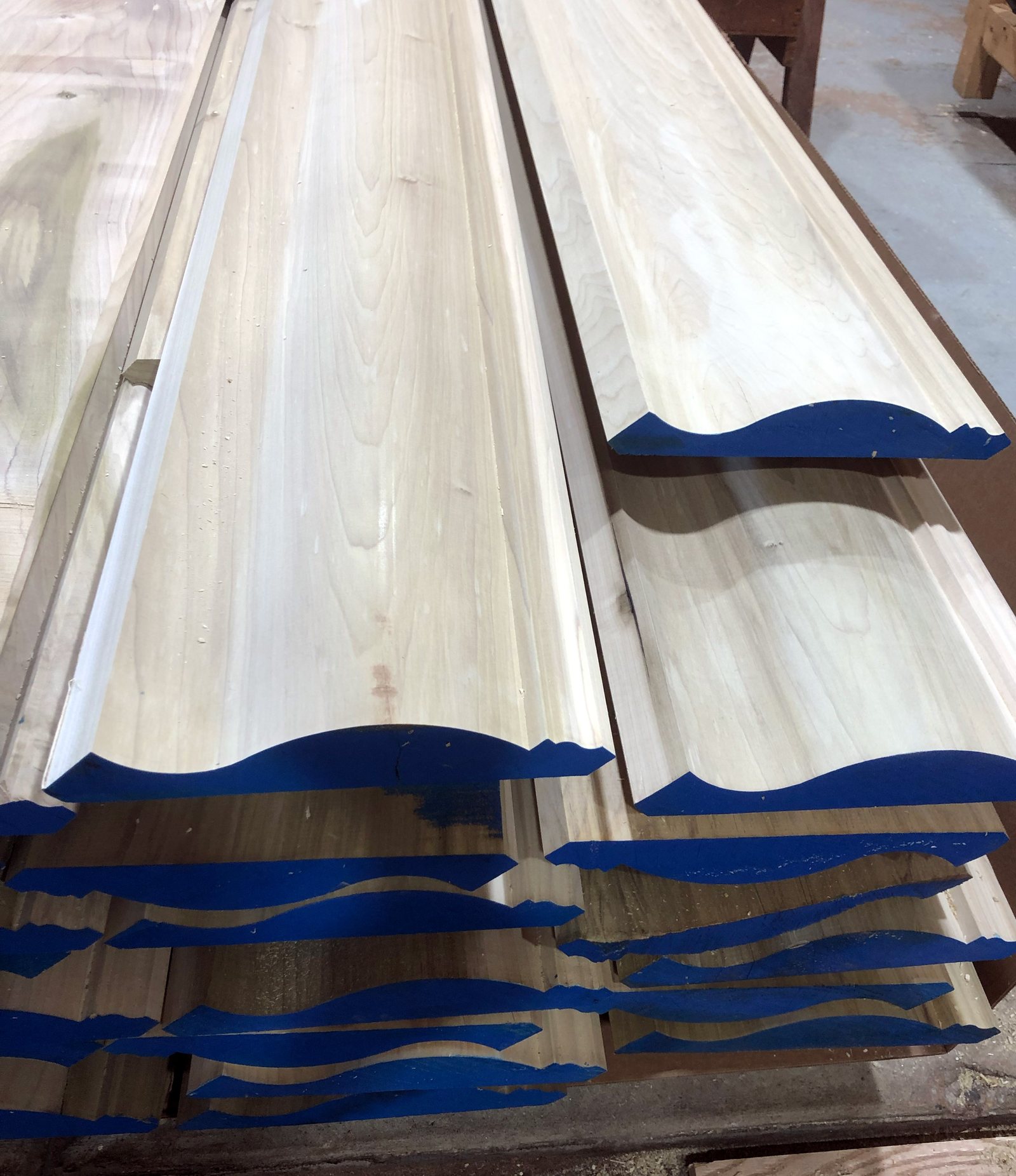
Quartersawn and rift stock moves less across its width than plainsawn, which is why it gets specified anywhere a painted or panelized surface has to stay flat. Paint is a thin, unforgiving film. It cracks at a joint that opens and it telegraphs a cupped face, because the sheen breaks across the curve and the eye reads that break before it reads the profile.
On wide paint grade parts, a flat stile, a panel mould, a deep base, the sawing call does more for the finished look than the primer does. Plainsawn stock in a 5 inch or 7 inch width has more tangential movement to give, and it gives it seasonally in a heated house. The Architectural Woodwork Institute standards treat flatness and the allowable variation in a painted surface as measurable criteria rather than as a matter of taste, which is the right way to think about it.
Stain grade uses orientation for appearance as much as for stability. Quartersawn White Oak shows ray fleck. Quartersawn Sapele gives the tight, even ribbon that people are usually picturing when they ask for Sapele by name. Plainsawn gives cathedral figure, which looks right on a wide panel and busy on a 3 inch chair rail.
Color and Figure Matching Only Applies to One Side
Stain grade is where lot matching becomes the actual work, and J. Gibson McIlvain holds over seven million board feet of exotic and domestic lumber at its Maryland yard so a run can be pulled from consistent material rather than assembled from whatever arrived that month. A chair rail that wraps four walls of a dining room is read as one object. Two boards from two different lots, one pinker and one browner, will be visible across that room for the life of the house.
Matching is not only color. Pore size, figure direction and the presence of sapwood all have to agree along a run, and they have to agree between the chair rail, the casing and the plinth if those parts are meant to look like a set. A shop working from thin inventory solves this by shortening the runs and adding joints, which quietly moves the problem to the installer.
Paint grade gets none of that scrutiny, and that is the honest difference between the two orders. Mineral streak, a sapwood band, a color mismatch between two sticks in the same bundle, all invisible under two coats. Paint grade material can therefore be selected almost entirely for how it behaves rather than for how it looks.
Moisture Targets Follow Location, Not Grade
Interior millwork is milled to an in-service moisture content near 6 to 8 percent and exterior work near 12 to 16 percent, and that target does not change because a part is going to be painted. The Forest Products Laboratory Wood Handbook is the reference the whole trade works from on equilibrium moisture content, and it has nothing to say about the topcoat.
Where grade does change things is in how a failure presents itself. Stain grade trim milled wet shrinks and opens a visible gap at a mitre, ugly but honest. Painted trim milled wet cracks the paint film at that same joint, and the crack runs, because the film is continuous across a joint that is not.
Cupping on exterior trim is driven by installation and back ventilation, not by species. A board that cannot dry from both faces will cup whether it is Sapele, Cedar or a modified product, and no primer schedule rescues an assembly with no air behind it. The building enclosure work on rain control and drying is worth reading before anyone blames the lumber.
Jointing and Glue-Up Change Completely Between Grades
Paint grade allows finger-jointed and edge-glued stock because the joint disappears under primer, while stain grade forces one-piece material or a glue-up matched for grain and color, and that is the single largest practical difference in how a run gets built. Long painted runs are routinely made from finger-jointed blanks that stay straighter than one long board would.
Wide paint grade parts get edge-glued to reach width. Wide stain grade parts get edge-glued too, but the shop has to sequence the boards so the joint reads as figure rather than as a line, and it has to keep the glue line tight enough that stain does not pool along it and darken.
Box beams make the grade call concrete, because the joinery choice is visible in the room. Butt joints give the most minimal profile, the fastest turnaround and the easiest on-site assembly, but they leave visible seams and visible end grain and they are the weakest of the three. Dado joints are strong and still easy to assemble on site, and they still show seams and end grain. Lock miter joints show no visible seams and are the strongest.
For a painted box beam, butt or dado joinery is defensible, since the installer fills and sands the seam and the paint closes it out. For a stained beam in Sapele or Utile, lock miter is the only one of the three that holds up, because end grain takes stain several shades darker than face grain and a seam becomes a stripe running the length of the ceiling.
Profile Detail Behaves Differently Under Paint and Stain
A profile ground for paint grade wants slightly more relief than the same profile in stain grade, because every coat of primer and paint softens an arris while a penetrating stain leaves the geometry exactly where the knife left it. Three coats of anything will round a fine quirk. A 1/16 inch bead can go nearly flat.
J. Gibson McIlvain grinds new moulding knives every week and works from a profile library holding thousands of ground profiles, so an existing chair rail, base or casing profile gets repeated rather than approximated, and a profile that is not already in the library gets ground to match, including difficult historical restoration profiles and contemporary shapes. That is the mechanism behind matching an original 1920s chair rail in a room where only one wall is being rebuilt. Standard WM series profiles are a starting vocabulary, not a limit.
Radius work raises the stakes on both sides. ICD, the architectural millwork division of J. Gibson McIlvain, builds radius trimwork and radius millwork for curved walls and elliptical openings, and the laminated segments behind a curved chair rail read very differently depending on grade. Under paint the lamination lines vanish. Under a clear or stained finish they have to be matched lamination to lamination, which is a different build and a different lead time.
| Mill decision | Paint grade | Stain grade |
|---|---|---|
| Species selection | Straight-grained, low-figure, stable stock. Poplar and soft Maple for interior, Sapele or CVG Cedar for painted exterior | Sapele, Iroko, Afrormosia, Teak or Utile, or White Oak, Hard Maple and Cherry where a domestic look is wanted |
| Sawing orientation | Quartersawn or rift on wide parts to keep the film flat | Chosen for figure as well as stability, ribbon or cathedral by design |
| Color and figure matching | Not required. Mineral streak and sapwood acceptable | Matched along the run and across casing, chair rail and plinth |
| Reaching length and width | Finger-jointed and edge-glued blanks acceptable | One piece wherever the run allows, glue-ups sequenced for grain continuity |
| Box beam joinery | Butt or dado, seams filled by the installer | Lock miter, no visible seams and no exposed end grain |
| Profile relief | Slightly deeper quirks and beads to survive the coating build | Ground as drawn, geometry stays where the knife left it |
| Finishing at the mill | Primed in one of three levels, oil-based or water-based, sanded after priming | Ships unfinished for site or shop staining |
| Moisture target | Near 6 to 8 percent for interior work, near 12 to 16 percent for exterior, regardless of grade | |
Priming Is Where Paint Grade Gets Its Advantage
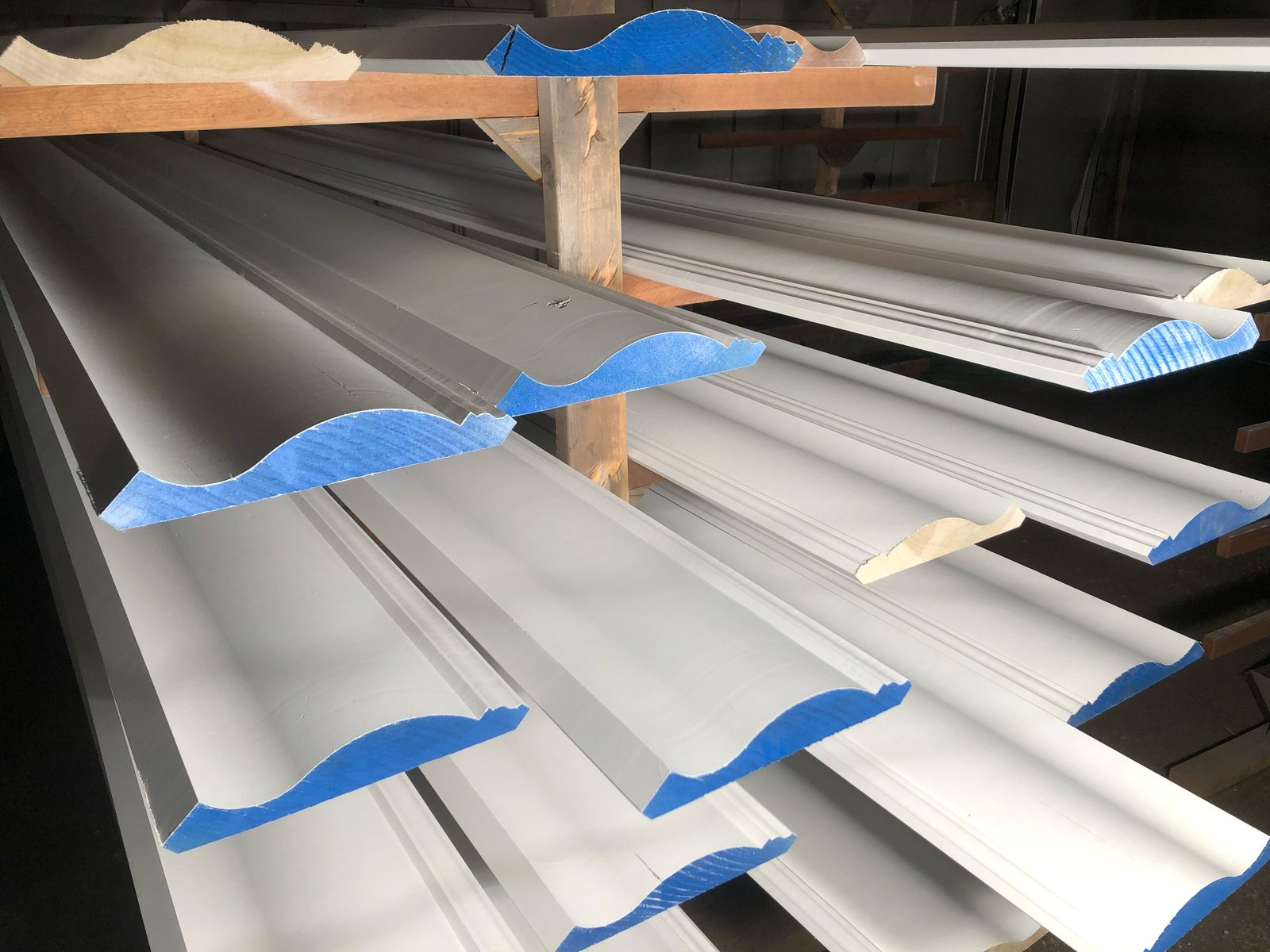
J. Gibson McIlvain primes wood in three levels, in both oil-based and water-based systems, and exterior primed trim carries a fungicide additive, which is work that simply does not exist on the stain grade side of the same order. Priming at the mill is not a convenience item. It is the step that decides whether the painted surface looks like millwork or like coated lumber.
Open-grained and oily species absorb a great deal of finish, so a primer coat evens out the eventual painted surface. Without it the topcoat sinks unevenly into pores and ray tissue and the sheen goes patchy along a run. Sanding or buffing after priming knocks back grain raising while keeping moulded detail crisp, which is the difference between a bead you can still see and a bead that has been buried.
All six faces matter on painted trim. A primed face with a raw back is a one-way moisture path, and on exterior trim that is how a coating fails from behind while the front still looks fine. J. Gibson McIlvain ships primed trim packages nationwide, California included, which is worth knowing for a job where priming on site means priming in a driveway in February.
For painted exterior trim, Sapele is the better call than Genuine Mahogany. It holds paint better and it comes in a wider range of sizes and longer lengths. Sapele is not milled 1x8 for exterior use, since that width is too wide to stay stable in that application. Cedar remains a legitimate default for painted exterior trim and cladding, with CVG, clear vertical grain, where a smooth painted face is wanted, and STK, select tight knot, where knots are part of the intended look.
Modified products carry real limits that belong on the order. Accoya, at roughly 1,600 lbf, gets dramatically reduced shrinkage and swelling from acetylation, which is why it holds paint so well. Thermory and Abodo Vulcan are both carried as well. All of these modified woods top out around 16 ft, most sold on metric lengths just under 16 ft, because of kiln size. Thermally modified Ash is not available wider than 8 inches, so a wide board in a modified product means Accoya or Abodo Vulcan. Warranties exist only on modified products. There is no warranty on solid unmodified wood, an organic material responding to its environment.
Chair Rail, Base and Casing as a Coordinated Set
The grade call has to be made profile by profile and then checked across the whole room, because a painted base under a stained chair rail is a deliberate detail while a painted base under a stained casing on the same wall is usually an accident. Residential interior trim is read as an assembly. The eye picks up the transitions before it picks up the profiles.
Mixed-grade rooms work when the break follows a logic. Stained handrail and chair rail with painted base, casing and crown is a common and durable scheme, since the stained elements are the ones hands touch. Stained casing with painted base asks the installer to resolve two finishes at the plinth, and it only reads as intentional when the plinth is part of the design.
Blocking, plinths and returns get ordered in the same grade as the part they serve. A stain grade chair rail returning into a painted panel mould leaves an end grain return that will never match, and end grain is where stain goes darkest. Those details get drawn before the knives run, not after the trim is on the wall.
"The grade call is the first question we ask, before species and before profile, because it changes what we are allowed to substitute. On a painted run we can reach a length with a finger joint and nobody will ever know. On a stained run that same joint is a defect, so we pull from one lot and we build the run longer."
Norm Moton, Director of Sales, J. Gibson McIlvain
Where the Custom Work Comes In
Linear trimwork, finished cladding and primed trim come off the J. Gibson McIlvain millwork shop on site at the lumber yard, while true custom work planned around a specific space comes from ICD, and a mixed-grade house usually needs both. A chair rail run is a linear order. A curved chair rail on a radius wall, a custom door, a built-in bench or a set of kitchen cabinets is a designed assembly.
ICD builds custom doors, custom cabinets, radius millwork, shutters, benches, railings, box beams and gates to a specific opening rather than to a module. Kitchen cabinetry gets engineered around how the space is actually used, which is what avoids the filler strips and mismatched face frames that come with standard modules, and it accounts for plumbing and mechanical obstacles and for the countertop material being carried.
Shutters show grade driving the build as clearly as anything. ICD makes wood shutters in louver and panel styles, including complete historical matching for both style and species, which matters where a historic district requires like-for-like replacement under the kind of criteria the National Park Service treatment standards describe. A painted louver shutter and a stained one are different builds, because paint bridges the louver pins and stain does not hide a single unmatched blade.
The installer inherits whatever the grade call left behind. On paint grade work that means cutting, fitting, fastening, filling the nail holes and seams, a final sanding and the topcoat. On stain grade work it means fitting scarf joints so the figure runs through, and staining a run that has no filler anywhere to hide a sloppy cut. Getting the grade right on the order is what keeps that scope from expanding.
How J. Gibson McIlvain Would Specify This
J. Gibson McIlvain would ask for the grade call profile by profile on the schedule, then mill each group to the target that grade requires rather than running the whole package the same way. Write it as two columns on the moulding list. Paint grade or stain grade, next to every profile number.
For paint grade interior runs the specification reads straight-grained low-figure stock, quartersawn or rift on any part over about 4 inches wide, milled to an in-service moisture content near 6 to 8 percent, finger-jointed blanks permitted for length, profile relief set slightly deeper to survive the coating build, and primed in the level the painter is prepared to work over, with a sanding pass after priming.
For stain grade runs that same list changes to a named species from the Sapele, Iroko, Afrormosia, Teak and Utile palette or a domestic equivalent, material pulled from a single lot with color and figure matched across chair rail, casing and plinth, one-piece lengths wherever the run allows, lock miter joinery on any box beam, and no finish applied at the mill.
For painted exterior trim the specification is Sapele rather than Genuine Mahogany, or CVG Cedar, milled near 12 to 16 percent, primed on all six faces in an exterior system with the fungicide additive, with modified products held to 16 ft and to the width limits of the product chosen. Back ventilation gets detailed by the installer, since that, not species, decides whether a board cups.
Send the drawing, a photo or a return sample of any existing profile that has to be matched, along with the room-by-room grade split. To start a millwork order or get a profile matched, see the J. Gibson McIlvain millwork services page, review the ICD trim profile work for custom and radius trim, or call 800-638-9100.
Frequently Asked Questions
Does paint grade mean I am getting lower quality lumber?
No. Paint grade changes which qualities are being paid for, not how much quality is in the order. An opaque finish makes color, figure, mineral streak and sapwood irrelevant, so selection shifts entirely to how the wood behaves. Paint grade stock is chosen for straight grain, low figure, tight pores and dimensional stability, and wide parts are specified quartersawn or rift because those move less across the width than plainsawn. A painted panel mould made from quiet, stable stock is a better part than the same mould cut from a beautifully figured board that cups in January.
Can finger-jointed stock be used on a stain grade run?
Not honestly. A finger joint is invisible under primer and paint, which is why it is standard on long painted runs, and it often produces a straighter part than a single long board. Under stain the joint shows, because end grain in the fingers absorbs pigment differently than the surrounding face grain. Stain grade runs should come from one-piece lengths wherever the run allows, and where a glue-up is unavoidable the boards have to be sequenced so grain and color carry through the joint.
Which species does J. Gibson McIlvain recommend for painted exterior trim?
Sapele ahead of Genuine Mahogany. It holds paint better and comes in a wider range of sizes and longer lengths, which matters on a long run of exterior casing or a water table. One limit to note, Sapele is not milled 1x8 for exterior use, since that width is too wide to stay stable in that application. Cedar is also a legitimate default, with CVG, clear vertical grain, where a smooth painted face is wanted, and STK, select tight knot, where the knots are part of the look. Where a modified product is specified, Accoya at roughly 1,600 lbf is the paint-holding benchmark, and modified woods top out around 16 ft because of kiln size.
Will a stain grade version of the same profile need a different knife than the painted version?
Often yes, and the difference is relief. Primer and topcoat build thickness in the corners of a profile, so a fine quirk or a 1/16 inch bead that reads beautifully in stained Sapele can go nearly flat after three coats of paint. Grinding a paint grade profile with slightly deeper relief keeps the shadow line alive under the film. J. Gibson McIlvain grinds new knives every week and works from a profile library holding thousands of ground profiles, so a paint grade and a stain grade variant of the same shape can both be kept on record.
Does the moisture content spec change if the trim is being painted?
No. Interior millwork is milled to an in-service moisture content near 6 to 8 percent and exterior work near 12 to 16 percent regardless of finish. What changes is how a moisture mistake shows up. Stain grade trim that was milled wet shrinks and opens a gap at a mitre. Painted trim that was milled wet cracks the paint film across the joint and the crack travels, because the coating is continuous where the wood is not.
How should a mixed paint and stain room be written on the moulding schedule?
Add a grade column and fill it in for every profile number, including blocking, plinths and returns. The most common failure is not a wrong species, it is a stain grade chair rail returning into a painted panel mould, which leaves an exposed end grain return that will never match, since end grain takes stain darkest. Mark the break where it is intentional, such as stained handrail and chair rail with painted base, casing and crown, and confirm that casing and base are not split across grades on the same wall unless the plinth is designed to resolve it.
What about curved chair rail on a radius wall, does grade matter there?
More than on a straight run. Radius trimwork and radius millwork are built from laminated segments, and under paint those lamination lines disappear entirely. Under a clear or stained finish every lamination has to be matched for color and figure, which is a different build with a longer lead time. ICD, the architectural millwork division of J. Gibson McIlvain, builds radius trim to the actual arc of the wall, so the grade call should be made before the segments are laid up rather than after.
Sources and Standards Referenced
- Wood Handbook: Wood as an Engineering Material (FPL-GTR-282), USDA Forest Products Laboratory
- National Hardwood Lumber Association
- Architectural Woodwork Institute
- Wood Moulding and Millwork Producers Association
- BSD-013: Rain Control in Buildings, Building Science Corporation
- Sapele, The Wood Database
- Accoya Acetylated Wood
- Technical Preservation Services Standards, National Park Service