The short answer on what gives out first
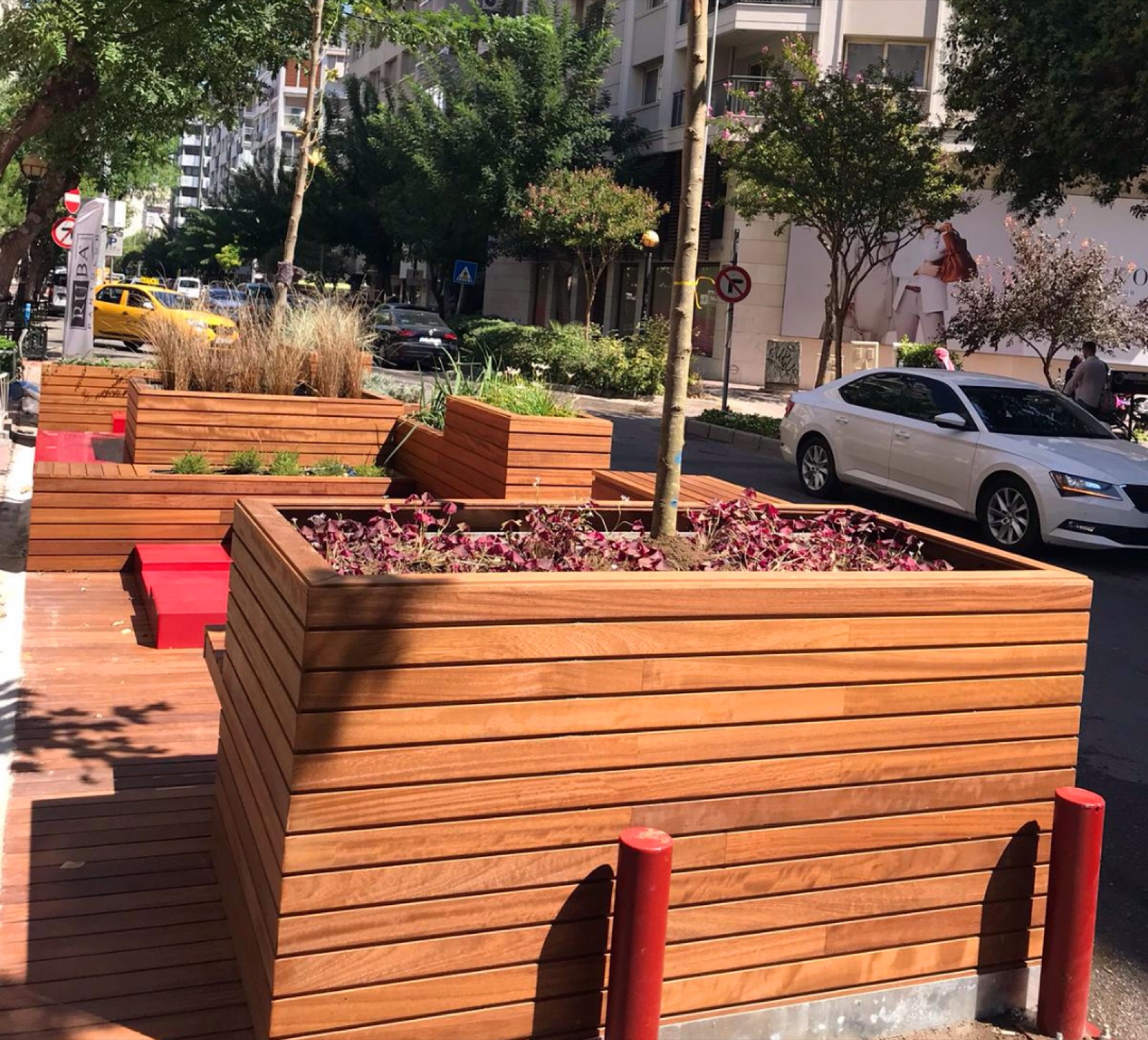
In an outdoor kitchen built from modified wood, the carcass almost always fails before the door fronts do, because the box absorbs every condition the doors are protected from. Door fronts get the attention. They get the species selection, the frame and panel construction that lets wood move, the finish schedule, and the yearly maintenance the owner actually performs, because the fronts are the part anyone looks at. The box behind them gets none of that. It sits tight against masonry or a steel frame, it catches the water that runs off the counter, it holds still air, and in most builds it is finished on exactly one face. Five years later the doors look tired and the box is delaminating at the bottom rail of the opening.
That is not a species failure. It is a construction and detailing failure, and it is fixable at the shop drawing stage. ICD, the architectural millwork division of J. Gibson McIlvain, builds outdoor cabinetry as two separate engineering problems rather than one, because the box and the fronts are living in different environments even though they are bolted together.
The carcass is doing three jobs at once
An outdoor kitchen carcass is simultaneously a structural frame, a water management detail and a ventilation path, and most shop drawings only solve the first one. Structurally it has to carry a stone, concrete or stainless countertop, the appliance cutouts punched through it, and the door and drawer hardware hanging off its sides. That part is straightforward. The other two jobs are where boxes die.
Water reaches the carcass from four directions. It runs off the countertop edge and down the face frame. It blows in sideways through the door reveals during a storm. It comes up off the slab or the patio as splash, which is the most damaging of the four because it loads the bottom rail and the base end grain over and over. And it condenses on the inside of the box on a cool morning after a warm night, which nobody accounts for because nobody sees it.
Ventilation is the quiet one. A wood box set inside a masonry surround with no air gap at the back has no way to dry. The Wood Handbook from the USDA Forest Products Laboratory is blunt about the relationship between sustained high moisture content and decay, and the threshold is not exotic. Keep wood wet long enough and it will rot regardless of what the label on the lumber says. The full reference is worth keeping on the desk, at Wood as an Engineering Material. Rain control thinking from the building enclosure world applies directly here, and the drain and dry logic set out by Building Science Corporation is the same logic a cabinet box needs at a much smaller scale.
One-side finishing is the most common single cause of a cupped outdoor carcass
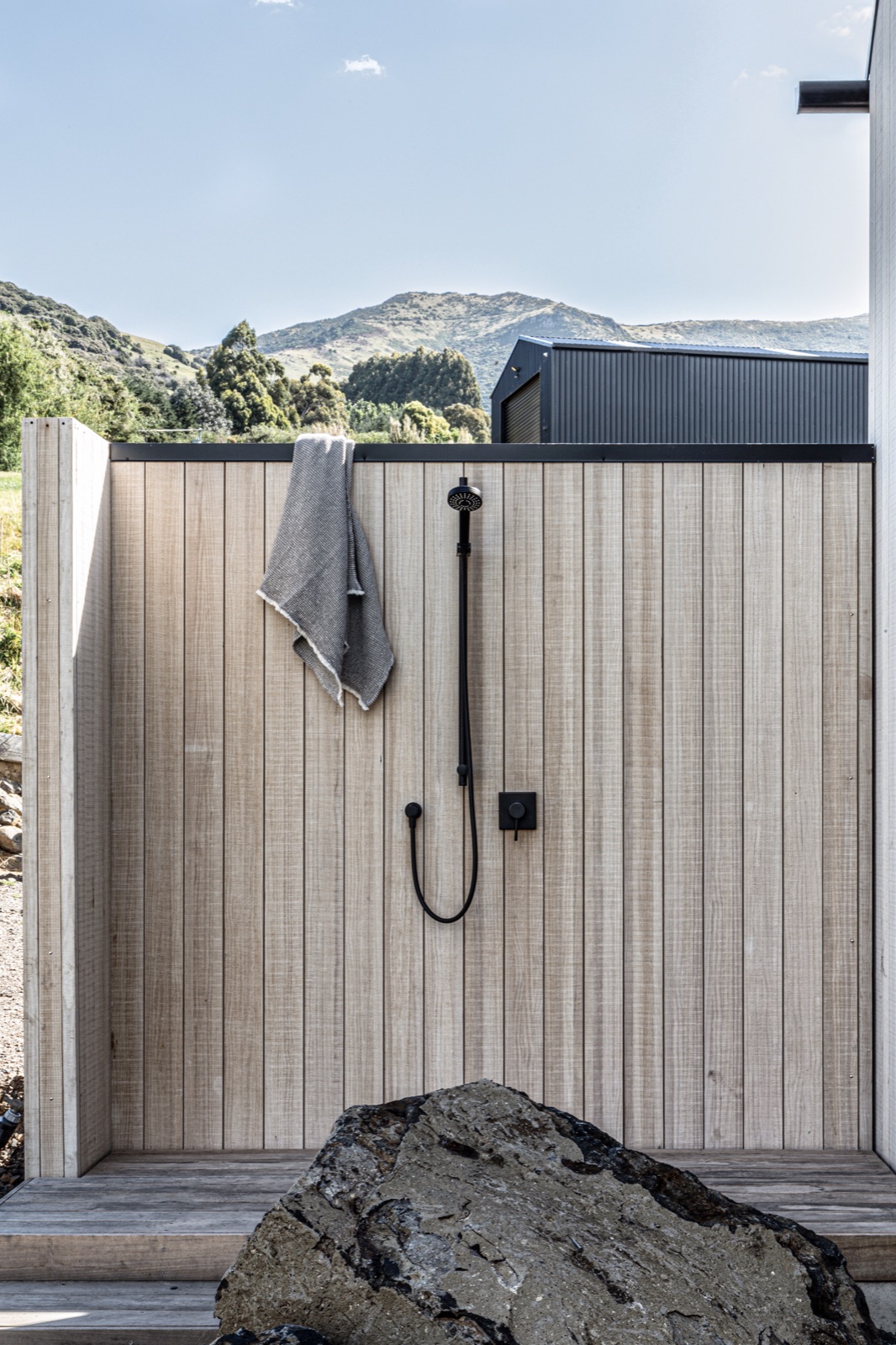
A panel coated on its show face and left bare on its back face will take on moisture from one side only, and it will cup toward the dry side every time. This is the failure a shop sees more than any other in outdoor cabinetry, and it has nothing to do with whether the species was the right pick. Coatings are vapor retarders. Put one on a single face of a wide panel and the two faces reach equilibrium at different rates, the wood swells unevenly through its thickness, and the panel curls. On a door with a floating panel, that movement has somewhere to go. On a glued-up carcass side captured in a dado at both ends, it does not, so the stress lands on the glue line or the fastener.
The remedy is dull and it works. Coat all six faces before assembly, including the faces that will never be seen again once the box is together. J. Gibson McIlvain primes in three levels in both oil-based and water-based systems, and specifies a fungicide additive on exterior work, which matters far more on the hidden faces of a carcass than on a door that gets washed and recoated. Open-grained and oily species drink a lot of finish, so a primer coat evens out what the topcoat eventually sits on, and sanding or buffing after priming knocks back grain raising without softening the moulded detail on a face frame or a stile edge.
Modified wood belongs in the box, with real limits on what it can do
Acetylated and thermally modified stock are the right family of materials for an outdoor carcass, but the two behave differently enough that using them interchangeably is how boxes get built wrong. Accoya, the acetylated product, is the one to reach for when a carcass part needs width and dimensional stillness. Acetylation converts the free hydroxyl groups that make wood hygroscopic, which produces dramatically reduced shrinkage and swelling, and the material runs around 1,600 lbf on the Janka scale, harder than the radiata it started as. Technical detail sits with Accoya directly. For a carcass side, a bottom deck or a wide back panel, that stability is the whole argument.
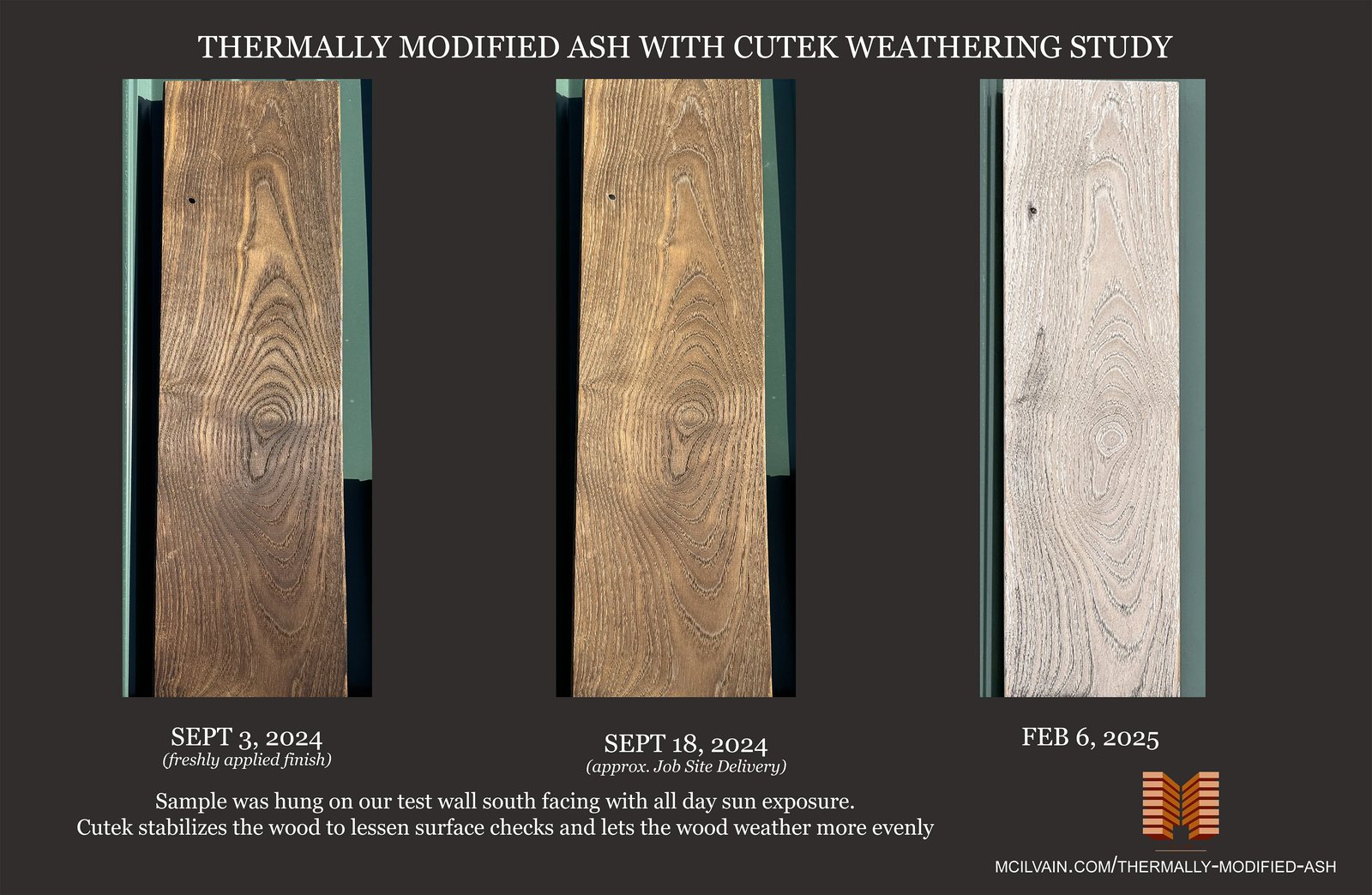
Thermally modified material is a different tool. J. Gibson McIlvain carries both Thermory and Abodo Vulcan, and the two get specified where the look and the reduced equilibrium moisture content of heat treatment are what the job wants. Thermal modification also reduces toughness. Heat-treated wood is more brittle than it was, which argues against using it for the parts of a box that take hinge screws, carry a stone top or absorb a slam. Width is the other constraint. Thermally modified Ash is not available wider than 8 inches, so a wide carcass panel in a modified product means Accoya or Abodo Vulcan, not thermally modified Ash glued up out of narrow stock. Modified products also top out around 16 feet, most of them sold on metric lengths just under 16 feet because of kiln size, which rarely constrains a cabinet but absolutely constrains the cladding run and the counter apron that ties a long outdoor kitchen together.
Unmodified species still have a place on the fronts and the face frames. Sapele, Iroko, Afrormosia, Teak and Utile are the millwork palette for exterior work, and they machine, glue and hold a profile the way a cabinet shop needs. The tropical decking species are a separate conversation. Ipe, botanically Tabebuia spp, along with Cumaru, Garapa, Jatoba and Red Balau, are extremely hard and carry high oil content, which makes them difficult to glue reliably. Those belong on a deck surface, not in a glued carcass or a coped and sticked door. Species data for the millwork palette is easy to cross-check at The Wood Database.
Component by component, the exposure is not evenly distributed
Every part of an outdoor kitchen sees a different set of loads, and specifying one species and one build for the whole assembly guarantees that the worst-exposed part sets the service life. The map below is how a millwork shop reads an outdoor kitchen elevation before it draws anything. Note how much of the trouble collects in the lower third of the box, and how little of it reaches the door panel that the owner worries about.
| Component | Exposure that actually reaches it | What shows first when it fails | How the shop builds it |
|---|---|---|---|
| Carcass bottom or deck | Splash off the slab, standing water, no drying airflow | Soft end grain, swelling at the dado, fastener staining | Accoya, all six faces primed, slotted or drilled for drainage, held off the slab by the installer's sleepers |
| Carcass side panel | Condensation on the inside face, trapped moisture at the masonry contact | Cupping toward the coated face, glue line opening | Accoya or Abodo Vulcan for width, coated both faces, back relieved for an air gap |
| Carcass back | Zero ventilation, wind-driven water from behind the enclosure | Blackening, then delamination at the panel edge | Modified stock, sealed edges, never fitted tight to masonry |
| Face frame | Runoff from the counter edge, direct sun on the stiles | Finish checking at the joint, open mortise shoulder | Sapele or Iroko, quartersawn where the width matters, primed before assembly |
| Door stile and rail | Full weather, full sun, repeated wetting and drying | Joint movement at the cope, not rot | Frame and panel in Sapele, Iroko or Accoya, adhesive matched to the substrate |
| Door panel | Full weather, but free to move inside its groove | An unpainted margin appearing as the panel shrinks | Floating panel, prefinished on all faces including the tongue |
| Adjustable shelf | Trapped humidity, point loads, occasional standing water | Sag, then a cupped shelf that binds the door | Accoya for stiffness and stability, edges sealed, pin holes sealed |
| Toe base or plinth | Continuous splash, snowmelt, cleaning water | The first visible rot on the whole job | Modified stock only, or a non-wood base supplied by the fabricator |
Door fronts survive because frame and panel construction was designed for this
A cope and stick or mortise and tenon door front lets its panel expand and contract independently of its frame, which is precisely the accommodation a glued-up carcass panel does not have. The panel floats in a groove. It moves seasonally, and the only evidence is a faint unpainted line at the panel edge if the panel was not prefinished before assembly. Prefinish it and even that disappears. The frame itself is narrow stock in stiles and rails, so the absolute dimensional change across any single member is small.
That is the whole reason the fronts outlast the box. It is not that the fronts are made from better wood. Slab doors in an outdoor kitchen are the exception that proves the rule, and they fail on the same schedule as a carcass panel because they are the same thing, a wide glued panel with nowhere to put its movement. ICD builds exterior doors and fronts as frame and panel assemblies for that reason, and details the bottom rail with a drip so water leaves the door instead of wicking into the joint. Its exterior work and door construction are set out at ICD custom doors and windows.
Exterior millwork gets milled to a different target than interior work. Interior cabinetry runs near 6 to 8 percent in-service moisture content. Exterior components run near 12 to 16 percent, which is where they will actually live, and milling them dry to an interior number sets up swelling the first week they are outside. J. Gibson McIlvain mills exterior components to that higher range deliberately.
Acetylated wood changes the fastener and adhesive schedule
Accoya releases acetic acid, which attacks mild steel and some non-ferrous metals, so an acetylated carcass needs stainless fasteners and hardware or the box will fail at its connections while the wood itself is still sound. This is the most-missed detail in outdoor kitchen cabinetry built from modified wood. Stainless is the baseline, and near salt air the higher-alloy grades earn their keep. Galvanized coatings and mild steel screws are not appropriate in contact with acetylated stock. The same caution applies to hinge cups, shelf pins, drawer slide screws and any steel bracket carrying the countertop.
Adhesives need the same attention. Acetylation changes surface chemistry, so bond performance depends on using an adhesive system rated for the material rather than whatever the shop keeps on the bench for interior casework. Exterior-rated systems are the floor, never an interior white or yellow glue. On the thermally modified side, reduced toughness means screw withdrawal in end grain is weaker than the untreated species would suggest, which is another argument for keeping thermally modified stock out of hinge stiles and hardware-bearing carcass members. Product-specific guidance lives with Thermory and with the Abodo Vulcan technical literature, and both are carried.
"The call we get is almost always about the doors. Somebody wants to match a front that has gone gray, and when we ask what the box looks like, there is a pause. I would rather have that conversation before anything gets built, because the box is the part nobody plans to replace and it is the part that goes first."
Norm Moton, Director of Sales, J. Gibson McIlvain
Grill heat is a drying load on one face of the box, and a code question the shop cannot answer for you
A built-in grill puts sustained radiant heat on the carcass member next to it, which drives that face to a lower moisture content than the rest of the box and sets up the same one-sided stress a one-sided finish creates. The effect is real and it is local. The cabinet side adjacent to a grill cutout sees a different environment from the cabinet side four feet away, and a shop drawing that treats them identically is missing something.
Clearance to combustibles is the appliance manufacturer's number, and it governs. Every built-in grill, side burner and outdoor refrigerator ships with a listed clearance and an insulated jacket requirement, and those numbers are not negotiable by the millwork shop. Fire code context for combustible construction near appliances is available through the National Fire Protection Association, and local adoption varies, so the authority having jurisdiction is the final word. The practical shop response is to size the appliance opening from the manufacturer's cut sheet, keep wood outside the listed clearance envelope, and let the fabricator handle the insulating jacket and any non-combustible liner. That is not a millwork scope item and no honest shop will pretend otherwise.
Drainage and standoff are decided on the shop drawing and executed in the field
A carcass that can drain and dry will outlive one that cannot by a wide margin, and most of that outcome is set by three details that cost nothing to draw. First, the box never touches the slab. It sits on sleepers or feet that create a continuous air gap under the bottom deck, and the bottom itself is slotted or drilled so water that gets in has an exit. Second, the back and sides stand off the masonry rather than bearing tight against it, so the air behind the box moves. Third, every horizontal surface above the box, the counter edge in particular, carries a drip so runoff leaves the assembly instead of tracking back along the underside into the face frame.
J. Gibson McIlvain supplies and mills. It does not install, and it does not perform field measurement. The sleepers, the flashing, the masonry surround, the appliance hookups and the final fit are the buyer's fabricator or installer. What the shop controls is everything that arrives on the truck already correct, which is the milling, the moisture content, the joinery, the priming and the packaging. ICD draws the box so those field details have somewhere to happen, and the installer executes them. A clear split of scope at the drawing stage prevents the common failure where a beautifully built box gets buttered tight to block with construction adhesive and suffocates.
What arrives from the shop decides how much the installer can get wrong
Millwork that shows up primed on all six faces, at the right moisture content, packaged to stay that way, has already eliminated most of the field errors that kill outdoor cabinetry. J. Gibson McIlvain runs a full millwork shop on site at the lumber yard for linear trimwork, finished cladding and primed trim, and ICD off site for true custom work planned to fit a specific space, which means a job's cladding, its cabinet fronts and its counter apron can come off a single order in a single species lot. That matters on an outdoor kitchen more than on an interior job, because the assembly is read all at once in daylight.
Material availability is the other half. J. Gibson McIlvain holds over seven million board feet of exotic and domestic lumber at its Maryland yard, which is what makes lot matching across a whole outdoor kitchen possible rather than aspirational. The company runs its own fleet of trucks with a section of the mill dedicated to packaging, and ships nationwide, regularly to California. Finished millwork can be stored at the yard and released in stages when a site is not ready, which on a project where masonry and millwork are on different schedules is the difference between a dry box and a box that sat in the weather on a pallet for three weeks.
Documentation travels too. J. Gibson McIlvain is an FSC certified importer and miller, and where a CITES-listed species is involved the documentation and chain of custody move with the material. Specification language and program detail are at FSC and CITES. Grading references for the domestic side sit with the National Hardwood Lumber Association, and casework quality tiers with the Architectural Woodwork Institute.
One more point on solid wood. There are no warranties on solid unmodified wood, and there cannot be. It is an organic material responding to its environment. Warranties exist on modified products, which is a genuine part of the argument for putting a modified product in the carcass where the exposure is worst and the part is hardest to replace.
How J. Gibson McIlvain Would Specify This
Specify the box and the fronts separately, put the modified product where the water collects, and prime everything on all six faces before a single joint closes. For a typical built-in outdoor kitchen, that reads as follows on a shop drawing.
Carcass sides, bottom deck, back and shelves in Accoya for the width and the stability, with Abodo Vulcan as the alternate where the specifier wants a different visual. Bottom deck slotted for drainage, all edges and both faces primed. Face frames and door fronts in Sapele, Iroko or Accoya depending on the finish direction, built as frame and panel with floating panels prefinished before assembly, bottom rails detailed with a drip. Every component milled to a 12 to 16 percent in-service moisture content rather than an interior 6 to 8 percent. Stainless fasteners and hardware throughout, exterior-rated adhesive matched to the substrate, and no thermally modified Ash anywhere a hinge screw lands or a wide panel is needed.
J. Gibson McIlvain grinds moulding knives every week and keeps a library of thousands of profiles on file, so a face frame profile or an apron moulding specified today can be repeated on a phase two addition years later without redrawing it. Seventh generation and family run since 1798, the company keeps that record, which is what makes matching a run possible long after the original crew has moved on. ICD's approach to drawing and building custom casework is at ICD cabinets and case work, its exterior scope at ICD exterior millwork, and the linear milling and priming services at the J. Gibson McIlvain millwork service.
To get a species and construction recommendation against a real elevation, call 800-638-9100 and have the appliance cut sheets and the countertop material ready, since both change what the box has to be.
Frequently Asked Questions
Why does the cabinet box fail before the doors in an outdoor kitchen?
Three reasons stack up. The box is usually coated on one face only, which makes it cup and stress its glue lines. It is set tight against masonry or a frame with no air gap, so it never dries. And it sits closest to the slab, where splash loads the bottom deck and the base end grain repeatedly. Door fronts, by contrast, are frame and panel assemblies whose panels are free to move, they dry on both faces, and they are the part the owner maintains. Same weather, very different service life.
Should the carcass and the door fronts be the same species?
Not necessarily, and on a well drawn job they often are not. The carcass is the harder exposure and the harder part to replace, so an acetylated product such as Accoya earns its place there for the stability and the width. Fronts and face frames can be Sapele, Iroko, Afrormosia, Teak or Utile, which machine and hold a profile the way cabinet work requires. If the whole assembly is going to be painted, matching species across the box and the fronts matters less than matching movement behavior.
Can thermally modified Ash be used for outdoor cabinet carcasses?
Only in a limited way. Thermally modified Ash is not available wider than 8 inches, so it cannot supply a wide carcass panel without glue-ups that reintroduce the movement problem. Thermal modification also reduces toughness, which weakens screw holding in end grain and makes it a poor choice for hinge stiles or members carrying a stone countertop. Where a wide modified panel is needed, the answer is Accoya or Abodo Vulcan. Thermory and Abodo Vulcan are both carried by J. Gibson McIlvain.
What fasteners and adhesives does acetylated wood require?
Stainless. Accoya releases acetic acid that corrodes mild steel and certain other metals, so screws, hinges, shelf pins, slide hardware and any bracket in contact with the wood should be stainless, with higher-alloy grades preferred near salt air. Galvanized and plain steel are not appropriate. Adhesives should be exterior-rated systems suited to acetylated stock rather than the interior glue a shop keeps on the bench, because acetylation changes the bonding surface.
Does J. Gibson McIlvain install outdoor kitchen cabinetry or take field measurements?
No. J. Gibson McIlvain supplies and mills, and ICD, the architectural millwork division, draws and builds the custom work. Setting the boxes, the sleepers and standoff, flashing, the masonry surround, the countertop and the appliance hookups are handled by the buyer's own fabricator or installer. What ships is millwork already correct on the details a shop controls, which is milling, moisture content, joinery, priming and packaging.
Why prime the inside of a box nobody will ever see?
Because an uncoated back face takes on moisture at a different rate than a coated show face, and that difference is what cups panels and opens glue lines. Coating all six faces before assembly balances the panel. On exterior work, a fungicide additive in the primer is the right call on those hidden faces, since they are the ones that stay damp. J. Gibson McIlvain primes in three levels in both oil-based and water-based systems.
What moisture content should outdoor kitchen components be milled to?
Near 12 to 16 percent, not the 6 to 8 percent used for interior cabinetry. Milling exterior components to an interior number means they will swell as soon as they reach their actual service environment, which shows up as binding doors and stressed joints in the first season. Modified products behave differently in service, but the milling target for the assembly should still reflect where the cabinetry will live.
Is there a warranty on the wood in an outdoor kitchen?
There are no warranties on solid unmodified wood, and there cannot be. It is an organic material responding to its environment. Warranties exist on modified products, which is part of the practical case for putting a modified product in the carcass, where exposure is worst and replacement is hardest, and reserving unmodified species for the fronts and face frames that get maintained.
Sources and Standards Referenced
- Wood Handbook, Wood as an Engineering Material (USDA Forest Products Laboratory, GTR-190)
- BSD-013: Rain Control in Buildings, Building Science Corporation
- Accoya acetylated wood technical information
- Thermory thermally modified wood
- The Wood Database, Sapele
- National Fire Protection Association
- Forest Stewardship Council
- CITES, Convention on International Trade in Endangered Species
- National Hardwood Lumber Association
- Architectural Woodwork Institute