The short answer depends on how much sky your deck sees
For a Northeast residential deck with no roof over it, full winter snow load and afternoon sun, Ipe is the best tropical hardwood decking species, with Cumaru the only substitute that behaves close enough to matter. That is the honest ranking for the hardest condition. Most Northeast decks are not that condition. A covered porch floor, a shaded north-facing platform under mature oaks, a small second-story landing off a bedroom, and a pool surround that gets bleached from May to September are four different exposure problems, and the species that wins changes with them.
Ipe (Tabebuia spp.) sits at roughly 3,680 lbf on the Janka scale with a density near 1,050 kg/m3 and an EN 350 Class 1 durability rating. Cumaru runs about 3,540 lbf and is actually slightly denser at around 1,070 kg/m3, with more grain movement and more color swing across a pack. Jatoba at roughly 2,690 lbf belongs on covered and partly covered floors where its color is spectacular and the UV load is low. Red Balau in the 1,700 to 2,000 lbf range and Garapa near 1,700 lbf are legitimate residential decking, lighter in weight, easier on a two-person crew, and cooler underfoot in the case of Garapa's pale honey color.
Species is one of four decisions. Frame, fastener system, drainage detailing and delivery condition carry the same weight. A perfectly specified Ipe deck screwed down wet over a poorly ventilated frame with no ledger flashing will look worse in three years than a Garapa deck built by someone who understood water.
A Northeast year attacks wood in four different ways
Cold is not what damages a deck board in New England or the mid-Atlantic. Cycling does. The Northeast puts exterior wood through repeated wetting and drying, repeated freezing and thawing of water already inside the surface fibers, and a summer UV load that is close to what the Gulf Coast delivers.
Count the events. From Baltimore up through coastal Maine, the shoulder seasons deliver dozens of freeze-thaw crossings each year, concentrated in March and November when the deck surface is already saturated. Water that has wicked into a surface check or an unsealed end grain expands as it freezes and pushes the fiber apart a little further each time. Snow makes it worse in a way homeowners rarely anticipate. A drift that sits on a deck for three weeks holds the top of the board near fiber saturation while the underside, if the frame is ventilated, keeps drying. That moisture gradient is the engine behind cupping.
Summer flips the gradient. A dark Ipe surface in full July sun climbs well past air temperature, drives moisture out of the top few millimeters fast, and sets up the tension that produces surface checking. Autumn adds a chemical problem. Wet leaf litter left in board gaps holds water against the wood for weeks and leaches tannins that stain adjacent surfaces. The Building Science Corporation literature on drainage and drying planes applies to a deck as directly as it applies to a wall. Wood that can dry from both faces survives the cycling. Wood trapped against a solid surface does not.
Density and durability class predict Northeast performance better than any marketing claim
Two numbers do most of the predicting, and they are specific gravity and EN 350 natural durability class. Janka hardness gets quoted constantly because it is a single memorable figure, but it measures resistance to indentation, not resistance to rot, weathering or movement. It matters for a deck that will host patio furniture and dog claws. It tells you very little about how a board handles a February thaw.
EN 350 is the European standard classification for natural durability against fungal decay, running from Class 1 (very durable) to Class 5 (not durable). Ipe holds Class 1. That rating, combined with density above 1,000 kg/m3 and an extractive chemistry that resists fungal colonization, is why an uncoated Ipe deck in Connecticut can run decades with no preservative treatment. The USDA Forest Products Laboratory Wood Handbook remains the reference for how density, extractives and moisture interact in service, and the species-level mechanical data at The Wood Database is a reasonable cross-check on published figures.
Ipe also carries an ASTM E84 Class A fire rating, meaning a flame-spread index of 25 or less, which matters on multi-family and elevated residential decks where a code official asks the question. Testing standards and their scope are documented through ASTM International.
| Species | Janka (lbf) | Density (kg/m3) | EN 350 durability | Color at 3 years unfinished | Available in 2x decking | Best Northeast residential role |
|---|---|---|---|---|---|---|
| Ipe | ~3,680 | ~1,050 | Class 1 (very durable) | Even silver-gray, very slow to weather | Yes | Full-exposure main deck, stairs, pool surrounds, rail caps |
| Cumaru | ~3,540 | ~1,070 | Class 1 to 2 | Gray with more variation between boards | Yes | Full-exposure decks where slightly more grain movement is acceptable |
| Jatoba | ~2,690 | ~910 | Class 2 to 3 | Darkens then grays, fades noticeably in direct sun | Yes | Covered porch floors, screened porches, shaded platforms |
| Red Balau | ~1,700 to 2,000 | ~850 | Class 2 to 3 | Warm brown to gray, moderate variation | No | Residential 5/4 decks, easier handling on small crews |
| Garapa | ~1,700 | ~800 | Class 3 | Pale honey to light silver | No | Residential 5/4 decks and pool decks where surface heat matters |
| Massaranduba (comparison only) | ~3,190 | ~1,150 | Class 1 to 2 | Deep red fading to gray, prone to visible checking | Limited | Density comparison reference only, not stocked by J. Gibson McIlvain |
| Teak | ~1,070 | ~660 | Class 1 | Soft silver-gray, very stable | Rarely | Boat-adjacent and marine-style residential work, not general decking |
Residential decks run 5/4, and there is a hard reason commercial work does not
5/4x6 is the correct default for a residential Northeast deck framed at 16 inches on center, and the 2x thickness question belongs to a different category of project entirely. A 5/4x6 board covers roughly 2.1 linear feet per square foot of deck once you account for the gap, which makes takeoff arithmetic straightforward on a rectangular deck.
Commercial boardwalks, piers and public plaza decks get specified at 2x thickness to control deflection under crowd loading and to satisfy the engineer of record, and no professional will go first with a thinner board on a public job even in the cases where the strength math on 1x or 5/4 works out. That specification quietly filters the species list, since only Ipe, Cumaru and Jatoba can be sourced consistently in 2x decking thickness. Red Balau and Garapa live in residential and engineer-approved 5/4 work. For a homeowner, that distinction is useful mostly as a signal about which species have the deepest, most reliable supply behind them.
Width deserves a decision, not a default. A 6 inch board moves more across its face than a 4 inch board, and in a climate that cycles a deck from snow-covered to sun-baked twice a year, that difference shows up as cupping on wide boards over an under-ventilated frame. On a shaded, damp, ground-level deck, 4 inch boards are the safer specification. On an elevated deck with good airflow, 6 inch boards are fine and cut installation time meaningfully. One inch nominal material handles fascia, skirt boards and stair risers, where the same species keeps the color consistent.
Surface checking is the wood releasing tension, and no one can promise you it will not happen
Small surface checks in dense tropical decking are normal, they do not weaken the board, and anyone who guarantees a check-free deck is selling something. Checking happens when the surface of a board heats and dries faster than its core. The outer fibers try to shrink, the core holds them, and the wood relieves the stress by opening fine splits along the grain. On a species as dense as Ipe or Cumaru, that tension is substantial. A pack of decking sitting in full sun on the day it is delivered will start checking before it is ever fastened down.
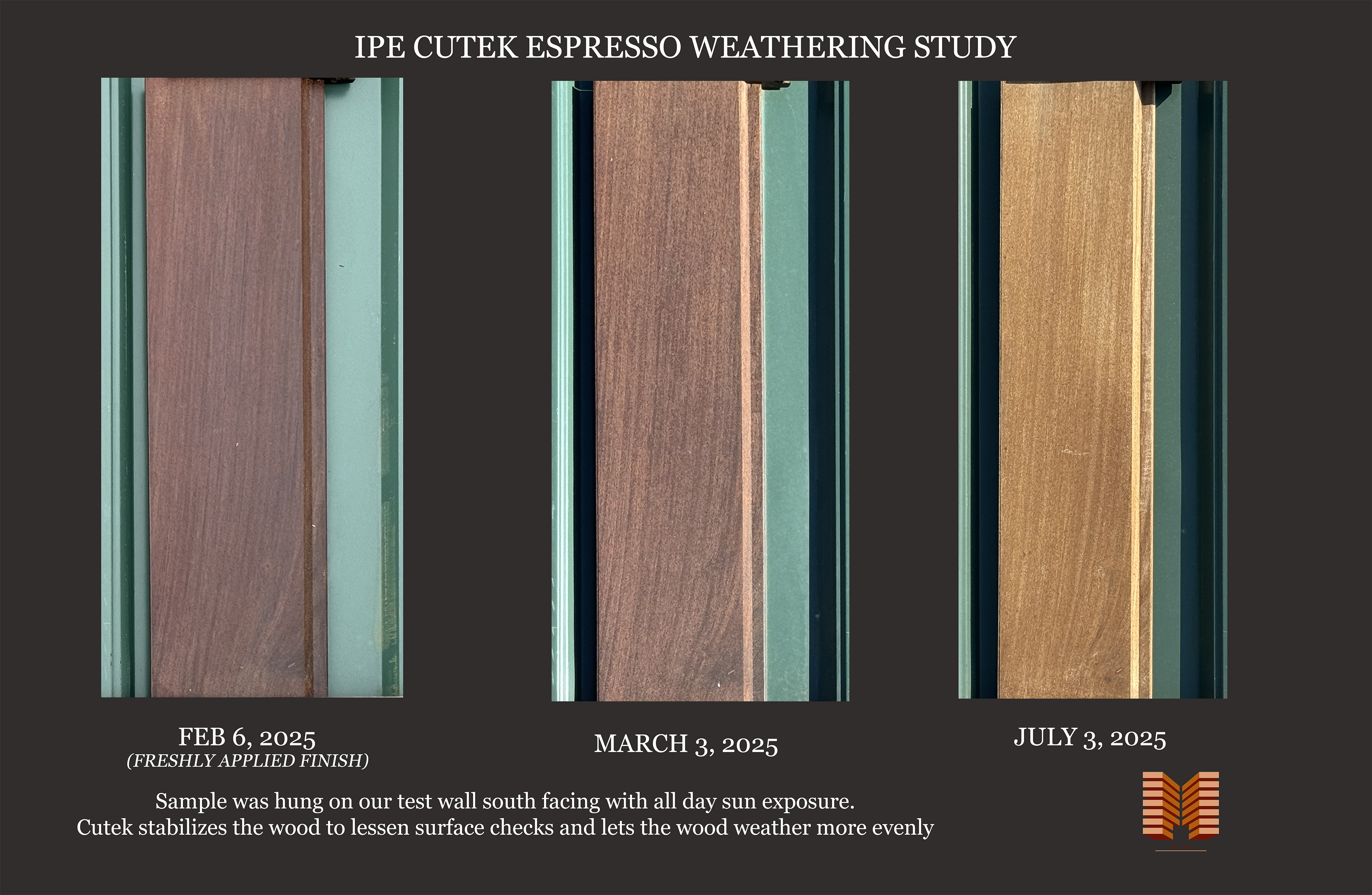
What reduces it is slowing the moisture exchange at the surface. J. Gibson McIlvain factory coats tropical decking with Cutek, a penetrating oil wood stabilizer that moves into the fiber rather than sitting on top of it, and that treatment measurably reduces checking on delivered material. Site practice does the rest. Keep the material out of direct sun before installation, sticker the pile so air moves through it, seal every field cut on the end grain with a proper end sealer, and get the deck ventilated underneath. Those steps keep checks small and cosmetic. They do not eliminate them, and a homeowner who expects elimination will be unhappy with a perfectly good deck.
Fine checks that appear in the first summer usually stabilize. They collect a little dirt, they weather to the same silver as the rest of the surface, and on an unfinished deck they become invisible at standing distance within two seasons.
Fasteners and profiles are a Northeast-specific decision, and the holes get drilled on site
Every fastener hole in dense tropical decking must be pilot drilled against the frame as it was actually built, which is why decking should never be ordered pre-drilled or pre-countersunk. Field cuts, stair layouts, picture-frame borders and the inevitable joist that landed a half inch off all invalidate any hole pattern established at a mill. Drilling is installation work.
The technique is not complicated but it is unforgiving. Pilot every hole. Two fasteners per board per joist. Hold about 3/4 inch of edge distance so the fastener is not splitting the edge fiber, and use full-depth pilots near board ends where splitting risk is highest. Butt joints land on doubled bearing, never on a single joist edge shared by two board ends. A self-centering combination bit that drills, countersinks and centers in one motion is the tool that makes a large deck feasible.
Metal choice matters more here than in a dry climate. Coastal Northeast work from Long Island through Cape Cod and up the Maine coast calls for 316 stainless steel, both for salt air and for the tannin chemistry in tropical hardwoods that will corrode lesser alloys and bleed black streaks down the face of the board.
Profile decides the fastener system. Hidden fastener clips need a grooved edge or tongue and groove profile to engage, so that has to be part of the order, not an afterthought. Shiplap and square-edge material take visible fasteners, and on a deck that means face screwing with plugs or leaving the screw heads exposed and neatly aligned. When the same species runs up onto a privacy screen, a skirt or a soffit as siding, install shiplap and tongue and groove with the grooves facing down so water drains out instead of collecting in the profile.
The frame under a dense hardwood deck carries load most homeowners never calculate
Joists go 16 inches on center under any tropical hardwood decking, and the frame has to be detailed to dry. Ipe and Cumaru weigh roughly twice what cedar weighs. That dead load is real, and on a retrofit over an existing frame it needs to be checked rather than assumed. The American Wood Council publishes the prescriptive residential deck guidance that most Northeast jurisdictions enforce, and local adoption of the residential code is tracked through the International Code Council.
Detailing decides longevity. Joist tape over every joist top keeps water out of the fastener penetrations. Ledger flashing has to be right, since ledger failures are the single most common cause of catastrophic deck collapse in the Northeast. Ground-level decks need real clearance and real airflow, and if the deck sits close to grade over a poorly drained yard, that is a case for narrower boards and a vented skirt rather than solid lattice.
"The calls I get in March are almost never about the species. They are about a deck that was built tight over a frame that could not breathe, or boards that went down at whatever moisture content they arrived at because the crew was chasing a deadline. I would rather sell a customer Cumaru and have them build it right than sell them Ipe and watch it cup over a frame with no airflow." Norm Moton, Director of Sales, J. Gibson McIlvain
Moisture content at delivery sets the gap, and the calendar sets the moisture content
Tropical decking should be installed at 12 to 16 percent moisture content, and the season you install in changes the gap you should leave. Kiln-dried decking that arrives in January during a dry cold snap is at the low end of its service range and will pick up moisture through spring. Gap it a little tighter. The same material delivered in humid August is near the top of its range and will shrink through the first winter, so gap it wider or the boards will pull apart into a wide, uneven pattern by February.
Handling on site is where good material gets ruined. Never leave decking shrink-wrapped in the sun, since the plastic traps moisture against the boards and turns the pack into a kiln. Break the bands, sticker the pile with spacers every few feet, cover the top against rain but leave the sides open, and let the material sit on site for at least several days before installation. A moisture meter with a hardwood correction setting is worth owning on any job over a few hundred square feet.
Late spring and early fall are the best install windows in the Northeast. Both avoid the extremes and let the deck settle at a moisture content close to its long-term average. J. Gibson McIlvain mills and ships Ipe decking in every standard and custom dimension, and ships nationwide, including regularly to California and across the Northeast corridor, so scheduling delivery to hit the right install window is a conversation worth having before the frame goes up. Call 800-638-9100 to work through dimensions, lengths and delivery timing with someone who handles decking orders daily, and browse current profiles at mcilvain.com/ipe-decking.
Snow removal and ice melt do more damage than the winter itself
The most common avoidable damage on a Northeast tropical deck comes from a metal snow shovel and a bag of the wrong ice melt. Use a plastic or poly-edged shovel, push parallel to the boards rather than across them, and leave a thin layer of snow rather than scraping to bare wood. A steel blade catching a raised grain edge on a frozen board will tear fiber that never fully recovers.
De-icing chemistry is a mixed picture. The salts themselves are not decay agents on dense tropical hardwood, but the chloride residue is corrosive to fasteners and hardware, which is another argument for 316 stainless on any deck that will be salted. Sand and grit-based products are abrasive and will dull the surface. Where possible, clear mechanically, keep chemicals off the wood, and rinse the deck in early spring.
The rest of maintenance is simple and seasonal. Blow or sweep leaf litter out of the board gaps every fall, since packed debris is what holds water against the wood through the winter. Wash once a year with a mild cleaner and a soft brush rather than a pressure washer, which erodes the softer early wood and leaves a permanently striped surface. If you want to keep the brown color, an oil-based penetrating finish reapplied on a roughly annual cadence is the tool, and reapplication frequency depends far more on sun exposure than on species. If you are content with silver-gray, do nothing beyond cleaning. Graying is a surface phenomenon, not decay, and an unfinished Class 1 durable species does not lose structural life to it.
Tropical hardwood is not automatically the right answer for a Northeast home
Two categories of material beat tropical hardwood on specific Northeast projects, namely western red cedar on shaded low-traffic decks and porches, and modified wood where dimensional stability outranks hardness. Cedar is a legitimate default and it performs. The distinction that matters is grade. Clear vertical grain (CVG) cedar is quartersawn, stable, knot-free and appropriate for a visible porch floor or a finished soffit. Select tight knot (STK) cedar is a flat-grain, knotty grade that is perfectly sound and considerably more economical for skirts, screens and rustic decking. Specify which one you want, because they are different products.
Modified wood is the other real option. Thermory and Abodo Vulcan are thermally modified products with meaningfully improved dimensional stability and decay resistance, and Accoya is acetylated wood with exceptional movement performance. Kiln size caps all of these around 16 feet, with metric-length products landing just under 16 feet, so any design that depends on longer single boards has to be resolved before specification. These modified products carry manufacturer warranties. Solid, unmodified tropical hardwood does not carry a warranty, from anyone, and a supplier offering one on solid Ipe is offering something the industry does not provide.
Sourcing documentation now shows up in residential specifications, not only commercial ones. FSC chain-of-custody certification is available on much of the tropical decking supply, and when using a CITES-listed species, documentation is required at import and should follow the material to the job, with the current listings published by the CITES Secretariat. Ask your supplier for it in writing before the truck rolls.
How J. Gibson McIlvain Would Specify This
For a typical uncovered Northeast residential deck between 300 and 800 square feet, the J. Gibson McIlvain specification starts with Ipe in 5/4x6, Cutek factory coated, over a frame at 16 inches on center with 316 stainless fasteners. That is the configuration with the deepest supply, the longest track record through freeze-thaw country, and the fewest ways to go wrong.
The working spec looks like this. Species Ipe (Tabebuia spp.), EN 350 Class 1, ASTM E84 Class A, kiln dried to 12 to 16 percent moisture content, delivered factory coated with Cutek. Field boards 5/4x6 on an open elevated deck, 5/4x4 if the deck is ground-level, shaded or over damp soil. Fascia, risers and skirt in 1x of the same species so the color matches. Random lengths ordered to the actual run dimensions rather than a single length, with roughly 10 percent added for waste on a rectangular layout and 15 percent on anything with angles or a picture frame border.
Substructure at 16 inches on center, joist tape on every joist top, proper ledger flashing, and at least 18 inches of ventilated clearance under a ground-level deck. Fasteners 316 stainless throughout. Face screwing with plugs where the budget prefers speed, or a grooved-edge profile with hidden clips where the customer wants a clean field, specified at order time since the profile has to be milled in. Every hole pilot drilled on site with a self-centering combination bit, two fasteners per board per joist, 3/4 inch edge distance, full pilots near ends, butt joints on doubled bearing.
Where the deck is covered or heavily shaded, substitute Jatoba for the color and accept the lower UV exposure. Where the customer wants a lighter, cooler surface around a pool, Garapa in 5/4 is the call. Where a small crew is handling the material by hand and the budget is tighter than Ipe allows, Red Balau in 5/4 is honest decking that will serve a residential deck well. J. Gibson McIlvain carries Ipe, Cumaru, Garapa, Jatoba and Red Balau decking along with Thermory, Abodo Vulcan and Accoya, works with contractors and specifiers at project volume, and ships nationwide. Start the conversation at mcilvain.com or by phone at 800-638-9100, and bring the frame plan with you, since half the questions worth asking are about the frame rather than the board.
Frequently Asked Questions
Which tropical decking species stays coolest underfoot on a south-facing Northeast deck?
Garapa. Its pale honey color reflects considerably more solar energy than Ipe or Cumaru, both of which are dark enough to become uncomfortable barefoot on a clear July afternoon. Color drives surface temperature far more than density does. If the deck surrounds a pool or gets used barefoot by children, Garapa in 5/4 is the practical answer, with the tradeoff that it is a softer species in the 1,700 lbf range and rates EN 350 Class 3 rather than Class 1. Shade structures, a light penetrating finish and allowing the surface to weather toward silver all reduce heat as well.
How wide should the gap between boards be if the deck is installed in February?
Tighter than a summer install. Decking delivered during a Northeast cold snap arrives near the low end of its 12 to 16 percent moisture range and will take on moisture through spring, so the boards will expand slightly. Gapping generously in February produces a deck with wide, uneven spacing by August. The reverse applies to an August install, where boards near the top of the moisture range will shrink through the first winter and need a wider starting gap. Measure the material with a moisture meter set for dense hardwood rather than guessing, and set the gap against the reading.
Does snow sitting on the deck all winter hurt tropical hardwood?
Snow itself does not cause decay in a Class 1 or Class 2 durable species. The problem is the moisture gradient. Snow holds the top face near fiber saturation for weeks while the underside continues to dry, and that imbalance is the main driver of cupping. The fix is airflow underneath, not snow removal. A deck with 18 inches of ventilated clearance and open board gaps handles a long snow cover without complaint. A ground-hugging deck over wet soil with a solid skirt does not.
Can ice melt be used on an Ipe or Cumaru deck?
Chloride-based ice melt will not rot dense tropical hardwood, but the residue is corrosive to fasteners, hangers and hardware, which is a strong argument for 316 stainless throughout on any deck that gets salted. Avoid sand and grit-based products, which abrade the surface and leave a dull, scuffed finish. Clearing mechanically with a plastic or poly-edged shovel pushed parallel to the boards, then rinsing the deck in early spring, is the approach that keeps both the wood and the hardware in good shape.
What is Cutek, and does factory coating mean the deck never needs finishing?
Cutek is a penetrating oil wood stabilizer that migrates into the fiber rather than forming a film on the surface. J. Gibson McIlvain factory coats tropical decking with it because slowing moisture exchange at the surface significantly reduces checking, particularly during the exposed weeks between delivery and installation. It is a stabilizer, not a permanent finish. A deck that should stay brown still needs periodic reapplication of a penetrating oil finish, with frequency driven mostly by sun exposure. A deck allowed to weather to silver needs nothing beyond seasonal cleaning.
How much extra material should be ordered for waste?
Around 10 percent above the calculated square footage on a straightforward rectangular deck, and closer to 15 percent on any layout with angles, a picture frame border, stairs or a curved edge. A 5/4x6 board covers roughly 2.1 linear feet per square foot of deck once the gap is accounted for, which makes the base calculation simple. Ordering random lengths matched to the actual run dimensions produces less waste than ordering a single length and cutting everything down.
Is Garapa or Red Balau strong enough for a real residential deck?
Yes, on a properly framed residential deck at 16 inches on center in 5/4 thickness. Both are legitimate exterior decking species with decades of service history. What they cannot do is satisfy a commercial or public deck specification, which calls for 2x thickness to control deflection under crowd loading. Only Ipe, Cumaru and Jatoba are consistently available in 2x decking, so Garapa and Red Balau belong to residential and engineer-approved 5/4 work. For a backyard deck or a pool surround, that limitation does not apply.
Can the same species run on a covered porch floor and an open deck on the same house?
It can, but the two surfaces will not stay the same color. An open deck weathers toward silver within a couple of seasons while a covered porch retains its color far longer, so even identical material diverges visually. On covered floors, Jatoba is worth considering on its own merits, since low UV exposure lets its color hold and it is available in the same thicknesses. Where a matched appearance across both areas matters, plan on maintaining the exposed section with a penetrating oil finish rather than expecting the two to weather alike.