Why Vertical Grain Teak Arrives Narrow

Narrow teak is what quartersawing a log physically produces, not what is left over once the good boards are taken. Quarter the log, saw radially, and the usable width of every board is bounded by the radius of the log it came out of. Vertical grain and narrow width are the same supply story told twice. A wide board with the grain standing dead vertical on its face demands a large diameter log, and large diameter teak is the scarcest part of any teak supply anywhere in the world.
That geometry explains why two buyers asking for teak are not in the same market. One wants a 4 inch vertical grain slat, the normal output of a radial cut. The other wants a 12 inch vertical grain panel, which asks the log to be something it rarely is.
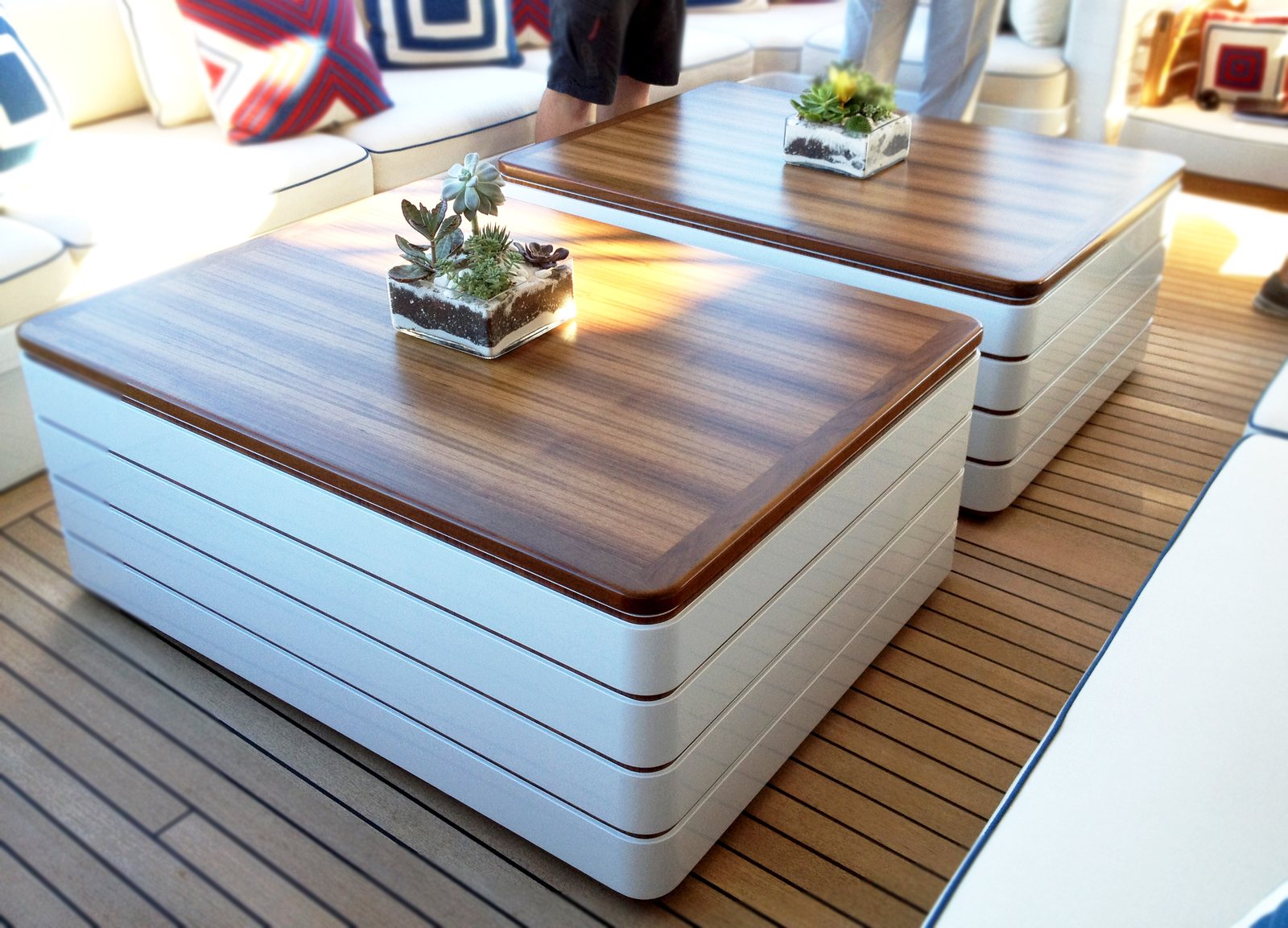
Marine furniture was built on the narrow output long before anyone wrote a specification for it. A cockpit bench, a folding deck chair, a swim platform tread, a grating panel, a cap rail, a slatted table top. Every one of them is assembled from repeated narrow members rather than cut out of a single wide field of wood. The convention tracks the saw, and it has held for two centuries because the engineering behind it holds.
Teak is Tectona grandis. Its density and shrinkage behaviour are published on the Wood Database entry for teak.
How Width Multiplies Movement
Wood moves far more tangentially than radially, and the total movement you see across a board scales directly with how wide that board is. A 4 inch board moves roughly half as much across its face as an 8 inch board of the same species in the same orientation. Halve the width and you halve the dimensional change that every adjacent joint has to absorb. That is arithmetic, not opinion.
Quartersawing stacks a second advantage on top of the first. In a quartersawn or rift board the width direction runs radially, and radial movement is the smaller of the two numbers for essentially every hardwood. So a narrow vertical grain slat is working in its least active direction across its least active dimension. The U.S. Forest Service wood handbook, hosted by the Forest Products Laboratory, remains the standard reference for the shrinkage coefficients behind that claim.
The practical consequence shows up in seasons rather than in a specification. A teak bench slat at 3 inches wide expands and contracts through a humid summer and a dry winter by an amount a fastener and a caulked seam can carry without complaint. The same bench built from 9 inch boards puts several times that movement into the same number of joints.
Quartersawn and rift stock also stays flatter than plainsawn, which is why it gets specified wherever a surface has to hold its plane. On marine furniture that matters twice over, once because the surface is walked on or sat on, and once because the finish schedule is unforgiving of a surface that has gone out of flat under it.
The Seam Is the Whole Point
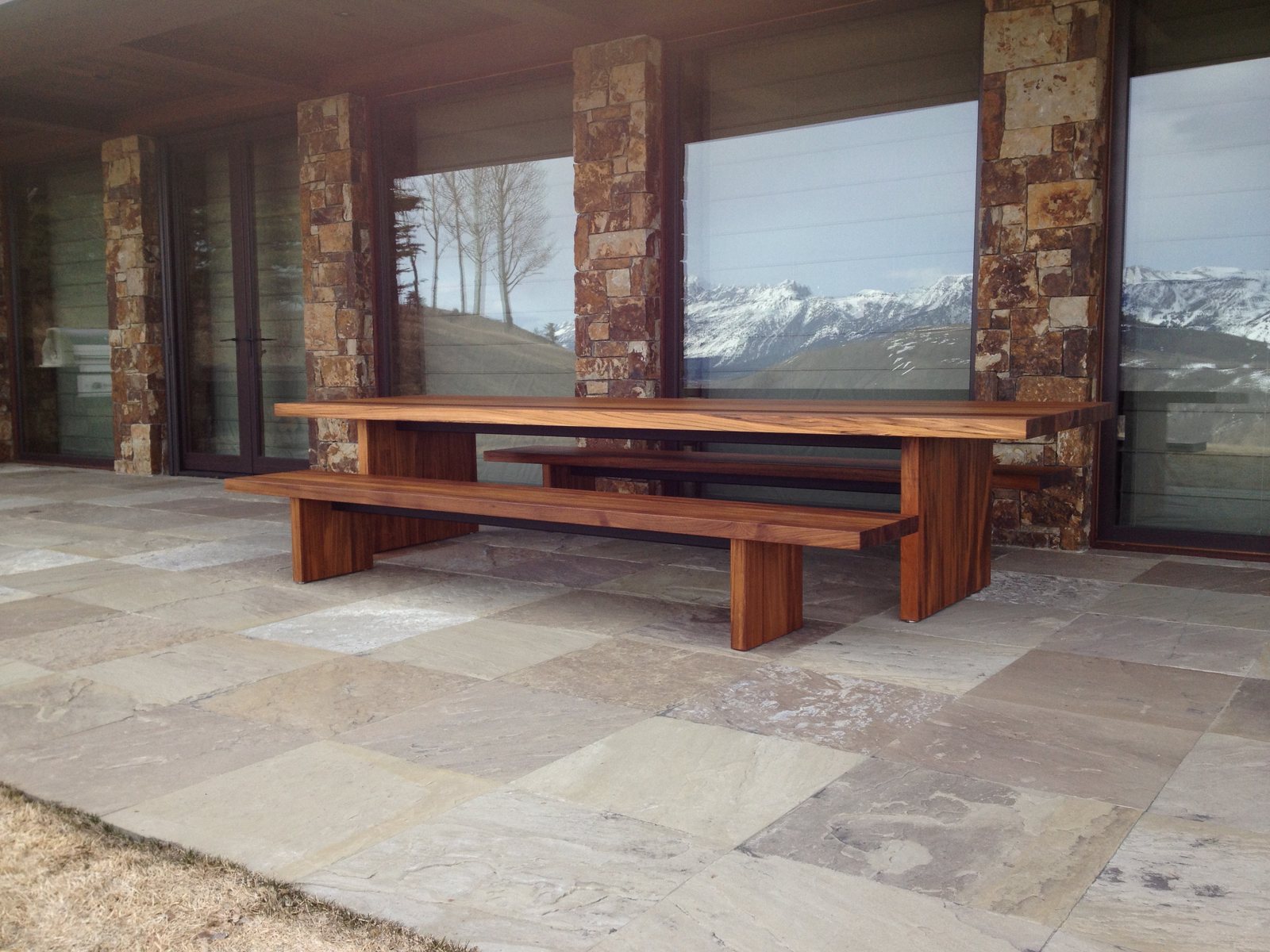
On a laid surface, many seams each moving a little is a more stable assembly than few seams each moving a lot. Traditional laid decks and caulked strip decks are narrow by convention because the convention was arrived at by failure. Wide strakes opened their seams, pulled their fasteners and cracked their bungs. Narrow strakes did not.
Distribute the movement and no single joint carries enough of it to fail. A caulked seam has a working range, and the sealant in it has an elongation limit set by its own chemistry rather than by the wood, classified under the ASTM standards for elastomeric joint sealants. Feed that joint the movement of a 3 or 4 inch strake and it stays inside its range through the whole annual cycle. Feed it the movement of a wide board and the joint spends part of every year at the edge of what the sealant can do.
Open slat construction solves the same problem differently and just as well. Gaps between bench slats, grating members and duckboard battens drain water, dry the faces and give each member room to move without touching its neighbour. Cupping is driven by installation and back ventilation rather than by species, and a narrow member simply has less width across which to cup in the first place. Ventilate the back, hold the gap, and the slat has very little opportunity to misbehave.
Plantation Teak and Repeatable Dimension
Plantation teak grows on shorter rotations and comes out of smaller logs, which caps both width and length, and the narrow widths are the part of that supply that repeats reliably. A plantation log of modest diameter yields vertical grain stock at 3, 4 and 5 inches all day. Ask the same log for a wide board and the answer becomes inconsistent from one release to the next.
That consistency is the real argument for a production shop. A marine furniture builder running a model year, a yard refitting a run of hulls, or an architect phasing a waterfront terrace all need the second delivery to look like the first. Narrow vertical grain is where plantation teak is most repeatable, so a program built on narrow members is a program that can be matched later.
J. Gibson McIlvain is an FSC certified importer and miller, so where a specification carries sourcing requirements the documentation travels with the material rather than being reconstructed afterward. The Forest Stewardship Council publishes the chain of custody standard that governs how that paperwork is handled.
"A builder asking for narrow teak is usually solving a movement problem, not a budget problem. When we know the piece is a slatted deck chair or a cap rail rather than a panel, we can keep the grain orientation and the width consistent across every release of that order."
Norm Moton, Director of Sales, J. Gibson McIlvain
Oils, Silica and the Glue Line
Teak carries natural oils and silica, which dull tooling and work against adhesion, so a slatted assembly that carries its load through mechanical joinery is a stronger engineering answer than a broad glued field. The oils that let teak survive salt water and ultraviolet exposure are the same oils that interfere with a bond line. Nothing about that changes by buying a different grade.
Shops that glue teak successfully do it on freshly machined faces. Teak oxidizes, and an oxidized surface bonds worse than one cut an hour earlier, so joint faces get machined and bonded in the same shift rather than milled one week and clamped the next. Degreasing with an appropriate solvent before glue up is standard practice on structural teak joinery. None of that is exotic, but all of it has to be planned into the shop schedule.
A slatted bench, a grating panel or a duckboard sidesteps the question almost entirely. Load passes through screws, bungs, mortise and tenon or a bolted frame, and the open gaps do work that a continuous glued surface would otherwise have to do. Where staves do get glued into a table top, narrow quartersawn staves give a flatter top than wide plainsawn ones, which is why stave construction is the traditional method for an exterior teak surface.
The same oil content is why the millwork palette and the decking palette are different lists. Sapele, Iroko, Afrormosia, Teak and Utile, sold as Sipo, are the species a millwork shop reaches for when a component is milled, glued or machined. The tropical decking species, Ipe (Tabebuia spp), Cumaru, Garapa, Jatoba and Red Balau, are extremely hard and carry high oil content that makes them difficult to glue, so they belong on a deck surface rather than inside a glued assembly. Teak sits in both worlds, which is exactly why it has been the marine species for three hundred years.
Where 3, 4 and 5 Inch Slats Earn Their Place
Narrow teak is the right call anywhere the finished surface is made of repeated members with a joint between them. Laid and caulked deck surfaces. Cabin and cockpit soles. Swim platforms and boarding steps. Grating and duckboard. Bench and chair slats. Table tops built from staves. Handrail caps, cap rail, toe rails and rub rails. Brightwork trim, transom and coaming repair stock. Shower and wet room duckboard. In every one of those the member is narrow because the assembly wants it narrow.
Width selection inside that 3 to 5 inch band is a real design decision rather than a rounding error. Narrower members mean more joints to cut and more fasteners to set, and they mean less movement per joint. Wider members inside the band mean fewer operations and a cleaner visual rhythm, with more movement landing on each seam. A production shop picks the point on that curve that suits its joinery and its labour.
| Nominal width | What changes dimensionally | Where it fits |
|---|---|---|
| 3 inch | Least movement across the face of any member in this band, and the least width across which a board can cup | Caulked laid decks, grating and duckboard, cockpit soles, fine slatted seat backs, brightwork trim |
| 4 inch | Roughly half the cross face movement of an 8 inch board of the same species and orientation | Bench and chair slats, swim platform treads, boarding steps, narrow cladding and rainscreen boards, soffit boards |
| 5 inch | Fewer joints per square foot of surface, with proportionally more movement arriving at each seam | Stave built table tops, stair treads built up from staves, interior wall slats and ceiling boards, wider laid surfaces |
| Wider than 5 inch | Movement per seam rises with width, and vertical grain requires a correspondingly larger log | Panels and single board surfaces, where flatness is held by frame and panel construction rather than by narrow members |
J. Gibson McIlvain rips teak slat stock to one consistent width on straight line and gang rip saws, which is what makes a repeated member actually repeat. A slat that varies by a sixteenth across a pack turns into shimming and sanding at the bench. J. Gibson McIlvain resaws thicker teak on band resaws when a slat has to come out of a heavier blank, and trims it to length on trimming saws before it leaves the mill.
Moisture Content Does Not Care About Width
Interior millwork is milled to an in-service moisture content near 6 to 8 percent and exterior work near 12 to 16 percent, and narrow stock does not change either target. Width changes how much total movement a given moisture swing produces. It does not change where the wood has to start.
J. Gibson McIlvain mills exterior teak to a 12 to 16 percent in-service moisture content and interior joinery stock to 6 to 8 percent, because a cockpit sole below deck and a swim platform in full sun are not the same service environment even on the same vessel. Deliver a slat at 7 percent into exterior service and it takes on moisture, swells and closes its gaps. Deliver a slat at 14 percent into a conditioned interior and it shrinks, opening every joint it sits in.
Air dried teak settles near the local equilibrium and is not a substitute for kiln dried stock where an interior tolerance matters. For a bare exterior assembly that will weather anyway the distinction is softer. For interior joinery, brightwork or anything carrying a film finish, it is not soft at all. Building Science Corporation publishes the clearest material on how an assembly and its moisture environment interact.
Fastening, Bedding and What the Fabricator Plans For
A narrow slat only delivers its stability advantage if the fastening schedule lets it move in the direction it is going to move. Two fasteners across the width of a 4 inch member, both set tight, create a restraint the wood will eventually win. One line of fasteners, or a slotted detail on the second line, lets the member change dimension without splitting around the screw.
Bungs and plugs have to be cut from the same stock as the surface they sit in, and the grain has to run with the member rather than across it. A bung cut from random offcuts reads as a different colour within a season of ultraviolet exposure. Counterbore depth sets how many refinishing cycles the surface can survive before a fastener head appears, which is a decision made at the drawing stage and cannot be fixed later.
Back ventilation is the other half of the problem. A slat with a sealed face and an unventilated back dries on one side and not the other, and that moisture gradient is what cups a board. Spacers, battens, drainage gaps and a real air path behind the assembly matter more to long term flatness than any grade or species decision made at the yard.
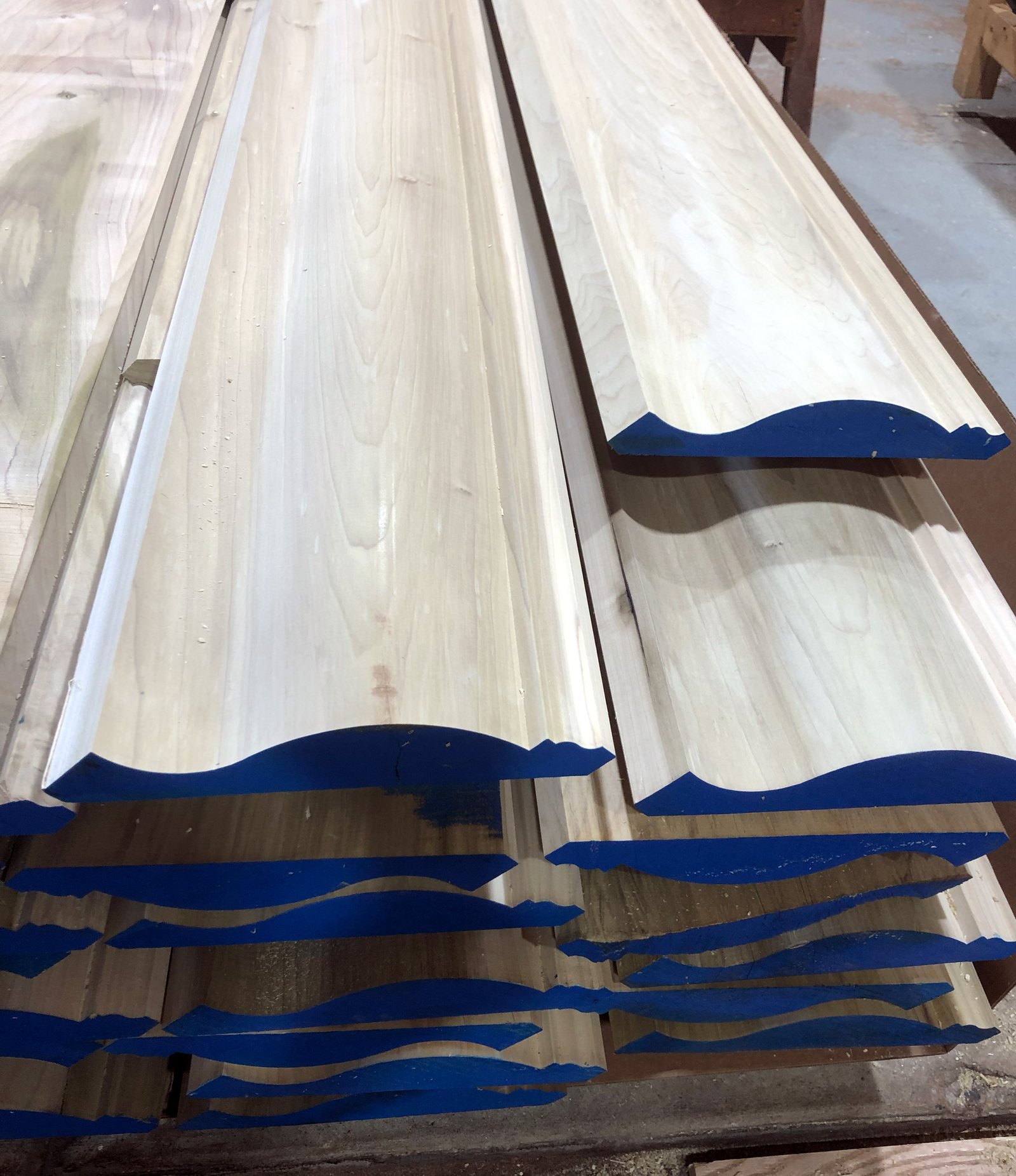
Fastener selection, bedding compound, adhesive chemistry and the assembly sequence belong to the boatbuilder, the furniture shop or the fabricator doing the work. What arrives from the mill is dimensioned, dried and graded stock cut to the width and length that assembly needs. J. Gibson McIlvain grinds a knife when a cap rail, a toe rail or a trim profile has to match an existing section, drawing on a profile library of thousands of ground knives with new ones ground every week. The Architectural Woodwork Institute publishes the quality standards most shops reference for tolerances on that kind of work.
Finish Schedules on Narrow Exterior Teak
Narrow stock changes the finish schedule in one specific way, which is that it puts far more linear edge and end grain per square foot into the surface. Edges and ends take on and give up moisture faster than faces, so they are where a film finish lifts first and where water finds a way in. Sealing ends before assembly costs minutes and saves seasons.
Open-grained and oily species absorb a great deal of finish, and teak absorbs more than most. A varnish schedule on teak brightwork runs through multiple build coats before it starts to behave like a film rather than a stain, and every coat on a slatted assembly has to reach the edges as well as the faces. Shops that spray a built up assembly and skip the inner faces end up with a finish that fails from the inside out.
Many marine builders finish teak with nothing at all and let it weather to silver grey, which is the historical choice. Oil schedules sit in the middle, easy to apply and demanding regular attention. Varnish gives the deepest appearance and the most upkeep. None of the three is improved by a wider board, and the bare weathered option is helped by the narrow one, since a weathered surface with many small seams opens less visibly than one with few large ones.
Warranties exist on modified products, Thermory and Abodo Vulcan among them, and on nothing else. It is not possible to warranty solid unmodified wood, an organic material responding to its environment. Those modified products also top out around 16 ft, most sold on metric lengths just under 16 ft because of kiln size, and thermally modified Ash is not available wider than 8 inches. Where teak is not the right call for an exterior seating frame, cedar is a legitimate default and the grade decision matters more than the species decision, with CVG, clear vertical grain, behaving very differently from STK, select tight knot.
Grading, Thickness and Matching a Run Across Phases
Hardwood grading describes the yield of clear face cuttings a board will give, not how the board looks, which is why the grade call on short narrow parts is different from the grade call on long clear runs. North American hardwood runs on the National Hardwood Lumber Association rules, which do not govern an imported species like teak, though they supply the language a furniture order uses to describe what it needs. FAS is the top grade and requires a minimum board of 6 inches wide by 8 ft long yielding 83 and 1/3 percent clear face cuttings. FAS One Face, or F1F, meets FAS on the better face. Selects meet FAS on the better face at a smaller minimum size.
No. 1 Common requires 66 and 2/3 percent clear face cuttings from a minimum board of 3 inches by 4 ft, and No. 2A Common requires 50 percent. A No. 1 Common board is not a defective board. It yields smaller clear cuttings, which makes it the economical grade for short parts and the wrong grade for a long clear run. A bench slat program cutting 18 inch members and a laid deck program cutting 14 ft strakes are not asking the same question of a grade.
Thickness is quoted in quarters of an inch of rough thickness. 4/4 is a nominal 1 inch rough, 8/4 is 2 inches and 16/4 is 4 inches, and every surfaced dimension comes off those rough numbers. A 3/4 inch finished slat and a 1 inch finished tread do not start from the same blank, and a parts list that gives finished dimensions without naming the rough thickness hands that decision to someone who is not in the room.
J. Gibson McIlvain records the grade, the rough thickness and the moisture target on the order, and J. Gibson McIlvain matches a run across phases so the second release reads like the first. Seventh generation and family run since 1798, the company keeps that kind of record because a refit program or a phased terrace comes back two years later asking for the same material. Janka figures for the alternates a specifier might weigh against teak, Red Oak at roughly 1,290 lbf, White Ash at roughly 1,320 lbf and Black Walnut at roughly 1,010 lbf, are published species by species on the Wood Database.
How J. Gibson McIlvain Would Specify This
A specification for narrow marine teak needs six lines, and leaving any one of them off moves the decision to the saw operator. Name the species as Tectona grandis. Name the grain orientation as quartersawn or rift, vertical grain on the face. Name the finished width, 3, 4 or 5 inches, rather than a nominal one. Name the rough thickness in quarters and the finished thickness separately. Name the in-service moisture content, 12 to 16 percent for exterior and 6 to 8 percent for interior. Name the length, and say whether the run has to match a later phase.
Add the profile where there is one. A cap rail, a toe rail, a rub rail or a handrail cap is a milled section rather than a flat slat, and it either matches something already on the vessel or it originates from a drawing. Send a section of the existing rail or a measured drawing, and the knife gets ground to it.
Where the piece is a built-in rather than loose furniture, a dockside bench, a waterfront terrace seat or a built-in storage run, ICD, the company's architectural millwork division, builds the custom assembly planned around a specific space instead of adapting standard modules to it. Its exterior millwork covers assemblies that have to survive weather rather than only look like they could.
J. Gibson McIlvain ships finished teak slat stock nationwide. For milling, ripping, resawing and knife work on a marine furniture program, see the millwork services page or call 800-638-9100 with the width, the thickness, the moisture target and the length, and the order gets cut to those four numbers rather than to a guess about them.
Frequently Asked Questions
Where do I source teak for exterior marine furniture production?
Buy from an importer and miller that can hold a width and a grain orientation across repeat releases, because a furniture program needs the fifth delivery to match the first. Specify Tectona grandis, quartersawn or rift with vertical grain on the face, a finished width of 3, 4 or 5 inches, the rough thickness in quarters, the length, and the in-service moisture content. J. Gibson McIlvain rips teak slat stock to one consistent width on straight line and gang rip saws, mills exterior work to a 12 to 16 percent in-service moisture content, and ships nationwide. Call 800-638-9100 with those numbers rather than asking for teak by the board foot and sorting it out later.
Why is narrow teak better for a deck surface or a bench than a wide board?
Movement across a board scales with its width. A 4 inch board moves roughly half as much across its face as an 8 inch board of the same species and orientation, so every joint between narrow members has less movement to absorb. On a caulked laid deck that keeps each seam inside the sealant's working range through the annual cycle. On an open slat bench it means the gaps stay closer to their designed dimension. A narrower member also has less width across which to cup in the first place, although cupping is driven by installation and back ventilation rather than by species.
Is narrow teak just a byproduct of cutting wide boards?
No. Narrow is what quartersawing produces. Quarter the log and saw radially and the usable width of each board is bounded by the log radius, so vertical grain teak comes off narrow by geometry. A wide vertical grain board requires a large diameter log, which is the scarcest part of any teak supply. Narrow stock and vertical grain are the same supply story told twice.
How does plantation teak differ from older growth teak on width and length?
Plantation teak runs to shorter rotations and smaller logs, which caps both width and length. The narrow widths are the part of that supply that is consistent and repeatable, which is exactly what a job matched across phases needs. A program designed around 3, 4 and 5 inch members can be matched two years later far more reliably than one designed around wide boards.
What moisture content should teak slats be delivered at?
Exterior work lands near 12 to 16 percent in-service moisture content and interior millwork near 6 to 8 percent, and narrow stock does not change either target. A cockpit sole below deck and a swim platform in full sun are different service environments even on the same vessel, so they get different numbers. Air dried teak settles near the local equilibrium and is not a substitute for kiln dried stock where an interior tolerance matters.
Can teak be glued up into a wide exterior surface instead?
It can, with care, but the oils and silica in teak dull tooling and work against adhesion. Shops that succeed machine and bond the joint faces in the same shift rather than milling one week and clamping the next, and they degrease before glue up. Where staves are glued into a table top, narrow quartersawn staves give a flatter result than wide plainsawn ones. A slatted assembly that carries load through screws, bungs or a bolted frame avoids the question almost entirely.
Is there a warranty on teak slat stock?
No. Warranties exist on modified products, Thermory and Abodo Vulcan among them, and on nothing else. It is not possible to warranty solid unmodified wood, an organic material responding to its environment. Those modified products also top out around 16 ft, most sold on metric lengths just under 16 ft because of kiln size, and thermally modified Ash is not available wider than 8 inches.
What grade should I order for short slat parts?
Grade describes the yield of clear face cuttings rather than appearance. FAS requires a minimum board of 6 inches wide by 8 ft long yielding 83 and 1/3 percent clear face cuttings, No. 1 Common requires 66 and 2/3 percent from a minimum board of 3 inches by 4 ft, and No. 2A Common requires 50 percent. A No. 1 Common board is not defective, it simply yields smaller clear cuttings, which makes it the economical grade for short parts and the wrong grade for long clear runs such as full length deck strakes.