
Why Interior Teak Arrives in Narrow Widths
Narrow teak is not a remainder, it is the width that quartersawing produces. Quarter the log, saw radially toward the heart, and the usable width of every board is bounded by the radius of that log. Vertical grain comes off narrow by geometry. The growth rings stand close to perpendicular to the face, which is the orientation an architect asks for when a surface has to stay flat, and the trade for that orientation is width.
A wide board with true vertical grain needs a large diameter log. That is the whole arithmetic. Teak is Tectona grandis, and plantation teak runs to shorter rotations and smaller logs than the old forest material the species built its reputation on, which caps both width and length. The 3, 4 and 5 inch widths are the part of that supply that repeats, order after order, phase after phase.
Specifiers who ask for vertical grain teak and then ask for 10 inch widths are asking for two things that fight each other. Narrow stock and vertical grain are the same supply story told twice. Reading it that way changes the design conversation early, while the drawing can still absorb it, instead of at submittal when a shop drawing comes back with a width nobody can fill.
None of this makes narrow stock a compromise on an interior job. Wall slats, ceiling boards and built up stair treads are three places where a narrow board is the better engineering answer rather than the fallback, and each of them gets more stable as the individual board gets narrower.
How Width Drives Movement in a Conditioned Room
Wood moves far more tangentially than radially, and movement across a board scales with its width. That single relationship is the reason narrow interior stock behaves. A 4 inch board moves roughly half as much across its face as an 8 inch board of the same species and the same grain orientation. Cut the width, cut the dimensional change the detail has to absorb. The USDA Forest Products Laboratory Wood Handbook sets out the shrinkage coefficients that govern it, and they are the same numbers a cabinet shop has been working around since long before anyone published them.
Interior rooms are not stable environments. They swing with the heating season, with a humidification system that runs or does not, with a glass wall facing south. Kiln dried hardwood for interior use lands near 6 to 8 percent moisture content, and the surface that was milled at 7 percent in February will see something different in August. Design for the swing, not for the delivery day.
The useful way to think about a laid or slatted surface is seam by seam. Lay a wall in 4 inch boards and there are twice as many seams as the same wall laid in 8 inch boards, and each seam has half as much movement arriving at it. More seams, each moving less, is a more stable surface than fewer seams each moving more. Traditional laid decks and caulked strip decks are narrow by convention for exactly this reason rather than by fashion, and the physics does not change when the surface moves indoors.
Cupping follows the same logic. Cupping is driven by installation and back ventilation rather than by species, and a narrower board has less width across which to cup in the first place. A 3 inch slat with air behind it has almost no width to distort across. A 10 inch board bonded tight to a vapor closed substrate has plenty.
Building Science Corporation's digest on moisture and materials is worth a read for anyone detailing a wood surface against an exterior wall assembly, since the wall behind the slats sets the humidity the slats will live in.
What a Teak Slat Wall Actually Needs
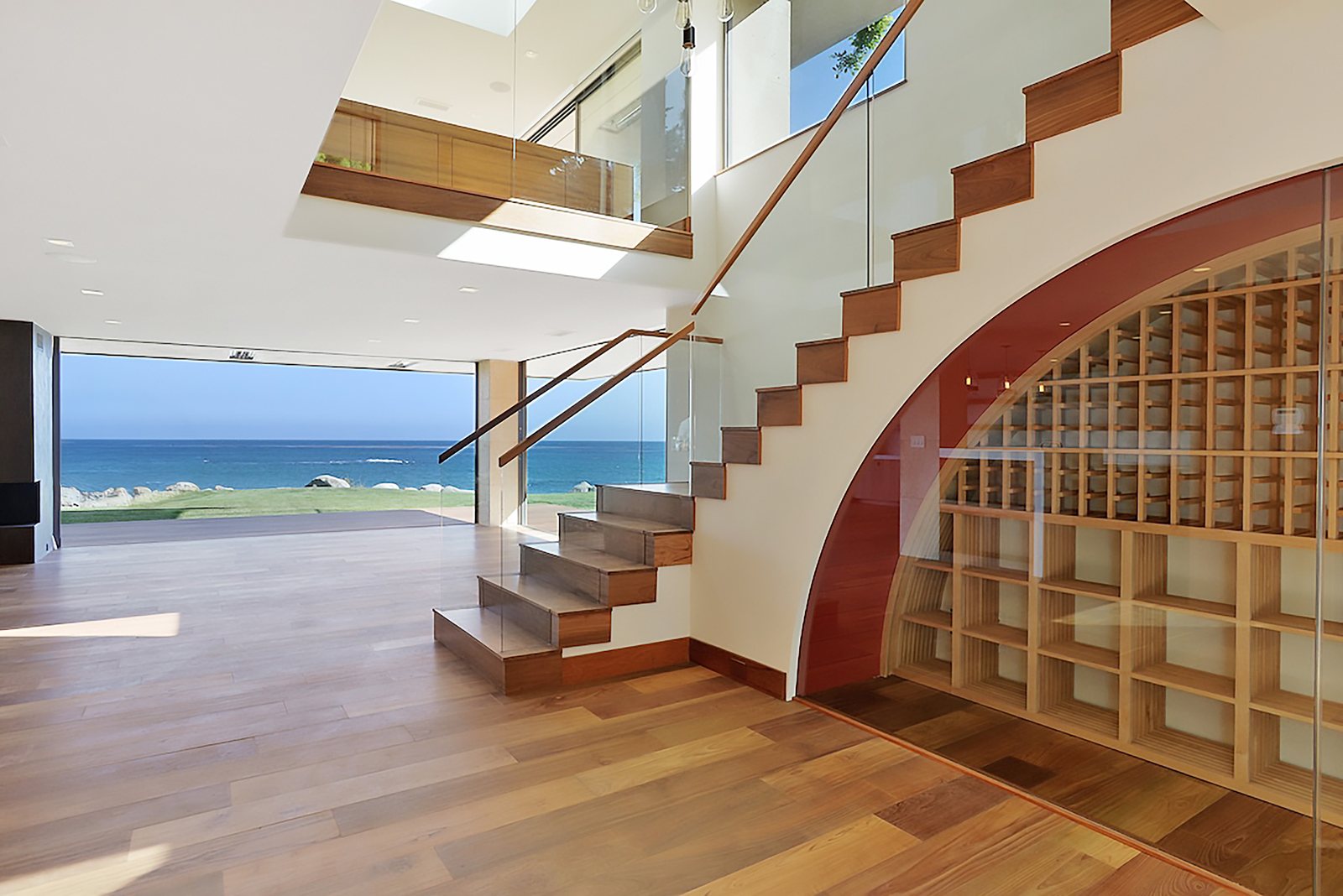
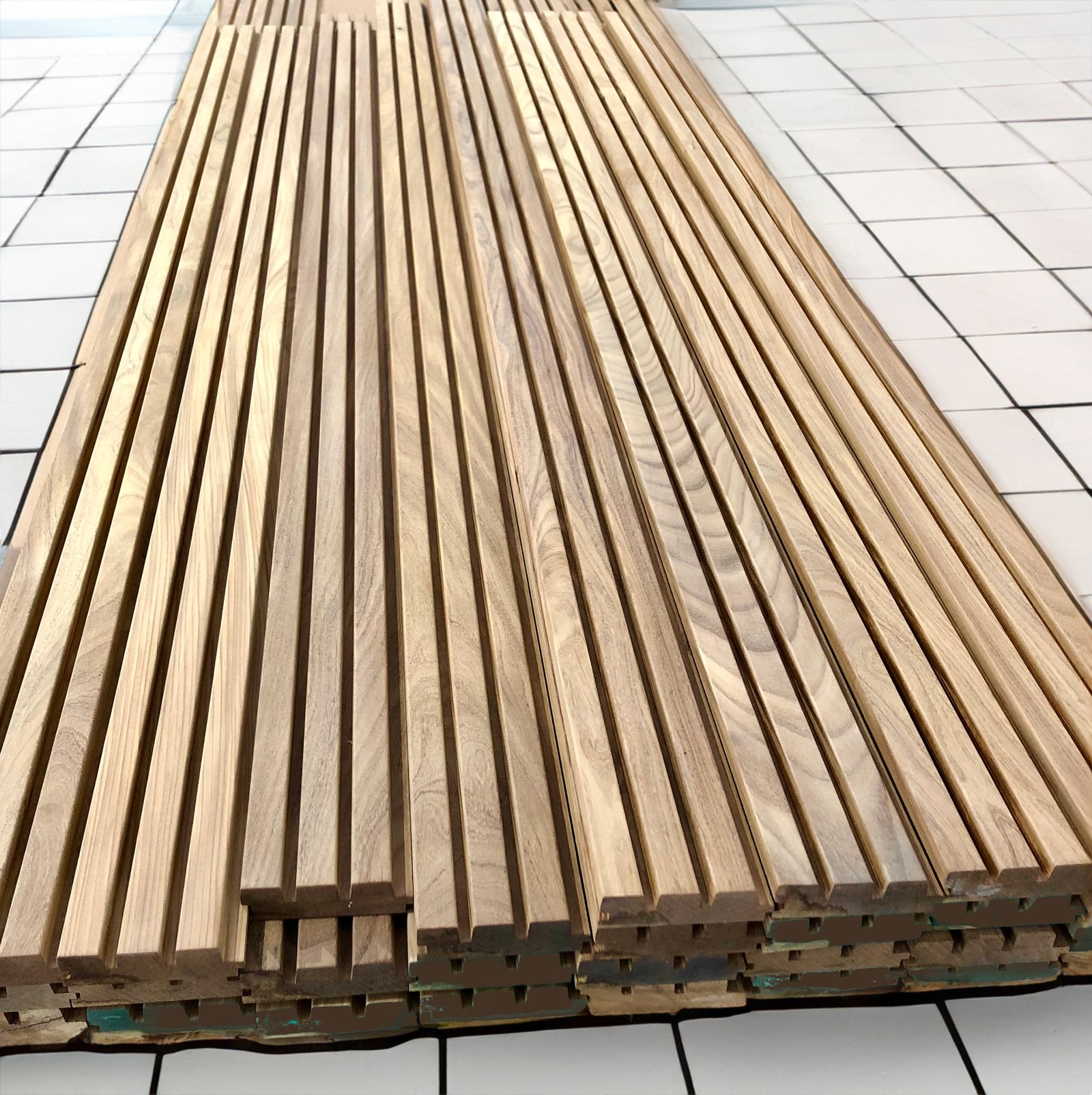
A slat wall is a movement problem solved with reveals, and the reveal only reads clean if every board is the same width. The eye forgives a lot on a slat wall. It does not forgive a gap that tapers from 12 ft up the wall to 10 ft, which is what happens when boards come off a ripping operation that chases the widest cut out of each piece instead of holding one dimension.
J. Gibson McIlvain rips teak to one consistent width on straight line and gang rip saws, so a 3 inch slat is a 3 inch slat at the top of the run and at the bottom. That consistency is what lets a designer call a 1/2 inch reveal and get a 1/2 inch reveal. It also lets the installing carpenter work from a spacer block rather than from a tape measure on every course.
Behind the face there is a second decision. Slats screwed or pinned to vertical battens leave an air space, which is the condition a narrow board wants. Slats bonded continuously to a panel substrate give up that air space and put every bit of seasonal movement into the adhesive line. The fabricator building the panels makes that call, and the substrate, the fastening pattern and the blocking in the wall belong to the buyer's own shop and installer.
Finish all four faces. A slat finished on the show face and left raw on the back takes on and gives off moisture unevenly, and the board twists. Teak takes a penetrating oil or a hardwax finish beautifully and takes a film finish only after the surface has been prepared for it, which is a function of the species oil content rather than of the width.
One more item for the drawing set. Interior wall and ceiling finishes are regulated for flame spread and smoke development under the interior finish provisions of the building code, and the International Code Council publications govern. A code consultant confirms what the occupancy requires before material is ordered.
Ceiling Boards and the Overhead Problem
A teak ceiling fails at the edge detail and the fastener long before it fails on the face. Overhead, gravity works against the installer all day, and there is no second chance to re nail a board once the one beside it is up. Narrow boards weigh less per piece, go up faster, and let a tongue and groove or shiplap edge carry the fastener out of sight.
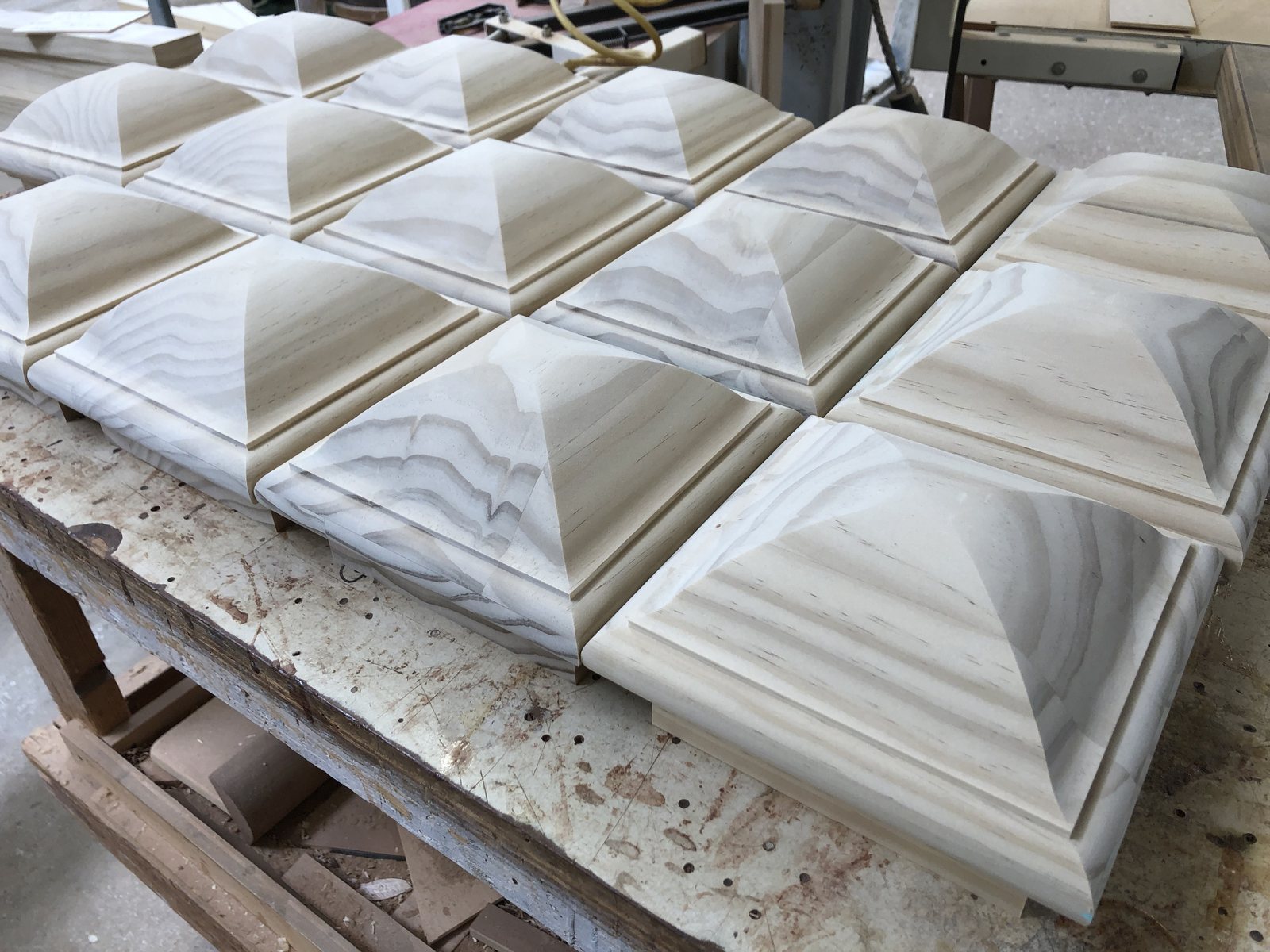
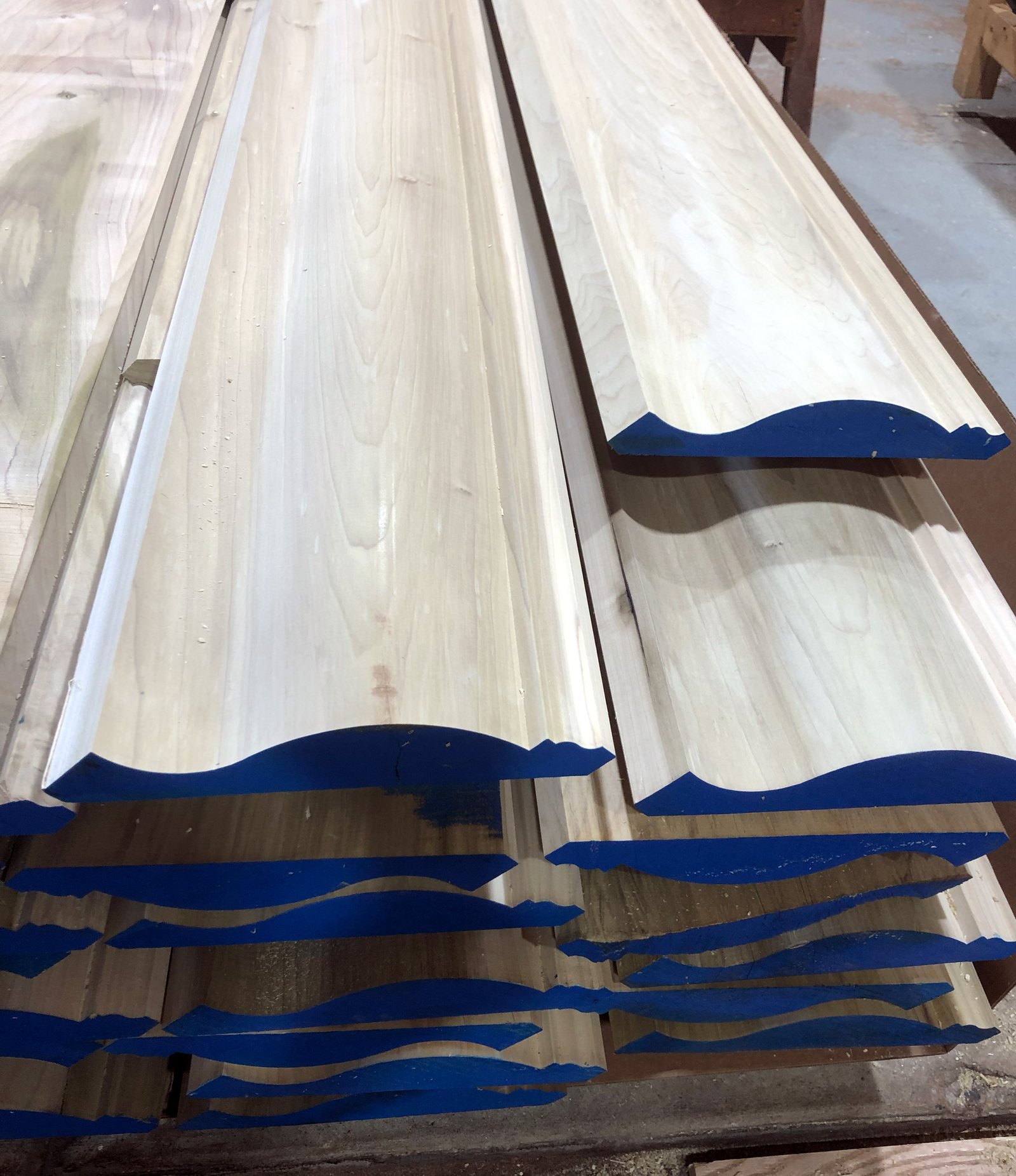
That edge is a milled profile, which means it is a knife. J. Gibson McIlvain grinds the knife when a ceiling board edge, a handrail cap or a trim section has to match something already in the building, drawing on a profile library that holds thousands of ground profiles with new knives cut every week. A historical match and a contemporary micro shiplap are the same kind of problem to a knife grinder, and both start from a physical sample or a full size section drawing.
Ceiling plenums stratify. Hot air collects at the top of a room, and the space above a finished ceiling can sit warmer and drier than the occupied volume below it. A board with its show face in the room and its back face in that plenum carries a moisture gradient across its thickness from the day it goes up, which argues for narrow widths and for an edge detail that lets boards move relative to one another.
Acclimation is the installer's step and it is not optional. Material goes into the space, the building runs at its service temperature and humidity, and the boards sit until they stop changing. The Architectural Woodwork Institute quality standards describe the in service conditions that architectural woodwork is built to, and a ceiling installed into a building that has not reached those conditions will move after the scaffolding comes down.
Stair Treads Built Up From Narrow Staves
A tread glued up from 3 or 4 inch vertical grain staves stays flatter than a single wide slab tread of the same species. A stair tread is a flat surface under load, fixed at both ends, walked on in the middle, and visible on its nose from below. Nothing about that assembly tolerates a cup or a twist.
Build it from narrow staves, all of them quartersawn or rift, and the movement across the finished tread is the sum of several small movements running in the same direction rather than one large movement in whatever direction the ring pattern of a single flatsawn board dictates. Quartersawn and rift stock moves less across its width than plainsawn, which is why it is specified where a panelized surface has to stay flat. A stave built tread is that principle applied three or four times across a 10 inch run.
Thickness comes off rough numbers. Hardwood thickness is quoted in quarters of an inch of rough thickness, so 4/4 is nominal 1 inch rough, 8/4 is 2 inches and 16/4 is 4 inches, and the surfaced dimension a shop drawing calls out comes off those rough numbers after milling. A tread finishing at 1 inch and a tread finishing at 1 1/2 inches start from different rough thicknesses, and the stave stock has to be ordered accordingly.
The nose is the part people touch. J. Gibson McIlvain grinds a knife to match an existing nosing profile when treads are going into an occupied building beside a stair that stays, which is the common condition in a phased renovation. Rise and run, tread depth, nosing projection and the slip resistance of the finished surface belong to the stair builder and the code review, and the US Access Board's ADA standards are the reference for the accessible route.
Where the stair, the slat wall and the ceiling are one designed assembly rather than three orders, ICD, the company's architectural millwork division, builds the custom work planned around that specific space. Its working process starts from the drawing and the space rather than from a catalog of modules.
Gluing and Machining Teak Without Fighting Its Oil
Teak carries natural oils and silica, which dull tooling and complicate adhesion, and both of those facts change how an interior assembly gets built. On a slat wall or a ceiling the answer is to design the glue out. Boards set with reveals, tongue and groove, or shiplap edges are mechanically fastened, so the field of the surface carries no adhesive at all and seasonal movement is absorbed in the joint rather than resisted by it.
Built up treads and stave tops do need glue, and there the discipline is the schedule. Freshly machined faces bond better than faces that have sat a week collecting migrated oil, so machining and glue up belong close together in the fabricator's sequence, with test joints pulled from the actual lot rather than from a sample board. Adhesive selection and clamp pressure are the buyer's own shop's call, and a shop that has glued teak before already knows this.
Silica is hard on knives. Milling teak is done with carbide tooling and with the expectation of resharpening sooner than a run of Walnut or Poplar would require. J. Gibson McIlvain resaws and rips dense oily stock on band resaws and gang rip saws set up for that work, which is a different setup from the one used on a soft domestic hardwood.
Teak sits inside the millwork palette for a reason. The species a millwork house reaches for are Sapele, Iroko, Afrormosia, Teak and Utile, the last of which is sold as Sipo. Sapele runs roughly 1,410 lbf on the Janka scale, Hard Maple roughly 1,450 lbf, White Oak roughly 1,360 lbf, White Ash roughly 1,320 lbf, Red Oak roughly 1,290 lbf and Black Walnut roughly 1,010 lbf, all of them machinable and glueable in a cabinet shop.
The tropical decking species are a different animal. Ipe, which is Tabebuia spp, along with Cumaru, Garapa, Jatoba and Red Balau, are extremely hard and carry high oil content, which makes them difficult to glue. They belong on a deck frame rather than in a glued up interior tread, and that is why a millwork shop specifying an interior surface reaches for the palette species instead. The Wood Database entry for teak carries the working properties and the hardness figure for the species, and it is the right place to check any number this article has not given.
Grading and Thickness for Narrow Interior Stock
Hardwood grade describes yield, not appearance, and ordering narrow interior stock by the wrong grade is the most common mistake on this kind of job. North American hardwood grading runs on the National Hardwood Lumber Association rules, which grade a board by the yield of clear face cuttings it will produce. Teak is imported and is not graded under them, so an interior order uses the terms as shared language and then writes its own yield requirement.
FAS is the top grade. It requires a minimum board of 6 inches wide by 8 ft long yielding 83 and 1/3 percent clear face cuttings. FAS One Face, written F1F, meets FAS on the better face. Selects meet FAS on the better face at a smaller minimum size. No. 1 Common requires 66 and 2/3 percent and a minimum board of 3 inches by 4 ft. No. 2A Common requires 50 percent.
Read those numbers as yield and the ordering logic falls out. A No. 1 Common board is not defective, it simply yields smaller clear cuttings, which makes it the economical grade for short parts and the wrong grade for long clear runs. Slat stock cut to 8 ft courses and stave stock for treads are short parts. A continuous handrail cap running 16 ft without a joint is not, and it wants the upper grades at the length it is drawn.
Grain orientation is a separate call from grade and has to be written separately on the order. Quartersawn and rift are sawing and selection specifications, not grade designations, and a board can be FAS and flatsawn or No. 1 Common and rift. A specification that says FAS teak and expects vertical grain has left the important half unwritten.
Thickness is the third axis. Quoting in quarters of rough thickness keeps the conversation honest about what is available, since a 4/4 board surfaced two sides does not finish at 1 inch, and a shop drawing that calls for a full 1 inch finished face needs 5/4 or thicker in the rough. The Wood Moulding and Millwork Producers Association publishes the dimensional conventions the trade works from.
Choosing Between 3, 4 and 5 Inch Teak
The width that suits the application is the one whose movement the joint can absorb, which is a different question in a slat wall than in a tread. The table below sorts the three widths by the work each one does well. All three carry the same in service moisture target, the same grain orientation options and the same finish requirements, since width changes movement and seam count, not species behavior.
| Nominal width | Movement across the face | Interior work it suits | What to plan for |
|---|---|---|---|
| 3 inch | Smallest of the three, well under half that of an 8 inch board at the same orientation | Wall slats with a pronounced reveal, interior ceiling boards, stave stock for narrow treads, bench and chair slats | Highest piece count and the most fasteners, so installer labor rises as movement falls |
| 4 inch | Roughly half that of an 8 inch board of the same species and orientation | Ceiling boards with a milled tongue and groove or shiplap edge, slat walls on battens, built up tread staves, handrail cap blanks | The common middle for vertical grain plantation teak, and the width most profiles are ground around |
| 5 inch | More than a 4 inch board and still well under a wide flatsawn face | Wider ceiling boards, stair tread staves where fewer glue lines are wanted, interior trim and jamb stock | Vertical grain at this width needs larger diameter logs, so width and grain orientation have to be agreed together |
Mixing widths on purpose is a legitimate design move. A wall laid in a repeating 3, 4 and 5 inch rhythm reads as deliberate rather than as a shortage, and it lets a fabricator use the stock efficiently across a long run. What it requires is that the rhythm be drawn and dimensioned rather than left to the carpenter on the wall.
Plantation Supply, Records and What Can Be Warranted
Plantation teak gives a project repeatability at narrow widths, and repeatability across phases is usually what the job is actually buying. Shorter rotations and smaller logs cap width and length, and in exchange the narrow widths come consistently, lot after lot, in a way material on allocation never does.
Phasing is where that matters. A lobby slat wall installed this year and a stair enclosure installed eighteen months later have to read as one surface. J. Gibson McIlvain matches a run across phases so the second release reads like the first, and keeps the knife and the order record on file against the day the third phase comes in. Seventh generation and family run since 1798, the company has kept records longer than most of the buildings it supplies have stood.
Sourcing documentation belongs in the submittal rather than in a phone call after the fact. J. Gibson McIlvain is an FSC certified importer and miller, which is what answers a specification carrying chain of custody or responsible sourcing language.
"The question we get on narrow teak is almost always framed as a shortage question, and it is really a geometry question. If you want vertical grain, you are going to get narrow boards, and on a wall or a ceiling that is the result you wanted anyway. I would rather have that conversation at the drawing stage than at the submittal."
Norm Moton, Director of Sales, J. Gibson McIlvain
One expectation has to be set plainly. There is no warranty on solid unmodified wood, and there cannot be, since it is an organic material responding to its environment. Warranties exist only on modified products, Accoya among them along with Thermory and Abodo Vulcan, and those belong to exterior work rather than to an interior teak slat wall. Modified material also tops out around 16 ft, most of it sold on metric lengths just under 16 ft because of kiln size, and thermally modified Ash is not available wider than 8 inches, so wide boards in a modified product means Accoya or Abodo Vulcan.
Species selection for interior work is not a hierarchy with teak at the top. Cedar remains a legitimate default where its properties suit the detail, and there the grade call matters more than the species call, which is CVG, clear vertical grain, against STK, select tight knot.
How J. Gibson McIlvain Would Specify This
A complete order for narrow interior teak names six things, and an order missing any one of them comes back with a question before it comes back with material. Write them into the millwork section of the specification rather than leaving them to a submittal exchange.
Species and botanical name, which is Teak, Tectona grandis. Nominal width, called as 3, 4 or 5 inch and stated as a held dimension rather than as a minimum. Grain orientation, written as quartersawn or rift and separate from the grade line. NHLA grade at the length required, with the understanding that a long clear run and a short part want different grades. Rough thickness in quarters, with the finished dimension the shop drawing needs stated beside it. Profile, by physical sample or full size section where an edge or a nosing has to match.
Moisture content is the seventh line and the one that gets forgotten. J. Gibson McIlvain mills interior teak to a 6 to 8 percent in service moisture content, which is the band a conditioned building holds, and exterior work to 12 to 16 percent, and width does not change either target. Stating the number on the order is what makes it verifiable on arrival with a meter.
What belongs to the buyer's side should be written down too. Substrate, battens and blocking, fastening pattern, adhesive selection, acclimation in the conditioned space, field cutting and the finish applied after installation are the fabricator's and the installer's scope. The milled material arrives worked to the drawing, J. Gibson McIlvain ships it nationwide, and the wall, the ceiling and the stair belong to the trades that build them.
For a slat wall, a ceiling or a built up stair in narrow teak, send the drawing and the width you want held. Call 800-638-9100 or start from the J. Gibson McIlvain millwork service page, and bring the section detail, since the profile and the width are the two things that decide everything downstream of them.
Frequently Asked Questions
Why is vertical grain teak only available in narrow widths?
Width is set by the log. Quartersawing means sawing radially off each quarter of the log, so the usable width of every board is bounded by the radius available between the pith and the bark. A wide board with true vertical grain requires a large diameter log with that much clear radius to give up. Plantation teak runs to shorter rotations and smaller logs, which caps both width and length, and 3, 4 and 5 inch widths are the part of that supply that repeats reliably. Asking for vertical grain and a 10 inch width at the same time is asking for two things that work against each other.
Is a stair tread glued up from narrow staves as good as a solid wide tread?
For flatness it is better. Movement across a board scales with width, so several narrow quartersawn or rift staves each move a little in the same direction instead of one wide flatsawn board moving a lot in whatever direction its ring pattern dictates. The glue lines are visible as grain changes if the staves are not laid out with care, so stave layout belongs on the shop drawing. Thickness is ordered in quarters of rough thickness, and the finished tread dimension comes off that rough number after milling.
What width should I specify for a teak slat wall?
Pick the width by the reveal and the piece count you are willing to install. A 3 inch slat with a wide reveal gives the most pronounced rhythm and the least movement per board, with the highest fastener count. A 4 inch slat is the common middle for vertical grain plantation teak and the width most edge profiles are ground around. A 5 inch slat reduces piece count and still stays well under a wide flatsawn face. Whichever you choose, specify it as a held dimension rather than as a minimum so the reveal stays constant down the wall.
What moisture content should interior teak be milled to?
Interior work lands near 6 to 8 percent moisture content, which is the band a conditioned building holds through the year. Exterior work runs near 12 to 16 percent. J. Gibson McIlvain mills interior teak to the 6 to 8 percent range, and width does not change the target. Put the number on the purchase order so it can be checked with a meter when the material arrives, and let the boards acclimate in the finished space before anything goes on the wall or the ceiling.
Which NHLA grade makes sense for slat and stave stock?
Grade describes clear face cutting yield rather than appearance. FAS requires a minimum board of 6 inches by 8 ft yielding 83 and 1/3 percent clear face cuttings, No. 1 Common requires 66 and 2/3 percent at a minimum of 3 inches by 4 ft, and No. 2A Common requires 50 percent. Slats cut to 8 ft courses and staves for treads are short parts, which is exactly what No. 1 Common is efficient for. A continuous 16 ft handrail cap with no joint is a long clear run and wants the upper grades at that length. Grain orientation is a separate line on the order from grade.
Is there a warranty on solid teak millwork?
No. It is not possible to warranty solid unmodified wood, which is an organic material responding to its environment. Warranties exist on modified products, Accoya along with Thermory and Abodo Vulcan, and those are exterior materials rather than interior slat wall or tread stock. Modified products also top out around 16 ft, most of them sold on metric lengths just under 16 ft because of kiln size, and thermally modified Ash is not available wider than 8 inches.
Does J. Gibson McIlvain install a slat wall or a teak ceiling?
No. The company supplies and mills the material. J. Gibson McIlvain rips teak to one held width, grinds a knife when an edge or a nosing profile has to match something existing, mills interior stock to a 6 to 8 percent in service moisture content and ships the order nationwide. Substrate, battens and blocking, fastening pattern, adhesive selection, acclimation on site, field cutting and the applied finish are the buyer's fabricator and installer. Where the stair, wall and ceiling are one designed assembly, ICD, the company's architectural millwork division, builds the custom work planned around that space.
Sources and Standards Referenced
- Wood Handbook, Chapter 4: Moisture Relations and Physical Properties of Wood, USDA Forest Products Laboratory
- National Hardwood Lumber Association
- BSD-138: Moisture and Materials, Building Science Corporation
- Teak (Tectona grandis), The Wood Database
- Architectural Woodwork Institute
- Wood Moulding and Millwork Producers Association
- ADA Standards, US Access Board
- Forest Stewardship Council