What a Divided Lite Assembly Is Actually Made Of
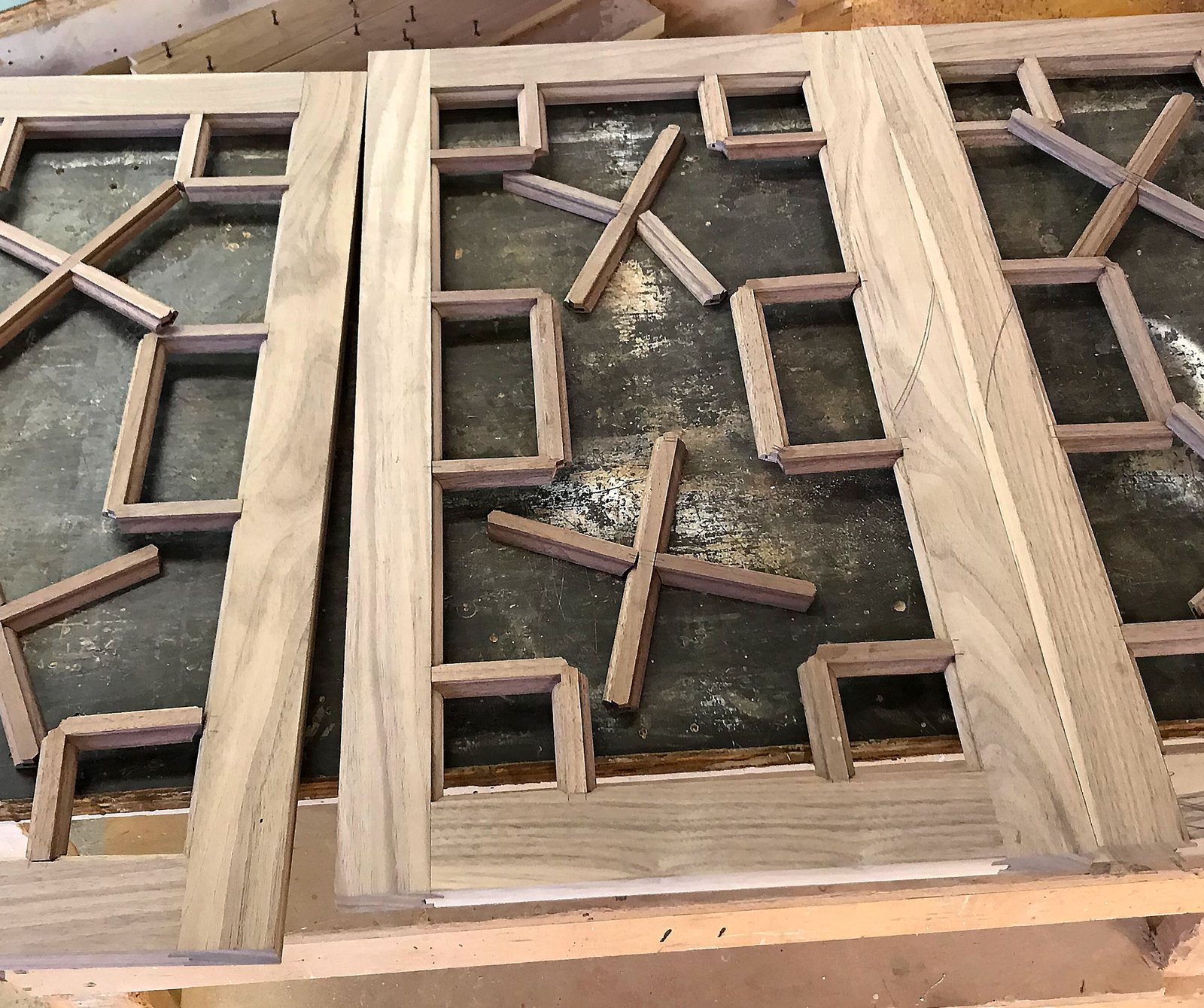
A divided lite door or sash is three milled systems working as one, and the muntin bar is the only part a person standing in the room actually reads. Stiles and rails carry the load and the hardware. Glass carries the view. The muntin bar carries the design, and it does so at a scale of eighths of an inch.
Three constructions dominate. True divided lite, where each pane is an individual piece of glass set into a milled muntin grid that is structural. Simulated divided lite, where a single glass unit gets bars adhered to both faces, usually with a spacer bar inside the airspace so the shadow lines up. And the removable grille, a light frame that drops into the opening and comes back out for cleaning.
The three are not interchangeable in appearance, and a drawing that just says "divided lite" has not decided anything yet. A muntin grid built as true divided lite has real depth, real shadow and a putty or stop detail that catches light differently at every hour. An adhered bar on insulated glass reads flatter unless the profile and the spacer are handled with care. ICD, the architectural millwork division of J. Gibson McIlvain, builds custom doors and windows in all three constructions, and the first question in the shop is always which one the elevation is drawn to.
Sight Line, the Number That Decides the Elevation
Sight line is the visible face width of the muntin measured from glass edge to glass edge, and it is the single dimension that separates a door that looks right from one that looks almost right. Everything else about a divided lite assembly can be correct while the sight line is wrong, and the eye will still catch it from across a courtyard.
Common specified widths run from about 7/8 inch for a fine residential sash, through 1 1/8 and 1 1/4 inch for heavier entry work, up past 2 inches where a period building or a commercial storefront calls for mass. Those numbers sound close together on paper. They are not. Across a 15 lite door, a 1/8 inch difference in bar width changes the total glass area by a visible margin and changes the proportion of every single pane.
The second number is lite proportion. A 3 wide by 5 high pattern on a 36 inch leaf produces one rectangle. The same pattern on a 42 inch leaf produces a different one, and if the sidelights keep the original bar spacing while the door stretches, the assembly stops reading as a set. Sight lines should be carried across the door, the sidelights and the transom as one decision rather than three.
Sight line also has to survive the stile and rail layout. A bar that lands on a rail shoulder, or a horizontal muntin that falls within an inch of a lock rail, will look like a mistake even when it measures correctly. Resolving that on paper is faster than resolving it at the bench.
Muntin Profiles and How a Knife Reaches the Drawing
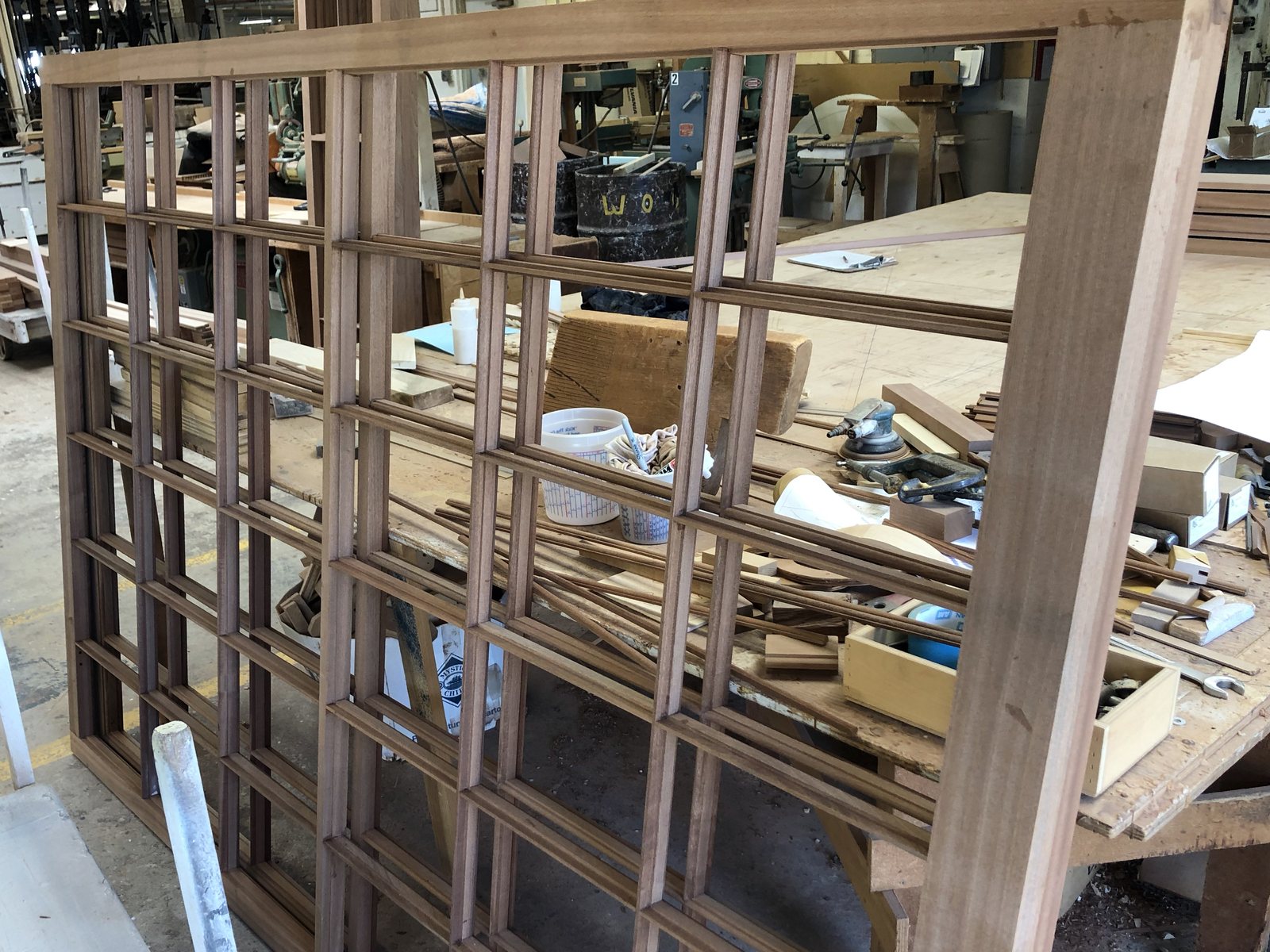
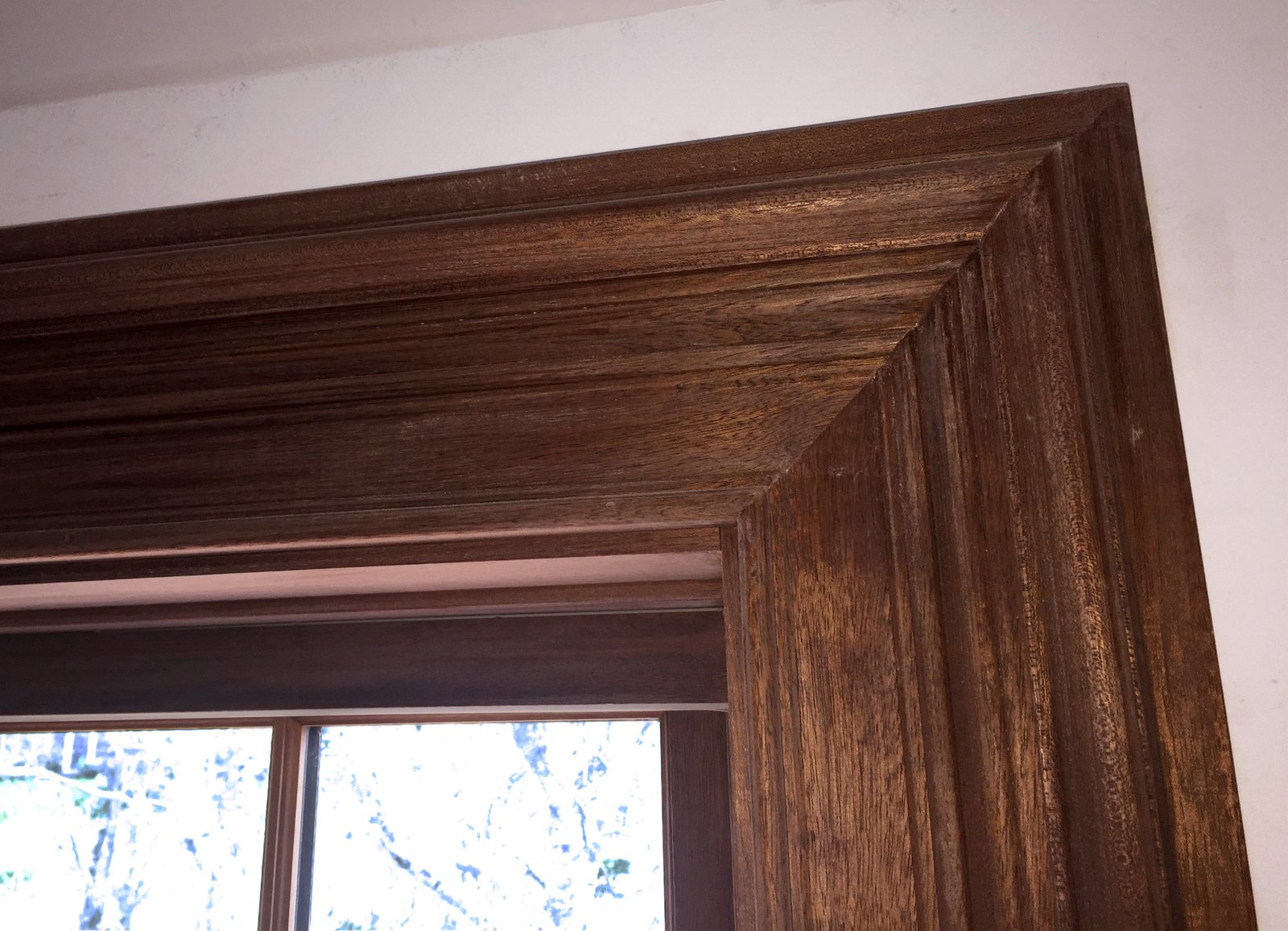
The muntin profile is a ground steel shape before it is a wood shape, and the quality of the knife sets the crispness of every quirk and fillet on the finished bar. Ovolo, ogee, quirked bead, beveled putty glaze and simple square stick each throw a different shadow, and each demands a different grind.
J. Gibson McIlvain holds a moulding profile library of thousands of ground knives and grinds new ones every week, which means a muntin profile does not have to exist yet to be specified. A rubbing taken off an existing sash, a shop drawing, or a dimensioned section from an architect all arrive at the same place, which is a knife ground to match and a sample run for approval before production starts. Historical restoration profiles and contemporary ones get the same treatment.
Profile depth matters as much as face width. A muntin with a deep ovolo and a tight quirk holds a shadow line all day. A shallow radius on the same face width washes out by mid morning and reads as a painted stripe. On exterior work the profile also has to shed water off the horizontal bars, which usually means a slight wash on the top face rather than a flat shelf that holds moisture against the glazing seal.
Where the bars intersect, the shop cuts a coped joint so the profile runs through the crossing uninterrupted. A mitered intersection can be made to work, but a cope holds its line better through seasonal movement and is the safer detail on a tall assembly. The profile itself decides which is appropriate, and that is a bench decision made against the actual knife, not a note on a drawing.
Species That Belong in a Muntin Bar
A muntin bar is a small section carrying a long span, so it wants a species that is stable, straight grained, and willing to hold a crisp arris at the knife. The millwork palette here is Sapele, Iroko, Afrormosia, Teak and Utile, and those five cover nearly every exterior and high traffic interior divided lite assembly worth building.
Sapele is the workhorse at roughly 1,410 lbf on the Janka scale, with tight interlocked grain that machines cleanly and takes paint better than Genuine Mahogany, which is why it is the preferred choice for painted exterior work and why it comes in a wider range of sizes and longer lengths. Utile machines similarly and runs a bit calmer in figure. Iroko and Afrormosia both bring high natural durability for exposed sash and door work. Teak sits at the top for weathering behavior and for assemblies that will be left to go silver.
Interior work opens the palette further. White Oak at roughly 1,360 lbf and Hard Maple at roughly 1,450 lbf both hold an edge well under a clear finish. Cherry at roughly 950 lbf is softer and darkens with light exposure, which is worth knowing when half the bar sits in a sunbeam and half sits in shadow. Genuine Mahogany at roughly 800 lbf still has a place in interior stain grade work where its color and stability are the point.
The tropical decking species come up in conversation and should be set aside here. Ipe, botanically Tabebuia spp, along with Cumaru, Garapa, Jatoba and Red Balau, are extremely hard and carry high oil content that makes them difficult to glue reliably. A muntin grid is nothing but small glued and machined joints, so a millwork house reaches for Sapele, Iroko, Afrormosia, Teak or Utile instead. The technical data behind those choices is worth reading directly, and the Wood Database entry for Sapele and its Iroko and Teak pages are a reasonable starting point.
Selection is where a large holding matters. J. Gibson McIlvain keeps over seven million board feet of exotic and domestic lumber at its Maryland yard, and muntin stock gets pulled from that inventory for straightness of grain and color consistency across a run rather than taken off whatever came in last. On a 20 lite entry with matching sidelights, that selection is what keeps the assembly looking like one piece of work.
Modified Wood in Sash and Muntin Components
Acetylated and thermally modified woods solve dimensional movement in exterior divided lite work, and they are the only wood products in this conversation that carry a warranty at all. Solid unmodified wood cannot be warranted. It is an organic material responding to its environment, and no honest supplier will pretend otherwise.
Accoya sits around 1,600 lbf and its acetylation process delivers dramatically reduced shrinkage and swelling, which is exactly what a narrow bar sandwiched between two glazing seals needs. Less seasonal movement means less stress on the sealant, less telegraphing at the coped intersections, and a paint film that stays intact longer. The chemistry is documented on the Accoya site.
Thermally modified material is the other route. J. Gibson McIlvain carries both Thermory and Abodo Vulcan. Two limits apply to every modified product. Kiln size caps length at around 16 ft, with most material sold on metric lengths just under 16 ft, so a taller assembly has to be designed around that or built from another species. And thermally modified Ash is not available wider than 8 inches, so a wide stile, a wide bottom rail or a wide panel member in a modified product means Accoya or Abodo Vulcan.
For most divided lite grids the width limit is irrelevant, since muntins are narrow by definition. The length limit is the one that bites, usually on a tall stile or a continuous vertical bar running the full height of a two story entry assembly.
Moisture Content and Grain Orientation
A muntin bar has almost no cross section to resist movement, which makes moisture content and grain orientation more consequential here than anywhere else in a door. Get them wrong and the bar bows between intersections, the glazing seal opens, and water starts working at the joint.
J. Gibson McIlvain mills interior millwork to an in-service moisture content near 6 to 8 percent and exterior work near 12 to 16 percent, which is the practical reason an interior lite pattern and an exterior one are not the same order even when they look identical on the elevation. Delivering exterior stock at interior moisture content sets it up to swell. Delivering interior stock at exterior moisture content sets it up to shrink and open every joint in the grid.
Grain orientation does the rest. Quartersawn and rift stock moves less across its width than plainsawn, and on a painted or panelized surface that difference decides whether the finish stays flat. Muntin stock cut quartersawn keeps its face true and keeps the profile reading the same along its whole length. The Forest Products Laboratory publishes the underlying shrinkage data, and the FPL Wood Handbook remains the standard reference for anyone specifying to a moisture target.
Grain selection also affects machining. A bar with runout at a quirk will tear rather than cut cleanly no matter how sharp the knife is. That is a stock selection problem solved at the rack, before the wood ever reaches the moulder.
Choosing Between True Divided Lite, Simulated and Grille
The three constructions differ less in appearance than in what happens at the glass, and that difference determines the whole sequence of the job. True divided lite means many small pieces of glass and many glazing operations. Simulated divided lite means one large unit and a bar applied to its faces. A grille means the glass and the pattern are independent of each other.
Energy performance drives a lot of the decision. Individual insulated units in a true divided lite grid are possible but the sight lines grow, because each small unit needs its own edge seal. Single glazed true divided lite keeps the finest sight lines and is often what a historic district requires, which puts the thermal work on the storm panel instead. The National Park Service treatment of historic wooden windows lays out how that tradeoff is usually resolved on a landmark building.
| Construction | Sight line behavior | What leaves the shop | Glazing work on site | Best fit |
|---|---|---|---|---|
| True divided lite, putty glazed | Finest achievable, real depth and shadow | Milled and assembled sash or leaf with rabbeted muntin grid, primed | Individual panes bedded and puttied by the glazier | Historic replacement and landmark elevations |
| True divided lite, wood stop glazed | Slightly wider than putty glazed, crisp and serviceable | Sash or leaf plus matching milled stops run from the same knife | Panes set and stops fastened, individually replaceable later | Buildings where a single pane will need swapping someday |
| Simulated divided lite with internal spacer | Reads close to true divided lite when spacer aligns with bar | Milled bars and a prepared leaf ready for a glass unit | Insulated unit installed, bars adhered to both faces | New construction with an energy performance target |
| Simulated divided lite without spacer | Flatter, shadow breaks at the glass line | Milled bars and prepared leaf | Unit installed, bars adhered, no internal alignment | Interior assemblies and secondary elevations |
| Removable wood grille | Widest, sits proud of a continuous glass plane | Independent milled grid with clips or turn buttons | Grid set into the opening, removed for cleaning | Retrofit patterns and spaces where glass access matters |
Glazing itself, along with hanging the leaf and sealing the perimeter, belongs to the glazier and the installing carpenter. What the shop controls is everything that makes their work possible, which is a grid milled to the drawn sight line, rabbets cut to the correct glass thickness, and stops run from the same knife as the bars so the profile does not change where the glass is held.
Radius Heads, Elliptical Tops and Curved Muntins
A curved head turns a straightforward lite pattern into a geometry problem, and it is where radius millwork capability stops being a nice extra and becomes the whole job. Segmental arches, full round tops, elliptical heads and gothic points all change how the muntin grid has to be laid out, because the panes at the head are no longer rectangles.
ICD produces radius trimwork and radius millwork alongside its custom door and window work, and a curved muntin gets built by one of two methods. Sawn from solid, where the curve is cut out of thicker stock and the profile is then worked into the curved edge, which keeps the grain continuous but produces short grain at the ends of the arc. Or laminated, where thin laminations are bent around a form and glued, which yields a stronger bar with grain following the curve at the cost of visible glue lines that matter under a clear finish and disappear under paint.
Radial muntins in a fan or sunburst head need a separate decision at the hub. Every bar converges on a single point, and the profile has to be coped into a center block at a different angle for each bar. That is bench work, and it is the reason a fan light takes more bench time than the same number of lites in a rectangular grid.
Springback is the other variable. A laminated curve relaxes slightly off the form, so the form is built to overbend by a small amount that depends on species, lamination thickness and radius. Getting that right the first time is a function of having done it before rather than of any formula.
Priming and Finish on a Divided Lite Assembly
A muntin grid has more surface area and more inside corners per square foot than any other part of a door, which is why the finish schedule fails there first. Every quirk, every cope, every rabbet shoulder is a place a brush can skip and water can sit.
J. Gibson McIlvain primes wood in three levels, in both oil-based and water-based systems, and exterior primed trim carries a fungicide additive. Open-grained and oily species absorb a great deal of finish, so a primer coat evens out the eventual painted surface, and sanding or buffing after priming knocks back grain raising while keeping moulded detail crisp. On a muntin bar that last point is everything, since a heavy uncut primer film will round over the very arris the profile was ground to produce.
Priming before glazing is the correct sequence. Bare wood inside a glazing rabbet that gets sealed behind putty or a stop will never be reachable again, and an unprimed rabbet is the most common origin of rot in an otherwise sound sash. Primed rabbets, primed cope shoulders and primed end grain at every bar termination are the difference between a 15 year assembly and a 50 year one.
Sapele deserves a specific note on painted exterior work. It holds paint better than Genuine Mahogany, which is the main reason it gets specified for painted exterior components. It is not milled 1x8 for exterior use, since that width is too wide to stay stable outdoors. And cupping, when it shows up, is driven by installation and back ventilation rather than by the species itself.
Matching an Existing Elevation
Replacing part of a divided lite elevation is harder than building all of it new, because the existing work sets a sight line and a profile that were never written down. The original knife is gone. The drawing, if it ever existed, is not in the file. What survives is the wood on the building.
The path starts with a physical rubbing or a cut section taken from a sacrificial piece, which gets translated into a knife ground to match. Historical restoration profiles and contemporary ones run through the same grinding process, and a sample is run before any production so the architect or the historic commission can approve the actual shadow rather than a drawing of it. Where a historic district requires like-for-like replacement, that approval step is not optional.
The same logic extends to the rest of the opening. Wood shutters in louver and panel styles get built to complete historical matching for both style and species, which matters when the shutter profile and the muntin profile have to read as one period assembly from the street.
"The sight line is the first thing I ask about and the last thing we check before anything ships. A customer can accept a species substitution and live with it for thirty years. Nobody ever stops seeing a muntin bar that is an eighth of an inch too wide."
Norm Moton, Director of Sales, J. Gibson McIlvain
Phased projects add one more requirement, which is that the profile has to still be available in year three. Keeping the ground knife and the run record on file is what makes phase two match phase one, and it is why a shop that grinds and stores its own knives is worth more on a long project than one that outsources the grinding.
How J. Gibson McIlvain Would Specify This
A divided lite package gets specified as one assembly with one sight line, one profile, one species and one moisture target, and the glass decision made before the knife is ground. That sequence prevents almost every problem described above.
Start with construction. True divided lite, simulated with an internal spacer, simulated without, or a removable grille, chosen against the energy target and any historic review requirement. Then fix the sight line as a dimension and carry it across the door, the sidelights and the transom without variation. Then select the profile, either from an existing ground knife or ground fresh to a rubbing, and require a sample run for approval before production.
Species follows exposure. Sapele, Iroko, Afrormosia, Teak or Utile for exterior and heavy interior work, with Sapele the default on anything painted. White Oak, Hard Maple, Cherry or Genuine Mahogany for interior stain grade. Accoya or Abodo Vulcan where movement has to be engineered out, inside the 16 ft length limit. ICD builds the leaf, the sidelight frames and the muntin grid as a matched set, and J. Gibson McIlvain mills the linear trimwork and primed casing that surrounds the opening off the same order.
Specify the moisture target explicitly, near 6 to 8 percent interior and near 12 to 16 percent exterior, and specify priming on all faces including the glazing rabbets and all end grain. Note that glazing, hanging and perimeter sealing are the installer's and glazier's scope, and that the shop delivers rabbets sized to the actual glass thickness and stops run from the bar knife. J. Gibson McIlvain ships finished millwork nationwide, including regularly to California, so a distant job site is a scheduling question rather than a sourcing one.
For reference on the wider specification framework, the Architectural Woodwork Institute quality standards and the Wood Moulding and Millwork Producers Association profile conventions are both useful, and Building Science Corporation on rain control is worth reading before finalizing any exterior glazing detail.
To scope and schedule a divided lite door, sash or window package, or to have a muntin profile ground to an existing elevation, talk to J. Gibson McIlvain at 800-638-9100 or start with the millwork services overview and the ICD trim profiles page.
Frequently Asked Questions
What sight line should I specify for a custom divided lite entry door?
It depends on the weight of the elevation, not on a rule. Fine residential sash work often lands near 7/8 inch. Entry doors that need presence usually run 1 1/8 or 1 1/4 inch. Period and commercial work can go past 2 inches. The more important requirement is that whatever number you pick gets carried across the door leaf, the sidelights and the transom without drifting, since a sidelight bar an eighth of an inch narrower than the door bar is visible from the sidewalk.
Can true divided lite be built with insulated glass?
Yes, but the sight line grows. Each small pane becomes its own sealed unit with its own edge seal, and that seal has to be concealed inside the muntin, which forces the bar wider than a single glazed equivalent. If the elevation demands the narrowest possible bar, single glazed true divided lite with a separate storm panel is the usual answer, and it is frequently what a historic commission will accept.
Does a simulated divided lite bar need an internal spacer bar?
If you want it to read like true divided lite, yes. Without a spacer inside the airspace, the shadow of the applied bar stops at the glass surface and the pattern looks like it is floating on the pane. With a spacer aligned behind the exterior and interior bars, the eye sees a continuous divider through the thickness of the glass. On interior assemblies and secondary elevations the spacer is often skipped without much loss.
Which species works best for exterior muntin bars?
Sapele, Iroko, Afrormosia, Teak and Utile are the millwork palette for this work. Sapele at roughly 1,410 lbf is the default on anything that will be painted, since it holds paint better than Genuine Mahogany and comes in a wider range of sizes and longer lengths. Iroko and Afrormosia bring natural durability for exposed work, and Teak is the choice where the assembly will be allowed to weather. The tropical decking species such as Ipe, botanically Tabebuia spp, Cumaru, Garapa, Jatoba and Red Balau are extremely hard and high in oil, which makes them difficult to glue, so a millwork shop does not build muntin grids from them.
Can muntin bars be made from Accoya or thermally modified wood?
Yes, and it is a sound choice for exterior sash where movement has to be minimized. Accoya runs around 1,600 lbf and its acetylation gives dramatically reduced shrinkage and swelling. Two limits apply to every modified product. Kiln size caps length at around 16 ft, with most material sold on metric lengths just under 16 ft. And thermally modified Ash is not available wider than 8 inches, so any wide member in a modified product has to be Accoya or Abodo Vulcan. Modified products are also the only wood in this category that carries a warranty. Solid unmodified wood cannot be warranted, since it is an organic material responding to its environment.
How is a muntin profile matched when the original drawings are gone?
With a rubbing or a cut section taken from a sacrificial piece of the existing work. That physical evidence gets translated into a knife ground to match the original shape, and a sample is run and approved before any production begins, so the architect or the historic commission signs off on the actual shadow rather than a drawing of it. Historical restoration profiles and contemporary profiles go through the same grinding process.
Who sets the glass, the millwork shop or the installer?
Glazing, hanging the leaf and sealing the perimeter belong to the glazier and the installing carpenter. What comes off the shop floor is the grid milled to the drawn sight line, rabbets cut to the actual glass thickness being supplied, stops run from the same knife as the bars, and primed surfaces inside the rabbets so no bare wood gets sealed behind putty or a stop.
Sources and Standards Referenced
- USDA Forest Products Laboratory, Wood Handbook and wood properties research
- National Park Service Preservation Brief 9, The Repair of Historic Wooden Windows
- The Wood Database, Sapele
- Architectural Woodwork Institute, quality standards for architectural woodwork
- Wood Moulding and Millwork Producers Association
- Accoya, acetylated wood performance and specification data
- Thermory, thermally modified wood
- Building Science Corporation, BSD-013 Rain Control in Buildings