What a Mudroom Locker Has to Survive
A mudroom locker bank is the only casework in a building that gets soaked, loaded and kicked inside the same ten minutes. Coats come in wet. A backpack lands on the bench with a shoulder behind it. Boots sit in a puddle nobody wipes up until Sunday, and the whole assembly is expected to look like furniture while it happens.
Library built-ins live a gentle life by comparison. So does a dining room sideboard. Locker banks drawn with library shelf details fail in a predictable order, and the failures cluster at the bench nose, the hook rail and the bottom 6 inches of the side panels where standing water finds an unsealed edge.
Buyers asking where to get this made in real domestic or exotic wood are usually asking two questions at once. What carries the load, and what happens to the wood when the room swings from a humid August to a dry January with the heat running. Those are shop questions, not drawing questions, and they get answered in the millwork house rather than on the plan.
ICD, the architectural millwork division of J. Gibson McIlvain, builds entry casework as true custom work planned around the specific space rather than as a run of standard modules pushed together and closed up with filler strips. That distinction shows up faster in a mudroom than anywhere else in a house. The room is narrow, it is interrupted by a door swing, and it is asked to hold more than its footprint suggests.
Where the Loads Actually Land
Almost every structural problem in a locker bank traces back to a point load that the drawing treated as a distributed one. A bench seat is not loaded by a uniform blanket of weight. It is loaded by one adult sitting hard on the front edge, boot in hand, with the whole body mass landing on a strip maybe 4 inches deep at the nose.
Hook rails take a different kind of abuse. A loaded pack hanging off a hook is a cantilever, and the moment it generates tries to pull the top of the rail away from the back panel. Add a teenager who grabs the rail to lever a boot off and the load reverses direction entirely. A rail fastened only into a 1/4 inch back panel is a fastener pull-through waiting for the right Tuesday.
The third load is the one people forget. Shelves above head height carry helmets, sports gear and bins of things nobody has opened in a year, and they deflect slowly under sustained load in a way that short-term handling never reveals. Creep under constant load is a documented behavior of wood in bending, covered in the Forest Products Laboratory Wood Handbook, and it is why a 36 inch open shelf span in a locker bay wants either a thicker section or a stiffener at the back edge.
| Component | What loads or wets it | How the shop responds |
|---|---|---|
| Bench seat and front apron | Point load at the nose from a seated adult, repeated daily | Thicker glued panel, front apron working as a beam, cleats let into the partitions rather than screwed to a face |
| Hook rail and its backer | Cantilever pull from loaded coats and packs, plus occasional downward yank | Solid rail fastened through a full thickness backer captured in dados, not into a thin back panel |
| Cubby back panel | Wet outerwear pressed against it, low airflow | Sealed on both faces before assembly, held in a groove that lets it move seasonally |
| Boot area floor and toe kick | Standing water, salt, grit, direct impact | Removable or sealed tray surround, no unsealed end grain at the floor line, generous reveal above finish flooring |
| Upper storage shelf | Sustained load from bins and gear, long-term deflection | Increased thickness or a rear stiffener, span broken by a partition where the elevation allows |
| Tall side panel or partition | Racking from daily use, plus seasonal movement across the width | Quartersawn or rift stock where flatness is visible, panels captured so they can move without splitting a stile |
Bench Seats, Spans and Point Loads
The bench seat is the one component worth over-building, because it is the only part of the locker bank that carries a person's full weight every day. A seat that flexes underfoot reads as cheap even when nothing is actually failing, and that flex is what opens glue lines at the edge joints over a few seasons.
Two details do most of the work. The first is the front apron. Run a deeper apron below the seat and the effective section depth goes up sharply, which matters far more than adding thickness to the seat itself. The second is how the seat meets its supports. Cleats let into dados in the partitions transfer load into the partition in compression. Cleats screwed to a face rely on fasteners in shear and on a glue line holding.
Seat height is worth fixing early. A seat in the 17 to 19 inch range above finished floor works for most adults pulling boots on, and anything taller starts to feel like perching. Where the entry serves a commercial or institutional building, the governing reach and clearance requirements live with the US Access Board rather than with the millwork shop, and they need to be resolved before the elevation is approved.
ICD builds the seat as a glued panel with the growth rings alternated across the width and the joints cut so the visible face stays flat, then sizes the apron and the cleats to the span the elevation actually calls for. Where a bay runs long enough that a single seat would be marginal, the partition spacing gets adjusted at the drawing stage rather than compensated for with a thicker slab of wood.
Species That Handle a Wet Coat
For entry casework that will show its grain, the millwork palette is Sapele, Iroko, Afrormosia, Teak and Utile, with White Oak, Hard Maple and Cherry as the domestic answers. Each one solves a slightly different problem in a room that has water in it.
Sapele is the workhorse. It machines cleanly, takes a moulded profile without tearing, glues predictably and lands around 1,410 lbf on the Janka scale, which is enough hardness for a bench nose that gets struck with boot heels. The Wood Database entry for Sapele covers its interlocked grain, worth knowing about because it is exactly why the shop takes a light finishing cut rather than a heavy one.
Iroko earns its place where the entry is covered but effectively outdoors, a breezeway bench or a locker bank in an unconditioned garage entry. It handles moisture cycling with less fuss than most, and the Wood Database entry for Iroko notes the calcium carbonate deposits that occasionally turn up in it, which the shop works around at the saw.
Afrormosia and Utile sit close to Sapele in working properties and give a designer a different color range without changing how the parts get built. Teak is the choice when the bench genuinely sits in weather and the client wants a material that is forgiving about it.
Among the domestics, quartersawn White Oak at roughly 1,360 lbf is the obvious pick for a mudroom that reads as traditional, and its ray fleck is a feature rather than a defect. Hard Maple at roughly 1,450 lbf is harder still and takes paint well. Cherry at roughly 950 lbf is soft enough that a bench nose will mark, so it belongs on upper doors and panels rather than on seats.
Worth saying plainly, since exterior projects push people toward them. The tropical decking species, Ipe (Tabebuia spp), Cumaru, Garapa, Jatoba and Red Balau, are extremely hard and carry high oil content, which makes them difficult to glue. A millwork house reaches for Sapele, Iroko, Afrormosia, Teak or Utile instead, precisely because locker casework is a glued and machined assembly rather than a run of separate deck boards.
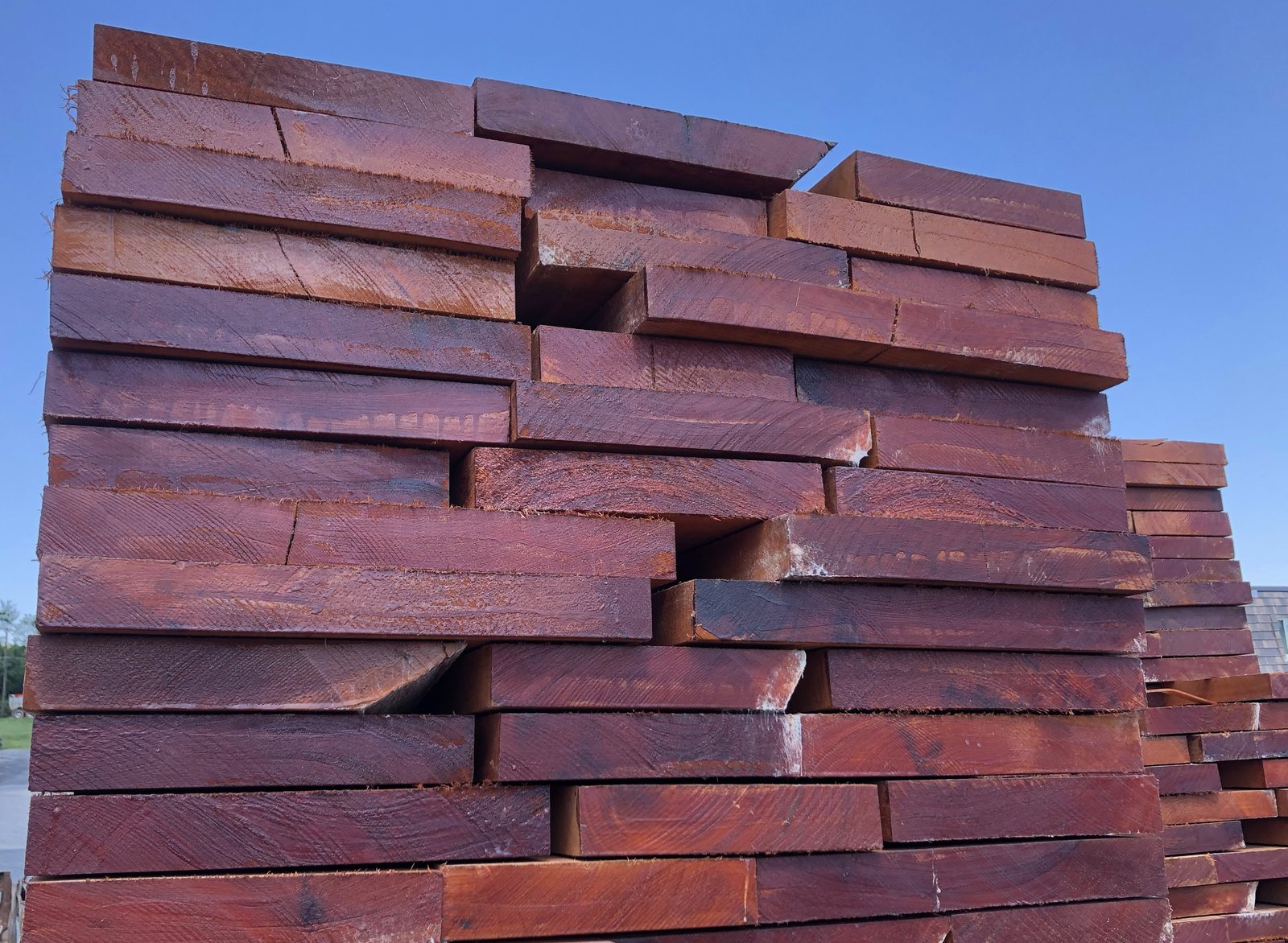
J. Gibson McIlvain holds over seven million board feet of exotic and domestic lumber at its Maryland yard, which is what makes it possible to pull tall locker side panels and a long bench seat from matched stock rather than from whatever three lifts happened to arrive that month. On a locker bank the side panels stand full height next to each other in plain view, and a color mismatch between adjacent bays is the first thing anyone notices.
Moisture Content for a Room That Swings
A mudroom is conditioned space that behaves like a transition zone, and millwork built at the wrong moisture content will telegraph that within one heating season. The door opens forty times a day. Wet gear evaporates into a small volume of air. The room is frequently the coldest conditioned space in the house.
Interior millwork gets milled to an in-service moisture content near 6 to 8 percent. Exterior work runs near 12 to 16 percent. A mudroom is interior, so 6 to 8 percent is the target, but the assembly still has to tolerate stretches where the local air sits well above what the rest of the house sees. That tolerance is designed into the joinery, not into the number.
The mechanism behind it is ordinary moisture physics, laid out well in the Building Science Corporation digest on moisture and materials. Wood equilibrates with the air around it. Panels held in grooves can move. Panels glued rigidly into a frame cannot, and they split or push the frame apart instead.
J. Gibson McIlvain mills locker stock to a 6 to 8 percent in-service moisture content and cuts the panel grooves with seasonal movement allowance built in, so a back panel that picks up moisture in August has somewhere to go. None of that allowance is visible in the finished piece, which is the point.
No supplier can warranty solid unmodified wood. It is an organic material responding to its environment, and anyone offering a warranty on it is describing something other than what they are selling. Warranties exist on modified products. Where a bench genuinely lives outside the door in weather, Accoya at roughly 1,600 lbf brings acetylation with dramatically reduced shrinkage and swelling, and Thermory and Abodo Vulcan cover the modified side alongside it. All of the modified products top out around 16 ft, most sold on metric lengths just under 16 ft, because of kiln size, and thermally modified Ash is not available wider than 8 inches. Wide boards in a modified product means Accoya or Abodo Vulcan.
Joinery That Takes Daily Abuse
Entry casework is a racking problem before it is a load problem, and housed joinery beats fasteners every time. A locker bank is tall, shallow and open at the front, which is the geometry least able to resist being pushed sideways. Every time someone leans a shoulder into a bay to wrestle with a zipper, the assembly takes a racking load.
Shelves and partitions housed in dados hold the carcass square by geometry. Shelves screwed to the inside of a panel rely entirely on fasteners, and fasteners in a panel edge loosen with cycling. The back panel is the other bracing element, which is why it should be captured in a groove on all four sides rather than nailed to the back edge as an afterthought.
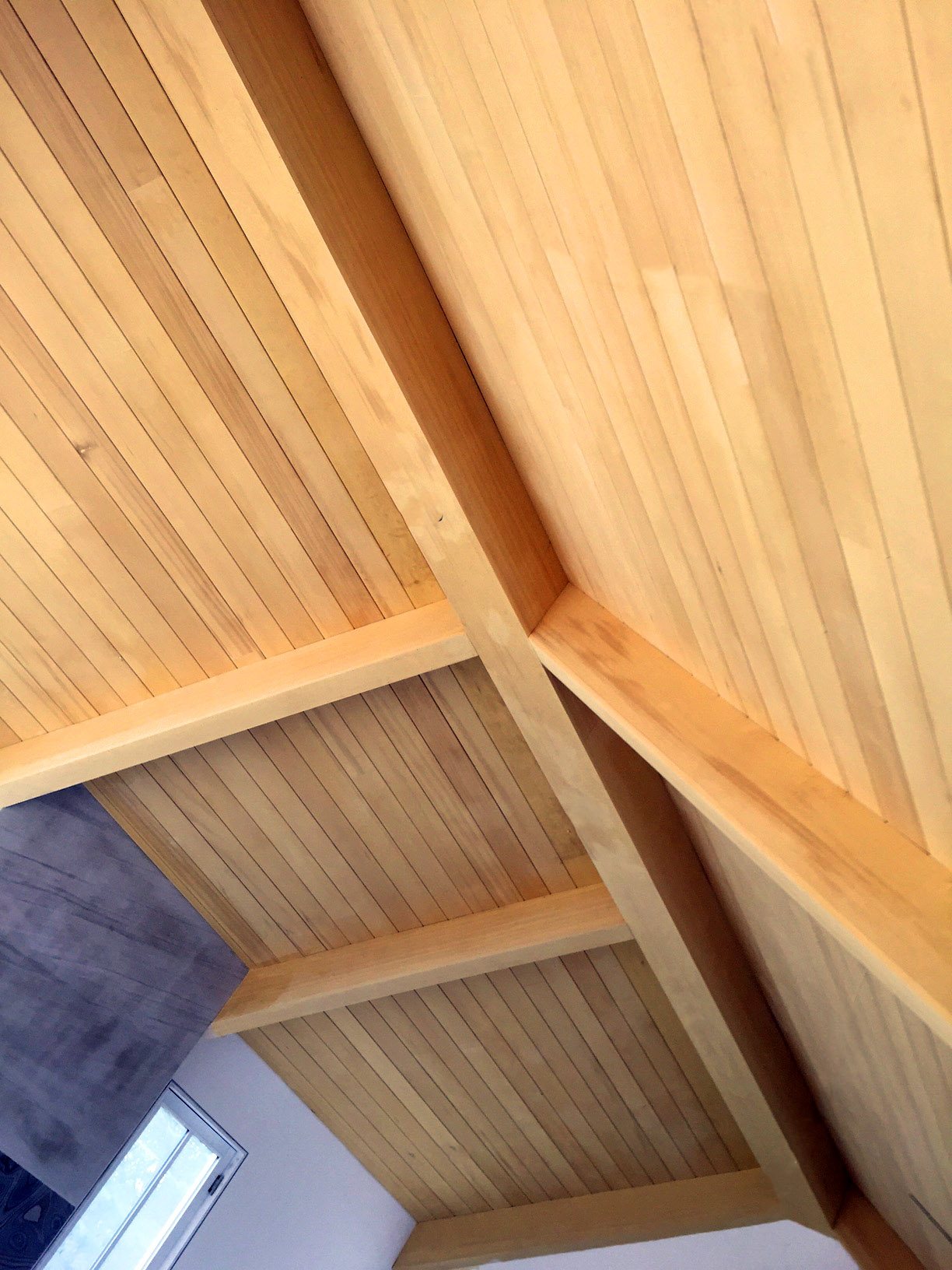
Box beams show the same logic at a larger scale, and the shop builds them three ways. Butt joints give the most minimal profile, the fastest turnaround and the easiest on-site assembly, but they leave visible seams and visible end grain and are the weakest of the three. Dado joints are strong and still easy to assemble on site while still showing seams and end grain. Lock miter joints show no visible seams and are the strongest. Where a mudroom ceiling carries a beam treatment over the locker bank, that choice belongs in the specification and not in the field.
The reference standards for casework construction grades, joinery and tolerances come from the Architectural Woodwork Institute, and naming a construction grade in the specification is the fastest way to strip ambiguity out of a bid set. It tells every shop pricing the work the same thing about what the drawer boxes and the carcass joints are supposed to be.
Hook Rails, Cap Moulding and Profile Records
The mouldings on a locker bank are structural in one case and purely visual in the rest, and the specification should say which is which. A hook rail is structure. It carries a cantilevered load, it gets grabbed, and its profile needs enough material behind the bead to hold a fastener without splitting.
The cap moulding across the top, the base at the floor line and the bead around each bay opening are all visual. Their job is to tie the bank into the existing trim in the house, which frequently means matching a profile that was run decades ago. J. Gibson McIlvain keeps a profile library holding thousands of ground knives and grinds new knives every week, so a locker bank going into a house with unusual existing casing gets mouldings that match rather than mouldings that are close. Where nothing in the library fits, the knife gets ground to match the sample, including difficult historical restoration and contemporary profiles.
That matters for phased work. A client who does the mudroom this year and the back hall next year needs the same profile both times, and a ground knife on file is what makes the second run identical to the first. The Wood Moulding and Millwork Producers Association maintains the standard profile numbering that a lot of architects still specify from, and matching a WM number is straightforward when the library is deep.
ICD documents the profiles used on a job along with the rest of the drawing package, which is the step most people skip and then regret. A profile record is cheap to keep and expensive to reconstruct from a photograph. More on how those profiles get originated and matched sits on the ICD trim profiles page.
Painted Lockers and the Primer Underneath
Most mudroom lockers get painted, and the primer decides how the finished surface looks far more than the topcoat does. Paint sits on whatever is underneath it. A surface that drank the first coat unevenly will read unevenly no matter how many finish coats follow.
Open-grained and oily species absorb a great deal of finish, so a primer coat evens out the eventual painted surface, and sanding or buffing after priming knocks back grain raising while keeping moulded detail crisp. That last part is where shop priming separates from field priming. A moulded bead sanded aggressively in the field loses its crispness, and a hook rail profile rounded over by a sanding block stops reading as a profile at all.
J. Gibson McIlvain primes millwork in three levels, in both oil-based and water-based systems, so a specification can name how far the finish is carried before the parts leave. For a painted locker bank being topcoated on site, a shop-primed and sanded surface is what lets the painter put on two coats and be done rather than fight grain raise on an assembled carcass.
Species selection interacts with this directly. Paint-grade lockers do not need Sapele grain, but they do need stock that stays flat, and quartersawn and rift stock moves less across its width than plainsawn, which is why it gets specified where a painted or panelized surface has to stay flat. A painted stile that cups after the first winter throws a shadow line that no amount of touch-up hides.
The grading rules behind what arrives in the shop come from the National Hardwood Lumber Association for domestic hardwoods. A paint-grade specification that ignores grade is a specification that will get quoted three different ways by three different shops.
Boot Drawers and Mechanical Obstacles
The lower third of a mudroom locker is where custom work stops being cosmetic and becomes the only option. Entry walls carry things. Baseboard heat, a return air grille, a hose bib on the other side of the wall, an electrical panel that cannot legally be covered. Standard cabinet modules meet these obstacles and lose.
ICD engineers storage around plumbing and mechanical obstructions rather than around a module width, the same approach the division takes to kitchen cabinetry, where building around how a space is actually used is what eliminates filler strips and mismatched face frames. In a mudroom the equivalent win is a boot drawer that runs the full width of a bay instead of stopping short of a heating pipe.
Specialty drawers matter here more than in most rooms. A boot drawer wants a different depth from a glove drawer, and a drawer holding wet footwear benefits from a removable tray that can be pulled and rinsed. None of that is a catalog item. It gets drawn, built and fitted to the opening, which is what the ICD cabinets and casework side of the division does.
Where the locker bank carries a stone or solid surface top over a lower cabinet run, the construction has to be tailored to the countertop material being carried. A heavy slab wants continuous support and a different substrate than a wood top does, and that decision belongs in shop drawings rather than in the week the fabricator shows up to template.
What Arrives and What Happens On Site
A locker bank arrives as finished components with a clear assembly sequence, and the installing carpenter supplies the scribe, the shim and the fastening to structure. Knowing that split in advance changes what gets asked for in the shop drawings.
Scribe allowance is the item most worth confirming. Entry walls are rarely plumb and mudroom floors are rarely flat, especially where a slab steps down to a garage. Side panels and end panels need enough material left on the scribe edge to be cut to the actual wall, and the reveal detail at the cap and the base has to be deep enough to absorb whatever the scribe cannot.
Fastening to structure is the other one. A hook rail carrying loaded coats should be landing in blocking, not in drywall, and blocking has to be in the wall before the rock goes up. That is a framing decision made weeks before the millwork arrives, which is why the shop drawing should show hook rail height and backer location clearly enough for the framer to act on it.
Finished millwork also has to be protected between delivery and installation. Entry casework often lands while the entry is still the main path for every other trade on the job, and a bench seat leaned against a wall in that traffic is a bench seat that will need refinishing.
How J. Gibson McIlvain Would Specify This
Specify the load path, the moisture content, the species and the finish level, and the rest of the locker bank resolves itself. Most mudroom millwork that disappoints was specified as an elevation and nothing more.
Start with the bench. Name the span, the apron depth and the cleat detail, then confirm that partitions land where the seat needs them rather than where the elevation happened to draw them. Name the seat height. Name the hook rail backer, and get blocking onto the framing drawings while the walls are still open.
Species next. Sapele, Iroko, Afrormosia, Teak or Utile where the grain shows and the entry sees moisture. Quartersawn White Oak or Hard Maple where a domestic look is wanted. Paint-grade stock in quartersawn or rift where the surface has to stay flat under a painted finish, and Cherry reserved for doors and panels rather than bench tops.
"The mudroom jobs that come back to us are almost never about the wood. They are about a bench drawn 5 inches too long for the support under it, or a hook rail screwed into a back panel that could not hold it. We would rather have that conversation before we cut anything than after the painter is finished."
Norm Moton, Director of Sales, J. Gibson McIlvain
Then the finish level. Decide whether the parts arrive raw, primed, or primed and sanded, and put it in writing. Naming the level removes the most common source of disagreement between the millwork package and the painting contractor, and it settles whether the painter is budgeting two coats or five.
The linear side of the package comes off the same order. J. Gibson McIlvain mills the trimwork, the finished cladding and the primed trim that surrounds the locker bank through its millwork service, while ICD builds the custom casework, the radius work and anything planned to fit a specific opening. How the custom side runs a project is described on the ICD working process page.
J. Gibson McIlvain ships finished millwork nationwide, regularly to California, so a locker bank built in Maryland reaches a job in any state as a coordinated package rather than as a pile of loose parts. To start a mudroom or entry built-in package, call 800-638-9100 with the elevation, the wall conditions and the finish level you want the parts to arrive at.
Frequently Asked Questions
How long can a mudroom bench seat span before it needs a support underneath?
There is no single number, because the answer depends on seat thickness, apron depth and how the seat is attached to the partitions. What matters is that the load is a point load at the front nose, not a distributed one, so a seat that looks fine on paper can feel springy in use. A deeper front apron does more for stiffness than added seat thickness, and cleats let into dados in the partitions carry load in compression rather than relying on fasteners in shear. Where an elevation draws a bay wider than the seat detail can carry, the right fix is to move a partition, not to thicken the slab. ICD sizes the apron, cleats and partition spacing to the actual span during shop drawings.
Which wood should a mudroom bench and locker bank be built from?
For casework that will show its grain in an entry that sees moisture, the millwork palette is Sapele, Iroko, Afrormosia, Teak and Utile. Sapele is the usual starting point at roughly 1,410 lbf, machines cleanly and glues predictably. Iroko suits a covered but effectively outdoor entry. On the domestic side, quartersawn White Oak at roughly 1,360 lbf and Hard Maple at roughly 1,450 lbf are both good bench material, while Cherry at roughly 950 lbf is soft enough that a bench nose will mark, so keep it on doors and upper panels. Tropical decking species such as Ipe, Cumaru, Garapa, Jatoba and Red Balau are extremely hard with high oil content that makes them difficult to glue, which is why a millwork shop does not reach for them on a glued, machined assembly like a locker bank.
Will solid wood lockers warp in a mudroom, and can I get a warranty against it?
Solid wood responds to the air around it, and a mudroom swings harder than most rooms in a house. Nobody can warranty solid unmodified wood, because it is an organic material responding to its environment. Warranties exist on modified products only. What actually controls movement is milling to an in-service moisture content near 6 to 8 percent, using quartersawn or rift stock where flatness is visible, and holding panels in grooves so they can move without splitting a stile. Where a bench sits outside the door in real weather, Accoya at roughly 1,600 lbf brings dramatically reduced shrinkage and swelling through acetylation, and Thermory and Abodo Vulcan cover the modified side. All of those products top out around 16 ft because of kiln size.
Does a hook rail really need blocking in the wall?
Yes, if it is carrying loaded coats and packs. A hook is a cantilever, and the pull it generates tries to lever the top of the rail away from the wall. Landing the fasteners in blocking rather than in drywall or a thin cabinet back is what keeps that from happening. Inside the casework, the rail should fasten through a full thickness backer captured in dados rather than into a 1/4 inch back panel. Blocking is a framing item, so the shop drawing needs to show hook rail height and backer location while the walls are still open.
Can lockers be built around a baseboard heater, a return air grille or an electrical panel?
That is exactly where true custom work earns its keep. Standard cabinet modules hit a mechanical obstruction and either stop short or get covered with a filler strip. ICD engineers storage around plumbing and mechanical obstructions rather than around a module width, so a boot drawer can run the full width of a bay instead of stopping at a pipe. Obstructions that cannot legally be enclosed, such as a panel requiring clear access, get designed around rather than buried.
Should the lockers arrive primed or should the painter handle all of it?
Shop priming produces a better painted surface than field priming on moulded work. Open-grained and oily species absorb a great deal of finish, so a primer coat evens out the eventual painted surface, and sanding or buffing after priming knocks back grain raising while keeping moulded detail crisp. Field sanding an assembled carcass tends to round over the profiles. J. Gibson McIlvain primes millwork in three levels in both oil-based and water-based systems, so the specification can state how far the finish is carried before the parts ship and what the painting contractor is expected to add.
Who handles scribing and fitting the lockers to the wall?
The locker bank arrives as finished components with an assembly sequence, and the installing carpenter does the scribing, shimming and fastening to structure. Entry walls are rarely plumb and mudroom floors are rarely flat, particularly where a slab steps down toward a garage, so the shop drawings should carry a scribe allowance on side and end panels plus a reveal at the cap and base deep enough to absorb what the scribe cannot. Confirming that allowance before production is far easier than adding material after delivery.
Can the matching trim in the rest of the entry come from the same order?
Yes. J. Gibson McIlvain mills the linear trimwork, finished cladding and primed trim that surrounds the locker bank, while ICD builds the custom casework and anything planned to fit a specific opening. Where the entry has an existing profile that has to be matched, the profile library holds thousands of ground knives and new knives are ground every week, so an unusual historic or contemporary section can be matched rather than approximated. Keeping the knife on record is what makes a second phase match the first.
Sources and Standards Referenced
- Wood Handbook: Wood as an Engineering Material (FPL-GTR-282), USDA Forest Products Laboratory
- BSD-138: Moisture and Materials, Building Science Corporation
- Sapele, The Wood Database
- Iroko, The Wood Database
- Architectural Woodwork Institute
- National Hardwood Lumber Association
- Wood Moulding and Millwork Producers Association
- ADA Accessibility Guidelines, US Access Board
- Accoya Acetylated Wood
- J. Gibson McIlvain Millwork Service