The Short Answer on Coating Modified Wood
Modified wood needs a different coating schedule than unmodified hardwood because the substrate has stopped behaving like ordinary wood. Acetylated stock such as Accoya, and thermally modified stock such as Thermory and Abodo Vulcan, hold far less water and move far less across the grain. A paint film sitting on that surface is being asked to do a different job. On hardwood siding and trim mouldings, coatings usually fail first at joints, end grain and fastener penetrations, where seasonal movement opens a path and water gets behind the film. On modified stock those movement-driven failures largely go away, and what is left is ordinary weathering of the top coat under ultraviolet exposure.
That single change reorders the whole schedule. Primer chemistry shifts. Build level shifts. The color range a specifier can safely use gets wider. The recoat trigger stops being a cracked corner joint and becomes a dulled, chalked surface on a south elevation. ICD, the architectural millwork division of J. Gibson McIlvain, builds custom exterior components around that distinction, and J. Gibson McIlvain primes siding and trim mouldings in three build levels in both oil-based and water-based systems so the coating matches the substrate rather than a house default.
What Modification Does to the Surface a Coating Has to Grip
Acetylation and thermal modification both reduce the wood's appetite for water, but they get there by different routes, and the coating sees the difference. Acetylation replaces free hydroxyl groups in the cell wall with acetyl groups, which is why Accoya shows dramatically reduced shrinkage and swelling while staying a solid, machinable board at roughly 1,600 lbf on the Janka scale. Thermal modification, the process behind Thermory and Abodo Vulcan, drives off the hemicellulose that water likes to grab, under controlled heat and low oxygen, which darkens the wood through its thickness and lowers its equilibrium moisture content.
Both processes run through the full section. Cut a board in half and the interior is as modified as the face, which matters enormously for how field cuts behave. The surfaces still differ in practical ways. Acetylated stock machines clean and takes a water-based acrylic primer readily. Thermally modified stock is drier, slightly more brittle at the surface, and generates fine dust when moulded, so that dust has to be off the profile before any primer goes down. Neither substrate should be treated as if it were kiln-dried Sapele. The Forest Products Laboratory Wood Handbook chapter on finishing explains why moisture movement under a film drives most exterior coating failures, and modification is a direct attack on that mechanism.
Moisture Content Is Where the Two Schedules Split First
The number you prime at is not the same number for modified and unmodified stock, and priming at the wrong one is the most common avoidable failure. J. Gibson McIlvain mills interior millwork to an in-service moisture content near 6 to 8 percent and exterior work near 12 to 16 percent, then primes at that condition so the film goes onto wood already sitting at the dimension it will hold in service. An unmodified Sapele or Utile casing primed wet will shrink under its coating and telegraph every joint.
Modified stock sits lower and stays lower. Accoya and thermally modified boards resist taking moisture back on, which means the window between milling and coating is far less fraught and the board is not quietly changing width between the moulder and the spray line. That is a scheduling advantage, not a license to skip verification. Any board that has sat on a job site under a tarp through a wet week gets checked before a top coat goes on it, modified or not. Quartersawn and rift unmodified stock moves less across its width than plainsawn, which is why a painted panel or a wide frieze in Sapele or White Oak is specified that way. With Accoya the grain orientation question loses most of its urgency, and that is precisely why it earns its place on wide painted elements.
Primer Chemistry, Extractives and What Actually Needs Blocking
Oil-based and water-based primers are not interchangeable, and the deciding factor is usually what is inside the wood rather than what is on the spec sheet. Unmodified tropical hardwoods carry extractives that will bleed through a water-based film. Sapele, Iroko, Afrormosia, Teak and Utile all hold enough natural oil and colored extractive content to warrant a stain-blocking approach under light top coats. Teak in particular is oily enough that surface preparation and solvent wiping matter before anything goes on. Open-grained and oily species absorb a great deal of finish, so the primer coat does double duty, sealing the surface and evening it out so the eventual painted face reads uniform.
Cedar belongs in this conversation as a legitimate default, not as a compromise. Clear vertical grain cedar, CVG, gives a uniform face with no knots to bleed. Select tight knot cedar, STK, is a sound and widely specified product, and its knots carry resin that will telegraph through a light coating unless the primer blocks it. The two grades are not the same coating problem, and specifying one after costing the other is how a repaint arrives early.
Modified stock flips the priority. Thermal modification drives off much of what would have bled, and acetylation locks the cell wall down. Flexibility and adhesion matter more than blocking, which is why a quality water-based acrylic system performs well over both. J. Gibson McIlvain primes in three build levels in either chemistry, and exterior primed trim carries a fungicide additive regardless of which substrate it is going onto.
Build Level Is a Separate Decision From Primer Chemistry
Choosing oil or water answers half the question, and the second half is how much film the piece needs before it leaves the shop. A light build seals the wood and gives the finisher a clean, uniform surface to work over. A heavier build starts to bury minor grain raising and carries more of the protection itself, which matters when the piece is going onto a fully exposed elevation and the top coat may not arrive for weeks. The trade against heavier build is detail. Pile enough film onto a bead or a quirk and the profile softens, which is why sanding or buffing after priming is part of the process rather than an extra step. It knocks back grain raising while keeping moulded detail crisp.
Modified stock often needs less build than a specifier expects. The film is not fighting a moving substrate, so the argument for burying the surface under heavy primer weakens. On unmodified hardwood siding and wide trim mouldings, the heavier build is buying insurance against movement. Architectural woodwork standards published by the Architectural Woodwork Institute treat finish grade as its own specification line for the same reason, separate from species and separate from construction.
| Schedule variable | Unmodified hardwood (Sapele, Iroko, Afrormosia, Teak, Utile) | Acetylated (Accoya) | Thermally modified (Thermory, Abodo Vulcan) | Cedar CVG |
|---|---|---|---|---|
| Moisture content at the spray line | Near 12 to 16 percent for exterior work, verified before priming | Sits low and holds it, little drift between milling and coating | Low and slow to take water back on | Near 12 to 16 percent, stable once properly dried |
| Primer chemistry that fits | Oil-based where extractives need blocking, water-based where flexibility leads | Water-based acrylic bonds and flexes well over the acetylated surface | Water-based, applied after machining dust is fully removed | Stain-blocking system to hold back extractives under light colors |
| Build level that earns its keep | Mid to heavy on exposed elevations and wide faces | Moderate build, since movement is not what the film is fighting | Moderate build, keeping profile detail crisp | Mid build under light top coats, heavier on full exposure |
| Cut ends in the field | Seal immediately, this is the primary failure path | Modification runs through the section, still seal to keep the film continuous | Modification runs through the section, still seal the coating edge | Seal immediately, end grain drinks |
| Dark color latitude | Limited, heat gain plus movement stresses the film | Wide, dimensional stability removes most of the risk | Wide, and the substrate is already dark through its thickness | Moderate, watch heat gain on unvented assemblies |
| First failure mode to expect | Joints, end grain and fastener penetrations | Gradual top coat weathering under ultraviolet exposure | Gradual top coat weathering, plus surface checking if left bare | Extractive bleed under light colors, then top coat chalking |
| Warranty position | None, solid unmodified wood cannot be warranted | Warranty attaches to the modified product | Warranty attaches to the modified product | None, solid unmodified wood cannot be warranted |
End Grain, Cut Ends and Six-Face Coverage
Every board should leave the shop primed on all six faces, and every cut made after that reopens the assembly. End grain absorbs water at many times the rate of a face, and a single unsealed miter on a water table or a rake board will pull moisture into a run of otherwise sound trim. J. Gibson McIlvain primes all six faces on exterior siding and trim mouldings for exactly this reason, including the back face nobody will ever see.
Modified wood complicates the intuition here. Since acetylation and thermal modification go through the section, a fresh cut end is still modified material and will not drink the way a cut end of Iroko does. That does not make sealing optional. The coating film has been interrupted, and a film with an open edge is a film that will lift at that edge. The installer seals the cut, the same as always. J. Gibson McIlvain supplies and mills, and it does not install, so cut-end discipline belongs to the installing contractor and should be written into the scope before the trim ships.
Color, Film Thickness and When the First Recoat Comes Due
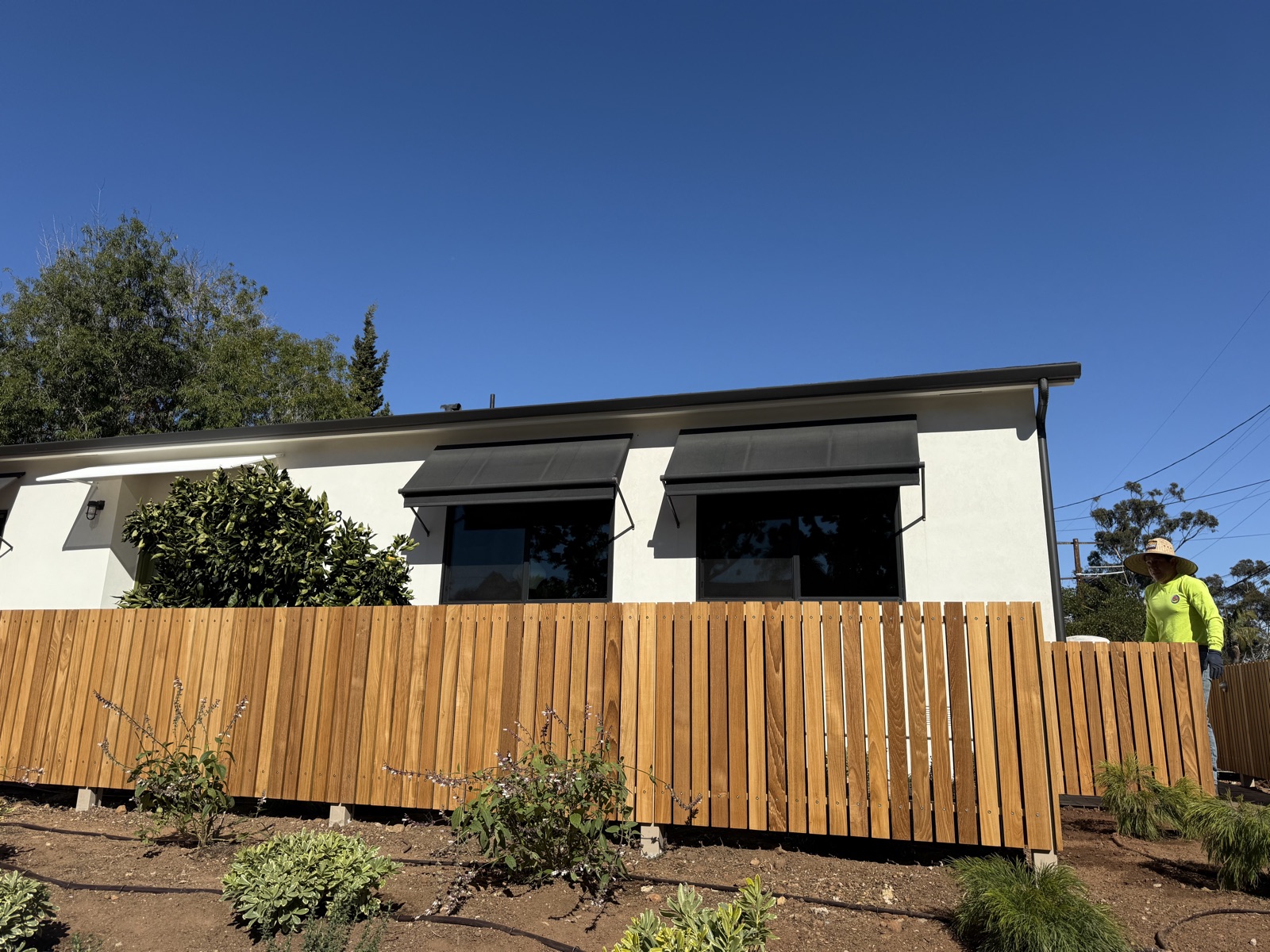
Dark colors on exterior wood are a substrate question before they are an aesthetic one. A dark surface on a fully exposed south or west elevation runs hot. On unmodified hardwood, that heat drives moisture out of the board faster than the shaded faces lose it, which loads the film and the joinery at the same time. The result is early cracking at the joints, not a uniformly faded wall. Accoya and thermally modified stock take dark colors far more comfortably, which is a real argument for putting them on the elevations where a designer insists on a deep color.
Recoat expectations should be set at the same time. Coatings on modified substrates last longer before they need attention, and when they do need it, the work is usually a wash and a top coat rather than a strip back to bare wood. That is the payoff for the higher entry point. Rain control and drying capacity in the wall behind the cladding still govern outcomes, as Building Science Corporation has documented repeatedly, and no coating schedule compensates for a wall that cannot dry.
What the Coating Cannot Fix
A primer is not a substitute for a detail, and the three things that most often ruin painted exterior millwork are all installation decisions. Back ventilation is first. Cupping is driven by installation and back ventilation, not by species, and a board that cannot dry from the back will cup no matter how carefully it was primed. Fastener choice is second. Stainless is the default on tropical hardwoods and on modified stock, and a corroding fastener will stain straight through a top coat. Flashing and sealant sequencing is third, since a sealant joint that bridges a gap the assembly needs for movement traps water instead of shedding it.
This is also where the species conversation for painted exterior work resolves. Sapele is preferred over Genuine Mahogany for painted exterior trim because it holds paint better and comes in a wider range of sizes and longer lengths. Sapele is not milled 1x8 for exterior use, since that width is too wide to stay stable in that application. The tropical decking species, Ipe, Cumaru, Garapa, Jatoba and Red Balau, sit outside this discussion on purpose. They are extremely hard and carry high oil content, which makes them difficult to glue and difficult to coat, so a millwork house reaches for Sapele, Iroko, Afrormosia, Teak or Utile when the part is going to be milled, glued or painted.
Length, Width, Warranty and Documentation on a Modified Order
Modified wood carries hard physical limits that shape the coating plan before a spray gun is ever picked up. Thermory, Abodo Vulcan and Accoya top out around 16 ft, and most of it sells on metric lengths just under 16 ft, because the modification kiln is only so long. A 20 ft primed fascia run is not a modified-wood order. Width is the second limit. Thermally modified Ash is not available wider than 8 inches, so a wide painted board in a modified product means Accoya or Abodo Vulcan. J. Gibson McIlvain holds over seven million board feet of exotic and domestic lumber at its Maryland yard, which is what makes it possible to lot match a wide painted elevation rather than splicing pieces together to reach a width.
Warranty follows the same logic. Warranties exist on modified products and do not exist on solid unmodified wood, which is an organic material responding to its environment. Anyone offering a warranty on unmodified solid stock is selling something they cannot deliver. Where a CITES-listed species is part of the package, documentation and chain of custody travel with the material. J. Gibson McIlvain is an FSC certified importer and miller, so sourcing paperwork referenced against FSC and CITES requirements moves with the order instead of being reconstructed later.
"The mistake I see most often is a spec that names a modified product for its stability and then writes the coating schedule off the hardwood page. You end up paying for a substrate that barely moves and then burying it under a heavy film designed to bridge movement that is never going to happen. Tell us the substrate and the exposure together and we will prime it right the first time."
Norm Moton, Director of Sales, J. Gibson McIlvain
Profiles, Radius Trimwork and Shutters Primed Before They Ship
Priming is easiest and best when it happens in the shop, on the profile, before assembly, and that is a strong argument for buying the millwork and the coating from the same place. J. Gibson McIlvain keeps a moulding profile library holding thousands of ground knives and grinds new knives every week, so a run of trim mouldings can be originated or matched and then primed to the build level that elevation needs without a second vendor in the middle. If a profile is not in the library it gets ground to match, including difficult historical restoration work and contemporary profiles. The Wood Moulding and Millwork Producers Association maintains the standard profile references most architects start from, and custom work picks up where those leave off.
ICD, the architectural millwork division, handles the true custom side, planned around a specific space rather than pulled from a catalog. Radius trimwork and radius millwork, rafter tails, pergolas, benches, railings, box beams, shutters, custom doors and gates all come through that shop. ICD builds wood shutters in louver and panel styles, including complete historical matching for both style and species, which is what a historic district demands when it requires like-for-like replacement. The National Park Service Technical Preservation Services guidance on historic woodwork is the reference reviewers cite, and matching the profile and the species is usually the condition of approval.
Box beams deserve a note on sequencing. Butt joints give the most minimal profile, the fastest turnaround and the easiest on-site assembly, but they leave visible seams and visible end grain and are the weakest option. Dado joints are strong and still easy to assemble on site, though seams and end grain still show. Lock miter joints show no visible seams and are the strongest. Priming happens before assembly on any of the three, and the joinery choice determines how much of that primed surface stays visible in the finished room. ICD's exterior millwork and trim profile work, along with the working process page, show how a custom run moves from drawing to finished part.
How J. Gibson McIlvain Would Specify This
Name the substrate class first, then write the coating schedule to it, and keep both on one order so nobody is guessing what the primer is sitting on. For a painted exterior elevation with wide boards, long runs or a deep color, the substrate is Accoya or Abodo Vulcan, the primer is a water-based acrylic at a moderate build with a fungicide additive, all six faces, and the top coat goes on after the cut ends are sealed in the field. For a traditional painted trim package in a species that has to match existing work, the substrate is Sapele, Iroko, Afrormosia, Teak or Utile depending on the match, the primer is stain-blocking at a mid to heavy build on exposed elevations, and moisture content is verified near 12 to 16 percent before anything is sprayed. Interior work is milled and primed near 6 to 8 percent instead.
The order should also say when it ships. J. Gibson McIlvain stores finished millwork for inventory control and delivers on its own fleet of trucks out of a mill with a section dedicated to packaging, which is how a primed surface reaches a job site without transit damage and without sitting outdoors ahead of the trades. The company ships nationwide, regularly to California. Seventh generation and family run since 1798, J. Gibson McIlvain keeps the knife and the record on file, so phase two of a building matches phase one years later.
Specifiers working the linear trimwork, finished cladding and primed trim side can review the millwork services at J. Gibson McIlvain, and the true custom side sits with ICD. Bring the elevation, the exposure, the color and the species to the same conversation. Call 800-638-9100 and get the substrate and the schedule settled before the knives are ground.
Frequently Asked Questions
Can I use the same primer on Accoya that I already use on Sapele trim mouldings?
Usually not, and the reason is what each substrate needs from the film. Sapele, Iroko, Afrormosia, Teak and Utile carry extractives that want a stain-blocking primer under light colors, and open-grained oily species soak up a great deal of finish, so the primer is also evening out absorption. Accoya has a much lower moisture response and a less polar surface, and a quality water-based acrylic system bonds and flexes well over it without needing heavy blocking. J. Gibson McIlvain primes in three build levels in both oil-based and water-based systems, so the same order can carry two different schedules for two different substrates.
Does thermally modified Ash come wide enough for a painted frieze board?
No. Thermally modified Ash is not available wider than 8 inches. A wide painted board in a modified product means Accoya or Abodo Vulcan. Length is the other limit worth checking early, since modified products top out around 16 ft and most sell on metric lengths just under 16 ft because of kiln size. If the elevation calls for a run longer than that, the design needs a joint or an unmodified species.
If modified wood barely moves, is priming all six faces still necessary?
Yes. Six-face coverage is not only about dimensional movement. It keeps a continuous film around the piece, protects the back face against whatever the wall assembly throws at it, and gives the fungicide additive a chance to work on the surface that stays damp longest. J. Gibson McIlvain primes exterior siding and trim mouldings on all six faces as standard practice, modified or unmodified.
What happens when an installer cuts a primed modified board in the field?
The exposed end is still modified material, since both acetylation and thermal modification run through the full section, so it will not absorb water the way a cut end of unmodified hardwood does. The coating film is still interrupted, though, and an open film edge is where lifting starts. Seal every cut end before the piece goes up. J. Gibson McIlvain supplies and mills rather than installs, so that step belongs in the installing contractor's scope.
Is a clear finish or a semi-transparent stain a reasonable schedule on thermally modified siding?
It is a legitimate choice, with a shorter maintenance cycle than paint. Left bare or under a thin clear film, thermally modified stock weathers to grey and can show surface checking. A pigmented penetrating finish gives more ultraviolet protection than a clear one and is far easier to refresh than a failed film. If the owner wants long intervals between attention, a pigmented opaque schedule over a properly primed substrate outlasts a clear one.
Why does a millwork shop prefer Sapele over Genuine Mahogany for painted exterior trim?
Sapele holds paint better and comes in a wider range of sizes and longer lengths, which matters on long fascia and frieze runs. Its Janka hardness sits around 1,410 lbf against roughly 800 lbf for Genuine Mahogany. One caution on sizing, Sapele is not milled 1x8 for exterior use, since that width is too wide to stay stable in that application. Cupping in service comes from installation and back ventilation rather than from the species.
Can J. Gibson McIlvain hold primed millwork until the site is actually ready for it?
Yes. J. Gibson McIlvain stores finished millwork for inventory control and delivers on its own fleet of trucks from a mill with a section dedicated to packaging, which keeps a primed surface intact in transit and off the job site until the trades are ready. The company ships nationwide, including regularly to California. Call 800-638-9100 to arrange a staged release against the construction schedule.
Do any of these coating schedules come with a warranty?
Warranties exist on modified products such as Accoya, Thermory and Abodo Vulcan, and they do not exist on solid unmodified wood. It is not possible to warranty solid wood, an organic material responding to its environment. Coating manufacturers warrant their own systems separately, and those warranties almost always depend on substrate preparation, moisture content at application and end-grain sealing being documented.
Sources and Standards Referenced
- Wood Handbook, Wood as an Engineering Material (FPL-GTR-190), USDA Forest Products Laboratory
- BSD-013 Rain Control in Buildings, Building Science Corporation
- Accoya Acetylated Wood
- Thermory Thermally Modified Wood
- Architectural Woodwork Institute
- Wood Moulding and Millwork Producers Association
- National Park Service Technical Preservation Services
- Forest Stewardship Council
- CITES, Convention on International Trade in Endangered Species
- Sapele, The Wood Database