What Ground Contact Actually Means
Ground contact is the harshest exposure a piece of wood will ever see, and nothing measured above grade predicts how the same board behaves buried in soil. Soil holds water against every face at once. It holds it at a temperature and a pH that decay organisms like, and it carries a population of soft rot fungi and bacteria that behave differently from the brown rot and white rot fungi working on a rain screen wall.
Wood in the ground also loses the one advantage that keeps wood alive above grade, which is the chance to dry. A cladding board wets on Tuesday and gives most of that water back by Thursday. A buried post sits near saturation for months at a stretch, and the wood cells never get the dry cycle that stalls fungal growth. Stake test data from the U.S. Forest Service Forest Products Laboratory has shown for decades that the durability ranking of species and treatments in soil does not track the ranking in an above-grade wall.
The preservative industry sorts exposure into use categories that run from interior dry, through exterior above ground, into soil and fresh water contact. A product earns a category by testing, not by reputation. "Rot resistant" is a description of field behavior above grade. A ground contact rating is a specification backed by published test methods of the kind ASTM maintains, and the two phrases are not interchangeable on a drawing.
Why Thermal Modification Is Not a Below Grade Treatment
Thermal modification buys decay resistance and dimensional stability above grade, and it does not buy a ground contact rating. The process runs wood up past roughly 180 to 215 degrees C in a low oxygen chamber. Hemicellulose degrades under that heat. The hygroscopic sugars that fungi feed on are largely cooked out of the cell wall, equilibrium moisture content drops, and the board moves far less across its width than the same species untreated.
That chemistry costs something. Thermally modified stock loses toughness and bending strength, and it is more brittle than the same species in its untreated state. It does not carry published structural design values the way framing species do through the values the American Wood Council maintains for design. A specifier who needs a number for a bending member cannot get one from a thermally modified board.
Now look at what a fence post actually is. It is a cantilever loaded in bending by wind and by the fence hanging off it, and its maximum moment lands right at grade. That is the exact plane where moisture is highest and where decay starts. Putting a brittle material with no published design values and no soil exposure data at that plane stacks three separate problems on one line.
Manufacturer guidance says the same thing in plainer terms. Published warranties and installation instructions for Thermory and for Abodo Vulcan cover above-grade service, decking, cladding, siding, trim and soffits. Both lines are carried at the yard and both are excellent above grade. Neither is sold as an in-ground product.
Where Acetylated Wood Behaves Differently
Accoya is acetylated rather than heat treated, and that difference in chemistry is exactly why it is the one modified product in this family with published in-ground coverage. Acetylation reacts the wood with acetic anhydride and swaps free hydroxyl groups for acetyl groups. The cell wall stops accepting water the way untreated wood does, which produces dramatically reduced shrinkage and swelling rather than merely improved shrinkage and swelling.
The numbers land in a useful place for exterior work. Accoya runs around 1,600 lbf on the Janka scale, harder than Sapele at roughly 1,410 lbf and Hard Maple at roughly 1,450 lbf. Accoya publishes a manufacturer warranty of 50 years above ground and 25 years in ground contact and fresh water. That in-ground figure has no equivalent on the thermally modified side.
Blurring the two categories under the single phrase "modified wood" is where specifications go wrong. Acetylation is not a biocide and it does not make wood immune to termites, so the manufacturer's own detailing and fastener guidance still governs. A note on a drawing that reads "modified wood post, in ground" is not a specification. A note that names an acetylated product and cites the manufacturer's in-ground use guidance is.
Fence Posts, Answered Plainly
For a wood fence, thermally modified stock belongs in the rails, pickets, boards, louvers and caps, and it does not belong in the buried post. Build the fence as a hybrid and the problem disappears. Put something rated for soil contact in the hole, then hang the modified wood on it where the wood can dry from both faces.
Three details do most of the work. A standoff base anchored to a concrete footing keeps wood end grain out of soil entirely, which is the strongest version of the detail. A steel post set in concrete does the same thing and lets the fence carry gate loads. Where a buried wood post is unavoidable, that member has to be a material with published soil contact performance, and the modified boards above it stay clear of grade.
"The question comes to me every spring. Somebody wants thermally modified Ash for a fence and wants the posts out of the same pack. I tell them the same thing every time. Put the modified boards where they can dry and put something rated for soil in the hole."
Norm Moton, Director of Sales, J. Gibson McIlvain
Fabrication matters at the picket too. Thermally modified stock splits more readily at ends than untreated stock of the same species, so pre-drilling near ends and using fasteners with a shank sized for the hole is standard practice rather than a precaution. J. Gibson McIlvain cross-cuts modified stock to a cut list and seals the fresh ends before the material leaves the shop, which keeps the most absorbent surface on the board from arriving raw.
Raised Beds and Anything Touching Soil
Raised garden beds are the one ground contact question where the appeal of thermal modification is real and the durability claim still is not. Thermal modification adds no preservative metals and no biocide. Heat and a low oxygen atmosphere do the whole job. For a grower who does not want treated wood next to vegetables, that is a legitimate reason to ask the question.
The service condition is still brutal. A bed wall has wet soil on the inside face and open air on the outside face, which means a permanent moisture gradient across a board that is also being watered several times a week. The inside face is where the failure starts, every time, and no coating survives long on a surface in continuous contact with damp soil.
A bed that lasts is detailed rather than specified into existence. Set the lowest board on a gravel base so it is above grade rather than in it. Drive separate corner stakes or steel posts rated for soil. Line the soil face with a drainage layer that breaks continuous contact while still letting the board dry outward. Where a member genuinely has to be buried, Accoya is the modified product whose published coverage reaches that condition, and a wide bed board is another reason to reach for it, since thermally modified Ash is not available wider than 8 inches.
Matching Material to the Exposure Zone
Sorting a project by exposure zone instead of by species is what keeps modified wood out of the wrong hole. The zones below are the ones that matter on a real exterior package, and the right-hand column is usually the thing that decides service life more than the material choice does.
| Exposure zone | Modified wood that fits | Keep out of this zone | Detail that decides service life |
|---|---|---|---|
| Fully buried below grade | Accoya, per the manufacturer's published in-ground and fresh water coverage | Thermally modified stock, including Thermory and Abodo Vulcan | Whether wood is in the hole at all, or a standoff base carries the load off a footing |
| Ground line and splash zone, grade to about 8 inches | Accoya for any member crossing the line, modified boards starting above it | Unsealed end grain of any species, modified or not | Clearance above grade plus a gravel or hard-surface drip strip to kill splash-back |
| Exterior above grade, cladding and trim | Thermory and Abodo Vulcan both perform here, as does Accoya | Nothing in this family is out of place | Back ventilation and a continuous drainage plane behind the board |
| Planter interior and permanently damp faces | Accoya where the face cannot dry | Thermally modified stock held in continuous soil contact | A drainage layer that breaks soil contact and lets the board dry outward |
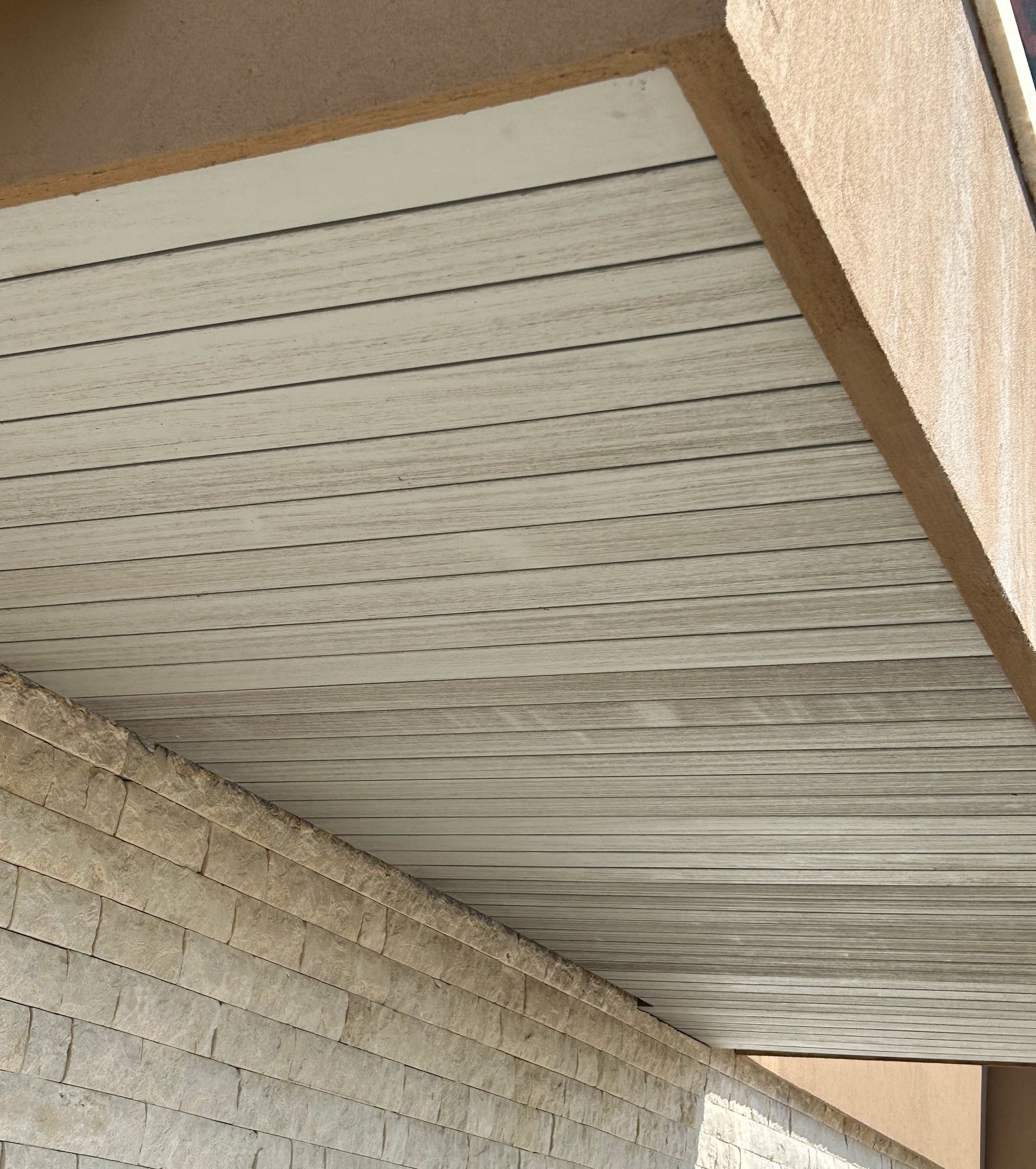
| Covered exterior, soffit, porch ceiling, pergola underside | All three modified products, with stability the reason to choose them | Unprimed absorbent stock on a painted assembly | Priming before installation and sealing every field cut |
The Splash Zone Fails More Millwork Than the Buried End
More exterior wood is lost in the first 8 inches above grade than is lost underground, because that is the zone designers stop thinking about. Rain hits a walk or a patio and comes back up as splash. Snow piles against a base trim board and melts into it. Irrigation heads soak one column base every morning for years. None of that is ground contact on a drawing, and all of it behaves like it.
Clearance is the cheapest fix available. Hold the bottom of any wood member at least 6 inches above grade, more where snow collects, and give it a gravel strip or a hard surface below so splash has somewhere to break. A capillary break under a base block stops the assembly from wicking upward out of masonry. The detailing logic behind all of it is the drainage and drying framework laid out at Building Science Corporation, and modified wood does not exempt an assembly from it.
End grain is the other half. A cut end absorbs many times more water than a face, and every field cut on a modified board opens a new one. Seal every cut, on every product, including the ones with warranties. Cupping is driven by installation and back ventilation, not by species, so a board fastened tight to a solid substrate with no air behind it will cup whether it is cedar, Sapele or thermally modified Ash.
Fastener chemistry deserves a line of its own. Acetylated wood releases small amounts of acetic acid, which is why manufacturer guidance calls for stainless fasteners, stainless or compatible flashings, and care with uncoated steel and bare aluminum in direct contact. Thermally modified stock takes stainless for the same corrosion reasons and pre-drilling for its brittleness. Getting the metal wrong shows up as staining and streaking on a wall long before it shows up as a structural problem.
The Size Limits That Decide the Design
Chamber size, not demand, sets the ceiling on every modified wood product, and the ceiling is around 16 ft. Accoya, Thermory and Abodo Vulcan all top out near that mark, and most of the material is sold on metric lengths that land just under 16 ft. A 20 ft uninterrupted run of modified trim does not exist. It becomes a joint detail, and that detail should be drawn before the order goes in rather than solved on the wall.
Width is the other hard limit, and it splits by product. Thermally modified Ash is not available wider than 8 inches. When a design calls for a wide modified board, a deep fascia, a wide bed wall, a broad water table, the answer is Accoya or Abodo Vulcan rather than a glued-up thermally modified panel that nobody wants holding together on an exterior wall.
J. Gibson McIlvain stocks Accoya, Thermory and Abodo Vulcan at the Maryland yard alongside over seven million board feet of exotic and domestic lumber, which is what makes it possible to check a length and a width against real inventory instead of against a manufacturer's theoretical size list. J. Gibson McIlvain mills that stock into linear trimwork, finished cladding and primed trim on the moulders, using ground knives matched to the profile on the drawing.
Cedar, the Millwork Palette and What Actually Carries a Warranty
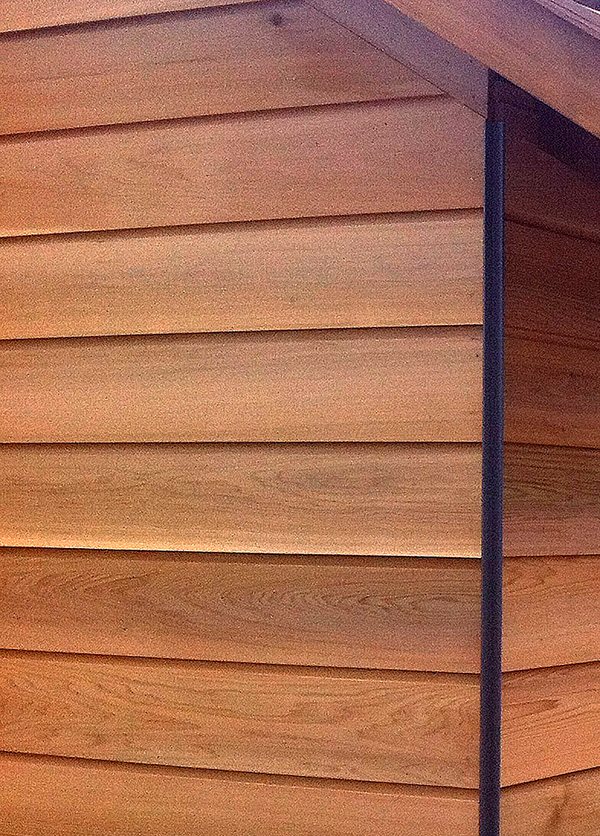
Cedar is the default exterior species for most contractors and it rarely fails, and with cedar the grade call decides more than the species call. CVG, clear vertical grain, moves less across its width and holds a painted surface better, which is why it belongs on a water table or a base trim near splash. STK, select tight knot, is the right call on a stained wall where knots read as intended. Neither grade is a ground contact material, and neither is being asked to be.
For milled, glued and machined exterior components, the palette is Sapele, Iroko, Afrormosia, Teak and Utile. Sapele runs roughly 1,410 lbf on the Janka scale and is the better choice than Genuine Mahogany at roughly 800 lbf for painted exterior trim, since it holds paint better and comes in a wider range of sizes and longer lengths. Sapele is not milled 1x8 for exterior use, too wide to stay stable in that thickness. Quartersawn and rift stock moves less across its width than plainsawn, which is why it gets specified where a painted or panelized face has to stay flat.
The tropical decking species sit in a different part of the business. Ipe, botanically Tabebuia spp, along with Cumaru, Garapa, Jatoba and Red Balau, are extremely hard and carry high oil content, which makes them difficult to glue and slow to machine. A millwork house reaches for Sapele, Iroko, Afrormosia, Teak or Utile on a glued or moulded component for exactly that reason. None of those decking species is a ground contact solution either, whatever their reputation on a deck surface suggests. Where a CITES-listed species is involved, documentation and chain of custody travel with the material, and the CITES paperwork is part of the shipment rather than an afterthought.
One more distinction that buyers ask about constantly. Warranties exist on modified products and on nothing else. It is not possible to warranty solid unmodified wood, an organic material responding to its environment, and any species-level durability discussion for unmodified stock is a field performance discussion instead. Reference data of the kind published at the Wood Database describes tendencies, not guarantees.
Custom Components Where the Post Is the Problem
When a design puts a wood member near grade, the component has to be built for that condition up front rather than adapted on the wall. Gates, pergolas, benches, railings and column surrounds all put wood within a few inches of a hard surface, and each one has a different answer for how the load gets to the ground without burying wood to do it.
J. Gibson McIlvain runs a full millwork shop on site at the lumber yard for linear runs, and a full architectural millwork house off site, ICD, its architectural millwork division, for true custom components. ICD builds custom gates, pergolas, shutters, doors, box beams, benches, railings, rafter tails and radius millwork, and it builds them from modified stock where the exposure calls for it. ICD exterior millwork is where those components are described in more detail.
Large driveway swing gates are the clearest case. A gate of that size and weight requires engineering rather than only craftsmanship, and the post and hardware carrying it are a structural element in the buyer's site work. J. Gibson McIlvain supplies and mills the wood and ICD builds the leaf. It does not install, coordinate installation or field measure, so the footing, the post, the hinge hardware and the swing clearance belong to the buyer's own fabricator or installer. Saying that plainly at the drawing stage is what keeps a beautifully built gate from hanging on the wrong post.
How J. Gibson McIlvain Would Specify This
The specification splits the job at the ground line and never lets one material try to cover both sides of it. Below grade and at the ground line, name an acetylated product with the manufacturer's in-ground guidance cited, or take wood out of the hole entirely with a standoff base on a footing. Above the line, Thermory, Abodo Vulcan and Accoya are all in play, chosen on width, length and finish rather than on which one sounds more durable.
The milling side is specific. J. Gibson McIlvain mills exterior work to an in-service moisture content near 12 to 16 percent and interior millwork near 6 to 8 percent, runs the profile on the moulders, and primes exterior trim in three levels, in both oil-based and water-based systems, with a fungicide additive on exterior primed stock. Open-grained and oily species absorb a great deal of finish, so a primer coat evens out the eventual painted surface, and sanding or buffing after priming knocks back grain raising while keeping the moulded detail crisp. Every cross-cut end gets sealed before packing.
Delivery is planned the same way. J. Gibson McIlvain ships nationwide out of Maryland, regularly to California, on its own fleet of trucks, with a section of the mill dedicated to packaging so a primed face arrives without handling marks. Finished millwork can be held in storage and released by phase when a site is not ready for all of it at once. Send the elevations, the exposure conditions and the cut lengths, and call 800-638-9100 or start from the J. Gibson McIlvain millwork service page, and the material list will come back split by zone with the sizes checked against what is actually on the ground.
Frequently Asked Questions
Can thermally modified wood be used for ground contact applications like fence posts and garden beds?
No. Thermal modification improves decay resistance and dimensional stability above grade, and the producers' own warranties and installation guidance cover above-grade service for Thermory and Abodo Vulcan. Soil contact is a different exposure, with continuous moisture and soil-borne soft rot organisms, and thermally modified stock is also more brittle than the same species untreated with no published structural design values. Use it for fence rails, pickets, boards, caps and bed walls that sit above grade, and put a soil-rated post, a steel post in concrete, or a standoff base on a footing in the hole.
Is Accoya different, and can it actually go in the ground?
Accoya is acetylated rather than heat treated, which is why it behaves differently below grade. Acetylation replaces hydroxyl groups in the cell wall with acetyl groups instead of degrading hemicellulose, so the strength loss thermal modification brings does not happen. Accoya runs around 1,600 lbf on the Janka scale and the manufacturer publishes a warranty of 50 years above ground and 25 years in ground contact and fresh water. Detail it and fasten it per the manufacturer's guidance, including stainless fasteners, and cite that guidance on the drawing.
What should the posts be if my fence boards are thermally modified?
Anything with published soil contact performance. A steel post set in concrete works and carries gate loads well. A standoff base anchored to a footing is the strongest detail because it keeps wood end grain out of soil entirely. Where the post must be wood and must be buried, an acetylated product used within its published in-ground guidance is the modified option. Keep the bottom of every modified board at least 6 inches above grade and seal every cut end.
Does thermally modified wood work for raised vegetable beds?
It works for the part of the bed that can dry. Thermal modification adds no preservative metals and no biocide, only heat and a low oxygen atmosphere, which is the real reason growers ask about it. The inside face in continuous contact with damp soil is still the failure surface. Set the lowest board on gravel so it sits above grade, use separate soil-rated corner stakes or steel posts, and line the soil face with a drainage layer that breaks continuous contact while letting the board dry outward. A wide bed board means Accoya or Abodo Vulcan, since thermally modified Ash is not available wider than 8 inches.
How long and how wide can modified wood be ordered?
Around 16 ft is the ceiling on Accoya, Thermory and Abodo Vulcan, and most of the material is sold on metric lengths landing just under 16 ft, because of kiln size. Plan any longer run as a joint detail at the drawing stage. On width, thermally modified Ash is not available wider than 8 inches, so a wide fascia, water table or bed wall in a modified product means Accoya or Abodo Vulcan. J. Gibson McIlvain stocks all three at the Maryland yard and can check a length and width against real inventory.
Do modified woods carry warranties, and does solid wood?
Warranties exist on modified products and on nothing else. It is not possible to warranty solid unmodified wood, which is an organic material responding to its environment. Species durability tables describe field tendencies rather than guarantees. That distinction is worth putting in writing on a project where an owner expects a paper commitment on exterior wood.
Is cedar still a reasonable choice for exterior work near grade?
Yes. Cedar is the default cladding species for most contractors and it rarely fails, and the grade call matters more than the species call. CVG, clear vertical grain, moves less across its width and holds paint better, which suits a water table or base trim near splash. STK, select tight knot, is the right call on a stained wall. Like every unmodified species, cedar is not a ground contact material, and its service life near grade depends on clearance, a drip strip below and air behind the board.
What fasteners and flashing should be used with modified wood?
Stainless, as a default. Acetylated wood releases small amounts of acetic acid, so manufacturer guidance calls for stainless fasteners and compatible flashings, with care taken about uncoated steel and bare aluminum in direct contact. Thermally modified stock takes stainless for corrosion reasons and pre-drilling near ends for brittleness. Corrosion in this family usually shows up first as staining and streaking on a finished wall.
Sources and Standards Referenced
- USDA Forest Service Forest Products Laboratory
- American Wood Council, Codes and Standards
- Accoya, Acetylated Wood Performance and Warranty Information
- Thermory, Thermally Modified Wood Products
- ASTM International, Wood Standards and Test Methods
- Building Science Corporation, Enclosure Drainage and Drying Guidance
- The Wood Database, Species Property Data
- CITES, Convention on International Trade in Endangered Species