Why New Teak Never Matches Weathered Teak on Arrival
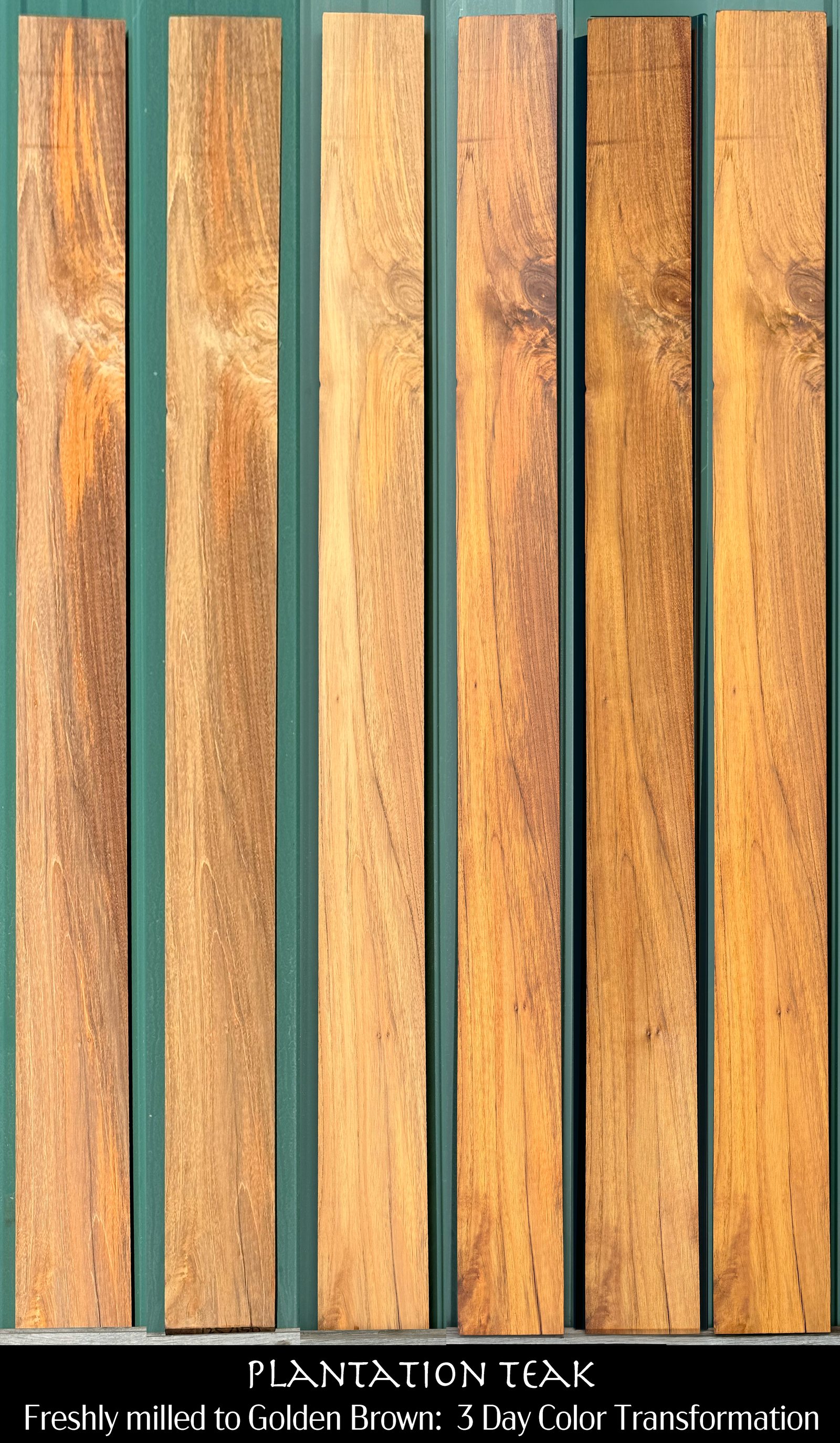
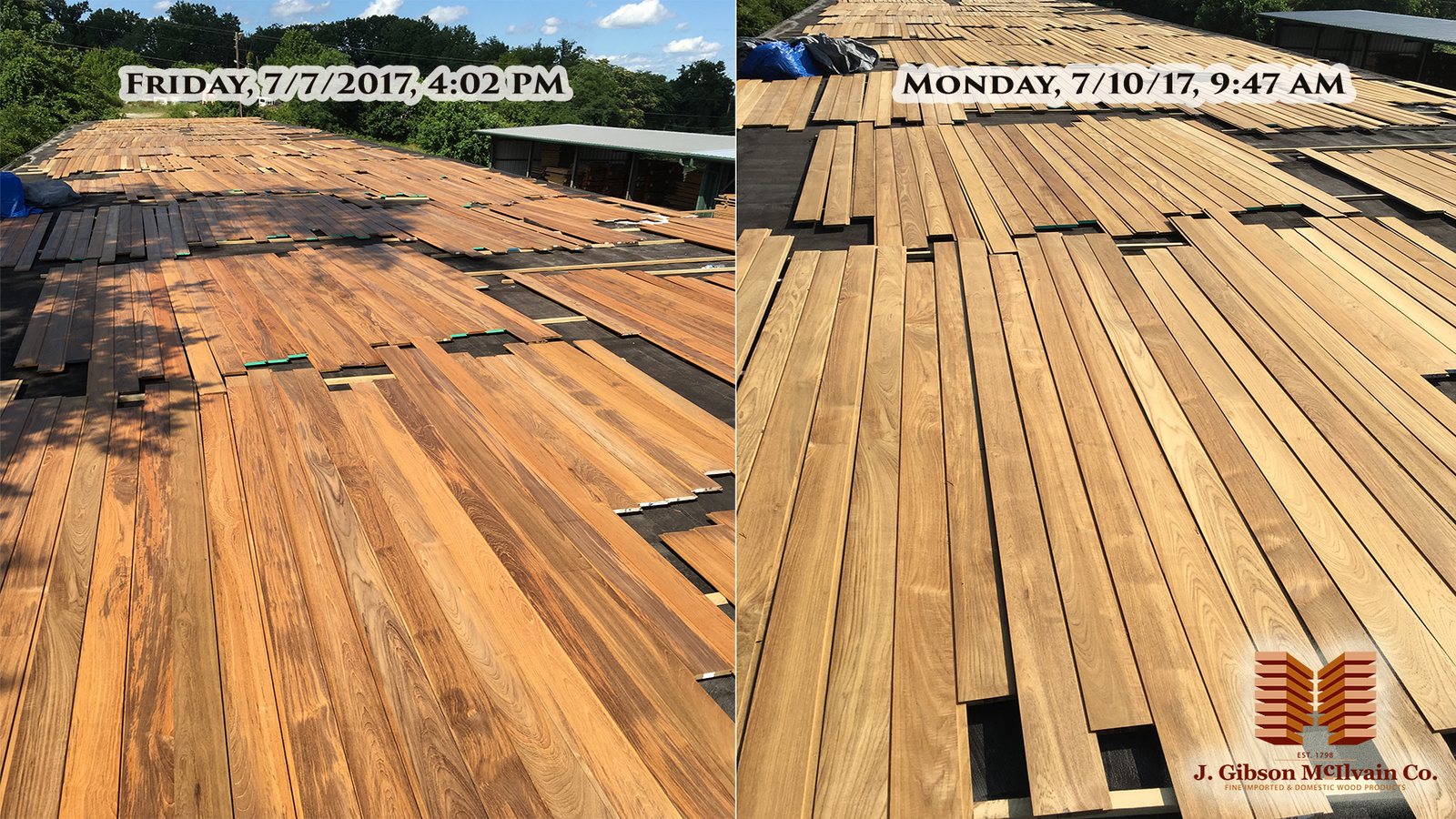
A teak match is a match of grain, density and texture, since the silver color of weathered teak is a surface condition no new board can be bought with. Teak that has stood outside for a decade is not gray wood. Sunlight has broken down lignin in the top cells, rain has carried the breakdown products off, and what remains is a thin weathered layer lying over wood that is still honey brown a few thousandths of an inch down. Scrape it and the old color walks back into the room.
So the question a buyer should be asking is not which teak is gray. It is which teak will arrive with the same ring spacing, the same grain orientation and the same surface quality as the boards already in place, and then weather on the same curve. The Forest Products Laboratory covers that weathering process and the way finishes behave on it in its published work on wood as an engineering material, available through the Forest Products Laboratory.
Two failure modes show up on restoration jobs. One is a new board that looks perfect on day one because somebody stained it to the weathered color, then drifts away from its neighbors as the stain fades at its own rate. The other is a board that looks wrong on day one and is right two seasons later. The second one is the job done properly.
Teak Is Tectona grandis, and the Log Decides the Board
Two boards can both be true teak and still refuse to sit next to each other, because growth rate, log diameter and sawing pattern change the board more than the species name does. Teak grown slowly over a long rotation gives tight ring spacing, a quieter figure and a heavier feel in the hand. Faster grown plantation material runs wider rings, more contrast between earlywood and latewood, and a busier face.
Log size matters just as much. Shorter rotations produce smaller logs, and a smaller log caps both the width and the length that can come out of it. If the existing work carries long clear boards or wide single-piece components, that is a supply question before it is a matching question, and it is the point in the conversation where the depth of the yard decides whether the job can be filled at all.
Teak also carries natural oils and silica. The oils are the reason it survives on a deck and the reason adhesion needs thought on a glued assembly, and the silica is why tooling dulls faster than it does in white oak. For published hardness, density and shrinkage figures on the species, the Wood Database entry for teak keeps the numbers in one place rather than having them quoted from memory.
Where the Match Actually Happens
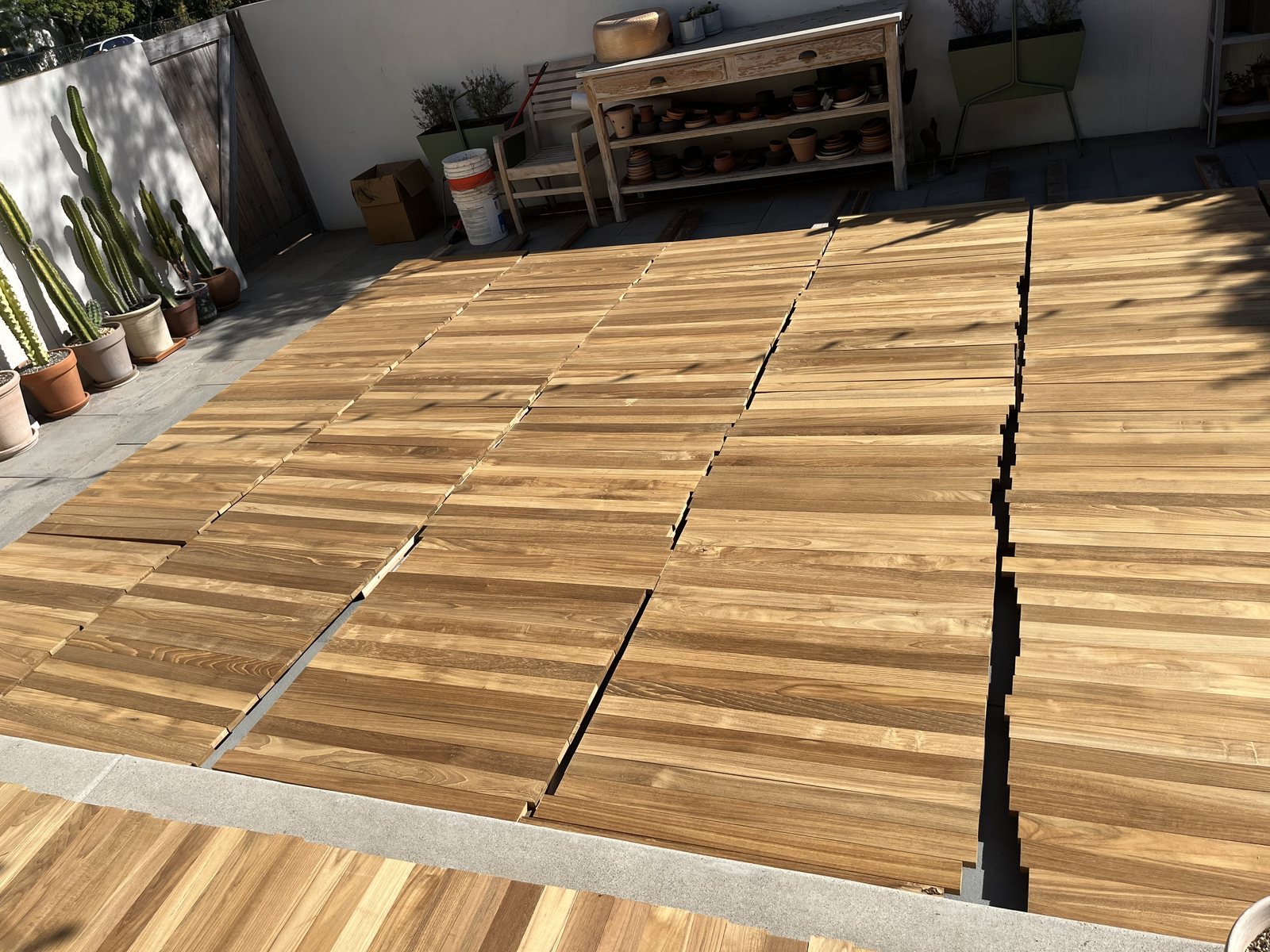
The match happens in the stack, at the moment somebody stands at the lumber pile with a sample of the existing material in hand and sets boards aside. It does not happen at the finish stage, and it cannot be recovered there. A finisher can nudge tone. A finisher cannot change ring spacing, grain orientation or the way a face takes light.
That is also why a restoration order behaves differently from a stock order. A stock order is a grade, a thickness and a footage. A matched order is a grade, a thickness, a footage and a set of selection instructions that a person has to carry out by eye at the pile. J. Gibson McIlvain pulls boards against a submitted sample for exactly that reason, and the sample travels with the order rather than sitting in a drawer.
| What is being matched | Where it gets settled | What the order has to carry |
|---|---|---|
| Base color under the weathering | At the pile, against a sanded sample of the existing board | A physical sample with one freshly cut face |
| Ring spacing and figure | At the pile, board by board | Instruction to match growth rate, not only species |
| Grain orientation | At the saw, in how the log is broken down | Vertical grain, rift or plainsawn called out by name |
| Width and length | In the log, before anyone sees the board | Finished sizes, and whether single pieces are required |
| Grade and clear yield | In the grading rules, at inspection | The clear yield required, written out on the purchase order |
| Moisture content | In the kiln, against the service condition | Interior or exterior service stated plainly |
| Profile and section | At the moulder, from a ground knife | A sample section, a rubbing or a measured drawing |
| Surface texture | At the sander, and later by the installing trade | Whether the old surface is smooth, worn or sawn |
Read that table as a division of labor. Some of it is decided years before the order, in the forest and at the headrig. Some of it is decided in one afternoon at the pile. Confusing the two is how a buyer ends up blaming a finish schedule for a sawing decision.
Send a Sample, Not a Color Word
No color word in English is precise enough to match teak, so the only reliable instruction is a physical piece of the existing material. Golden brown, honey, silver and weathered gray all describe dozens of boards that will not sit together. A cut-off from the job answers in one second what a paragraph of description cannot.
The useful sample has two faces. Leave one face in its weathered state so the shop can see where the material has been, and sand or plane a small area on the back so the base color underneath is visible. That second face is the one the match is actually made against, because that is the color the new boards will hold through the first year.
"Send us a piece of the old material with one corner sanded, and tell us where it lives on the building. We will put a man at the pile with it. Guessing at a color over the phone is how you end up with a board that reads wrong for the next thirty years."
Norm Moton, Director of Sales, J. Gibson McIlvain
Photographs help with context and nothing else. A phone camera corrects white balance, the light on a job site at four in the afternoon is not the light in a lumber shed, and no screen reproduces the depth of a weathered teak surface. Send the photograph for orientation. Send the wood for the match.
Grain Orientation Carries the Match Over Time
Grain orientation is the one matching decision that keeps paying off, because it governs how the new boards move after the job closes. Wood moves far more tangentially than radially. Quartersawn and rift stock moves less across its width than plainsawn, which is why it gets specified anywhere a surface has to stay flat and anywhere a joint between boards has to stay tight.
On older teak work, vertical grain is usually what is already there. Traditional laid decks, cap rails, thresholds and exterior sills were cut that way on purpose. A plainsawn board dropped into a vertical grain run announces itself twice, first with cathedral figure that none of its neighbors have, and later with a seam that opens and closes more than the seams on either side of it.
Width compounds it. Movement across a board scales with its width, so a 4 inch board moves roughly half as much across its face as an 8 inch board of the same species and orientation. More seams, each moving less, is a steadier surface than fewer seams each moving more. That is why narrow boards are the convention on laid teak decks rather than a stylistic habit. Cupping, when it shows up, is driven by installation and back ventilation rather than by the species on the tag.
One more thing the grain decides. Teak and the rest of the millwork palette, Sapele, Iroko, Afrormosia and Utile, which is sold as Sipo, all machine and glue predictably enough for a shop to build matched assemblies out of them. The tropical decking species, Ipe, Cumaru, Garapa, Jatoba and Red Balau, are extremely hard and carry high oil content, which makes them difficult to glue, so they belong in a decking conversation and not in a matched millwork assembly. Ipe is Tabebuia spp, and it is a deck board, not a cap rail blank.
Grading Language for a Restoration Order
Hardwood grades describe clear yield, not appearance, so a grade alone will never buy a color match. Hardwood grading in North America runs on the National Hardwood Lumber Association rules, which grade a board by the yield of clear face cuttings it will produce. FAS is the top grade and requires a minimum board of 6 inches wide by 8 ft long yielding 83 and 1/3 percent clear face cuttings. FAS One Face, written F1F, meets FAS on the better face. Selects meet FAS on the better face at a smaller minimum size.
Below that, No. 1 Common requires 66 and 2/3 percent clear face cuttings and a minimum board of 3 inches by 4 ft, and No. 2A Common requires 50 percent. None of those grades is a defect call. A No. 1 Common board is not damaged goods. It yields smaller clear cuttings, which makes it the economical grade for short parts and the wrong grade for a long clear run. Those rules cover North American hardwood, and imported teak does not arrive under them, so on a matched order that vocabulary describes the yield wanted while the written description and the sample do the actual work.
For a restoration, that distinction decides the order. Long single-piece replacements for a sill, a cap rail or a run of cladding need the yield of FAS or F1F, because the clear length has to come out of one board. Short repair pieces, blocking, plugs and bungs come out of lower grades without anybody on the job ever knowing. J. Gibson McIlvain grades and sorts to those rules and then applies the matching instructions on top of them, since the rules themselves say nothing about whether two boards look like each other.
Thickness, Width and Length on Matched Stock
Thickness is bought in quarters of an inch of rough thickness, and every finished dimension on a restoration drawing has to be worked backward from that. 4/4 is nominal 1 inch rough, 8/4 is 2 inches, and 16/4 is 4 inches. Surfaced dimensions come off those rough numbers, so a 3/4 inch finished board starts at 4/4 and a 1 and 3/4 inch finished cap starts at 8/4 with material to lose in surfacing.
Settle that before anyone quotes a footage. A restoration component matched to an existing section often lands at an odd finished thickness, and the only way to hit it is to start thicker and machine down, which changes both the footage and the grade the job needs.
Width and length are where matched teak orders stall. J. Gibson McIlvain holds over seven million board feet of exotic and domestic lumber at its Maryland yard, and depth of that kind is what makes it possible to pull several boards of one color family and one growth rate out of the same lot rather than assembling a run out of whatever three suppliers happen to have. On a job that has to be matched again in a later phase, that is the difference between a repeatable order and a one-time lucky pull.
Moisture Content and the Service Condition
A teak match that ignores moisture content will come apart on its own schedule, no matter how well the boards were selected. Kiln dried hardwood for interior use lands near 6 to 8 percent moisture content. Exterior work runs near 12 to 16 percent. Those are not interchangeable targets, and dropping an interior-dry board into an exterior assembly guarantees it will take on moisture and swell against whatever is holding it.
Air dried stock settles near the local equilibrium and is not a substitute where an interior tolerance matters. That is worth stating on a restoration job, because old material is often sitting at a moisture content nobody has measured, and the new material has to be delivered to the service condition rather than to the condition of the old boards on the day of the survey. Building Science Corporation and the Forest Products Laboratory chapter on moisture relations and physical properties of wood both lay out the equilibrium behavior behind those numbers.
J. Gibson McIlvain mills exterior teak to a 12 to 16 percent in-service moisture content and interior stock to 6 to 8 percent, and the service condition belongs on the purchase order in writing. One line. It prevents the most expensive category of callback on matched work, which is material that was selected correctly and dried to the wrong number.
Matching the Profile and the Section
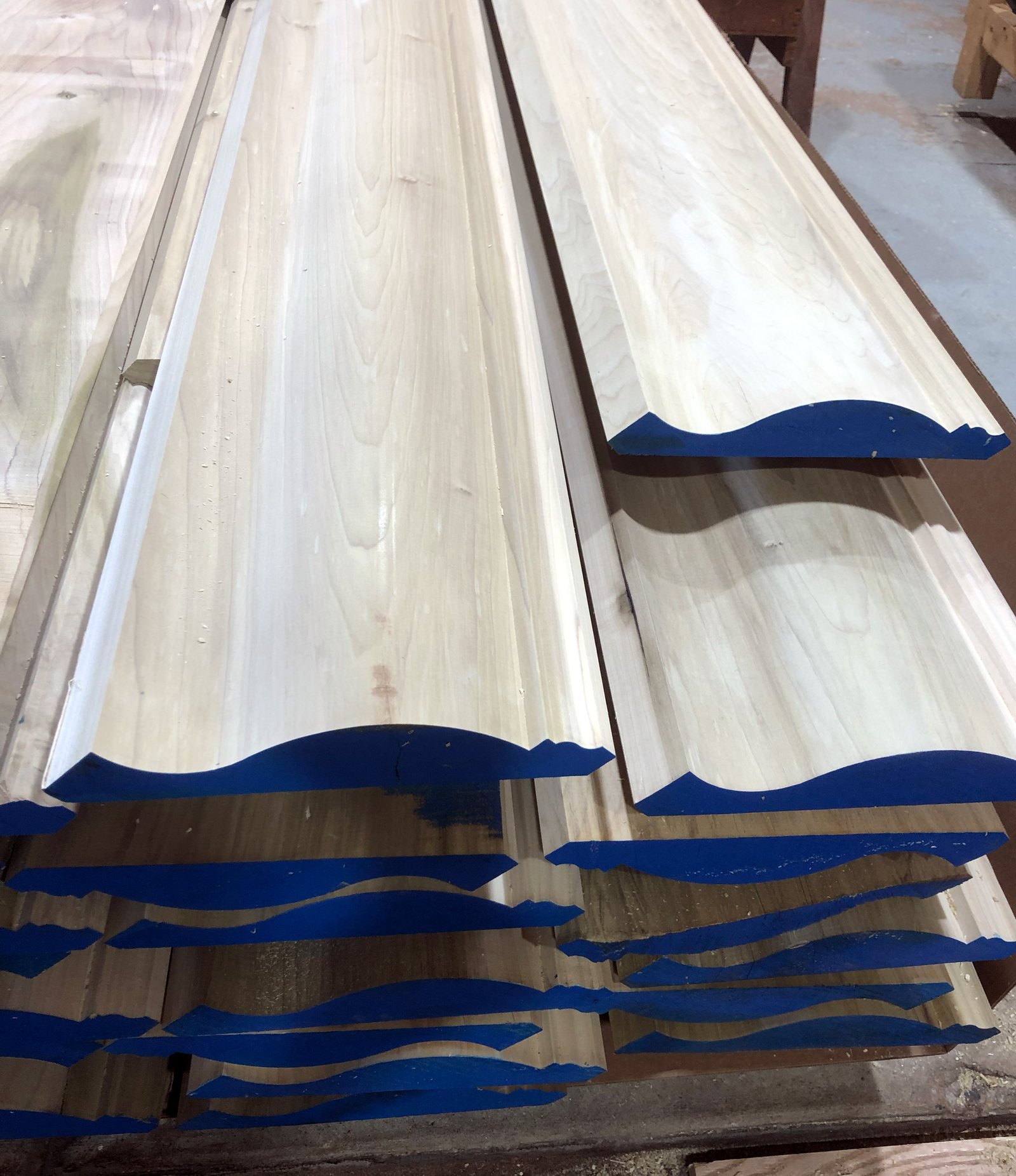
Where the existing teak is moulded rather than flat, the match is a knife problem before it is a lumber problem. A worn cap rail. A bead on an old sill. A shutter stile with a stuck profile, or an exterior casing with a specific back bevel. None of that comes off a shelf, and all of it comes off a ground knife that reproduces the section.
J. Gibson McIlvain keeps a moulding profile library holding thousands of ground knives and grinds new knives every week, so an existing section gets matched against the patterns on file or cut fresh when nothing on file fits. Difficult historical restoration profiles and contemporary ones both get ground to match. That work runs on moulders, straight line and gang rip saws, band resaws and trimming saws, and the capability is set out on the J. Gibson McIlvain millwork service page.
What the shop needs is a section, and a buyer has three ways to hand one over. Send a short cut-off of the existing moulding, take a pencil rubbing of the end section, or supply a measured drawing. The cut-off is best, since it carries the wear pattern and the real dimensions at once. Field measurement of the existing opening sits with the installing contractor, and the shop works from the dimensions that measurement produces.
Where a restoration runs past linear mouldings into a true custom assembly, that work is handled by ICD, the company's architectural millwork division, which builds exterior millwork planned around a specific opening rather than assembled out of standard parts. ICD builds the assembly and the installing trade fits it. Quality tiers those assemblies get written to are published by the Architectural Woodwork Institute, and moulding and profile practice by the Wood Moulding and Millwork Producers Association.
Finish, Documentation and the Limits of a Promise
New teak set beside weathered teak closes the color gap on its own, and the finish decision is really a decision about how fast and how evenly that happens. Leave both bare and the new work silvers toward the old over a few seasons of exposure, unevenly at first. Oil both and the whole surface reads warmer, which means the old boards change too, so the comparison moves under everyone's feet. Decide which of those two outcomes the project wants before the material ships.
Open-grained and oily species absorb a great deal of finish, so the first coats on new teak disappear into the wood and the surface does not read as finished until the later coats build. Work the schedule out on sample boards from the actual order rather than on the old material. Sand to the grit the existing surface reads at, because a surface sanded finer reflects light differently and will look like a different board even when the wood is identical.
Solid unmodified wood carries no warranty from anyone. It is an organic material responding to its environment, and no supplier controls that environment. Warranties exist on modified products, where Thermory and Abodo Vulcan both carry them, and those modified products top out around 16 ft, most sold on metric lengths just under 16 ft because of kiln size. Thermally modified Ash is not available wider than 8 inches, so a wide board in a modified product means Accoya or Abodo Vulcan. That is a separate conversation from a teak match and it belongs in a separate line of the specification.
Documentation travels with the material on teak more than on most species. J. Gibson McIlvain imports as an FSC certified importer and miller, and chain of custody certification is what lets a sourcing requirement on a public or institutional job be answered with a record instead of a reassurance. On work inside a historic district or under review, the National Park Service preservation briefs and the Secretary of the Interior standards are the documents a reviewer holds a like-for-like replacement against, and complete historical matching of both style and species is what such a district tends to enforce on wood shutters and exterior trim.
How J. Gibson McIlvain Would Specify This
A teak matching order that holds up is written in seven lines, and every one of them removes a decision somebody would otherwise make for you. State the species as Tectona grandis. State the clear yield in the grade vocabulary everyone shares, FAS or F1F where long clear lengths are required and a lower yield where the parts are short, remembering that an import carries no NHLA stamp and the written description governs. State rough thickness in quarters and the finished dimension you need out of it.
State grain orientation by name, vertical grain or rift where the existing work is vertical grain. State the service condition so the kiln target is unambiguous, 6 to 8 percent for interior and 12 to 16 percent for exterior. State that boards are to be pulled against the submitted sample, and where the work runs in phases, that the lot and the sample are to be recorded so a later release can be matched to the first.
Then send the sample. One piece of the existing material with a sanded corner, a note on where it sits on the building, and a cut-off or a rubbing of any moulded section. J. Gibson McIlvain matches the release across phases, grinds the knife where a section has to be reproduced, mills to the stated moisture content, and ships the order nationwide, regularly including California.
To open a matched teak order, or to find out whether an existing profile can be reproduced before the drawings are finished, call J. Gibson McIlvain at 800-638-9100 with the sample in hand. The conversation moves faster when there is a piece of the old material on the bench.
Frequently Asked Questions
Can new teak ever be made to match weathered teak exactly on the day it is installed?
No, and a supplier who promises it is promising something wood does not do. The gray on weathered teak is a thin surface layer produced by years of sun and rain, and the wood under it is still honey brown. A new board can be stained to approximate that gray, but the stain and the weathering then age at different rates and the two boards drift apart. The durable approach is to match the board rather than the surface, meaning growth rate, grain orientation, grade and thickness, and then let exposure bring the new work toward the old over a few seasons. If an immediate visual blend is required for a presentation or an inspection, that is a finishing decision to work out with the painting or finishing trade on sample boards from the actual order.
What should I send a supplier so boards can be selected against my existing material?
Send a physical cut-off of the existing board, not a color name and not only a photograph. Leave one face in its weathered state and sand or plane a small area on the opposite face so the base color underneath is visible, since that second face is what the new boards will look like for the first year. Add a note saying where the material sits on the building, how it is exposed and whether the surface is smooth, worn or sawn. If any part of the work is moulded, include a short cut-off of the moulding, a pencil rubbing of the end section or a measured drawing so the section can be matched to a ground knife.
Is plantation teak acceptable for a restoration match?
It depends on what is already there and on the sizes the job needs. Plantation teak is true Tectona grandis, but shorter rotations produce faster growth and smaller logs, which means wider ring spacing, more contrast between earlywood and latewood and a cap on both width and length. Against older slow grown material, a fast grown board can read busier even when the color is close. Where the replacement parts are short and narrow, that difference is manageable with careful selection. Where the existing work uses long clear boards or wide single pieces, the limiting factor is log size rather than preference, and the sizes have to be confirmed before the drawings are finished.
What grade should go on the purchase order for teak restoration stock?
Match the grade to the length of clear material each part needs. FAS requires a minimum board of 6 inches wide by 8 ft long yielding 83 and 1/3 percent clear face cuttings and is the grade for long single-piece replacements such as a sill, a cap rail or a run of cladding. FAS One Face and Selects meet FAS on the better face, which suits parts where only one side is seen. No. 1 Common requires 66 and 2/3 percent clear face cuttings and a minimum board of 3 inches by 4 ft, and it is the economical grade for short repair pieces, blocking, plugs and bungs. Grade describes clear yield rather than appearance, so a color and grain matching instruction has to be written on the order separately from the grade.
Does grain orientation matter if the color is right?
It matters more than color over the life of the job. Wood moves far more tangentially than radially, so quartersawn and rift stock moves less across its width than plainsawn and holds a flat surface and a tight joint better. Most older teak work, including laid decks, cap rails, thresholds and exterior sills, was cut vertical grain on purpose. A plainsawn board set into a vertical grain run shows cathedral figure its neighbors do not have, and the seam beside it opens and closes more than the seams further along. Width compounds the effect, since movement across a board scales with width, which is why narrow boards remain the convention on laid teak decks.
Can the moisture content of the new teak be matched to the old boards?
The target is the service condition, not the reading taken off the old material on the day of the survey. Kiln dried hardwood for interior use lands near 6 to 8 percent moisture content and exterior work runs near 12 to 16 percent, and those targets are not interchangeable. Old material in place has usually settled to whatever its exposure dictates, and if it has been wet or neglected it may be nowhere near where it will sit once the building is back in service. Write the service condition on the purchase order in one line. Air dried stock settles near the local equilibrium and is not a substitute where an interior tolerance matters.
Is there a warranty on matched teak?
Solid unmodified wood carries no warranty from anyone. It is an organic material that responds to its environment, and no supplier controls the environment a board ends up in. Warranties exist on modified products, where Thermory and Abodo Vulcan both carry them, and those products top out around 16 ft, most sold on metric lengths just under 16 ft because of kiln size. What a lumber supplier can commit to on a teak match is the species, the grade, the grain orientation, the thickness, the kiln target and selection against a submitted sample, and those commitments belong in writing on the order.
Sources and Standards Referenced
- USDA Forest Service Forest Products Laboratory
- Wood Handbook, Moisture Relations and Physical Properties of Wood
- National Hardwood Lumber Association Grading Rules
- The Wood Database, Teak
- Building Science Corporation, Moisture and Materials
- National Park Service Preservation Briefs
- The Secretary of the Interior Standards for the Treatment of Historic Properties
- Forest Stewardship Council Chain of Custody Certification
- Architectural Woodwork Institute Standards
- Wood Moulding and Millwork Producers Association