The Honest Answer for a Large Residential Field
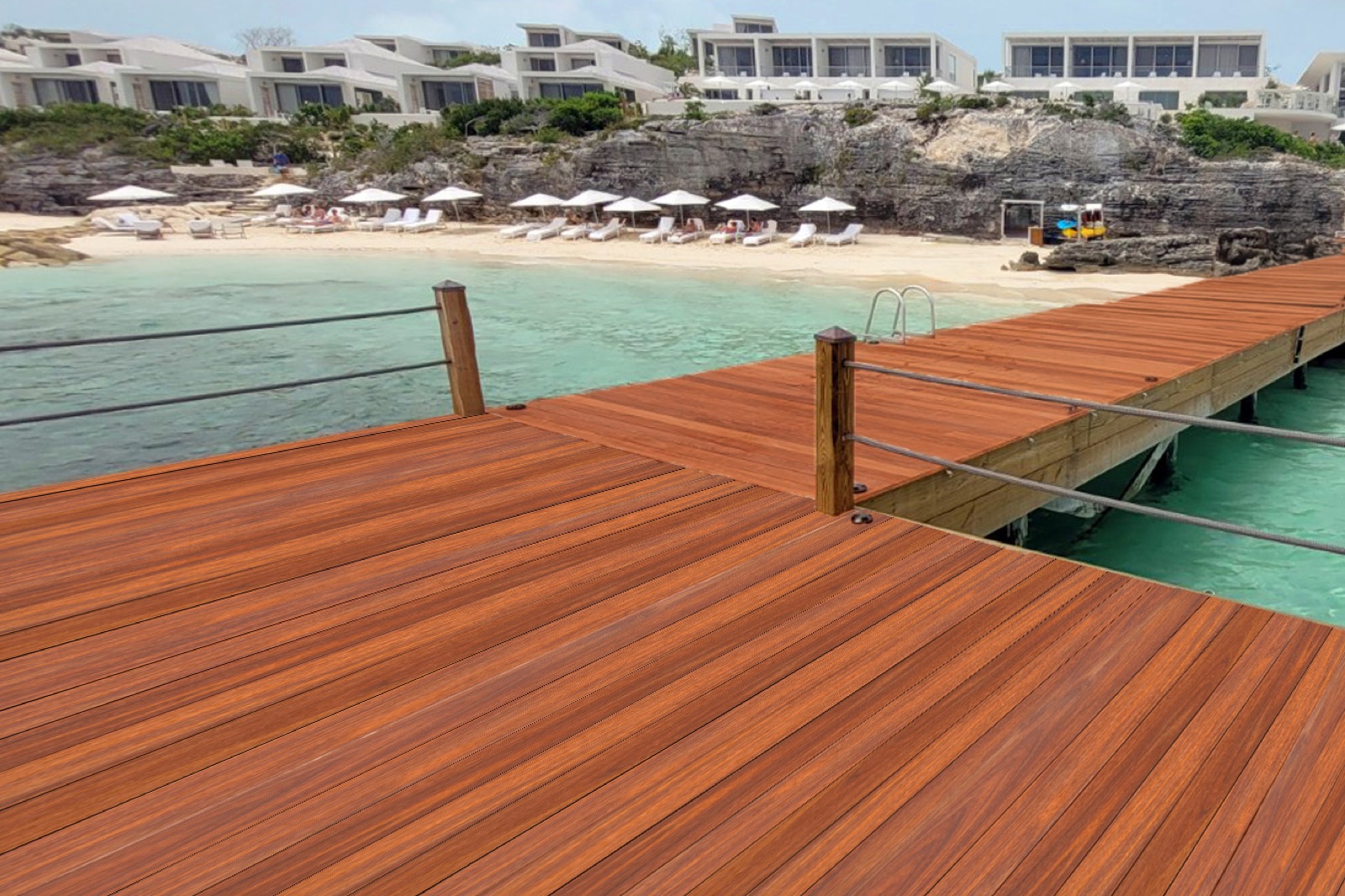
Massaranduba lands under Ipe on the delivered invoice, and across a field of 800 square feet or more that gap is worth taking seriously, but Ipe recovers most of it in waste, labor and the maintenance cycle, then pulls ahead over a twenty year ownership window. That is the whole answer in one sentence. The rest of this page is the arithmetic behind it, because a large deck is not a species decision. It is a takeoff, a fastening plan, a substructure, a finish schedule and a delivery, and the species you pick changes the number attached to every one of those lines.
Small decks hide this. On 250 square feet, a difference in board price barely registers against demo, framing and railing. Scale to 1,200 or 2,000 square feet and the decking package becomes the single largest material line on the job, which is exactly when buyers start pricing Massaranduba against Ipe and asking whether the premium species still makes sense. It sometimes does not. A shaded lakeside deck in a stable climate, built by a crew that has run dense tropical hardwood before, is a fine place for a species other than Ipe. A full sun southern exposure over a pool, with a homeowner who will oil it once and never again, is not.
Price the Deck in Installed Square Feet, Not Board Feet
Comparing tropical decking on board footage produces the wrong answer, because the two species do not convert board feet into finished deck surface at the same rate once yield, tally and cut waste are accounted for. Decking is sold by the piece or by the linear foot in most tropical programs, and the number that matters is what it costs to cover a square foot of framed field.
Start with the coverage math. A nominal 5/4x6 board dresses out near 5.5 inches wide, and with a normal gap it covers about 2.1 linear feet of board for every square foot of deck. A 1,200 square foot field therefore needs roughly 2,520 linear feet of decking before any waste factor. Add 10 percent on a plain rectangle with square corners. Add closer to 15 percent when the design carries a picture frame border, and more again where stairs, angled bays or mitered returns force short cuts out of long boards.
Now the part buyers miss. Random length tally and specified length tally are two different purchases. A random tally arrives with whatever the mill run produced, and on a long field that means more butt joints, more offcuts and more crew time hunting for the piece that finishes a run. Specified lengths cost more per foot and waste less. On a large residential field with long clean runs, the specified length package frequently ends up cheaper installed, and that comparison is the one to run before deciding either species is the value option.
Density Sets the Labor Clock
Both species are hard enough to change how a crew works, and the labor difference between them is smaller than the labor difference between dense tropical hardwood and anything a deck crew normally handles. Ipe runs about 3,680 lbf on the Janka scale at roughly 1,050 kg per cubic meter. Massaranduba is slightly softer on paper at about 3,190 lbf, and noticeably heavier at about 1,150 kg per cubic meter. Handling weight is a real line item on a big order, and Massaranduba is the heavier board to carry up a hill and across staging.
Every fastener hole in either species gets piloted. Count what that means on a real field. At 16 inch joist centers, 2,520 linear feet of decking crosses roughly 1,900 bearing points, and at two fasteners per board per joist that is close to 3,800 holes, each one drilled and countersunk against the frame as built.
Never buy decking pre-drilled, and never let a supplier offer to punch the pattern before shipping. Layout shifts, joists get sistered in the field, a stair landing moves four inches, and any factory hole pattern is scrap the moment the first board is cut to length. Drilling is site work. Use a self centering combination bit that pilots and countersinks in one pass, keep fasteners about three quarters of an inch off the board edge, run full depth pilots within a few inches of every board end where splitting risk is highest, and land butt joints on doubled bearing so both board ends get full support. Carbide blades dull fast in either species. Budget for spares and expect the crew to move slower than they would on cedar.
How the Tropical Field Species Line Up on Cost Drivers
The species that make sense on a large residential field separate less on hardness than on three practical axes, which are dimensional behavior in service, availability in the thickness the job needs, and how much attention the finish demands to hold its color. The table below sorts the common candidates on those terms rather than on raw specification numbers alone. Two entries are included only for comparison, and one of them is not part of the J. Gibson McIlvain program at all.
| Species | Janka (lbf) | Density (kg/m3) | EN 350 durability | Sourced in 2x decking | Where it belongs on a large field |
|---|---|---|---|---|---|
| Ipe (Tabebuia spp.) | ~3,680 | ~1,050 | Class 1 | Yes, consistently | Full sun, coastal, pool surrounds, rooftop and any field that may be engineered |
| Cumaru | ~3,540 | ~1,070 | Class 1 to 2 | Yes, consistently | Large fields where warm brown tone is wanted and slightly more movement is acceptable |
| Massaranduba | ~3,190 | ~1,150 | Class 1 to 2 | Comparison only, not part of the J. Gibson McIlvain program | Stable climates, shaded or partly shaded fields, owners who will maintain the red tone |
| Jatoba | ~2,690 | Moderate to high | Class 2 to 3 | Yes | Covered porches and protected fields, plus 2x work where a lighter red brown is wanted |
| Red Balau | ~1,700 to 2,000 | Moderate | Class 2 | No | Residential 5/4 fields on a budget, never a public or engineered deck |
| Garapa | ~1,700 | Moderate | Class 2 to 3 | No | Residential fields wanting a pale golden deck that runs cooler underfoot |
Technical profiles for individual species are documented at the Wood Database entry for Ipe and the corresponding Massaranduba entry, and the underlying shrinkage and mechanical property methodology comes out of the USDA Forest Products Laboratory.
The Substructure Is Part of the Decking Price
Dense tropical decking forces framing decisions that a large field pays for whether the species is Ipe or Massaranduba, and skipping them is where cheap decking turns expensive. Joists go at 16 inches on center for either species in a standard residential field. Diagonal layouts tighten that further. Both species carry serious dead load compared to softwood decking, and on an elevated deck that load needs to be part of the framing design rather than an afterthought, with span tables and connection detailing checked against the current standards published by the American Wood Council and the residential code adopted locally through the International Code Council.
Airflow under the field matters more than species choice for long term stability. A deck that traps humid air below and bakes on top sets up a moisture gradient across the board thickness, and that gradient is what cups boards and opens checks. Keep the underside vented, keep the field off grade, and detail the ledger and flashing so water leaves rather than sits, using the principles documented by Building Science Corporation. Both species will move if the underside cannot dry. Massaranduba moves more.
Order Size Changes What You Are Actually Buying
A large residential deck is a mill and logistics problem more than a retail transaction, and the way the order is assembled affects installed cost as much as the species on the packing list. A 2,500 linear foot package pulled from a single run gives consistent color, consistent thickness and consistent milling across the whole field. The same footage assembled from three lots arrives with color variation the homeowner will notice on day one and a thickness variation the crew will fight at every butt joint.
Documentation travels with the order too. J. Gibson McIlvain is FSC certified, and when a project calls for a CITES listed species, permits and documentation have to accompany the shipment under the rules administered through CITES. On tropical decking that paperwork chain is worth confirming before an order ships, not after a truck is on the road.
"When someone calls me about a two thousand square foot deck, the first thing I ask is not which species. I ask how long the runs are, what the exposure looks like and when the crew is booked. I have seen buyers save on the board and lose it three times over on a random tally that did not fit the field. We would rather build the package around the takeoff and ship it in one truck." Norm Moton, Director of Sales, J. Gibson McIlvain
Orders leave the mill for job sites nationwide, including regular truckloads to California, and a large field is worth scheduling around the install date so material is not sitting outdoors for six weeks before anyone touches it. Call 800-638-9100 with a takeoff and a target delivery week and the package can be built around both.
Surface Checking, Cutek and What Factory Coating Buys on a Big Order
Checking cannot be prevented in dense tropical decking, and any supplier promising otherwise is selling something. Checking is tension release. The surface of a board heats and dries faster than its core, the outer fibers shrink against a core that has not moved yet, and fine checks open along the grain. They do not weaken the board. Small surface checks are normal on Ipe and on Massaranduba, and on properly seasoned material they are a sign the wood is doing what dense wood does.
What can be changed is the severity. J. Gibson McIlvain factory coats tropical decking with Cutek, a penetrating oil wood stabilizer that slows moisture exchange at the surface and significantly reduces checking. On a large field that treatment is applied before the material ships, which means every face and edge is covered rather than only what a crew can reach after the deck is down. Site practice does the rest. Take delivery at an in service moisture content near 12 to 16 percent, seal every field cut end, sticker and cover the stacks off the ground, and get the field oiled soon after install. Those steps keep checks small. They do not eliminate them, and no species in this comparison is exempt.
Twenty Years of Maintenance Is Where the Comparison Resolves
The species with the lower delivered cost has the higher maintenance obligation, and on a large field maintenance is priced by the square foot every few years for as long as the deck exists. Left alone, both species weather to silver gray. Ipe goes there slowly and evenly. Massaranduba starts deep red, which is exactly why buyers want it, and that red is the least stable part of the deal. It fades faster and less evenly, especially where a railing or planter throws a shadow line across the field.
Holding color means a pigmented penetrating oil on a cycle, and in full southern sun that cycle is short. On 1,200 square feet the cleaning and recoating labor is a meaningful recurring number, and it lands on the homeowner rather than the contractor, which is why it disappears from the original comparison and then reappears in year three. Run the math over twenty years before deciding which board was cheaper.
Movement matters here as well. Massaranduba's higher density comes with more seasonal dimensional change, and on a wide field that shows up as gaps that open and close more than the owner expects, occasional cupping where ventilation is poor, and a handful of boards that need swapping. Ipe is the calmer board in service. Neither species carries a warranty, and no solid unmodified wood should be sold with one. Warranty coverage belongs to modified products such as Accoya, or Thermory and Abodo Vulcan in the thermally modified category, all of which top out around 16 feet in length because of kiln size, with metric lengths landing just under that.
When a Residential Deck Quietly Becomes a Commercial Spec
Large residential projects cross into engineered territory more often than owners expect, and the moment an engineer stamps the deck the species field narrows hard. Rooftop decks over occupied space, pool surrounds on structural slabs, shared amenity decks in a homeowners association, and long span framing all tend to get reviewed by someone who will specify 2x decking to control deflection. Commercial boardwalk, pier and plaza work is specified at 2x as standard practice, and no professional goes first with a thinner board on a public walking surface even where the strength math on 5/4 works.
Only Ipe, Cumaru and Jatoba can be sourced consistently in 2x decking thickness. That single fact removes most alternatives from any engineered field, including Red Balau and Garapa, which belong in residential and engineer approved 5/4 work. If there is any chance the project gets reviewed or the deck serves more than one household, specify a species available in 2x from the start rather than redesigning after the first plan check.
Fire rating pulls in the same direction. Ipe carries an ASTM E84 Class A rating, meaning a flame spread index of 25 or less under the test method maintained by ASTM International. In wildland urban interface zones and on multifamily rooftop assemblies that rating is not optional, and it settles the species question before cost enters the conversation. Reference material on fire performance in wood assemblies is published by the National Fire Protection Association and through the technical library at WoodWorks.
Where Large Tropical Orders Actually Go Wrong
Most failures on big tropical decks trace back to profile and fastening decisions rather than the species on the invoice. Profile dictates fastening, and the rule does not bend. Shiplap and square edge boards take visible fasteners, face screwed through piloted holes. Only tongue and groove profiles accept hidden fastener systems. Any groove profile installs with the groove facing down so water drains rather than collecting in the channel, and material sits on furring strips or joists with airflow underneath.
The other recurring problems on a large field are storage and moisture. Material delivered wet and installed tight will open gaps all season. Material delivered dry and installed with the gaps a contractor uses on softwood will crowd. Stainless fasteners are the right call on any tropical field, and 316 stainless is the requirement within salt air range of the coast, where lesser fasteners streak the deck within a season. Mixing lots mid field, skipping end sealing on cuts, and running boards over single bearing at butt joints round out the list.
How J. Gibson McIlvain Would Specify This
For a large residential field, specify Ipe when the exposure is severe or the deck may ever be engineered, and consider a lower cost tropical species only where climate is stable, the field is partly shaded and the owner has committed to a real maintenance cycle. The practical spec reads like this.
Run the takeoff in square feet, then convert at roughly 2.1 linear feet of 5/4x6 per square foot and add 10 to 15 percent depending on how much border and stair work the design carries. Price specified lengths against random tally on the same field before assuming random is cheaper. Frame at 16 inches on center, tighter for diagonal layouts, with the underside vented and the ledger flashed to drain. Choose the profile first and let it dictate fastening, with hidden systems reserved for tongue and groove and every groove facing down. Order 316 stainless within coastal range, plan for two fasteners per board per joist, pilot every hole on site with a self centering combination bit at about three quarters of an inch edge distance, and land butt joints on doubled bearing. Ask for Cutek factory coating on the package. Seal every field cut end. Schedule delivery close to the install window and keep the stacks stickered, covered and off the ground.
J. Gibson McIlvain mills and ships Ipe decking in a vast inventory across every standard and custom dimension, including 2x thickness for engineered and elevated work, along with Cumaru, Jatoba, Garapa and Red Balau for residential fields where a different tone or a lighter budget fits the job. Full species and profile detail is available on the Ipe decking page and across the rest of the J. Gibson McIlvain program, and the sales desk will review a takeoff, a framing plan and a delivery date together at 800-638-9100 before anything ships.
Frequently Asked Questions
How much decking should I order above the square footage on a large field?
Convert first, then pad. A nominal 5/4x6 board covers about 2.1 linear feet for every square foot of deck, so a 1,200 square foot field needs roughly 2,520 linear feet before waste. Add about 10 percent on a plain rectangle with square corners, closer to 15 percent when the design has a picture frame border, and more where stairs, angled bays or mitered returns force short cuts. Random length tally usually needs the higher figure. Specified lengths need less, which is why the two packages should be priced against each other rather than assumed.
Does Massaranduba require different tools or drilling technique than Ipe?
The technique is the same and the tool wear is comparable. Both species need carbide blades, a pilot hole under every fastener, two fasteners per board at each joist, roughly three quarters of an inch of edge distance and full depth pilots near board ends. Massaranduba is the heavier of the two to move around a site at about 1,150 kg per cubic meter against roughly 1,050 for Ipe, so handling and staging labor on a large order runs higher. Neither species should ever arrive pre-drilled. Layout changes and field cuts make any factory hole pattern useless.
Can I mix two tropical species on the same deck to reduce cost?
It works only when the design treats them as separate elements rather than blending them in one field. A border in one species with a field in another can look deliberate. Random mixing inside a single field reads as a mistake, and the two species will fade at different rates and to different tones, so the difference gets more obvious with age rather than less. Movement differences also mean gap behavior varies across the deck. If budget is the driver, change the species for the whole field rather than half of it.
What does factory Cutek coating actually accomplish on a large order?
Cutek is a penetrating oil wood stabilizer that slows moisture exchange at the board surface, which significantly reduces surface checking. Applied at the mill before shipping, it reaches every face and edge, including the underside a crew can never coat once the deck is down. It does not prevent checking. Nothing does in dense tropical hardwood, since checking is the surface releasing tension as it dries faster than the core. What the coating buys is smaller, less frequent checks and a more even starting point across a field that came from one run.
Will I be able to match boards years later if a few need replacing?
Match on species and dimension, and expect a color difference for a season or two. A weathered field and a fresh board will never look identical on day one, whichever species is on the deck. Ipe replacements blend faster because the aged tone is more uniform to begin with. Deep red species are harder to blend, since the original red has usually shifted unevenly depending on shade lines. Ordering a small quantity of extra material with the original run and storing it stickered and covered is the cheapest form of insurance on a large field.
Is Massaranduba an option for a rooftop or pool deck at a large home?
Not once an engineer gets involved. Rooftop decks over occupied space, pool surrounds on structural slabs and shared amenity decks tend to be reviewed and specified at 2x decking thickness to control deflection, and only Ipe, Cumaru and Jatoba can be sourced consistently in that thickness. Fire rating narrows it further in wildland urban interface zones and on multifamily rooftops, where an ASTM E84 Class A rating is required. Ipe carries that rating. Plan the species around the review rather than redesigning after the first plan check.
How much does the substructure change between these two species?
Very little between them, and a great deal compared to softwood decking. Both call for joists at 16 inches on center in a standard residential field, tighter for diagonal layouts, and both put real dead load on the frame, which needs to be part of the structural design on any elevated deck. Ventilation under the field is the variable that matters most for either species. A deck that cannot dry underneath will cup boards and open checks regardless of what is on top, and the denser, more mobile species punishes that mistake harder.
Does either species come with a warranty on a large residential job?
No, and no reputable supplier offers one on solid unmodified wood. Warranty coverage belongs to modified products such as Accoya, and to thermally modified decking from Thermory and Abodo Vulcan, all of which are limited to roughly 16 feet in length because of kiln size, with metric lengths landing just under that. Solid tropical decking is sold on species durability, grade and moisture content instead. Ipe rates EN 350 Class 1 for natural durability, which is the substantive assurance behind the material.