
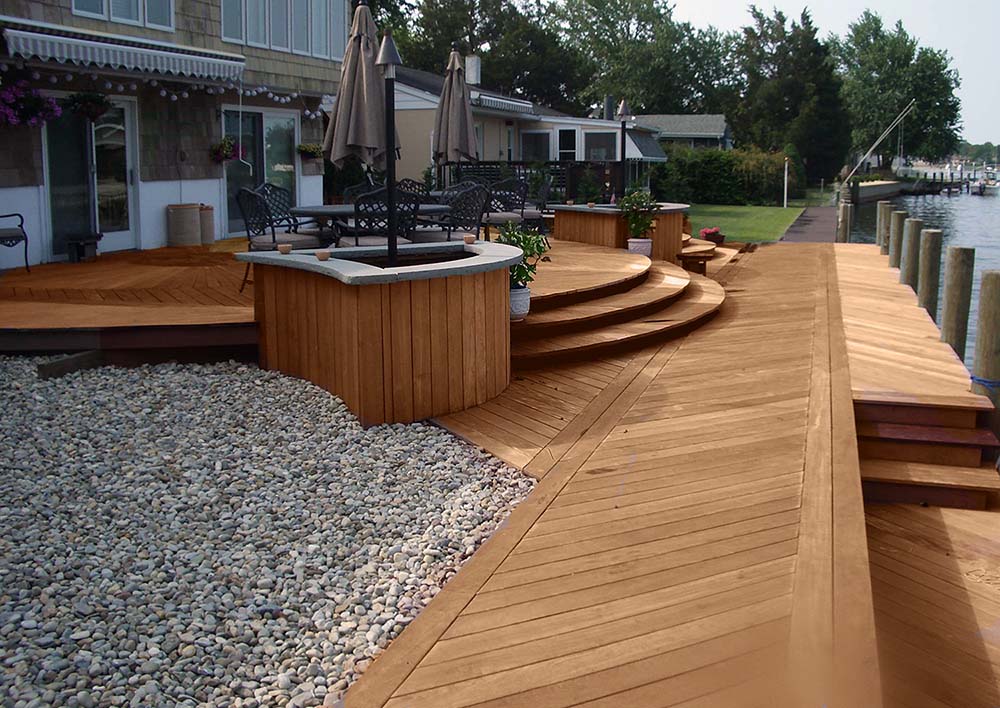
The Short Answer on Cost Effectiveness
Massaranduba costs less than Ipe per board, but on a large residential deck that saving shrinks toward a rounding error once board width, yield, fastening labor and rework risk get priced into the job, and Ipe finishes ahead on installed cost in most of the country. The board is one line on a project that also carries footings, framing, ledger, flashing, stairs, railing, demolition and permits. None of those lines move when the species changes. Cut the decking material by some percentage and you have cut the total project by a much smaller percentage. That is the arithmetic buyers miss when they compare two numbers on a quote sheet and stop there.
There is a real case for Massaranduba. It lives in humid, dimensionally forgiving climates, on narrower boards, on decks that are shaded or close to grade, with a crew that has run tropical hardwood before and details it correctly. Put Massaranduba on a 1,200 square foot open field of 5/4x6 in full sun in the interior West and the species will spend the first two summers telling you about it.
So the honest answer is conditional. The rest of this page walks the conditions.
What Actually Separates Massaranduba from Ipe
Hardness is not the difference between these two species, and anyone selling on Janka alone is selling the wrong number. Ipe runs about 3,680 lbf on the Janka scale at roughly 1,050 kg/m3. Massaranduba (Manilkara bidentata, sold in some markets as bulletwood) runs about 3,190 lbf at roughly 1,150 kg/m3, which makes it the heaviest of the common tropical decking species and denser than Ipe despite testing softer on the ball. Both are several times harder than anything a residential deck will ever do to them. A dropped grill, a dog, a patio chair dragged across the field in August: neither species cares.
The difference that matters is movement. Ipe carries a volumetric shrinkage of roughly 12 percent with a tangential-to-radial ratio near 1.3. Massaranduba sits closer to 17 percent volumetric with a T/R ratio near 1.4. Those numbers look academic until they land on a 6 inch face in direct sun. Higher volumetric shrinkage means more total dimensional change across a seasonal cycle. A higher T/R ratio means the board moves unevenly between its two axes, which is the mechanism behind cupping and surface checking. Massaranduba also carries interlocked grain that adds a second stress path when the surface dries faster than the core. The Wood Database entry for Massaranduba and its Ipe counterpart put the two side by side, and the shrinkage lines are where the species part company.
Color parts them too. Massaranduba arrives a deep, almost brick red. Ipe arrives olive brown to near chocolate with more variation from board to board. Left unfinished, both drift to a silver gray. Massaranduba's red gives up faster and less evenly, which matters if the homeowner picked the species from a photograph of a freshly oiled sample.
Durability is close enough that it should not decide the job. Both sit at or near the top of the EN 350 scale. The general fundamentals behind these ratings and the mechanics of wood movement are documented by the USDA Forest Products Laboratory, and nothing in the decay data separates these two species in a way a homeowner would ever notice.
Species Comparison for Large Deck Fields
The tropical decking species are not interchangeable, and the right pick depends on board width, exposure and how much movement the detail can absorb. The table below covers the species that realistically compete for a large residential field.
| Species | Janka (lbf) | Density | EN 350 Durability | In-Service Movement | Material Cost vs Ipe |
|---|---|---|---|---|---|
| Ipe | ~3,680 | ~1,050 kg/m3 | Class 1 | Low (~12% volumetric) | Benchmark, highest of the group |
| Massaranduba | ~3,190 | ~1,150 kg/m3 | Class 1 to 2 | High (~17% volumetric) | Less than Ipe |
| Cumaru | ~3,540 | ~1,070 kg/m3 | Class 1 to 2 | Moderate | Less than Ipe |
| Jatoba | ~2,690 | ~910 kg/m3 | Class 3 (moderately durable) | Moderate | Less than Ipe |
| Red Balau | ~1,700 to 2,000 | Moderate | Class 2 | Moderate | Well below Ipe |
| Garapa | ~1,700 | ~800 to 830 kg/m3 | Class 2 to 3 | Moderate | Well below Ipe |
| Teak | ~1,070 | Moderate | Class 1 | Very low | Above Ipe |
Read that table with the exposure in mind. Massaranduba's durability class earns it a place on the list. Its movement column is why it belongs on narrower boards.
Why Board Width Quietly Decides the Budget
Massaranduba should be specified in 5/4x4 rather than 5/4x6 on a large sun-exposed field, and that single decision erases most of the material saving before a screw goes in. Run the coverage. A 5/4x6 board with a 3/16 inch gap covers about 2.1 linear feet per square foot of deck. Drop to 5/4x4 and coverage climbs to roughly 3.25 linear feet per square foot. That is about 55 percent more boards across the same field.
On an 800 square foot deck the swing is concrete. At 5/4x6 the field takes roughly 1,680 linear feet of decking. At 5/4x4 it takes roughly 2,600 linear feet. Nine hundred twenty additional linear feet of board. Every one of those boards needs the same treatment as the ones it replaced: pre-drilled, countersunk, fastened at every joist, end-sealed at every cut. Both species are dense enough that pre-drilling is mandatory, not optional, and a crew that skips it will split boards and snap screw heads. The labor scales with board count, not with square footage.
Ipe's lower movement is what lets it hold a 6 inch face in the open without the cupping risk that pushes Massaranduba narrow. Fewer boards. Fewer pilot holes. Fewer fasteners. Fewer linear feet of gap for a crew to keep straight across a long run. That is the mechanism by which the more expensive board becomes the less expensive deck.
Someone will ask whether Massaranduba can run 5/4x6 anyway. In a humid, dimensionally stable climate, under partial shade, at correct moisture content, with proper gapping, yes. In the open in a climate with dry winters, that is a bet on the weather.
Movement, Checking and the Climate Question
Climate is the variable that flips this comparison, and the same Massaranduba deck that performs beautifully in coastal Georgia will check and cup in interior California. Tropical hardwood decking should reach 12 to 16 percent moisture content in service. The species does not decide that range. The site does. A deck in a humid Gulf Coast or Southeast climate lives near the top of that band year round and moves very little because the ambient conditions barely swing. That is Massaranduba's home field. Its higher shrinkage number never gets exercised.
Move the same deck to a climate with hot dry summers and low winter humidity and the wood cycles through a much wider moisture range every year. Now the 17 percent volumetric figure and the 1.4 T/R ratio are doing real work, and they express as surface checking on the wide face and cupping across it. The Building Science Corporation literature on moisture and assemblies explains the mechanism better than any species datasheet: wood moves with the vapor environment it sits in, and dark boards in full sun are hotter and drier at the surface than the air around them.
The mitigations are ordinary and they cost money. Acclimate the material on site, stickered and covered, before installation. Gap for the moisture content the boards are at when they go down, not for a number from a chart. Seal every fresh cut with a wax-based end sealer, including field cuts on the last board of a run. Keep the underside ventilated so the board dries from both faces at the same rate. Skip any one of those on Massaranduba and the checking shows up the first summer.
"People call us with two numbers on a page and want to know which one to circle. I ask where the deck is and how wide the boards are. If it is a shaded ground-level deck in Charleston on 5/4x4, Massaranduba is a smart buy and I will say so. If it is a big open field in the Central Valley on 5/4x6, that saving will not survive the first dry winter, and the customer will be paying my competitor's labor rate twice. The board is the cheap part of a deck. The crew is not."
Norm Moton, Director of Sales, J. Gibson McIlvain
Yield, Lengths and What Happens on a Large Order
A 10 percent lower board cost is not a saving if the pack yields 12 percent more waste, and yield is where large tropical orders separate the suppliers from the brokers. Massaranduba arrives with more color spread than most buyers expect, from a dark brick red through to lighter tones, and on a large field that variation forces the crew to sort. Sorting is labor. Boards culled for color are waste. Neither shows up on the quote sheet.
Length availability moves the number too. Long boards mean fewer butt joints, and every butt joint on a hardwood deck is real work: it needs a doubled joist or blocking underneath, two more sets of pilot holes and countersinks, end sealer on both cut ends, and a crew member paying attention so the joints stagger instead of lining up in a row. J. Gibson McIlvain mills and stocks Ipe decking across all standard and custom dimensions and in the full run of lengths, which is what lets a large field get laid out with the long boards where they show and the shorts consumed on stairs and around obstructions. The Ipe inventory is deep enough that a large residential job does not get designed around what happens to be on the ground.
That inventory position is the practical reason Ipe often wins a large deck. The specifier gets to pick the layout. With a thinner length run the layout picks itself, and it picks more joints.
Sourcing documentation belongs in this same conversation. Both species come out of South America, and responsible supply chains for either one mean traceable, legal harvest. FSC certification is available on tropical decking, and when using a CITES-listed species, documentation is required and must travel with the shipment; the CITES Appendices are the authority on which species that covers. J. Gibson McIlvain is FSC certified and handles that paperwork on the import side so it does not become the contractor's problem at the jobsite.
Fasteners, Profile and Where the Labor Actually Lives
The fastening decision costs more than the species decision, and high-movement species narrow the options. Both Ipe and Massaranduba go over joists at 16 inches on center. That spacing is not about strength. It is about restraint. Dense hardwood decking wants to move, and the joist is what holds it flat, so the 24 inch spacing that works under softwood will let a tropical board cup between bearing points.
Hidden fasteners are the default request on residential work, and they demand a side-grooved board and a clip that lives in that groove. On Ipe the system works well. On Massaranduba the calculus is different. The clip restrains the board at a thin groove wall while the board tries to move more than Ipe would, and that stress has to go somewhere. Two 316 stainless screws per joist, pre-drilled, countersunk and plugged, hold a high-movement board flatter than any clip will. Plugging is labor and it is worth it. Coastal work takes 316 stainless regardless of species, since 304 will bleed rust down a dark board within a season or two.
Cladding on the skirt, fascia and soffit follows different rules and buyers routinely mix them up. Shiplap takes visible fasteners. Only tongue and groove works with hidden fasteners. Either profile goes on furring strips or framing with a drainage gap behind it, and the grooves face DOWN so water leaves the assembly instead of sitting in a channel. The American Wood Council maintains the standards that govern the framing beneath all of it, and residential deck construction has code provisions worth reading before the ledger goes on.
None of this is species-specific magic. There is no board that fixes a bad joist layout, a starved ventilation gap or the wrong screw. Installation carries as much of the outcome as the wood does.
Fire Rating and Where It Decides the Species
If the project sits in a wildland urban interface zone or the AHJ asks for a Class A flame spread rating, Ipe answers with a documented listing. Massaranduba is not published to the same standard, so confirm its report with the supplier before it goes in the spec rather than assuming the rating from density. Ipe has tested to ASTM E84 Class A, meaning a flame-spread index of 25 or less, which is the same class as many noncombustible assemblies and unusual for a solid wood product with no treatment. That result exists because the material was tested and listed. For Massaranduba, the flame-spread report has to be confirmed for the specific material before it goes on the drawings, and no species can be substituted into a Class A specification on the strength of being similarly dense.
For large residential projects in California, Colorado and other WUI-mapped regions, this is not a preference. It is a permit condition. The test method is published by ASTM and the code path that references it runs through the International Code Council. Fire performance data and its application to wood assemblies is also covered by WoodWorks. When Class A is on the drawings, the comparison is over and the answer is Ipe.
Lifetime Cost: Fade, Finish and Rework
Neither species carries a warranty, because no solid unmodified wood does, and the real lifetime variable is how often the deck gets refinished or repaired. Left alone, both weather to silver gray and both last decades. The decay resistance is not the question. Appearance is.
Massaranduba's deep red fades faster and less evenly than Ipe's brown, so the homeowner who fell in love with the sample either accepts the gray or commits to a UV-inhibiting oil on a recurring cycle. That cycle is labor, and on a large deck it is the same labor every time regardless of what the boards cost. Ipe holds its tone somewhat longer under the same oil. Neither is maintenance free and any supplier claiming otherwise is guessing.
Rework is the line item nobody quotes. A field of checked or cupped Massaranduba does not fail structurally. It fails visually, and the fix is replacement boards and a crew back on site. That risk is small in a humid climate on narrow boards and meaningful in a dry climate on wide ones. Price it as what it is: a probability, weighted by climate and detail.
Buyers who want a written warranty are asking for a different product category. Modified woods carry them because the process is engineered and the manufacturer stands behind it. Accoya, along with Thermory and Abodo Vulcan thermally modified products, all come with manufacturer warranty coverage. They also top out around 16 feet, with the metric lengths landing just under 16 feet, because the modification kilns are only so long. On a large deck that length ceiling means more butt joints, which is the same labor conversation from two sections up.
Western Red Cedar deserves a mention here rather than a dismissal. Cedar is the default standard on a great deal of residential exterior work and it earns that position, weathering freeze and thaw cycles extremely well over long service lives. CVG (clear vertical grain) and STK (select tight knot) are different products for different markets and should never be quoted interchangeably. Cedar is simply a different use case than a high-traffic tropical hardwood field, not a lesser one.
How J. Gibson McIlvain Would Specify This
Specify by climate and board width first, then let the species fall out of that decision rather than starting from the cost line. Here is the practical path.
Humid, stable climate. Shaded or ground-level deck. Massaranduba in 5/4x4, gapped 3/16 inch, acclimated on site to 12 to 16 percent, face-screwed with two 316 stainless screws per joist, pre-drilled and countersunk, plugged, all cuts end-sealed. Joists at 16 inches on center. This is where the saving is real and it survives to the finished deck.
Dry climate, wide temperature and humidity swings, or a large open field in full sun. Ipe. 5/4x6 is safe here where it is not on Massaranduba, which cuts board count by roughly a third against a 5/4x4 layout and takes the labor down with it. Hidden fasteners are on the table since Ipe's movement will not fight the clip.
WUI zone or Class A on the drawings. Ipe, with the ASTM E84 documentation. No substitution.
Any large field, either species. Joists at 16 inches on center. 316 stainless within a few miles of salt water. Full ventilation under the deck with a clear drainage path. Long boards where they show, shorts consumed on stairs and around penetrations, butt joints staggered and landed on doubled joists or blocking. If accessibility governs any part of the deck, the surface and gap requirements under the US Access Board guidelines apply and should be checked before layout.
Order the field and the trim together. Color-matching a second Massaranduba pack against the first is genuinely difficult given the spread the species carries. One order, one time.
J. Gibson McIlvain supplies Ipe to contractors and commercial buyers nationwide, ships full truckloads to California and the West on a regular basis, and mills to the profile and dimension a specific job needs. We carry Ipe, not Massaranduba, so on a supply-sensitive schedule Ipe is the safer spec. The Ipe decking program covers the full dimensional range with the inventory depth a large residential field requires. This is contractor and commercial volume work rather than a walk-in yard, so the conversation starts with the drawings and the site.
Making the Call on Your Project
Bring the climate, the square footage, the exposure and the board width to the conversation, and the species answers itself. Massaranduba is a legitimate way to build a beautiful hardwood deck for less material outlay, and it is the wrong answer more often than its cost line suggests, because the conditions that make it work are narrower than the conditions that make Ipe work. A buyer in Savannah and a buyer in Bakersfield should not get the same recommendation, and any supplier who gives them one is not paying attention.
Grading rules and species identification matter on any tropical order, and the National Hardwood Lumber Association standards are the reference point for how hardwood gets graded in this market. Ask any supplier what grade they are quoting. The answer tells you a great deal.
To price a specific field with real dimensions, lengths and a layout, call J. Gibson McIlvain at 800-638-9100 or request a quote at mcilvain.com. Have the square footage, the site location, the joist spacing and the fastening method ready. Those four answers determine which species belongs on the deck, and the number follows from there.
Frequently Asked Questions
Is Massaranduba really cheaper than Ipe once the deck is finished?
The board is cheaper. The deck often is not. Massaranduba should be run in 5/4x4 rather than 5/4x6 on a large sun-exposed field because of its movement, and that alone raises board count by roughly 55 percent (about 3.25 linear feet per square foot versus about 2.1). Every additional board carries the same pre-drilling, countersinking, fastening and end-sealing labor as the one it replaced. Add color sorting waste and rework risk, and on a large residential project the installed-cost gap usually closes or reverses. In a humid, stable climate on narrow boards, the saving is real and it holds.
Why does Massaranduba move more than Ipe?
Volumetric shrinkage of roughly 17 percent versus roughly 12 percent for Ipe, with a tangential-to-radial ratio near 1.4 versus about 1.3. Higher volumetric shrinkage means more total dimensional change across a seasonal moisture cycle. The higher T/R ratio means the board changes unevenly between its two axes, which is what drives cupping and surface checking. Massaranduba's interlocked grain adds another stress path when the exposed face dries faster than the core.
Can I use hidden fasteners with Massaranduba?
It is possible but not the best choice on a large field. Hidden fastener clips restrain the board at a thin side-groove wall, and a higher-movement species puts more stress into that groove than Ipe does. Two 316 stainless screws per joist, pre-drilled, countersunk and plugged, restrain a Massaranduba board flatter and more reliably. Ipe's lower movement makes it the better candidate when a clip system is a firm requirement.
Does Massaranduba have a Class A fire rating like Ipe?
Not on the same documented footing. Ipe has tested to ASTM E84 Class A, meaning a flame-spread index of 25 or less, and that documentation exists because the material was tested and listed. For Massaranduba the flame-spread report has to be confirmed for the specific material before it goes into a Class A specification. Similar density is not a substitute for a test report. If the project sits in a wildland urban interface zone or the drawings call for Class A, specify Ipe.
What joist spacing do both species need?
16 inches on center for either one. The spacing is about restraint rather than load capacity. Dense tropical hardwood wants to move, and the joist is what holds the board flat, so the 24 inch spacing common under softwood decking allows cupping between bearing points. This applies to Ipe, Massaranduba, Cumaru and the rest of the dense tropical group.
Which species is better in a coastal or humid climate?
Both perform well, and Massaranduba's cost advantage is most defensible there. Humid climates hold the wood near the top of the 12 to 16 percent in-service moisture range year round with little seasonal swing, so Massaranduba's higher shrinkage figure never gets exercised. Use 316 stainless fasteners within a few miles of salt water for either species, since 304 will bleed rust down a dark board within a season or two.
Do either of these species come with a warranty?
No solid unmodified wood carries a warranty, Ipe and Massaranduba included. Warranty coverage comes with modified products such as Accoya and the thermally modified Thermory and Abodo Vulcan lines, because those are engineered processes the manufacturer stands behind. Those products top out around 16 feet, with metric lengths landing just under 16 feet, since the modification kilns are only so long. On a large deck that length ceiling means more butt joints and more labor.
Can J. Gibson McIlvain ship a large deck order to the West Coast?
Yes. J. Gibson McIlvain ships tropical decking nationwide and runs full truckloads to California and the West regularly. This is contractor and commercial volume supply rather than a walk-in retail yard, so the conversation starts with the drawings, the square footage, the site location and the fastening method. Call 800-638-9100 to price a specific field.
Sources and Standards Referenced
- Wood Database: Massaranduba (Manilkara bidentata)
- Wood Database: Ipe (Handroanthus spp.)
- USDA Forest Products Laboratory
- American Wood Council: Codes and Standards
- ASTM International
- International Code Council
- WoodWorks: Wood Products Council
- Building Science Corporation
- Forest Stewardship Council
- CITES: Convention on International Trade in Endangered Species
- National Hardwood Lumber Association
- US Access Board


