Responsible Sourcing Starts at the Stump, Not the Invoice
Responsibly harvested tropical decking comes from a standing natural forest working under an approved management plan, and every certificate on the paperwork side exists only to prove that fact. Buyers ask about the documents first. Fair enough. A certificate is the thing an auditor can hold. But a certificate describes a forest system, and a buyer who understands how that system works can judge a supplier's answers instead of taking them on faith. This article walks through how concession forestry operates in the two regions that matter for tropical decking, South America and the Congo Basin of Africa. It then follows the consequences down the chain, into which species you can spec, at which thicknesses, and what a serious importer does with the material before it reaches your jobsite.
How Selective Harvest Works on the Ground
A managed tropical concession removes roughly one to three commercial trees per hectare, then leaves that block of forest alone for 25 to 35 years. That single fact reorders most people's mental picture of tropical logging. There is no clearcut. From the air, a harvested block looks like intact canopy with a few small gaps, and within a few growing seasons the gaps close.
The work is slow and heavily front-loaded. Before a saw starts, crews walk the block and census every commercial stem, recording species, diameter and location. The management plan sets a minimum diameter cutting limit for each species, and trees below it stay. Seed trees above the limit stay too, so the population can regenerate. Skid trails are mapped in advance to limit soil disturbance, fellers drop each tree directionally to protect the residual stand, and climbing vines are cut ahead of the harvest so a falling crown does not drag its neighbors down with it. Foresters call this package reduced-impact logging, and it is the working standard in every credible concession on both continents.
The cutting cycle is the discipline that makes the rest of it meaningful. Once a block is harvested, it comes out of production for decades. A concession is carved into annual harvest areas so that by the time the rotation returns to block one, the forest has had a full generation to recover. Your deck boards come out of that rotation, not out of a liquidation.
Why Decking Demand Keeps Tropical Forests Standing
Selective timber harvest is not what levels tropical forest, conversion to cattle pasture and row crops is. The economics are blunt. Land in the tropics gets cleared when standing forest earns less than the alternative use. A concession that sells high-value decking species on a sustained cycle gives the forest a paying job, which gives governments, communities and landowners a reason to keep it as forest.
This is the argument that surprises specifiers who arrive assuming the responsible move is to avoid tropical hardwood entirely. Walk it through and the logic flips. A boycott removes the timber income and leaves the conversion income untouched. A managed harvest, verified by a credible third party such as the Forest Stewardship Council, ties the forest's survival to its productivity. The buyer who specifies verified tropical decking is funding the patrols, the inventories and the 30 year rotations described above. The buyer who walks away funds nothing.
None of that excuses sloppy sourcing. Illegal harvest exists in both regions, and it competes directly against the managed concessions by undercutting them. Which is exactly why the sourcing question deserves the depth this article gives it.
The Amazon Basin Species Shelf, From Ipe to Garapa
South America supplies nearly every dense decking species in the trade, and the national forestry systems there tie each board to a specific approved harvest. Brazil runs the most developed version. A landowner or concession holder submits a sustainable forest management plan to the environmental authority, the plan is approved with species-by-species volumes, and transport documents are issued against those volumes as the wood moves. A load of decking traveling without paper that traces to an approved plan is illegal on its face, which gives an importer with long relationships a clear line to verify.
The species list follows the forest's own composition. Ipe (Tabebuia spp.) is the anchor of the category, with a Janka hardness around 3,680 lbf, density near 1,050 kg per cubic meter, Class 1 natural durability under EN 350 and a Class A flame spread rating, meaning a flame spread index of 25 or less under the ASTM E84 tunnel test. Ipe grows scattered through the forest, a few mature stems per hectare at best, which is precisely why it can only come out of large managed areas on long cycles. The Wood Database entry on Ipe is a fair independent reference for its properties. Cumaru runs close behind at roughly 3,540 lbf and slightly higher density, with bolder grain and a warmer brown. Jatoba, around 2,690 lbf, brings a reddish color and machines cleanly. Garapa, near 1,700 lbf, is the golden-toned option that reads lighter on a residential deck and stays cooler underfoot in full sun.
Peru and other Amazon basin countries operate concession systems of their own, with third-party certification available from the better operations. An importer's job is to know which mills sit on which concessions and to have watched them work over years, not to shop the spot market for whoever quotes fastest.
The Congo Basin Sends Cladding and Trim, Not Deck Boards
Africa's Congo Basin holds some of the largest FSC-certified natural forest concessions on earth, and most of what they ship to American projects is architectural lumber rather than decking. Concessions in Cameroon, the Republic of Congo and Gabon run on long-term government agreements with terms that span decades, with management plans and annual allowable cuts structured much like the South American model. Certification has advanced fastest here among the large industrial concessions, because European buyers demanded it early and the concession holders are big enough to absorb the audit burden.
The species mix is the difference. African managed forests yield Sapele, Utile, African Mahogany and similar millwork species rather than the extreme-density decking woods. On a decking project, that material shows up around the deck instead of on it. Sapele makes exceptional rainscreen cladding and exterior trim for the structure the deck serves. For painted exterior trim in particular, Sapele is the better call over Genuine Mahogany, since it holds paint better and comes in longer lengths. When a project needs a CITES-listed species from either continent, export documentation issued under the convention is required before the shipment moves, and a supplier who imports at volume handles that filing as routine rather than as a crisis.
So the honest answer on Africa is this. Its managed forests are among the best-verified tropical sources in the world, and they belong in your project as cladding, trim and millwork while the deck surface itself comes out of South America.
Certification Watches the Forest, the Law Assigns the Risk
FSC certification audits the forest system and the chain of custody, while the Lacey Act makes illegal origin the importer's problem regardless of what the paperwork claims. The two mechanisms do different jobs and a buyer should want both working. Forest management certification puts auditors in the concession checking the inventories, the cutting limits and the rotation. Chain of custody certification follows the wood through each change of hands so the claim survives to the invoice. Projects pursuing LEED can earn credit for FSC-certified wood under the USGBC rating systems, which is a practical reason to raise certification at the spec stage rather than at purchasing.
The Lacey Act sits underneath all of it as strict liability. Trading in illegally sourced wood is a violation whether or not the importer knew. That legal structure is why supplier selection is the real control point. A company that has bought from the same mills for decades, visits the operations and rejects material that cannot be traced is doing your Lacey diligence before you ever see a quote.
Sorting the Species by Origin, Density and Spec Fit
The forests described above produce a short list of decking species, and they sort by origin and dimension availability more cleanly than most buyers expect. The table below compares them on the axes that decide a spec. Read the 2x column with care. It filters harder than any other line.
| Species | Primary origin | Janka hardness (lbf) | Consistent 2x sourcing | Where it belongs in a spec |
|---|---|---|---|---|
| Ipe (Tabebuia spp.) | South American managed forests | ~3,680 | Yes | Commercial boardwalks, piers, plazas, premium residential |
| Cumaru | South American managed forests | ~3,540 | Yes | Commercial decks, high-traffic residential |
| Jatoba | South American managed forests | ~2,690 | Yes | Commercial decks, reddish-tone architectural work |
| Garapa | South American managed forests | ~1,700 | No | Residential and engineer-approved 5/4 decks, lighter color palettes |
| Red Balau | Southeast Asian managed forests | ~1,700 to 2,000 | No | Residential and engineer-approved 5/4 decks, uniform red-brown color |
| Massaranduba | South American forests | ~3,190 | Unreliable | Comparison reference only, not part of the J. Gibson McIlvain program |
Two notes on the table. Red Balau comes from Southeast Asia rather than the two regions this article centers on, but it earns its row because it competes in the same residential specs as Garapa. Massaranduba appears because buyers ask about it, and it illustrates a sourcing lesson. Its density is real, near 1,150 kg per cubic meter, but its supply chain and its drying behavior in North American climates have kept it out of disciplined import programs.
The 2x Thickness Rule Filters Commercial Specs First
Commercial boardwalk, pier and plaza decks are specified at 2x thickness to control deflection, and only Ipe, Cumaru and Jatoba can be sourced consistently at that dimension. The engineering math on a 5/4 board over tight joist spacing can pencil out. It does not matter. No professional will go first with a thinner board on a public job, because the specifier who breaks that convention owns every callback on a surface that thousands of people cross daily. Span and design guidance from the American Wood Council frames the calculation, and public walkway surfaces also have to meet the accessibility requirements for openings and level changes published by the U.S. Access Board, one more reason stiffness gets specified conservatively.
The consequence for sourcing is sharp. Species that cannot be supplied in 2x at commercial volumes drop out of public work no matter how well their forests are managed. Red Balau and Garapa are honest, durable decking woods, and their place is residential decks and 5/4 applications an engineer has approved. Write a municipal boardwalk around Garapa and you have written a spec the supply chain cannot fill. The responsible-sourcing question and the dimension question are the same question, asked twice.
Yard Work Between the Sawmill and Your Jobsite
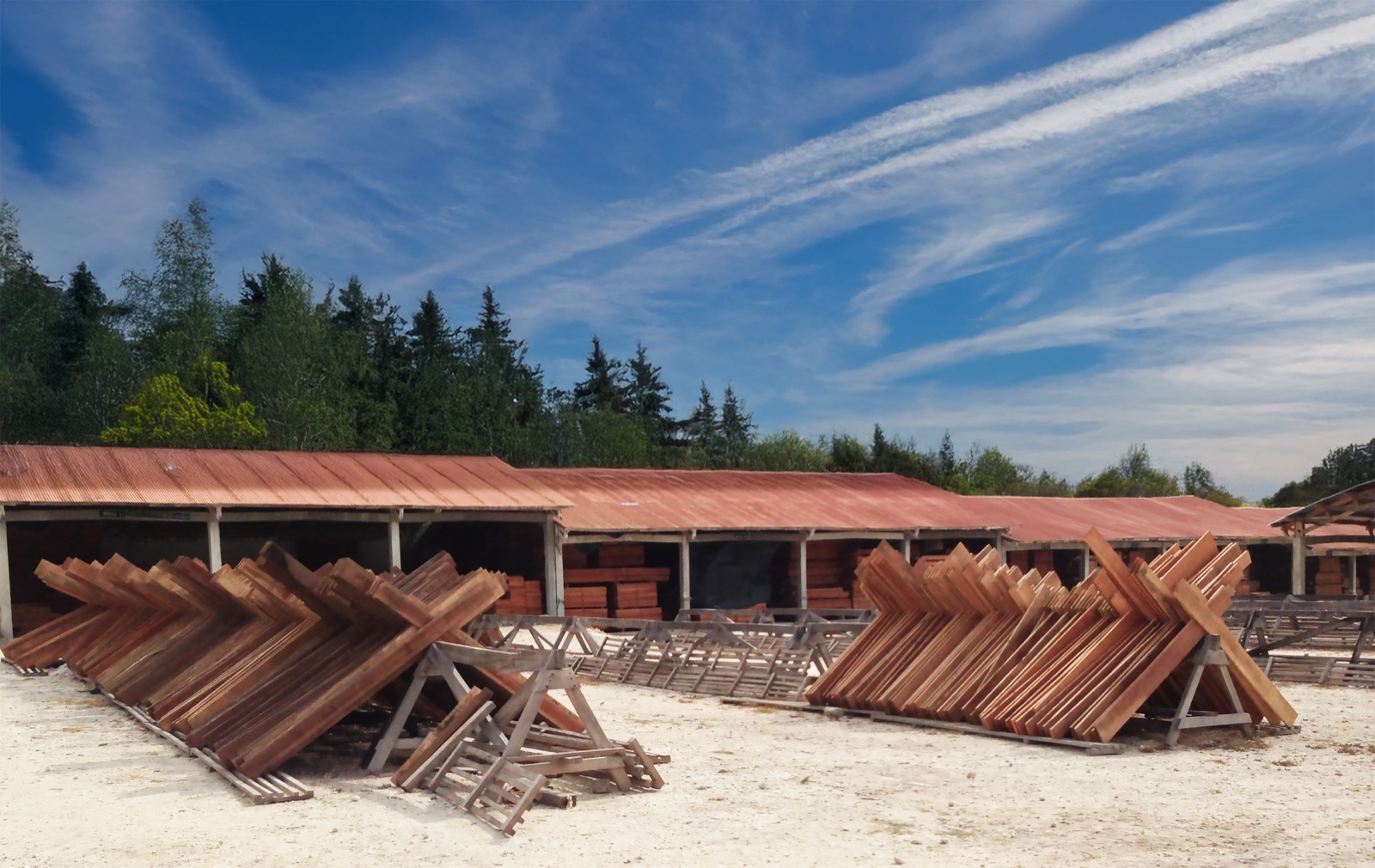
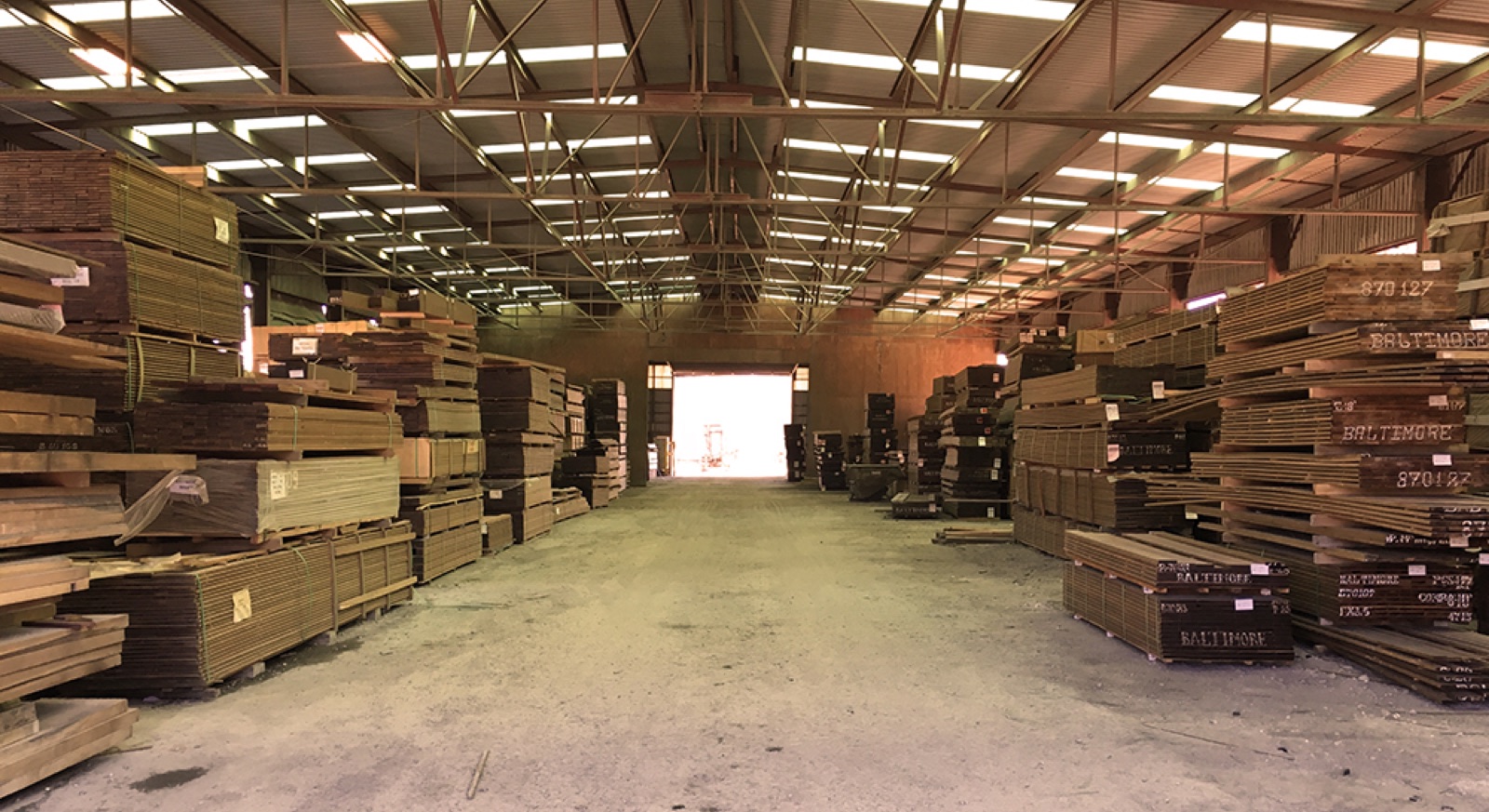
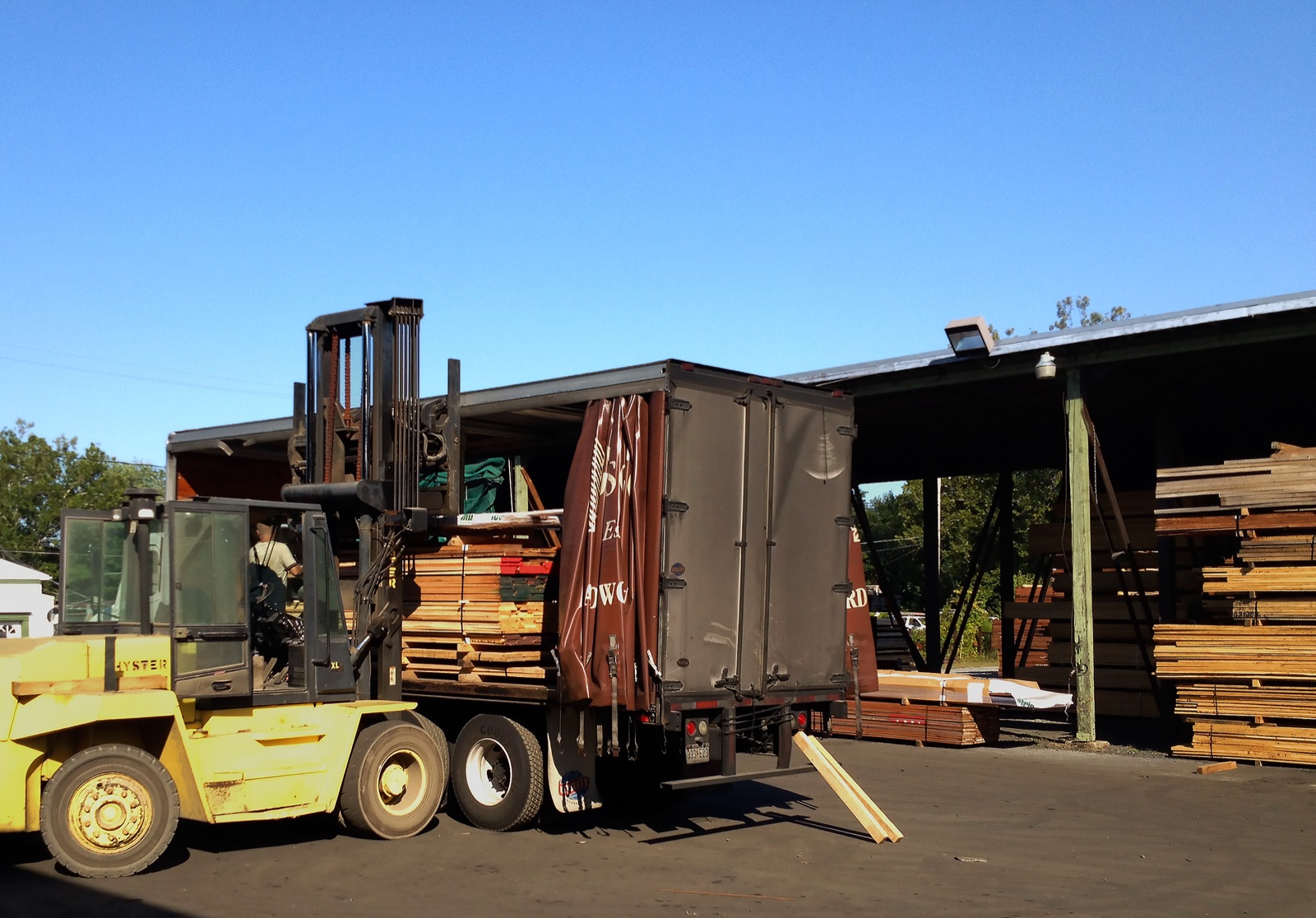
Concession forestry gets the board onto the water, and the importer's yard work decides whether it arrives fit to install. Dense tropical decking should land on site at 12 to 16 percent moisture content, matched to exterior service, a range grounded in the wood and moisture research published by the USDA Forest Products Laboratory. Getting it there takes inventory discipline, correct stickering and air-drying practice, and milling on equipment set up for wood at 1,050 kg per cubic meter. J. Gibson McIlvain stocks Ipe decking in a vast inventory across every standard and custom dimension, mills Cumaru, Garapa, Jatoba and Red Balau profiles at its own facility, and ships nationwide, with regular freight to California and the West Coast. FSC-certified material is available for projects that specify it, and current profiles are listed on the J. Gibson McIlvain Ipe decking page.
One yard practice deserves particular attention. Surface checking in dense tropical decking is the wood relieving tension as its surface heats and dries faster than its core. It cannot be promised away, it does not weaken the board, and small surface checks are normal, even a sign of properly seasoned stock. The genuine mitigation is a factory-applied coat of Cutek, a penetrating oil stabilizer that slows surface moisture exchange and significantly reduces checking, and J. Gibson McIlvain factory coats its tropical decking with it before shipment. Good site practice after delivery, meaning sealed end cuts, boards kept off wet ground and air moving around the stack, keeps checks small. It does not eliminate them, and any supplier who says otherwise is selling you a disappointment on a delay.
We have been buying from some of the same mills for decades. When a buyer asks me whether the wood is legitimate, I can tell them who cut it, which concession block it came out of and when that block gets harvested again. That is what a real supply relationship looks like, and it is why the paperwork is never a scramble on our end.
Norm Moton, Director of Sales, J. Gibson McIlvain
Installation Is Part of Responsible Sourcing
A deck that fails in ten years wastes a 30 year forest cycle, so the joist system, fasteners and ventilation carry the same weight as the certificate. Dense hardwood decking wants joists at 16 inches on center and open cross-ventilation beneath the boards, since a deck that traps moist air under itself cups from below regardless of pedigree. Coastal work calls for 316 stainless fasteners. Profile choice sets the fastening method, and there is no mixing the two. Shiplap takes visible face fasteners. Only tongue and groove works with hidden fasteners, the material goes down over joists or furring strips, and grooves face down so water drains instead of ponding in the profile.
Drilling is site work, full stop. Layout and field cuts change every board's bearing points, so holes get drilled against the frame as built. Pilot every hole, run two fasteners per board at every joist, hold about three quarters of an inch of edge distance, drill full pilots near board ends where splitting risk peaks, land butt joints on doubled bearing and use a self-centering combination bit to keep the pattern clean. Crews who follow that sequence on Ipe report almost no splitting. Crews who skip pilots learn fast why the Janka number matters.
Thermally and chemically modified woods run as a parallel path for teams that want lighter weight or a factory warranty. Thermory and Abodo Vulcan cover the thermally modified side and Accoya the acetylated side, all three carry manufacturer warranties that solid unmodified wood does not, and all three top out around 16 feet, with metric stock running just under that, because kiln size caps the length. For long single-span runs, unmodified tropical stock is the only route to longer boards.
How J. Gibson McIlvain Would Specify This
Write the spec so the forest system, the species and the dimension line up, and the sourcing takes care of itself. For a commercial boardwalk, pier or plaza, specify 2x6 Ipe or Cumaru from South American managed forests, verified legal origin, FSC certification if the project pursues it, delivered at 12 to 16 percent moisture content with a factory Cutek coating. For residential work, 5/4x6 Ipe remains the reference standard, with Garapa or Red Balau where an engineer has approved the span and the budget favors them. A 5/4x6 board covers about 2.1 linear feet per square foot of deck, which makes takeoffs quick to check.
Name the installation requirements in the same spec section. Joists at 16 inches on center, ventilated framing, 316 stainless steel fasteners near salt water, site-drilled pilot holes, and the correct profile-to-fastener pairing for the look the architect wants. For the building around the deck, put African material where it excels, Sapele rainscreen cladding and Sapele for painted exterior trim.
Then put the sourcing burden on the supplier in writing. Require documented legal origin traceable to an approved management plan, certification claims carried on the invoice, and export documentation handled for any CITES-listed species. J. Gibson McIlvain has been importing hardwood since 1798, sells at contractor and commercial volume, and ships these species to jobsites nationwide every week. Call 800-638-9100 with a plan set or a takeoff, and a lumber specialist will walk the species, dimensions and documentation through with you before the purchase order goes out.
Frequently Asked Questions
How long does a managed tropical concession rest between harvests?
Credible concessions in both South America and the Congo Basin work on cutting cycles of roughly 25 to 35 years. The concession is divided into annual harvest blocks, crews remove about one to three commercial trees per hectare from each block, and that block then stays out of production until the rotation returns to it a generation later. The rest period is written into the approved management plan, which is the document the whole legality chain traces back to.
Is buying Ipe decking bad for the rainforest?
Not when it comes from a managed concession with verifiable origin. Tropical forest is lost to conversion for cattle pasture and row crops, not to selective harvest that removes a few trees per hectare on decades-long cycles. A forest that earns sustained income as forest has an economic defense against clearing, and the buyer who specifies verified material funds the inventories, patrols and rotations that keep it standing. The real risk is undocumented wood, which undercuts the managed operations, so origin verification is the point of leverage a buyer actually controls.
Why does so little tropical decking come from African forests?
Species composition, not forest quality. The Congo Basin holds some of the largest FSC-certified natural forest concessions in the world, but its commercial species run to Sapele, Utile and African Mahogany, which are millwork and cladding woods rather than extreme-density decking woods. On a decking project, African material belongs on the building as rainscreen cladding and exterior trim, with Sapele preferred over Genuine Mahogany for painted trim, while the deck surface itself comes from South American species like Ipe, Cumaru, Jatoba and Garapa.
Can I get FSC-certified tropical decking for a LEED project?
Yes. FSC-certified Ipe and other tropical decking species are available when the project specifies them, and LEED rating systems credit FSC-certified wood. Raise certification at the spec stage rather than at purchasing, since the certified claim has to be carried on the invoice through an unbroken chain of custody to count in the submittal. J. Gibson McIlvain holds chain of custody certification and can quote certified material against a project requirement.
Which species can be specified at 2x thickness for a public boardwalk or pier?
Only Ipe, Cumaru and Jatoba can be sourced consistently in 2x decking thickness. Commercial boardwalk, pier and plaza decks are specified at 2x to control deflection, and no professional goes first with a thinner board on a public job even where 5/4 strength math works out. That availability fact filters Garapa and Red Balau out of commercial specs regardless of their durability. Both remain sound choices for residential decks and for 5/4 applications an engineer has approved.
Does the factory-applied Cutek coating stop surface checking?
It significantly reduces checking, and nothing stops it entirely. Checking is the board relieving tension as its surface heats and dries faster than its core, it does not weaken the wood, and small surface checks are normal in dense tropical decking, even a sign of properly seasoned stock. The factory Cutek coat slows surface moisture exchange, and good site practice, meaning sealed end cuts, boards kept off wet ground and ventilated stacking, keeps checks small. Any supplier promising a check-free deck is promising something the wood will not honor.