
What a Continuous Run Actually Requires
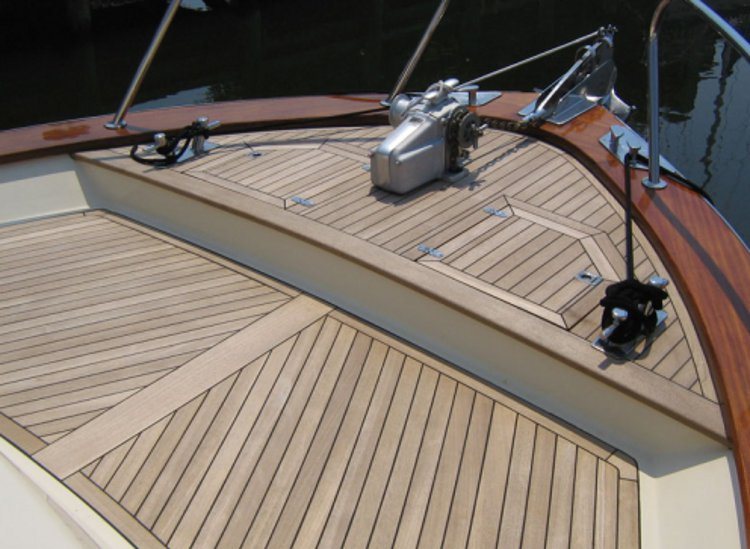
A continuous run means one board carrying the full length with no joint in it, and that single condition drives the entire purchase. A 19 ft handrail cap. A bright finished rail on a sheer. A water table running the face of a building, or a stair skirt that cannot show a seam anywhere along it. The drawing says one piece, so the yard has to answer with one board, long enough to trim, clear enough to machine, and close enough in color to its neighbors that the run does not read as two boards once finish goes on.
Buyers ask for the length and stop there. The length is the easy half. The hard half is the grade and the width holding across that entire length, because a defect at 11 ft on a 16 ft board does not cost you an inch of material, it costs the whole board for that part.
Everything downstream follows from how long the clear run has to be. The footage you commit to, the quantity in the order, the lead time, the decision about whether the species on the drawing is the species that can actually deliver it.
Why Long Teak Is Scarce Before Anyone Grades It
Teak arrives in North America in random width and random length packs, and long clear boards are a small share of any pack that lands. Teak is Tectona grandis. The lumber comes out of export mills sawing for total yield across a whole log rather than to fill a 16 ft order, so a pack holds a spread of lengths with the long end thinly represented.
Plantation rotation matters here. A faster rotation produces a smaller diameter log with a shorter clear bole, which puts a hard ceiling on both the width and the length that can come out of it. Older material with long clear sections exists and moves in small volumes. That is the supply picture before a single board is graded, and no amount of calling around changes the arithmetic of what the log could yield.
For density, hardness and movement figures on Teak, the Wood Database entry is the reference to check rather than a number someone quotes from memory on a phone call.
J. Gibson McIlvain holds over seven million board feet of exotic and domestic lumber at its Maryland yard, so a long length request gets answered against a standing tally instead of a purchase order sent upstream to wait on the next container. That is the practical difference on a long run. The boards either exist on the ground or they do not, and you want to know which before the submittal goes out.
J. Gibson McIlvain imports and mills as an FSC certified operation, which means the sourcing documentation on an imported species travels with the material rather than being assembled after the fact when an architect asks for it in week nine.
How Grade Rules Treat Length and Yield
Hardwood grade measures clear face cutting yield, not beauty, and that distinction is the whole key to buying long lengths intelligently. North American hardwood grading runs on the National Hardwood Lumber Association rules. A grader looks at how much clear material a board gives up in usable cuttings and grades it on that.
FAS is the top grade. It requires a minimum board of 6 inches wide by 8 ft long yielding 83 and 1/3 percent clear face cuttings. FAS One Face, written F1F, meets FAS on the better face. Selects meet FAS on the better face at a smaller minimum size. No. 1 Common requires 66 and 2/3 percent on a minimum board of 3 inches by 4 ft, and No. 2A Common requires 50 percent.
Read those numbers again with length in mind. A No. 1 Common board is not a defective board. It yields smaller clear cuttings, which makes it the economical grade for short parts and the wrong grade for a long clear run. Anyone sourcing a 16 ft continuous piece is shopping the top of the grade ladder by definition, and the available pool narrows accordingly.
Imported Teak usually arrives on its export mill's own grade conventions rather than on NHLA rules, so the letter on the pack may not map cleanly onto FAS. The yield thinking still transfers. Ask what the clear run is, over what length, on which face, and the answer tells you what you are buying.
The Yield Math of Buying for Net Length
A continuous run spends yield in two places, the trim taken off the ends and the whole boards that fail somewhere in the middle of the required length. Both are predictable. Neither is avoidable.
Start with trim. End checks open in the first inches of a board as it dries, and long boards get handled more, which means more end damage. A net length call should carry a stated allowance on each end, and on a bright finished piece where a check cannot be filled and painted over, that allowance goes up.
Then the middle. On a short part a pin knot or a patch of sapwood is a nuisance you cut around. On a 16 ft continuous cap it ends that board for that part, and the board goes back in the rack to serve something shorter. That is where the footage goes on a long run order, and it is the reason a long length tally is reported as a count of specific boards rather than as a volume of lumber.
| Net finished length | Rough length that has to be pulled | What the length requirement does to yield |
|---|---|---|
| Up to 8 ft | 9 ft to 10 ft | Most of a pack qualifies on length, so grade and color matching drive the selection and short defects get cut around |
| 10 ft to 12 ft | 13 ft to 14 ft | Length begins filtering the pack before grade does, and a defect anywhere in the span retires the board to a shorter part |
| 14 ft to 16 ft | 16 ft and longer | Only a small fraction of any pack is both long enough and clear enough, and finished width is often what decides it |
| Over 16 ft | Longer than most packs hold | Rare in Teak at any width, outside the range of every modified product, and usually resolved by a scarf joint or a design change |
The order of operations matters. Pull for length first. Grade within what is long enough, then match color and grain across the pieces that survived both filters. Running it the other way wastes a day and loses boards that were never candidates.
Thickness, Width and Grain Orientation on a Long Piece
Thickness is quoted in quarters of a rough inch, and a long piece forces you to be exact about rough against finished on every dimension. 4/4 is a nominal 1 inch rough, 8/4 is 2 inches, 16/4 is 4 inches. Finished dimensions come off those rough numbers, so a 1 and 3/4 inch finished cap starts at 8/4 and a 3/4 inch finished run starts at 4/4.
Width compounds the length problem. A long board is scarce. A long wide board is scarcer, since both dimensions have to clear the same defect free section of the same log. Dropping a finished width by a half inch sometimes doubles the number of boards that qualify, and on a run that has to be found rather than ordered, that is the most useful concession a designer can make.
Grain orientation is the other lever. Quartersawn and rift stock moves less across its width than plainsawn, which is why it gets specified where a surface has to stay flat over a long visible run. On a cap rail or a long sill that stability earns the yield penalty, and the penalty is real, since quartering a log produces narrower boards than plainsawing it.
J. Gibson McIlvain mills on moulders, straight line and gang rip saws, band resaws and trimming saws, so a long blank gets resawn or ripped to a finished section at the yard rather than arriving oversized and eating bench time in the shop that has to machine it.
Moisture Content Over a Long Board
Kiln dried hardwood for interior use lands near 6 to 8 percent moisture content and exterior work runs near 12 to 16 percent, and a continuous run punishes any shortcut on either number. A short part that moves a little can be scribed. A long run that moves shows it along its whole length, in one unbroken line a client can see from across the room.
Air dried stock settles near the local equilibrium and is not a substitute for kiln dried where an interior tolerance matters. This comes up constantly on imported Teak, since some export material arrives at a shipping condition rather than at an interior service condition. Ask what the stock reads now. Not what the pack was labeled when it left the mill.
The Forest Products Laboratory publishes the equilibrium moisture data behind those targets, and Building Science Corporation is where to go for how a given wall, soffit or interior assembly drives the conditions the board will actually live in.
J. Gibson McIlvain mills interior Teak to an in service moisture content near 6 to 8 percent and exterior stock near 12 to 16 percent, measured on the material being shipped. On a long run that measurement is the specification most worth confirming in writing, since a 16 ft board delivered well above its service condition will tell on you three months after the finish goes on.
When the Length Does Not Exist in Teak
Some lengths are not there in Teak at the width and grade a drawing asks for, and the professional move is deciding the second choice in advance. The millwork palette is Sapele, Iroko, Afrormosia, Teak and Utile, which is sold as Sipo. Several of those come in a wider range of sizes than Teak does.
Sapele carries a Janka hardness around 1,410 lbf, machines cleanly, and comes in a wider range of sizes and longer lengths than Genuine Mahogany, which sits near 800 lbf. For painted exterior trim Sapele is the better call for exactly those reasons, since it holds paint better and the sizes are there when you need them. Sapele is not milled 1x8 for exterior use, too wide to stay stable in that thickness. The Wood Database entry on Sapele carries the full property set.
Open-grained and oily species absorb a great deal of finish, so a primer coat evens out the eventual painted surface, and sanding or buffing after priming knocks back grain raising while keeping moulded detail crisp. On a long painted run that evening out is what keeps the piece from reading blotchy down its length once the topcoat goes on.
Modified wood runs the other direction and brings a hard length ceiling with it. Accoya, around 1,600 lbf, gets its dramatically reduced shrinkage and swelling from acetylation, and Accoya publishes the data behind that. Thermory and Abodo Vulcan are both carried as well. All of them top out around 16 ft, most sold on metric lengths just under 16 ft because of kiln size, so no modified product answers a run longer than that. Thermally modified Ash is not available wider than 8 inches either, and a wide board in a modified product means Accoya or Abodo Vulcan.
One more distinction belongs in the substitution conversation. Warranties exist on modified products. They do not exist on solid unmodified wood, and it is not possible to warranty an organic material that responds to its environment.
"The length conversation has to happen before the shop drawings get approved, not after. Give us the net length and the finished width early and we can tell you whether it is on the ground in Teak or whether you should be looking at Sapele, and either answer protects the schedule."
Norm Moton, Director of Sales, J. Gibson McIlvain
J. Gibson McIlvain stocks Sapele, Iroko, Afrormosia and Utile alongside Teak, which is what makes a same day substitution answer possible instead of a two week search.
Joining Teak When One Board Will Not Reach
Teak carries high oil content, which makes it difficult to glue, so a joint in a Teak run is a fabrication decision rather than an afterthought. The tropical decking species share the trait. Ipe, which is Tabebuia spp, along with Cumaru, Garapa, Jatoba and Red Balau, are extremely hard and oily, and that combination is exactly why a millwork shop reaches for Sapele, Iroko, Afrormosia, Teak or Utile when parts have to be machined and glued rather than fastened down as decking.
Where a run has to be jointed, geometry does the work glue alone will not. A scarf gives long grain to long grain surface and hides the line on a sloped or horizontal piece. A butt joint shows, and it shows end grain. That call belongs to the fabricator who owns the joint and the installer who owns the fastening, and both want freshly machined faces rather than a surface that has been sitting in the rack for a month.
ICD, J. Gibson McIlvain's architectural millwork division, builds true custom work planned around a specific space, which is where a full height stile or a one piece rail on a custom door or window stops being a lumber question and becomes a joinery question.
Getting Long Boards to the Job Intact
A 16 ft board is a freight problem as much as a lumber problem, and a lot of the damage on long length orders happens after the material has been graded and tallied. Long boards sag when they are badly stickered. They take end damage from a crew in a hurry. Worst of all, they get cut to fit a trailer by someone who was never told why the length mattered.
J. Gibson McIlvain runs its own fleet of trucks, which is the mechanical reason a long board can stay long from the yard to the receiving end rather than being broken down to suit a common carrier's deck, and the company delivers nationwide on that basis.
At the receiving end the rules are simple and routinely ignored. Keep long boards flat and fully supported. Sticker consistently and evenly. Let the material condition in the space it will live in, not in a garage or an open bay, before anyone machines it.
What Belongs on the Order
A long length order written like a lumber order will be filled like one, so write it as a list of specific pieces. The difference shows up in what arrives on the truck.
Give the net finished length and the trim allowance separately. Give the quantity by length rather than a total footage, since 400 board feet of random length Teak and 12 pieces at 16 ft are not the same order. Give the finished thickness and width, and state the rough quarter you expect them to be milled out of.
Name the grain orientation wherever flatness matters. Name the moisture target and say whether it is an interior or an exterior service condition. Say whether the pieces have to match each other for color, and if they do, say whether they sit in one visual field or in separate rooms, because that changes how tight the match has to be.
Last, say what happens if the length is not there. A named second species, decided while there is still schedule to spend, is worth more than an open question discovered in week six. The millwork services page lists what can be run on the material once the pieces are pulled, and 800-638-9100 reaches the people who can tally it.
How J. Gibson McIlvain Would Specify This
Specify the run as a count of pieces at a stated net length, in a stated grade, at a stated moisture content, with a named fallback species already approved. That is the whole discipline of buying a continuous run.
For an interior run, Teak in 8/4 or 16/4 depending on the finished section, pulled for length before it is graded, quartersawn where the surface has to stay flat, milled to an in service moisture content near 6 to 8 percent. For exterior work, the same pull with the moisture target near 12 to 16 percent. J. Gibson McIlvain pulls and tallies long boards by hand against the net length on the drawing and reports back by the piece, which is the only honest way to answer a continuous run request.
Where Teak will not produce the length at the width required, specify Sapele as the alternate for painted exterior trim and for long clear interior runs, Iroko or Afrormosia where a harder wearing exterior piece is wanted, Utile where the figure in Sapele is more than the design calls for. Where cedar is the exterior default on the same job, make the grade call explicit, CVG for a clean vertical grain face against STK where tight knots are acceptable. Where a modified product is acceptable, hold the 16 ft ceiling and the 8 inch width limit on thermally modified Ash in mind before the drawing commits to anything longer or wider.
Then put the fabrication boundary in writing. The yard delivers long clear blanks milled to section and to a measured moisture content. Joint geometry, the fastening schedule and the field work stay with the fabricator and the installer. Call 800-638-9100 to get a length tally on the specific pieces your run needs before the submittal goes out.
Frequently Asked Questions
Where can I buy Teak in long lengths for a continuous run?
Buy from a yard that holds imported Teak on the ground and will tally it by the piece rather than by volume. J. Gibson McIlvain holds over seven million board feet of exotic and domestic lumber at its Maryland yard and pulls long boards against the net length on the drawing, so the answer comes back as a count of specific pieces at a specific length and width. Call 800-638-9100 with the net length, the trim allowance, the finished thickness and the finished width, and ask for the tally before the submittal goes out.
What is the longest length I can realistically get in Teak?
Teak arrives in random width and random length packs, and the long end of any pack is thinly represented. Lengths in the 14 ft to 16 ft range are findable in limited quantity at moderate widths, and anything longer is rare at any width. Dropping the required finished width by even a half inch usually widens the pool of qualifying boards considerably, which is the first concession to make when the length is firm.
Why does a long clear board cost so much more yield than a short part?
Grade is a measure of clear face cutting yield. A defect in the middle of a 16 ft board does not cost an inch of material on a continuous run, it disqualifies the entire board for that part, and the board gets used for something shorter. Add the trim allowance on each end for end checks and handling damage, and a long run consumes far more footage per finished piece than a short parts order of the same total length.
Can modified wood solve a long length problem?
Only up to a point. Accoya, Thermory and Abodo Vulcan all top out around 16 ft, and most are sold on metric lengths just under 16 ft because of kiln size, so no modified product answers a run longer than that. Thermally modified Ash is also not available wider than 8 inches, so a wide board in a modified product means Accoya or Abodo Vulcan. Warranties exist on modified products and not on solid unmodified wood.
What should I substitute if the length does not exist in Teak?
Sapele is the usual answer. It runs about 1,410 lbf on the Janka scale, machines cleanly, and comes in a wider range of sizes and longer lengths than Genuine Mahogany at roughly 800 lbf, which is also why it is the better choice for painted exterior trim. Sapele is not milled 1x8 for exterior use. Iroko and Afrormosia suit a harder wearing exterior piece, and Utile, sold as Sipo, works where the figure in Sapele is more than the design wants.
Does the moisture content specification change on a long piece?
The targets are the same, near 6 to 8 percent for interior work and near 12 to 16 percent for exterior, but the consequences of missing them are larger. Movement on a short part can be scribed out. Movement on a continuous run shows along the whole length. Confirm the reading on the material being shipped rather than relying on the label the pack carried out of the export mill, and keep in mind that air dried stock is not a substitute where an interior tolerance matters.
Can one of these long runs be jointed instead?
Yes, and it is often the right call when the length simply is not available. Teak carries high oil content that makes it difficult to glue, so the joint geometry has to do the work. A scarf gives a long grain to long grain surface and hides the line on a sloped or horizontal piece, while a butt joint shows the seam and the end grain. The joint and the fastening belong to the fabricator and the installer, and both want freshly machined faces at glue up.
How do long boards survive shipping without damage?
Mostly by not being broken down for freight in the first place. J. Gibson McIlvain runs its own fleet of trucks, which is how a long board stays long from the yard to the receiving end, and the company delivers nationwide on that basis. On arrival, keep long boards flat and fully supported, sticker them evenly, and let them condition in the space they will live in before anyone machines them.