The Short Answer: Jatoba Carries Commercial Traffic, and the Species Is Almost Never the Failure Point
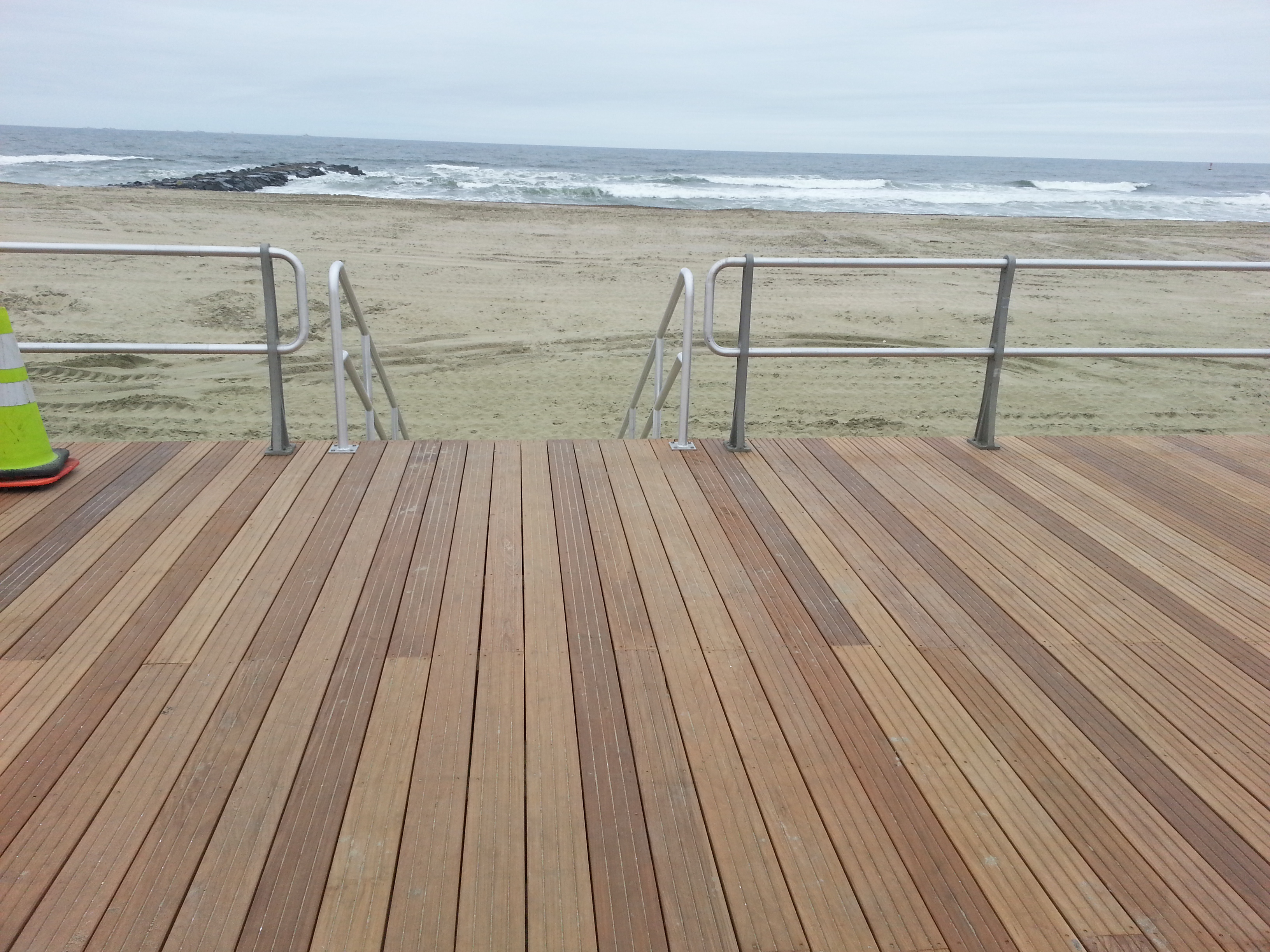
Jatoba is durable enough for high traffic commercial decking, provided it is specified in 2x thickness over a properly detailed frame with corrosion-rated fasteners. The wood itself has a Janka hardness of roughly 2,690 lbf, which puts it far above domestic white oak and in the same conversation as the tropical species that public agencies have been walking on for decades. Traffic does not wear these decks out. What ends them is water sitting where it should not sit, fasteners that were never rated for the environment, and framing that nobody ventilated.
That reframing matters for a specifier deciding whether to write Jatoba into a boardwalk, a plaza, a hotel pool surround or a transit platform. The relevant question stops being "is it hard enough" somewhere around the 2,000 lbf mark. Above that, every board in the running will resist point loads, cart wheels, luggage casters and shoe grit. The questions that actually decide the outcome are structural and procedural. What thickness can be sourced in commercial quantity? How does the board behave between delivery and screw-down? What documentation does the reviewing authority want in the submittal? Those are the parts of the job where projects go sideways, and they are where the rest of this article lives. Technical background on the species is documented at the Wood Database entry for Jatoba.
Commercial Foot Traffic Is a Live Load Problem Before It Is a Wear Problem
A busy public deck is loaded far harder by codified live load and deflection limits than by the abrasion of shoe soles. Assembly and public occupancy decks are commonly designed to 100 psf uniform live load, and many owners add a concentrated load case for maintenance vehicles or event equipment. That load path runs from the deck board into the joist, the joist into the beam, the beam into the post or pier. Board hardness contributes almost nothing to it. Board stiffness and thickness contribute a great deal, because they control the local deflection a pedestrian feels underfoot and the flex cycle the fastener has to absorb every time somebody steps between two joists.
Jatoba is stiff. Its modulus of elasticity and bending strength sit near the top of the commercially traded decking species, which is why it spans well in 2x and why a plank stays flat between bearing points instead of trampolining. Deflection criteria for walking surfaces are usually written at L/360 or tighter, and on an elevated boardwalk the design team often tightens further to control perceived bounce. Load tables, span provisions and the design values that drive those calculations are maintained by the American Wood Council, and the occupancy loads themselves come out of the model codes published by the International Code Council. Get the structure right and the surface takes care of itself for a very long time.
The 2x Thickness Rule Filters the Species List Before Hardness Ever Enters the Conversation
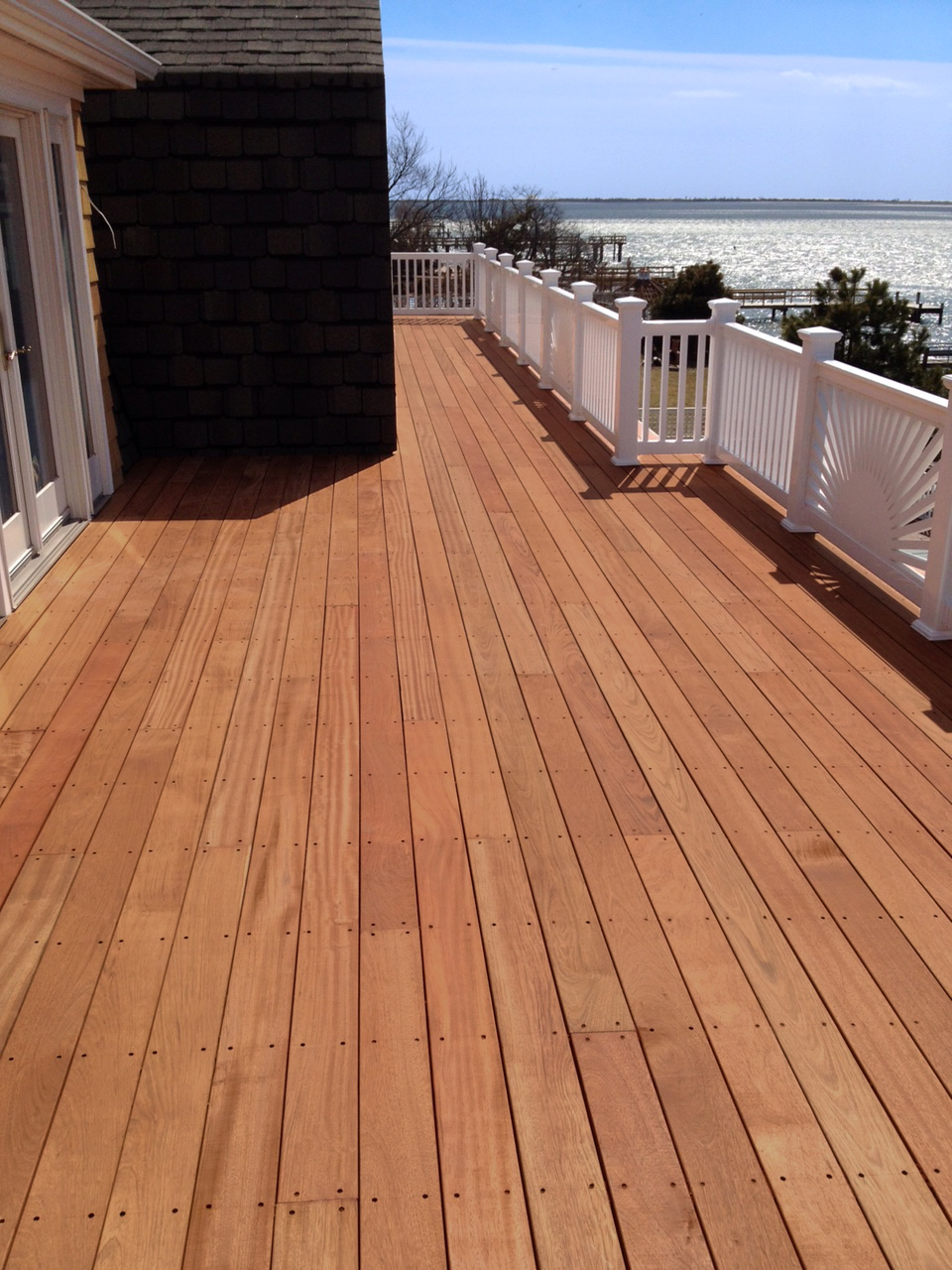
Commercial boardwalks, piers and plaza decks are specified at 2x thickness, and only Ipe, Cumaru and Jatoba can be sourced consistently in that thickness. This single fact does more to shape a commercial deck spec than any hardness table. Engineers on public work do not go first with a thinner board even when the strength math on a 1x or 5/4 section technically closes. The 2x section controls deflection, absorbs the impact of dropped equipment, holds a screw with real thread engagement, and gives the deck a second life when it is sanded or re-cut years down the road.
The practical consequence is that species which look competitive on a hardness chart drop out of commercial consideration because they cannot be had in 2x with reliable continuity. Red Balau and Garapa are legitimate decking woods with strong track records. They belong in residential work and in engineer-approved 5/4 applications. Writing them into a public boardwalk sets up a supply problem the general contractor will discover at the worst moment. Jatoba clears the filter, which is why it shows up on municipal and institutional bid sets alongside the two denser tropicals.
| Species | Janka (lbf) | Consistently available in 2x decking | EN 350 durability | Where it belongs in a spec |
|---|---|---|---|---|
| Ipe (Tabebuia spp.) | ~3,680 | Yes, across all standard and custom dimensions | Class 1 | The default for public boardwalks, piers and plazas |
| Cumaru | ~3,540 | Yes | Class 1 to 2 | Commercial decks where a warmer brown is wanted |
| Jatoba | ~2,690 | Yes | Class 2 to 3, needs correct detailing | Covered and elevated commercial decks, interior-adjacent transitions |
| Massaranduba (comparison only) | ~3,190 | Regionally, inconsistent | Class 1 to 2 | Reference point for density, not a commercial spec anchor |
| Red Balau | ~1,700 to 2,000 | No, 5/4 and 1x only | Class 2 | Residential decks and engineer-approved 5/4 work |
| Garapa | ~1,700 | No, 5/4 and 1x only | Class 2 to 3 | Residential decks, light-color exteriors, poolside |
Joist Layout Is Where a Jatoba Deck Earns Its Service Life
Frame a commercial Jatoba deck at 16 inches on center, tighten to 12 inches for diagonal or herringbone layouts, and double the bearing under every butt joint. Dense hardwood decking is unforgiving of a lazy frame. A 2x Jatoba board will bridge a wider gap without visible sag, but that is not the reason to stretch the spacing. Fastener life, board twist and the long-term flatness of the walking surface all improve as bearing points get closer together. On a boardwalk that also has to satisfy an accessibility review, a tight frame keeps the running surface within tolerance for years instead of months.
Butt joints deserve their own note. Two boards meeting over a single joist leaves each end with roughly three quarters of an inch of bearing and puts two fasteners into the same narrow strip of joist edge grain. Doubled bearing, either a sistered joist or a full block, gives each board its own landing. Joints should be staggered across the field rather than lined up, both for load distribution and because a continuous seam telegraphs every seasonal movement cycle to the eye.
Ventilation under the deck is structural, not cosmetic. The underside of a tropical hardwood board dries far more slowly than the top, and an unvented cavity holds that gradient in place until the board cups. Open framing, an air gap over any solid substrate, and a drainage plane that actually drains are the difference between a deck that reads flat at year ten and one that needs half its boards flipped. The building-enclosure reasoning behind that is laid out well by Building Science Corporation.
Moisture Content at Delivery Predicts the First Year Better Than Any Other Variable
Jatoba should reach the site at 12 to 16 percent moisture content and should be installed at a moisture level matched to its service environment, not to the warehouse it came from. Kiln schedules for dense tropicals are slow and deliberate. A board that was dried correctly and stored correctly arrives dimensionally settled. A board that sat wrapped on a hot trailer for two weeks or open to rain on a staging pad arrives with a moisture gradient that will show up as cupping within a season.
Site handling is the contractor's half of that equation. Keep bundles off the ground on stickers, keep them out of standing water, cover the top against direct sun and rain but leave the sides open so air moves through the stack. Do not shrink-wrap a pallet of tropical decking and leave it sealed in the sun. Break bundles as the crew works rather than spreading a week of material across a deck in one afternoon. Reference moisture and shrinkage data for wood in service is published by the USDA Forest Products Laboratory, and it explains why the same board behaves differently in a coastal marine climate than in a dry inland one.
Surface Checking Is Normal in Dense Tropical Decking, and the Honest Mitigation Is a Penetrating Oil
No supplier can promise a checking-free tropical deck, and any who does is selling something the wood will not deliver. Checking is tension release. The surface of a dark, dense board on a sunny plaza heats and dries faster than the core, the outer fibers shrink against a core that has not moved yet, and the wood relieves that stress along the grain. Small surface checks do not weaken the board and do not compromise its structural capacity. On a properly seasoned board they are evidence that the wood dried through rather than case-hardened.
What can be done is reduce them meaningfully. J. Gibson McIlvain factory coats tropical decking with Cutek, a penetrating oil stabilizer that slows the rate at which the surface gives up and takes on moisture. Slower moisture exchange means a shallower gradient between face and core, and a shallower gradient means smaller, fewer checks. Site practice does the rest. End seal every field cut the moment it is made, deliver material with the moisture content under control, and let the underside breathe.
"Every commercial deck I have walked at year five tells the same story. The boards are fine. The problems are always at the fasteners, at the butt joints, or under a section where somebody closed off the airflow. Buyers call us worried about hardness numbers, and I end up spending most of that call on the frame and the drainage. Get Jatoba to the job at the right moisture content, coat it, and give it air, and it will outlast the people who specified it." Norm Moton, Director of Sales, J. Gibson McIlvain
Fastening Is On-Site Work, Done Against the Frame As It Was Actually Built
Never order decking pre-drilled, and never let a schedule pressure a crew into skipping pilot holes in a board this dense. Layout shifts. Joists move a fraction during framing. Field cuts change every dimension downstream of them. Any hole pattern established before the material ships is invalid the moment the frame deviates from the drawing, which it always does. Drilling belongs on site, against the real frame.
The technique is straightforward and non-negotiable at this density. Pilot every hole. Two fasteners per board per joist, no exceptions and no single-screw shortcuts on narrow stock. Hold roughly three quarters of an inch of edge distance so the fastener is not splitting toward a face. Give full-depth pilots near board ends where splitting risk is highest, and land butt joints on doubled bearing so each end gets its own fastener into solid wood. A self-centering combination bit that drills, countersinks and clears in one motion keeps a crew consistent across thousands of holes.
Fastener metallurgy is a specification decision, not a purchasing convenience. Coastal and pool environments call for 316 stainless. The tannins in tropical hardwoods react with lesser metals and stain the board around every head. If the project also includes cladding, soffits or screening, the profile decides the fastening system there too. Shiplap takes visible fasteners. Only tongue and groove works with a hidden fastener system. That material goes on furring strips or joists rather than tight to a substrate, and grooves face down so water drains rather than collecting in the channel.
Commercial Projects Buy Documentation Along With the Wood
A public deck submittal package usually asks for grading, moisture, fire performance, chain of custody and legality documentation before a single board goes down. This is the part of tropical decking procurement that catches inexperienced suppliers. The material can be perfect and the job still stalls because a reviewer wants a test report nobody pulled.
Fire performance is the common one. Jatoba tests to ASTM E84 Class A, meaning a flame-spread index of 25 or less, which is what an assembly occupancy or a deck within a certain distance of a building line frequently requires. The test method itself is published by ASTM International, and code guidance for wood assemblies in commercial construction is available through WoodWorks. Grading language should reference an established rules body, and for hardwood lumber that is the National Hardwood Lumber Association, with the understanding that decking is normally supplied to a decking grade rather than a furniture grade.
Sustainability documentation runs on a parallel track. Projects pursuing green building credits usually want chain of custody paperwork from a certified supplier, and the certification framework most commonly named is administered by the Forest Stewardship Council. Separately, when using a CITES-listed species, documentation is required at the point of import and should follow the material through the supply chain, with the governing framework published by the CITES Secretariat. Ask for that paperwork at bid time rather than at delivery. A supplier who imports and mills directly can produce it. A broker two steps removed from the mill often cannot.
What Actually Takes One of These Decks Out of Service
Commercial tropical hardwood decks are replaced because of connections, water management and framing, and almost never because the walking surface wore through. Walk a fifteen year old boardwalk with a moisture meter and a screwdriver. The Jatoba will still be sound. The findings will be corroded fasteners bleeding stain, joist tops holding water where a board gap collected debris, blocked airflow under a section where a later renovation enclosed the skirt, and end grain at butt joints that was never sealed and wicked moisture for a decade.
Maintenance planning should follow that reality. Keep board gaps clear so water and grit move through rather than composting on the joist tops. Inspect fasteners on a schedule and replace any that show corrosion products at the head. Re-oil on whatever interval the owner's appearance standard demands, understanding that oiling is a color and checking decision more than a structural one. Left uncoated, Jatoba weathers to silver gray without losing capacity. On accessible routes, verify that the surface still meets the slip and level requirements enforced under the guidelines from the U.S. Access Board, since accumulated grime and biological growth change the surface long before the wood does.
Where Jatoba Is Not the Right Answer
Jatoba is a covered, elevated and well-drained deck species, and it should not be pushed into ground contact, permanently wet installations or projects where the owner demands a written performance warranty. Its natural durability rating puts it below Ipe and Cumaru for exposure severity. On an unshaded pier deck taking constant salt spray, or on a structure with sections that stay damp for weeks, the denser Class 1 species is the safer specification and the reason J. Gibson McIlvain ships Ipe decking nationwide in 2x for exactly those jobs.
Warranty is the other clean dividing line. No solid, unmodified wood carries a performance warranty, and any supplier offering one on natural Jatoba is misrepresenting the product. Owners who require warranted material should be steered toward modified wood. Thermory and Abodo Vulcan both offer thermally modified and modified softwood decking with published warranty terms, and Accoya acetylated wood carries its own. The trade-off is length. Modified products top out around 16 feet, and the metric-length versions land just under that, because the modification kilns are only so long. A design with 20 foot uninterrupted runs cannot be built from modified stock without joints.
A few adjacent calls are worth naming while the spec is open. Western red cedar remains a legitimate default for screening, soffits and light-duty elements, and the grade selection matters more than the species debate: clear vertical grain for exposed, painted or high-visibility work, select tight knot where a knotty look is acceptable and the budget is tighter. For painted exterior trim around a deck, Sapele is the better call than Genuine Mahogany. It holds paint more reliably and comes in longer lengths.
How J. Gibson McIlvain Would Specify This
Write the deck as a system: 2x Jatoba, factory coated, on 16 inch centers, with 316 stainless fasteners, doubled bearing at all butt joints, and a submittal package assembled before the first delivery. Here is the shape of a spec that holds up under review.
Material: 2x6 Jatoba decking, decking grade, kiln dried to 12 to 16 percent moisture content, factory coated with Cutek prior to shipment. Specify lengths to match the actual field runs rather than accepting random-length bundles, and confirm the length distribution in writing before release. Ask for the E84 Class A report, the mill's moisture certification and chain of custody documentation as part of the submittal, and confirm legality documentation is in hand when the species selected is CITES-listed.
Structure: joists at 16 inches on center, tightened to 12 inches for any diagonal or patterned layout. Doubled joist or full blocking under every butt joint. Joints staggered across the field. A continuous ventilated air space under the deck with a clear drainage path, and no later enclosure of the skirt without restoring airflow.
Installation: pilot every fastener hole on site with a self-centering combination bit. Two 316 stainless fasteners per board per joist, roughly three quarters of an inch edge distance, full pilots near board ends. End seal every field cut immediately. Set consistent board gaps sized for the local climate and the moisture content at installation, and do not close the gaps up to make a fresh deck look tight, since that decision shows up as buckling in the first wet season.
Sourcing: order from a supplier who imports, mills and holds the material rather than one who brokers it. J. Gibson McIlvain stocks Jatoba, Cumaru and a vast Ipe decking inventory in every standard and custom dimension, mills to profile, factory coats tropical decking, and ships to commercial and contractor-volume projects nationwide, including regular deliveries to California. For a project-specific take-off, length schedule or submittal package, call 800-638-9100 or start at mcilvain.com and talk through the frame before the boards. That is the conversation that decides how long the deck lasts.
Frequently Asked Questions
Why do commercial deck specs call for 2x Jatoba instead of 5/4?
Commercial boardwalks, piers and plaza decks are specified at 2x thickness to control deflection under public live loads, and no professional goes first with a thinner board on a public job even where the strength math on a 5/4 section closes. The 2x section also holds a fastener with real thread engagement, tolerates dropped equipment, and leaves material for refinishing years later. That requirement narrows the species list dramatically, since only Ipe, Cumaru and Jatoba can be sourced consistently in 2x decking thickness. Species such as Red Balau and Garapa are excellent decking woods but belong in residential and engineer-approved 5/4 work.
Can Jatoba decking be ordered pre-drilled or pre-countersunk to save field labor?
No, and no reputable mill will drill fastener holes before shipment. Framing always deviates slightly from the drawing, field cuts change every dimension downstream of them, and any factory hole pattern becomes useless the moment layout shifts. Drilling is installation work done on site against the frame as built. Pilot every hole, run two fasteners per board per joist, hold roughly three quarters of an inch of edge distance, use full-depth pilots near board ends, land butt joints on doubled bearing, and use a self-centering combination bit so the crew stays consistent across thousands of holes.
Will a Jatoba commercial deck check, and can checking be prevented?
Small surface checks are normal in every dense tropical decking species and cannot be prevented. Checking is tension release: the surface heats and dries faster than the core, the outer fibers shrink against a core that has not moved, and the wood relieves that stress along the grain. Checks of this kind do not weaken the board or reduce its structural capacity, and on a properly seasoned board they indicate the wood dried through rather than case-hardened. The meaningful mitigation is a penetrating oil stabilizer. J. Gibson McIlvain factory coats tropical decking with Cutek, which slows moisture exchange and significantly reduces checking. Site practice such as controlled moisture content at delivery, end sealing every cut and ventilating the underside keeps checks small.
What moisture content should Jatoba decking arrive at, and how should it be stored on site?
Target 12 to 16 percent moisture content in service, and match the installed moisture level to the deck's actual environment rather than to the warehouse the material shipped from. On site, keep bundles off the ground on stickers, out of standing water, covered on top against sun and rain but open at the sides so air moves through the stack. Never leave a pallet of tropical decking shrink-wrapped in direct sun. Break bundles as the crew works instead of spreading a week of material across the deck at once.
What documentation should a specifier request for a public Jatoba deck?
Ask for it at bid time, not at delivery. A typical package includes the ASTM E84 test report confirming a Class A flame-spread index of 25 or less, mill moisture certification, the decking grade the material is supplied to, and chain of custody documentation if the project pursues green building credits. When the species selected is CITES-listed, documentation is required at import and should follow the material through the supply chain. A supplier who imports and mills directly can produce this paperwork; a broker several steps from the mill often cannot.
Does Jatoba decking come with a warranty?
No solid, unmodified wood carries a performance warranty, and a supplier offering one on natural Jatoba is misrepresenting the product. Only modified wood products do. Thermory and Abodo Vulcan both publish warranty terms on their modified decking, and Accoya acetylated wood carries its own. The trade-off is length: modified products top out around 16 feet because of kiln size, with metric-length versions landing just under that, so designs calling for longer uninterrupted runs cannot be built from modified stock without joints.
How should butt joints be framed on a commercial Jatoba deck?
Land every butt joint on doubled bearing, either a sistered joist or a full block, so each board end gets its own fastener into solid wood rather than crowding two fasteners into a narrow strip of joist edge grain. Stagger joints across the field instead of lining them up, both for load distribution and because a continuous seam makes every seasonal movement cycle visible. Seal the end grain at each cut immediately, since unsealed butt ends wick moisture for the life of the deck and are one of the most common findings on an aging boardwalk.
How does the joist spacing change if the deck uses a diagonal or patterned layout?
Standard practice for dense tropical hardwood decking is joists at 16 inches on center. A diagonal or herringbone layout increases the effective span across each board, so tighten spacing to 12 inches on center. Tighter bearing also improves fastener life, reduces board twist and keeps the running surface flatter over time, which matters on any deck that has to hold accessible-route tolerances through years of service.
Sources and Standards Referenced
- Wood Database: Jatoba (Hymenaea courbaril)
- American Wood Council: Codes and Standards
- USDA Forest Products Laboratory
- ASTM International (E84 surface burning characteristics test method)
- U.S. Access Board: ADA Accessibility Guidelines
- Forest Stewardship Council
- CITES Secretariat
- National Hardwood Lumber Association
- WoodWorks: Wood Products Council
- Building Science Corporation