
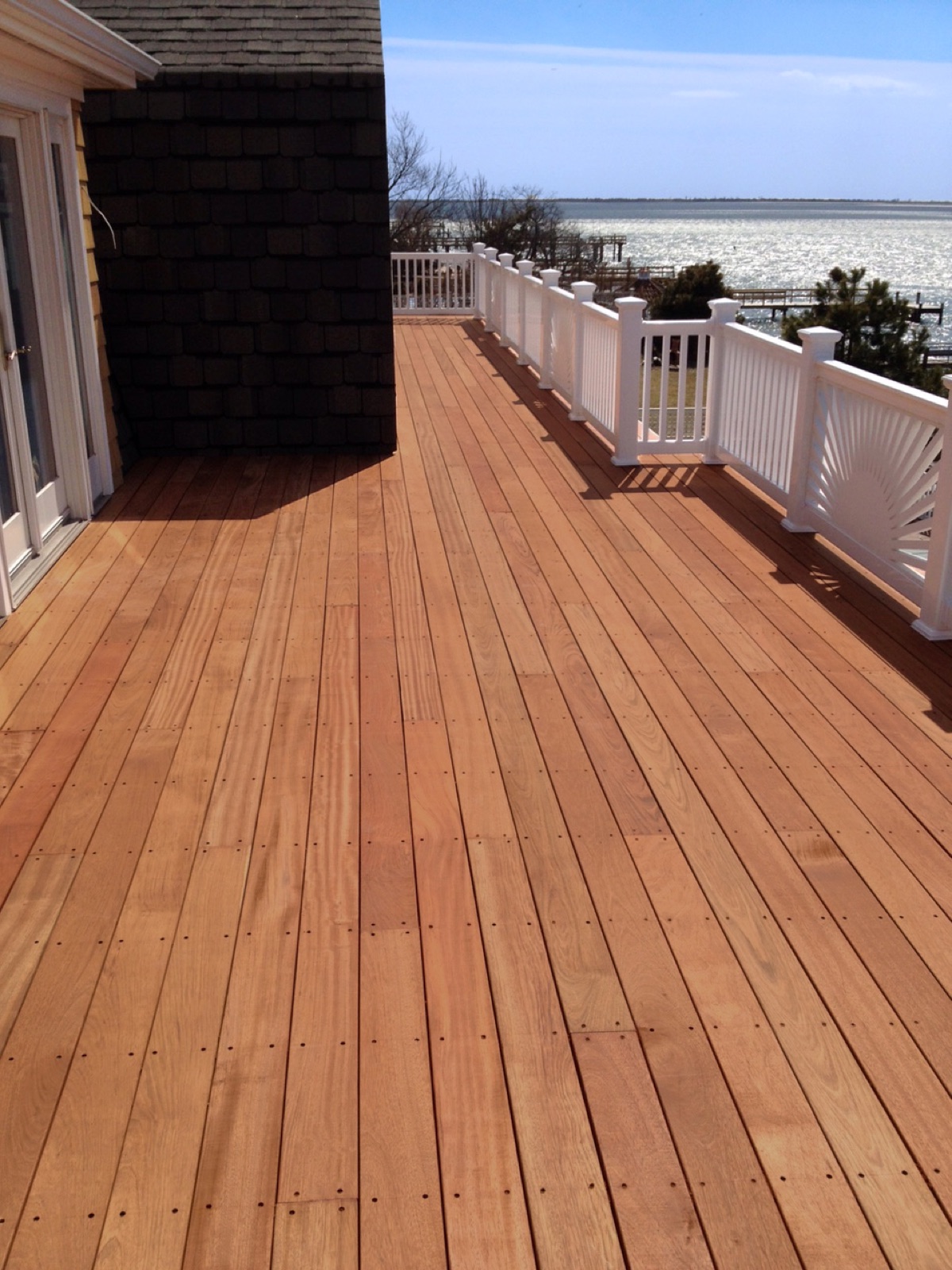
Jatoba handles high traffic commercial use, and the surface is not where these decks fail.
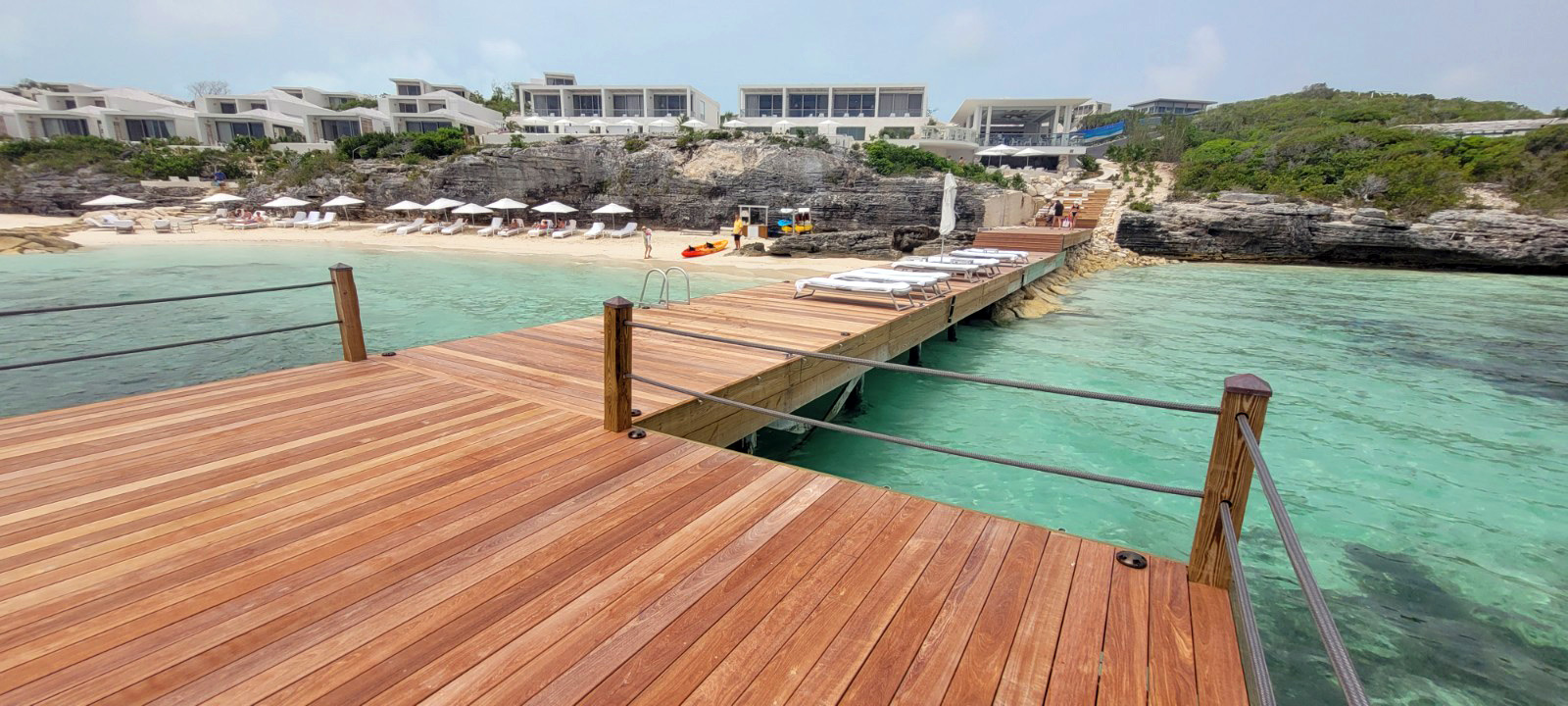
Put the concern in the right place. A plaza, a rooftop amenity deck, a transit boardwalk, a restaurant patio that turns tables all day. What those spaces do to a wood deck is a mix of abrasion from grit underfoot and point loading from heels, cart wheels, and furniture. Jatoba answers both. It sits near 2,690 lbf on the Janka hardness scale, which puts it in the upper tier of commercial deck species and far above anything a pressure treated softwood delivers. Dense hardwood does not dent under a stiletto or scuff into a traffic path the way a softer board will.
So the durability question is real, and the honest answer is that the wood is rarely the weak link. Decks that look tired at year eight almost always failed at the connections, the drainage, or the gapping. Those are drawing decisions. Get them right and Jatoba carries a heavily used commercial surface for decades. This article treats the parts the first look at Jatoba tends to skip: how the surface actually wears, how the material behaves underfoot for slip and accessibility, how much it moves, and the assembly engineering that turns a good species into a deck that survives the traffic.
High traffic attacks a deck two ways, and Jatoba resists both mechanisms.
Pedestrian wear is not one thing. Separate it into abrasion and indentation, because a species can be strong against one and weak against the other.
Abrasion is the slow sanding action of grit tracked across the boards. Sand, road salt, planter soil, the fine debris that rides in on shoes. Over years it polishes softwood into visible traffic lanes and rounds the arrises of the boards. Density is the defense, and Jatoba is dense, roughly 900 kg per cubic meter at service moisture. The wood fibers are tight and interlocked, which is the same grain structure that makes the species tough to machine and also the reason a walking path does not carve into it.
Indentation is the localized crush from a concentrated load. A chair leg, a loaded hand truck, the point of a heel. This is what the Janka test measures, the force to press a steel ball halfway into the wood. At about 2,690 lbf, Jatoba shrugs off the point loads a commercial pedestrian environment generates. For reference on how hardness maps to real dent resistance, the USDA Forest Products Laboratory Wood Handbook is the standard technical source, and Jatoba's mechanical numbers sit comfortably above the threshold where indentation becomes a maintenance issue. The wood database entry collects the same figures in a shorter form.
Both mechanisms favor a dense, interlocked tropical hardwood. Jatoba is one. That is the physical basis for specifying it under traffic, and it is why the species outlasts the softer alternatives that photograph the same on day one.
Slip resistance on a commercial deck is a detailing decision, and Jatoba supports the profiles that pass an accessibility review.
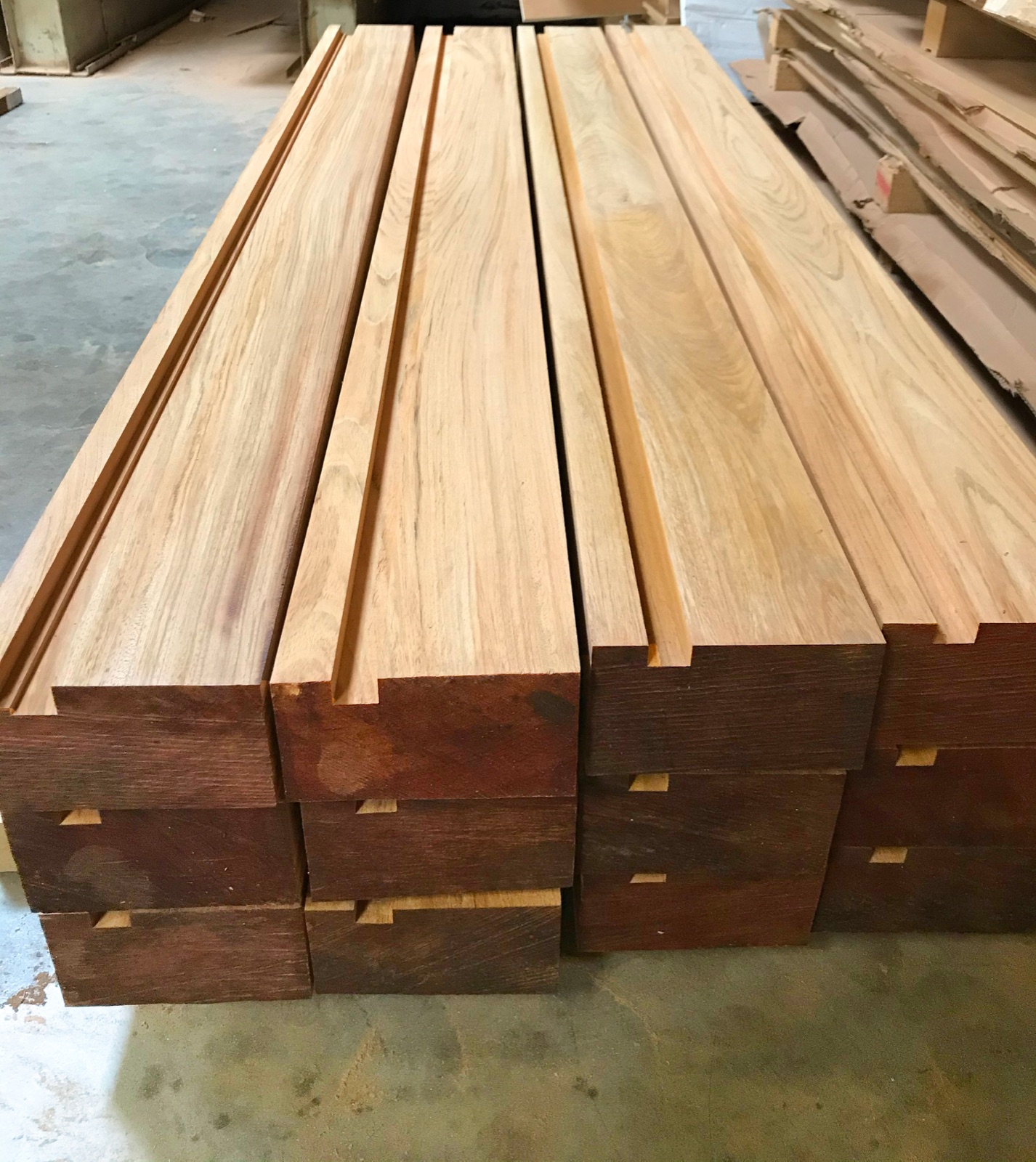
Hardness gets the attention. Slip is what an owner and a code official actually ask about on a public walking surface. A dense hardwood can be slick when wet and smooth, so the specification has to build traction into the surface rather than assume the species provides it.
The controlling reference is the accessible route. The U.S. Access Board explains the intent and the surface requirements for walking surfaces in its ADA Accessibility Standards guidance, and the practical takeaway is that an accessible route wants a firm, stable, slip resistant surface with any openings and level changes held within limits. On a Jatoba deck you meet that with three levers. First, choose a profile with a fine grip texture or specify a light broom or brushed finish rather than a glassy sanded face. Second, hold the board gaps tight and consistent so a cane tip or a narrow wheel does not catch, which the accessible route rules care about directly. Third, keep the surface draining so water sheets off instead of pooling into a slick film.
Slip is measurable. ASTM publishes the test methods for static and dynamic coefficient of friction that a designer can cite in a submittal, and the ASTM standards catalog at astm.org is where those live. Specifying to a measured friction target, then verifying the delivered finish against it, is how a public Jatoba deck clears review with no surprises. The wood does not fight you here. It takes texture well and holds it under traffic.
Seasonal movement, not decay, is the design constraint you build the deck around.
Jatoba does not rot in a deck that drains and breathes. Its outdoor durability against fungal decay is solid for a properly detailed exterior application. The property that demands respect is dimensional movement, because Jatoba moves more across the grain than the very stable tropicals.
The numbers tell the story. Jatoba's tangential shrinkage runs near 7 to 8 percent from green to oven dry, with radial movement roughly half that. In service you are working across a narrower moisture band, but a wide board on a hot exposed plaza still expands and contracts a meaningful amount between a humid summer and a dry winter. Ignore that and the boards cup, the fasteners work, and the gaps close up or gape. The Forest Products Laboratory data on shrinkage and moisture behavior in the Wood Handbook is the reference for putting real figures behind the movement, and it is worth building the gap schedule from those numbers rather than a rule of thumb.
The design responses are straightforward. Acclimate the material on site to local conditions before fastening. Set the deck at an in service moisture content in the 12 to 16 percent range for most of the country. Keep board widths sensible, since a 4 inch face moves less in absolute terms than a 6 inch face. Gap the boards for the season you are installing in, tighter when the wood is already swollen, wider when it is dry. Movement is predictable. It is only a problem when the details pretend it is not there.
Fastener engineering carries the cyclic load of a busy deck, and the profile decides the system.
A commercial deck sees load cycles that a residential deck never approaches. Every crossing flexes the boards a little, and over millions of cycles a marginal fastener strategy loosens and squeaks. The fastening has to be chosen for the traffic, not just the look.
Match the system to the profile. Only tongue and groove profiles accept true hidden fasteners, where a clip engages the groove and leaves the face clean. A shiplap or a square edge board takes visible fasteners, and on dense Jatoba that means pre drilling and countersinking every screw, because the wood is too hard to drive into cold. When the deck runs over sleepers or joists, the boards land on the framing. When it runs over furring strips on a slab or a roof deck, the strips carry the fastening and provide the drainage plane. If the profile has a grooved back for a hidden clip, install it grooves down so the channel drains rather than holds water.
Corrosion is not optional on a public deck, and it is decisive near salt. Use stainless steel fasteners, and go to 316 stainless for coastal or pool deck work where chloride exposure will eat lesser metals. Space the joists to hold the boards flat under load. For dense hardwood decking, 16 inches on center is the working baseline, and heavy commercial loading or thinner stock pushes that tighter. For the structural side of a raised commercial deck, the American Wood Council codes and standards resources are the reference a designer cites for connection and framing capacity. The fasteners and the frame do as much for the twenty year outcome as the species does.
The underside you never see is where a commercial deck lives or dies.
Every dense tropical deck that failed early has the same autopsy. The top looked fine. The underside stayed wet. Airflow under the boards is not a nicety on a commercial installation, it is the mechanism that keeps a moisture loving species dry enough to last.
Wood equilibrates with the air around it. Trap humid, still air under a deck and the boards hold moisture, cup toward the dry face, and invite the decay that a ventilated assembly never sees. The fix is deliberate air movement. Raise the deck on sleepers or pedestals with clear space beneath. Keep the perimeter open so air can cross rather than dead end. On a rooftop or over a membrane, use a pedestal system that lifts the boards and lets the slab breathe. The building science community treats through drying and drainage as the core of durable exterior assemblies, and the primers at buildingscience.com lay out why a wetted material that can dry survives and one that cannot fails.
Gap the boards for drainage as well as movement. Water has to leave the surface fast and the debris that collects in the gaps has to be flushable. A deck that drains its top and ventilates its bottom keeps Jatoba in the moisture window where it performs, indefinitely.
"Clients call worried about whether Jatoba is hard enough for a plaza, and it always is. What I walk them through instead is the boring stuff that actually decides the job. How the deck breathes underneath, how the boards are gapped for the season we ship in, what fastener goes into wood this dense. We mill the Jatoba to a consistent moisture content and profile so the crew on site is fighting the schedule, not the lumber."
Norm Moton, Director of Sales, J. Gibson McIlvain
Against the other commercial tropicals, Jatoba trades a little stability for hardness and a strong value position.
The species that compete for a commercial deck separate on the axes that matter under traffic. Raw hardness is only one of them. Dimensional stability, weight for the crew handling the boards, and the ideal use case round out the real comparison. The table below sets Jatoba against the tropicals a specifier actually weighs, on the metrics that decide a plaza rather than the ones that decide a photo.
| Species | Janka (lbf) | Relative in-service movement | Relative board weight | Best commercial fit |
|---|---|---|---|---|
| Jatoba | ~2,690 | Moderate to high, gap for the season | Heavy | Plazas and patios wanting hardness and warm color at strong value |
| Ipe (Tabebuia spp.) | ~3,680 | Low, very stable | Very heavy | The default for demanding public boardwalks and long service life |
| Cumaru | ~3,540 | Moderate to high | Heavy | High wear decks where movement is detailed for |
| Garapa | ~1,700 | Moderate | Medium | Lighter color decks with lower point loading |
| Red Balau | ~1,700 to 2,000 | Moderate | Medium to heavy | Value tropical for moderate commercial traffic |
| Massaranduba | ~3,190 | High | Very heavy | Comparison only, movement demands careful detailing |
Read the table as a set of tradeoffs, not a ranking. Ipe leads on hardness and stability and remains the reference standard for the most demanding public boardwalks. Jatoba sits a step down in hardness while still clearing every pedestrian requirement, costs less than Ipe, and brings a warm red brown color a lot of designers want. Its price for that is more movement, which the detailing absorbs. That is the whole case for Jatoba on a commercial deck. Plenty of hardness, real value, and a movement number you plan for.
A Class A flame spread rating clears Jatoba through the code review most public decks trigger.
Commercial and assembly occupancies often require a documented surface burning characteristic for exterior walking surfaces, and a deck the public uses tends to land in that review. Jatoba carries a Class A rating, meaning an ASTM E84 flame spread index of 25 or less, the top tier of the test. Dense tropical hardwoods earn this on their own density with no added treatment.
The standard behind the number is ASTM E84, the tunnel test for surface burning, published through astm.org. How that class feeds into the building code is spelled out in the International Code Council materials at iccsafe.org, and the National Fire Protection Association resources at nfpa.org give the fire side context for assembly spaces. For the submittal, ask for the test documentation with the material so the flame spread claim is backed by a report, not a reputation. Jatoba supplied to a commercial spec should arrive with that paperwork available.
A commercial Jatoba deck asks for a maintenance decision up front, not a rescue later.
Left alone, Jatoba weathers from its warm red brown to a silver gray, same as every uncoated tropical. That is a finish choice, not a durability problem. The wood is just as sound gray as it is brown. What a commercial owner needs is a decision made before the deck opens, because a facilities team that expected the color to hold and did not budget for upkeep is the one that calls unhappy.
Two honest paths. Let it gray and keep maintenance to periodic cleaning of grit and debris from the surface and the gaps, which also protects the slip performance. Or hold the color with a penetrating UV oil finish, which means a recoat cycle, more frequent in a hot exposed plaza than a shaded courtyard. Either path lasts. Neither is wrong. The failure mode is not choosing, then reacting when the deck grays and nobody planned for it. Write the maintenance regime into the closeout documents so the owner runs the cadence instead of discovering it.
Jatoba is the wrong spec in a few honest situations, and naming them protects the project.
A supplier that only tells you where a species wins is not helping you specify. Jatoba is not the answer everywhere.
Skip it where dimensional movement cannot be tolerated and there is no appetite to detail for it, since the very stable tropicals or a modified wood will behave better with looser detailing. Reconsider it where the design wants a factory backed performance guarantee, because solid unmodified hardwoods carry no warranty on the wood itself. When a warranty is a hard requirement, a modified product is the route. Thermory and Abodo Vulcan offer thermally and acetylated modified options with warranty coverage and strong dimensional stability, though those top out near 16 feet in length because of kiln size, so long uninterrupted runs still favor a solid tropical. Accoya is the acetylated modified option when maximum stability and a warranty outrank the density and color of a tropical. And where the budget or the loading is light, a lighter species like Garapa may be the sensible call rather than paying for hardness the deck will never use. Match the species to the real demands. Jatoba earns its place on plenty of commercial decks and not on all of them.
How J. Gibson McIlvain Would Specify This
Start from the traffic and the exposure, then work down to the board. For a high traffic plaza or boardwalk, specify Jatoba decking milled to a consistent profile and an in service moisture content in the 12 to 16 percent range, delivered with the ASTM E84 Class A documentation for the code file. Choose the profile deliberately. Tongue and groove where you want hidden fasteners and a clean face, square edge or shiplap where you want visible stainless fasteners you can service, always pre drilled into wood this dense. If the profile is grooved for clips, install it grooves down to drain.
Engineer the assembly for the traffic. Joists or sleepers at 16 inches on center as the baseline, tighter under heavy load. Stainless fasteners, 316 stainless within reach of salt. Continuous ventilation under the boards and an open perimeter so the deck dries. Gap for the season of installation and for drainage. Specify a surface texture and a measured slip target for any accessible route, and hold board gaps consistent so the route passes an accessibility review. Write the maintenance path, gray or oiled, into the closeout so the owner runs a plan instead of a reaction.
On sourcing, J. Gibson McIlvain stocks and mills Jatoba decking across the dimensions a commercial job needs and ships nationwide, including regularly to California, from a family lumber operation running since 1798. If a project needs FSC certified material, that path is available and the certification body's resources at fsc.org explain the chain of custody. When a species on the plan is CITES-listed, documentation is required to import and move it, and the framework is on the CITES site at cites.org. For the decking itself, the tropical decking line covers Jatoba alongside the other commercial species, and a lumber specialist can size the lengths and profile to the drawing set. Call 800-638-9100 to spec it. The right answer is a matched system, not a silver bullet species, and the deck that reaches year twenty is the one detailed for the traffic from the first line on the plan.
Frequently Asked Questions
Will a Jatoba deck wear into visible traffic lanes in a busy commercial space?
Not under normal pedestrian use. Traffic lanes form when grit slowly abrades a soft surface, and Jatoba's density near 900 kg per cubic meter resists that sanding action. Point indentation from heels and cart wheels is governed by hardness, and at roughly 2,690 lbf on the Janka scale Jatoba is well above the threshold where dents become a maintenance issue. Keeping grit swept off the surface protects both the wear resistance and the slip performance over the life of the deck.
How do you make a Jatoba deck slip resistant enough for an accessible public route?
Build traction into the surface rather than relying on the species. Specify a profile with a fine grip texture or a light brushed or broom finish instead of a glassy sanded face, hold the board gaps tight and consistent so a cane tip or narrow wheel does not catch, and keep the surface draining so water does not pool. Slip is measurable with ASTM coefficient of friction test methods, so specify to a friction target and verify the delivered finish against it. The U.S. Access Board's ADA standards are the reference for accessible walking surfaces.
How much does Jatoba move seasonally, and what does that mean for the details?
Jatoba moves more than the most stable tropicals. Its tangential shrinkage runs near 7 to 8 percent green to oven dry, with radial movement roughly half that. In service across a normal moisture band the swing is smaller, but a wide board on a hot exposed plaza still expands and contracts noticeably between seasons. You absorb that by acclimating the material on site, targeting a 12 to 16 percent in service moisture content, keeping board widths sensible, and gapping for the season of installation. Movement is predictable and only becomes a problem when the details ignore it.
What fasteners and framing should a commercial Jatoba deck use?
Match the system to the profile. Tongue and groove accepts hidden clips, while shiplap and square edge take visible fasteners that must be pre drilled and countersunk into wood this dense. Use stainless steel throughout, stepping up to 316 stainless near salt or pool chloride. Set joists or sleepers at 16 inches on center as a baseline and tighter under heavy load. If the board is grooved for clips, install it grooves down so the channel drains. The framing and connections do as much for the twenty year outcome as the species choice.
Does a Jatoba deck need ventilation underneath, and why?
Yes, and it is not optional on a commercial installation. Wood equilibrates with the surrounding air, so trapped humid air under the boards keeps them wet, causes cupping toward the dry face, and invites decay that a ventilated assembly never sees. Raise the deck on sleepers or pedestals with clear space beneath, keep the perimeter open for cross flow, and gap the boards for drainage. A deck that drains its top and breathes underneath keeps Jatoba in the moisture window where it lasts indefinitely.
When should I choose a modified wood instead of Jatoba for a commercial deck?
Choose a modified product when a factory backed warranty is a hard requirement or when maximum dimensional stability with loose detailing matters more than tropical density and color. Solid unmodified hardwoods carry no warranty on the wood itself. Thermory and Abodo Vulcan offer modified options with warranty coverage and strong stability, and Accoya is the acetylated choice for maximum stability. Note that modified woods top out near 16 feet because of kiln size, so long uninterrupted runs still favor a solid tropical like Jatoba.
Sources and Standards Referenced
- USDA Forest Products Laboratory, Wood Handbook: Wood as an Engineering Material
- U.S. Access Board, ADA Accessibility Standards
- ASTM E84 Standard Test Method for Surface Burning Characteristics of Building Materials
- American Wood Council, Codes and Standards
- Building Science Corporation, Moisture and Durability Resources
- The Wood Database, Jatoba (Hymenaea courbaril)
- International Code Council


