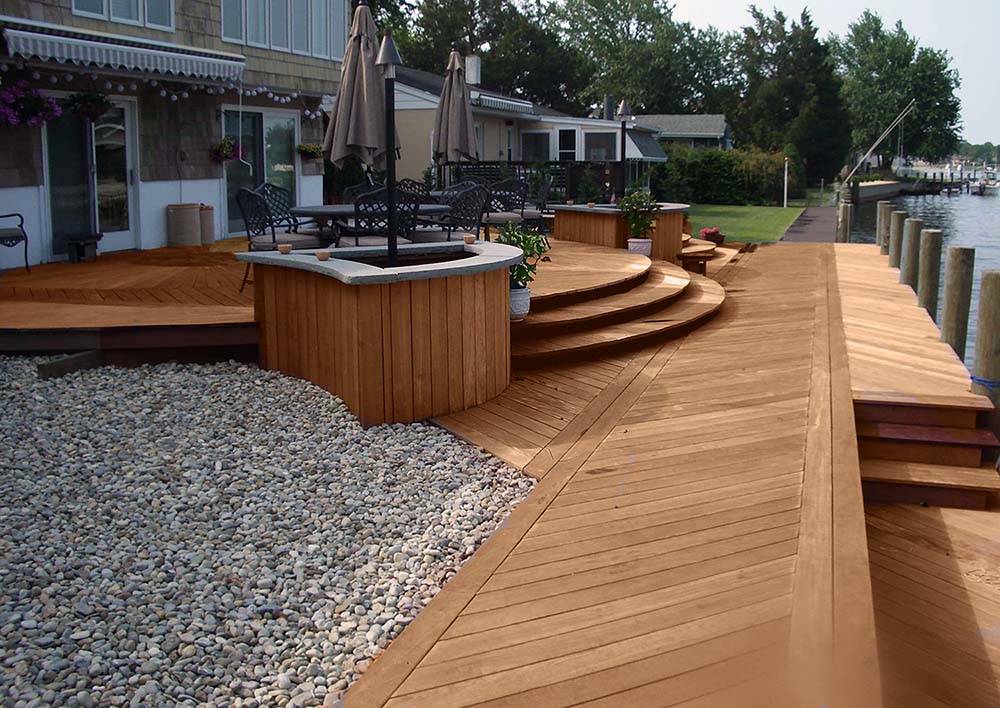
At year twenty an Ipe deck is a mid-life asset with decades of service still ahead of it, while a composite deck of the same age is approaching the end of its engineered design life.
That single sentence answers the question, but it hides the more useful one. The two materials do not travel toward year twenty on the same road. Ipe ages the way dense wood ages, from the surface inward, at a rate the USDA Forest Products Laboratory measures in fractions of an inch per century. Composite ages the way a plastic product ages, through polymer oxidation, cap abrasion and thermal cycling, on a clock its manufacturer set when the board left the extruder. Understanding what each material is actually doing in years one through three, four through ten, and eleven through twenty tells you far more than a headline lifespan number ever will. This article walks that timeline year by year.
One framing point before the timeline starts. Ipe (genus Tabebuia) is rated EN 350 Class 1 for natural durability, the top class, with a Janka hardness around 3,680 lbf and density near 1,050 kg per cubic meter. Composite is not rated under EN 350 at all because it is not wood in any structural sense. It is wood flour bound in polyethylene or PVC. The comparison is real, both are legitimate decking, but they are different categories of material and they fail by different mechanisms.
Wood and composite degrade by entirely different mechanisms, and the mechanism is what determines how each one looks and performs at twenty years.
Weathering in dense tropical hardwood is a surface event. Ultraviolet light breaks down lignin in the top few thousandths of an inch, rain washes the gray residue away, and the process repeats. The Forest Products Laboratory's Wood Handbook puts surface erosion from weathering at roughly a quarter inch per century for softwoods, and dense tropicals erode slower than that. On a board that starts at a full inch or more of solid material, that erosion rate is a rounding error over twenty years. The board under the gray patina at year twenty is, mechanically, the same board that was installed.
Composite degradation runs on chemistry, not erosion. The polyethylene matrix oxidizes under UV exposure and heat, which is why every capped composite board wears a co-extruded polymer shell engineered to shield the core. That cap is the product. It is also a wear layer measured in hundredths of an inch, and once it is scratched through, gouged by a grill or a dragged planter, or abraded along a traffic path, the core beneath it loses the defense the cap was providing. The core itself takes on moisture through cut ends and fastener penetrations, and wood flour that stays wet inside a plastic matrix supports mold that cannot be sanded out. None of this makes composite a bad product. It makes composite a product with a consumption curve, which is exactly why manufacturers write 25, 30 or 50 year limited warranties with proration schedules rather than talking about indefinite service.
The first three years are the loudest for Ipe and the quietest for composite, which misleads a lot of owners about the decades that follow.
New Ipe announces itself. The chocolate brown color begins shifting within the first season of full sun. Small surface checks appear as the board's surface heats and dries faster than its core and the wood releases that tension. Checking cannot be prevented in any dense tropical decking, and a supplier who promises otherwise is promising against physics. What checking can be is small, shallow and cosmetic, and it does not weaken the board. Fine surface checks are normal in properly seasoned material. J. Gibson McIlvain factory coats its tropical decking with Cutek, a penetrating oil stabilizer that slows the surface moisture swings driving the checking, and site practice does the rest. Seal every field cut end. Keep air moving under the deck. Let the material acclimate to the site before it goes down at its in-service moisture content of 12 to 16 percent.
Composite spends those same three years looking almost exactly as it did in the showroom, minus some early color settling that most cap manufacturers disclose for the first months of UV exposure. What is actually happening in years one through three is thermal education. Composite moves along its length with temperature far more than hardwood does, and decks gapped incorrectly at installation show it early, with boards bowing against fixed ends or gaps opening at mitered borders. Guidance from Building Science Corporation on assemblies applies here in miniature. Materials move, and detailing either accommodates the movement or fights it.
The middle years are when Ipe stabilizes and composite starts spending its cap.
By year four or five an Ipe deck has finished its dramatic phase. Left uncoated, it settles into an even silver gray that many architects specify on purpose for coastal work. Re-oiled every year or two, it holds brown indefinitely. Either way the maintenance decision is purely aesthetic. The Wood Database entry for Ipe rates the species very durable against rot and highly resistant to insect attack, and those properties belong to the whole board thickness, not to a coating. There is nothing on an Ipe deck at year seven that needs protecting to keep the deck structural.
Composite's middle years are an accounting period. Every scratch is permanent, because there is no refinishing a co-extruded cap. Traffic lanes begin to burnish differently from the field. In shaded or north-facing exposures, airborne organic film feeds surface mildew that needs regular washing, and hard scrubbing is itself a form of cap wear. Fade is slow and warranted within limits, but replacement boards ordered in year eight rarely match a field that has weathered for eight years, and matching gets harder still when the manufacturer has updated or discontinued the color line. Owners who expected zero maintenance discover the real proposition was low maintenance, on a product whose appearance ratchets in one direction.
The second decade is where the two curves visibly separate, because Ipe can be renewed and composite can only be managed.
An Ipe deck at year fifteen that an owner wants to look new again can be made to look new again. Sand the surface, and fresh wood with full color comes up, because the board is the same material all the way through. Boards damaged by a dropped fireplace ember or a mechanical accident are replaced individually with new stock that will weather to match, since the replacement is the same species aging by the same mechanism. This is the property no engineered surface product shares, and over a twenty year horizon it is the single biggest practical difference between the materials.
Composite in its second decade is managed decline. The cap on twenty year old boards has thinned along traffic paths. Cut ends and fastener holes have been wicking moisture into the core for two decades. Early-generation and uncapped product from the same era shows the surface flaking and core swelling that pushed the industry to co-extrusion in the first place. The warranty, if the original owner still holds it, has prorated down to a fraction of replacement value, and the deck's plastic surface has meanwhile ridden on a substructure that may or may not have been built to last as long as either deck surface. A pressure-treated frame nearing year twenty is frequently in worse shape than whatever is screwed to it, which brings the whole comparison back to structure.
"The calls that stick with me are the twenty year check-ins. An Ipe boardwalk we shipped in the mid 2000s comes back for an expansion, and the owner wants the new section to match the old one, which it will, because the old section is still sound. I have never had that conversation about a plastic deck. By year twenty those calls are about replacement, not expansion."
Norm Moton, Director of Sales, J. Gibson McIlvain
Twenty years of thermal cycling treats a dense hardwood and a thermoplastic very differently, and fire performance follows the same split.
Composite expands and contracts along its length with temperature, and it softens as it heats. Dark composite boards in full summer sun reach surface temperatures uncomfortable for bare feet and hard on the polymer itself, since heat accelerates the oxidation that ages the cap. Two decades of daily expansion cycles work fasteners, open butt joints and fatigue the material around clip slots. Ipe moves with moisture rather than temperature, its movement is small for a hardwood, and it does not soften in the sun at any temperature a deck will ever see.
Fire separates the materials even more cleanly. Ipe carries a Class A flame spread rating under ASTM E84, meaning a flame spread index of 25 or less, the same class as concrete, and it holds that rating for its entire service life because the rating comes from density, not from a treatment that leaches out. Most wood-plastic composite is combustible thermoplastic and rates Class B or C. For projects in wildland-urban interface zones, or any jurisdiction enforcing ignition-resistant construction under codes referenced through the American Wood Council's codes and standards program, that classification difference decides the spec before aesthetics enter the conversation. Fire authorities working from NFPA guidance on defensible space treat deck surfaces as ignition pathways to the structure, and a Class A surface is a materially different pathway than a Class C one.
Put the aging behavior of the candidate materials side by side and the twenty year picture organizes itself.
The table below scores the materials on how they age rather than on how they test when new. Massaranduba appears for comparison only. It is a dense South American species some specifiers ask about, but its high movement in service and its tendency to check aggressively in dry climates keep it out of most North American specs, and J. Gibson McIlvain does not carry it.
| Material | What degrades first | Expected condition at year 20 | Renewal path | Fire behavior (ASTM E84) | Available in 2x for commercial work |
|---|---|---|---|---|---|
| Ipe (Tabebuia spp.) | Surface color only; fine surface checks in years 1 to 3 | Structurally unchanged; silvered or oiled brown by owner choice | Sand to fresh wood; re-oil; replace single boards with matching stock | Class A, permanent (density-based) | Yes, consistently |
| Cumaru | Surface color; slightly more movement than Ipe | Structurally sound where acclimation at install was disciplined | Same as Ipe; sands and re-oils fully | Class A range by density | Yes, consistently |
| Jatoba | Surface color; moderate seasonal movement | Sound in covered and well-ventilated exposures | Sands and refinishes fully | Verify per project; below Ipe | Yes, consistently |
| Massaranduba (comparison only, not stocked) | Checking and movement, early and aggressive in dry climates | Serviceable in humid climates; rough surface likely elsewhere | Sands, but movement issues persist | Class A range by density | Inconsistent supply |
| Capped wood-plastic composite | Cap abrasion, scratch accumulation, cut-end moisture uptake | At or near end of rated design life; cap thinned on traffic paths, repairs hard to color match | None; cap cannot be refinished, boards replaced from current (changed) product lines | Class B or C, most products | Profile-dependent; governed by span ratings, not thickness |
No deck surface, wood or plastic, outlives the frame and fasteners it is attached to, and twenty year performance is decided at the joist line as much as in the species column.
Dense hardwood decking belongs on joists at 16 inches on center. Ventilation under the deck matters as much as the joist spacing, because a deck that can dry from below keeps its moisture cycling shallow and its checking small, while a skirted, sealed cavity under any deck traps humidity against the frame. Fasteners are a twenty year decision made in one afternoon. Coastal projects get 316 stainless steel, no exceptions, since a chloride environment will destroy lesser fasteners decades before it touches the Ipe around them.
Drilling is site work, done against the frame as built. Pilot every hole. Run two fasteners per board at every joist, hold roughly three quarters of an inch of edge distance, drill full pilots near board ends where splitting risk is highest, and land butt joints on doubled bearing rather than a single joist edge. A self-centering combination bit keeps the pattern clean across a big field. For a planning number, a 5/4x6 board covers about 2.1 linear feet per square foot of deck, which is how a takeoff converts area to footage.
On commercial boardwalks, piers and plazas, the twenty year question is settled by the 2x thickness rule before it is settled by anything else.
Public decks are specified at 2x thickness to control deflection under crowd loading, and no engineer of record will go first with a thinner board on a public job even where the strength math for 5/4 stock pencils out. That rule filters the field hard. Ipe, Cumaru and Jatoba are the species that can be sourced consistently in true 2x decking thickness. Red Balau and Garapa are honest performers at Janka values around 1,700 to 2,000 lbf, and they belong in residential decks and engineer-approved 5/4 work, but they do not belong in a commercial spec that calls for 2x because the supply is not there in that thickness. Composite in public work lives or dies on its span rating and its fire classification, and on boardwalks serving the public it must also meet the surface and gap requirements in the U.S. Access Board's accessibility guidelines, which a dimensionally stable 2x hardwood surface meets without special detailing.
Twenty years is also short in commercial accounting. A municipal pier is a fifty year asset. Specifying a surface with a twenty five year design life onto a fifty year structure builds a mid-life resurfacing project into the budget on day one. Specifying 2x Ipe builds in a sanding.
Over a twenty year horizon the real comparison is not maintenance hours, it is replacement cycles and documentation that hold up for the full term.
Composite's pitch is the elimination of finishing labor, and inside its design life the pitch is fair. An owner who never wants to see an applicator pad again is a real owner with a real preference. But the twenty year ledger has a right-hand column. The composite deck at year twenty is planning its replacement, demolition, disposal of boards no recycler wants, and a new surface at whatever the market then offers. The Ipe deck at year twenty is deciding whether to re-oil this spring or let it stay silver. Wood costs more attention per year. Composite costs a deck per generation. Which trade suits a given owner is a legitimate conversation, and it is the conversation a specifier should be having instead of comparing warranty page counts, since no warranty applies to solid unmodified wood anyway. Ipe does not need one. Its record on century-old municipal boardwalks is the document.
Sourcing paper belongs in the same ledger. Tropical hardwood earns scrutiny, and the answer to scrutiny is documentation. FSC certification through the Forest Stewardship Council provides chain of custody from forest to jobsite, and FSC-certified wood contributes toward credits in the U.S. Green Building Council's LEED rating system. When using a CITES-listed species, documentation is required under the CITES convention, and an importer who handles that documentation as a matter of routine is protecting the buyer as much as the forest. J. Gibson McIlvain has been importing hardwood since 1798 and mills and grades its tropical decking in its own yards, which means the paperwork and the material quality are verified by the same company that answers the phone if a question comes up in year fifteen.
Composite carries its own environmental story, recycled content on one side, an unrecyclable mixed-material board at end of life on the other. The honest comparison is that a hardwood deck sanded and kept in service for fifty years spreads its material footprint across two or three composite replacement cycles.
How J. Gibson McIlvain Would Specify This
For a residential deck with a twenty year plus horizon, specify 5/4x6 Ipe, air-dried to exterior moisture content of 12 to 16 percent, factory coated with Cutek, on joists at 16 inches on center with free ventilation below. Fasten with two stainless screws per board per joist, 316 grade within reach of salt air. Seal every field-cut end the day it is cut. Decide up front whether the owner wants silver or brown, and write the re-oiling cycle, or the absence of one, into the maintenance plan so nobody mistakes a cosmetic choice for a defect later.
For commercial boardwalks, piers and plazas, specify 2x6 Ipe, with Cumaru or Jatoba as engineer-approved alternates, and hold the 2x thickness as non-negotiable for public loading. Require FSC chain of custody documentation in the submittal, and require species-level verification on the import paperwork. Where a fire classification is part of the approval, cite Ipe's ASTM E84 Class A flame spread directly in the spec.
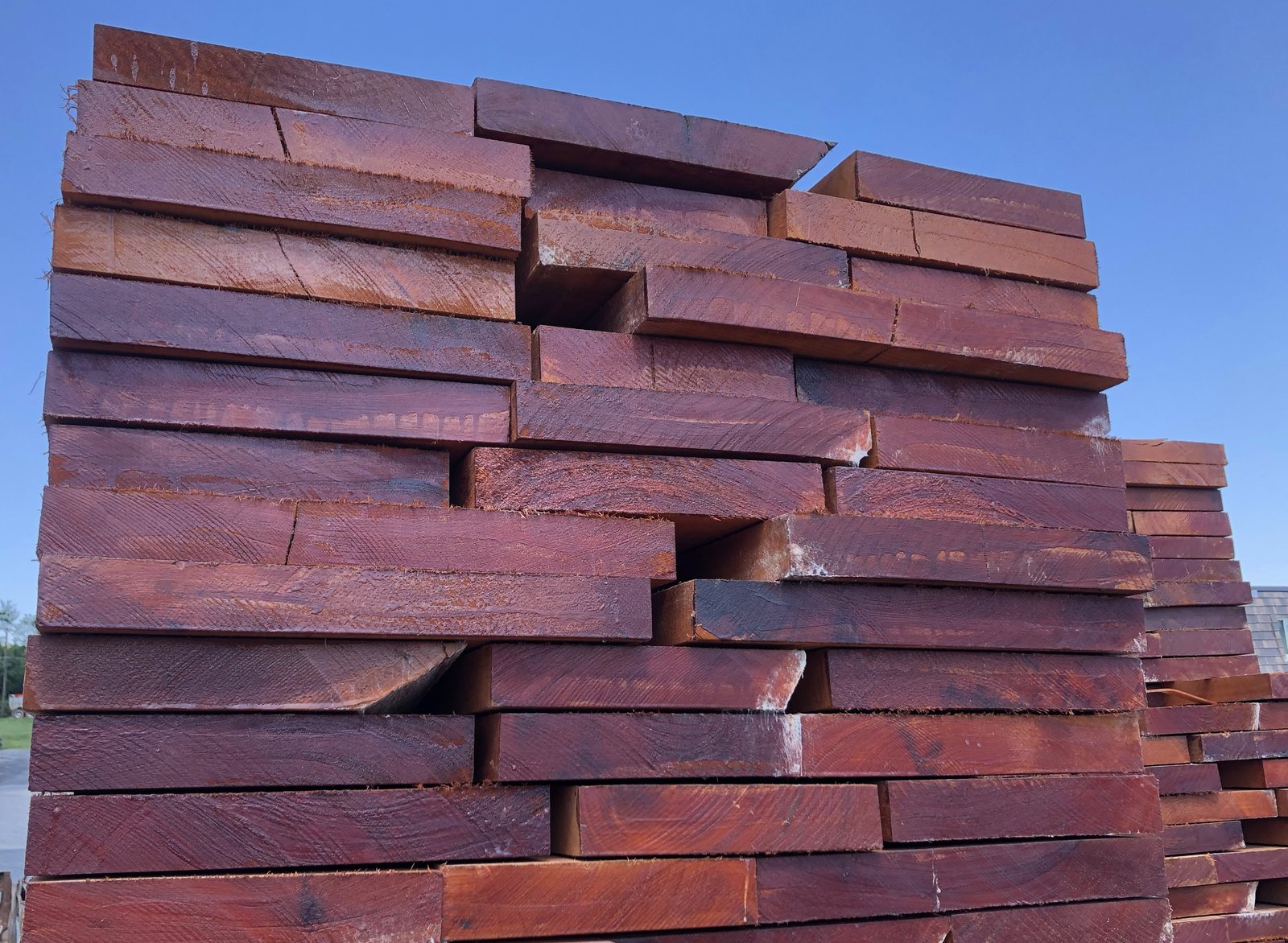
J. Gibson McIlvain stocks Ipe decking in a vast inventory across every standard and custom dimension, from 1x4 through 2x12 and in long lengths, alongside Cumaru, Garapa, Jatoba and Red Balau, and ships nationwide from its own yards, with regular deliveries as far as California. Details, profiles and current stock are at mcilvain.com/ipe-decking. For a takeoff review or a quote on a specific deck, call 800-638-9100 and talk through the frame, the exposure and the timeline before the species decision gets locked in. The right board on the right structure is what delivers the twenty year result this article describes.
Frequently Asked Questions
What does a composite deck actually look like at year fifteen?
Expect a surface that still functions but shows its age in one direction. The cap is duller and thinner along traffic paths, scratches from furniture and grills are permanent because a co-extruded cap cannot be refinished, and any boards replaced along the way stand out against fifteen years of field weathering. Shaded areas need regular washing to control surface mildew. The deck is usable, but its appearance has been ratcheting downward since installation and there is no mechanism to reverse it.
Does Ipe get weaker as it turns silver?
No. The silver-gray patina is a photodegraded surface layer a few thousandths of an inch deep where UV light has broken down lignin. The USDA Forest Products Laboratory measures total erosion from weathering in fractions of an inch per century, and dense tropical hardwood erodes slower than the softwood baseline. The board beneath the gray surface retains its full Janka hardness, density and EN 350 Class 1 durability. Sanding the surface exposes fresh brown wood at any point in the deck's life.
Can individual boards be replaced years into each deck's life?
With Ipe, yes, cleanly. A new board of the same species weathers by the same mechanism and blends with the field within a season or two. With composite it is harder than most owners expect. Manufacturers update and discontinue color lines, a new board never matches a cap that has weathered for years, and warranty replacement is prorated. On older decks the original profile or clip system may no longer exist, which can turn a one-board repair into a section rebuild.
Why does composite get so much hotter than Ipe in the sun, and does the heat shorten its life?
Dark thermoplastic absorbs solar energy and holds it at the surface, and polyethylene softens as it heats. Beyond comfort underfoot, heat accelerates the oxidation chemistry that ages the polymer, and daily thermal expansion cycles work fasteners and open butt joints over two decades. Ipe at roughly 1,050 kg per cubic meter also gets warm in full sun, but it does not soften, and its in-service movement is driven by moisture, which proper acclimation and ventilation keep small.
Does Ipe keep its Class A fire rating as it ages?
Yes. Ipe's Class A flame spread rating under ASTM E84, a flame spread index of 25 or less, comes from the density of the wood itself, not from an applied treatment that could leach or wear away. A twenty year old Ipe board tests the same way a new one does. Most wood-plastic composite is combustible thermoplastic rated Class B or C, which matters in wildland-urban interface zones and any jurisdiction enforcing ignition-resistant construction.
Does J. Gibson McIlvain coat its Ipe decking before it ships?
Yes. J. Gibson McIlvain factory coats its tropical decking with Cutek, a penetrating oil wood stabilizer that slows the surface moisture swings that drive checking. Checking in dense tropical decking cannot be eliminated, it is the wood releasing tension as the surface dries faster than the core, and small surface checks are normal and do not weaken the board. The factory coating plus good site practice, end sealing and under-deck ventilation, keeps checks small and shallow.
Which species besides Ipe can carry a commercial deck through twenty years and beyond?
Cumaru and Jatoba are the realistic alternates, because along with Ipe they are the only species consistently available in the 2x thickness that commercial boardwalk, pier and plaza specs require for deflection control under public loading. Red Balau and Garapa perform well in residential decks and engineer-approved 5/4 applications, but 2x supply is not dependable in those species, so they do not belong in a public deck spec.
Sources and Standards Referenced
- USDA Forest Products Laboratory, Wood Handbook: Wood as an Engineering Material (FPL-GTR-190)
- The Wood Database: Ipe
- American Wood Council, Codes and Standards
- Forest Stewardship Council
- National Fire Protection Association
- U.S. Access Board
- U.S. Green Building Council
- CITES, Convention on International Trade in Endangered Species