Why a Deck That Looked Perfect at Handover Checks in July
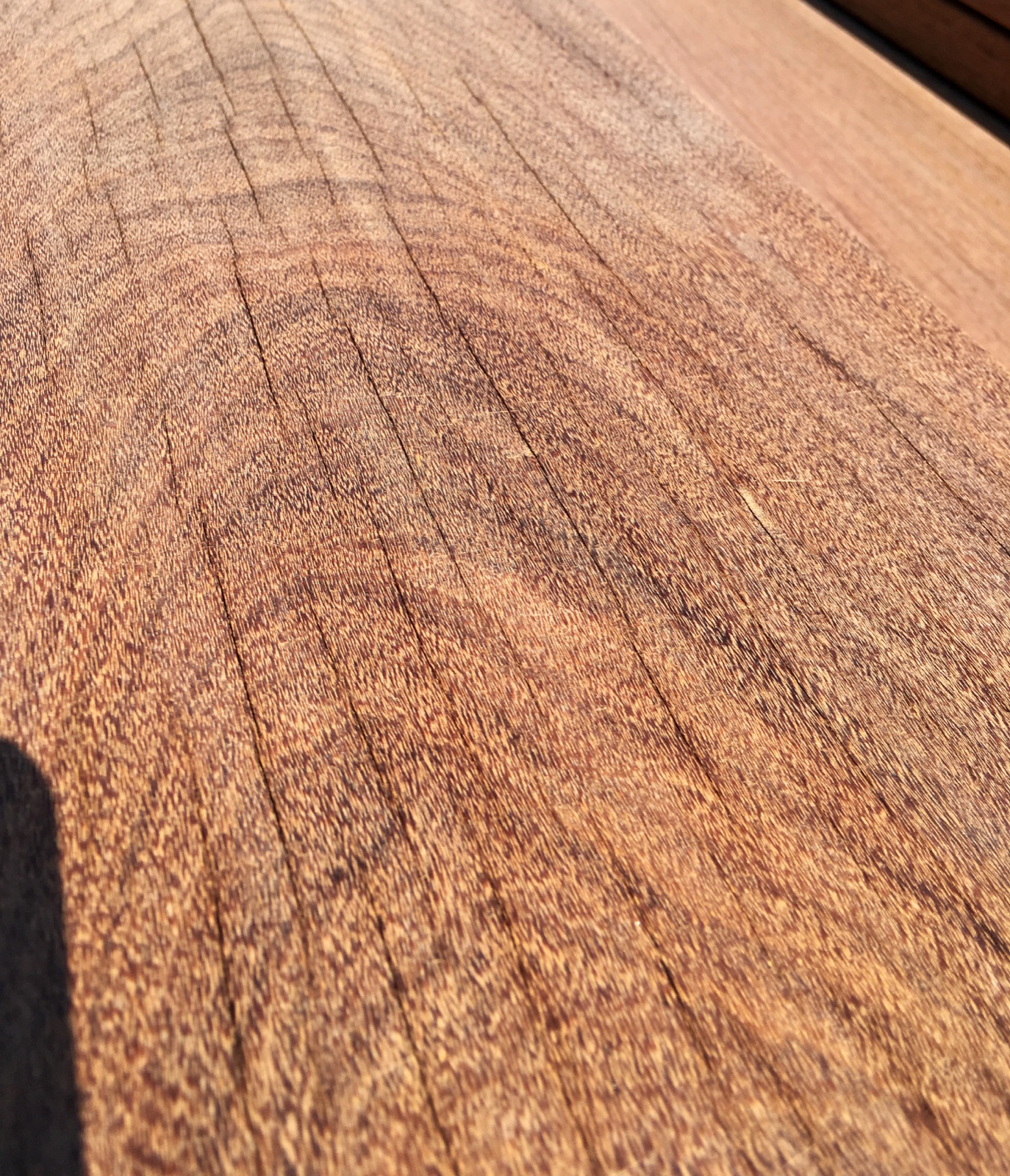
An installed tropical hardwood deck never stops exchanging moisture with the air, and every hot dry stretch puts the board surface in tension against its own core. Wood is hygroscopic for its entire service life. The USDA Forest Products Laboratory Wood Handbook documents how wood continuously chases the equilibrium moisture content of the air around it, and outdoors that target moves every week. A deck board in full July sun can pass 140 degrees Fahrenheit at the surface while the core of the board sits far cooler and noticeably wetter. The surface fibers shrink. The core refuses to follow. Something has to give, and what gives is the surface, in the form of fine longitudinal checks that follow the grain.
That mechanism matters for one reason. It tells you the honest answer to the question in the title. You do not prevent checking in dense tropical decking after installation. You manage it. Small surface checks are the wood relieving tension in a controlled way, they do not reduce the strength of the board, and on a properly seasoned board they stay shallow and tight. A deck that shows a scatter of hairline checks after its first summer is behaving exactly the way Ipe (Tabebuia spp.) at roughly 1,050 kilograms per cubic meter is supposed to behave. The goal of everything that follows is to keep those checks small, shallow and cosmetic for decades.
The First Two Summers Set the Pattern for the Next Twenty Years
The checking character your deck will carry for its whole life is established in its first two full weathering cycles, so first-year habits matter more than any habit formed later. A new tropical deck arrives with its moisture content settled into the exterior service range of 12 to 16 percent and, on material from J. Gibson McIlvain, with a factory coat of Cutek penetrating oil already in the wood. That coat slows the first summer's surface drying and takes the edge off the steepest gradients a board will ever face, the ones it meets before it has ever cycled.
Then the first heat wave comes. Surface moisture drops fast, the board releases a first generation of fine checks, and over the following winter those checks swell nearly shut. The second summer reopens some of them and adds few new ones. By the third year a well-managed deck has found its pattern. An unmanaged deck, one that lost its oil in month eight and spent a summer grey and bone dry on top while staying damp underneath, finds a much coarser pattern, and no amount of later care fully erases it. Put the first recoat and the first drainage cleanup on the calendar before the crew leaves the site.
Triage What You See Before You Treat Anything
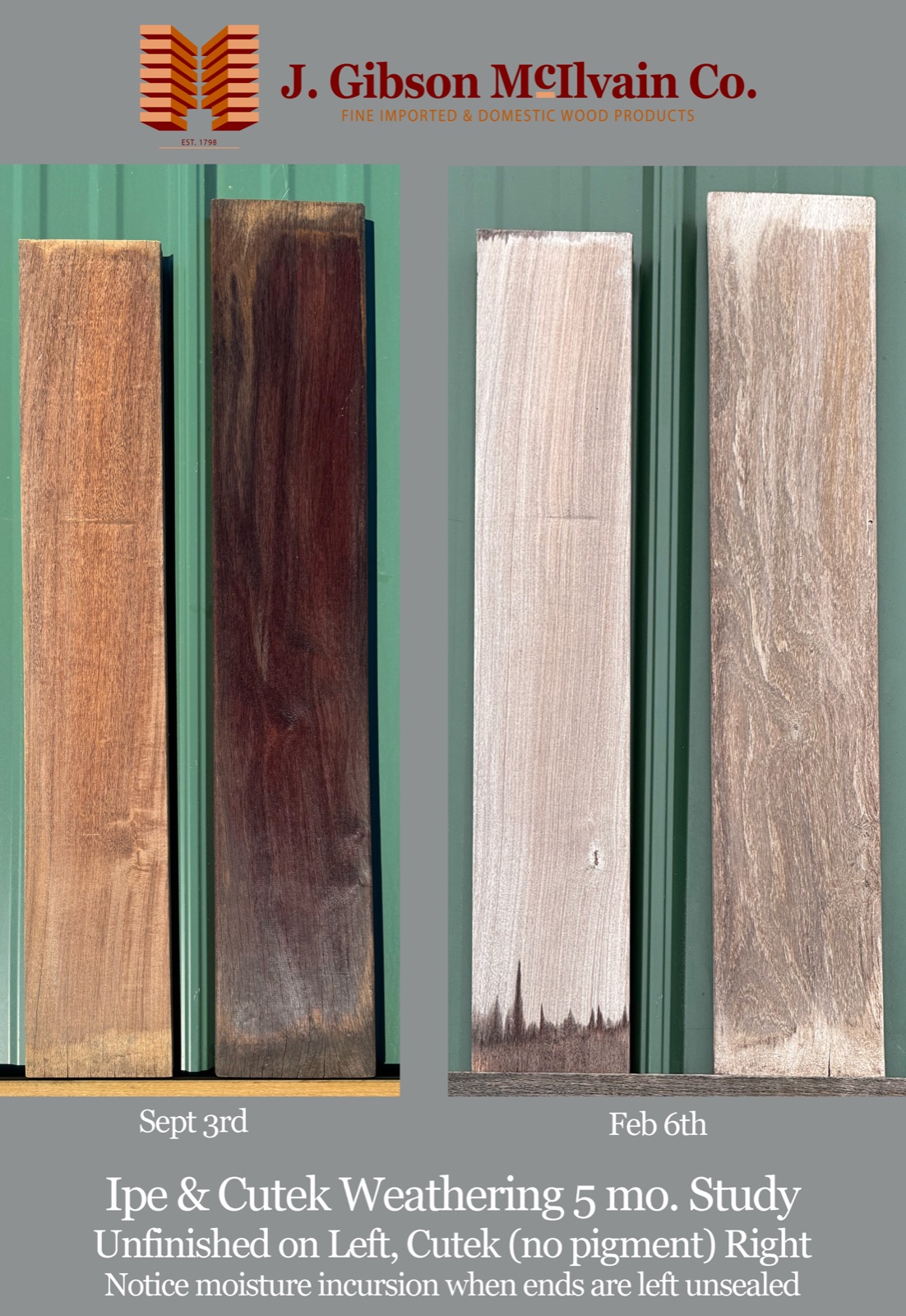
Not everything that looks like a crack is a check, and the treatment depends entirely on which of three defects you are looking at. Surface checks run with the grain in the middle of the board face, stay shallow enough that a fingernail barely catches, and open and close with the weather. They are normal. End splits start at a cut end and run inward, driven by fast end-grain moisture loss. They are preventable at the cut, not afterward, which is why every field cut gets end sealer the day it is made. Fastener splits radiate from a screw and are an installation defect, full stop.
Fastener splits deserve a closer look because they get blamed on the wood. Dense tropical decking is drilled on site, against the frame as actually built, and never at the mill. A factory hole pattern cannot survive real joist layout and field cuts, so no reputable supplier drills decking before shipping. On site the rules are firm. Pilot every hole. Use a self-centering combination countersink bit sized for the screw. Hold roughly three quarters of an inch of edge distance, run two fasteners per board per joist, drill full-depth pilots near board ends and land butt joints on doubled bearing. A deck fastened that way in 316 stainless steel, the correct grade for coastal exposure, almost never shows a radiating split. When one appears anyway, that single board gets replaced. Filling it is not a repair.
The Recoat Clock Matters More Than the First Coat
A penetrating oil finish reduces checking only while it is actually in the wood, and the decks that stay tight are the ones whose owners treat recoating as a schedule rather than a reaction. Cutek and comparable penetrating oils slow the rate at which the board surface sheds moisture, which flattens the gradient between face and core. Flatter gradient, less tension, smaller checks. The factory coat J. Gibson McIlvain applies to its tropical decking buys the first season. It does not buy the fifth.
Walk the deck at the start of each season. When rainwater stops beading, when the color has gone flat, when end grain looks chalky, the oil is spent and the board surface is drying at full speed again. Recoat then, not the following year. Choose a pigmented penetrating oil over a clear one for any deck in strong sun, since pigment absorbs ultraviolet light that would otherwise degrade surface lignin and accelerate both greying and checking. Skip film-building finishes entirely. A film cannot follow the seasonal movement described in the Wood Database primer on wood and moisture, so it cracks, traps water under itself and peels in sheets that take real labor to strip.
"Owners call us worried about hairline checks in year one, and I tell them the same thing every time. I have never seen a small surface check turn into a structural problem on Ipe or Cumaru. I have seen plenty of decks go coarse and grey because nobody re-oiled them, and I have seen ten-year-old boardwalks that look close to new because somebody put the recoat on a calendar. The wood does its part. The schedule is yours."
Map the Exposure, Not Just the Deck
Checking on an installed deck is rarely uniform, and the boards that check worst are the ones sitting in a microclimate the drawings never showed. Walk the finished deck at two in the afternoon in midsummer and map the hot zones. South and west exposures take the heaviest load. Glass doors, glass railing panels and pool water all reflect extra radiation onto nearby boards, and those bands run hotter and drier than the field of the deck. Dark grills, fire tables and metal furniture create scorch zones. The fix is management, not resignation. Give the reflective bands an extra recoat cycle, shade what can be shaded, and expect the exposure map to reappear as the checking pattern if you do not.
Watch what sits on the boards too. A rubber-backed mat traps moisture underneath while the surrounding wood bakes, which builds a sharp moisture step at the mat's edge, and checks concentrate exactly there. Planters without feet do the same. Use breathable mats, put every planter on risers and move both a few times each season.
Keep Water Moving for the Life of the Deck
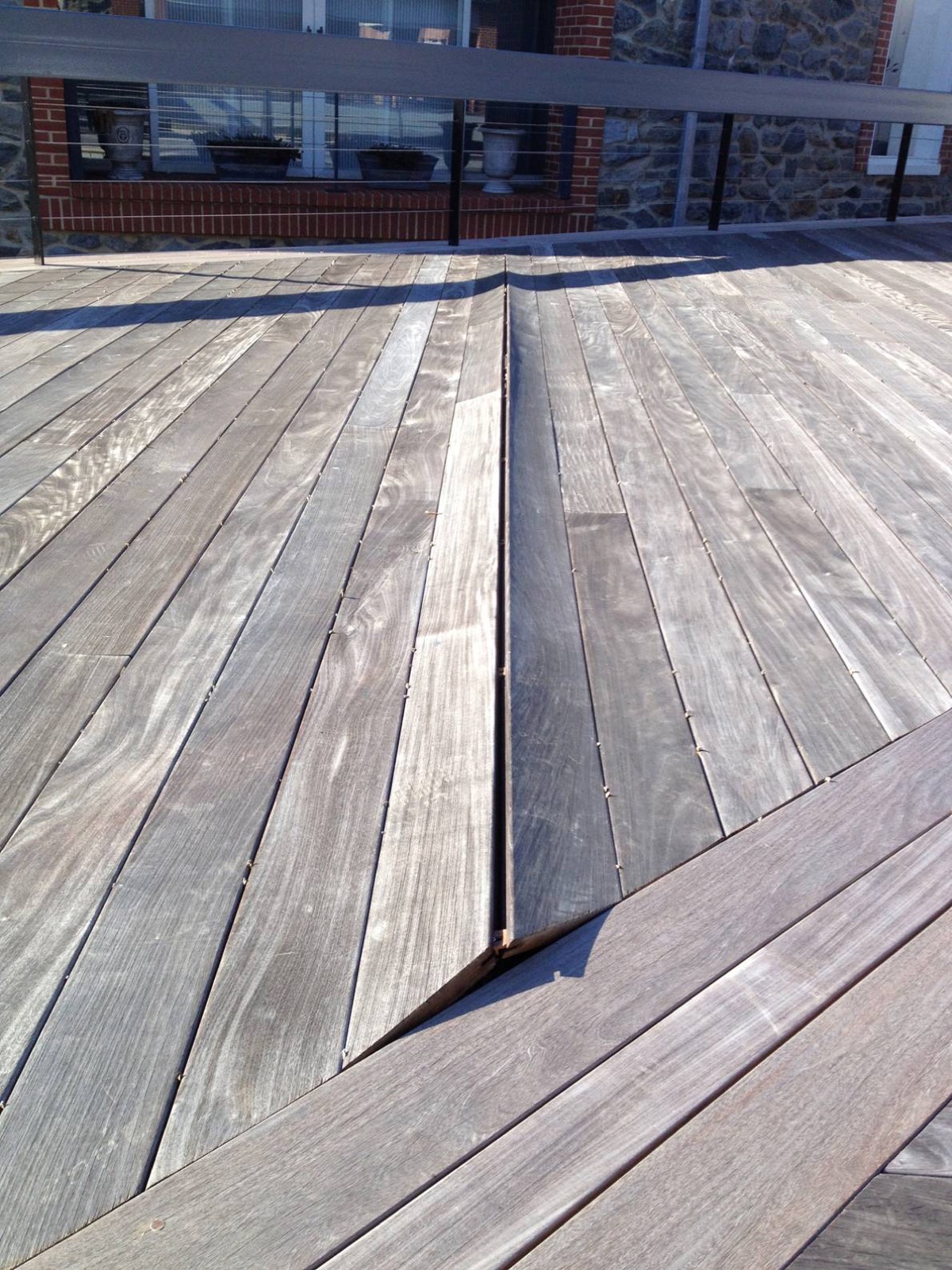
The worst checking gradient a deck board can face is a wet bottom and a baking top, and that condition is built one clogged gap at a time. Board gaps exist to drain water and to let air reach the underside. Leaves, seed pods and grit pack those gaps within a season or two, and once drainage stops, the underside of the deck stays damp while the sun drives the top face dry. The board is then shrinking on one face and swollen on the other. Cupping comes first. Aggressive checking follows. Clean the gaps with a putty knife and a garden hose every spring and fall. It is the cheapest checking control there is.
Ventilation underneath the boards is the other half of water management, and it can be retrofitted. Low decks that were skirted solid for looks are the classic failure, since the enclosed cavity holds humid air against the board bottoms year round. Open the skirting with vent panels on opposing sides so air actually crosses the cavity, and keep the ground below sloped away or covered so the cavity is not fed from the soil. The physics of keeping assemblies drying faster than they wet is laid out well in Building Science Corporation's digest on moisture and materials, and it applies under a deck exactly as it does inside a wall.
Each Species Brings Its Own Checking Behavior to the Job
Density decides how steep the internal moisture gradients get, so the hardest species need the most disciplined management while lighter species forgive more neglect. Ipe at a Janka hardness near 3,680 pounds-force moves moisture so slowly that its surface can be dry while the core lags for weeks, which is exactly the condition that opens checks. The payoff is that Ipe's checks stay fine and shallow, and its EN 350 Class 1 durability and ASTM E84 Class A flame spread rating make it the default for demanding public work. Cumaru behaves similarly, though its interlocked grain punishes sloppy acclimation and rewards a steady oil schedule. Massaranduba, a species J. Gibson McIlvain does not carry but which shows up in comparisons, is the cautionary tale of the group. It is dense, handsome and famously quick to check once the recoat schedule slips.
| Species | Janka Hardness (lbf) | Checking Behavior After Installation | Consistent 2x Availability | Best Fit |
|---|---|---|---|---|
| Ipe | ~3,680 | Fine, shallow checks that stay tight when oil is maintained; slow moisture exchange demands recoat discipline | Yes | Commercial boardwalks, piers and plazas; premium residential |
| Cumaru | ~3,540 | Small checks; interlocked grain punishes lapses in acclimation and oiling | Yes | Commercial decks; high-traffic residential |
| Jatoba | ~2,690 | Moderate, predictable movement; checks stay cosmetic under a normal recoat cycle | Yes | Commercial decks; covered porches |
| Garapa | ~1,700 | Gentler gradients and shallower checking than the densest species | No | Residential decks; engineer-approved 5/4 work |
| Red Balau | ~1,700 to 2,000 | Tight, small checks; well behaved at 5/4 thickness | No | Residential decks |
| Massaranduba (comparison only) | ~3,190 | Pronounced checking when finish maintenance lapses; least forgiving of hot dry exposure | No | Shown for comparison; not stocked by J. Gibson McIlvain |
What to Do About Checks That Have Already Opened
Most opened checks need nothing but oil, and the repairs owners most want to make are the ones that cause the most damage. The instinct is to fill. Resist it. Epoxy, hardening wood fillers and caulks all fail in a moving check, since the check is not static. It closes in humid weather and opens in dry weather, and a rigid filler either gets crushed and spat out or acts as a wedge that drives the check deeper. A flexible filler simply peels. The correct treatment for a cosmetic check is a light hand sanding if grain has raised at its edges, a generous flood coat of penetrating oil worked into the check itself, and patience. Oiled checks weather to the same tone as the surrounding board and visually disappear at any normal viewing distance.
Replacement is reserved for real defects. A split that passes through the board thickness, a split running from a fastener, or an end split that keeps extending season after season all call for swapping that board, and the replacement gets the full site-drilling treatment, pilots, edge distance and end sealing included. On a deck built with hidden side clips, a mid-field board swap takes more disassembly than a face-screwed one, which is a fair argument for face screwing on commercial decks that will see decades of service.
Commercial Decks Play by the 2x Rule, and It Changes the Checking Math
Public boardwalks, piers and plaza decks are specified at 2x thickness to control deflection, and no professional will go first with a thinner board on a public job even where the strength math for 5/4 works on paper. That rule, applied to structures reviewed under the codes and standards published by the American Wood Council, quietly filters the species list. Only Ipe, Cumaru and Jatoba can be sourced consistently in 2x decking thickness. Garapa and Red Balau, whatever their merits on a residential deck, do not belong in a commercial spec for that reason alone.
Thickness changes checking management too. A 2x board carries far more mass than a 5/4 board, cycles moisture more slowly and resists cupping better, but its greater depth means the face-to-core gradient in a heat wave can run steeper for longer. The management program stays the same, factory oil, scheduled recoats, clean drainage, real ventilation, except it runs on a public-works maintenance contract instead of a homeowner's weekend. Specifiers writing municipal work should put the recoat interval and gap-cleaning cycle into the operations and maintenance manual, because a boardwalk with no assigned maintenance owner is a boardwalk that will grey out and check coarse by year four.
Where a Modified Board Answers the Question Differently
A buyer who cannot accept any visible checking should be steered toward a modified wood rather than promised a tropical hardwood that will not check. Thermory thermally modified decking and Abodo Vulcan, both of which J. Gibson McIlvain carries, along with acetylated Accoya, start from a different premise. Modification lowers the wood's equilibrium moisture content and flattens its response to weather, so surface checking drops sharply, and these are the only products in this conversation that carry manufacturer warranties. Solid unmodified hardwood carries none, and any supplier implying otherwise should be pressed on it.
The trade is scale. Kiln dimensions cap modified stock at lengths just under 16 feet, and the modified products do not match the hardness or the 2x structural sections that put Ipe on public piers. For a residential deck around a pool where the owner wants a low-movement, warranted surface, modified boards are a legitimate answer. For a ferry terminal, they are not the tool. Sorting a project into the right column is a five-minute conversation with a supplier who handles both, and buyers can verify chain of custody on tropical stock through FSC certification. When using a CITES-listed species, trade documentation under the CITES convention is required as well, and a serious importer manages that paperwork as routine.
How J. Gibson McIlvain Would Specify This
The spec that keeps checking small is written before the first board ships and enforced for the life of the deck. J. Gibson McIlvain stocks Ipe decking in a vast inventory covering every standard and custom dimension, mills Cumaru, Jatoba, Garapa and Red Balau to order, and ships nationwide, with regular freight to California. Here is how the company would write this job.
- Species by duty. Ipe, Cumaru or Jatoba in 2x thickness for commercial and public decks. Garapa or Red Balau in 5/4 for residential and engineer-approved work.
- Moisture and finish. Decking delivered at exterior equilibrium, 12 to 16 percent, factory coated with Cutek penetrating oil. First owner recoat scheduled within the first year of exposure, pigmented oil in hard sun.
- Structure and air. Joists at 16 inches on center for dense hardwood, an open ventilation path under the boards, no solid skirting without opposing vents, ground moisture managed below low decks.
- Fastening. Site-drilled only, self-centering bit, pilots at every hole, two fasteners per board per joist, about three quarters of an inch edge distance, butt joints on doubled bearing, 316 stainless within reach of salt air.
- Profiles where they belong. Open deck boards face-screwed or side-clipped on joists. Covered porch flooring in tongue and groove takes hidden fasteners, and its grooves face down so incidental water drains. Shiplap, where it appears on adjacent cladding, takes visible fasteners.
- Maintenance in writing. Recoat trigger defined by water absorption, gap cleaning every spring and fall, exposure hot zones flagged on the plan.
None of this is exotic. It is the ordinary discipline that separates a deck wearing a scatter of tight hairlines from a deck the owner regrets. Review stocked profiles and dimensions at the J. Gibson McIlvain Ipe decking page, or call 800-638-9100 and walk the project, exposure, structure and maintenance plan included, with a sales team that has shipped tropical decking to every corner of the country for decades.
Frequently Asked Questions
My Ipe deck developed hairline cracks in its first summer. Did I get bad wood?
No. Fine surface checks in the first summer are the board releasing tension as its face dries faster than its core, and they are the expected behavior of dense tropical hardwood in direct sun. They do not reduce the strength of the board, and on properly seasoned, factory-oiled stock they stay shallow and tight. Judge the deck in year three, after two full weathering cycles, not in month four.
Can I fill surface checks with epoxy or wood filler?
Do not fill them. A check moves with the seasons, closing in humid weather and opening in dry weather, so a rigid filler gets crushed and ejected or wedges the check deeper, and a flexible filler peels. The correct treatment is a light hand sanding if grain has raised, a flood coat of penetrating oil worked into the check, and time. Oiled checks weather to match the board and disappear at normal viewing distance.
Will surface checks close up on their own?
Seasonally, yes. Checks open during hot dry stretches and swell nearly shut when humidity returns, which is one more sign they are movement, not damage. What you are managing over the years is their depth and width, and that is controlled by keeping penetrating oil in the wood, keeping drainage gaps clear and keeping air moving under the deck.
How do I know when the deck needs another coat of oil?
Watch the surface, not the calendar alone. When rainwater stops beading, the color has gone flat and end grain looks chalky, the oil is spent and the surface is drying at full speed again. Recoat at that point with a penetrating oil, and use a pigmented version on decks in strong sun because the pigment absorbs the ultraviolet light that accelerates greying and checking.
Do checks let water in and rot the boards?
Not in practice on the dense tropical species. Ipe rates EN 350 Class 1 for natural durability, and a shallow surface check does not change the decay resistance of the wood around it. The condition worth fixing is standing moisture under the deck from clogged gaps or solid skirting, which drives cupping and coarser checking long before it threatens the wood itself.
Do 2x boards check less than 5/4 boards?
They behave differently rather than strictly better. A 2x board has more mass, cycles moisture more slowly and resists cupping, but its depth means face-to-core gradients can persist longer in a heat wave. Commercial decks are specified at 2x to control deflection on public structures, and only Ipe, Cumaru and Jatoba are consistently available at that thickness. The checking management program is identical at both thicknesses.
Is pressure washing a safe way to clean a tropical hardwood deck?
Keep it gentle. A garden hose, a soft brush and twice-yearly gap cleaning handle almost everything. If you use a pressure washer, run a wide fan tip at low pressure and keep the wand moving, because aggressive close-range washing erodes the softer earlywood, raises grain and opens the surface, which invites deeper checking and adds sanding work before the next oil coat.
Sources and Standards Referenced
- Wood Handbook, Wood as an Engineering Material (FPL-GTR-190), USDA Forest Products Laboratory
- Ipe, The Wood Database
- Cumaru, The Wood Database
- Wood and Moisture, The Wood Database
- BSD-138 Moisture and Materials, Building Science Corporation
- Codes and Standards, American Wood Council
- Forest Stewardship Council