Why a Long Teak Run Needs a Joint
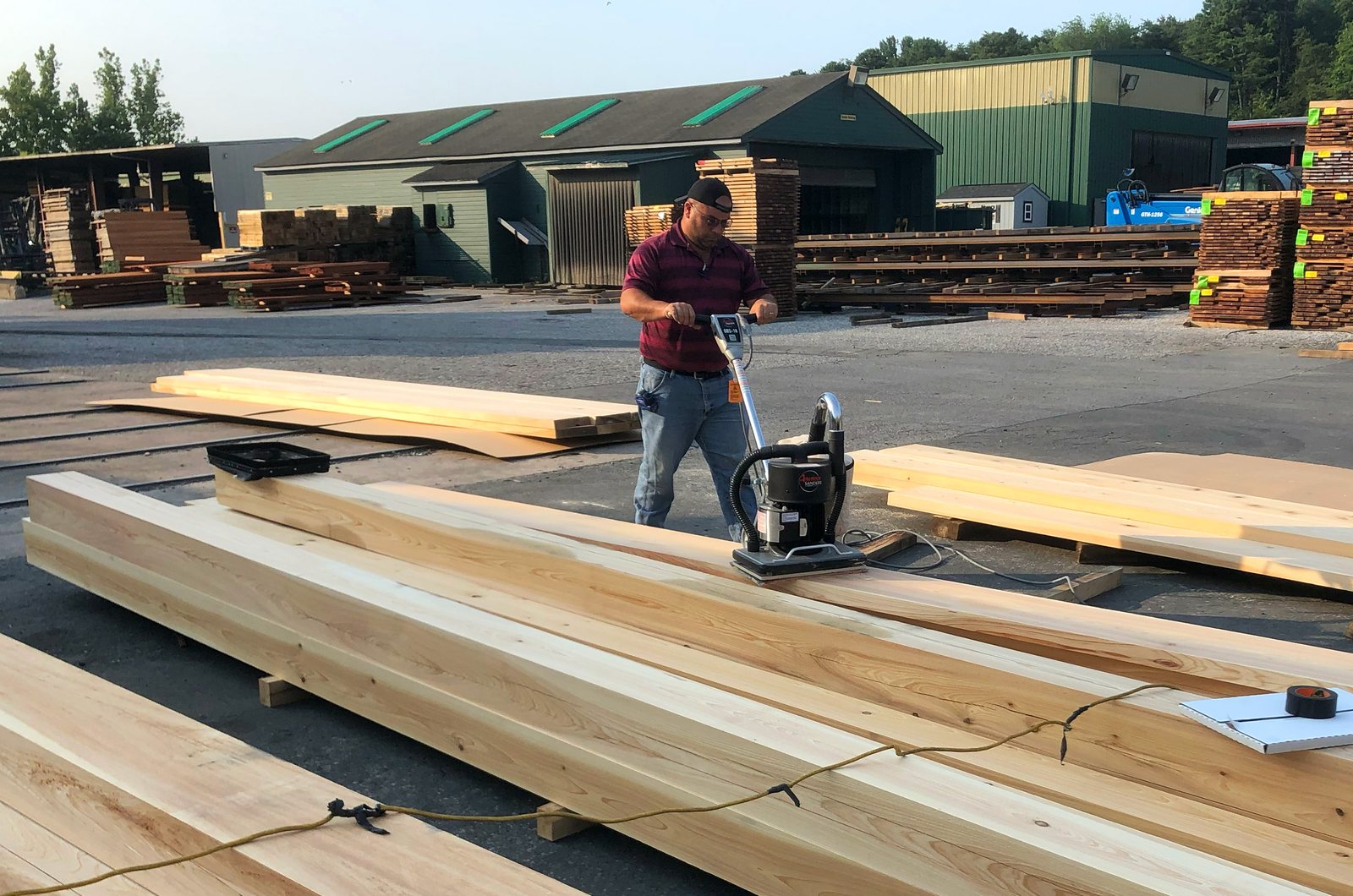
Any teak run longer than the longest clear board in the pile has to be joined, and on clear-finished work the scarf is the only joint that stops reading as a seam. Log length sets the first ceiling. Clear length inside that log sets a lower one, since knots, pin holes and figure breaks interrupt a face long before the board runs out of material. A 40 ft soffit band, a continuous lobby reveal, a 60 ft handrail cap, none of those arrive as one piece.
The real version of this problem is a tally problem, not a joinery problem. Long clear teak exists, but it comes out of particular lifts in limited numbers, and the longer the piece the fewer sit behind it. A run drawn around 20 ft pieces and the same run drawn around 14 ft pieces are two different orders. The second one carries more joints. Settle that before the shop drawing leaves the office.
Butt the pieces instead and the joint announces itself twice over. End grain drinks finish harder than face grain, so a butt line reads as a dark stripe under oil or varnish the moment the first coat goes on. The glue surface is end grain as well, which is the weakest face in the board. Add a little seasonal movement and the line opens.
What a Scarf Joint Actually Is
A scarf is two matching bevels cut on opposing faces so the boards overlap along their length, which turns an end grain butt into a long face grain glue line. Nothing exotic is happening. The joint is a ramp. One piece thins to a feather going one direction, the next thins to a feather going the other, and the two ramps sit on top of each other so the full thickness is carried at every point along the overlap.
Slope is the only real variable. A shallow slope stretches the glue line over more face area and hides the transition better, but it leaves a long thin feather that chips if it is handled roughly or sanded hard. A steep slope cuts faster, survives the truck and the job site, and gives up glue area. Shop practice on trim runs sits at a 45 degree bevel lap, which is easy to cut repeatably on a chop saw and easy for a finish carpenter to tune in the field.
Anything carrying load is a different conversation. A glued scarf in a structural member answers to the adhesive manufacturer's data and to an engineer, not to a trim carpenter's habit, and the slope gets specified rather than assumed. The American Wood Council publishes the standards that govern engineered wood connections, and the USDA Forest Products Laboratory Wood Handbook covers the mechanics of bonded joints in solid wood.
Thickness changes how much the slope matters. Lumber is quoted in quarters of an inch of rough thickness, so 4/4 is nominal 1 inch rough, 8/4 is 2 inches and 16/4 is 4 inches, with surfaced dimensions coming off those rough numbers. A scarf in surfaced 4/4 has very little meat to work with, which is why the slope wants to be shallow there. In 8/4 stock the same 45 degree cut already yields a generous overlap.
Joint Options for a Continuous Run
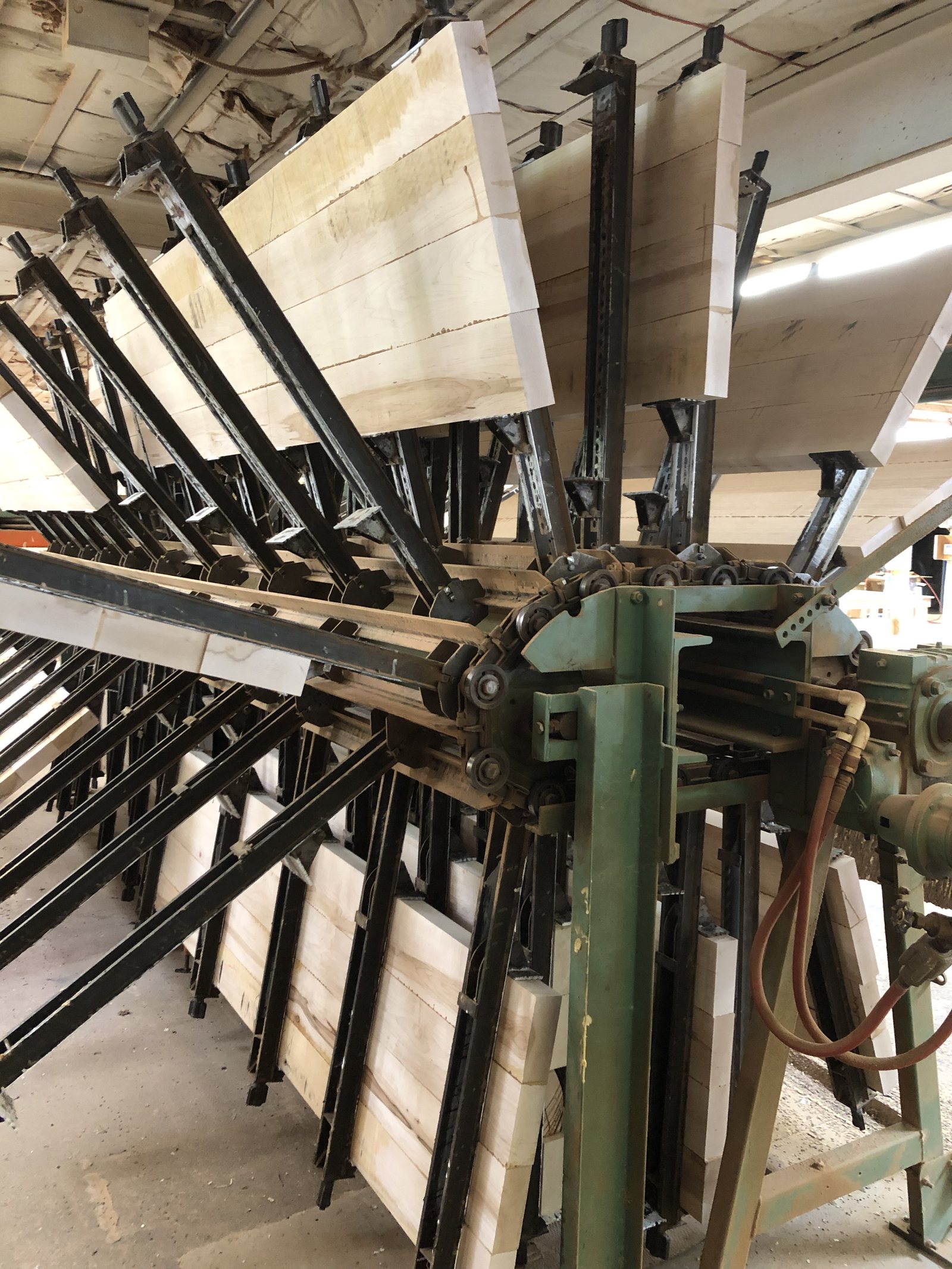
Five lengthwise joints get proposed for long runs and exactly one of them disappears under a clear finish. The deciding question is not strength in the abstract. It is what the eye catches at 6 ft under the light the space actually has, and what the joint does when the two pieces move a little against each other across a heating season.
| Joint | Under a clear finish | Glue surface | Backing needed | Where it belongs |
|---|---|---|---|---|
| Square butt | Visible line, darker than the face, opens with movement | End grain only, weakest option | Solid blocking under the line | Paint-grade work where caulk and filler finish the job |
| Splined butt | Still a visible line, spline edges can telegraph | End grain plus two spline faces | Solid blocking under the line | Paint-grade work needing more alignment than a butt gives |
| Half lap | Two visible lines instead of one | Long face grain, strong | Helpful but not required | Concealed framing and box beam internals |
| Scarf, beveled lap | One fine line that can be lost in grain and shadow | Long face grain along the full overlap | Helpful, needed if the run is unsupported | Clear-finished runs where the joint has to vanish |
| Finger joint | Interlocking pattern reads clearly through clear coats | Large, mechanically interlocked | Not required | Primed and painted trim only, never clear teak |
Finger jointing is the one that fools people. It is strong, it is stable, it is everywhere in painted trim stock, and it is completely wrong here. The interlock shows through any transparent film, and teak's color variation makes it show more rather than less. Clear teak gets a scarf or it gets a visible joint.
Where to Place the Joint So It Disappears
Placement does more to hide a scarf than cutting technique does, and the best location in a long run is almost never the middle. A joint at the midpoint of a wall sits exactly where a person stands, at exactly the height they look. Move it off center and the same joint stops being a focal point.
Start with the backing. A scarf wants solid material behind it, a stud, blocking, a nailer, something that keeps both feather edges in the same plane for the life of the run. Lay the joint locations over the framing plan first and let the framing veto the places that have nothing behind them. On a run with a known stud layout, the joints land where the studs are and the rest of the plan works around that.
Then use the interruptions the room already gives you. A joint set a few inches off a door head casing, a column, a return, a bracket or an inside corner disappears into the visual noise of that detail. The eye arriving at a corner is busy reading the corner. Put the joint in the stretch of blank wall between two features and it has the whole field to itself.
Sight lines finish the job. Walk the approach the way a visitor walks it and mark where the eye lands and where it is traveling. On a stair rail cap, the joint goes low and on the wall side rather than at the landing where people stop and put a hand down. In a corridor, the joint goes near the far end where the run is foreshortened and a 1/64 in line reads as nothing at all.
Orienting the Bevel to Light and Water
A scarf cut the same way twice can be invisible in one orientation and obvious in the other, and the variable is which way the overlap faces. The joint is a lap, so one piece covers and one piece is covered. Which piece covers is a decision, not an accident of how the boards came off the truck.
Indoors, aim the exposed feather edge away from the main approach and away from the dominant light. A lap facing the viewer catches a hairline of light along its edge and draws attention. The same lap facing away puts that edge in its own shadow. Grazing light is what exposes everything here, so check the joint under the fixtures the space will actually have, not under a work light sitting on the floor.
Outdoors the rule is drainage first. The upper piece laps over the lower one so water sheds across the joint the way it sheds across lapped siding, never into an upward facing seam that holds moisture against a glue line. Teak tolerates wet and dry cycling better than most species, but a joint detailed to collect water will still fail before the boards around it. The building enclosure literature at Building Science Corporation is the reference for how water moves across a lapped detail.
Matching Grain and Color Across the Seam
A perfectly cut scarf still shows if the grain changes character across it, which makes board selection part of the joinery. Three things have to carry through the joint. Ring spacing, pore direction and color. Miss any one and the line becomes visible even when the glue line itself is tight.
The cleanest answer is to take both halves of a joint from the same board, cut sequentially, so the grain that ran into the feather on one piece picks up on the other. Where a run needs more length than one board holds, the next best answer is to keep the lift together and work in sequence through it, matching ring spacing across each joint rather than grabbing the next board off the top. Teak runs from honey to a deep brown even within a single tree, and the Wood Database entry for Teak documents that range along with the species' working properties.
Color settles down over time, which helps. Interior teak under a clear finish darkens and evens out as it oxidizes. Exterior teak left bare weathers toward silver gray and the original board to board variation largely disappears. A joint that is slightly mismatched on day one is often gone by year two, which is an argument for accepting a small color step rather than cutting the run into more pieces chasing a perfect match.
Moisture Content and Movement at the Joint
A scarf opens for one of two reasons, a glue failure or two halves that were at different moisture contents when they were joined. The second is more common and it is entirely preventable at the yard. Both halves of every joint come off the same kiln charge, at the same reading, or the run is being set up to fail.
Interior millwork gets milled to an in-service moisture content near 6 to 8 percent. Exterior work runs near 12 to 16 percent. Air dried stock settles near the local equilibrium and is not a substitute where an interior tolerance matters, no matter how long it has been in the shed. Confirm the reading on arrival and let the material sit in the conditioned space before the joints get cut, because a board milled to 7 percent and installed into a building still running a drying load will move after the joint is glued.
Direction of movement is what makes the scarf work. Wood moves across its width and its thickness far more than along its length, and a scarf puts its glue line almost entirely along the grain, so the two halves expand and contract together instead of pulling against each other. For a wide flat run, quartersawn and rift stock moves less across its width than plainsawn, which is why it gets specified where a panelized or painted surface has to stay flat. J. Gibson McIlvain mills both halves of a scarf from the same lift so the grain orientation and the moisture reading carry straight through the joint.
Buying Teak in the Lengths the Run Needs
Long clear lengths are a yield question before they are an availability question, and the grade rules explain exactly why. Hardwood grading in North America runs on the National Hardwood Lumber Association rules, which grade a board by the yield of clear face cuttings rather than by appearance alone. That distinction is the whole story for a continuous run.
FAS is the top grade and requires a minimum board of 6 inches wide by 8 ft long yielding 83 and 1/3 percent clear face cuttings. FAS One Face, F1F, meets FAS on the better face. Selects meet FAS on the better face at a smaller minimum size. No. 1 Common requires 66 and 2/3 percent on a minimum board of 3 inches by 4 ft, and No. 2A Common requires 50 percent. Grade describes yield, not defect. A No. 1 Common board is not damaged goods, it simply yields smaller clear cuttings, which makes it the economical grade for short parts and the wrong grade for long clear runs. Teak is an import and carries no such grade, so a long run order has to state the clear length outright.
Depth is what lets a specifier hold a length. J. Gibson McIlvain holds over seven million board feet of exotic and domestic lumber at its Maryland yard, which is what makes it possible to pull a set of long teak pieces from matched lifts instead of accepting whatever two lengths a single pack happens to contain. J. Gibson McIlvain imports and mills as an FSC certified operation, so sourcing documentation travels with teak that has to satisfy a specification with sourcing requirements. See the J. Gibson McIlvain millwork services page for what comes off the same order as the lumber.
"On a long run the length call has to come before the joinery call. Tell me the longest piece you can get into the building and I will tell you how many joints you are going to have. Do it the other way around and we are cutting good teak into the lengths your truck can handle."
Norm Moton, Director of Sales, J. Gibson McIlvain
Getting a 20 ft piece to the site intact is its own problem. J. Gibson McIlvain delivers on its own fleet of trucks, which is the difference between a long piece arriving straight and a long piece arriving with a set in it from being strapped badly onto common freight. J. Gibson McIlvain ships nationwide, regularly to California, and the length of the run does not change that.
Gluing Teak, and Why the Oil Matters
Teak's natural oils and extractives are the reason a teak scarf gets glued differently than a Sapele or Utile one. The species carries enough oil to interfere with adhesion on a surface that has been sitting around, and enough silica to dull tooling faster than a temperate hardwood will. Both facts change shop sequence rather than making the work harder.
Machine the bevel and glue it the same day. A freshly cut surface bonds. A surface that has oxidized for a week does not bond as well, and no amount of clamp pressure recovers it. Where a wipe with a solvent is part of the shop's routine, it happens immediately before glue up, not the day before. The adhesive manufacturer's data governs the choice and the open time, and that guidance is written for exactly this condition.
Clamping a feather needs cauls. Pressure applied to the thin end of a scarf without a backing block crushes the tip and starves the middle of the glue line, so the joint gets a flat caul across the whole overlap and even pressure along its length. Keep the two halves registered with a dry run first. A scarf that slides under pressure is a scarf that has to be recut.
When Another Material Fits the Run Better
Teak is the right call for a clear-finished exterior run, and it is the wrong call for several jobs that look similar on a drawing. The millwork palette a shop reaches for is Sapele, Iroko, Afrormosia, Teak and Utile, which is sold as Sipo, and each one has a lane.
Paint changes the answer immediately. For painted exterior trim, Sapele is the preferred species over Genuine Mahogany, because it holds paint better and comes in a wider range of sizes and longer lengths, though it is not milled 1x8 for exterior use. Open-grained and oily species absorb a great deal of finish, so a primer coat evens out the eventual painted surface, and sanding or buffing after priming knocks back grain raising while keeping moulded detail crisp. Cupping on an exterior run is driven by installation and back ventilation, not by the species on the order.
Where cedar is on the table, the grade call matters more than the species call. CVG, clear vertical grain, and STK, select tight knot, are two very different products out of the same tree, and a run where every joint has to read as nothing is a CVG conversation. Hardness tells you how the long piece behaves while it is being handled and fastened. Sapele sits around 1,410 lbf on the Janka scale, White Oak around 1,360 lbf, Hard Maple around 1,450 lbf, Red Oak around 1,290 lbf, White Ash around 1,320 lbf, Black Walnut around 1,010 lbf, Cherry around 950 lbf, Genuine Mahogany around 800 lbf and Yellow Poplar around 540 lbf.
Modified wood has a hard length ceiling that a long run runs straight into. Thermory and Abodo Vulcan are both carried, as is Accoya, and all of them top out around 16 ft, most sold on metric lengths just under 16 ft, because of kiln size. Thermally modified Ash is not available wider than 8 inches, so a wide board in a modified product means Accoya or Abodo Vulcan rather than modified Ash. Accoya sits around 1,600 lbf, and acetylation gives it dramatically reduced shrinkage and swelling, which is why it earns a look on a long painted exterior run. Product information on the thermally modified side is published by Thermory.
One thing follows from that length ceiling. Warranties exist on modified products and on nothing else. It is not possible to warranty solid unmodified wood, an organic material responding to its environment, so a solid teak run is specified on grade, moisture content and detailing rather than on a piece of paper.
Exterior decking is the one place the tropical decking species belong in this discussion. Ipe, which is Tabebuia spp, along with Cumaru, Garapa, Jatoba and Red Balau, are extremely hard and carry high oil content, which makes them difficult to glue. A deck cap or a continuous rail that has to be scarfed is better served by Teak, Iroko or Afrormosia, and the decking species stay on the deck where their hardness is the point.
How J. Gibson McIlvain Would Specify This
A long teak run gets specified from the length backward, and the order names the lengths, the grade, the sawing, the moisture content and the joint locations before anyone cuts a bevel. Call out the longest piece that can be handled on site and let the joint count fall out of that number. Name the grade for the yield the run needs rather than defaulting to the top grade for parts that do not require it.
Specify the moisture content for the actual service condition, near 6 to 8 percent for interior work and near 12 to 16 percent for exterior, and require that both halves of every joint come from the same charge at the same reading. Ask for quartersawn or rift where a wide face has to stay flat. Mark the joint locations on the shop drawing against the framing plan, note which piece laps over, and note the direction of the dominant light so the shop and the installer are working from the same intent.
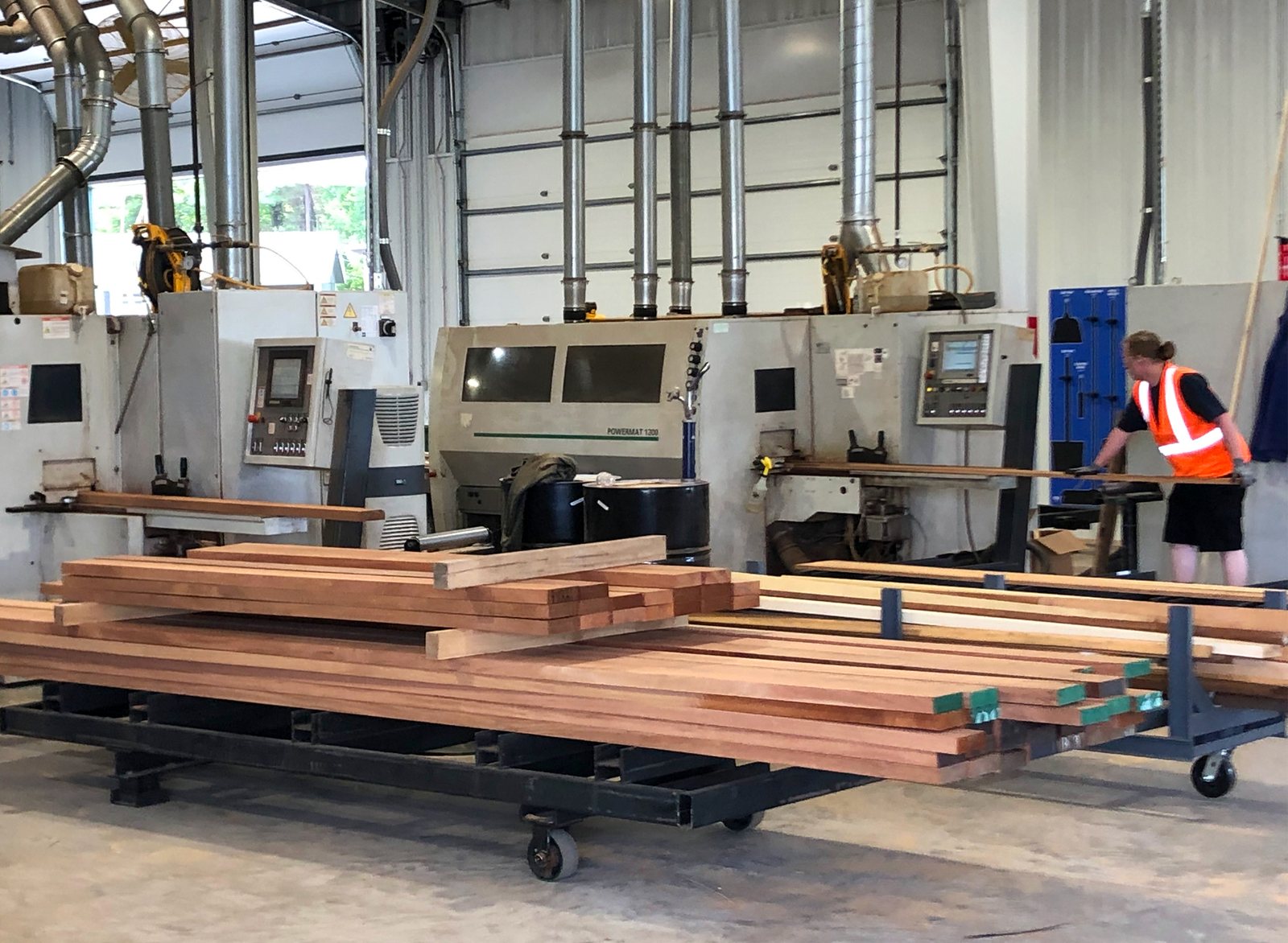
J. Gibson McIlvain grades and tallies the long stock, mills the run on moulders and resaws on the floor, and stages the pieces in sequence so the matched halves stay together from the yard to the site. ICD, the company's architectural millwork division, builds the true custom assemblies that get planned around a specific space, and its work is shown at icdwoodwork.com. Field cutting, fastening and back ventilation of the installed run are the installer's work, and the run is delivered so that work is straightforward.
To spec a long length teak run, call 800-638-9100 and have the longest handleable length, the service condition and the finish schedule ready. For standards background on millwork specification, the Architectural Woodwork Institute and the Wood Moulding and Millwork Producers Association publish the industry references, and the National Park Service Technical Preservation Services briefs cover matching existing runs in historic work.
Frequently Asked Questions
Where in a long teak run should the scarf joint go so nobody notices it?
Off the center of the run, over solid backing, and within a few inches of something the eye is already reading. A stud, blocking or a nailer has to sit behind the joint so both feather edges stay in the same plane. From there, move the joint away from the midpoint of a wall, which is where a person stands at the height they look, and toward a casing, a column, a return, a bracket or an inside corner. On a stair rail cap the joint goes low and on the wall side. In a corridor it goes near the far end, where the run is foreshortened and a hairline reads as nothing.
Which way should the bevel face?
Indoors, point the exposed feather edge away from the main approach and away from the dominant light, so the edge sits in its own shadow instead of catching a hairline of light. Outdoors, drainage decides it. The upper piece laps over the lower one so water sheds across the joint the way it sheds across lapped siding, never into an upward facing seam that traps moisture against the glue line. Check the finished joint under the fixtures the space will actually have, because grazing light exposes what a work light on the floor hides.
Can a long teak run be finger jointed instead of scarfed?
No, not on clear-finished work. Finger joints are strong and stable and they are standard in painted trim stock, but the interlock reads straight through any transparent film. Teak's natural color variation makes the pattern more visible rather than less. A square butt is no better, since end grain takes finish darker than face grain and leaves a dark stripe along the seam. Clear teak gets a scarf or it gets a joint everyone can see.
Does teak's oil cause problems gluing a scarf?
It changes the shop sequence more than it changes the difficulty. Teak carries enough oil and extractives to interfere with adhesion on a surface that has oxidized, and enough silica to dull tooling faster than a temperate hardwood does. Machine the bevel and glue it the same day, keep any solvent wipe immediately ahead of glue up, and follow the adhesive manufacturer's data for the product and open time. Clamp the overlap under a flat caul, since pressure on a bare feather crushes the tip and starves the middle of the glue line.
How long can teak be ordered for a continuous run?
Long clear teak exists, but it comes out of particular lifts in limited numbers, and the longer the piece the fewer sit behind it. The practical limit is usually what can be handled on site and brought into the building rather than what the yard can pull. J. Gibson McIlvain holds over seven million board feet of exotic and domestic lumber at its Maryland yard, which is what makes a matched set of long pieces possible instead of two random lengths from one pack. If the drawing calls for a modified product instead, understand the ceiling. Thermory, Abodo Vulcan and Accoya all top out around 16 ft, most sold on metric lengths just under 16 ft, because of kiln size.
What moisture content should the two halves of a joint be at?
The same one, and it should match the service condition. Interior millwork is milled to an in-service moisture content near 6 to 8 percent and exterior work near 12 to 16 percent. Both halves of every joint should come off the same kiln charge at the same reading, since a scarf that opens usually opens because the two pieces were at different moisture contents when they were glued. Air dried stock settles near the local equilibrium and is not a substitute where an interior tolerance matters.
Will the joint become more visible as the teak ages?
Usually the opposite. Interior teak under a clear finish darkens and evens out as it oxidizes, and exterior teak left bare weathers toward silver gray, which pulls board to board color variation together. A small color step across a joint on day one is often gone within a couple of years. That is an argument for accepting a slight mismatch rather than cutting the run into more pieces chasing a perfect match, since every extra piece is another joint.
Is solid teak covered by a warranty on a long exterior run?
No. Warranties exist on modified products and on nothing else. It is not possible to warranty solid unmodified wood, which is an organic material responding to its environment. A solid teak run is specified on grade, sawing, moisture content and detailing instead, and that specification is what protects the job. Cupping on an exterior run is driven by installation and back ventilation rather than by the species on the order.
Sources and Standards Referenced
- USDA Forest Products Laboratory
- National Hardwood Lumber Association
- American Wood Council Codes and Standards
- The Wood Database, Teak
- Building Science Corporation
- Architectural Woodwork Institute
- Wood Moulding and Millwork Producers Association
- National Park Service Technical Preservation Services
- Accoya
- Thermory