The Species Call for a Wet, Low Deck
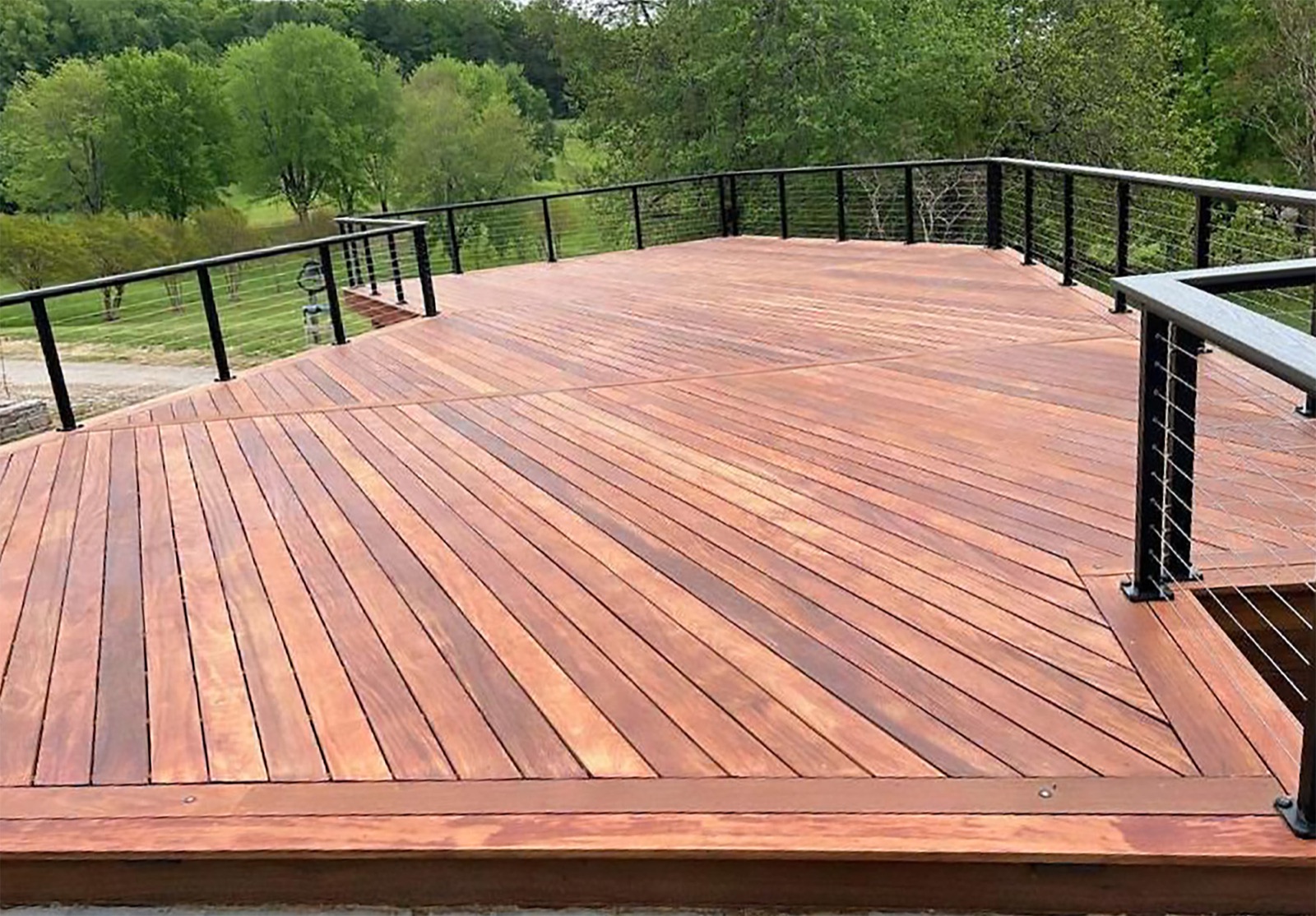
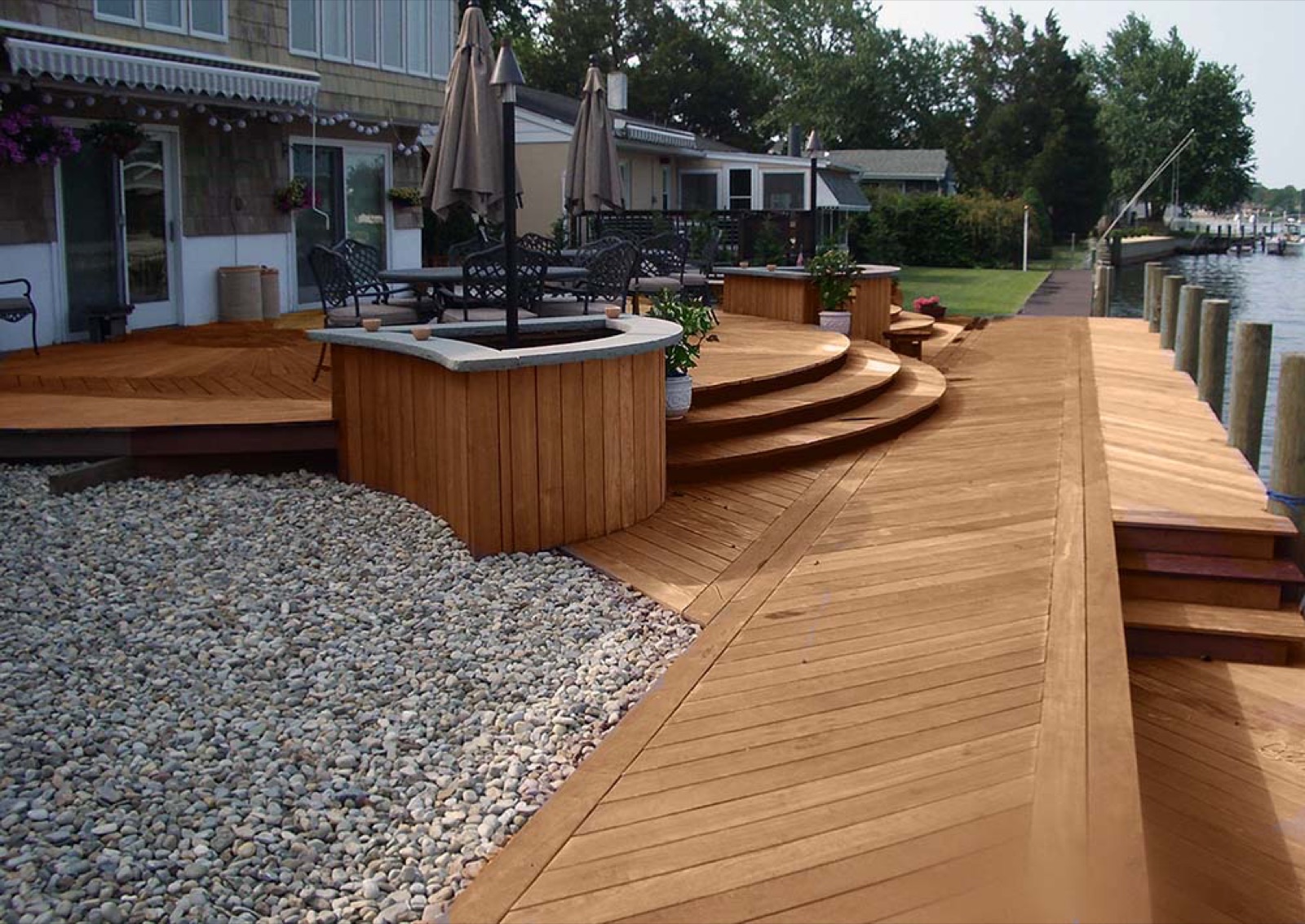
Ipe is the best tropical decking species for a ground level deck in a heavy rainfall region, with Cumaru a close second and Jatoba the third proven option where 2x thickness governs. That answer holds for a reason most species charts never touch. A deck sitting inches above wet soil lives in a different environment than the same boards on a second-story frame, and the species that wins is the one that tolerates staying damp with almost no airflow underneath it. Ipe (Tabebuia spp.) tests at roughly 3,680 lbf on the Janka scale, carries a density near 1,050 kg/m3, and earns EN 350 Class 1 durability, the highest natural decay rating a wood can hold. The Wood Database entry for Ipe confirms what decades of boardwalk service records show. It shrugs off fungal attack in conditions that destroy pressure-treated pine in a decade.
This article works through the problem from the ground up. Literally. It covers the microclimate under a low deck, what rainfall load does to the definition of durable, how density changes drying behavior, which species survive commercial spec filters, and the detailing that decides whether any of it matters. J. Gibson McIlvain mills and ships tropical decking nationwide, so the guidance here reflects material that actually arrives on jobs from Maryland to California.
The Air Under a Low Deck Stays Wet Long After the Rain Stops
A ground level deck in a heavy rainfall region traps a humid microclimate beneath the boards, and that trapped moisture, not the rain itself, is what kills marginal species. Rain that lands on an elevated deck drains through the gaps and blows dry within hours. Rain that lands on a deck eight inches off grade drains into a shaded, windless cavity where relative humidity sits near saturation for days. Add vapor rising from wet soil and splash-back off the ground at every board gap, and the underside of the decking spends much of the year wetter than the top ever gets.
Building physics researchers describe this as a vapor drive problem, and the principles that govern wall assemblies apply under a deck too. The Building Science Corporation body of work on moisture transport makes the core point plainly. Assemblies survive by their ability to dry, not by their ability to stay dry. A low deck has almost no drying capacity on its underside, so the wood itself has to carry the load. That is the real reason species selection tightens at grade. A board that performs at 30 inches of clearance can fail at six, since the six-inch deck asks the wood to resist decay while wet for weeks at a stretch.
Heavy Rainfall Redefines What Durable Means
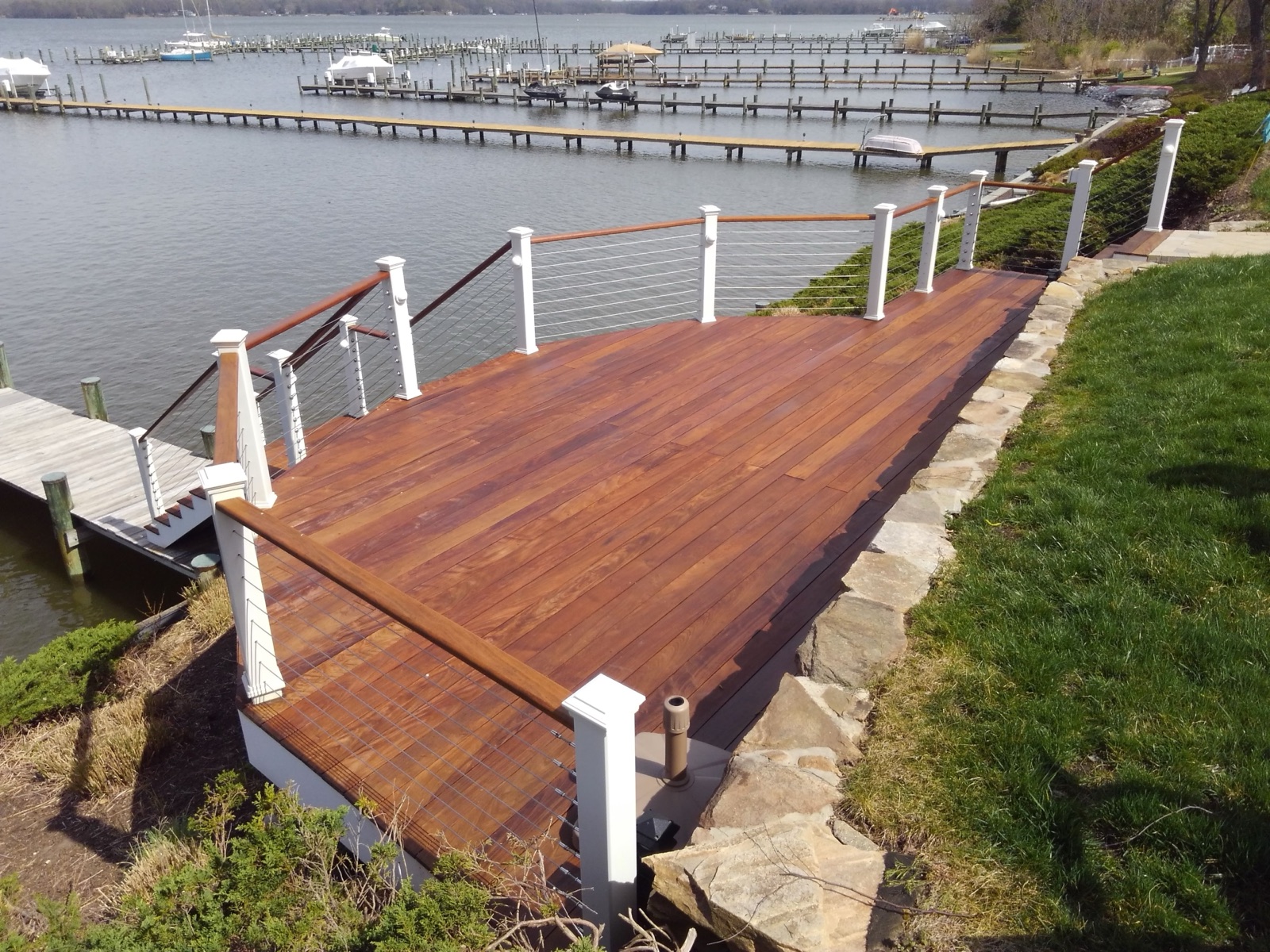
In a high-rainfall region the only durability that counts is resistance to decay fungi during long wet spells, and that is a chemistry property, not a hardness property. Janka numbers measure dent resistance. Decay resistance comes from extractives, the natural compounds loaded into the heartwood of certain tropical species that make the wood inedible to fungi. Teak proves the distinction. It tests at only about 1,070 lbf, softer than many domestic species, yet its oily extractives made it the standard for ship decks. Ipe and Cumaru happen to combine both traits, extreme hardness and Class 1 decay resistance, which is why they dominate wet-climate decking.
The USDA Forest Products Laboratory publishes the decay resistance research behind these ratings, including the soil-block testing that underpins natural durability classes. Pay attention to what those tests simulate. Wood in ground-proximate, persistently damp service. That is precisely the condition of a ground level deck in rain country, which makes the lab data unusually relevant here. A species rated moderately durable can serve well on a breezy elevated deck. At grade, under heavy rainfall, specify from the top durability class and treat everything below it as a compromise you must engineer around.
Density Slows Wetting and Slows Drying in Equal Measure
Dense tropical hardwoods absorb water slowly, which protects them in the rain, but they also release it slowly, which makes acclimation and gapping decisions matter more than they do with lighter woods. A board at 1,050 kg/m3 has very little void space. Liquid water struggles to penetrate the face grain, so a week of storms raises the moisture content of an Ipe deck far less than it would a softwood deck. End grain is the exception. Water wicks into board ends many times faster than into faces, which is why end sealing every field cut is standard practice on tropical decks.
The same density works against you during dry spells. A board that soaked up moisture over a wet month gives it back slowly, and the surface dries ahead of the core. That differential drives cupping and surface stress. The defense is to start at the right moisture content and detail for movement. Exterior tropical decking should arrive at 12 to 16 percent moisture content, matching its in-service equilibrium in most humid climates, then acclimate on site on stickers under cover before installation. Side gaps of about a quarter inch give each board room to swell across a wet season without buckling against its neighbor.
Rating the Candidates for Low-Clearance, High-Rainfall Service
Six tropical species show up in wet-climate decking conversations, and their behavior in a damp, low-airflow cavity separates them faster than their Janka numbers do. The table below rates each one on the axes that decide a ground level job in rain country.
| Species | Janka (lbf) | Density (kg/m3) | EN 350 durability | Behavior in a damp, low-airflow cavity | 2x availability | Best fit at grade |
|---|---|---|---|---|---|---|
| Ipe (Tabebuia spp.) | ~3,680 | ~1,050 | Class 1 | Exceptional; stays stable and decay-free through prolonged wet spells | Consistent, all dimensions | Every application, residential through public boardwalk |
| Cumaru | ~3,540 | ~1,070 | Class 1 | Excellent decay resistance; interlocked grain demands correct acclimation | Consistent | Residential and commercial decks where Ipe is not selected |
| Jatoba | ~2,690 | ~910 | Class 1-2 | Strong performer with slightly more seasonal movement than Ipe | Consistent | Commercial 2x work and red-toned residential decks |
| Red Balau | ~1,700-2,000 | ~850 | Class 2 | Good with generous ventilation; needs disciplined drainage detailing | Not consistent | Residential 5/4 decks with engineered airflow |
| Garapa | ~1,700 | ~830 | Class 2 | Serviceable when kept draining; lighter color shows mildew staining sooner | Not consistent | Residential 5/4 decks, light golden aesthetic |
| Massaranduba (comparison only) | ~3,190 | ~1,150 | Class 1 | Dense and durable but prone to pronounced checking in wet-dry cycling | Inconsistent | Uncommon in North American spec work |
Massaranduba appears for comparison because buyers ask about it. Its density exceeds Ipe, yet its reputation for aggressive surface checking under wet-dry cycling keeps it out of most North American specifications, and J. Gibson McIlvain does not stock it.
The 2x Rule Sorts Commercial Candidates from Residential Ones
Commercial boardwalk, pier, and plaza decks are specified at 2x thickness to control deflection, and that single requirement filters the species list down to Ipe, Cumaru, and Jatoba. The math on a 5/4 board can pencil out for strength on paper. No professional goes first with the thinner board on a public job, and the engineers reviewing municipal work in wet regions will not stamp it. The 2x standard exists because public decks see point loads, maintenance carts, and decades of traffic that residential decks never face, and a heavy-rainfall site adds saturated-wood loading on top of all of it.
Only Ipe, Cumaru, and Jatoba can be sourced consistently in 2x decking thickness. Red Balau and Garapa cannot, which removes them from commercial consideration regardless of how a given span table treats them. This is a supply reality as much as an engineering one, and fighting it mid-project stalls jobs.
When a municipality calls about a boardwalk sitting a foot off wet grade, I stop the species conversation until we settle thickness. If the public walks on it, it is 2x, and 2x means Ipe, Cumaru, or Jatoba. I have never heard an engineer regret specifying the heavier board.
Norm Moton, Director of Sales, J. Gibson McIlvain
Red Balau and Garapa both belong in residential and engineer-approved 5/4 work, where they deliver genuine tropical durability while costing less than Ipe. Neither is a downgrade in the way buyers sometimes fear. Red Balau brings a consistent red-brown color and around 1,700 to 2,000 lbf of hardness, more than enough for foot traffic and furniture. Garapa runs golden to honey-toned and weathers to a handsome silver-gray if left uncoated. Both carry EN 350 Class 2 durability, one step below the Ipe and Cumaru tier but still far above domestic softwoods.
At grade in a heavy rainfall region, that one step matters. Class 2 species handle wet service well when the cavity beneath them drains and breathes. They punish decks built over flat, muddy ground with no ventilation path. Choose them for a low residential deck only when the design includes real drainage grade and cross-ventilation, and be honest with the homeowner that the lighter Garapa surface will show mildew shadowing sooner in a climate that stays damp. On elevated residential decks in the same region, both species perform with a much wider margin.
Rain Does Not Cause Checking, Sun After Rain Does
Surface checking in dense tropical decking cannot be prevented, only kept small, and buyers in rainy regions need to hear that before the first board goes down. Checking is the wood's natural tension release. After a storm system clears, sun hits the deck surface, the top fibers heat and dry faster than the core, and the surface relieves that stress in fine checks. This does not weaken the board. Small surface checks are normal in Ipe and Cumaru, and their presence is a sign of properly seasoned dense hardwood doing what dense hardwood does.
The meaningful mitigation happens before shipment. J. Gibson McIlvain factory coats its tropical decking with Cutek, a penetrating oil wood stabilizer that soaks into the board rather than filming over it, and that treatment significantly reduces checking by slowing the surface moisture swings that open checks in the first place. Site practice keeps checks small from there. Verify moisture content at delivery, seal every field-cut end the day it is cut, and keep air moving under the deck so the underside tracks the topside. None of that eliminates checking. Anyone promising a check-free dense hardwood deck in a climate that alternates downpours with hot sun is selling something wood cannot do.
Drainage and Ventilation Decide Whether the Species Choice Matters
The best species on the list will fail over a flat, sealed, waterlogged cavity, so the substructure spec deserves as much attention as the wood spec. Start with the ground. Strip organic soil, grade the surface to fall away from the structure, and cap it with a vapor retarder under several inches of compacted gravel so rainwater passing through the board gaps drains out instead of ponding. The decking then goes on furring strips or joists, never in ground contact, with joists at 16 inches on center for dense hardwood decking. Openings at the deck perimeter must let air cross the cavity. Skirting that seals the deck edge tight to grade turns the whole assembly into a decay chamber.
Profile and fastening follow fixed rules. Boards milled with drainage grooves get installed grooves facing down, so the relief channels shed moisture instead of holding it. Shiplap profiles take visible fasteners. Only tongue and groove works with hidden fasteners, and tongue and groove belongs on covered or well-drained applications, not on a puddle-prone slab. For fasteners in a wet region, and anywhere near salt, specify 316 stainless steel screws.
Drilling is site work, full stop. Decking does not ship pre-drilled, because layout and field cuts change against the frame as built and would strand any factory hole pattern in the wrong place. On site, pilot every hole, run two fasteners per board at every joist, hold about three-quarters of an inch of edge distance, drill full pilots near board ends where splitting risk peaks, land butt joints on doubled bearing, and use a self-centering combination bit to keep the countersinks uniform.
Codes and Accessibility Add Their Own Wet-Weather Requirements at Grade
Ground level decks in public and commercial settings must satisfy accessibility and fire requirements that quietly favor dense tropical hardwoods. The U.S. Access Board's guidance on floor and ground surfaces caps surface openings at one half inch and limits changes in level, which constrains board gapping and demands decking that stays flat through wet-dry cycles. A species that cups or moves aggressively can drift out of compliance seasons after it passed inspection. Cross slopes on accessible routes are limited as well, so the drainage plan has to work within tight geometry rather than relying on steep pitch.
Fire performance enters the spec on many commercial and wildland-interface projects. Ipe achieves a Class A flame spread rating under ASTM E84, meaning a flame-spread index of 25 or less, the same class as concrete, without any chemical treatment. Structural design of the supporting frame falls under the codes and standards maintained by the American Wood Council, and jurisdictions enforcing the International Building Code through the International Code Council will want stamped load documentation on any public boardwalk. A dense Class 1 species in 2x thickness makes each of these conversations shorter.
Sourcing and Documentation Carry Real Weight on Tropical Species
A wet-climate deck spec is only as good as the paper trail behind the wood, and tropical decking now carries documentation requirements that a serious supplier handles as routine. Several tropical species appear on the appendices maintained under CITES, and when using a CITES-listed species, documentation is required to move material legally across borders. Lacey Act declarations apply to imported wood as well. Buyers should expect their supplier to produce species, origin, and permit records without being chased for them.
Chain-of-custody certification adds another layer for projects chasing green building credits. The Forest Stewardship Council certifies responsibly managed forests and the supply chains that move their timber, and FSC-certified tropical decking can contribute toward credits under USGBC LEED rating systems. J. Gibson McIlvain is FSC certified and imports its tropical decking directly, which means the compliance records live in the same building as the inventory. On the supply side, its Ipe position is vast, covering every standard and custom dimension, so a commercial job needing long 2x6 and a residential job needing 5/4x6 draw from the same deep stock rather than a broker's spot market.
How J. Gibson McIlvain Would Specify This
For a ground level deck in a heavy rainfall region, the working spec starts with Ipe and adjusts by project class, never by wishful thinking about drainage. J. Gibson McIlvain stocks Ipe decking in every standard and custom dimension and ships it nationwide, with regular freight into California, alongside Cumaru, Jatoba, Garapa, and Red Balau.
For a public or commercial deck at grade, specify 2x6 Ipe, smooth face, factory coated with Cutek, over a graded and graveled cavity with engineered cross-ventilation. Cumaru or Jatoba substitute where the owner accepts their color and movement profiles. For a residential low deck, 5/4x6 Ipe is the default, with Garapa or Red Balau as engineer-approved alternatives when the design delivers real airflow beneath the boards. In every case, call out 12 to 16 percent moisture content at delivery, on-site acclimation, end sealing of field cuts, quarter-inch side gaps, joists at 16 inches on center, 316 stainless fasteners, visible fastening on shiplap or grooved profiles installed grooves down, and site drilling with piloted holes throughout.
Homeowners who want a modified-wood surface near grade can also look at thermally treated Thermory and Abodo Vulcan, or acetylated Accoya, which carry manufacturer warranties and suit many wet climates, with the caveat that modified stock tops out around 16 feet because of kiln size. Send the deck drawings to the J. Gibson McIlvain sales team or call 800-638-9100, and they will spec the package board by board before the framing goes in.
Frequently Asked Questions
Should I put a vapor barrier and gravel under a ground level deck in a heavy rainfall region?
Yes. Strip the organic topsoil, grade the ground so water falls away from the structure, lay a vapor retarder, and cap it with several inches of compacted gravel. The barrier stops soil vapor from loading the cavity with humidity, and the gravel gives rain that passes through the board gaps a drainage path instead of a puddle. Skipping this step is the most common reason low decks in wet climates grow mildew on the board undersides within the first year.
Is surface checking on Ipe or Cumaru decking in a rainy climate a defect?
No. Small surface checks are the wood relieving tension as sun dries the board face faster than the core after rain, and they do not weaken the board. Checking in dense tropical decking cannot be prevented, only kept small. J. Gibson McIlvain factory coats its tropical decking with Cutek, a penetrating oil stabilizer that significantly reduces checking, and end sealing field cuts plus good under-deck ventilation keeps checks minor from there.
Can I install tropical decking over a concrete patio using sleepers?
Yes, and it is a common way to build a ground level deck in a wet region. Fasten furring strips or sleepers to the slab, shim them to create drainage fall, and make sure water can exit at the low edge rather than ponding under the boards. Keep the decking itself out of ground and slab contact, leave perimeter openings for cross-ventilation, and use visible fasteners on shiplap or grooved profiles with any drainage grooves facing down.
Massaranduba is denser than Ipe, so why is it not recommended for a wet-climate deck?
Density is not the deciding trait. Massaranduba carries strong decay resistance on paper, but it has a reputation for pronounced surface checking under the wet-dry cycling a rainy climate delivers, and it is not consistently available in the 2x thickness commercial work requires. Ipe and Cumaru give equal or better durability with far better behavior in service, which is why they dominate North American specifications. J. Gibson McIlvain does not stock Massaranduba.
What fasteners should I use, and can the boards come pre-drilled from the mill?
Use 316 stainless steel screws in wet regions and anywhere near salt exposure. Boards do not ship pre-drilled, because drilling is installation work done against the frame as built. Layout shifts and field cuts would put any factory hole pattern in the wrong place. On site, pilot every hole, run two fasteners per board at each joist, keep about three-quarters of an inch of edge distance, drill full pilots near board ends, and land butt joints on doubled bearing.
Does Ipe need to be re-oiled every year in a heavy rainfall climate?
Only if you want to hold the brown color. Left alone, Ipe weathers to an even silver-gray and keeps its full decay resistance, since the protection comes from the heartwood extractives rather than the finish. If the owner prefers the oiled look, refresh the penetrating oil when the color starts to fade, which in a high-rainfall, high-sun climate tends to come around annually on exposed decks. Clean the surface first so the oil penetrates.