Where a Panel Wall Gets Decided
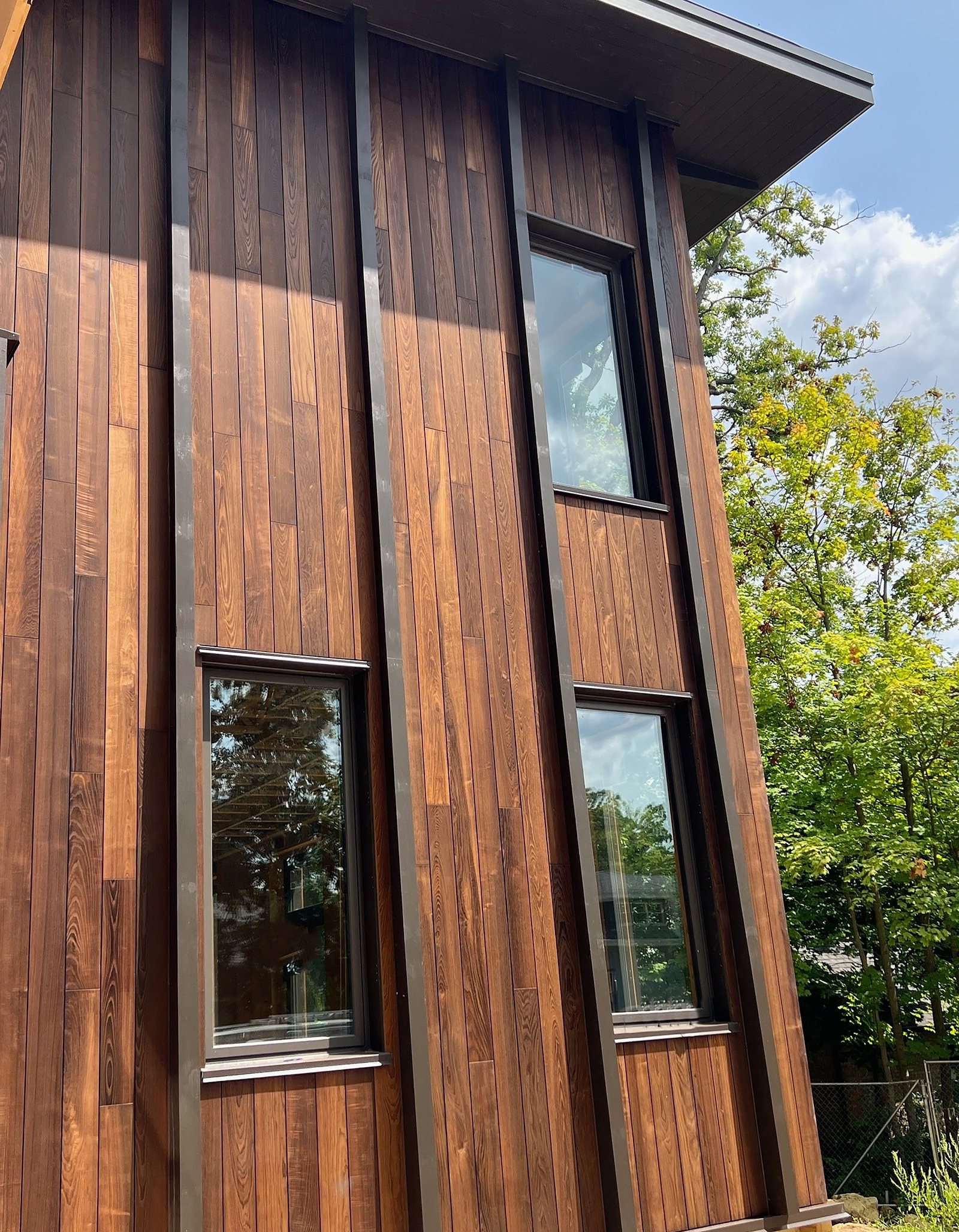
A hardwood panel wall is laid out around its interruptions before anyone picks grain or finish. The elevation on the drawing shows an even rhythm of stiles, rails and panels. The wall in the room has four duplex outlets, a return air opening, a thermostat, a television mount and a door that lands 3 inches off the panel module. Each one moves the layout. Plot them first and the wall reads the way it was drawn.
True custom panel work comes out of ICD, the architectural millwork division of J. Gibson McIlvain. ICD builds millwork planned around one specific space rather than assembled from standard sizes, which is what a wall full of penetrations actually needs. A catalog panel system forces the interruptions into whatever module the catalog sells. A shop drawing set for a single wall puts the module where the interruptions already are.
So the first working document is not a species list. It is a dimensioned elevation carrying every device, register, mount and rough opening, pulled from the electrical and mechanical sheets and checked against what is framed in the wall. The Architectural Woodwork Institute quality standards cover the joinery and the grade of the panel itself, and they assume the field conditions have been resolved somewhere. On a panel wall, that somewhere is the shop drawing.
| Interruption | Effect on panel layout | What ships from the shop | Handled by another trade |
|---|---|---|---|
| Duplex outlets and switches | Pulls a stile or rail onto the device centerline, or centers the device in a flat panel | Panel with the opening machined and edges sealed | Listed box extender, device and plate set by the electrician |
| Return air opening | Sets a dedicated panel bay sized to the net free area the mechanical drawing calls for | Hardwood surround and casing milled to the rough opening | Grille or register face supplied and set by the mechanical contractor |
| Thermostat and keypads | Ganged into one flat field so the devices share a single reveal line | Blank panel or flat backer, machined for the plate footprint | Low voltage rough-in and plate alignment |
| Television mount | Fixes a solid rail or backer behind the panel at mount height | Matched panel section over solid blocking, grain continued across | Framing blocking, cable path and the mount itself |
| Access to a valve or junction box | Moves the nearest seam onto a reveal so the removable section reads as part of the field | Removable panel cut from the same flitch, profile continued | Fastening method chosen by the installer |
| Door opening and casing | Compresses or widens the adjacent stile so the casing does not collide with a panel edge | Custom door, jamb and casing milled to one profile family | Hanging, shimming and hardware |
| Sconce or picture light | Centers a junction box on a rail rather than a panel field | Machined rail with a flat mounting face | Fixture, canopy and wiring |
| Base, cap and ceiling line | Absorbs out of level floors and ceilings in the scribe, not in the panel | Linear trim run to matching profiles with scribe allowance left on | Scribing and fastening in the field |
Setting the Grid Around Outlets and Switches
An outlet belongs on a stile or rail centerline whenever the wall will allow it, and centered in the panel field when it will not. Those are the two clean answers. A device box that lands half on a stile and half on a raised panel is the condition that ruins a wall, because the plate then bridges a step in the surface and never sits flat. Catch it on the elevation and the fix costs nothing.
Device height is not fully open to design. Operable parts in accessible spaces fall inside the reach ranges set out in the ADA Standards for Accessible Design, which means the rail heights in a panelized commercial wall have to be checked against the device schedule rather than picked purely for proportion. ICD sets rail centerlines against the device schedule during shop drawings so the two grids agree before any stock is machined.
Adding a hardwood panel over existing drywall sets the device box back from the new finished face. The electrician handles that with a listed box extender, a detail governed by the National Electrical Code published by the National Fire Protection Association. J. Gibson McIlvain supplies and mills the panel package. It does not install, and it does not set devices, so the panel thickness gets published on the shop drawing early enough for the electrician to order the right extender depth.
Machining matters at the opening itself. A cutout milled in the shop has a square, clean edge that the plate covers completely. A hole cut on site with a rotary tool in a hardwood face grain tends to chip on the exit side, and on a quartersawn panel it can lift a ray fleck right where the plate ends.
Return Air Openings and the Honest Limit
A panel wall can frame a return beautifully, but the grille itself is a mechanical product and comes from the mechanical contractor. This is worth saying plainly, because a lot of millwork marketing implies otherwise. J. Gibson McIlvain and ICD do not manufacture HVAC grilles, registers or radiator covers. What ships is the panel field around the opening and the hardwood surround that makes the opening look intentional.
That still takes coordination. The return has a required net free area, and the mechanical drawings and the applicable mechanical code adopted from the International Code Council set it. Trimming an opening down to make a panel bay look symmetrical can choke the return and put a whistle in the system. The usable move is the opposite one, which is to size a full panel bay to the opening and let the surrounding bays absorb the difference.
"The jobs that go sideways are almost never about the wood. They are about a return that moved 8 inches after the shop drawings were approved, and nobody told us until the panels were already machined. We would rather hold the release for a week and get the mechanical layout confirmed than ship a wall that has to be cut open."
Norm Moton, Director of Sales, J. Gibson McIlvain
Thermostats, Keypads and the Low Voltage Cluster
Low voltage devices should be ganged into one flat field rather than scattered across a panel elevation. A thermostat, a lighting keypad, a shade controller and an intercom plate spread over three panel bays reads as clutter no matter how good the millwork is. Collected into one vertical band, they read as a deliberate control station.
The band wants to be flat stock, not a raised panel. Every controller plate has its own footprint and its own mounting bracket, and a flat field lets all of them sit tight without the plate riding up on a panel bevel. ICD machines that band as a separate component so it can be fitted late, which helps when the control package changes after the millwork is released.
Alignment is the detail people notice. Device centerlines that match a rail centerline look correct even to someone who could not say why. Centerlines that miss by half an inch look like a mistake. Both cost the same to build.
Access Panels, Mounts and Removable Sections
Anything behind the wall that will need service again should get a removable panel designed into the field, not a hole cut later. Shutoff valves, junction boxes, low voltage distribution and the back of a television mount all fall in this group. The rule of thumb is simple enough. If a plumber or an electrician will ever need to reach it, the wall should already have a way in.
A removable section works when its seams land on reveals that the layout already has. Continue the profile across the joint, cut the removable piece from the same flitch, and the eye follows the grain past the seam without registering it. Cut the same piece out of a different board and it announces itself in every raking light.
Television mounts need solid material behind the panel, not a cavity. A cantilevered arm puts real load on a few fasteners, and drywall with a panel glued over it will not hold it. ICD builds a solid rail or a laminated backer into the panel assembly at mount height, and the framing blocking behind it is the general contractor's scope.
Where Panel Walls Meet Doors and Casing
A door opening is the interruption most likely to break the panel module, and it is also the easiest one to fix in the drawing. Doors land where circulation puts them. The panel module is arbitrary by comparison. Adjusting the stile widths on either side of the opening by a small amount, spread across two or three bays, hides the whole problem.
The better outcome is a door that belongs to the wall. ICD builds custom doors with stile and rail proportions taken from the panel elevation, so the door reads as a panel that opens rather than as a separate product set into a hole. Matching jamb and casing come off the same order and the same profile family.
Profile matching is where the knife library earns its keep. J. Gibson McIlvain holds thousands of ground moulding knives and grinds new ones every week, so a panel wall's bolection, cap or backband can be matched to trim that already exists in the building rather than approximated with the closest stock profile. Where nothing on file matches, a knife gets ground to the traced section, including historical work where a district requires like for like replacement. The National Park Service Preservation Briefs set the expectation for that kind of matching in a landmarked interior.
Running trim around the rest of the room comes off the same package. J. Gibson McIlvain mills linear trimwork, casing and finished cladding through the millwork shop on site at the lumber yard, while the true custom panel assemblies come from the architectural millwork house off site. One order, one species lot, two shops.
Radius Walls and Panels That Curve
Every interruption gets harder on a curved wall, because a device plate is flat and the wall is not. A duplex plate on a tight radius will rock on its corners. The fix is a flat mounting pad machined into the curved panel, sized so the plate lands fully on a flat surface and the transition falls under the plate edge.
Curved rails and curved panel fields are built, not bent on site. Coopered and laminated construction both work, and the choice follows the radius, the species and whether the face will be painted or left clear. ICD mills radius trimwork and radius millwork to the actual plan radius taken from the field, which is why the template or the confirmed dimension matters more here than anywhere else in the job.
Returns and reveals on a radius also need more room. A reveal that reads as a crisp shadow line on a flat wall closes up visually as the surface turns away from the viewer, so the reveal usually grows slightly on a curve to hold the same apparent line.
Species, Grain and Movement at a Cut Edge
The species that make good panel walls are a much shorter list than the species a lumber yard carries. A panel wall gets glued, machined, coated and cut into, and those four operations rule out a lot of wood that looks wonderful on a sample. For milled and glued millwork the working palette is Sapele, Utile, Iroko, Afrormosia and Teak on the imported side, with White Oak, Walnut, Cherry and Hard Maple carrying most domestic work.
Hardness tells you how an edge survives a cutout and a lifetime of vacuum cleaners. Sapele runs roughly 1,410 lbf on the Janka scale, Hard Maple roughly 1,450 lbf, White Oak roughly 1,360 lbf, Cherry roughly 950 lbf and Genuine Mahogany roughly 800 lbf. Softer species take a beautiful profile and mark more easily at a device opening, which is a reason to keep outlets off a Cherry panel field and on a rail where a plate covers the arris.
The tropical decking species sit outside this conversation on purpose. Ipe, botanically Tabebuia spp, along with Cumaru, Garapa, Jatoba and Red Balau, are extremely hard and carry high oil content, which makes them difficult to glue. A millwork shop reaches for Sapele, Iroko, Afrormosia, Teak or Utile instead, because those machine cleanly, hold glue and take a coating without a fight.
Grain orientation does more work than species selection on a panel wall. Quartersawn and rift stock moves less across its width than plainsawn, which is the reason a panelized surface that has to stay flat gets specified that way. The shrinkage behavior behind that is documented in the Forest Products Laboratory Wood Handbook chapter on physical properties, and the numbers are not small. Species character is easy to read in the Wood Database entry for Sapele and its Iroko counterpart, both of which quartersaw into the ribbon figure clients ask for by name.
Moisture content is the part nobody sees until it fails. J. Gibson McIlvain mills interior millwork to an in service moisture content near 6 to 8 percent, and exterior work near 12 to 16 percent, which is the difference between a panel seam that stays tight in February and one that opens. The Wood Handbook chapter on drying and control of moisture explains the equilibrium the wood is chasing. A wall with a return air opening in it is also a wall with air moving across it, so the interior humidity story matters more there than on a blank wall, a point worth reading alongside Building Science Corporation on vapor control. Where a species is CITES listed, documentation and chain of custody travel with the material.
Priming and the Finish Around an Opening
A painted panel wall needs its primer specified as carefully as its species, and every cut edge needs sealing before the wall closes up. Paint failure on millwork almost always starts at an unsealed edge, and a wall full of device openings has a great many edges.
J. Gibson McIlvain primes millwork in three levels, in both oil based and water based systems, and exterior primed trim carries a fungicide additive. Open-grained and oily species absorb a great deal of finish, so a primer coat evens out the eventual painted surface, and sanding or buffing after priming knocks back grain raising while keeping moulded detail crisp. Iroko and Teak sit at the oily end of that range and behave accordingly.
Field cuts are the installer's responsibility and they should be planned for. Any opening enlarged on site, any scribe taken at a ceiling and any trimmed panel edge wants primer or sealer on the fresh wood before the trim goes over it. Sending a small quantity of the same primer to the site with the package is the cheapest insurance on the job.
For clear finished work the sequence runs the other way. Sanding sealer and topcoat on a machined panel before it ships gives a better film in a controlled shop than a sprayer can get in an occupied building, and the interruptions then get fitted into an already finished field rather than finished around.
Building, Storing and Shipping the Package
A panel wall arrives as a sequenced package, not as a pile of parts. Panels, stiles, rails, cap, base, the door and the control band all carry the same species lot and the same finish schedule, and they are labeled against the elevation so the installer works from the drawing rather than from guesswork.
J. Gibson McIlvain ships on its own fleet of trucks, and a section of the mill is dedicated to packaging, which is the part that protects a finished panel face from a strap mark or a corner hit in transit. Deliveries run nationwide, regularly to California, and a wall that ships as one protected unit is a wall that does not need touch up work on arrival.
Timing is its own problem on a panel job. The mechanical and electrical rough-in has to be complete and verified before panels are machined, and the finish trades want the wall late. J. Gibson McIlvain stores finished millwork for inventory control, so a package can be built when the lot is right and released when the site is ready, which is a normal request on a phased fit-out or a multi floor building.
How J. Gibson McIlvain Would Specify This
Specify the interruptions first, the module second and the species third, and the wall will build itself. Start with a dimensioned elevation carrying every device, return, mount and opening confirmed against the field, not against the design drawings from six months ago. That single sheet resolves most of what goes wrong on panel walls.
Put outlets and switches on a rail or stile centerline, or dead center in a flat panel, and publish the finished panel thickness so the electrician can order box extenders. Give the return its own full bay at the net free area the mechanical drawing requires, and let the mechanical contractor supply the grille. Gang the thermostat and keypads into one flat band. Put solid backing behind the television mount and a removable, grain matched section anywhere a valve or junction box will need service again.
Call quartersawn or rift stock where the face must stay flat, take the profile from an existing moulding if the building already has one, and set the moisture content at 6 to 8 percent for interior work. Decide the finish path early, because a primed wall and a clear finished wall are machined and sequenced differently.
ICD builds the custom panel assemblies, the doors, the radius work and the removable sections, and the millwork shop at the lumber yard runs the linear trim and cladding that goes with them. Send elevations, sections and the mechanical and electrical layouts to J. Gibson McIlvain at 800-638-9100 or through the contact page, and review how a custom package is developed on the ICD working process page. Bring the mechanical layout to the first conversation. It changes the wall more than the species does.
Frequently Asked Questions
Can an outlet be cut into the face of a raised panel without hurting it?
Yes, and it is a normal condition, but the opening should be centered in the flat field of the panel rather than landing on a bevel or a raised edge. A plate that bridges a bevel will never sit flat and will show a shadow gap on one side. The opening is best machined in the shop, where the cut is square and the edges get sealed. A hole cut on site in hardwood face grain chips on the exit side, and on quartersawn stock it can lift a ray fleck right at the plate line.
Does J. Gibson McIlvain make the return air grille or register face?
No. Grilles, registers and radiator covers are mechanical products and come from the mechanical contractor or the grille manufacturer. What ICD and J. Gibson McIlvain supply is the panel field around the opening, the hardwood surround and the casing milled to the rough opening dimensions. The net free area the return requires is set by the mechanical drawings, and the panel bay gets sized to it rather than the opening being trimmed down to suit the millwork module.
How much does adding a panel wall over drywall change the electrical rough-in?
It sets every device box back by the finished thickness of the panel assembly, which the electrician resolves with a listed box extender. The number that matters is the finished panel thickness, and it should be published on the shop drawing early enough for the electrician to order the right extender depth before the plates go on. J. Gibson McIlvain supplies and mills the panel package. It does not install and it does not set devices.
What happens if the television mount location moves after the panels are machined?
It usually means a new panel section, because the solid rail or laminated backer that carries the mount is built into the assembly at a fixed height. A cantilevered arm puts real load on a small fastener pattern, and a panel glued over drywall will not hold it. The cheap version of this problem is solved on the elevation, either by confirming the mount height before release or by running continuous solid backing across the full bay so the mount can land anywhere within it.
Can a removable access panel be made invisible in a hardwood wall?
Close to it, if the seams land on reveals the layout already has and the removable piece is cut from the same flitch with the profile continued across the joint. Grain running past a seam keeps the eye moving. The failure mode is a removable section cut from a different board, which announces itself in raking light no matter how tight the joint is. Decide the access location during shop drawings, not after the valve needs service.
Which species hold up best at device openings and cut edges?
For milled, glued and machined panel work the palette is Sapele, Utile, Iroko, Afrormosia and Teak on the imported side, with White Oak, Walnut, Cherry and Hard Maple on the domestic side. Sapele runs roughly 1,410 lbf on the Janka scale, Hard Maple roughly 1,450 lbf and White Oak roughly 1,360 lbf, so all three take a crisp arris at an opening. Cherry at roughly 950 lbf marks more easily, which is an argument for keeping devices on a rail where the plate covers the edge. The tropical decking species such as Ipe, botanically Tabebuia spp, Cumaru, Garapa, Jatoba and Red Balau are extremely hard and high in oil, which makes them difficult to glue, so a millwork shop does not build panel assemblies from them.
Do panels ship primed, and what about the edges cut on site?
Panel stock can ship primed in three levels, in oil based or water based systems, and exterior primed trim carries a fungicide additive. Open-grained and oily species absorb a great deal of finish, so the primer coat evens out the eventual painted surface, and sanding or buffing after priming knocks back grain raising while keeping moulded detail crisp. Any edge cut or scribed on site needs primer or sealer on the fresh wood before it is covered, which is why a small quantity of the same primer should travel with the package.
Does a curved panel wall handle outlets differently?
Yes. A device plate is flat and a curved wall is not, so a plate on a tight radius rocks on its corners. The fix is a flat mounting pad machined into the curved panel, sized so the plate lands fully on flat material with the transition hidden under the plate edge. Curved rails and panel fields are coopered or laminated in the shop to the actual plan radius, which means a confirmed field dimension or a template matters more on radius work than anywhere else on the job.
Sources and Standards Referenced
- Wood Handbook, Chapter 4: Moisture Relations and Physical Properties of Wood (USDA Forest Products Laboratory)
- Wood Handbook, Chapter 13: Drying and Control of Moisture Content and Dimensional Changes (USDA Forest Products Laboratory)
- Architectural Woodwork Institute
- ADA Standards for Accessible Design (U.S. Access Board)
- National Park Service Preservation Briefs
- BSD-106: Understanding Vapor Barriers (Building Science Corporation)
- Sapele (The Wood Database)
- International Code Council