Where a Hardwood Closet Actually Fails
A hardwood closet fails in three predictable places, and none of them involves the wood running out of strength. Shelves bow. Rods droop at midspan. Tall cases rack out of square until the doors stop lining up with each other. Every one of those is a stiffness problem rather than a strength problem, which means the part is still carrying its load. It just stopped looking like it was.
The distinction drives every decision that follows. Rupture is a non-event in casework built from Sapele or Utile at the loads a closet sees. Deflection is the whole game. A shelf that settles an eighth of an inch at the center reads as a defect the instant the eye has a straight cabinet edge to measure it against, and a closet is the one room where every horizontal line sits at eye level under direct light.
Wood also creeps. Load that never comes off produces deflection that keeps growing after the initial elastic sag, and the Wood Handbook published by the USDA Forest Products Laboratory treats long-term deflection under sustained load as a multiple of the immediate value rather than an equal to it. A shelf that looks acceptable on install day is not the shelf being judged. The one being judged is the shelf three winters later, still holding the same stack of folded sweaters.
The Geometry That Sets Shelf Span
Shelf sag is governed by span and thickness long before it is governed by species. For a uniformly loaded shelf, deflection scales with the fourth power of the clear span and with the inverse cube of the thickness. Those two exponents decide almost everything, and they are why a closet drawn without a stated span is a closet drawn without a load answer.
Run the numbers and the point lands hard. Stretch a shelf from 30 inches of clear span to 36 inches, a change most people would call minor, and deflection roughly doubles under the same load. Take the same shelf from 13/16 inch dressed thickness up to 1 1/16 inch and deflection drops to well under half. Six inches of extra span costs more than a quarter inch of added thickness buys.
Working limits follow from that. A solid hardwood shelf dressed near 13/16 inch, 11 1/2 inches deep, carrying books or stacked denim, wants a clear span at or under 32 inches. Folded shirts and hats are a lighter load and tolerate 36 inches. Shoes, handbags and stored media are heavier than they look and belong on shorter bays or on a shelf with a stiffened front edge.
Structural deflection limits borrowed from framing, the L/360 and L/240 ratios documented by the American Wood Council, are the wrong tool at closet scale. A 36 inch shelf at L/360 is allowed a tenth of an inch of sag, and the eye catches that against a face frame. Casework gets judged on absolute sag, not on a ratio, and the practical threshold sits closer to 1/16 inch before anyone points at it.
Closet Rod Spans and the Weight Hanging on Them
A closet rod carries more weight per running foot than the shelf above it and is usually the first component to visibly bow. Hanging garments pack tightly, they never come off the rod for months at a stretch, and the load sits at the worst possible place, the unsupported center.
A round section makes the math unforgiving in a useful way. Stiffness of a rod rises with the fourth power of its diameter, so moving from a 1 1/4 inch turning to a 1 1/2 inch turning roughly doubles resistance to sag with no change in species. Diameter is the cheapest stiffness available in a closet, right up until the hanger hooks stop fitting.
Span is the other lever, and it is the stronger one. Hold unsupported wood rod runs at or under 42 inches in a garment closet. Past 48 inches, add an intermediate flange or move to a metal-cored rod carried inside a turned wood sleeve, which keeps the visible species consistent while handing the bending load to steel. A single center support on a 60 inch run cuts midspan deflection by more than an order of magnitude, since halving the span cuts the fourth-power term to a sixteenth of its former value.
Coat closets are their own category. Wool overcoats and leather hang heavier per foot than anything in a bedroom closet, and the rod in a front hall gets loaded to capacity exactly once a year, in the worst weather, with guests watching. Specify those runs short and supported.
Geometry around the rod matters as much as the rod. Set the rod centerline 11 to 12 inches off the back wall so shoulders clear, and hold at least 2 inches of clear space between the top of the rod and the underside of the shelf so a hanger hook drops in without a fight. Tight hanger clearance is the single most common complaint on an otherwise well-built closet.
Grain, Sawing and Moisture Before Anything Is Cut
Quartersawn and rift stock moves less across its width than plainsawn, which is why it belongs in any shelf or gable that has to stay flat. A plainsawn shelf 12 inches wide can cup enough across a heating season to break the visual line of a bank of shelves, and cupping in a closet is more noticeable than sag because it throws a shadow.
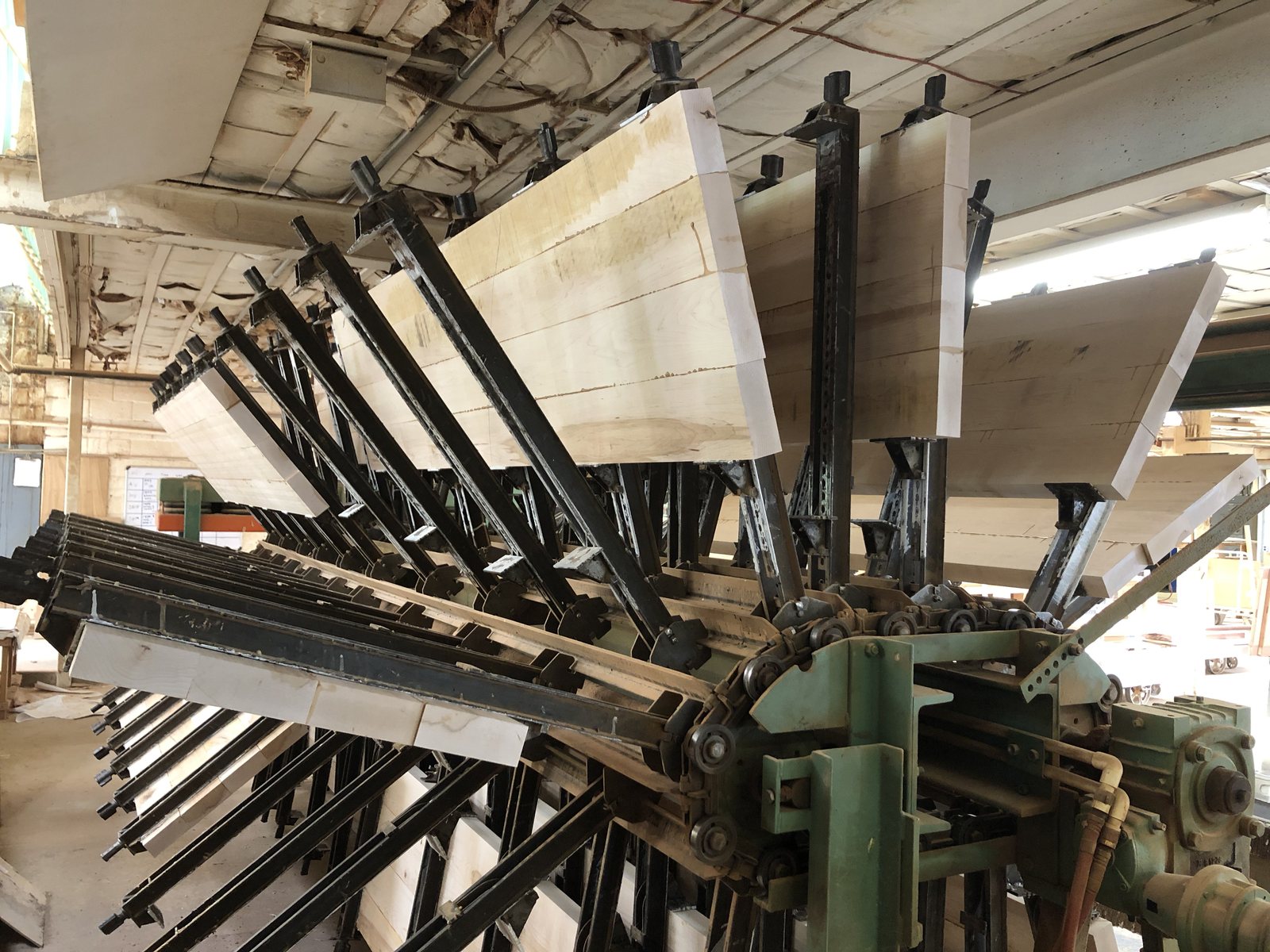
Moisture content sets the baseline. Interior millwork is milled to an in-service moisture content near 6 to 8 percent, which is where casework in a conditioned house wants to live. J. Gibson McIlvain mills interior closet stock to that range and rips shelf blanks from the same lot, so the front edges of a run read as one piece of wood rather than as five boards that happened to arrive together.
Lot matching is not cosmetic fussiness in a closet. Every shelf edge, every gable face and every rod is visible at once from the doorway, with nothing on the walls to distract from a color break. J. Gibson McIlvain holds over seven million board feet of exotic and domestic lumber at its Maryland yard, which is what makes it possible to pull a full closet package, including the long gables, from matched material instead of assembling it from whatever three suppliers had in stock that month.
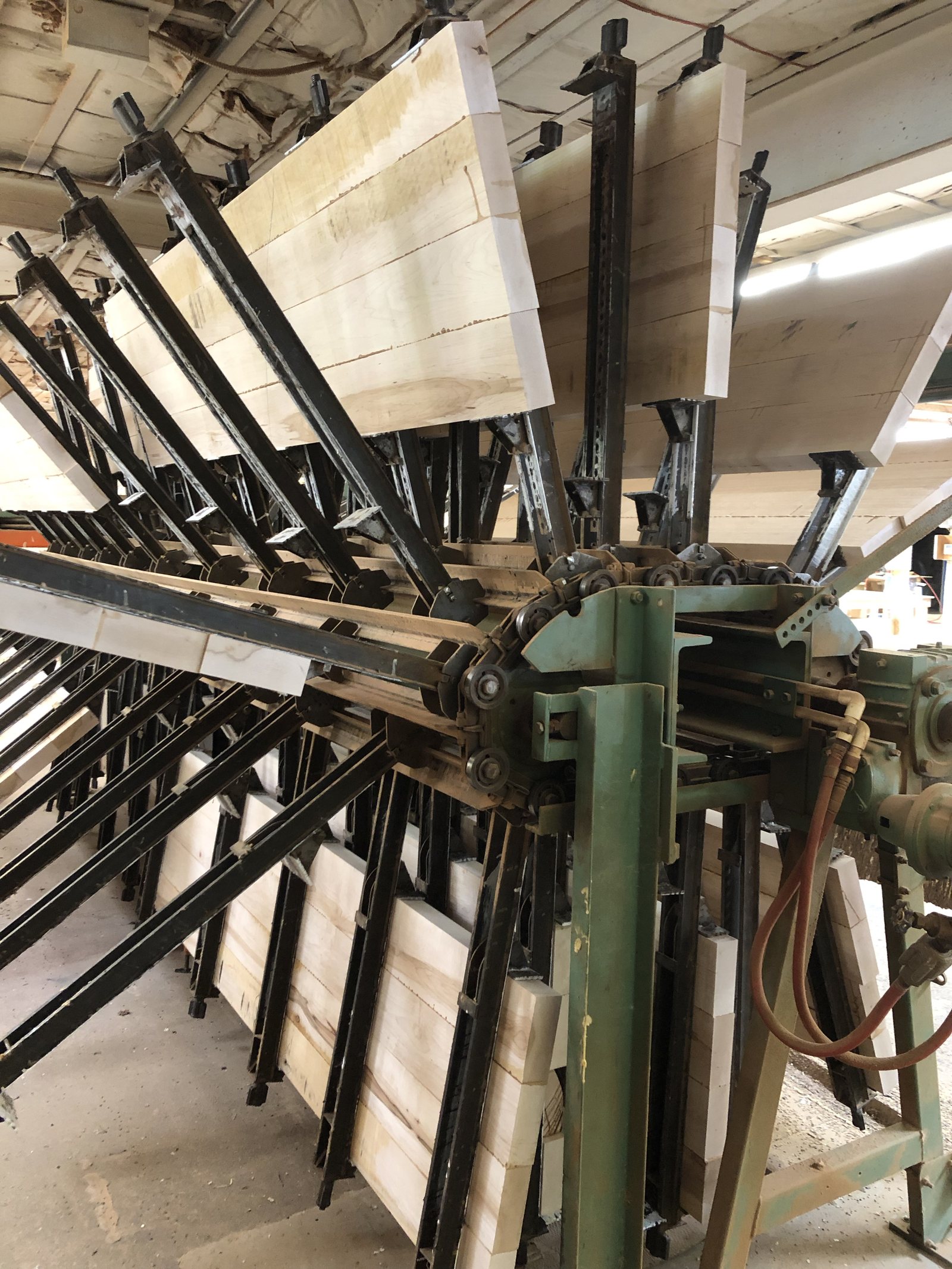
Panel layup deserves the same attention. Glued-up shelf and gable panels want alternating growth ring orientation and rip widths that keep any single stave from dominating the movement of the assembly. The National Hardwood Lumber Association grading rules govern what arrives in the rack, but the yield decision, which board becomes a 96 inch gable and which becomes drawer stock, happens at the rip saw.
Edge Details and Stiffeners That Buy Back Span
Adding depth at the front edge of a shelf buys far more span than switching to a harder species ever will. Stiffness rises with the cube of the section depth, so an applied nosing that takes the front edge from 13/16 inch to 2 inches transforms the shelf without changing what the buyer sees from three feet away.
The detail has to be glued and mechanically located to work. A nosing simply nailed on adds mass and no stiffness. Glued full-length, biscuited or doweled, and machined from the same species and the same lot, it acts as one section with the shelf and carries most of the bending. Run the nosing grain in the length of the shelf, never in short pieces.
A rabbeted rear cleat does similar work at the back. Picking up the back edge of a shelf on a cleat converts a two-point situation into a supported plane, and it takes the shelf a long way toward behaving like a torsion box. Fixed shelves gain the most from this, since adjustable shelves cannot rely on a cleat.
Box beams belong in closets more often than people expect. A valance header over a hanging bank, a cased opening between a dressing area and a bath, an island top rail in a large walk-in, all of them read as solid timber and none of them should be solid timber at that section. ICD, the architectural millwork division of J. Gibson McIlvain, builds box beams with a real joinery choice behind them. Butt joints give the most minimal profile, the fastest turnaround and the easiest on-site assembly, but they leave visible seams and visible end grain and are the weakest option. Dado joints are strong and still assemble easily on site, though seams and end grain still show. Lock miter joints show no visible seam at all and are the strongest of the three.
Specify the joint by what the beam has to do. A painted header in a utility closet can be butt jointed without anyone caring. A stained Sapele beam spanning the opening of a primary dressing room wants a lock miter, because a seam line in a clear-finished beam never stops being visible.
The Case Itself, Racking and the Bore Line
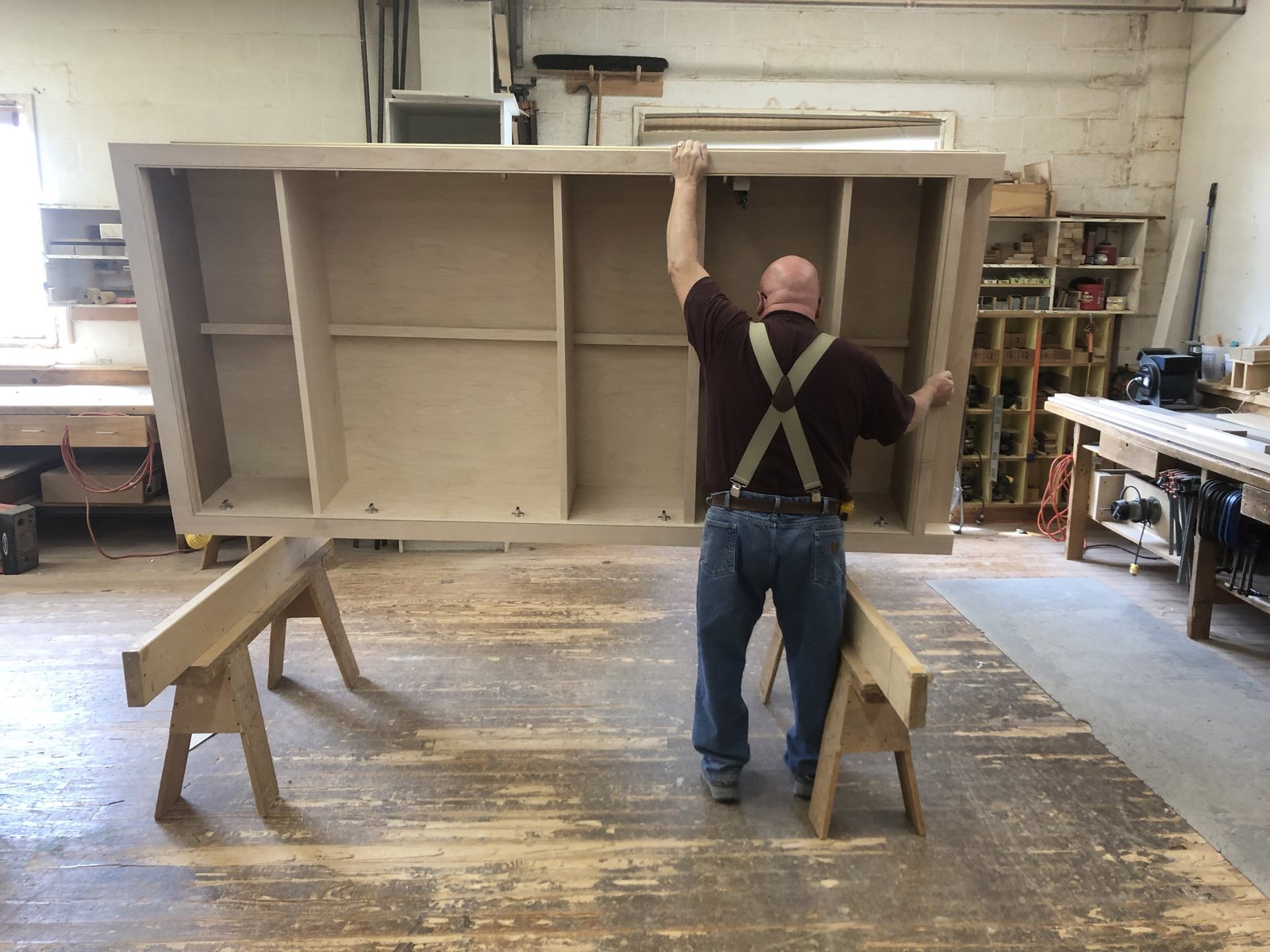
A closet case fails in the plane of its back long before it fails in its shelves. Racking is a shear problem, and the parts that resist it are the back panel, the fixed shelves and the joints that tie the gables to both.
A back panel captured in a groove on all four edges is the primary shear web of a cabinet. Nailed to the rear edge instead, it does a fraction of the work. The Architectural Woodwork Institute quality standards draw exactly this line between grades of casework, and it is the detail most often value-engineered out of a closet package by someone who does not know what it was doing.
Fixed shelves are the other shear element. In a tall unit, a dadoed fixed shelf near mid-height stops the gables from bowing inward under load and keeps the case square. Adjustable shelves cannot do that job. They sit on four pins, and the pins concentrate the entire shelf load onto four small bearing areas near the corners.
The bore line itself is a structural decision. A column of 5 mm holes at 32 mm centers removes material from the gable in a continuous vertical line, and running that line too close to a dado or to the rear edge sets up the weakest part of the panel exactly where the load path wants strength. Keep bore lines inboard, stop them short of fixed-shelf dados, and use a pin with a supporting shelf rather than a bare dowel where the load is heavy.
Drawer banks introduce their own geometry. Specialty drawers, jewelry inserts, deep sweater drawers, and storage worked around plumbing or mechanical obstacles all change where the case picks up load, which is one of the reasons ICD engineers cabinetry around how a specific space is used instead of assembling it from standard modules. Standard modules are what produce filler strips and mismatched face frames.
Choosing the Species for the Part
The millwork palette for closet work is Sapele, Iroko, Afrormosia, Teak and Utile, and hardness is the wrong reason to pick among them. Janka hardness measures resistance to denting. Sag resistance is a question of stiffness, and the two do not track each other closely enough to specify from a hardness chart.
Sapele at roughly 1,410 lbf is the workhorse of the group, dimensionally well behaved when quartersawn, available in the widths and lengths a tall gable needs, and predictable under a clear finish. Utile behaves as a close cousin with a slightly more open figure and works well where a calmer face is wanted. Iroko brings a golden tone that ambers as it ages, and Afrormosia machines cleanly and holds an edge detail crisply. Teak is the specialty choice, used where its color and its oiliness are wanted for a specific effect.
Domestic species still earn a place in a closet. White Oak at roughly 1,360 lbf, rift or quartersawn, is a standing request for a modern closet interior. Hard Maple at roughly 1,450 lbf takes paint or a light stain well in a case interior. Cherry at roughly 950 lbf is softer and darkens with light exposure, which matters more on a closet shelf than it would behind a cabinet door, since closet shelves get covered and uncovered constantly.
One correction worth making plainly. The dense tropical decking species, Ipe (Tabebuia spp), Cumaru, Garapa, Jatoba and Red Balau, are extremely hard and carry high oil content, which makes them difficult to glue. A millwork house reaches for Sapele, Iroko, Afrormosia, Teak or Utile instead, because closet work is glued work, panels, nosings, box beams and drawer boxes, and glue line reliability outranks a Janka number every time.
There are no warranties on solid unmodified wood, and there cannot be. It is an organic material responding to its environment. Warranties exist on modified products, and the modified woods, Thermory, Abodo Vulcan and Accoya, top out around 16 ft, with most sold on metric lengths just under 16 ft because of kiln size. Those products belong in exterior work rather than in a bedroom closet, and thermally modified Ash is not available wider than 8 inches in any case.
| Component | What governs it | How it goes wrong | What the shop builds in |
|---|---|---|---|
| Adjustable shelf | Clear span to the fourth power, thickness cubed | Visible midspan sag that grows under sustained load | Shorter bays, thicker blank, glued full-length front nosing |
| Fixed shelf | Dado into both gables plus rear cleat support | Rarely sags, but a shallow dado lets the gable bow | Full-depth dado, cleat at the back, same-lot stock |
| Hanging rod | Diameter to the fourth power, unsupported run length | Droop at center under a packed garment load | Runs at or under 42 inches, intermediate flange, metal core in a wood sleeve past 48 inches |
| Gable or case side | Panel width, grain orientation, bore line placement | Cupping across the face, bowing inward at mid-height | Quartersawn or rift layup, bore line held inboard, mid-height fixed shelf |
| Case back | Shear capacity of the panel and its captured edges | Racking that pulls doors out of alignment | Panel grooved in on four edges rather than applied to the rear |
| Valance or header beam | Joinery choice and the visible face requirement | Seam lines and end grain telegraphing through a clear finish | Lock miter where no seam may show, dado where strength matters and paint hides the joint |
| Drawer box | Corner joinery and bottom capture | Racking under load, bottom bellying out | Machined corners, captured bottom, box sized to the obstacle it clears |
Finishing, Priming and What a Coating Does Not Do
Finish does nothing for stiffness and everything for how the closet ages. No film thickness in the world stops a shelf from sagging. What a coating does is slow moisture exchange, even out the surface, and decide whether the closet still looks intentional in year ten.
Finish both faces of every shelf and both faces of every panel. Coating one side only sets up a moisture gradient across the thickness, and the part cups toward the uncoated face. That single omission causes more cupped closet shelves than any species selection ever has.
Painted closet interiors are common, and priming is where they are won or lost. Open-grained and oily species absorb a great deal of finish, so a primer coat evens out the eventual painted surface, and sanding or buffing after priming knocks back grain raising while keeping moulded detail crisp. J. Gibson McIlvain primes in three levels, in both oil-based and water-based systems, which lets a specifier decide how much of the finishing work arrives done and how much happens after the parts are hung.
Think through coating behavior in an enclosed, poorly ventilated space before the specification is locked. The moisture and vapor principles collected by Building Science Corporation apply to a closet on an exterior wall as much as to any other assembly, and a closet backed by an under-insulated exterior wall will run colder and damper than the room it opens onto.
"The closets we get called back about are almost never the ones where somebody picked the wrong species. They are the ones where a shelf run got stretched a few inches on site to make a wall work, and nobody went back and changed the thickness. I would rather have that conversation at the drawing stage than after the millwork is finished."
Norm Moton, Director of Sales, J. Gibson McIlvain
Drafting the Closet Before Anything Is Milled
A closet drawn to a load assumption survives the site. A closet drawn only to a wall dimension does not. Every span in this article is a drawing decision, made before a single board is ripped, and that is the only stage where changing a number is free.
True custom work means the case is planned around the specific space rather than around a catalog of box widths. ICD draws and builds cabinets and case work that way, with bay divisions placed where the load and the garment types want them rather than where a standard module happens to land. A walk-in with three 28 inch bays and one 34 inch bay is a better closet than one with four equal 31 inch bays, even though the second one draws faster.
The drawing should carry the load assumption in writing. Note which shelves are book or media shelves, which hold folded goods, which rods take overcoats. Those notes are what justify a thicker blank in one bay and a nosing in another, and they are what keep a well-meaning substitution from undoing the engineering six weeks later. ICD's working process puts that resolution ahead of production rather than during it.
Profiles get settled at the same stage. Closet work carries base, crown, light valances, face frame profiles and often a matched run of trim that has to agree with the rest of the house. J. Gibson McIlvain keeps a moulding profile library holding thousands of profiles and grinds new knives every week, so a profile that is not already on file gets ground to match, including difficult historical restoration work and contemporary shapes.
One boundary belongs in the drawing set too. Anchoring the cleats into solid blocking, shimming the case plumb in an out-of-square opening and setting the rod flanges are the installer's work, and the drawing should tell that installer where the blocking has to land before the walls are closed.
How J. Gibson McIlvain Would Specify This
Specify the span first, the section second, the species third, and the finish last. That order is the reverse of how most closet packages get written, and it is the reason so many of them sag.
The starting point is a written clear span for every shelf bay and every rod run, with the load type noted. Shelves carrying books or media get a 32 inch cap and a glued full-length nosing that takes the front edge section to at least 1 1/2 inches. Rod runs get a 42 inch cap, or an intermediate flange, or a metal core inside a turned sleeve of the same species.
Material follows. Sapele, Utile, Iroko, Afrormosia or Teak for the exotic palette, rift or quartersawn White Oak where a domestic look is wanted, milled to an in-service moisture content near 6 to 8 percent and pulled from matched lots so the shelf edges read as one run. J. Gibson McIlvain rips, resaws and moulds that material in house, on moulders, straight line and gang rip saws, band resaws and trimming saws, and ships finished millwork nationwide.
Case construction gets specified rather than assumed. J. Gibson McIlvain mills the gables, the fixed shelves and the shelf blanks to those numbers and ships them with the bore lines already run. Back panel captured in a groove on four edges. A dadoed fixed shelf near mid-height in any gable over 60 inches. Bore lines held inboard and stopped short of fixed-shelf dados. Lock miter on any box beam or valance that takes a clear finish, dado where paint will cover the joint and strength is the priority, butt joints only where the profile has to stay minimal and the seam does not matter.
Finishing closes it out. Both faces coated on every shelf and panel, and priming called out by level and by system, oil-based or water-based, depending on what the finish schedule downstream expects to receive. Settling that at the drawing stage means the parts arrive in a known condition rather than in whatever condition the shop assumed was wanted.
To specify a closet package, a dressing room or a full millwork service order, call J. Gibson McIlvain at 800-638-9100 and bring the spans with you.
Frequently Asked Questions
How far can a 13/16 inch solid hardwood closet shelf span before it sags visibly?
For books, stacked denim or anything similarly heavy, hold the clear span at or under 32 inches. Folded shirts and hats are a lighter load and a 36 inch bay is reasonable. Deflection scales with the fourth power of the span, so the jump from 32 to 38 inches is much larger than it looks on a drawing. If a wall dimension forces a longer bay, the fix is a deeper front edge rather than a harder species. A glued full-length nosing that takes the front section to 1 1/2 or 2 inches changes the behavior of the whole shelf, since stiffness rises with the cube of section depth.
What is the longest closet rod run that does not need a center support?
Hold unsupported wood rod runs at or under 42 inches in a normal garment closet. Past 48 inches, add an intermediate flange or specify a metal-cored rod running inside a turned wood sleeve so the visible species stays consistent while steel takes the bending. Coat closets should be treated more conservatively, since wool and leather load a rod far heavier per foot than shirts do. A single center support on a 60 inch run drops midspan deflection by more than an order of magnitude, because halving the span reduces the fourth-power term to a sixteenth.
Does a harder species make a stiffer shelf?
No. Janka hardness measures resistance to denting from a steel ball, not resistance to bending. Sapele at roughly 1,410 lbf, White Oak at roughly 1,360 lbf and Hard Maple at roughly 1,450 lbf all sit close together on hardness and none of those numbers predicts sag. Stiffness comes from the section and the span, which is why a nosing or a shorter bay outperforms any species substitution. Pick the species for color, machining behavior, dimensional stability and availability in the widths and lengths the case needs.
Should closet shelves and case sides be quartersawn?
Where flatness matters, yes. Quartersawn and rift stock moves less across its width than plainsawn, which is why it gets specified for wide shelves, tall gables and any painted or panelized surface that has to stay flat. A plainsawn shelf 12 inches wide can cup enough over a heating season to break the sight line of a bank of shelves, and a cupped shelf throws a shadow that makes it more obvious than a sagging one. Pair the sawing decision with an in-service moisture content near 6 to 8 percent for interior work.
Why do millwork shops avoid Ipe and other tropical decking species for closet interiors?
Ipe (Tabebuia spp), Cumaru, Garapa, Jatoba and Red Balau are extremely hard and carry high oil content, which makes them difficult to glue. Closet work is glued work. Panels, front nosings, box beams, face frames and drawer boxes all depend on reliable glue lines, so the millwork palette leads with Sapele, Iroko, Afrormosia, Teak and Utile instead. Those species machine cleanly, glue predictably and come in the widths and lengths that closet gables and long shelf runs need.
Can a hardwood closet be painted, and what does priming actually accomplish?
It can, and priming does more than provide a base coat. Open-grained and oily species absorb a great deal of finish, so a primer coat evens out the eventual painted surface, and sanding or buffing after priming knocks back grain raising while keeping moulded detail crisp. J. Gibson McIlvain primes in three levels, in both oil-based and water-based systems, so a specifier can decide how much finishing arrives done. Coat both faces of every shelf and panel regardless of the system, since finishing one side only sets up a moisture gradient and the part cups toward the uncoated face.
Do the adjustable shelf pin holes weaken a closet case side?
A continuous column of 5 mm holes at 32 mm centers removes material from the gable in a straight vertical line, and placement matters more than the holes themselves. Keep bore lines inboard, stop them short of any fixed-shelf dado, and avoid running them tight to the rear edge where the back panel is doing its shear work. In tall units, add a dadoed fixed shelf near mid-height. It keeps the gables from bowing inward and does racking duty that an adjustable shelf sitting on four pins cannot.
Is there a warranty on a solid hardwood closet?
No, and no supplier can honestly offer one. Solid unmodified wood is an organic material responding to its environment, so it moves with the humidity of the space it lives in. Warranties exist on modified products, which are engineered for exterior exposure rather than for closet interiors. What a buyer should expect instead is stock milled to the correct in-service moisture content, matched lots, correct sawing for the part and a finish specification that keeps both faces sealed.
Sources and Standards Referenced
- Wood Handbook: Wood as an Engineering Material, USDA Forest Products Laboratory
- American Wood Council Codes and Standards
- Architectural Woodwork Institute
- National Hardwood Lumber Association
- Building Science Corporation
- Sapele, The Wood Database
- Utile, The Wood Database
- Iroko, The Wood Database
- Afrormosia, The Wood Database
- J. Gibson McIlvain Millwork Service
- ICD Cabinets and Case Work