The Freeze Thaw Question Is Settled by the Project, Not the Thermometer
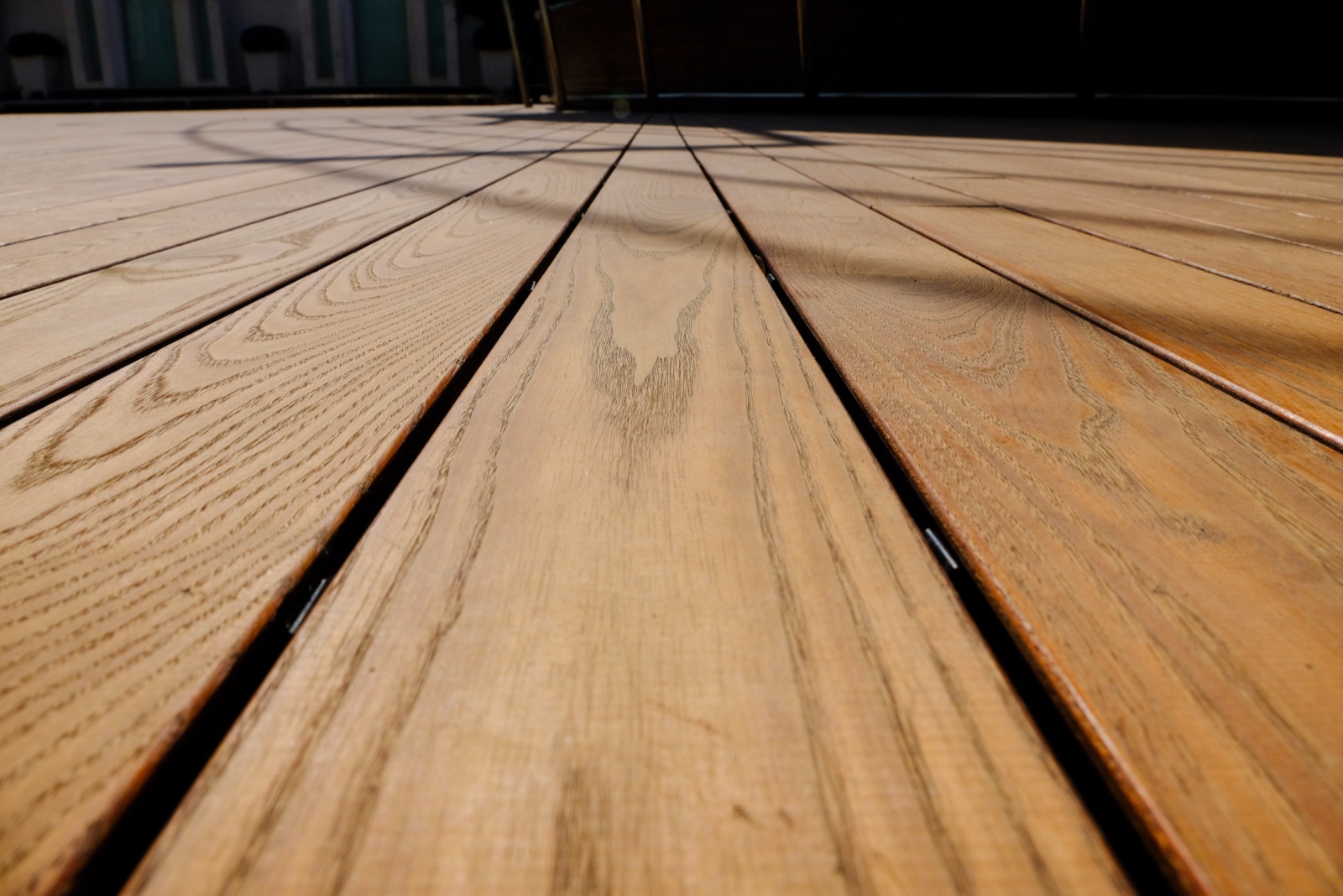
Tropical hardwood and thermally modified decking both survive freeze thaw cycling, so the honest answer is that the deck's winter duty decides the winner, not the material's data sheet. A municipal pier that gets plowed after every storm and a rooftop amenity deck three floors above a hotel lobby are both freeze thaw projects. They need different boards. The plowed pier needs mass, hardness and a full 2x section. The rooftop needs low weight, dimensional calm and boards that hold their gap lines through forty freeze thaw swings a season.
Ipe (Tabebuia spp.) and its dense tropical relatives bring a toughness that shrugs off plow blades, dropped shovels and salt grit ground in under boot traffic. Thermory and Abodo Vulcan bring a modified cell structure that has mostly lost interest in water, which is the one thing winter weaponizes. Both approaches work. Specify either one into the wrong duty cycle and you will hear about it by the second spring.
This article walks the decision the way a commercial estimator would. First the physics of what cold actually does to a deck board. Then what each material changes about the wood. Then the project types where each one wins outright. Last, the detailing that keeps any of them flat through March, because no species choice rescues a badly framed deck.
Wood Below Fiber Saturation Gives Ice Almost Nothing to Break
Decking in service holds its water bound inside cell walls rather than as free liquid, so the ice lensing that spalls concrete has very little to grab in a properly detailed wood deck. The USDA Forest Products Laboratory puts the fiber saturation point of most species near 28 to 30 percent moisture content. Below that threshold there is no free water in the cell cavities to expand on freezing. Exterior decking in North America equilibrates between 12 and 16 percent. That is a long way from saturation.
So where do winter failures come from? Wet and dry cycling, with frost as the accelerant. End grain drinks water many times faster than face grain. A field-cut board end left unsealed takes on meltwater during a thaw, then the surface fibers freeze while wet, then the sun dries them hard on a clear cold afternoon. Repeat that sixty times a winter and small checks open at the cut. Fastener penetrations behave the same way. Any spot where snowmelt ponds against a board edge and refreezes overnight works the surface fibers a little more each cycle.
Read the comparison through that lens and the real question comes into focus. It is not which material tolerates cold. Both do. It is which material takes on water more slowly, moves less when it does, and stands up to whatever scrapes the snow off. Those are three different properties, and the two material families split them.
Thermal Modification Rewrites the Wood's Relationship With Water
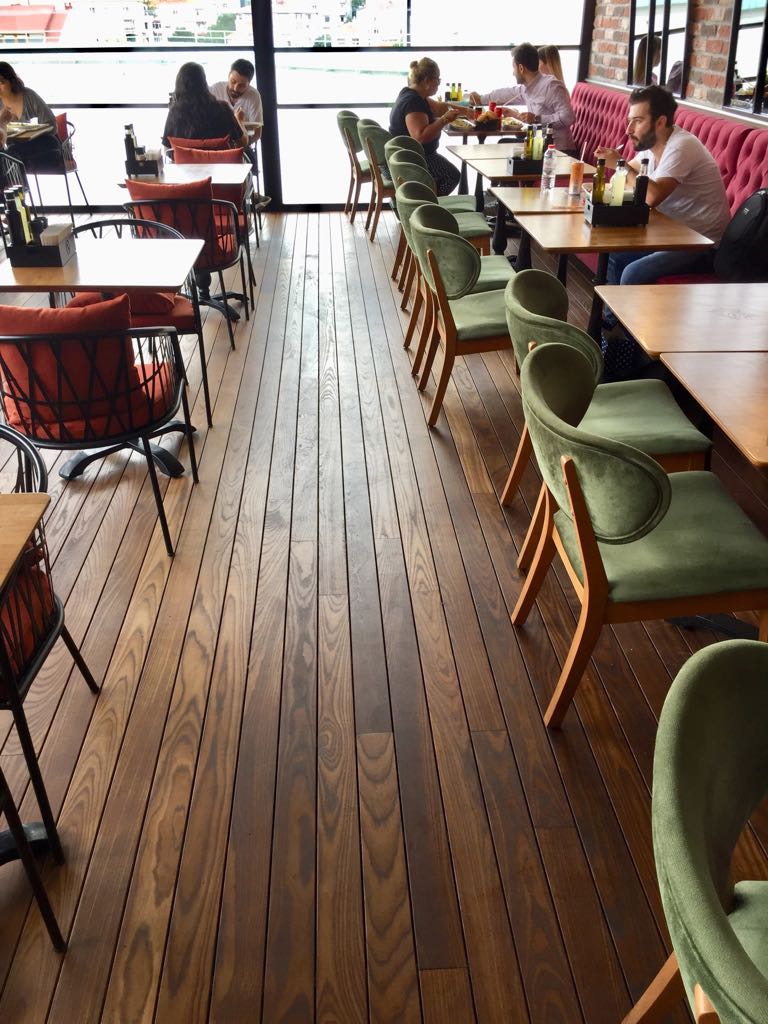
Cooking wood above roughly 180 degrees Celsius in a low oxygen kiln permanently degrades the hemicelluloses that bind water, which is why thermally modified decking absorbs less moisture and moves far less than the same species unmodified. Hemicellulose is the most hygroscopic component of the cell wall. Break it down and the wood loses most of the bonding sites water molecules attach to. Equilibrium moisture content drops to roughly half that of unmodified stock, and swelling and shrinkage fall with it. The same chemistry removes the sugars decay fungi feed on, so durability climbs into the top European classes, and manufacturers stand behind Thermory, Abodo Vulcan and Accoya with long decay warranties. Warranties on modified products are legitimate. On unmodified solid wood they are not a thing any honest supplier offers.
The trade is mechanical. Heat treatment costs the wood a meaningful share of its bending strength and makes it more brittle, especially at screw holes near board ends. A thermally modified board also cannot be produced at commercial deck thickness on a consistent supply basis, and kiln geometry caps lengths just under 16 feet. Accoya reaches similar stability through acetylation rather than heat, so it keeps more of its toughness, but it remains a modified softwood, not a substitute for dense hardwood in impact service.
For freeze thaw specifically, the payoff is real. A board that barely changes moisture content between a February thaw and a March cold snap barely moves, and a board that barely moves keeps its fasteners tight and its gap lines straight.
Density and Extractives Are the Tropical Answer to the Same Problem
Dense tropical heartwood attacks the water problem from the other direction, by being so tight grained and extractive rich that water gets in slowly and shallowly. Ipe runs about 1,050 kg per cubic meter with a Janka hardness near 3,680 lbf, and the Wood Database entry for Ipe rates it among the most decay resistant commercial timbers on earth. It carries EN 350 Class 1 durability and a Class A flame spread rating under ASTM E84, meaning a flame spread index of 25 or less, which matters on commercial and multifamily work reviewed under ICC code provisions.
Cumaru sits right behind it at roughly 3,540 lbf and 1,070 kg per cubic meter, with an oily extractive load that repels moisture much the way Ipe's does. Jatoba comes in near 2,690 lbf, still far harder than any temperate decking species. None of these boards is immune to moisture cycling. They do move. The point is that uptake is slow and the daily swing is small, so each freeze thaw cycle does very little work on the board. What the density adds on top is armor. A plow blade skimming a Cumaru surface polishes it. The same blade on a modified softwood leaves a gouge that then collects water for the next freeze.
Winter sun is the other quiet factor. Dense hardwood surfaces heat fast on clear cold days, and that surface heating drives the checking behavior covered further down. It is a cosmetic cost, not a structural one.
Commercial Freeze Thaw Decks Belong to 2x Ipe, Cumaru and Jatoba
Public boardwalks, piers and plaza decks in snow country are specified at 2x thickness to control deflection, and only Ipe, Cumaru and Jatoba can be sourced consistently at that thickness. No professional goes first with a thinner board on a public job, even where the strength math on 5/4 stock pencils out. That single sourcing fact filters Red Balau and Garapa out of commercial specs, and it filters out the modified woods too, which cannot deliver 2x sections and stop just short of 16 feet in length while a pier deck wants long continuous runs. Add snow removal equipment, salt grit under thousands of boots, and the firm stable surface requirements the U.S. Access Board applies to accessible routes, and the shortlist writes itself.
J. Gibson McIlvain stocks Ipe decking across every standard and custom dimension, including the 2x6 and 2x8 sections commercial boardwalk specs call for, and ships it nationwide from its Maryland yard, with regular freight into California, New England and the Great Lakes states. Cumaru and Jatoba move through the same milling operation for projects that want 2x performance in a different color.
"When a parks department calls about a boardwalk in a snow state, I don't start with species. I ask how the snow comes off. If a plow or a tractor brush touches that deck every storm, we're talking 2x Ipe, Cumaru or Jatoba, and nothing thinner or softer makes my shortlist."
Norm Moton, Director of Sales, J. Gibson McIlvain
Rooftops and Residential Decks Are Where Modified Wood Earns Its Keep
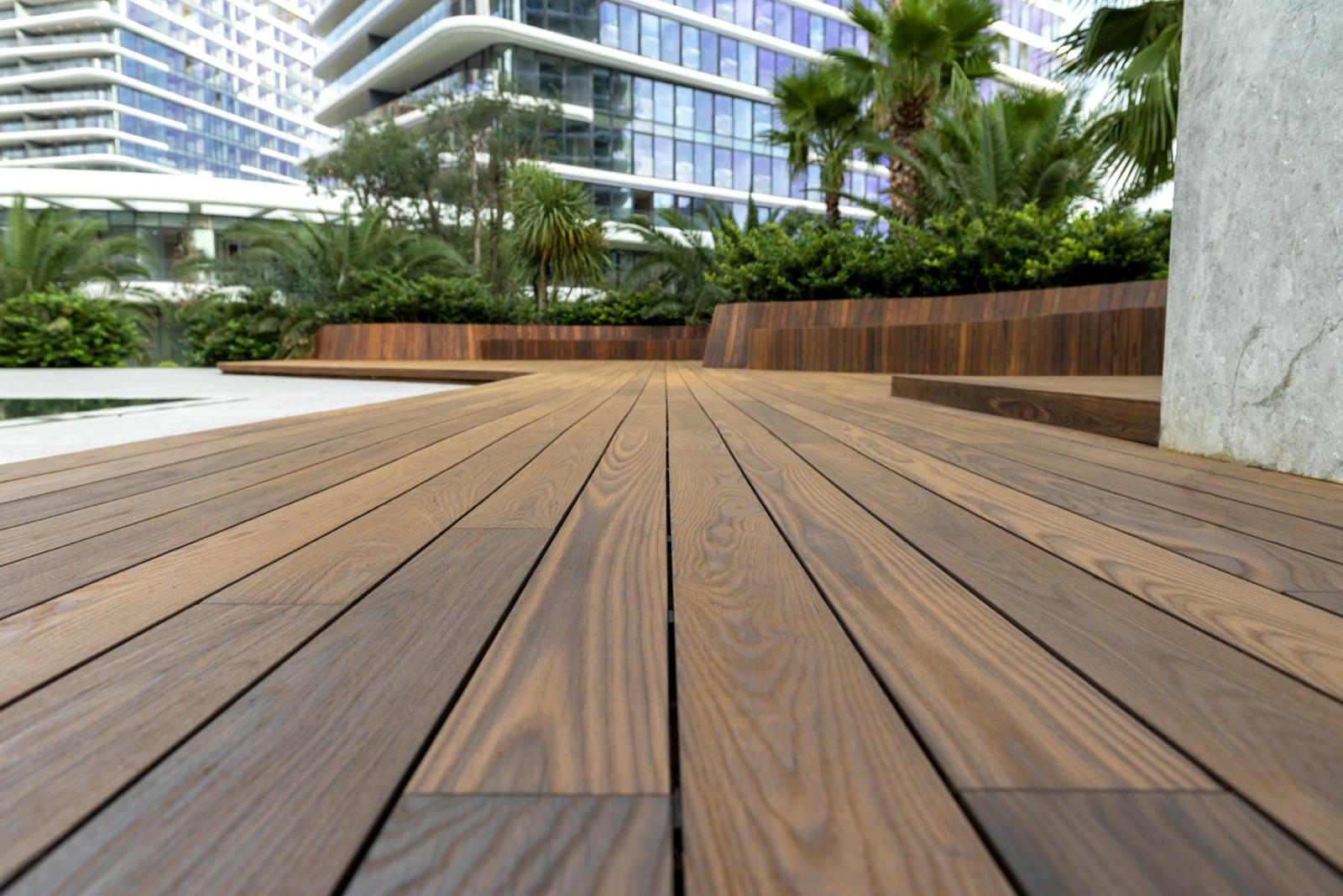
Thermally modified decking wins the projects where weight, barefoot comfort and dimensional stability outrank impact toughness, which describes most rooftop and many residential freeze thaw decks. A pedestal supported rooftop deck lives on a strict dead load budget, and Thermory or Abodo Vulcan boards weigh roughly half what Ipe does per square foot. They stay cooler underfoot in summer, gray to an even silver, and hold gap lines through moisture swings that would visibly work an unmodified softwood. The sub 16 foot length ceiling that disqualifies them from pier work is irrelevant on a rooftop laid out in modular bays. Accoya adds a machining friendly option where the design calls for custom profiles.
Residential ground level decks in freeze thaw country are a genuinely open field. Garapa and Red Balau, both around 1,700 to 2,000 lbf on the Janka scale and durable enough for decades of service, are strong value picks in 5/4 thickness over framing an engineer has signed off on. Nobody plows a backyard deck with a truck.
Cedar deserves its place in this conversation too. Clear vertical grain (CVG) Western Red Cedar is a stable, straight wearing deck and porch board, while select tight knot (STK) grades give a rustic look at a friendlier cost than the clears. Cedar has handled northern winters for a century and keeps doing it wherever the detailing is right. It is a legitimate default, not a compromise.
The Cold Climate Shortlist, Compared on the Axes That Decide Winter Specs
Put the candidates side by side on hardness, mass, durability, available section and role, and the two family split becomes obvious. The published figures for Cumaru and its peers below are the numbers estimators actually check before a snow country submittal.
| Material | Janka (lbf) | Density (kg/m3) | Decay durability | Consistent 2x supply | Cold climate role |
|---|---|---|---|---|---|
| Ipe (Tabebuia spp.) | ~3,680 | ~1,050 | EN 350 Class 1 | Yes | Commercial boardwalks, piers, plazas, plowed surfaces |
| Cumaru | ~3,540 | ~1,070 | Very durable | Yes | Commercial decks wanting warmer color than Ipe |
| Jatoba | ~2,690 | ~910 | Very durable | Yes | Commercial and heavy residential work in a red tone |
| Garapa | ~1,700 | ~830 | Durable | No | Residential 5/4 decks over engineer approved framing |
| Red Balau | ~1,700 to 2,000 | ~850 | Durable | No | Residential 5/4 decks, consistent brown color |
| Massaranduba (comparison only) | ~3,190 | ~1,150 | Very durable | Limited | Appears in competing quotes, moves hard in dry winter air |
| Thermory / Abodo Vulcan | Modest, softwood based | ~400 to 500 | Top class, warranty backed | No, lengths under 16 ft | Rooftop pedestal decks, residential decks, cladding |
| Accoya | Modest, softwood based | ~510 | Top class, warranty backed | No, lengths under 16 ft | Custom milled profiles and stable exterior joinery |
Massaranduba appears here only as a reference point. Its density looks appealing on paper, but its reputation for aggressive surface movement in freeze dried winter air is exactly the wrong trait for this climate class.
Surface Checking Cannot Be Prevented, Only Managed, and Winter Sun Makes It Honest
Every dense tropical deck board will show some surface checking, in any climate, and a freeze thaw region's bright cold days simply reveal it sooner. Checking is the wood releasing tension as its surface heats and dries faster than its core. It does not weaken the board. Small checks are normal and even a sign the material was properly seasoned before it shipped. Any supplier promising a check free Ipe deck is promising something the material cannot deliver.
What a supplier can do is slow the surface moisture cycling that drives checking. J. Gibson McIlvain factory coats its tropical decking with Cutek, a penetrating oil wood stabilizer that soaks into the surface rather than filming over it, and that treatment measurably reduces the size and frequency of checks through the first seasons. Site practice does the rest. Confirm moisture content in the 12 to 16 percent service range at delivery, seal every field cut end the day it is made, and frame for airflow so the underside of the deck dries at roughly the same rate as the top. Those habits keep checks small. Nothing eliminates them, and a spec that pretends otherwise sets the owner up for a warranty argument nobody can win on unmodified wood.
Framing, Fasteners and Airflow Decide More Winters Than the Species Line Does
A mediocre species on excellent framing outlasts an excellent species on mediocre framing, so the detailing section of the spec deserves as much attention as the material line. Dense hardwood decking wants joists at 16 inches on center. It goes down over joists or furring strips, never tight to a membrane. Cross ventilation under the boards is what lets a deck dry evenly after a thaw, a principle the building physics work at Building Science Corporation has documented for decades in every assembly that mixes wood and water.
Profiles dictate fasteners. Shiplap profiles take visible face fasteners. Only tongue and groove works with hidden fastening, and on any grooved board the grooves face down so they drain instead of holding meltwater against the wood. Coastal and deicing salt environments call for 316 stainless screws, since lesser alloys tea stain and pit under chloride exposure.
Drilling is site work, full stop. Layout and field cuts change with the frame as built, so holes get drilled against the actual joists, not in advance. Pilot every hole in dense hardwood, run two fasteners per board per joist, hold about 3/4 inch edge distance, drill full depth pilots near board ends where splitting risk peaks, land butt joints on doubled bearing, and use a self centering combination bit to keep the countersinks uniform. In freeze thaw service these habits matter double, since every fastener hole is a future water entry point that frost will test.
How J. Gibson McIlvain Would Specify This
Write the spec by duty cycle, and the material choice falls out on its own. For a public boardwalk, pier or plaza in a freeze thaw region, specify 2x6 Ipe, Cumaru or Jatoba, joists at 16 inches on center, 316 stainless fasteners drilled and countersunk on site, factory applied Cutek stabilizer, and end sealing of every field cut. Call for delivery moisture content in the 12 to 16 percent service range and open ventilation detailing at the skirting.
For a rooftop amenity deck, specify Thermory or Abodo Vulcan on a pedestal system in modular bays under 16 feet, grooves down, hidden fasteners only where the profile is true tongue and groove, and lean on the manufacturer's decay warranty in the submittal package. For residential ground level work, 5/4 Garapa or Red Balau over engineer approved framing is a sound value spec, with CVG cedar as a fully respectable alternative where a lighter board suits the build.
Sourcing language belongs in the spec too. Require FSC certified material where the project pursues credits, with chain of custody documentation verifiable through FSC, and, when using a CITES-listed species, the permits and documentation required under CITES before import. J. Gibson McIlvain handles that paperwork on the import side and mills to the spec in house, serving contractor volume projects coast to coast. For a submittal package, a dimension question or a freight quote to any state, call 800-638-9100 and talk to a lumber person, not a phone tree.
Frequently Asked Questions
Can Ipe or Cumaru decking be installed during freezing weather?
Cold air itself does not hurt dense hardwood, and winter installs happen on commercial schedules all the time. The real risks are wet boards and sloppy site storage. Keep the material stickered, covered and off the snow, confirm moisture content in the 12 to 16 percent service range at delivery, and seal every field cut end the day it is made. Pilot drilling dense hardwood also goes slower in deep cold, so budget crew time accordingly.
Why do commercial boardwalks in snow states require 2x decking instead of 5/4?
Public boardwalk, pier and plaza decks are specified at 2x thickness to control deflection under crowd loads, maintenance vehicles and snow equipment, and no professional will go first with a thinner board on a public job even where the strength math on 5/4 works. Only Ipe, Cumaru and Jatoba can be sourced consistently in 2x decking thickness, which is why those three species dominate commercial freeze thaw specs.
Does thermally modified decking need a finish to survive a freeze thaw climate?
No. The decay resistance is built into the modified cell structure, not into a coating, and the manufacturer warranties on Thermory, Abodo Vulcan and Accoya do not depend on keeping the boards oiled. A penetrating oil is purely a color decision. Left bare, the boards weather to an even silver gray and keep performing.
What does the factory applied Cutek coating actually do for winter checking?
Cutek is a penetrating oil wood stabilizer that soaks into the board surface and slows the moisture cycling that drives surface checking. It significantly reduces how large and how frequent checks get through the first seasons, which matter most. It does not eliminate checking, and nothing does. Small surface checks are the wood releasing tension naturally and do not weaken the board.
Will freeze thaw cycles work deck fasteners loose over time?
Not if the deck was fastened correctly. Fastener loosening comes from wood movement crushing fibers around a badly seated screw, and dense tropical boards at service moisture content move very little per cycle. Pilot every hole, run two fasteners per board per joist, hold about 3/4 inch of edge distance, and use 316 stainless screws where deicing salt or coastal air is in play. Decks detailed that way hold tight for decades of winters.
Can I order tropical decking pre-drilled from the mill?
No, and you should not want to. Fastener layout depends on the frame as it was actually built, and field cuts shift every hole location, so any factory pattern would be wrong the moment the first board is trimmed. Drilling is installation work done on site against the real joists, using a self centering combination bit, full pilots near board ends, and butt joints landed on doubled bearing.