The Short Answer, and the Three Conditions That Move It
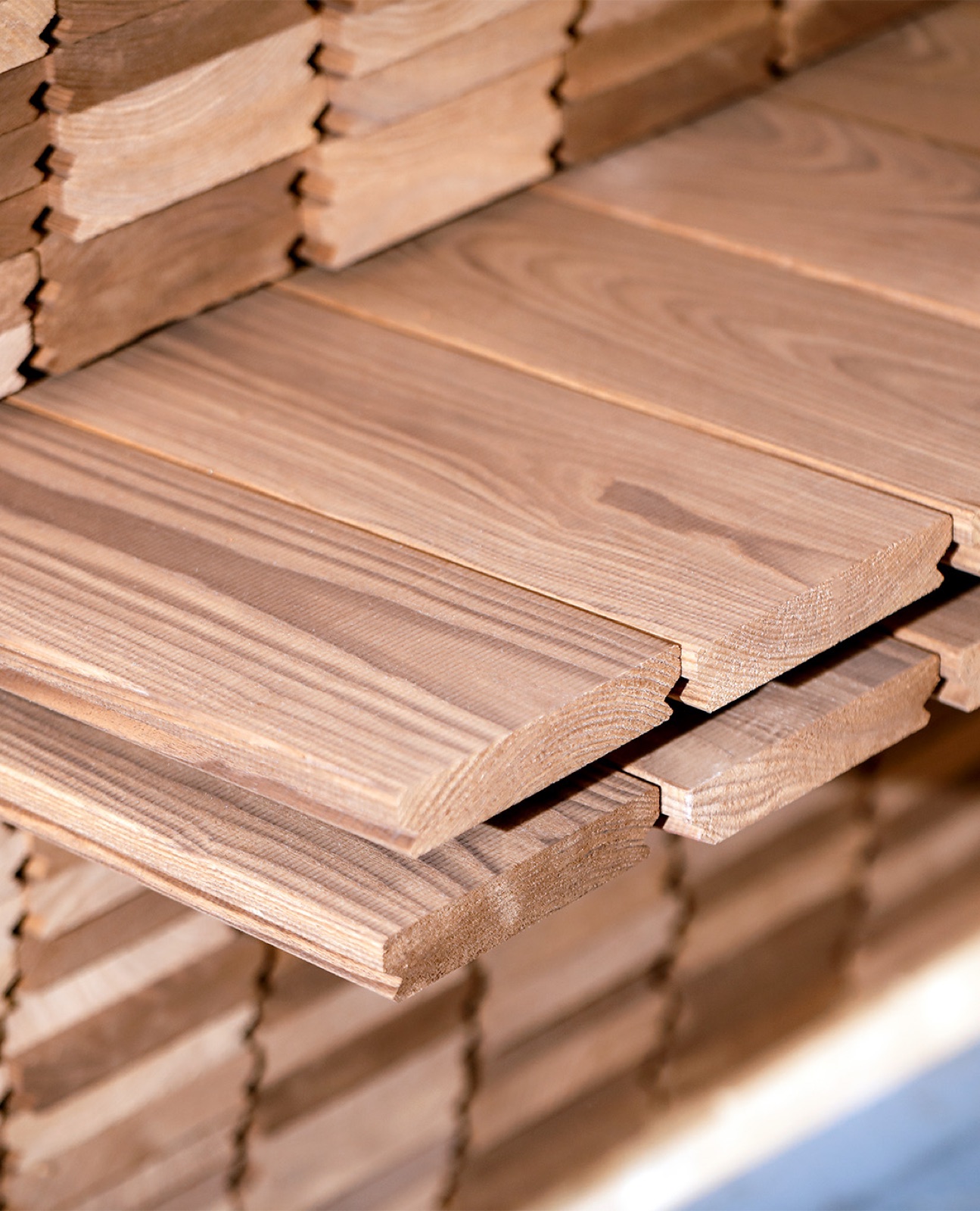
Frame dense tropical hardwood decking at 16 inches on center when the boards run perpendicular to the joists, and tighten to 12 inches on center the moment the layout goes diagonal. That single number covers most of the Ipe and Cumaru work built in this country. It is not a species rule. It is a board-thickness and geometry rule that happens to land in the same place for nearly every tropical hardwood a contractor is likely to install.
Three conditions move the number. The first is board thickness. Nominal 5/4 stock, which finishes near one inch, is the baseline for 16 inches on center; anything thinner belongs at 12. The second is the angle of the run, since a 45 degree layout stretches the actual span between bearing points by a factor of about 1.41, turning a 16 inch layout into a 22.6 inch clear span the board never signed up for. The third condition gets skipped most often. The joists themselves have to carry a heavier deck than the framer is used to, and spacing the joists correctly does nothing if the joists are undersized, over-spanned, or fastened to a ledger that was detailed for cedar.
Everything below explains where the 16 inch figure comes from, when it is not enough, and how the rest of the assembly has to change to make it hold.
The 16 Inch Rule Comes From Deflection, Not From Breaking Strength
Ipe and Cumaru at 5/4 will not break at 24 inches on center; they will bounce, and the bounce is what fails the deck. Decking is a bending member like any other, and the governing check on a walking surface is serviceability rather than rupture. Building officials evaluate residential and commercial deck surfaces against a uniform live load plus a concentrated load applied over a small area, and the acceptance criterion is a deflection limit expressed as a fraction of the clear span. The design values and load-duration adjustments behind those checks live in the National Design Specification maintained by the American Wood Council, and the load cases themselves come out of the model codes published by the International Code Council.
Run the math on a one inch thick Ipe board and the strength side is comfortable at 24 inches. The stiffness side is not. Deflection scales with the cube of the span, so widening from 16 to 24 inches multiplies the sag under a point load by roughly 3.4 times. A 200 pound person on a single board between two joists at 24 inches produces a springy, drum-like feel that homeowners describe as a soft spot and inspectors describe as a serviceability failure. That flex also works the fasteners. Every footfall cycles the screw shank in a hole drilled through wood harder than the steel is used to, and within a few seasons the heads sit proud.
Hardness numbers do not rescue the situation. Janka measures resistance to indentation, and Ipe at roughly 3,680 lbf and Cumaru at roughly 3,540 lbf are both extraordinary on that scale. Stiffness is a different property. The relationship between density and modulus of elasticity across species is documented in the Wood Handbook from the USDA Forest Products Laboratory, and the short version is that tropical density buys a modest stiffness gain, nowhere near enough to justify a 50 percent jump in span.
Every Board Has to Land on at Least Three Joists
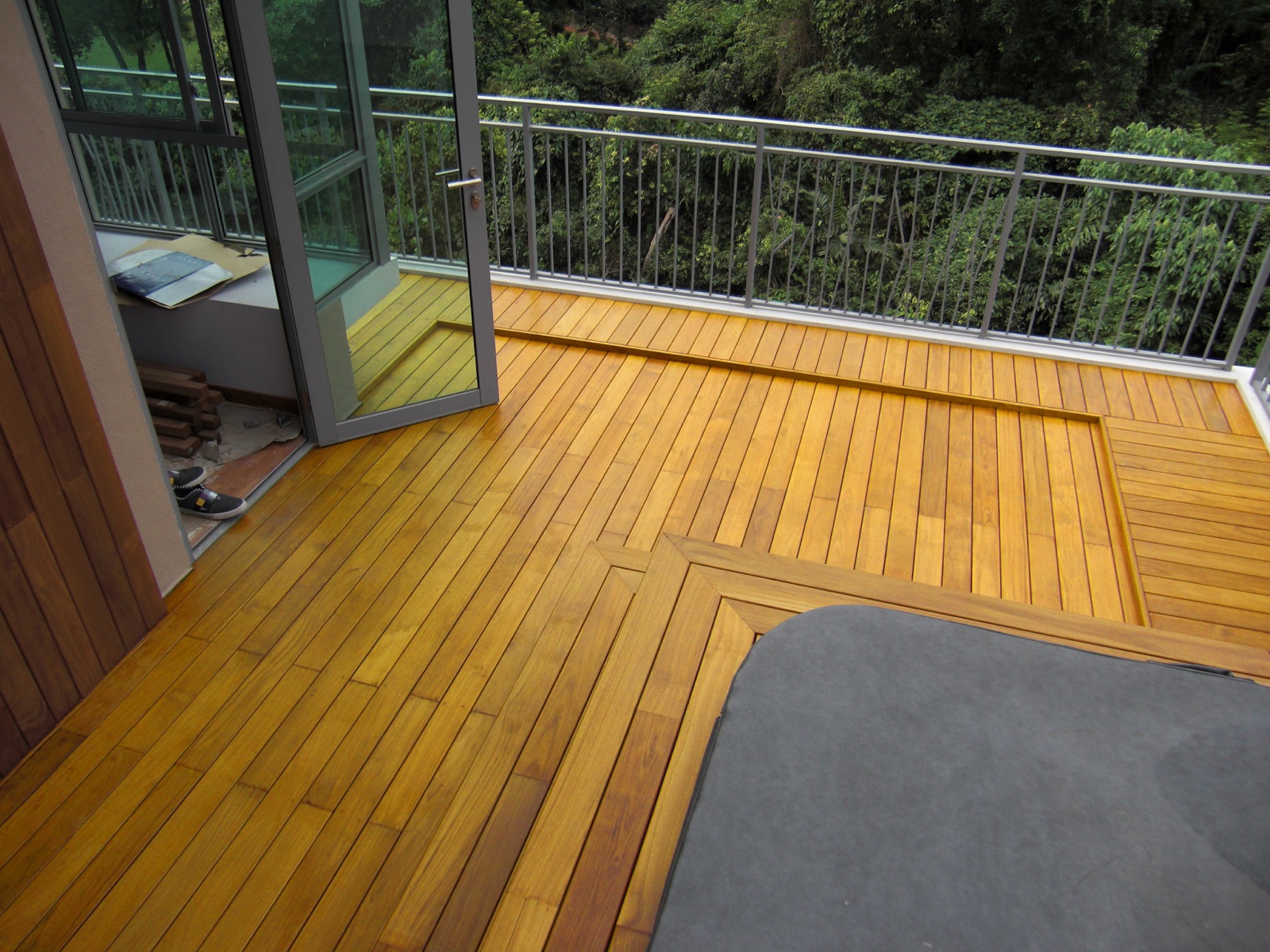
Joist spacing is only half the layout problem; the other half is making sure no board spans a single bay. A deck board bearing on three or more joists behaves as a continuous member. The interior support carries negative moment, the midspan sag drops sharply against the same board in a simple single span, and the whole field stiffens. Cut a short filler that touches only two joists and that piece will always feel different underfoot than the boards around it.
Set a minimum board length of three bays and enforce it at the layout stage rather than at the cut station. At 16 inches on center that means nothing shorter than about 32 inches finds its way into the field. Butt joints land on doubled bearing, not on a single 1.5 inch joist shared by two board ends. Two boards splitting one joist face leaves less than three quarters of an inch of bearing each, which is not enough for a fastener with proper edge distance in a species this hard. Double the joist at every butt line, or add a sister with a full-depth block, and stagger the joint lines across the field so the seams do not stack into a visible ridge.
Cantilevered ends deserve the same discipline. Overhang past the last joist should stay within a few inches for 5/4 material, and the rim needs to be a real joist rather than a fascia board asked to do structural work. Where a deck edge carries a guard post, the framing under that post is designed for the guard load, and the decking simply passes over it.
Tropical Decking Loads the Frame Harder Than the Framer Expects
An Ipe or Cumaru surface adds two to three times the dead load of a softwood deck, and the joists have to be sized for it before spacing is even discussed. Ipe runs near 1,050 kg per cubic meter at service moisture content and Cumaru near 1,070. Convert that and a 5/4x6 board weighs roughly two and a half pounds per linear foot. A 5/4x6 profile covers about 2.1 linear feet per square foot of deck, which puts the finished surface at roughly five pounds per square foot. Move to 2x6 stock for a commercial job and the same math lands closer to eight. Western Red Cedar decking, by comparison, sits near two.
Five to eight pounds per square foot of extra permanent load will not collapse a properly designed frame, but it eats the margin that framers rely on when they push a 2x8 to the edge of its allowable span. Two things follow. Joist depth and joist span should be checked against the actual dead load rather than a generic 10 psf assumption, and the ledger connection should be reviewed at the same time, since ledger fastener schedules in the prescriptive guides are tied to joist span and spacing together.
Framing lumber matters as well. Pressure treated Southern Yellow Pine, Douglas Fir and the various engineered options all behave differently in service, and a wet-service adjustment applies to every one of them on an exterior deck. Solid blocking or bridging at midspan on longer joist runs is worth the labor on a hardwood deck; it distributes point loads laterally and keeps the joists from rolling under the fastening load that a hard, dimensionally stable board applies. Guidance on exterior assembly detailing and drainage from Building Science Corporation is a good reference for anyone detailing a deck over occupied space.
Diagonals, Borders and Patterns Rewrite the Spacing Plan
Any layout that is not a straight perpendicular run needs framing drawn for it, not framing adapted to it. A 45 degree field is the common case. The clear span between bearing points grows by roughly 41 percent, so 16 inch framing becomes a 22.6 inch effective span and the deck feels soft in exactly the way described above. Frame diagonal fields at 12 inches on center. A 30 degree layout is worse still and should be engineered rather than guessed.
Picture frame borders introduce a second problem that has nothing to do with the field spacing. A mitered border runs perpendicular to the field boards along two of the four sides, which means it has no support at all unless framing is added under it. Every border board needs continuous bearing, so the perimeter gets a doubled rim plus intermediate blocking laid out to catch the border at the same 16 inch interval, and the miter joints need bearing directly beneath them. Breaker boards down the middle of a long deck follow the same requirement: a doubled joist under the breaker, with the field boards on either side each getting full bearing rather than sharing a single 1.5 inch face.
Herringbone, basket weave and other pattern work require a blocking grid rather than a joist layout. Draw it. On stairs, stringers for dense hardwood treads go at 12 inches on center or less, and open-riser designs need the tread thickness checked independently, since a tread carries a concentrated load at the worst possible location.
Commercial Decks Are Specified at 2x Thickness, and That Filters the Species List
Boardwalks, piers, plazas and public promenades are built with 2x decking, and that decision is made before joist spacing is even on the table. The reasoning is partly structural and partly institutional. Two inch nominal stock controls deflection under crowd loading and under maintenance equipment, it tolerates decades of refinishing without losing section, and it survives the abuse of a public installation. No professional is going to be the first to put a thinner board on a municipal job even where the strength math on 5/4 works out. Owners, engineers of record and the agencies that maintain these structures all expect 2x, and the specification follows.
That single decision narrows the species list hard. Only Ipe, Cumaru and Jatoba can be sourced consistently in 2x decking thickness across the volumes and lengths a commercial job requires. Red Balau and Garapa are excellent decking species with real advantages in residential and engineer-approved 5/4 work, but they do not belong in a commercial 2x specification. Fire performance often enters the conversation too: Ipe carries an ASTM E84 Class A rating, meaning a flame-spread index of 25 or less under the test method published by ASTM International, and fire-related requirements for exterior assemblies are addressed by NFPA standards as well.
Accessibility governs the gaps rather than the spacing. Openings in a walking surface on an accessible route are limited to half an inch in the direction of travel under the standards administered by the US Access Board, which is why boardwalk gap layouts get drawn and dry-fit rather than eyeballed. Joist spacing stays at 16 inches on center for 2x tropical decking in most commercial designs; the thicker board buys margin, load capacity and service life, not a wider bay.
| Decking profile | Approx. density | Perpendicular run | 45 degree diagonal | Where it belongs |
|---|---|---|---|---|
| Ipe 5/4x6 (Tabebuia spp.) | 1,050 kg/m3 | 16 in. o.c. | 12 in. o.c. | Residential and light commercial decks |
| Ipe 2x6 (Tabebuia spp.) | 1,050 kg/m3 | 16 in. o.c. | 12 in. o.c. | Boardwalks, piers, plazas, public decks |
| Cumaru 5/4x6 | 1,070 kg/m3 | 16 in. o.c. | 12 in. o.c. | Residential decks, rooftop pedestal systems |
| Cumaru 2x6 | 1,070 kg/m3 | 16 in. o.c. | 12 in. o.c. | Commercial decks and heavy traffic areas |
| Jatoba 2x6 | Janka approx. 2,690 lbf | 16 in. o.c. | 12 in. o.c. | Covered commercial walkways, 2x-available alternative |
| Red Balau 5/4x6 | Janka approx. 1,700 to 2,000 lbf | 16 in. o.c. | 12 in. o.c. | Residential and engineer-approved 5/4 work only |
| Garapa 5/4x6 | Janka approx. 1,700 lbf | 16 in. o.c. | 12 in. o.c. | Residential decks where a light color is wanted |
| Thermory or Abodo Vulcan 1x | Modified softwood or hardwood | 12 in. o.c. | Not recommended | Residential decks and cladding, lengths to about 16 ft |
| Accoya 5/4 | Modified radiata | 16 in. o.c. | 12 in. o.c. | Painted or coated decks, lengths to about 16 ft |
The Fastening System Sets How Much Spacing Error the Deck Will Forgive
Two fasteners per board per joist is the standard for dense tropical decking, and that requirement is what makes 1.5 inch joist faces and sloppy spacing incompatible. A screw needs roughly three quarters of an inch of edge distance from the board end and from the joist edge. Land a joist an inch off the layout line and the installer either drills into the gap or crowds the edge, and in a species at 3,500 lbf Janka the crowded hole splits. Snap the layout, check it at every third joist, and correct before decking starts.
Pilot every hole. Dense tropical hardwood does not accept a self-drilling point, and driving without a pilot burns tips, snaps heads and starts splits that migrate to the end grain. A self-centering combination bit that pilots and countersinks in one motion is the tool for this, and full-depth pilots are mandatory within a few inches of board ends and at butt joints. Nobody should order decking pre-drilled. Layout gets adjusted against the frame as it was actually built, field cuts happen constantly, and any hole pattern established before shipping would be wrong the day it arrived. Drilling is installation work performed on site.
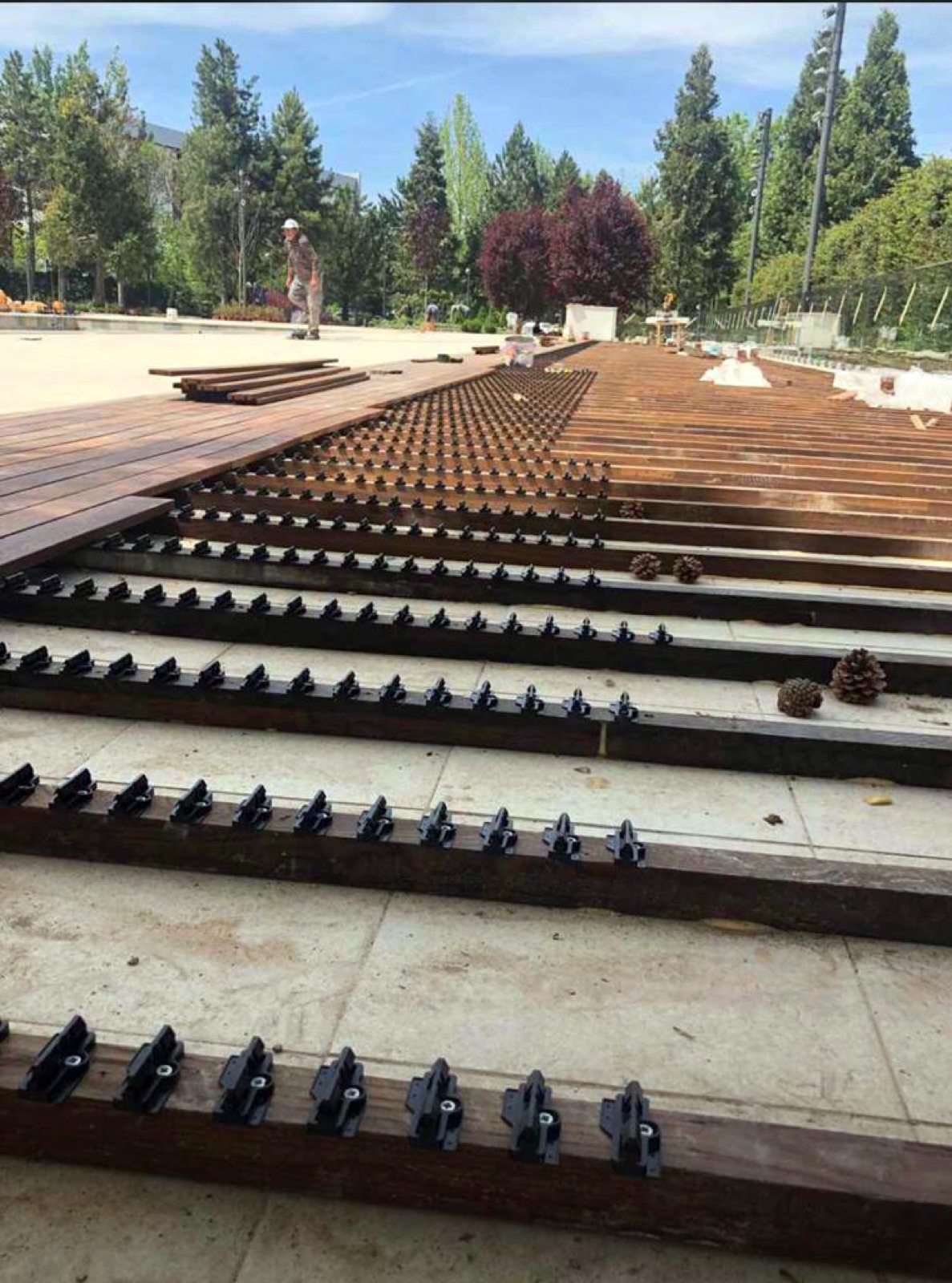
Profile choice matters as much as fastener choice. Tongue and groove decking is the only profile that accepts a true hidden fastener system, since the clip or biscuit needs a groove to engage. Shiplap takes visible fasteners, full stop. Material runs over furring strips or joists with grooves facing down so water drains rather than sitting in a channel. Coastal work calls for 316 stainless throughout, which resists chloride attack in a way that 304 does not. Hidden fastener clips do not change the spacing requirement, and some systems tighten it, so confirm the manufacturer's span limitation before the frame goes in.
Airflow and Moisture Content Decide Whether the Spacing Holds
Correct joist spacing on a deck with no ventilation underneath still produces cupped, twisted boards. Dense tropical decking arrives at 12 to 16 percent moisture content for in-service conditions, and it needs to dry and wet evenly from both faces. Trap the underside against a solid substrate and the top face moves while the bottom cannot, which is a recipe for cup regardless of how well the joists were laid out. Keep meaningful clearance beneath the frame, keep the perimeter open, and never lay tropical decking flat onto a roof membrane or a slab. Sleepers or furring create the air gap.
Gapping is part of the same system. A consistent gap between boards lets water and debris pass and lets air move, and the gap has to be set with a spacer rather than by eye. Joist tape over the top of each joist protects the framing from standing water at the fastener penetrations and adds years to a treated frame.
Surface checking deserves an honest explanation. Small checks appear in dense tropical decking as the surface heats and dries faster than the core, releasing tension the board has carried since the tree was standing. Checks of this kind do not weaken the board, and their presence usually indicates properly seasoned material rather than defective material. The meaningful mitigation is a factory-applied penetrating oil stabilizer. J. Gibson McIlvain factory coats tropical decking with Cutek, which slows moisture cycling at the surface and significantly reduces checking. Delivering material at the right moisture content, sealing every field-cut end, and keeping the underside ventilated keeps checks small. It does not eliminate them, and no supplier should claim otherwise.
Retrofitting Onto a 24 Inch Frame Is the Most Common Real-World Problem
An existing frame built at 24 inches on center for composite or treated decking cannot simply receive Ipe or Cumaru boards. This comes up constantly on remodels. The old surface is failing, the owner wants tropical hardwood, and the framer looks at a sound-looking structure and assumes the boards just swap. They do not. The bay is too wide for 5/4 hardwood, and the frame was sized for a lighter surface.
There are three workable responses. Add intermediate joists to bring the layout to 16 inches on center, which is the cleanest answer when the ledger, beams and footings can take the added load and there is access to hang new hangers. Install sleepers running perpendicular over the existing joists at 16 inches on center, which raises the deck height and has to be checked against door thresholds and guard heights but avoids touching the primary structure. Or run the decking diagonally over the existing 24 inch frame, which is almost never acceptable, since the effective span grows past 33 inches. Verify the beams and footings in every case, because adding several pounds per square foot of permanent load to a structure at the edge of its capacity is a structural change, not a finish change.
"The call we get most often starts with a contractor standing on a frame someone else built. My first question is always what the joist layout actually measures, not what the plan says, and the second is how the frame was sized. We would rather help a customer sort that out before the material ships than have beautiful Ipe sitting on a deck that flexes." Norm Moton, Director of Sales, J. Gibson McIlvain
Problems Blamed on Spacing That Usually Are Not Spacing
Half the callbacks attributed to joist spacing trace back to framing that was wet, crowned wrong, or out of plane. Pressure treated joists delivered saturated will shrink noticeably in width and thickness as they dry, and a frame decked the week it was delivered ends up with an uneven surface no fastener schedule can hide. Let the framing acclimate. Crown every joist the same direction, string the tops, and plane or shim the high ones before a single board goes down.
Squeaks and popping usually come from fasteners without pilot holes, from a board bearing on only two joists, or from joists that were never blocked and are rolling. Fastener heads that rise over the first year point to flex in the bay or to a screw driven into a hole that was drilled oversize. Gaps that close up in the first summer mean the material was delivered below service moisture content and is now taking on water. Boards that cup dramatically almost always sit over a substrate with no airflow.
Sourcing plays into durability as well. Tropical decking species vary in natural resistance to decay and insects, and Ipe is classified at the top of the EN 350 durability scale. Third-party chain of custody documentation through FSC supports responsible procurement, and when a project calls for a CITES-listed species, documentation is required before the material can move across borders. Design teams pursuing certification credits can find assembly-level guidance through WoodWorks, and species property data is well summarized at the Wood Database.
How J. Gibson McIlvain Would Specify This
Write the framing specification and the decking specification as one document, and make the joist layout a submittal item rather than a field decision. The language below is what a well-drawn tropical hardwood deck spec covers.
Set joists at 16 inches on center maximum for 5/4 and 2x tropical hardwood decking running perpendicular to the framing, and at 12 inches on center maximum for any layout at 45 degrees. Require a minimum of three points of bearing per board. Require doubled joists or full-depth sistered blocking at every butt joint and under every border, breaker board and miter. Call for solid blocking at midspan on joist runs over about eight feet. State the decking dead load explicitly, roughly five pounds per square foot for 5/4 and roughly eight for 2x, so the engineer sizes joists, beams, posts and footings against a real number.
Specify 2x thickness for any commercial, municipal or public deck and limit the species list to Ipe, Cumaru or Jatoba, since those are the species that come consistently in 2x. Keep Red Balau and Garapa in residential and engineer-approved 5/4 work. Require two fasteners per board per joist in 316 stainless for coastal or pool environments, require pilot holes at every fastener, and state clearly that drilling is site work performed against the frame as built. If the design calls for hidden fasteners, specify a tongue and groove profile, because shiplap cannot accept them. Note that grooved material installs with grooves down. Require joist tape, a set gap dimension, and a ventilated cavity under the entire deck.
J. Gibson McIlvain mills and stocks Ipe decking in a vast inventory across every standard and custom dimension, along with Cumaru, Garapa, Jatoba and Red Balau, and ships nationwide on company trucks and contract carriers, including regular deliveries to California. Where a project needs a modified product instead, the company carries Thermory and Abodo Vulcan as well as Accoya, all of which top out around 16 feet because of kiln size, and those are the products that come with manufacturer warranties. Solid unmodified tropical decking is sold on its natural durability rather than on a warranty, which is the honest way to describe it. Send drawings and a joist plan to the sales desk at mcilvain.com or call 800-638-9100 to review a takeoff, confirm available lengths against the framing layout, and get factory Cutek coating scheduled before the material ships.
Frequently Asked Questions
Does 2x Ipe or Cumaru decking on a boardwalk allow wider joist spacing than 5/4?
In most commercial designs it does not. Joist spacing stays at 16 inches on center for 2x tropical decking. The thicker board is specified to control deflection under crowd loading, to survive repeated refinishing without losing section, and to give the structure a long service life, not to open up the bay. Some engineers will approve a wider spacing for 2x on a specific project after running the numbers for that loading condition, but that is an engineered decision documented on the drawings rather than a default.
I have an existing deck frame at 24 inches on center. Can I install Cumaru on it?
Not as built. A 24 inch bay is too wide for 5/4 tropical decking, and the frame was almost certainly sized for a lighter surface. Three responses work. Add intermediate joists to bring the layout to 16 inches on center. Install sleepers perpendicular over the existing joists at 16 inches on center, checking the added height against thresholds and guard heights. Or have an engineer evaluate the structure for both the wider span and the added dead load. Verify the beams, posts and footings in every case, since a tropical surface adds several pounds per square foot of permanent load.
How much bearing does a butt joint need in tropical hardwood decking?
More than a single 1.5 inch joist face can give. Two board ends sharing one joist leave under three quarters of an inch of bearing each, which does not allow proper fastener edge distance in a species this hard. Double the joist at every butt line or add a sister with full-depth blocking so each board end lands on its own bearing surface. Stagger the joint lines across the field so seams do not stack into a visible ridge, and drill full-depth pilots at every fastener near a board end.
Do picture frame borders and breaker boards need extra framing?
Yes, and this is one of the most common framing oversights. A mitered border runs perpendicular to the field boards along two sides of the deck, so it has no support at all unless blocking is added beneath it. Add a doubled rim plus intermediate blocking at the same 16 inch interval, with bearing directly under every miter joint. Breaker boards need a doubled joist so the field boards on each side get full bearing rather than sharing one 1.5 inch face.
Can I order Ipe or Cumaru decking pre-drilled to save installation time?
No, and no reputable mill will do it. Joist layout gets adjusted against the frame as it was actually built, field cuts happen throughout the install, and any hole pattern established before shipping would be wrong on arrival. Drilling is site work. Pilot every hole with a self-centering combination bit that countersinks in the same motion, place two fasteners per board per joist, keep about three quarters of an inch of edge distance, and use full-depth pilots near board ends and at butt joints.
What joist spacing do modified woods like Thermory and Abodo Vulcan need?
Modified products are lighter and less dense than tropical hardwoods, and the thinner 1x profiles they are commonly supplied in belong at 12 inches on center rather than 16. Follow the manufacturer's published span table for the specific profile, since it governs the warranty. All modified products, including Accoya, top out around 16 feet in length because of kiln size, so plan butt joint locations and doubled bearing into the framing layout before ordering.
Does surface checking on my deck mean the joist spacing was wrong?
No. Checking is unrelated to span. Small surface checks form as the top face heats and dries faster than the core, releasing tension the board has carried since the tree was standing. They do not weaken the board and usually indicate properly seasoned material. Factory coating with Cutek, a penetrating oil stabilizer, significantly reduces checking. Delivering at 12 to 16 percent moisture content, sealing field-cut ends, and ventilating the underside keeps checks small. Nothing eliminates them entirely in dense tropical decking.
Why can't diagonal decking use the same spacing as a perpendicular run?
Geometry. A board crossing joists at 45 degrees spans about 1.41 times the on-center dimension between bearing points, so a 16 inch layout becomes a 22.6 inch clear span. Deflection rises with the cube of the span, which is why that deck feels soft even though the framing measured correctly. Frame diagonal fields at 12 inches on center. A 30 degree layout stretches the span further and should be engineered rather than estimated.
Sources and Standards Referenced
- Wood Handbook: Wood as an Engineering Material (FPL-GTR-190), USDA Forest Products Laboratory
- Codes and Standards, American Wood Council
- International Code Council
- ASTM E84 Standard Test Method for Surface Burning Characteristics of Building Materials
- ADA Accessibility Standards, US Access Board
- Building Science Corporation
- Forest Stewardship Council
- Ipe, The Wood Database
- WoodWorks Wood Products Council
- National Fire Protection Association