An exterior stair tread is a structural part with a moulded edge, and it has to be specified as both at once
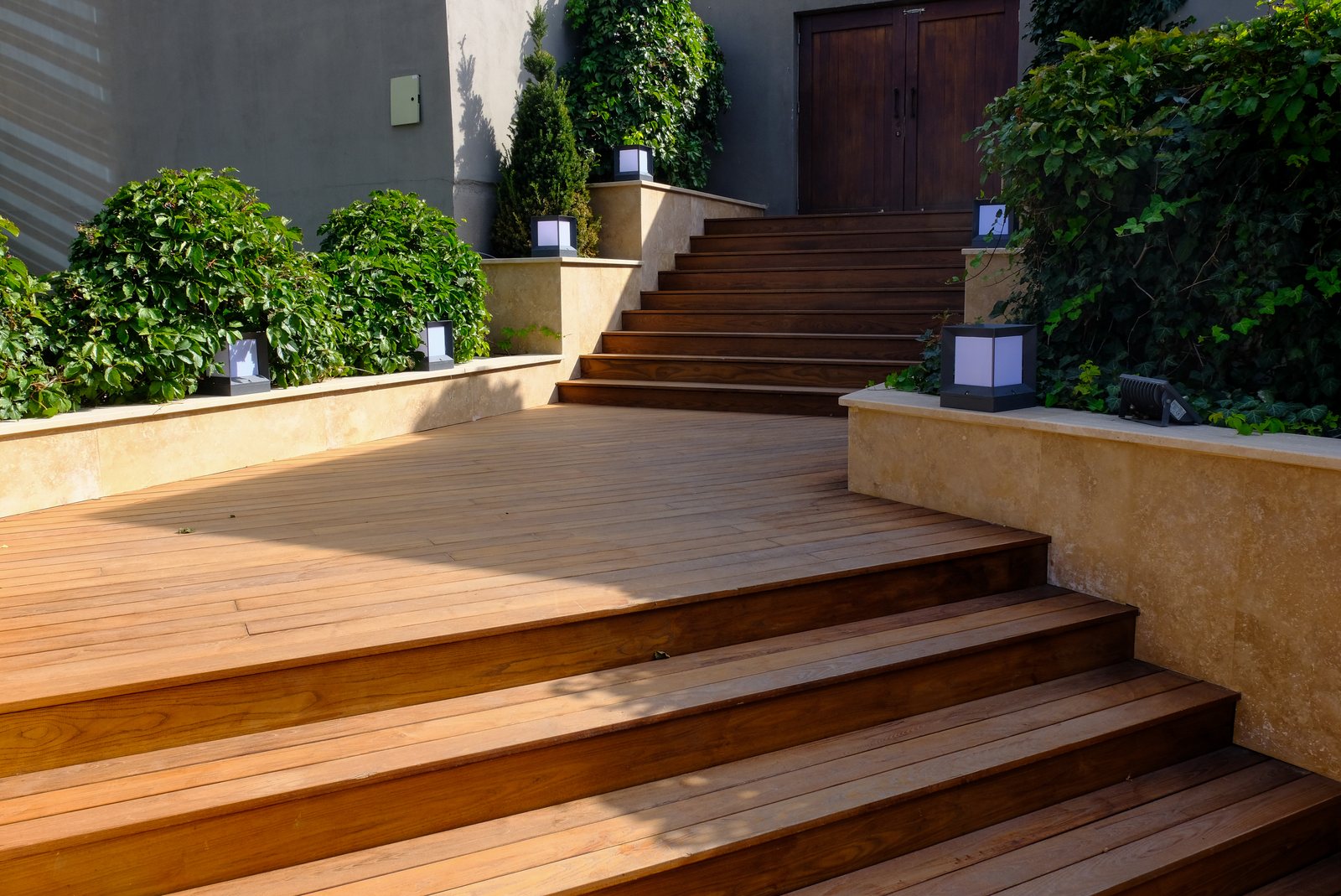
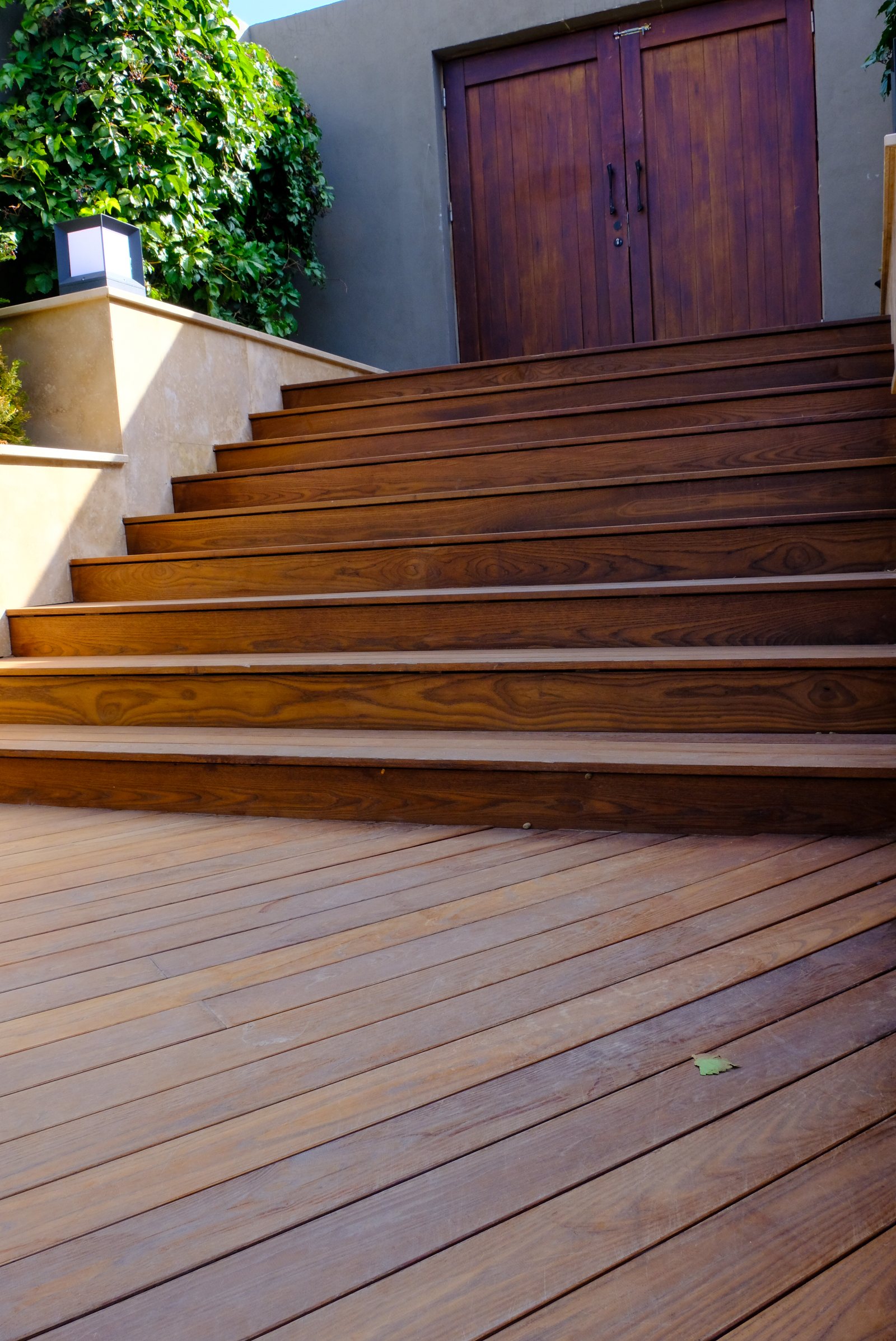
A milled exterior tread is a beam that people walk on, a weather-exposed surface that drains, and a profiled part whose nosing is set by a ground knife, and a specification that only addresses one of those three will fail on the other two. Most stair problems on a deck or a covered porch trace back to a part that was ordered like trim and installed like framing. The tread cups because nobody thought about the back face. The nosing radius does not match the code the inspector is reading. The riser was painted on five faces and the sixth face soaked up water from the tread above it.
Treads, risers, skirt boards and stringer cladding come off the moulder as a set of related parts. ICD, the architectural millwork division of J. Gibson McIlvain, builds that set as true custom work planned around a specific stair rather than pulled from a stock catalog, which matters when the rise and run were set by a landing elevation that nobody is going to move. The linear runs that surround the stair, primed riser stock, finished cladding for the stringer face, skirt and apron material, come off the J. Gibson McIlvain millwork service at the lumber yard. One order, two shops, one moisture target.
Tread thickness is a span decision before it is an appearance decision
The clear distance between stringers sets the tread thickness, and the concentrated load case in the residential code is what governs, not the uniform load. Stairs are designed for a concentrated load applied over a small area at the worst location on the tread, which is a harder test for a single board than a spread-out live load. The American Wood Council publishes the design values and span guidance that a structural reviewer will reach for, and the stair geometry provisions live in Chapter 3 of the IRC.
Practical numbers from the shop floor. A 5/4 blank dressed to roughly one inch works on stringers at a narrow clear span, the kind of three-stringer layout used on a standard deck stair. Push the stringers apart and the tread wants 6/4 dressed to about one and five sixteenths, or 8/4 dressed to about one and three quarters for a wide porch stair with only two carriages. Thickness also buys you nosing. A thin tread with a heavy bullnose leaves very little meat behind the profile, and the nosing becomes the first thing to split when a fastener is driven too close to the edge.
J. Gibson McIlvain resaws and mills tread blanks out of thick stock rather than accepting whatever thickness a distributor happens to carry, which is the reason an odd thickness is not an obstacle. Band resaws and straight line ripping on site mean a one and three eighths inch finished tread is a setup, not a special order to somebody else.
The nosing profile is a knife, and the knife is where the code numbers get enforced
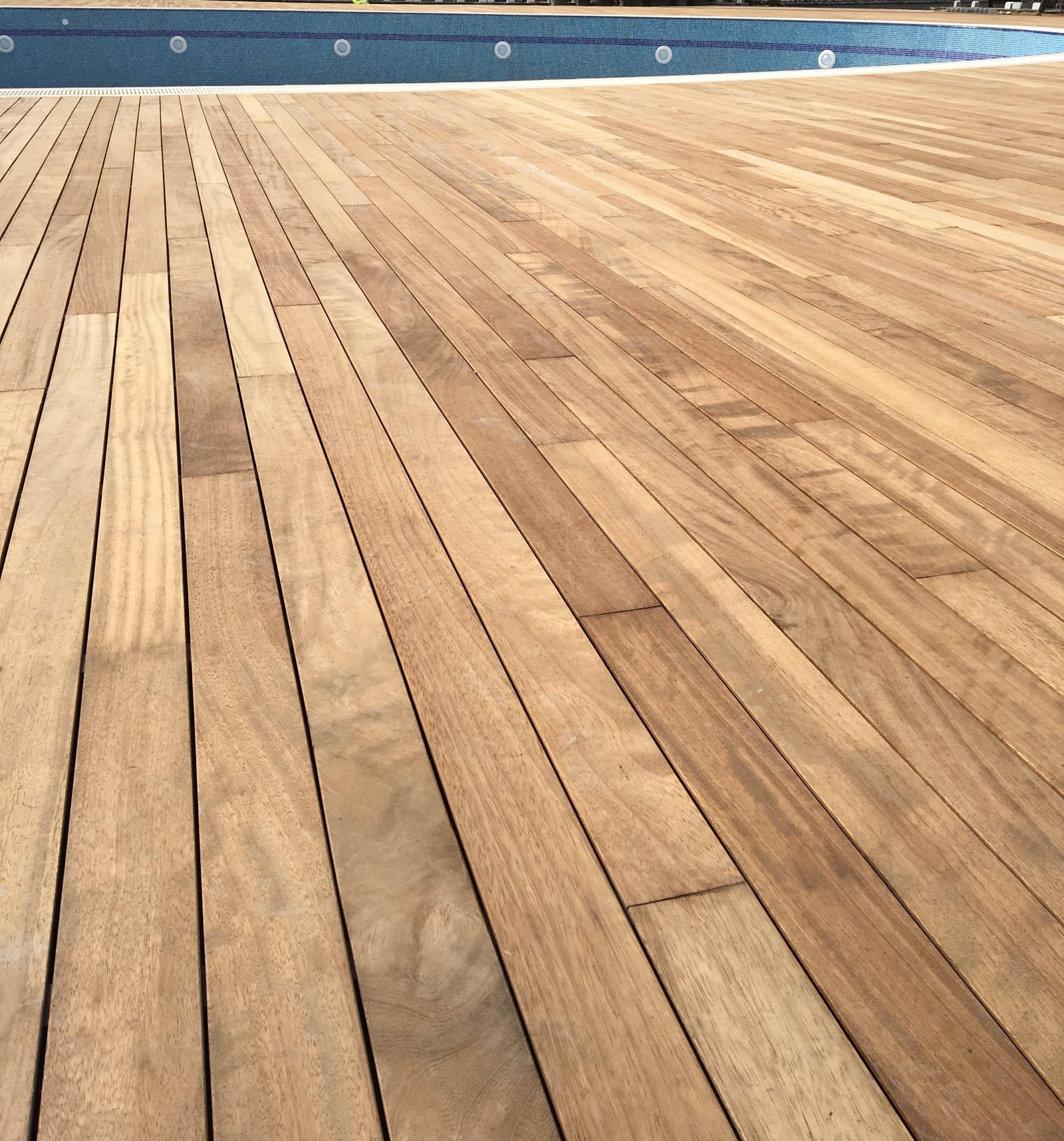
A nosing is not a sanding operation, it is a ground profile, and the radius at the leading edge is a dimension that an inspector can measure with a gauge. Residential stairs require a nosing projection between three quarters of an inch and one and a quarter inches where the tread depth is less than eleven inches, and the leading edge radius is capped. Stairs on the accessible route follow a different set of numbers, with a tighter radius allowance, a limit on how far the nosing projects, and a rule on the underside bevel, all laid out in the Access Board guidance on stairways. A porch stair at a commercial entry can easily land under the second set.
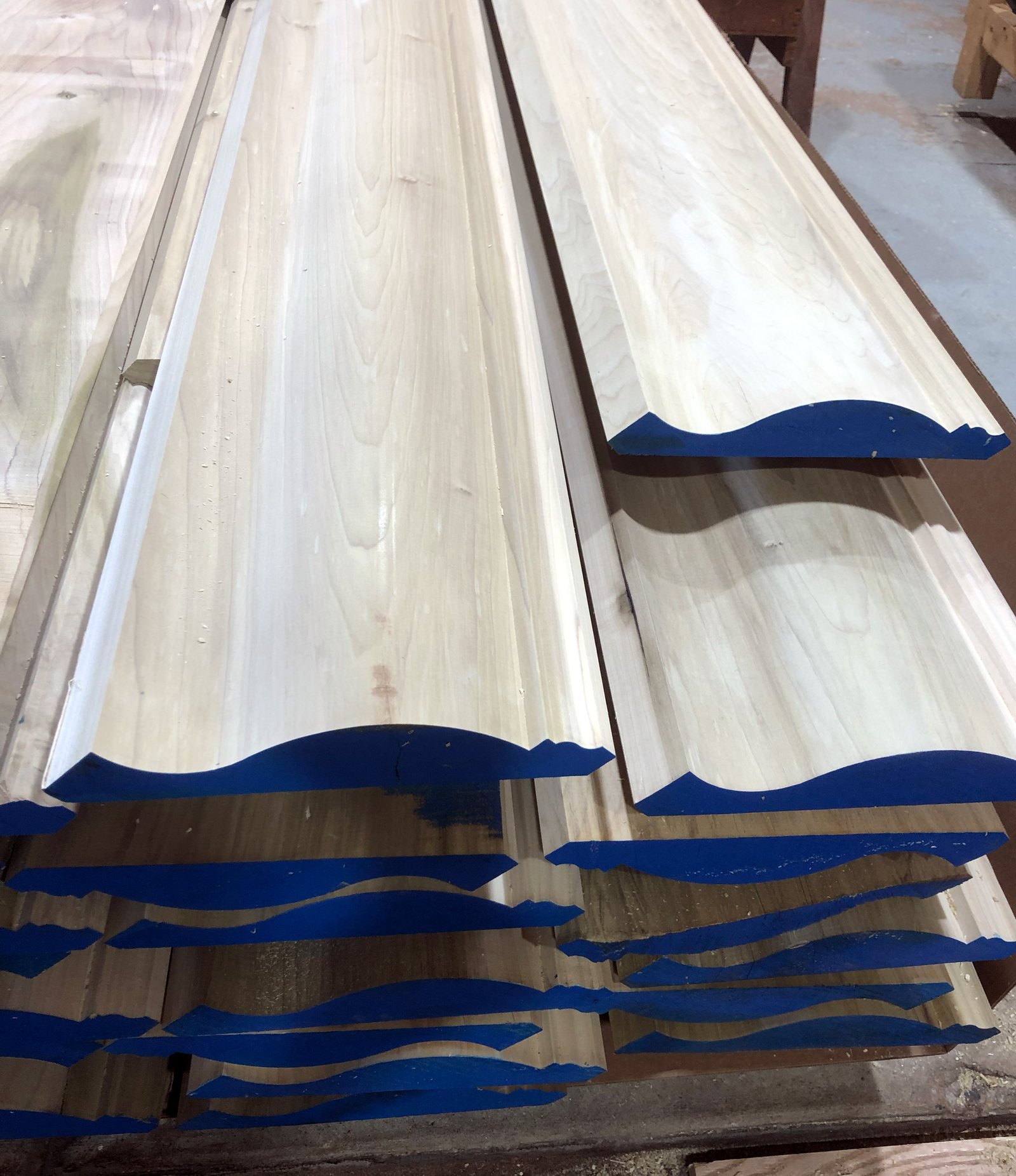
J. Gibson McIlvain grinds new knives every week and keeps a profile library holding thousands of them, so a nosing can be matched to an existing stair, originated to a drawing, or ground to hit a specific radius the reviewer has called out. The ICD profile work covers the same ground on the custom side, including historical restoration profiles where a replacement tread has to match a nosing that was run a century ago. A historic district that requires like-for-like replacement is not going to accept a modern stock bullnose on a front porch stair, and the National Park Service preservation briefs are the document that gets cited when that argument happens.
One detail that saves grief later. A cove or a small scotia under the nosing traps water on an exterior stair. Keep the underside of an exterior nosing simple and open so a drip can leave. Save the decorative undercut for interior work.
Tread width is the point where a solid board, a glue-up and a two-board tread stop being interchangeable
A tread wider than about seven inches in a single flatsawn board is a cupping problem waiting for a wet week, which is why wide exterior treads are either quartersawn, laminated from narrower stock, or built as two boards with a drainage gap. Wood moves across the grain far more than along it, and the Wood Handbook from the Forest Products Laboratory carries the shrinkage coefficients that make that movement predictable. Quartersawn and rift stock moves less across its width than plainsawn, which is exactly why it gets specified where a surface has to stay flat under weather.
Cupping, though, is driven more by installation and back ventilation than by species. A tread with an airtight underside and a wet-weather topside has a moisture gradient across its thickness, and the board curls toward the dry face. The fix is not a harder species. The fix is airflow under the stair, a finish or primer on all six faces so both faces exchange moisture at similar rates, and fastening that lets the board move. Building Science Corporation's work on rain control covers the same physics at the assembly scale.
| Tread build | Practical width limit | How it behaves outdoors | What the spec has to state | Where it goes wrong |
|---|---|---|---|---|
| Single solid board, plainsawn | Roughly 6 to 7 in of exposed face | Largest seasonal width change of the four, most prone to cupping if the underside is sealed off | Thickness, nosing profile, moisture content, six-face priming or finish | Specified at 1x8 or wider for exterior use, where it will not stay flat |
| Single solid board, quartersawn or rift | Roughly 8 to 10 in depending on species and log size | Moves noticeably less across the width, holds a painted or coated surface flatter | Grain orientation called out explicitly, not left to the mill's discretion | Availability, since quarter and rift yield is a fraction of the log |
| Edge-glued laminated tread | Full tread depth in one piece, 11 in and up | Alternating growth ring orientation cancels much of the cupping tendency | Adhesive suited to exterior exposure, joint layout, species that actually glues | Very oily, very dense species resist a reliable glue bond |
| Two boards with a drainage gap | Any depth, split into two narrow members | Best drainage and best ventilation, each member narrow enough to stay flat | Gap dimension, typically 1/8 to 3/16 in, and support under both members | Gap too wide, which becomes a heel catch and a code comment |
The millwork species for a machined, glued, coated tread are not the same as the deck board species around it
Sapele, Iroko, Afrormosia, Teak and Utile are the working palette for milled exterior stair parts, because they machine cleanly, take a moulded nosing without tearing, glue reliably and hold a coating. Sapele carries a Janka hardness around 1,410 lbf, which is plenty for foot traffic, and it comes in a range of sizes and lengths that a stair with a long landing tread can actually use. Iroko and Teak bring natural durability with an oil content that the shop plans around at the glue line. Afrormosia machines beautifully and holds an edge profile crisply. Utile behaves close to Sapele and often solves a color-matching problem when a stair has to sit next to existing work. The Wood Database entry for Sapele is a reasonable starting point on the mechanical properties.
The tropical decking species, Ipe (Tabebuia spp), Cumaru, Garapa, Jatoba and Red Balau, are a different conversation. They are extremely hard and carry high oil content, and that combination makes them difficult to glue and hard on knives. A decking contractor reaches for them constantly and should. A millwork shop reaches for them far less, because a laminated tread, a moulded nosing and a primed riser all depend on operations those species fight. If the deck field is Ipe and the client wants the stair to match, the honest answer is a solid single-width tread in the same decking species with no glue line and a simple eased edge, or a millwork species finished to blend. Do not promise a glued-up Ipe landing tread with a heavy profile and expect it to behave.
Cedar deserves a straight answer here too. Clear vertical grain cedar, CVG, is stable, holds paint and stain well and is a legitimate default for risers, skirt boards and stringer cladding. Select tight knot cedar, STK, is the right call where a knotty face is wanted and where the part is not carrying a coating that has to stay perfect over a knot. Cedar's lower hardness means a tread face will show point-load dents from furniture and hard heels sooner than Sapele will, so it belongs more often on the vertical parts of the stair than on the walking surface.
Modified woods belong in this conversation on their own terms. Accoya runs around 1,600 lbf Janka with acetylation giving dramatically reduced shrinkage and swelling, which is a real advantage for a wide tread. Thermory and Abodo Vulcan are both carried as well. Three constraints control the design. Modified material tops out around sixteen feet, most of it sold on metric lengths just under sixteen feet, because of kiln size. Thermally modified Ash is not available wider than eight inches, so a wide modified tread means Accoya or Abodo Vulcan. And warranties exist only on modified products. There is no warranty on solid unmodified wood, because an organic material responding to its environment cannot be warranted.
Exterior treads are milled near 12 to 16 percent, and the riser stock is primed on all six faces before it leaves
Interior millwork goes out at 6 to 8 percent in-service moisture content and exterior millwork at roughly 12 to 16 percent, and shipping an exterior stair part at interior moisture content guarantees it will swell on site. That difference is not a rounding error. A wide tread milled dry and installed outdoors in a humid month picks up width, closes its drainage gap and puts pressure against the skirt board. J. Gibson McIlvain mills exterior stair components to the exterior target and holds the finished parts in storage until the stair is ready, which is what keeps a tread from sitting on a job site absorbing whatever the weather offers.
Priming is the other half. J. Gibson McIlvain primes in three levels, in both oil-based and water-based systems, and exterior primed trim carries a fungicide additive. Open-grained and oily species absorb a great deal of finish, so the primer coat is what evens out the eventual painted surface instead of leaving it blotchy. Sanding or buffing after priming knocks back the grain raising while keeping the moulded detail crisp, which matters on a riser with a bead or a chamfer where a heavy primer coat would otherwise round the arris.
Six faces means six. The bottom of the tread, the back of the riser and both end grain cuts are where water gets in, and end grain drinks many times faster than face grain. Field cuts are the installer's responsibility to seal before the part goes down, and a stair with three field-cut ends left raw will tell you about it within two seasons.
Risers, skirt boards and stringer cladding are linear trim work, and they should be ordered that way
The vertical and flanking parts of an exterior stair are finished cladding and primed trim, which is J. Gibson McIlvain's own service at the yard, and running them alongside the custom treads keeps species, grade and coating consistent across the whole assembly. A closed riser wants to be stable and paint-ready more than it wants to be hard. For painted exterior trim, Sapele is the better choice over Genuine Mahogany, because it holds paint better and comes in a wider range of sizes and longer lengths. Genuine Mahogany runs around 800 lbf Janka and is a fine wood, but paint adhesion and size availability decide this one. Note that Sapele is not milled 1x8 for exterior use. That width is too wide to stay stable outdoors, which is the same reason a wide riser is better solved as two members or a narrower board with an applied cap.
Skirt boards take the worst of it. They sit against siding, they collect splash-back off the treads, and they are usually the longest single piece in the assembly. Over seven million board feet of exotic and domestic lumber at the Maryland yard is what makes a long, clear, single-piece skirt board a normal request instead of a scavenger hunt. The same inventory depth is what allows treads to be lot matched for color when a stair has eight of them in a row and a mismatched fourth tread would be obvious from the driveway.
Stringer cladding is where the deck's structural carriage gets covered with something that matches the trim package. Finished cladding runs get milled to the exact width the carriage presents rather than trimmed on site from a stock width, which keeps the reveal even along a raking line where any error is magnified visually.
Curved porch stairs mean radius treads, and a radius tread is laid out in the shop, not bent on site
A curved or flared bottom step is radius millwork, which means the tread is cut to a template and the nosing profile is run around a curve rather than along a straight line. ICD builds radius trimwork and radius millwork as part of its custom scope, and a flared entry step with a curved riser is one of the most common versions of it on a residential porch. The riser on a curved stair is its own problem, since a solid riser cannot follow a tight radius without being kerfed, laminated in thin plies around a form, or built as a segmented assembly.
What the shop needs is a template or a dimensioned drawing with the actual radius, the tread depth at the centerline, and the flare geometry at each end. What the shop delivers is a tread with the nosing already run and the underside relieved as drawn. The installer sets it, fastens it and handles any scribe to the existing structure. J. Gibson McIlvain supplies and mills. It does not install, and the layout information has to come from the builder's own field measurements.
"The stairs are where we see the most rework on an exterior package, and it is almost never the species that caused it. Somebody ordered treads at interior moisture content, or they primed five faces and called it done, or the nosing radius on the drawing did not match the one the inspector measured. We would rather have that conversation before the knife is ground than after eight treads are on a truck."
Norm Moton, Director of Sales, J. Gibson McIlvain
Slip resistance on a wood tread is a surface decision, and a moulder can only help with part of it
A moulder runs relief grooves along the length of a tread, not across it, so any cross-grain texture or applied non-slip treatment is the buyer's fabricator or finisher to handle. Longitudinal grooves do real work. They break surface tension, give water a path off the front edge and give a shoe sole something to bite. They are a ground profile like any other, so the groove spacing and depth get specified and the knife gets made. What a moulder cannot do is cut a texture perpendicular to the run, and nobody is served by pretending otherwise.
Slip resistance as a performance requirement lives in standards rather than in the millwork order. ASTM F1637 is the practice most often referenced for safe walking surfaces, and the accessible-route rules add their own language about stair surfaces being stable, firm and slip resistant. Where the project calls for a measured coefficient of friction, that number is a property of the applied finish system, not of the raw wood, and it should be verified on the actual coating.
Two practical notes. A smooth, heavily film-built finish on an exterior tread is slicker when wet than a penetrating finish, and it fails by peeling rather than by fading. And a tread that drains well is a tread that stays less slippery, which loops straight back to the drainage gap and the open underside discussed earlier.
Documentation travels with the material, and so does the packaging
An FSC certified importer and miller can put chain of custody paperwork in the same shipment as the treads, which is what a specification with sourcing requirements actually needs. J. Gibson McIlvain is FSC certified and carries the documentation through the mill rather than reconstructing it after the fact. Where a CITES listed species is part of the package, the permits and chain of custody documents travel with the material. The FSC and CITES sites are the primary references, and a design team writing a sourcing clause should be reading those rather than a supplier's summary of them.
Delivery matters more on stair parts than on almost anything else in an exterior package, because a primed tread with a crisp nosing is a finished surface from the moment it leaves the shop. J. Gibson McIlvain ships on its own fleet of trucks and runs a section of the mill dedicated to packaging, which is how a set of eight matched treads arrives with the nosings intact rather than chipped by a strap. Nationwide shipping is routine, including regular runs to California. Finished millwork can be held in storage and released in stages, so the treads are not sitting on a job site for six weeks waiting on the framing inspection.
Grading language belongs in the order as well. NHLA rules govern hardwood lumber grades, and the Wood Moulding and Millwork Producers Association publishes the moulding standards that give a profile drawing a shared vocabulary. Specifying to a grade is how a buyer avoids the argument about whether a small defect on a tread face was acceptable.
How J. Gibson McIlvain Would Specify This
A stair package that will not come back is specified in one document covering geometry, grain, moisture, coating and delivery, and J. Gibson McIlvain builds it that way because the custom treads and the linear trim come off the same order. Here is the shape of that specification.
State the geometry first. Total rise, number of risers, riser height, tread depth at the centerline, nosing projection and leading edge radius, and whether the stair falls under the residential code or the accessible route rules. Uniformity is a code item, so the largest and smallest riser heights in a flight have to fall within the allowed tolerance.
Then the material. Name the species from the millwork palette, Sapele, Iroko, Afrormosia, Teak or Utile, or name Accoya or Abodo Vulcan if the project wants a modified product and its warranty. Call out grain orientation explicitly on anything over seven inches wide. State the build method from the table above rather than leaving it to the mill.
Then the numbers that control behavior. Exterior moisture content at roughly 12 to 16 percent. Six-face priming with the fungicide additive on exterior work, at the primer level the finish schedule requires. Drainage gap dimension if the tread is a two-board build. Groove profile on the walking surface if one is wanted.
Then the shop instructions. J. Gibson McIlvain grinds the nosing knife to the drawing and records it, so phase two of the same project gets the identical profile years later. Seventh generation and family run since 1798 is the reason that record is still there when somebody calls back about a matching side stair. ICD plans the radius work and the custom tread assemblies around the actual stair rather than around a catalog, and the working process starts from the drawing, not from a stock list. J. Gibson McIlvain holds the material, mills the parts, primes them, packages them and delivers them on its own trucks.
Last, the honest boundary. The company supplies and mills exterior stair components. It does not install them, does not coordinate installation and does not field measure. Fastening, flashing at the stringer-to-structure connection, sealing field cuts and any applied non-slip treatment are the builder's scope. What arrives is a set of parts that fit the drawing, at the right moisture content, primed and packaged, with the nosing profile the reviewer asked for.
To put a stair package together, or to get a nosing profile matched from a template or a photograph, call J. Gibson McIlvain at 800-638-9100 or start with the ICD exterior millwork group.
Frequently Asked Questions
How thick should an exterior stair tread be for a deck with three stringers?
A 5/4 blank dressed to roughly one inch is the common answer on a standard deck stair where the clear span between stringers is short. Widen the stringer spacing, or drop to two carriages on a porch stair, and the tread wants 6/4 dressed to about one and five sixteenths or 8/4 dressed to about one and three quarters. Thickness is also what leaves material behind a moulded nosing so the leading edge does not split when a fastener lands close to it. J. Gibson McIlvain resaws and mills tread blanks out of thick stock, so a non-standard finished thickness is a machine setup rather than a special order.
Can a single board be used for an eleven inch deep exterior tread?
Only if the grain orientation supports it. A plainsawn board that wide will cup outdoors under a moisture gradient. Quartersawn or rift stock moves considerably less across its width and can carry more depth, though the yield off the log limits how much is available. The two reliable answers at full tread depth are an edge-glued lamination with alternating ring orientation, or two narrower members set with a drainage gap of about an eighth to three sixteenths of an inch. Call out which one you want rather than leaving it to the mill.
Why not use Ipe or Cumaru for the milled tread parts if the deck field is Ipe?
Those decking species are extremely hard and carry high oil content, which makes them difficult to glue and hard on knives. That is fine for a plain deck board and a problem for a laminated tread, a heavy moulded nosing or a primed riser. A millwork shop reaches for Sapele, Iroko, Afrormosia, Teak or Utile instead, because those machine cleanly, take a profile without tearing and bond reliably. If the stair has to visually match an Ipe field, the workable version is a solid single-width tread in the same decking species with a simple eased edge and no glue line.
What moisture content should exterior stair treads arrive at?
Roughly 12 to 16 percent for exterior work, against 6 to 8 percent for interior millwork. Parts shipped at interior moisture content will take on moisture outdoors, gain width, close a drainage gap and push against the skirt board. J. Gibson McIlvain mills exterior stair components to the exterior target and can hold the finished parts in storage until the stair is ready to receive them.
Does priming really need to cover the underside of the tread?
Yes. A tread primed only on the top and edges has one face exchanging moisture with the air and one face sealed, which is the condition that produces cupping. Prime or finish all six faces so both faces behave alike, and use the fungicide additive that belongs on exterior work. End grain absorbs many times faster than face grain, so any cut made in the field has to be sealed by the installer before the part goes down.
Can a nosing profile be matched to an existing historic porch stair?
That is routine work. J. Gibson McIlvain keeps a profile library holding thousands of ground knives and grinds new ones every week, so a nosing can be matched from a template, a section drawing or a salvaged sample, including historical restoration profiles. A historic district requiring like-for-like replacement will not accept a modern stock bullnose, so the matched knife is what makes the approval possible.
Are non-slip surfaces available on milled treads?
A moulder can run relief grooves along the length of a tread, and those get specified by spacing and depth like any other profile. What a moulder cannot produce is a texture running across the grain, and applied non-slip inserts or coatings are outside what the shop supplies. Those belong to the buyer's own finisher or fabricator. Where a project sets a measured coefficient of friction, that number is a property of the applied finish system, not of the bare wood, and it should be verified on the actual coating.
Can the company install the stair or measure it in the field?
No. J. Gibson McIlvain supplies and mills, and does not install, coordinate installation or field measure. The builder provides the layout, the template for any radius work and the field dimensions. What ships is a set of parts cut and profiled to the drawing, at the correct exterior moisture content, primed and packaged, delivered on the company's own trucks nationwide.
Sources and Standards Referenced
- Wood Handbook, Wood as an Engineering Material (FPL-GTR-190), USDA Forest Products Laboratory
- Codes and Standards, American Wood Council
- 2021 International Residential Code, Chapter 3 Building Planning (stairways)
- ADA Guide, Chapter 5: Stairways, U.S. Access Board
- ASTM F1637, Standard Practice for Safe Walking Surfaces
- BSD-013: Rain Control in Buildings, Building Science Corporation
- Preservation Briefs, National Park Service Technical Preservation Services
- Sapele, The Wood Database
- Forest Stewardship Council
- CITES, Convention on International Trade in Endangered Species of Wild Fauna and Flora
- National Hardwood Lumber Association
- Wood Moulding and Millwork Producers Association