What the Trade Means by Saddle and Sill

A sill, a saddle and a threshold are three separate members of the same opening, and calling them by the wrong name is how the wrong piece ends up on the truck. The sill is the sloped horizontal member at the bottom of the door frame. It carries the jamb legs, terminates the wall assembly and moves water away from the building. The saddle sits on top of the structural floor between the jamb legs and covers the joint where the exterior assembly hands off to the interior floor.
Threshold is the looser word. On a commercial opening it usually names the member that carries the weatherstrip, the sweep contact surface or the door bottom seal, whether that member is wood, metal or a wood core with an applied nosing. Transition piece is an interior term for the milled strip that bridges two floor coverings of different thickness inside the weather line.
Drawings mix all four freely. The shop cannot. A member milled as an interior transition and installed as an exterior sill will fail on moisture content alone, before a drop of rain touches it. ICD, the architectural millwork division of J. Gibson McIlvain, builds these pieces as true custom work planned around a specific opening rather than pulled from a catalog of stock sections, which means the naming gets settled at the drawing stage instead of at the job site.
The Water Problem at a Door Opening
The bottom of a door opening is the single hardest place on a facade to keep dry, because it collects water arriving from four directions at once. Rain runs down the door face and lands on the sill. Wind drives it sideways into the joint between the sill and the jamb. Splash off adjacent paving, a balcony deck or a stoop throws water back up onto the underside of the nosing. And the sill sits close enough to grade that capillary action pulls moisture up through any bearing point that stays wet.
Building Science Corporation's work on rain control in buildings describes the hierarchy every wall relies on, which is deflection first, drainage second, drying third. A door sill is where all three get compressed into a few inches of section. There is no cavity to drain into and very little room to dry.
End grain is the weak point. A sill exposes end grain at both ends, at every mitre, at every fastener hole and at the underside of any rabbet cut for the pan. Untreated end grain absorbs water at many times the rate of a face, which is why sealing it matters more than the species choice. ASTM E2112, the practice for installation of exterior windows, doors and skylights, treats the sill pan and the back dam as the assembly that protects the wood, not the other way around.
Species That Hold Up Under a Door
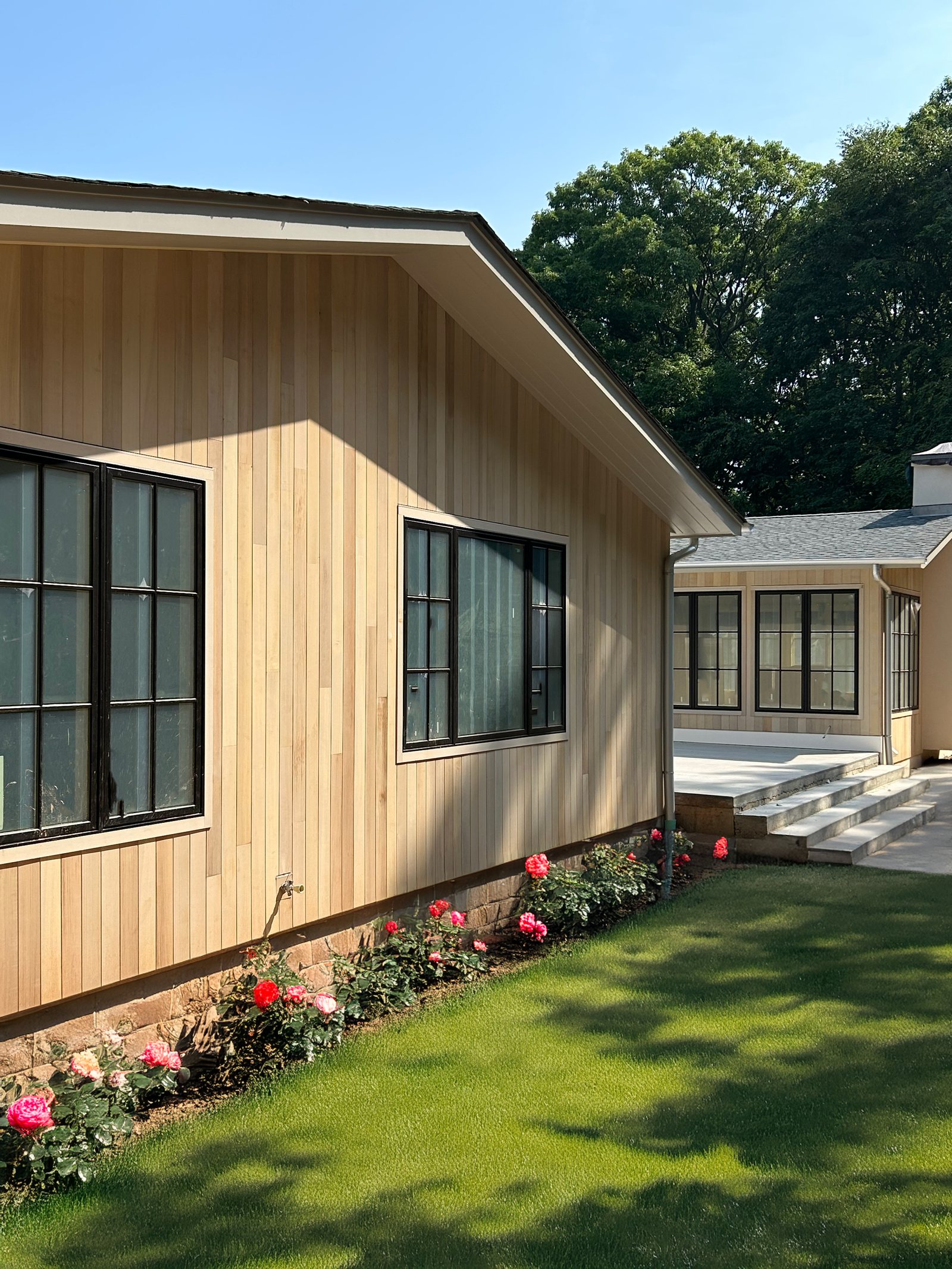
The millwork palette for exterior sills and saddles is Sapele, Iroko, Afrormosia, Teak and Utile, and every one of them machines and glues better than the tropical decking species buyers tend to ask for first. Sapele runs roughly 1,410 lbf on the Janka scale, takes a crisp arris off a moulder knife and holds paint better than Genuine Mahogany, which sits near 800 lbf. J. Gibson McIlvain stocks Sapele in a wider range of sizes and longer lengths than Genuine Mahogany, so a painted exterior sill spec almost always lands there.
Teak is the traditional answer where the top face stays uncoated and gets walked on, and its natural oil content and low movement are the reason. Afrormosia behaves much like Teak in service and machines cleanly. Iroko is stable and durable in exposure. Utile is close kin to Sapele, a little coarser in texture, and useful when a long or wide blank has to come out of one lift.
The tropical decking species are a different tool. Ipe, botanically Tabebuia spp, along with Cumaru, Garapa, Jatoba and Red Balau, are extremely hard and carry high oil content, which makes them difficult to glue reliably. That matters the moment a sill has to be laminated for width, wrapped with a nosing or joined to a jamb. A millwork house reaches for Sapele, Iroko, Afrormosia, Teak or Utile instead, and saves the decking species for the deck the door opens onto.
Western Red Cedar earns its place in the same opening. Clear vertical grain cedar, CVG, is dimensionally well behaved and takes primer beautifully, which makes it a sound choice for the casing, the jamb and the trim that surrounds the door. Select tight knot cedar, STK, carries sound knots and belongs on cladding and rustic work rather than on a coated sill face. What keeps cedar off the saddle itself is foot traffic, not durability.
Modified wood is the other option, and it is the only one that comes with a warranty. Accoya runs roughly 1,600 lbf with acetylation producing dramatically reduced shrinkage and swelling, which is exactly the behavior a painted sill wants. Thermory and Abodo Vulcan are both carried. Thermally modified Ash is not available wider than 8 inches, so a wide sill blank in a modified product means Accoya or Abodo Vulcan. All of these top out around 16 ft, most sold on metric lengths just under 16 ft, because of kiln size.
No one can warranty solid unmodified wood. It is an organic material responding to its environment, and a sill lives in the worst environment on the building. What a supplier can control is the stock, the grain, the moisture content and the coating, and those four decisions carry most of the service life.
Moisture Content for a Piece That Straddles Two Climates
A saddle is the only millwork item on a project with conditioned air on one face and weather on the other, so it has to be assigned to one side of the moisture line before a knife touches it. J. Gibson McIlvain mills interior millwork to an in-service moisture content near 6 to 8 percent and exterior work near 12 to 16 percent. Those are not interchangeable targets. A piece milled at 7 percent and set outdoors will take on moisture, swell across its width and push the joint at the jamb.
The working rule is to follow the weather line, not the floor plan. A sill outboard of the door seal gets exterior moisture content. An interior saddle at a vestibule, or a transition strip inside a conditioned lobby, gets interior moisture content. Where a single piece crosses the line, the exterior number governs, and the interior joint gets detailed to absorb the movement instead of resisting it.
The Forest Products Laboratory Wood Handbook gives the tangential and radial shrinkage coefficients that let you calculate this rather than guess at it. On a 6 inch wide plainsawn Sapele sill, a four point swing in moisture content is a visible dimensional change at the shoulder. Quartersawn stock cuts that number substantially.
Profile Geometry That Sheds Water
Almost everything that keeps a wood sill alive is geometry, and every piece of that geometry is a knife decision made before the blank goes through the moulder. The wash, the drip, the back dam and the nosing return are not decoration. Each one has a failure that follows from leaving it out, and each one has a machining implication that has to be settled while the profile is being drawn.
J. Gibson McIlvain grinds new knives every week and holds a profile library of thousands of ground knives. A sill section that includes a wash, a drip kerf and a rabbet for the pan is one knife setup, not three operations, once the profile is drawn correctly. Where a historic entry has to be matched, the existing sill gets templated and the knife gets ground to it, which is the same process the shop uses for historical restoration profiles.
| Profile feature | Function at the opening | How it gets produced | Failure mode when omitted |
|---|---|---|---|
| Sloped wash on the top face | Moves standing water away from the door seal and toward the exterior edge | Ground into the moulder knife so the slope and the shoulder come off in one pass | Water ponds against the sweep, the seal stays wet and the coating blisters from behind |
| Drip kerf under the nosing | Breaks surface tension so runoff releases instead of wrapping back to the wall | Cut on the moulder as part of the section, or run separately on a trimming saw | Water tracks along the underside and wets the band, the sheathing and the fastener line |
| Back dam or upstand | Holds wind driven water on the exterior side of the door seal | Milled as part of the sill section or applied as a separate rabbeted member | Driven rain crosses the seal line and shows up on the interior floor finish |
| Rabbet for the pan flashing | Lets the sill sit down onto the pan without trapping water in the bearing joint | Rabbeted on the moulder to the pan thickness given on the drawings | The pan gets packed out with shims, the sill rocks, and the joint holds water |
| Nosing and return | Carries the sill past the jamb line and conceals end grain at the return | Mitred and joined in the shop, lock mitre where no seam may show | Exposed end grain wicks, the mitre opens and the corner rots first |
| Interior bevel at the saddle | Meets the accessibility slope requirement where the level changes | Machined to the bevel ratio called for on the drawings | The opening fails inspection and the saddle has to be replaced after the floor is down |
Grain Orientation, Glue Lines and Built Up Sills
Quartersawn and rift stock move less across the width than plainsawn, which is the whole argument for specifying them in a sill that has to stay flat under a door seal. The seal only works against a flat plane. A sill that cups a sixteenth of an inch across its width has broken contact with the sweep along its entire length, and no amount of adjustment at the hardware fixes a surface that is no longer straight.
Width is the second constraint. Commercial openings frequently call for a sill deeper than the clear stock available in the species, which means laminating. Glue line quality is where the oily species punish you. Teak and the high oil tropicals need a fresh machined surface and a solvent wipe immediately before assembly, and the window between milling and clamping is short. Sapele, Iroko and Utile are far more forgiving and hold a glue line without that fuss.
Wrapped and built up sections get the same joinery decision the shop makes on box beams, and it is a real choice rather than a default. Butt joints give the most minimal profile, the fastest turnaround and the easiest assembly on site, but they leave visible seams and visible end grain and they are the weakest. Dado joints are strong and still easy to assemble on site, though seams and end grain still show. Lock mitre joints show no visible seams and are the strongest, which is why they are the right call on an exposed exterior return.
Priming and Finish on an Absorbent Sill
Coating failure at a sill almost always starts on a face nobody coated. J. Gibson McIlvain primes in three levels, in both oil-based and water-based systems, and exterior primed trim carries a fungicide additive. Open-grained and oily species absorb a great deal of finish, so a primer coat evens out the eventual painted surface, and sanding or buffing after priming knocks back grain raising while keeping moulded detail crisp.
All six faces matter on a sill more than on any other trim item. The underside sits on a pan and never dries quickly. The ends sit in pockets at the jamb. A piece primed on the show faces only has two uncoated end grain surfaces pointed straight at the wettest part of the assembly, and that is where the first dark stain appears two winters later.
The walking surface is a separate question. Paint on a trafficked saddle wears through at the traffic pattern and then holds water in the worn strip. Where the top face gets walked on, the usual answer is a penetrating finish applied by the buyer's finisher after the opening is complete, with the shop supplying the piece primed on the faces that will be painted and left clean where the final finish goes. The National Park Service Preservation Briefs cover the same logic for historic entrances, where the sill is usually the first member replaced.
Height, Bevel and Accessible Openings
On a commercial project the finished height of the saddle is not a millwork preference, it is a dimension set by accessibility requirements and by the floor finishes on either side. The ADA Accessibility Standards maintained by the United States Access Board limit thresholds at doorways and govern how a change in level has to be treated, with a bevel required above a defined vertical rise. Those numbers set the thickness budget before anyone picks a species.
The budget gets spent by the floor. A saddle between a stone entry and a carpeted lobby has a different rise on each side. A saddle between polished concrete and a wood floor has almost none. The millwork has to be drawn to the actual finished floor elevations, which come from the buyer's drawings and the buyer's field conditions.
J. Gibson McIlvain supplies and mills, and does not install or measure in the field. The practical consequence for a general contractor is simple. The dimensions on the shop order are the dimensions the buyer verified, and the installer owns the fit. The upside is that a shop working to verified dimensions can hold a tolerance a site-cut piece never will, and can repeat it across forty identical openings.
"The sill drawing tells me more about how a job will go than the elevation does. If someone has thought through the wash, the drip and the pan rabbet before they call us, that opening is going to be fine in ten years. If the sill is just a rectangle on the drawing, we start asking questions, because we would rather grind the right knife once than ship a piece that has to come back out after the floor is down."
Norm Moton, Director of Sales, J. Gibson McIlvain
Interior Transitions on Commercial Floors
Interior transition pieces are milled trim, not flooring, and treating them as trim is what gets them to match the specified species and profile across a whole building. A reducer between a wood floor and a resilient floor, a T section between two wood fields, a saddle at a restroom opening and a strip at a stair landing are all the same problem, which is a solid profile milled to a drawn section in a named species at a controlled moisture content.
ICD mills these as radius work too. A curved lobby transition, a segmented arc at a rotunda edge, or a transition following a radius wall is radius millwork, laid out and cut from the same species and the same lot as the straight runs so the color holds through the curve. Straight sections and curved sections coming off one order is the practical reason to keep them together.
Matching is the other half. J. Gibson McIlvain holds over seven million board feet of exotic and domestic lumber at its Maryland yard, which is what makes it possible to pull a single lot for 200 transition pieces so the color runs consistently through a corridor instead of shifting from floor to floor. The trim profile capability covers matching an existing section as readily as originating a new one, and the shop grinds a new knife when the section is not already in the library.
One boundary worth stating plainly. Custom engineered wood flooring is not something the company produces, so a transition that has to be manufactured as an engineered panel to match an engineered floor belongs with the flooring manufacturer. Solid hardwood transitions, thresholds and saddles milled to a drawn profile are squarely in the wheelhouse. Standards for architectural woodwork quality levels published by the Architectural Woodwork Institute are a useful reference when writing the spec section that covers them.
Delivery, Documentation and Inventory Control
A primed, finished sill is one of the easiest millwork items on a project to ruin between the shop and the opening. J. Gibson McIlvain runs its own fleet of trucks and keeps a section of the mill dedicated to packaging, which is what keeps a coated face from arriving scuffed. The company ships nationwide, regularly to California, and stages deliveries against a construction schedule rather than dumping a whole package on a site that is not ready for it.
Storage is part of the same service. Finished millwork sitting in a conditioned shop is stable. The same millwork sitting in a shrink wrapped bundle on a slab in August is not. J. Gibson McIlvain stores finished millwork for inventory control, so a phased project can release openings as the floors are poured and the frames are set.
Documentation follows the material. J. Gibson McIlvain is an FSC certified importer and miller, and where a CITES-listed species is involved, the documentation and chain of custody travel with the material. FSC chain of custody records and CITES permitting are routine parts of an order file rather than something assembled after the fact, which matters on federal, institutional and LEED tracked work where the sourcing paperwork gets audited.
How J. Gibson McIlvain Would Specify This
A sill and saddle package that holds up gets specified in seven decisions, and all seven belong on the drawing before the order is placed. Species first, from the millwork palette of Sapele, Iroko, Afrormosia, Teak and Utile, with Accoya or Abodo Vulcan where a warranted modified product is wanted and the piece stays under about 16 ft. Grain second, quartersawn or rift on anything that has to stay flat against a door seal.
Moisture content third, near 12 to 16 percent for anything outboard of the weather line and near 6 to 8 percent for interior transitions, decided piece by piece rather than package wide. Profile fourth, drawn with the wash, the drip kerf, the back dam and the pan rabbet shown as dimensions rather than described in a note. Joinery fifth, with lock mitre specified anywhere a return is exposed to weather and a seam would be visible.
Finish sixth, primed on all six faces in the specified system with the exterior fungicide additive, and left clean where a penetrating finish will be applied to a walking surface. Delivery seventh, staged and packaged against the real construction sequence, with the balance of the package held in storage until the openings are ready.
Seven generations of family ownership since 1798 is the reason a knife and a profile record stay on file between phase one and phase three of a project. J. Gibson McIlvain runs a full millwork shop on site at the lumber yard for linear trimwork, finished cladding and primed trim, and ICD, the architectural millwork division, handles the true custom side, including exterior millwork, custom doors, radius trimwork and the sills and saddles that go with them. Send the opening details and the finished floor elevations and call 800-638-9100 to get the profile drawn and the knife scheduled.
Frequently Asked Questions
What is the difference between a door sill and a saddle, and does it change what gets milled?
The sill is the sloped member at the bottom of the door frame that carries the jamb legs and sheds water outward. The saddle sits on the structural floor between the jambs and covers the joint where the exterior assembly meets the interior floor. It changes everything about the piece. A sill gets a wash, a drip kerf and usually a rabbet for the pan flashing, and it is milled near 12 to 16 percent moisture content. A saddle is flatter, often beveled to an accessibility ratio, and may be milled near 6 to 8 percent if it sits inboard of the door seal.
Which species should a painted exterior door sill be milled from?
Sapele, in most cases. It runs roughly 1,410 lbf on the Janka scale, holds paint better than Genuine Mahogany at roughly 800 lbf, and J. Gibson McIlvain carries it in a wider range of sizes and longer lengths. Iroko, Afrormosia, Teak and Utile are the rest of the millwork palette. Where the top face stays uncoated and gets walked on, Teak and Afrormosia are the usual answers. Accoya is the choice when a warranted modified product is wanted, at roughly 1,600 lbf with dramatically reduced shrinkage and swelling.
Why not use Ipe or Cumaru for a door sill, since they are used outdoors everywhere?
The tropical decking species, Ipe as Tabebuia spp, along with Cumaru, Garapa, Jatoba and Red Balau, are extremely hard and carry high oil content, which makes them difficult to glue. A sill is rarely one clean piece. It gets laminated for width, wrapped with a nosing or joined to a jamb, and every one of those operations depends on a reliable glue line. A millwork shop reaches for Sapele, Iroko, Afrormosia, Teak or Utile, and leaves the decking species for the deck itself.
Can a solid hardwood sill be warrantied against rot?
No. It is not possible to warranty solid unmodified wood, which is an organic material responding to its environment. Warranties exist only on modified products such as Accoya, Thermory and Abodo Vulcan. What a supplier controls is the stock selection, the grain orientation, the moisture content at milling, the profile geometry and the priming, and those decisions carry most of the service life on a solid wood sill.
How long can a one-piece sill or transition run be?
In solid Sapele, Iroko, Afrormosia, Teak or Utile, length is governed by what is available in the lift, and J. Gibson McIlvain holds over seven million board feet at its Maryland yard, which is what makes long clear lengths findable. Modified products are different. Accoya, Thermory and Abodo Vulcan top out around 16 ft, most sold on metric lengths just under 16 ft, because of kiln size. Thermally modified Ash is also not available wider than 8 inches, so a wide blank in a modified product means Accoya or Abodo Vulcan.
Does the sill arrive primed on the underside and the end grain?
That is the point of priming at the shop. J. Gibson McIlvain primes in three levels, in oil-based and water-based systems, with a fungicide additive on exterior primed trim, and a sill should leave the shop coated on all six faces. The underside sits on a pan and dries slowly. The ends sit in pockets at the jamb. Those are the two surfaces that start the failure when they are left bare. Where the top face will be walked on, it is left clean for a penetrating finish applied by the buyer's finisher.
Can curved transition pieces be milled to follow a radius wall?
Yes. Radius trimwork and radius millwork are part of what ICD, the architectural millwork division of J. Gibson McIlvain, produces, and a curved lobby transition or a segmented arc at a rotunda edge gets laid out and cut from the same species and the same lot as the straight runs so the color holds through the curve.
Who is responsible for setting the sill and verifying the dimensions?
The buyer's installer. J. Gibson McIlvain supplies and mills, and does not install or measure in the field. The shop works to the dimensions and finished floor elevations on the buyer's drawings, which is what allows a tolerance to be held and repeated across dozens of identical openings. Pan flashing, anchoring, shimming and sealant at the opening stay with the installer.
Sources and Standards Referenced
- Wood Handbook, Wood as an Engineering Material (FPL-GTR-190), USDA Forest Products Laboratory
- BSD-013 Rain Control in Buildings, Building Science Corporation
- ASTM E2112, Standard Practice for Installation of Exterior Windows, Doors and Skylights
- ADA Accessibility Standards, United States Access Board
- Preservation Briefs, National Park Service Technical Preservation Services
- Architectural Woodwork Institute
- Teak, The Wood Database
- Forest Stewardship Council, Chain of Custody Certification
- CITES, Convention on International Trade in Endangered Species of Wild Fauna and Flora
- J. Gibson McIlvain Millwork Services