The Whole Conversion in One Line
Board feet per square foot of deck equals nominal thickness times nominal width, divided by the dressed width plus the gap. That single expression collapses the entire takeoff into arithmetic you can do at the tailgate. A 5/4x6 tropical decking board carries a nominal thickness of 1.25 inches and a nominal width of 6 inches, which puts 7.5 in the numerator. It dresses out at 5-1/2 inches wide, and a 3/16 inch gap brings the repeat to 5.6875 inches. Seven and a half divided by 5.6875 is 1.32. Every square foot of finished 5/4x6 deck surface consumes about 1.32 nominal board feet.
Run the same expression on a 2x6 and the numerator becomes 12, so the answer is 2.11 board feet per square foot. Same deck, same square footage, sixty percent more wood. That is the part most takeoffs miss, and it is the part that decides whether the species you drew on the plan can even be sourced.
The formula works for any decking profile because it separates the two units that keep getting confused. Nominal dimensions are a tally convention inherited from rough green lumber and they set the billing measure. Dressed dimensions plus the gap are what physically covers ground. Mixing the two is the single most common reason a deck order arrives short.
Thickness Class Sets the Board Foot Count Before Deck Size Does
A specifier who moves from 5/4 to 2x decking on the same footprint has not changed the deck, but has changed the material order by roughly sixty percent in board feet and fifty percent in weight. Thickness is the dominant variable in the whole calculation, and it is usually decided by structural intent rather than by the estimator. Deflection control on a public walking surface, a joist spacing the engineer will not tighten, a heavy furniture load on a rooftop terrace, all of these push a project to 2x before anyone opens a calculator.
Width matters less than people expect. A 5/4x4 and a 5/4x6 covering the same area differ by only a few percent in board feet, since the narrower board loses proportionally more of its width to the gap. The narrow board does cost you in labor and fasteners, because you install roughly half again as many linear feet.
| Profile | Dressed size | Linear feet per sq ft | Nominal board feet per sq ft | Installed weight in Ipe (lb per sq ft) | Species sourced consistently in this thickness |
|---|---|---|---|---|---|
| 4/4x6 (1x6) | 3/4 x 5-1/2 | 2.11 | 1.06 | 4.0 | Ipe, Cumaru, Jatoba, Garapa, Red Balau |
| 5/4x4 | 1 x 3-1/2 | 3.26 | 1.36 | 5.2 | Ipe, Cumaru, Garapa, Red Balau |
| 5/4x6 | 1 x 5-1/2 | 2.11 | 1.32 | 5.3 | Ipe, Cumaru, Jatoba, Garapa, Red Balau |
| 2x4 | 1-1/2 x 3-1/2 | 3.26 | 2.17 | 7.8 | Ipe, Cumaru, Jatoba |
| 2x6 | 1-1/2 x 5-1/2 | 2.11 | 2.11 | 7.9 | Ipe, Cumaru, Jatoba |
Weights in that last column assume Ipe at roughly 1,050 kg per cubic meter, air dried to an in-service moisture content of 12 to 16 percent. Cumaru sits slightly denser at about 1,070 and behaves the same in the math. Massaranduba, a comparison species at roughly 1,150, would add another eight percent on top of any figure in the table. Density values for these woods trace back to the testing summarized by the USDA Forest Products Laboratory and cross-checked against the species entries at The Wood Database.
Three Inputs Set Your Multiplier, and Two of Them Are Site Decisions
Dressed width, gap width and board length availability are the three inputs that move a takeoff, and only the first is fixed by the mill. Dressed width is a milling fact. Ask for it in writing, because a 5-1/2 inch face and a 5-7/16 inch face produce different totals over a large plaza, and some import profiles are cut to metric-derived widths that do not land on a clean fraction.
Gap width is a field decision with real consequences on both ends of the math. Tighten from 1/4 inch to 3/16 inch and your board foot number climbs about one percent. That sounds trivial until the deck is 6,000 square feet. Gap width also has a code dimension on any surface subject to accessibility review, where openings in a walking surface are limited so that a half inch sphere cannot pass through in the direction of travel, a requirement laid out in the ADA Accessibility Standards. Dense tropical decking installed at 12 to 16 percent moisture content will shrink slightly in service, so the installed gap is the minimum gap, not the final one.
Length availability is the input nobody writes down and everybody pays for. A 22 foot run built from 16 foot stock generates a 6 foot balance on every course, and 6 foot pieces have limited downstream use unless the design gives them somewhere to go. Tropical decking is stocked in random and specified lengths, and Ipe in particular is held across the full run of standard and custom dimensions, which is what makes on-length ordering realistic. Thermally modified options behave differently. Thermory and Abodo Vulcan are kiln-limited and top out around 16 feet, with the metric lengths landing just under that, so long-run designs in modified wood need a joint strategy from the start.
Break the Deck Into Zones Before Anything Gets Multiplied
A deck is not one takeoff, it is five or six takeoffs that happen to share a species. Estimators who multiply one gross square footage by one factor consistently come up short, because the field surface is only part of what gets built out of the same material.
Zone the drawing before you touch a calculator. The field decking is the obvious one. Then the picture frame border, which sits inside the gross area but consumes mitered stock at a different rate. Then stair treads, which on tropical hardwood usually run two boards per tread and often step up a thickness class. Then riser boards and fascia, which are frequently a wider profile such as 1x8 or 5/4x8 and need their own board foot factor. Then skirting, bench tops, planter caps and rail cap, each measured in linear feet and converted separately.
Two rules keep zoning honest. First, never double count: a picture frame border replaces field boards inside the same square footage, so the border does not add area, it adds waste. Second, convert every zone to linear feet first, then to board feet, then sum. Summing square footages across zones with different profiles produces a number that means nothing.
Pattern Geometry Adds Board Feet That Straight Math Never Sees
A diagonal field layout adds roughly 15 percent to the field decking order, and a herringbone or parquet pattern can add 25 to 30 percent, entirely from angled offcuts. The coverage factor does not change. What changes is how much of each board survives the cut.
Straight runs on a rectangular deck with lengths ordered to the run waste very little, often under 5 percent. Straight runs built from random length stock across an irregular footprint waste more, generally 10 percent. A 45 degree field means every board terminates on two angled cuts and the short triangular pieces at the corners have nowhere to go, which is where the 15 percent lands. Picture frame borders add a smaller but sharper penalty, roughly 10 to 12 percent on the border stock alone, because each mitered corner sacrifices length and miters are cut long and trimmed twice.
Breaker boards, inlays and radius work push higher still. A curved perimeter cut from straight stock is the most wasteful geometry in decking, and it should be estimated by drawing the actual cut list rather than by applying a percentage. On any commercial job the pattern allowance belongs in the submittal, not in the installer's head.
A Zone by Zone Takeoff on an L Shaped 504 Square Foot Deck
Working an actual footprint shows how a 504 square foot deck turns into roughly 875 board feet of 5/4 material once every zone is counted. Take an L shape: a 24 by 16 main section at 384 square feet, plus a 12 by 10 return at 120 square feet, for 504 square feet of field. The perimeter measures 96 linear feet. The design calls for a double course picture frame border, four stair treads at 12 feet wide, and 1x8 fascia around the exposed edge.
Field decking in 5/4x6 comes to 504 times 2.11, or 1,063 linear feet, which at 0.625 board feet per linear foot is 664 nominal board feet. The border sits inside that area, so it adds only miter and trim waste: 192 linear feet of border stock at 12 percent is 23 linear feet, about 15 board feet. Stair treads run 4 treads times 12 feet times 2 boards, which is 96 linear feet, or 60 board feet in 5/4x6. Fascia in 1x8 converts at 0.667 board feet per linear foot, so 96 linear feet plus a 10 percent allowance is about 70 board feet. Add a 10 percent field waste allowance of 66 board feet and the order lands at 875 nominal board feet.
Specify the same deck in 2x6 for a commercial application and the field alone jumps from 664 to 1,063 board feet, treads follow, and the total passes 1,350. Nothing about the drawing changed.
Nominal Tally and Net Delivered Volume Are Two Different Numbers
The board foot figure on a decking tally is a nominal measure, and the actual dressed wood in the bundle is about 73 percent of it. Run the check on 5/4x6. Nominal volume per linear foot is 1.25 by 6 divided by 12, or 0.625 board feet. Dressed volume is 1 by 5.5 divided by 12, or 0.458. The ratio is 0.73. That gap is not shrinkage or a shortage. It is the difference between the rough sawn dimension the log was broken down to and the surfaced dimension delivered on the truck.
Hardwood lumber sold in the rough follows a different convention again, where board footage is figured from surface measure at the rough thickness under the grading rules published by the National Hardwood Lumber Association. Decking is a pattern product, not a grade product, which is why it usually gets quoted and shipped by the lineal foot with a board foot tally on the packing list. When a takeoff from an architect arrives in board feet and a quote comes back in lineal feet, neither party is wrong. They are speaking two dialects of the same measurement.
Always confirm which convention a number uses before comparing two quotes. A tally stated in dressed board feet and a tally stated in nominal board feet for the identical deck will differ by more than a quarter, and that difference is pure convention.
On Commercial Work the 2x Rule Filters the Species List First
Boardwalks, piers and public plaza decks are specified at 2x thickness to control deflection, and only Ipe, Cumaru and Jatoba can be sourced consistently in 2x decking thickness. That single sourcing reality removes species from the running before anyone calculates a board foot. Red Balau at roughly 1,700 to 2,000 lbf Janka and Garapa at about 1,700 are legitimate decking woods with long service records, and both belong in residential work and in engineer-approved 5/4 assemblies. Neither belongs in a 2x commercial spec, because the 2x material is not there to be had in volume.
The strength math on 1x and 5/4 boards over 16 inch on center joists often pencils out fine. No experienced specifier goes first with a thinner board on a public job anyway. Municipal reviewers, insurers and the maintenance department that inherits the structure all read thickness as a proxy for service life, and the deflection performance under crowd loading is visibly different underfoot. Design values and connection guidance for the framing that carries all this are published by the American Wood Council, and the commercial assembly context is covered well by WoodWorks.
Ipe brings the strongest technical case on these jobs: about 3,680 lbf Janka, EN 350 Class 1 durability, and an ASTM E84 Class A rating, which means a flame spread index of 25 or less under the test method administered through ASTM International. Cumaru follows closely at about 3,540 lbf and 1,070 kg per cubic meter. Jatoba at about 2,690 lbf rounds out the group available in 2x. J. Gibson McIlvain stocks Ipe decking in 2x thickness alongside 4/4 and 5/4, in a vast inventory covering standard and custom dimensions, and ships it nationwide including regular deliveries to California.
Board Feet Convert Straight Into Weight, Bundles and Site Logistics
Multiply installed square footage by the weight column and you get the number that determines your unloading plan. The 504 square foot example in 5/4 Ipe carries about 2,670 pounds of field decking, and with treads, fascia and waste the shipment approaches 3,500 pounds. In 2x the same footprint pushes past 5,000 pounds before waste.
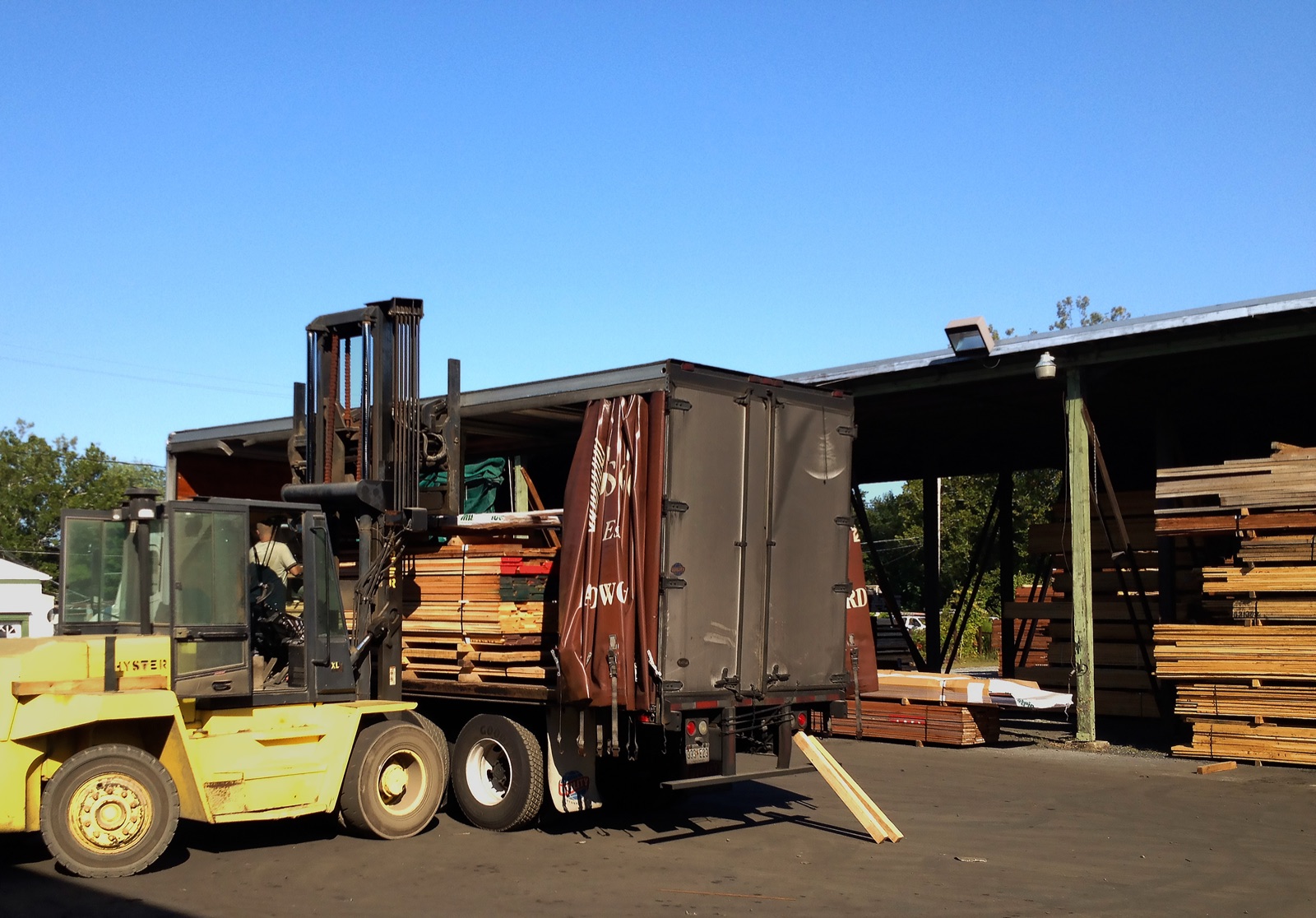
That changes what shows up at the curb. A shipment of this size wants a forklift or a machine on site, not four people and a liftgate. Bundles of dense tropical decking are banded tight and should stay banded until the stack is on level, dry dunnage with air moving through it. Ground contact on a strapped bundle for a week in humid weather is how a job starts with cupped boards.
Surface checking deserves a word here, since it shows up in the days right after delivery. Checking is the wood releasing tension as the surface heats and dries faster than the core. It does not weaken the board, and small surface checks are normal in dense tropical decking, sometimes a sign the material seasoned properly. Nobody can promise checking will not occur. The meaningful mitigation is a factory coat of Cutek, a penetrating oil wood stabilizer that significantly reduces checking, applied to tropical decking before it ships. On site, keeping delivered moisture in range, sealing every fresh cut end, and keeping the stack ventilated keeps checks small.
Turning the Total Into an Order a Mill Can Actually Fill
A single board foot number is a budget figure, and a cut list is a purchase order. The two are not interchangeable, and the difference determines how much wood ends up in the dumpster.
Send zones, not a lump sum. Field square footage with the run direction and the longest required run. Border linear footage with the corner count. Tread count, tread width, and the thickness class. Fascia linear footage with the profile. Then state whether you want random lengths or lengths specified to the run, because that decision alone moves your waste allowance from 10 percent down toward 5.
Profile and fastener method belong in the same message. Shiplap takes visible face fasteners. Only tongue and groove works with hidden fastener systems, and grooved material goes down with the grooves facing down for drainage over furring strips or joists at 16 inches on center. None of that changes the board foot arithmetic, and all of it changes what gets milled.
"The takeoffs that go smoothly are the ones that arrive as a schedule instead of a single number. When a contractor sends me field footage, run direction, tread count and fascia footage separately, I can look at what is on the floor and tell him where specified lengths will save him material and where random lengths are the better call. A lump sum board foot figure hides all of that, and the yard ends up guessing at lengths the job never needed."
Norm Moton, Director of Sales, J. Gibson McIlvain
One thing never belongs on the order: fastener holes. Do not ask a mill to pre-drill or pre-countersink decking. Layout gets set against the frame as built, field cuts move every hole, and a factory pattern is invalid the moment a joist lands a half inch off plan.
How J. Gibson McIlvain Would Specify This
Write the takeoff as a quantity schedule tied to profile, thickness class and length strategy, and the board foot total becomes a byproduct rather than the whole document.
Start with thickness class, set by the structural requirement and by what the application demands. Commercial boardwalk, pier and plaza work goes to 2x, which narrows the species to Ipe, Cumaru and Jatoba. Residential and engineer-approved 5/4 work opens the list to Garapa and Red Balau as well. Fix that before estimating anything, since it drives both the board foot factor and the sourcing.
Then state dressed width and gap in the spec rather than leaving them to the field. Both feed the multiplier, and both feed the accessibility review if the surface is in the path of travel. Use 1.32 nominal board feet per square foot for 5/4x6 at a 3/16 gap and 2.11 for 2x6, and carry those factors through every zone.
Build the zone schedule next: field, border, treads, risers, fascia, skirt, bench and rail cap, each in linear feet with its own profile. Apply waste by geometry, not by habit. Five percent on straight runs ordered to length, 10 percent on random length straight work, 15 percent on diagonals, more on radius or parquet layouts.
Specify fasteners and detailing alongside the quantities. Coastal and marine environments call for 316 stainless. Pilot every hole, two fasteners per board at each joist, roughly 3/4 inch edge distance, full depth pilots near board ends, and butt joints landing on doubled bearing. A self-centering combination bit keeps the countersinks consistent across a long deck. Ventilation under the deck and end sealing on every cut matter as much as the species selection does, and moisture management guidance from Building Science Corporation applies to a deck assembly as squarely as it does to a wall.
Handle documentation early. When the specification calls for a CITES-listed species, permits and documentation must be in hand before material moves, and the current listings are published by CITES. Projects pursuing certified material should confirm chain of custody through FSC at the quotation stage rather than after fabrication. Code officials will look to the adopted building code published through the International Code Council for guardrail, stair and structural provisions.
J. Gibson McIlvain mills and supplies Ipe, Cumaru, Garapa, Jatoba and Red Balau decking to architects, contractors and commercial buyers across the country, along with modified options including Thermory and Abodo Vulcan for projects that need a warrantied product. Send the zone schedule, the run direction, the longest required run and the thickness class, and the team will convert it into a tally and a delivery plan. Details on profiles and dimensions are on the Ipe decking page, and quotes go out by phone at 800-638-9100.
Frequently Asked Questions
What is the fastest way to convert deck square footage to board feet?
Divide nominal thickness times nominal width by the dressed width plus the gap. For 5/4x6 tropical decking that is 1.25 times 6 divided by 5.6875, which equals 1.32 nominal board feet per square foot at a 3/16 inch gap. Multiply your field square footage by that factor, then add waste by zone. The same expression handles any profile: 4/4x6 gives 1.06, 5/4x4 gives 1.36, 2x4 gives 2.17, and 2x6 gives 2.11.
How many board feet does a 2x6 tropical hardwood deck board contain per linear foot?
One board foot exactly, since 2 times 6 divided by 12 equals 1.0. That makes 2x6 easy to estimate: linear feet and nominal board feet are the same number. At 2.11 linear feet of coverage per square foot, a 2x6 deck consumes 2.11 nominal board feet per square foot, roughly sixty percent more material than the same deck in 5/4x6.
Does changing the gap width change how much decking I need to order?
Yes, but less than most people assume. Moving from a 1/4 inch gap to a 3/16 inch gap on 5/4x6 raises the board foot factor from about 1.30 to about 1.32, roughly one percent. On a small residential deck that is noise. On a 6,000 square foot plaza it is real material. Gap width matters far more for drainage, shrinkage allowance and accessibility compliance than it does for the quantity.
Why is the board foot total larger than the actual volume of wood delivered?
Board foot tallies on decking use nominal dimensions, which come from the rough sawn size before surfacing. A 5/4x6 board tallies at 0.625 board feet per linear foot but contains 0.458 board feet of dressed wood, about 73 percent. Nothing is missing. Nominal measure is the billing convention across the hardwood trade, and it should be applied consistently when comparing two quotes.
How do I count board feet for stair treads, fascia and a picture frame border?
Convert each zone to linear feet first, then apply that zone's own board foot factor. Treads are tread count times tread width times boards per tread. Fascia is perimeter linear footage at the fascia profile factor, which for 1x8 is 0.667 board feet per linear foot. A picture frame border sits inside the field square footage already counted, so it adds no area, only miter waste of roughly 10 to 12 percent on the border stock itself.
Does a 2x commercial deck limit which species I can specify?
It does, and that filter applies before any arithmetic. Commercial boardwalk, pier and plaza decks are specified at 2x to control deflection, and only Ipe, Cumaru and Jatoba can be sourced consistently in 2x decking thickness. Garapa and Red Balau are sound decking woods that belong in residential and engineer-approved 5/4 work, not in a 2x commercial specification.
What does the finished board foot total tell me about delivery and unloading?
Multiply installed square footage by the weight factor for the profile. A 504 square foot deck in 5/4 Ipe runs about 2,670 pounds of field material and approaches 3,500 pounds with treads, fascia and waste. The same footprint in 2x exceeds 5,000 pounds. Plan for a forklift or a machine on site, and stage the bundles on level dunnage with airflow underneath rather than directly on grade.