A Gazebo Arrives as Four Part Families, Not One Object
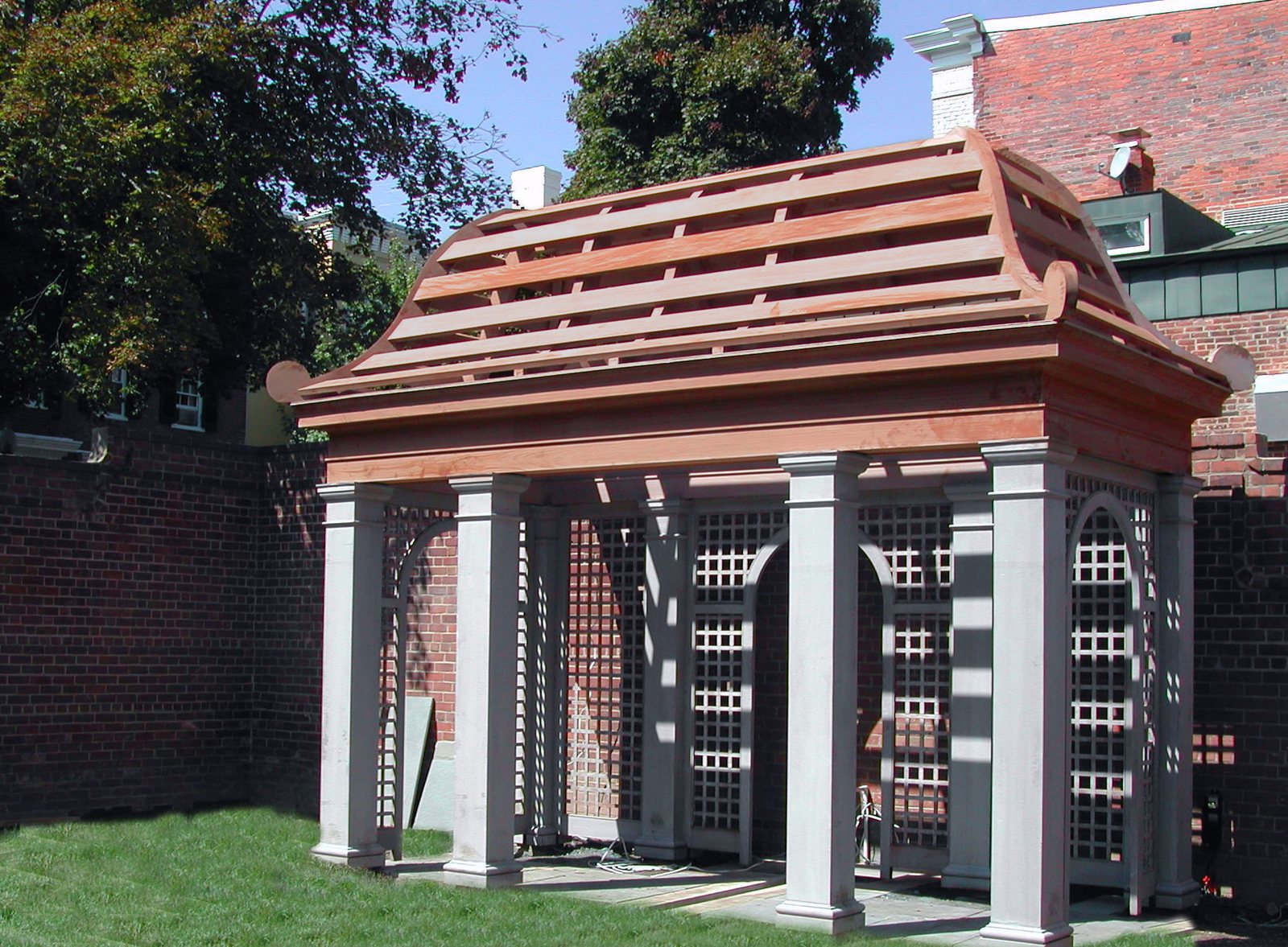
A custom gazebo leaves a millwork shop as four distinct families of parts, and each one is milled to a different tolerance for a different reason. The first family is vertical, the posts or columns. The second is the horizontal ring that ties the posts together, the beams, girts and header plates. Third come the brackets, corbels and any curved or radius trimwork that softens the corners. Fourth is the roof frame, which on an octagon means hip rafters, common rafters, rafter tails, a peak assembly and the fascia and frieze that close the eave.
Drawings almost never arrive as a member list. An architect sends an elevation, a plan, sometimes a section through the eave. Somebody still has to convert that into a schedule of parts with lengths, grain orientation, moulded profiles and a finish state. ICD, the architectural millwork division of J. Gibson McIlvain, does that conversion for exterior millwork planned around a specific footprint rather than assembled out of a catalog kit. A kit gazebo makes the site fit the product. A custom gazebo does the reverse, which is why the bill of material has to be right before a single knife goes on the moulder.
The reason this matters to a buyer is sequencing. Posts get set first and they are heavy. Brackets get scribed and fastened last and they are the fussiest parts in the crate. Building the order around that reality, instead of dumping every piece on the pad at once, is most of what separates a smooth raise from a week of rework.
Posts Ship Solid or as Shells, and That Decision Comes First
The single largest fork in a gazebo order is whether the posts are solid timber or hollow shells built as box beams, and it changes the species list, the joinery, the weight on the truck and what the crew has to do at the pad. Solid stock in a large section is simple to specify and honest looking, and it is also heavy, slower to acclimate, and prone to a drying check on the exposed face as the interior of the timber catches up with the exterior. A shell avoids that. Four staves glued into a hollow column move less, weigh a fraction of a solid timber, and can wrap a structural core that somebody else supplies, usually a treated post or a steel tube specified by the engineer of record.
The joinery choice inside that shell is not cosmetic. Butt joints give the most minimal profile, the fastest turnaround and the easiest on site assembly, and they leave visible seams and visible end grain and they are the weakest of the three. Dado joints are strong and still easy to assemble on site, and the seams and end grain still show. Lock miter joints show no visible seams and are the strongest of the three, which is why they are the default on anything that will be viewed from a few feet away at eye level. On a gazebo, every post is viewed from a few feet away at eye level. That usually settles the argument.
ICD builds post shells in lock miter for exposed corners and takes the joinery down to a dado where a shell is captured behind a base and a capital that hide the seam anyway. The shop also mills the base and capital trim as part of the same package so the reveal at the top and bottom of the column is a designed dimension rather than whatever the installer can improvise.
Beams and Girts Get Specified by Section Depth and Sawing, Not by Nominal Size
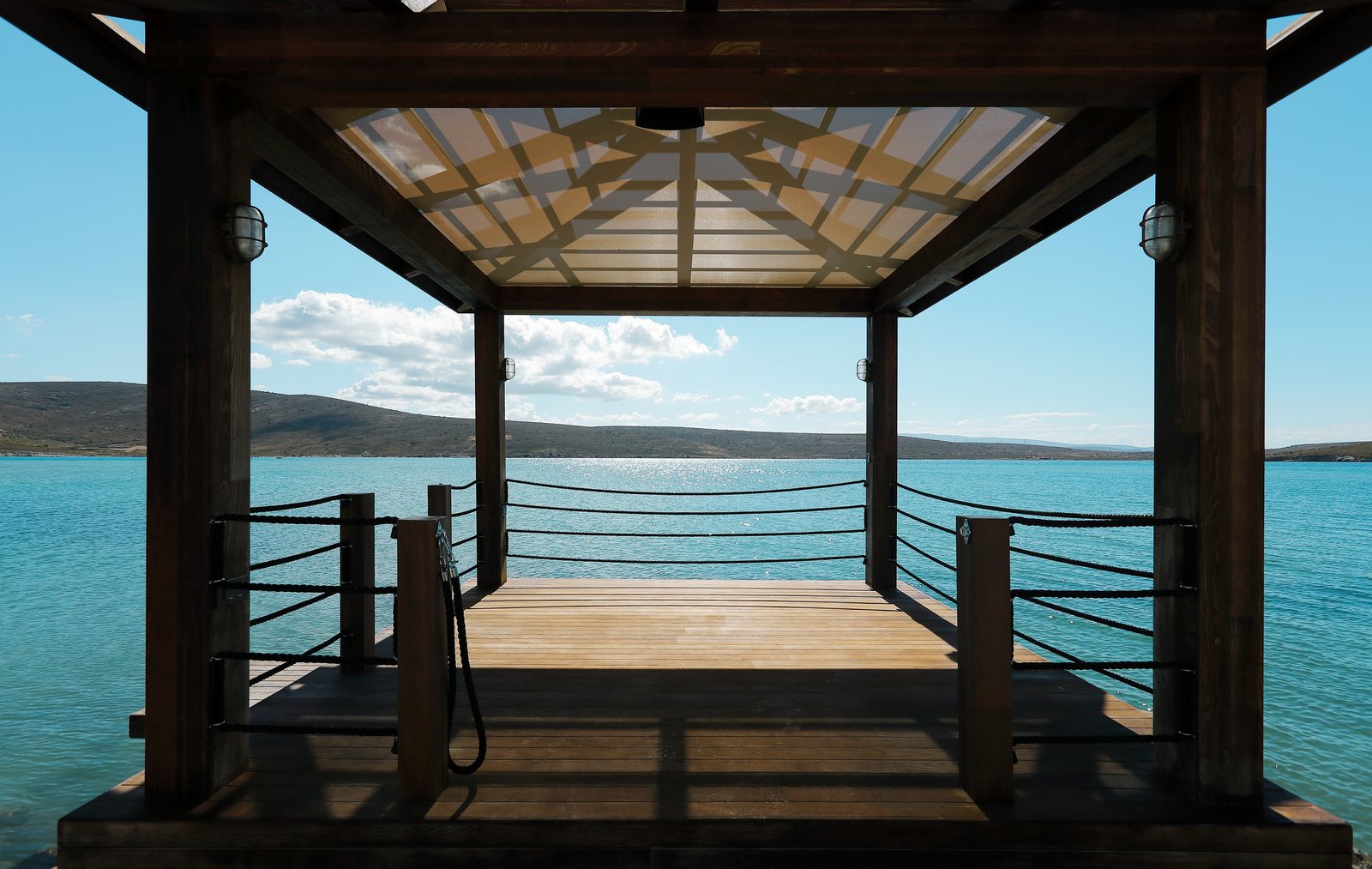
The horizontal ring is where a gazebo either stays flat or telegraphs every bit of seasonal movement, and the controls are section depth, sawing pattern and length. Depth resists deflection far more effectively than width. A member that is deeper than it is wide, oriented with the depth vertical, will hold a line across a clear span that a squat section of the same board footage will not. Structural sizing belongs to the engineer of record working from the American Wood Council codes and standards, and the shop mills to that number rather than guessing at it.
Sawing pattern is the part specifiers skip. Quartersawn and rift stock moves less across its width than plainsawn, which is why it gets called out where a painted or panelized surface has to stay flat over years of wet and dry cycles. On a beam face that runs eight or ten feet in plain view under a roof, that difference is visible. Plainsawn cups. Rift does not, or does so much less that no one notices.
Length is the constraint nobody plans for. Octagon beams are short, but a rectangular gazebo or a pergola extension off one face will want continuous members, and continuous members in one species and one color range are a stocking problem before they are a milling problem. J. Gibson McIlvain holds over seven million board feet of exotic and domestic lumber at its Maryland yard, which is what makes a matched set of long beams possible when the same species is on allocation at a distributor working out of one container.
Brackets and Radius Work Are Where the Profile Library Earns Its Keep
Brackets, corbels and radius trimwork consume more shop attention than any other part of a gazebo, and they are the parts most likely to be wrong if they are ordered as an afterthought. A bracket is a small part doing structural theater in a highly visible place. It has a curve, it has a moulded edge, and it has grain that must run along the length of the leg rather than across it. Short grain across a curve is the classic bracket failure. The part looks fine in the crate and snaps at the tightest radius the first time somebody torques a lag through it.
Curved work in a stable exterior assembly comes off a laminated blank or a segmented glue up, with the lamination lines planned to fall where a moulded edge or a shadow line will hide them. The moulded edge then has to match whatever profile is running elsewhere on the structure, on the fascia, the frieze, the rail cap. J. Gibson McIlvain keeps a moulding profile library holding thousands of ground knives and grinds new knives every week on its own knife grinders, so a bracket edge, a rafter tail and a frieze band can all come off the same profile rather than three approximations of it. If the profile is not in the library it gets ground to match, including difficult historical restoration work and contemporary shapes that do not exist as a stock cutter anywhere. The published trim profile library is the starting point, not the limit.
Repeat phases are where record keeping pays. A garden structure gets built, a second one gets added two years later, and the owner expects the brackets to match. J. Gibson McIlvain has been family run and in business since 1798, now in its seventh generation, and keeping a ground knife and a record of what ran on a given job is ordinary practice rather than a favor. That is the difference between matching a profile and re-designing it.
The Roof Frame Is Cut to Geometry the Shop Can Control and Geometry the Crew Must
A gazebo roof closes in three dimensions at once, so the shop takes responsibility for stock, length, profile and bevel while the crew takes responsibility for the final fit at the peak and the seat. On a regular octagon the plan angle at each corner is 22.5 degrees off the wall line, which means every hip rafter carries a compound cut at both ends and every jack or common rafter that dies into a hip carries a bevel on its cheek. Those angles are arithmetic, not opinion, and they can be milled. What cannot be milled from a drawing is the last sixteenth of an inch at the ring or king post, because that dimension depends on how the posts actually landed on the pad.
The practical split is clean. The shop supplies hips and commons in the correct species, section and length with the moulded or chamfered edges already run, plus rafter tails shaped to the specified profile and left long enough at the heel for a field trim. The installer sets the ring, dry fits, and makes the final closing cuts. J. Gibson McIlvain supplies and mills. It does not install, it does not coordinate installation and it does not field measure, so the eave exposure, the tail projection and the fascia return all have to come off the construction documents or off dimensions the builder verifies. A shop that pretends otherwise creates a finger pointing exercise when the roof does not close.
Rafter tails deserve their own line on the schedule. Exposure decides the profile as much as taste does. A deep overhang keeps water off the tail end grain and tolerates an ornate shape. A shallow eave on a west facing garden structure punishes an ornate shape, because every horizontal ledge in that profile holds water. Detailing that keeps water moving is standard building enclosure practice, and the rain control fundamentals published by Building Science Corporation apply to a tail end grain the same way they apply to a wall.
The Millwork Species Palette for a Gazebo Is Sapele, Iroko, Afrormosia, Teak and Utile
A gazebo is a glued, moulded, machined assembly, which puts it squarely in the millwork palette rather than the decking palette. Sapele runs around 1,410 lbf on the Janka scale, machines predictably, glues reliably and comes in a range of sizes and lengths that suits posts, beams and brackets out of one order. Iroko and Afrormosia bring similar exterior durability with a slightly different color path as they weather. Teak is the benchmark for exposure and for anything that will get wet and stay wet. Utile behaves like Sapele with a slightly coarser texture and is a sound substitution when a size is short.
The tropical decking species sit in a different category on purpose. Ipe, botanically Tabebuia spp, along with Cumaru, Garapa, Jatoba and Red Balau, are extremely hard and carry high oil content, which makes them difficult to glue. A millwork house therefore uses them far less than the decking side of the business does. If a gazebo deck platform is being priced alongside the structure, those species are exactly right for the walking surface, and the posts, brackets and roof frame above it still want Sapele, Iroko, Afrormosia, Teak or Utile, because those species take glue, take a knife and take paint.
Cedar is a legitimate default and always has been. The distinction that matters is grade. CVG, clear vertical grain, gives a tight even face for a painted or lightly stained column and a stable platform for a moulded edge. STK, select tight knot, gives a rustic read that suits a park shelter or a rough garden structure and costs less attention in the shop. Both are correct answers to different drawings.
Modified wood belongs in the conversation wherever paint and dimensional stability are the priority. Accoya runs around 1,600 lbf Janka and its acetylation gives dramatically reduced shrinkage and swelling, which is why it is specified for painted exterior work that has to hold a line. Thermory and Abodo Vulcan are both carried and both behave well outdoors. All of the modified products top out around 16 ft, and most are sold on metric lengths just under 16 ft, because of kiln size, so a long continuous member has to be designed around that ceiling rather than wished past it. Thermally modified Ash is not available wider than 8 inches, so a wide board in a modified product means Accoya or Abodo Vulcan. The Accoya technical literature and the Thermory product documentation both publish the dimensional data behind those limits.
One more point that buyers should hear plainly. There are no warranties on solid unmodified wood. Warranties exist only on modified products, and it is not possible to warranty solid wood, an organic material responding to its environment. What a supplier can stand behind on solid stock is grade, moisture content, milling accuracy and documentation.
Exterior Members Get Milled Near 12 to 16 Percent, Interior Trim Near 6 to 8
Moisture content at the moment of milling determines whether a gazebo joint stays tight, and an exterior structure gets a different target than the interior trim in the house next to it. Interior millwork is milled to an in-service moisture content near 6 to 8 percent. Exterior work is milled near 12 to 16 percent, because that is roughly where wood in a ventilated outdoor assembly lives. Ship an exterior post shell at 7 percent and it swells on site, which pushes the lock miter open at the corner. Ship an interior mantel at 14 percent and it shrinks in a heated room, which opens a joint the other direction. Equilibrium moisture content by region is tabulated in the USDA Forest Products Laboratory Wood Handbook, and the number to use is the one for the actual destination, not a national average.
Below is how the member families differ once moisture, sawing and finish state are put side by side. This is the sheet a project manager should be able to hand to a superintendent.
| Member family | Preferred stock form and sawing | Moisture target at ship | Finish state at ship | Why it is handled this way |
|---|---|---|---|---|
| Posts and columns | Lock miter box shell, rift or quartersawn faces | Near 12 to 16 percent | Primed inside and out, or sealed for stain | Shell moves less than a solid timber and the back priming stops moisture entering from the cavity side |
| Beams, girts and header plates | Solid or box beam, depth greater than width | Near 12 to 16 percent | Primed on all faces including the hidden top | Section depth controls deflection and the unseen top face is the one that gets wet |
| Brackets, corbels and radius trim | Laminated or segmented blank, grain along the leg | Near 12 to 16 percent | Primed and lightly sanded after prime | Grain direction prevents short grain failure and post prime sanding keeps the moulded detail crisp |
| Hip and common rafters | Solid stock, straight grain, edges pre moulded | Near 12 to 16 percent | Primed, ends left raw for field trim | Compound cuts are milled to geometry while the closing cut stays a field decision |
| Rafter tails | Solid stock, profile ground to match | Near 12 to 16 percent | Primed on all six faces before shipping | End grain on an exposed tail is the first place a coating fails |
| Railings, rail caps and balusters | Rift stock for caps, straight grain balusters | Near 12 to 16 percent | Primed, cap top left for final coat on site | A cupped rail cap holds standing water and shows from every seat in the structure |
| Built in bench components | Solid slats with eased edges, spaced for drainage | Near 12 to 16 percent | Primed or sealed per the finish schedule | Gaps and eased edges drain, and a sealed underside slows differential uptake |
| Interior grade trim in a screened structure | Plainsawn acceptable, moulded to profile | Near 6 to 8 percent | Primed three levels, oil or water based | A conditioned or semi conditioned space needs the interior target, not the exterior one |
Primed Parts Arrive Ready to Hang, and the Prime Coat Is a Specification
Priming is not a courtesy add on for exterior millwork, it is the step that decides whether the painted surface reads flat or blotchy two years later. J. Gibson McIlvain primes in three levels, in both oil based and water based systems, and exterior primed trim carries a fungicide additive. Open-grained and oily species absorb a great deal of finish, so a primer coat evens out the eventual painted surface. Sanding or buffing after priming knocks back the grain raising while keeping the moulded detail crisp, which matters most on the parts with the smallest radius in the profile, meaning brackets and rail caps.
Six sided priming is the request to make on rafter tails, bracket legs and any member with exposed end grain. End grain drinks. A tail primed on five faces and cut on site leaves a raw sixth face pointed at the weather, which is where the first coating failure shows up. Where the schedule allows it, the shop primes before the part is cut to final length and the installer seals the fresh cut before fastening.
"When a gazebo goes up in a weekend instead of a month, it is almost always because the parts showed up primed, labeled and in the order the crew needed them. We would rather spend the extra day in the shop than have somebody priming brackets on a tailgate in July."
Norm Moton, Director of Sales, J. Gibson McIlvain
Benches and Railings Belong on the Same Order as the Structure
The railings and built in benches inside a gazebo are the parts people actually touch, and ordering them separately is how a project ends up with three slightly different wood tones. A rail cap milled from the same lot as the beam above it weathers with it. A bench slat cut from a different container in a different month does not. ICD builds benches and railings as part of the structure package for exactly that reason, and the shop mills the cap, the shoe, the balusters and the bench slats off one pull of stock.
Geometry on these parts is about water and hands. Bench slats get eased edges and a deliberate gap so rain leaves instead of sitting in a joint. Rail caps get a crown or a slight wash so the top does not pond. Guard height, opening size and load requirements come from the authority having jurisdiction and the adopted code, which means the relevant provisions from the International Code Council, and where a structure is part of an accessible route the dimensional requirements published by the United States Access Board govern the graspable portion of a handrail. The shop mills to the dimension the design team specifies. It does not select the code path.
Documentation, Storage and Delivery Are Part of the Deliverable
A gazebo package is a long list of small valuable parts, so what happens after milling matters as much as what happens on the moulder. J. Gibson McIlvain is an FSC certified importer and miller, which is the practical answer when a specification carries sourcing requirements or an owner wants chain of custody on the record. Certification basics are published by the Forest Stewardship Council. Where a CITES listed species is involved, documentation and chain of custody travel with the material, and the framework behind that paperwork is published by the CITES Secretariat. Grade language on domestic hardwood components traces back to the National Hardwood Lumber Association rules, and moulding and millwork trade practice is documented through the Wood Moulding and Millwork Producers Association.
Finished millwork gets stored for inventory control, which sounds like a logistics footnote until a site loses six weeks to a concrete delay. Parts sitting in a controlled building are parts that have not warped on a pad under a tarp. J. Gibson McIlvain runs its own fleet of trucks and dedicates a section of the mill to packaging, so a gazebo can be crated by subassembly, labeled, released in stages and delivered nationwide, including regularly to California, without a primed bracket edge arriving scuffed. Anyone who has unwrapped a shipment of moulded parts from a common carrier understands why that packaging line exists.
The reason linear runs and true custom parts can sit on one order is structural. There is a full millwork shop on site at the lumber yard and a full architectural millwork house off site, which is ICD, so the fascia stock, the frieze band and the primed trim come from the same organization that builds the brackets and the post shells. One purchase order, one color range, one schedule. The documented working process is worth reading before the first shop drawing review.
How J. Gibson McIlvain Would Specify This
Specify a gazebo as a component schedule organized by subassembly, with a species, a sawing pattern, a moisture target, a profile reference and a finish state on every line. Start with the posts. Call out lock miter box shells in Sapele at 12 to 16 percent moisture content, primed inside and out, sized around whatever structural core the engineer of record requires. Move to the ring. Call beams and girts by section depth rather than nominal size, rift or quartersawn where a painted face is in plain view, primed on all faces including the top that nobody will see again.
Then the parts that need the most lead time. List brackets and radius trimwork with a profile reference from the library or a physical sample to match, grain running along the leg, laminated blanks where a curve demands it, primed and sanded after prime. List hips and commons with the compound cuts milled to the plan geometry and the ends left long for a field closing cut. List rafter tails with the profile called out and six sided priming specified. Put railings, rail caps and bench slats on the same order so they come off the same stock.
Where paint and dimensional stability drive the decision, substitute Accoya and design every member length under the 16 ft ceiling. Where a wide modified board is needed, go to Accoya or Abodo Vulcan rather than thermally modified Ash. Where the budget or the design language points at cedar, decide CVG or STK explicitly instead of leaving the grade to whoever fills the order. And write into the submittal that the supplier mills and supplies while the builder installs, so the split of responsibility at the peak is understood before anything ships.
Send drawings, an elevation and a section through the eave, and a list of what is already on the property if this is an addition to existing work. J. Gibson McIlvain will return a member schedule with species, profiles, moisture targets and finish states line by line. Details on the millwork services offered by J. Gibson McIlvain are online, the ICD exterior work is documented at icdwoodwork.com, and the fastest way to get a schedule reviewed by somebody who has milled this assembly before is to call 800-638-9100.
Frequently Asked Questions
Should gazebo posts be ordered as solid timber or as hollow shells?
For most custom gazebos, hollow shells built as box beams are the better engineering answer. A shell weighs a fraction of a solid timber of the same outside dimension, moves less seasonally, and can wrap a structural core that the engineer of record specifies, usually a treated post or a steel tube. Solid timber in a large section is heavier, slower to acclimate and more likely to develop a drying check on the exposed face. If the shell route is chosen, the joinery matters. Butt joints are the fastest and easiest to assemble on site but show seams and end grain and are the weakest. Dado joints are strong and still easy to assemble but still show seams. Lock miter joints show no visible seams and are the strongest, which is the right call on a gazebo post seen from a few feet away.
Can a whole gazebo be built from modified wood such as Accoya?
Yes, provided the member schedule is designed around the length ceiling. Accoya runs around 1,600 lbf Janka and its acetylation gives dramatically reduced shrinkage and swelling, which makes it excellent for painted posts, beams and rafter tails. All modified products top out around 16 ft, and most are sold on metric lengths just under 16 ft, because of kiln size. Thermally modified Ash is not available wider than 8 inches, so any wide board in a modified product means Accoya or Abodo Vulcan. Thermory and Abodo Vulcan are both carried as well. Plan splices, post heights and beam runs under that ceiling from the start rather than discovering it at submittal.
What moisture content should gazebo components arrive at?
Exterior work is milled near 12 to 16 percent in-service moisture content, which is roughly where wood in a ventilated outdoor assembly lives. Interior millwork is milled near 6 to 8 percent. Mixing the two targets is a common failure. An exterior post shell milled at 7 percent will swell after installation and push a lock miter open at the corner, while interior trim milled at 14 percent shrinks in a heated room. If part of the structure is enclosed and conditioned, that portion gets the interior target and should be called out separately on the schedule.
Why would a millwork shop steer away from Ipe or Cumaru for gazebo posts and brackets?
Ipe, botanically Tabebuia spp, along with Cumaru, Garapa, Jatoba and Red Balau, is extremely hard and carries high oil content, which makes it difficult to glue. A gazebo is a glued, moulded, machined assembly, so laminated bracket blanks, box beam post shells and moulded profiles all depend on reliable glue lines and predictable machining. That is why a millwork house reaches for Sapele, Iroko, Afrormosia, Teak or Utile on the structure. The decking species remain the right choice for the walking surface of a deck platform under the gazebo.
Does J. Gibson McIlvain install the gazebo or take field measurements?
No. J. Gibson McIlvain supplies and mills. It does not install, it does not coordinate installation and it does not field measure. The shop delivers posts, beams, brackets, hips, commons and rafter tails in the correct species, section and length with moulded edges run and parts primed, crated by subassembly and labeled. The builder or the buyer's own installer sets the posts, dry fits the roof frame and makes the final closing cuts at the ring or king post. That split needs to be written into the submittal so nobody assumes the last sixteenth of an inch belongs to the shop.
Is there a warranty on a solid wood gazebo?
There are no warranties on solid unmodified wood. It is not possible to warranty solid wood, an organic material responding to its environment. Warranties exist only on modified products. What a supplier can stand behind on solid stock is grade, moisture content at shipment, milling accuracy, profile match and documentation, including chain of custody where a CITES listed species is involved. If a project requires a written product warranty on the structure, that pushes the specification toward a modified product.
How early do brackets and radius trimwork need to be ordered?
Earlier than the rest of the package. Brackets and curved trim need a laminated or segmented blank, grain oriented along the leg to avoid short grain failure, and a moulded edge that matches whatever profile runs on the fascia, frieze and rail cap. If the profile already exists in the library of thousands of ground knives, the lead time is short. If it does not, a knife gets ground to match, including difficult historical restoration shapes, and new knives are ground every week. Send a physical sample or a full size section drawing with the initial inquiry rather than after the posts are approved.
Can the gazebo, its railings and its benches all come off one order?
Yes, and they should. A rail cap and bench slats pulled from the same stock as the beams weather together, while parts bought in different months from different sources do not. ICD, the architectural millwork division of J. Gibson McIlvain, builds the box beams, rafter tails, railings and benches, and the lumber yard side supplies the linear trimwork, finished cladding and primed trim, which means one purchase order and one color range. Finished millwork can also be stored for inventory control and released in stages if the site is not ready.
Sources and Standards Referenced
- Wood Handbook, Wood as an Engineering Material, USDA Forest Products Laboratory
- Codes and Standards, American Wood Council
- Rain Control in Buildings, Building Science Corporation Digest BSD-013
- Accoya Acetylated Wood Technical Information
- Thermory Thermally Modified Wood Product Documentation
- Forest Stewardship Council, Certification and Chain of Custody
- Convention on International Trade in Endangered Species of Wild Fauna and Flora
- National Hardwood Lumber Association Grading Rules
- Wood Moulding and Millwork Producers Association
- United States Access Board Accessibility Guidelines
- International Code Council