The Short Answer: Radius Decking Is a Sourcing Question, Not a Bending Question
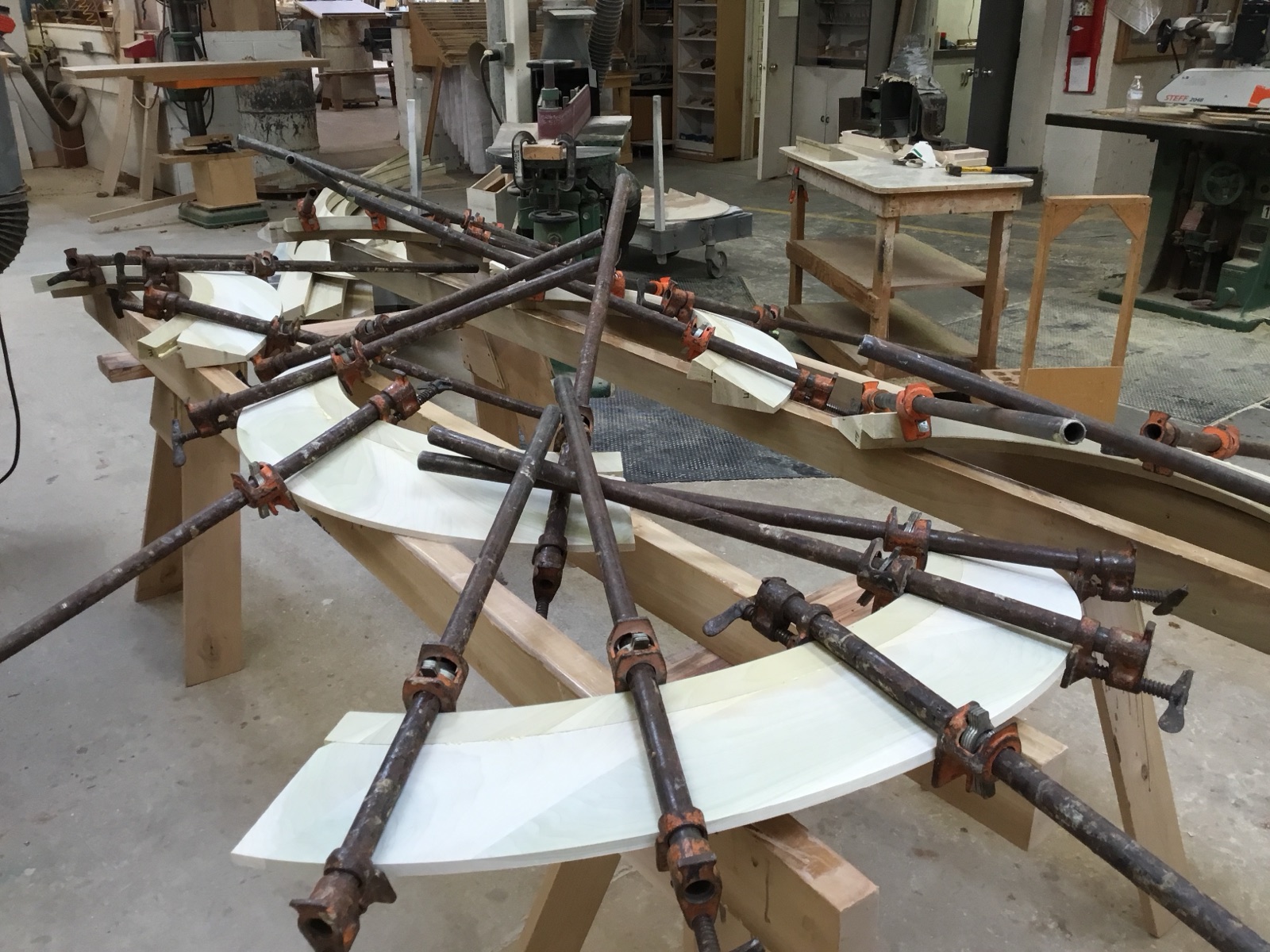
Ipe, Cumaru and Jatoba are the tropical species that carry curved deck work, and the reason has nothing to do with flexibility. Those three come in thick, wide, long stock consistently enough to saw arcs out of solid material. That is the whole trick. A curved deck board is not a straight board persuaded into a curve. It is an arc cut out of a wider blank, and the species that win are the ones a mill can supply in the widths and thicknesses the geometry demands.
Dense tropical hardwood does not bend cold, and it does not bend hot in any way a deck contractor can use. Ipe runs around 3,680 lbf on the Janka scale with a density near 1,050 kg/m3. Cumaru sits at roughly 3,540 lbf and 1,070 kg/m3. Material in that class fails in compression on the concave face long before it takes a useful radius, and whatever spring-back survives a forced curve keeps working against your fasteners for the life of the deck.
So the specifying question changes shape. Instead of asking which species bends, ask which species you can buy at 2x8, 2x10 or 2x12, in lengths that let you nest arcs efficiently, in a grade clean enough that the crescent-shaped offcut is still usable. The USDA Forest Products Laboratory Wood Handbook covers the mechanics behind why high-density tropical species resist plastic deformation. The jobsite consequence is simple. You saw the curve. You do not bend it.
Chord Math Sets Your Material List Before You Pick a Species
The radius and the finished board width together determine the maximum length of each arc segment and the rough width you have to buy. Run that math first. Everything downstream, species included, follows from it.
The governing number is the mid-ordinate, sometimes called the sagitta. For an arc of radius R spanning a chord of length L, the mid-ordinate m equals R minus the square root of R squared minus (L divided by 2) squared. That value is how far the arc bows away from its own chord at the center, and it is exactly how much extra width you must buy above your finished board width.
Work an example. You want 5-1/2 inch finished boards on a 12 foot radius, and you are cutting them from nominal 1x12 stock with an actual face of 11-1/4 inches. Your width budget for the bow is about 5-3/4 inches, or 0.48 feet. Solve backward and the usable chord comes out near 6 feet 8 inches. That is the maximum piece length on that radius from that blank. Tighten the radius to 6 feet and the same blank yields arcs under 5 feet.
Two things follow. First, curved decks eat length. A 40 foot arc built from 6 foot 8 inch pieces needs seven segments per course, each with two butt joints landing on framing. Second, waste climbs fast. The crescent offcut from a sawn arc is sometimes recoverable as a narrower arc on a different radius, and sometimes it is scrap. Plan on 40 to 60 percent yield loss inside the curved zone and order to that number, since a mid-project reorder on one specific width and grade is the thing that stalls a radius deck.
The 2x Thickness Rule Eliminates Most Species From Commercial Curves Before the Conversation Starts
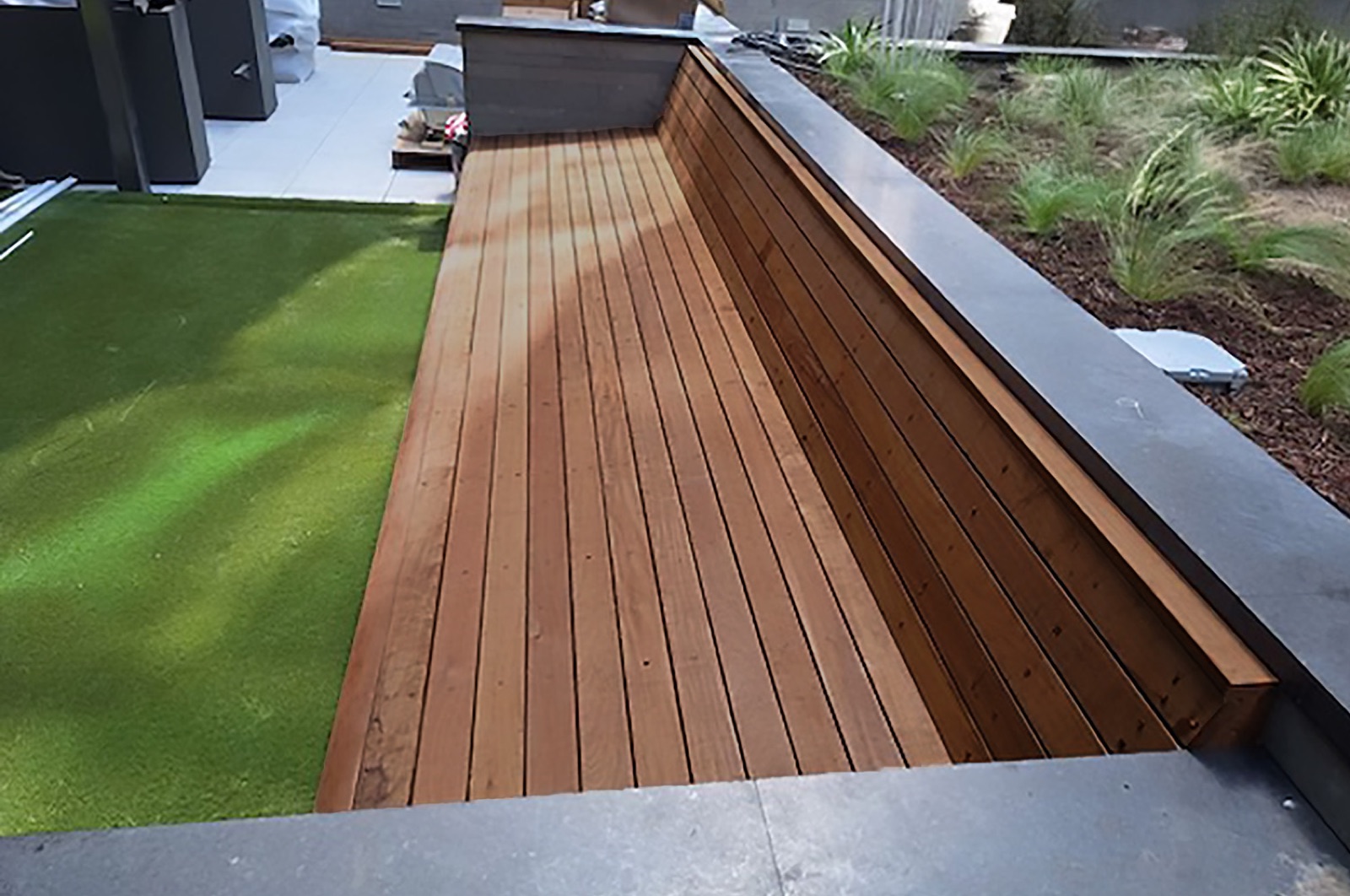
Commercial boardwalks, piers and plaza decks are specified at 2x thickness to control deflection, and only Ipe, Cumaru and Jatoba can be sourced consistently at that thickness. On a public job, no engineer of record goes first with a thinner board even in the spans where 5/4 strength math clears. That convention will not change on your project, and on a curved deck it matters more than usual.
Here is why the curve raises the stakes. A sawn arc is a board with grain running out of both faces at an angle that changes along its length. Effective stiffness varies segment to segment, and the short pieces the geometry forces on you mean more end grain, more butt joints and more places where load transfers into framing. Extra thickness absorbs that variation. It also gives the installer real meat to work with at the ends of short arcs, where fastener edge distance is already tight.
Red Balau and Garapa are legitimate decking species with real service records, and both belong in residential radius work or in engineer-approved 5/4 assemblies. Neither is a commercial 2x candidate. Specifying them on a municipal boardwalk with a curved edge puts you in the position of arguing structure with a reviewer you will not win over. The American Wood Council publishes the design standards those reviewers work from, and the International Code Council model codes set the framework local amendments build on.
Sawing an Arc Changes the Grain Angle Along Every Board
A curved deck board presents a continuously varying grain angle across its face, which changes how it machines, how it takes a fastener and how it weathers. Understand that before choosing a species, since the species differ sharply in how gracefully they handle it.
Cut an arc from a flat blank and the fibers that ran straight down the blank now run diagonally out through the edges of the finished piece. Near the ends of the arc, grain runout can approach 15 or 20 degrees. Those areas split more readily when a screw goes in dry, tear out at the router, and raise fiber under foot traffic if the surface is not sanded properly after milling.
Ipe handles runout better than anything else in the category. Its interlocked grain and tight pore structure hold the cut edge, and the arris stays crisp after a light easing. Cumaru is close behind, though its interlocked grain and higher oil content demand sharp carbide and a slower feed to avoid burnish marks. Jatoba machines beautifully and takes a fine finish, and it is the most cooperative of the three in a shop setting. Jatoba is also the least dimensionally stable of the group, so it wants tighter attention to moisture content at delivery.
Species with pronounced ribbon figure or higher silica behave worse here. Garapa's straighter, blonder grain looks clean on a curve but scuffs more readily at the edge. The working rule is that the denser and more interlocked the wood, the better it survives being cut across its own grain direction.
Judge Species by Fabrication Behavior, Not Hardness Alone
Janka tells you how a finished deck resists denting, and it tells you almost nothing about whether a species can be cut into arcs. The axes that matter on radius work are thick-stock availability, wide-stock availability, machining behavior at high grain runout, and whether the species has any business on a commercial deck at all.
| Species | Janka (lbf) | 2x thickness for commercial curves | Wide stock for sawn arcs | Behavior at high grain runout | Role on a curved deck |
|---|---|---|---|---|---|
| Ipe (Tabebuia spp.) | ~3,680 | Yes, consistently | Widest and deepest availability | Excellent, holds a crisp cut edge | First choice for commercial and residential arcs, fascia and picture frame |
| Cumaru | ~3,540 | Yes | Good, wide stock available | Very good, needs sharp carbide and slower feed | Strong second for commercial curves, warmer color than Ipe |
| Jatoba | ~2,690 | Yes | Good, best shop machining of the three | Excellent, finest finish | Commercial capable, favored where a machined edge is visible |
| Red Balau | ~1,700 to 2,000 | No | Limited above 5/4 | Fair, edges bruise more easily | Residential arcs and engineer-approved 5/4 work only |
| Garapa | ~1,700 | No | Limited above 5/4 | Fair, scuffs at the arris | Residential curves where light color drives the design |
| Teak | ~1,070 | Rarely specified for deck fields | Available, reserved for marine and joinery | Excellent, very stable | Curved marine decks and laminated caps |
| Massaranduba (benchmark only) | ~3,190 | Not part of the J. Gibson McIlvain program | Not applicable | Hard, brittle at the edge, checks readily | Listed for comparison context |
Read the table across, not down. Ipe wins on a curve not for being hardest but for being there in the widths and thicknesses a radius layout demands. J. Gibson McIlvain stocks Ipe decking in a vast inventory across every standard and custom dimension, including the 2x8, 2x10 and 2x12 blanks sawn arcs require, and ships that material nationwide to job sites from the mid-Atlantic to California. Species and dimension detail lives on the Ipe decking page.
Curved Boards Expose More End Grain, and Checking Behaves Accordingly
Surface checking cannot be prevented in dense tropical decking, and a sawn arc gives checking more opportunity because it exposes more end grain per square foot than a straight board. Anyone who tells you otherwise has not built one.
Checking is tension release. Sun heats the surface, the surface dries faster than the core, and the wood relieves the difference by opening fine splits along the ray planes. Small surface checks do not weaken the board. They are normal in this density class, and a modest amount of checking is evidence the material was seasoned properly rather than case hardened.
On a radius deck the exposure math shifts. Short arc segments mean more cut ends. Grain runout at the edges of each arc means end grain is also presented along portions of the board edge, not only at the butt joints. Those areas move moisture faster than a flat-sawn face does.
The real mitigation happens before the material ships. J. Gibson McIlvain factory coats tropical decking with Cutek, a penetrating oil wood stabilizer that significantly reduces checking by slowing the moisture gradient between surface and core. Site practice then keeps checks small. Deliver material at an in-service moisture content of 12 to 16 percent, seal every fresh cut end including the sawn arcs the moment they come off the bandsaw, sticker the stack off the ground under cover, and keep the underside of the deck ventilated so the board is not drying from one face only. Building Science Corporation publishes the moisture transport principles behind that practice.
Segmented Framing Is What Actually Holds a Curve Together
Every butt joint on a curved deck must land on doubled bearing, which means the framing plan has to be drawn from the arc layout rather than the other way around. Get that backward and the deck will telegraph the mistake within a season.
Start with joists at 16 inches on center, the standard spacing for dense hardwood decking. On a curve, that spacing gets measured along the radius, so joists fan out and the effective spacing at the outer edge grows unless you add intermediate framing. Sister in blocking wherever a spacing check at the outer arc exceeds 16 inches.
Then plan the joints. Arc segments of 5 to 7 feet put joints every few feet in every course, and those joints must be staggered course to course by at least two joist bays so the eye does not read a seam running out through the curve. Each joint sits on doubled framing, either a sistered joist or a pair of blocks, giving both board ends full bearing and independent fastening.
The perimeter deserves its own attention. A curved rim needs continuous backing behind the fascia, usually laminated plywood strips or segmented blocking cut to the radius, since a fascia board on a curve has no straight member to register against. Build that backing before any decking goes down. It sets the true arc that everything else references.
"The jobs that go sideways are the ones where somebody drew a pretty curve and ordered straight decking. When an architect sends me a radius plan, the first thing I do is run the chord math with them and settle the rough blank width before we talk about anything else. I have shipped 2x12 Ipe out to a boardwalk crew in California who were sure they needed 2x6, and that one phone call saved them a rebuild. Call us before the drawings get stamped, not after."
Hidden Fasteners Leave the Job the Moment You Saw an Arc
Sawn arcs take face fastening with stainless screws, since a bandsawn curved edge cannot carry the continuous groove hidden clip systems require. Accept that early and detail the deck so the fastener pattern reads as intentional.
Hidden fastener systems depend on a machined groove running the full length of a straight edge. Cut that board into an arc and the groove disappears at both ends and wanders in depth along the middle. Some crews try to route a groove into the finished arc afterward. It works only where the arc is gentle, the router rides a trammel, and someone has the patience to do it well, and it still fails at the segment ends where fastener count matters most.
Profile choice follows the same logic elsewhere on the project. Shiplap takes visible fasteners by design. Only tongue and groove works with hidden fasteners, and where tongue and groove material runs on a covered curved porch, the grooves face down so water drains rather than collecting in the channel. Decking runs over joists or furring strips with clear airflow beneath in either case.
Never buy decking pre-drilled, and do not ask a mill to bore fastener holes before shipping. Layout on a curve is established against the frame as it actually got built, and every field cut invalidates a factory hole pattern. Drilling is on-site work. Pilot every hole with a self-centering combination bit sized to the screw, run two fasteners per board per joist, hold roughly 3/4 inch edge distance, and use full pilots near board ends where short arc segments concentrate splitting risk. Butt joints get doubled bearing so each end takes its own pair of screws. Specify 316 stainless in any coastal or pool environment.
Gap spacing needs a second look on a curve as well. Segmented work opens wider at the outer radius than at the inner, and on any deck subject to accessibility review, openings in the walking surface must not pass a half inch sphere under the ADA Accessibility Standards. Measure the gap at the outside of the arc, not the inside.
Bending Belongs to Fascia and Laminated Components, Not the Deck Field
The only place bending makes sense on a curved deck is in thin laminations, where multiple flexible plies are glued into a curved member. Fascia, rail caps and curved trim are fair game. Deck boards are not.
Bent lamination works by keeping each ply thin enough that its bending stress stays elastic. For tropical hardwood on a moderate radius, plies land between 1/8 and 3/16 inch. Six to ten of them, glued with a rigid adhesive and clamped over a form cut to the radius, produce a member that holds its shape without spring-back. That is a shop operation with a real form, not something to attempt on a deck in July.
Kerf bending gets suggested constantly and deserves a flat answer. Slotting the back of a dense hardwood board to let it flex leaves a row of hinge points that telegraph through the face, collect water, and fracture under load. It has a place in interior millwork behind a covering surface. It has no place in an exterior walking surface or in fascia that faces weather.
If the fascia on a curved deck is going to be painted rather than left to weather, Sapele is the better specification than Genuine Mahogany. It holds paint more reliably and comes in longer lengths, which cuts the number of joints on a long sweeping rim. For clear-finished or naturally weathering fascia, run the same species as the deck field so the color story stays consistent.
Modified Wood and Cedar Have a Place on a Curve, With Limits
Modified woods can be sawn to arcs the same way tropicals can, but their maximum length caps at around 16 feet, which changes how you nest pieces. That ceiling is a kiln constraint. No supplier gets around it, and metric-length products land just under 16 feet.
Accoya, Thermory and Abodo Vulcan all machine cleanly and hold dimension well, and all three come with manufacturer warranty coverage, which solid unmodified wood never carries. Accoya's dimensional stability is the standout for curved work, since a sawn arc with variable grain angle is exactly the condition where movement shows up as an uneven joint line. Thermally modified material is lighter and more brittle at the edge than Accoya, so ease the arris and pilot generously.
The length ceiling matters more than it first appears. Wide blanks for sawn arcs are already length-limited by the radius math, so a 16 foot cap rarely binds on segment length. It binds on nesting efficiency, since you cannot stagger long blanks to recover crescent offcuts as freely.
Western Red Cedar remains a legitimate default and performs well on curved residential decks, particularly where weight and workability drive the decision. Specify the grade deliberately. Clear vertical grain, or CVG, gives straight, even-textured material that machines predictably on an arc and holds a clean edge. Select tight knot, or STK, reads more rustic and costs less than CVG, and a knot that lands in the cut line of an arc becomes a weak point you have to design around. For radius work, CVG earns its place. Documentation applies across all of these categories, so settle FSC chain of custody and, when using a CITES-listed species, the permit paperwork described by the CITES Secretariat, before material is committed.
How J. Gibson McIlvain Would Specify This
Specify the blank, not just the species, and do it before the drawings are stamped. A curved deck spec that names only "Ipe decking, 5/4x6" falls apart the moment a fabricator reads the radius off the plan.
Write it in this order. Name the finished board width and the tightest radius on the plan. Run the mid-ordinate calculation for each distinct radius and publish the resulting maximum chord length in the spec so the shop is not guessing. From that, state the rough blank dimension required, commonly 2x10 or 2x12 for commercial curves and 5/4x10 or 5/4x12 for residential. Add a yield allowance of 40 to 60 percent inside the curved zone as its own line on the takeoff rather than burying it in a general waste factor.
For commercial boardwalk, pier or plaza work, limit the species list to Ipe, Cumaru or Jatoba and state 2x thickness explicitly. On residential curves, Red Balau and Garapa open up, and cedar in CVG grade is reasonable where weight drives the decision. Call for factory Cutek coating on tropical material and require end sealing of all field cuts including sawn arcs. State an in-service moisture content of 12 to 16 percent at delivery, and note that small surface checks are an accepted characteristic rather than a defect.
On the framing side, specify joists at 16 inches on center measured at the outer arc, doubled bearing at every butt joint, joints staggered at least two bays, and continuous radiused backing behind any curved fascia. Call face fastening with 316 stainless screws in the curved zone and state that hidden fastener systems are not acceptable there. Prohibit pre-drilled material. Require pilot holes at every fastener with a self-centering bit, two fasteners per board per joist, and roughly 3/4 inch edge distance. If accessibility review applies, specify maximum gap measured at the outer radius.
Then start the material conversation early. J. Gibson McIlvain has been importing and milling hardwood since 1798, ships commercial and contractor volume nationwide, and will review a radius layout against real inventory before anyone commits to a dimension. Reach the sales desk at 800-638-9100 or start at mcilvain.com. Independent species reference on Ipe and Cumaru, the testing framework at ASTM International, and design resources from WoodWorks will fill in the technical detail a submittal package needs.
Frequently Asked Questions
How do I calculate yield loss on a curved deck before I order material?
Start with the mid-ordinate formula. For radius R and chord length L, the mid-ordinate m equals R minus the square root of R squared minus (L divided by 2) squared. That mid-ordinate is the extra width the arc consumes beyond the finished board width. Work it in reverse to find the longest chord your blank can produce, then divide the total curved footage by that chord length to get piece count. The waste is the difference between the blank area and the finished arc area, and in practice it lands between 40 and 60 percent inside the curved zone. Some crescent offcuts recover as narrower arcs on a tighter radius, so nest the cut list across all radii on the plan before finalizing the order.
Does cutting a curve out of a straight board weaken it?
It reduces effective bending capacity because the grain no longer runs parallel to the length. Grain runout near the ends of a sawn arc can reach 15 to 20 degrees, and fibers that exit the edge cannot carry tension across the full length the way straight grain does. The mitigation is thickness and support spacing rather than species substitution. Use 2x stock on commercial work, keep joists at 16 inches on center measured at the outer arc, and land every butt joint on doubled bearing so no arc segment relies on a single-joist connection.
Can a commercial curved boardwalk be built with 5/4 decking?
No professional specifies it that way first, even where the strength calculation clears. Commercial boardwalk, pier and plaza decks are specified at 2x thickness to control deflection, and a curved layout makes that convention harder to argue against because short arc segments and variable grain angle introduce stiffness variation the straight-board math does not capture. Only Ipe, Cumaru and Jatoba are consistently available in 2x decking thickness, which effectively removes Red Balau and Garapa from commercial radius specs.
Do curved deck boards check more than straight ones?
They present more opportunity for it. A sawn arc exposes end grain along parts of its edges as well as at the cut ends, and short segments mean more cut ends per square foot. Checking cannot be prevented in dense tropical decking. It is tension release as the surface heats and dries faster than the core, it does not weaken the board, and small checks are normal. J. Gibson McIlvain factory coats tropical decking with Cutek, a penetrating oil wood stabilizer that significantly reduces checking. On site, deliver at 12 to 16 percent moisture content, seal every fresh cut end including sawn arcs, and ventilate the underside so the board is not drying from one face only.
Why does steam bending work on white oak but not on Ipe or Cumaru?
Steam bending relies on softening lignin so fibers on the compression face can buckle and shorten without failing. Ring-porous temperate species such as white oak have the cell structure and moisture behavior that allows it. Tropical decking species at 1,050 to 1,070 kg per cubic meter, with interlocked grain and high extractive content, do not soften enough to yield in compression before they fracture, and the thickness used for decking makes the strain at the outer fiber far too high. Anything you force into shape retains spring-back that works against the fasteners for the life of the deck.
What backing does a curved fascia need?
Continuous radiused backing built before any decking goes down. A fascia on a curve has no straight framing member to register against, so the usual approach is laminated plywood strips bent to the radius or segmented blocking cut to the arc and fastened to the rim. That backing establishes the true curve that the decking, the fascia and any picture frame border all reference. If the fascia will be painted, Sapele is the better specification than Genuine Mahogany because it holds paint more reliably and comes in longer lengths, which reduces joints on a long sweeping rim.
Should short arc segments be fastened differently at their ends?
Yes. Segment ends carry the highest grain runout and the least fiber continuity, so treat them as the critical detail. Land every butt joint on doubled bearing, either a sistered joist or a pair of full-depth blocks, so each board end gets its own pair of screws with full bearing beneath. Drill full pilot holes near the ends rather than partial ones, hold roughly 3/4 inch edge distance, and use a self-centering combination bit. Never order material pre-drilled. Curved layout is set against the frame as built, and field cuts invalidate any factory hole pattern.
Can Accoya, Thermory or Abodo Vulcan be used for curved deck work?
All three can be sawn to arcs and all three machine cleanly, with Accoya standing out for dimensional stability on a variable grain angle. The constraint is length. Modified woods top out around 16 feet because of kiln size, and metric-length products land just under that. Segment length on a curve is already limited by the radius math, so the ceiling rarely restricts piece length. It restricts nesting efficiency, since you cannot stagger long blanks to recover crescent offcuts as freely. Modified products also carry manufacturer warranty coverage, which solid unmodified wood does not.
Sources and Standards Referenced
- Wood Handbook: Wood as an Engineering Material, USDA Forest Products Laboratory
- American Wood Council, Codes and Standards
- International Code Council
- United States Access Board, ADA Accessibility Standards
- The Wood Database, Ipe
- The Wood Database, Cumaru
- Building Science Corporation
- Forest Stewardship Council
- CITES Secretariat
- WoodWorks, Wood Products Council
- ASTM International