The Short Verdict for a Backyard, Not a Boardwalk
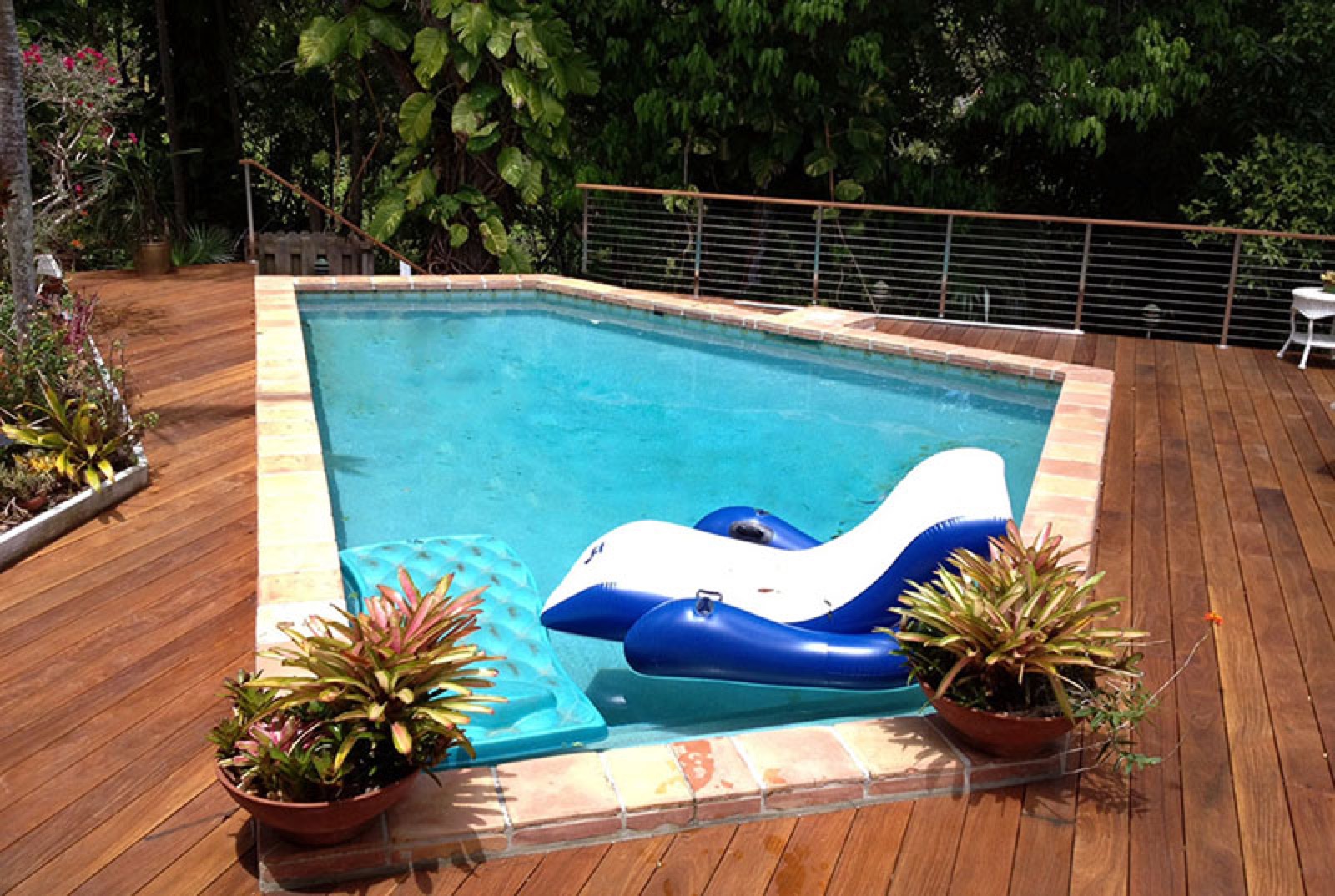
Cumaru is a sound substitute for Ipe across a residential outdoor living space, and the savings are real, but the two woods want different handling once they leave the truck. On a homeowner's deck, patio floor, screened porch or pool surround, Cumaru delivers the same category of performance Ipe does. Very high density. EN 350 Class 1 natural durability. Decades of service with no chemical treatment and no preservative. What separates them on a residential job is not strength. It is how each species behaves in narrow widths, under partial shade, next to a hot tub, and in the hands of a crew that may only build two hardwood decks a year.
The honest answer to the affordability question has two halves. Cumaru costs less than Ipe per square foot of coverage, and that gap widens as the package grows. It also asks for tighter control over moisture content, storage and gapping. Buyers who treat Cumaru as "cheap Ipe" and skip the acclimation step are the ones who post pictures of cupped boards. Buyers who spec it deliberately get a deck that is difficult to distinguish from Ipe at ten feet.
An Outdoor Living Space Is Six Material Decisions, Not One
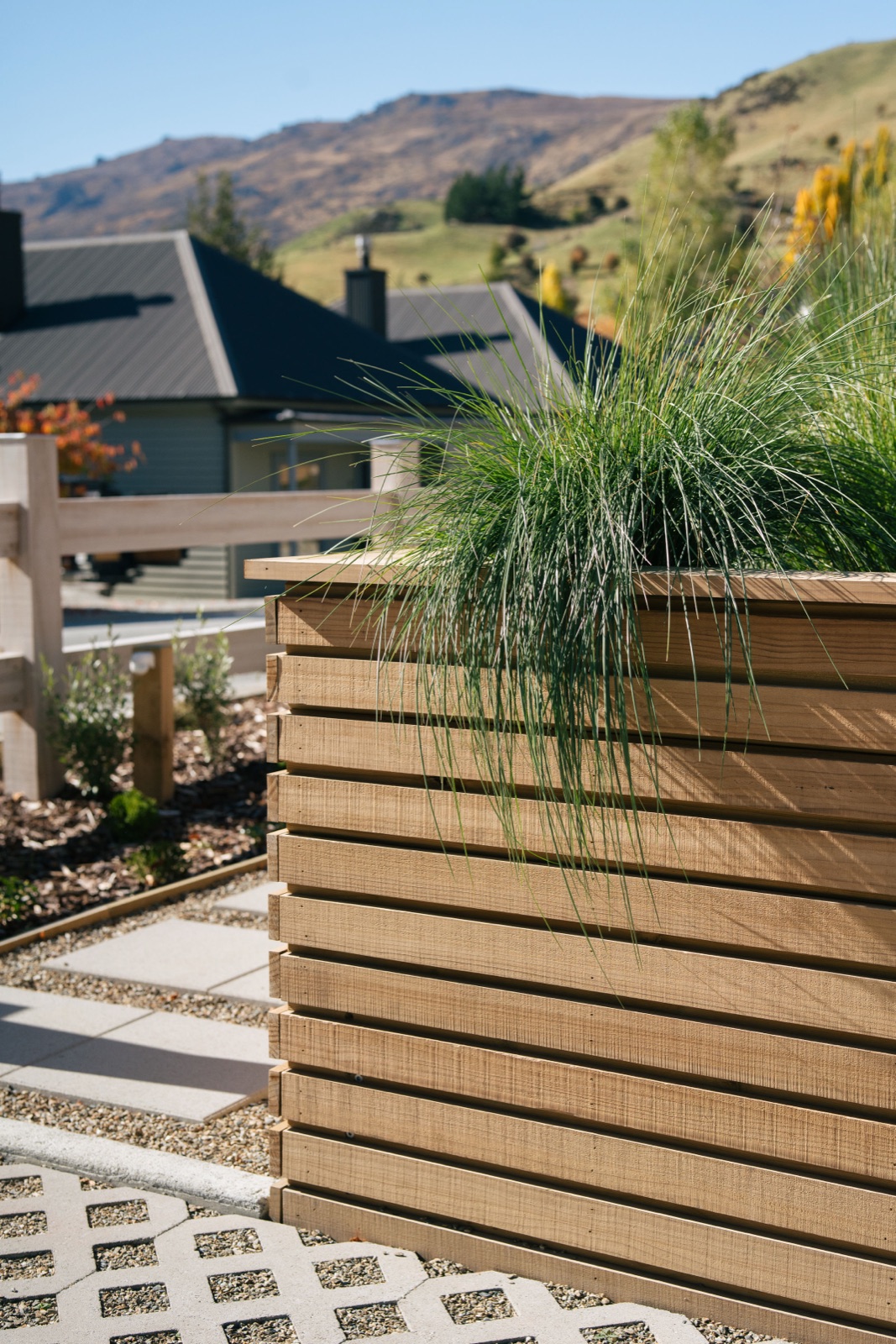
A residential deck question is almost never just about deck boards. By the time a design is finished, the package usually includes a field of decking, stair treads, a guard and railing cap, some kind of privacy screen or skirt, a pergola or shade structure, and a built-in bench or grill surround. Each of those parts sees different exposure, different contact with skin, and different structural demand. Running one species through all six is a choice, not a default.
This is where residential work departs from commercial work in a way that matters for species selection. Municipal boardwalks, piers and plaza decks get specified at 2x thickness to control deflection, and no professional goes first with a thinner board on a public job even where the strength math for 5/4 works out. Only Ipe, Cumaru and Jatoba can be sourced consistently in 2x decking thickness, which quietly filters most other tropical species out of those specs. A backyard deck carries no such burden. At residential spans with joists at 16 inches on center, 5/4 decking in any of the dense tropicals is more board than the load requires, which opens the field to species that never appear on a municipal drawing.
So the practical framing for a homeowner or a design-build contractor is not "Cumaru or Ipe." It is which species belongs in which zone of the finished space, and where mixing two species saves money without anyone noticing.
Hardness Is a Tie; Grain Behavior Is Where They Separate
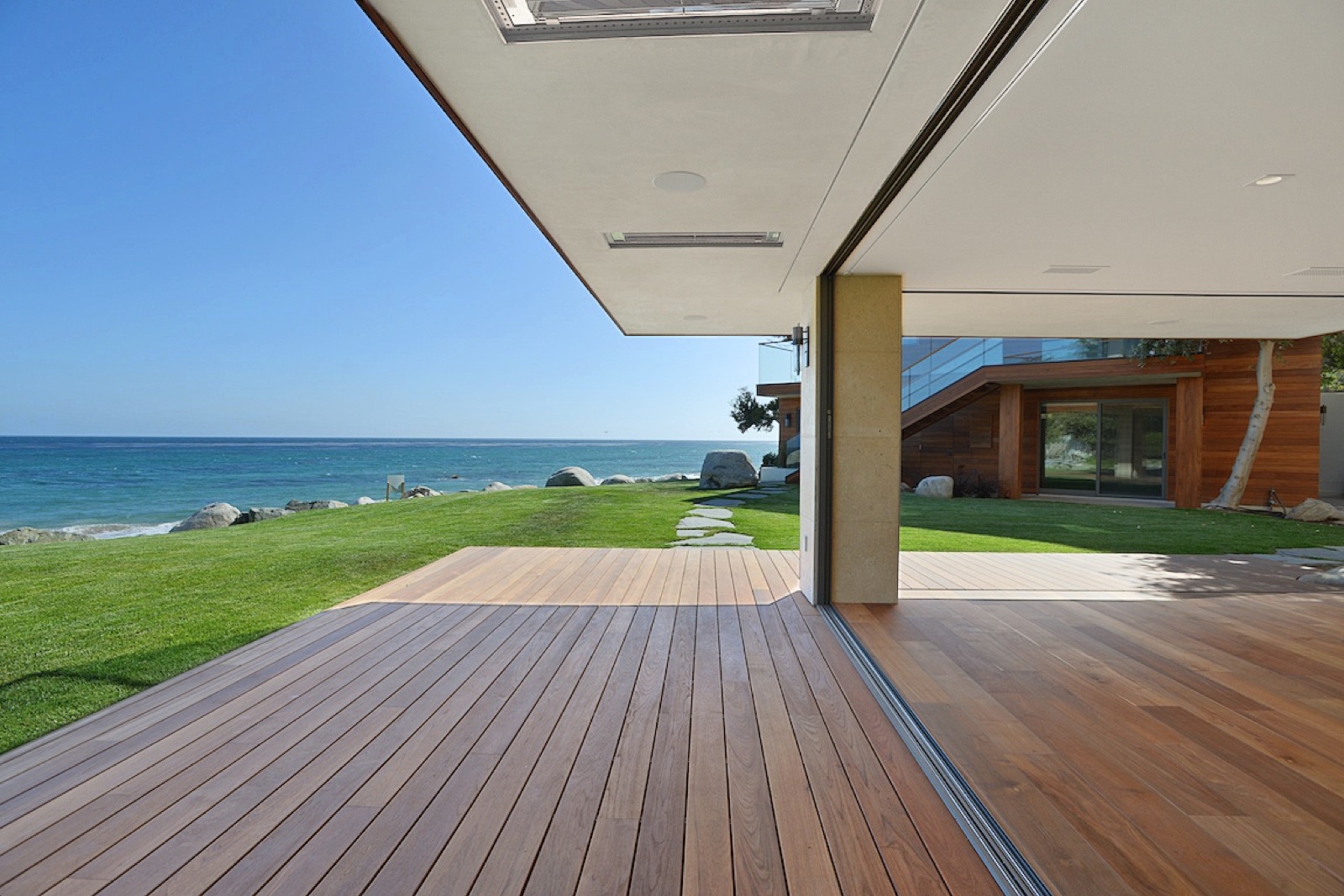
The Janka gap between Cumaru at roughly 3,540 lbf and Ipe at roughly 3,680 lbf is meaningless underfoot, and anyone selling you on that difference is selling a number, not a deck. Both woods sit far above the point where patio furniture, dog claws and dropped tools leave marks. Density tells the same story, with Cumaru near 1,070 kg/m3 and Ipe near 1,050 kg/m3. Two woods that heavy behave alike in fastener holding, edge durability and resistance to abrasion.
The real divergence is grain structure. Cumaru (Dipteryx odorata) grows with strongly interlocked grain. Ipe (Tabebuia spp.) tends toward straighter or irregularly figured grain with a heavier extractive load. Total shrinkage percentages for the two are close, as the species tables at the Wood Database entry for Cumaru and its Ipe entry show. What differs is how that movement expresses itself. Interlocked grain releases stress as twist and cup rather than as clean, uniform width change. A Cumaru board that arrives at the right moisture content, gets stickered in shade, and goes down within a reasonable window lies flat. The same board left banded and tarped in July sun for three weeks will fight you.
Target in-service moisture content is 12 to 16 percent for exterior decking in most of the country. That is the number to ask about when a quote is issued, not after the pallet is on the driveway. The USDA Forest Products Laboratory publishes the underlying equilibrium moisture content data if you want to see how far your region swings across a year.
One practical consequence. In Cumaru, board width is a lever. A 5/4x4 board has less cross-grain distance to work with than a 5/4x6, so it resists cupping better and is more forgiving of a substrate that is not dead flat. On a deck with heavy sun exposure or a crew new to tropical hardwood, narrower boards buy insurance. On a covered porch, 5/4x6 is fine and cuts the number of fastener holes nearly in half.
Matching Species to Each Zone of the Space
The cheapest way to build a tropical hardwood outdoor room is to use the expensive species only where it earns its keep. Ipe's edge over Cumaru shows up in three places. Stair treads that take concentrated wear. Railing caps that sit in full sun and get gripped by hand. Any surface where absolute color uniformity across a long run is the point. Everywhere else, Cumaru does the same job.
| Zone | Cumaru fit | Ipe fit | Other species worth pricing | Detail that decides it |
|---|---|---|---|---|
| Main deck field | Strong. Narrower widths in full sun | Strong. Flattest large runs | Red Balau, Garapa, Jatoba | Moisture at delivery and joists at 16 in. o.c. |
| Stair treads | Good. Use quartered or mixed grain, oversize the pilot | Best. Least edge wear over decades | Jatoba for covered stairs only | Two fasteners per board per joist, full pilots at ends |
| Railing cap and posts | Good. Watch twist on long unsupported caps | Best. Holds line on long caps | Accoya where the cap will be painted | Guard load requirements per local code |
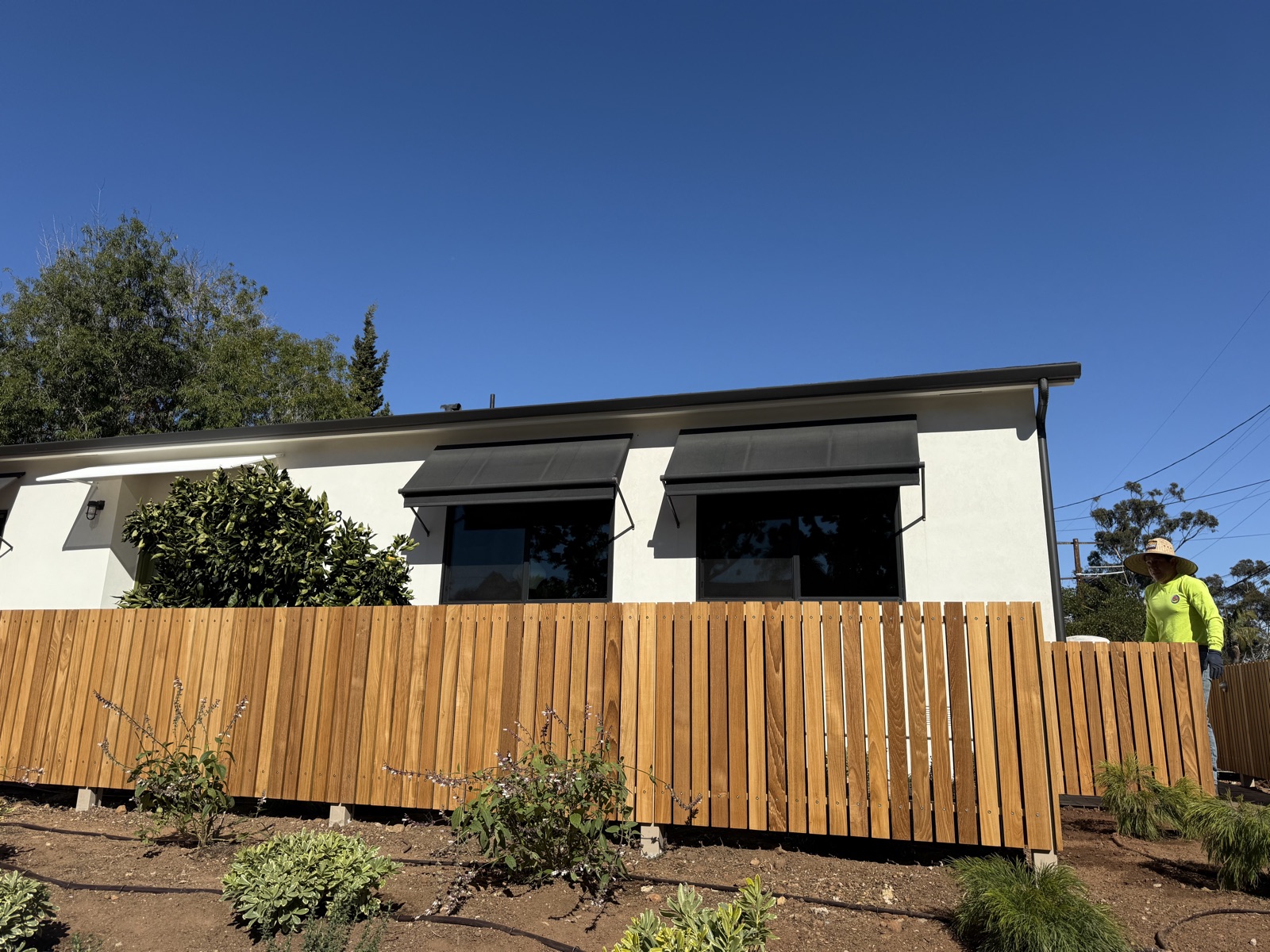
| Privacy screen or skirt | Good, but heavy for large panels | Good, heaviest option | Thermory and Abodo Vulcan, both to about 16 ft | Fastener pattern and back ventilation |
| Pergola and shade rafters | Workable. Weight drives post and beam sizing | Workable, heaviest | Accoya, Thermory and Abodo Vulcan | Dead load and connection hardware, not species |
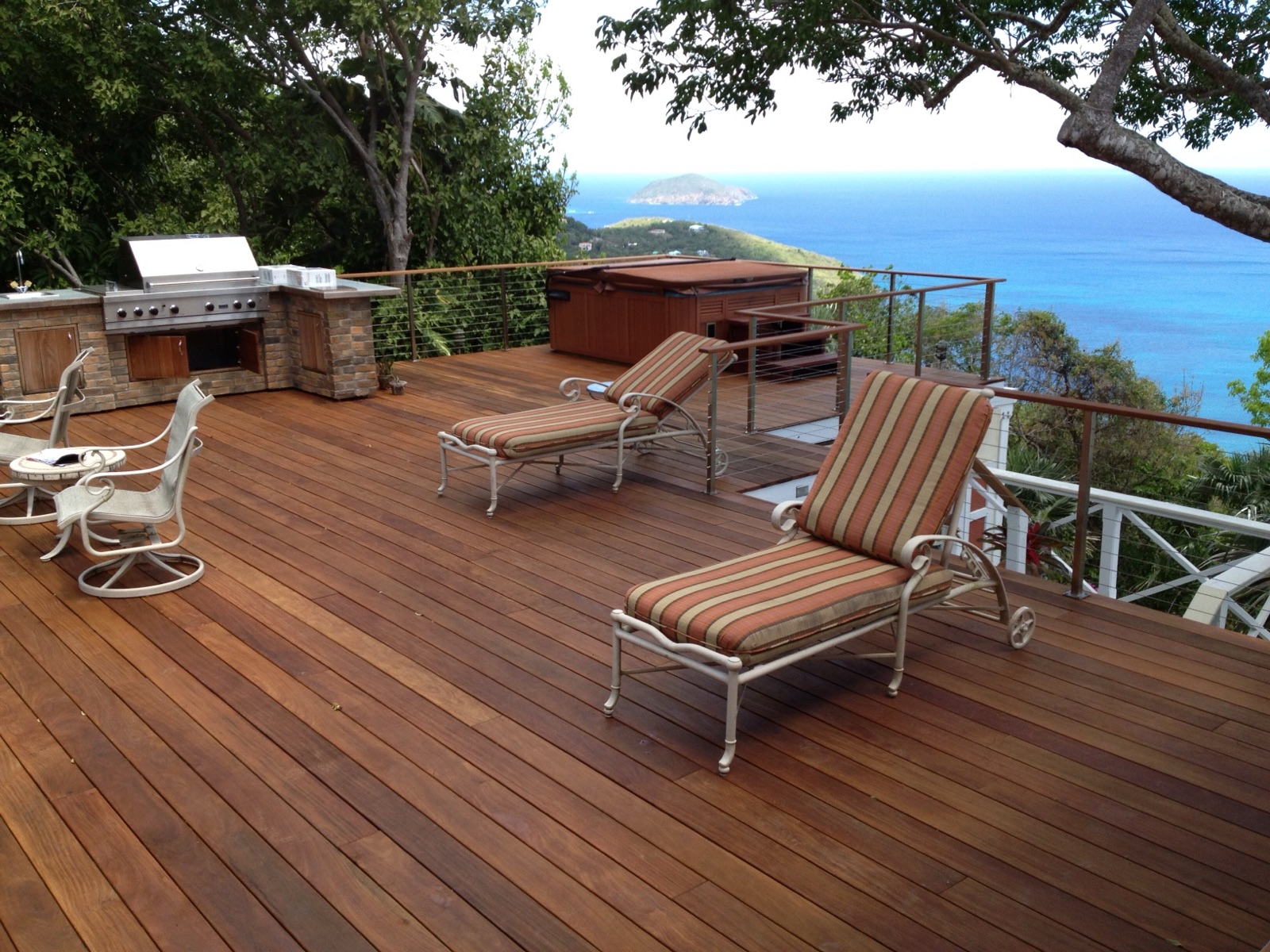
| Pool surround and barefoot zones | Good. Runs cooler than Ipe once weathered | Good, darkest and hottest | Garapa for the lightest color | Shade, orientation and gap width |
| Built-in bench and grill surround | Excellent. Best value per board foot | Excellent, no functional gain | Red Balau, Garapa | End sealing on every field cut |
Read that table as a budget tool. Ipe on treads and caps with Cumaru in the field is a common residential compromise, and the color difference between the two settles toward a similar silver once both weather.
Heat, Glare and What Bare Feet Actually Notice
Every dense tropical hardwood gets hot in direct sun, and no species selection fixes a south-facing pool deck with no shade. Solar gain on decking is driven mostly by surface color and exposure. Ipe runs dark olive brown to near black-brown when fresh and oiled. Cumaru starts a medium tan to reddish brown with more visible variation board to board. The lighter starting color helps marginally. Both will be uncomfortable at midday in August if there is nothing overhead.
Three moves do more than species choice. Add shade over the zone where people stand barefoot, whether that is a pergola, a sail or a roof overhang. Orient the boards so the traffic path runs through shadow at the hours the space gets used. And let the wood weather, since a silvered surface reflects more than a freshly oiled dark one. Homeowners who oil a pool deck every spring to keep the color are choosing appearance over comfort, which is a legitimate choice as long as it is a choice.
Where a client insists on the coolest possible barefoot surface in a tropical hardwood, Garapa is the honest answer. It is substantially lighter in color, sits near 1,700 lbf on the Janka scale, and works well in residential and engineer-approved 5/4 applications. It does not belong on a commercial deck spec, since it is not available in 2x thickness, but a backyard pool surround is exactly its use case.
Checking, Cutek and the Maintenance Bill Nobody Quotes
Surface checking in dense tropical decking cannot be prevented, and any supplier who promises otherwise is setting you up for a callback. Checking is the wood releasing tension as the exposed face heats and dries faster than the core. It does not weaken the board. Small surface checks are normal on Ipe, Cumaru, Jatoba and every other high-density decking species, and they are often a sign the material was seasoned properly rather than case-hardened.
What does move the needle is a factory coat. J. Gibson McIlvain factory coats tropical decking with Cutek, a penetrating oil wood stabilizer, and that treatment significantly reduces checking by slowing the moisture exchange at the surface. Site practice does the rest. Take delivery at the right moisture content, seal every field cut end, sticker the pile in shade rather than under a heat-trapping tarp, and give the underside of the deck room to breathe. The building enclosure principles published by Building Science Corporation apply here as much as to a wall assembly, since a deck that cannot dry from below will cup regardless of species.
On maintenance, run the labor math before choosing a finish strategy. A homeowner who wants Cumaru to keep its warm brown color is committing to a cleaning and re-oiling cycle roughly every one to two years depending on exposure, and that cost scales with square footage, not with what the lumber cost. A homeowner who lets it silver is committing to a wash. Cumaru weathers to a slightly warmer gray than Ipe does, and the transition is less abrupt because it starts lighter. Neither species needs a finish to survive.
Vertical, Overhead and Painted Elements Change the Calculus
Weight, not durability, is what disqualifies dense tropical hardwood from parts of an outdoor living space. A pergola rafter in Cumaru at roughly 1,070 kg/m3 is a serious dead load, and it drives beam sizing, post sizing and connection hardware upward. The structure gets more expensive to carry the wood than the wood costs. Same story on large gate leaves and tall privacy panels, where hinge and frame hardware has to be sized for the mass.
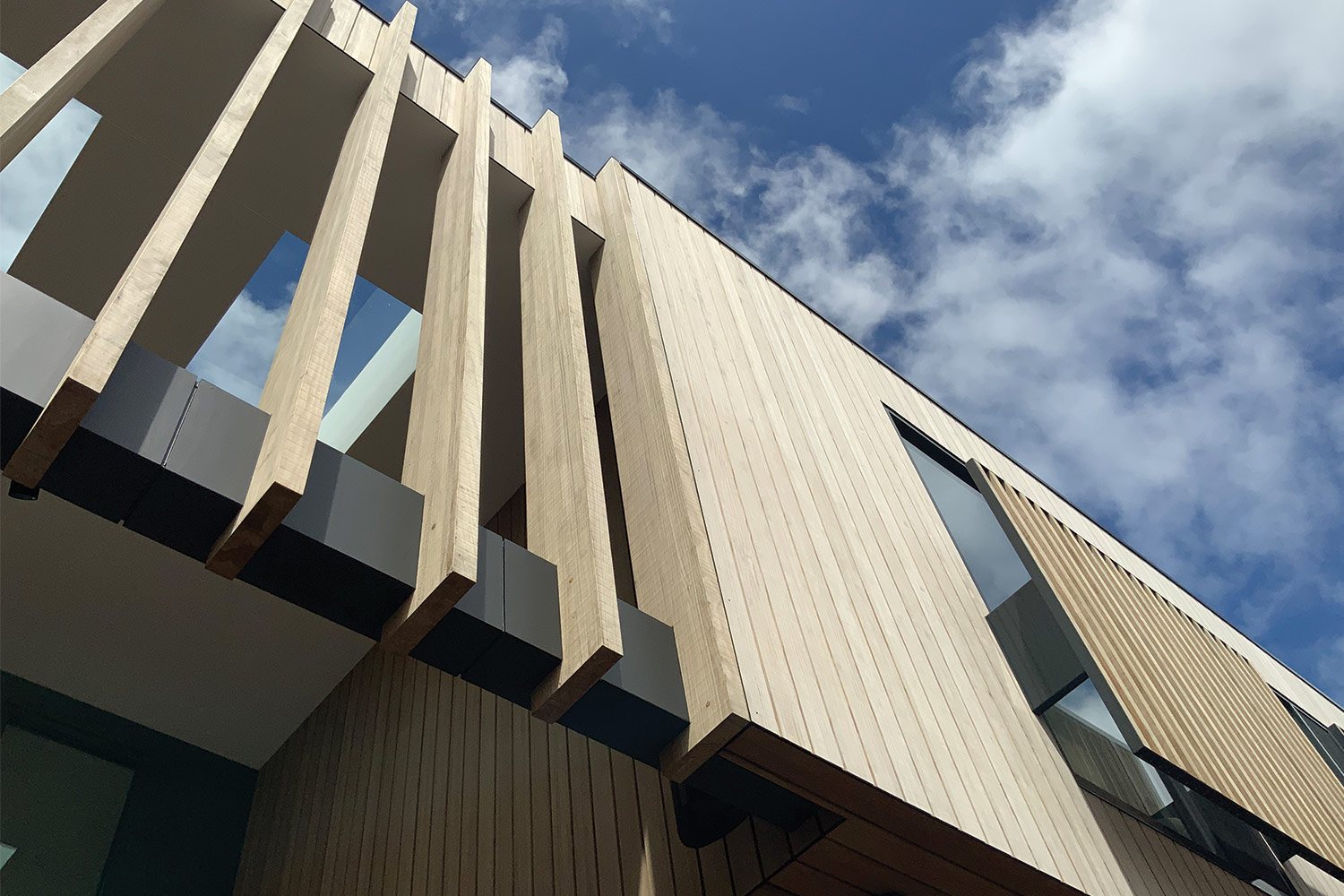
For overhead and screen work, modified wood usually makes more sense. Thermory and Abodo Vulcan both give dimensionally stable, decay-resistant cladding and screening at a fraction of the weight, and both carry manufacturer warranties, which no solid unmodified wood can offer. Both top out around 16 feet in length, with the metric sizes landing just under that, because kiln chamber size governs. Design the screen bays and rafter runs to that limit and the material list gets simple.
For anything that will be painted, do not put paint on Cumaru or Ipe. Oily dense tropicals fight coating adhesion. Accoya is built for painted exterior use. For painted exterior trim around doors, windows and the transition where the outdoor room meets the house, Sapele outperforms Genuine Mahogany on paint holding and is available in longer lengths, which reduces joints on long runs.
Fire Ratings and Code Items That Reach Residential Decks
An elevated residential deck is a code object, and in wildland urban interface zones the decking material itself is regulated. Ipe carries documented ASTM E84 Class A results, meaning a flame spread index of 25 or less. That rating comes from testing specific material, not from the species name, so ask for the actual test report on whatever species and thickness you are buying rather than assuming a category applies. Test methods and their scopes are published through ASTM International, and adoption of fire and building requirements runs through the International Code Council and, for many jurisdictional requirements, NFPA.
Structural items matter more on most jobs. Guard assemblies have to resist a concentrated load at the top rail, joist spans and connections have to meet prescriptive tables, and ledger attachment to the house is the single most common failure point in residential deck construction. The design values and span tables live at the American Wood Council codes and standards library, and the residential deck construction guide published there is worth having on site. Where a deck is part of an accessible route, surface openings and changes in level are governed by the criteria maintained by the U.S. Access Board.
Framing and Fastening Decide More Than Species Does
A poorly detailed Ipe deck fails before a well detailed Cumaru deck shows its age. Start with the substructure. Joists at 16 inches on center for any dense hardwood decking, doubled bearing under every butt joint so each board end lands on solid framing, and a plan for airflow beneath the deck. Material over a solid surface goes on furring strips, never flat on the slab.
Profile drives the fastener choice. Shiplap takes visible fasteners, full stop. Only tongue and groove works with hidden fastener clips. When a grooved profile is installed, the grooves face down so water drains out rather than collecting in the channel. Getting that backwards is one of the more expensive rookie errors in tropical decking.
Drilling is site work. Never order decking pre-drilled or pre-countersunk, and no mill should be putting fastener holes in boards before shipping, because the frame as built and the field cuts made on site invalidate any factory hole pattern. On site, pilot every hole. Two fasteners per board per joist. Roughly 3/4 inch edge distance. Full-depth pilots near board ends where splitting risk is highest. Butt joints land on doubled bearing. A self-centering combination bit that drills and countersinks in one pass will save a crew hours across a full deck. In coastal exposure, use 316 stainless fasteners, since 304 will bleed rust streaks within a few seasons of salt air.
Gapping deserves a sentence of its own. Install gaps sized to the moisture content of the boards as delivered, not to a number from a blog. Material delivered at the dry end of the range will expand slightly and needs a wider initial gap than material delivered damp.
Sourcing, Documentation and Getting a Residential Package Delivered
The difference between a smooth hardwood deck job and a painful one is usually decided before the truck is loaded. Residential packages get built from mixed lists. Deck boards in one or two widths, tread stock, cap stock, maybe a bundle of screen material, plus enough overage to absorb defect cuts and the inevitable design change at the stairs. Ordering those pieces from one source in one shipment avoids the color mismatch that comes from buying the field this month and the treads next month from somewhere else.
J. Gibson McIlvain mills and stocks Cumaru decking alongside a vast Ipe inventory across every standard and custom dimension, and ships both nationwide, including regular deliveries to California. Orders arrive banded, protected and, when specified, factory coated with Cutek. That matters more on a residential job than on a commercial one, since a homeowner's driveway is not a lumberyard and material sitting exposed for a week is material that moves.
"The residential jobs that go well are the ones where we get the whole list at once, including the treads and the cap. I would rather sort a full package in the yard than have a contractor call me in six weeks trying to match a color that has already started weathering. Send me the drawing, not just a square footage." Norm Moton, Director of Sales, J. Gibson McIlvain
On documentation, ask for it in writing. FSC certified material carries chain of custody paperwork traceable through the Forest Stewardship Council. When using a CITES-listed species, documentation is required at import and should follow the material to the buyer, with permit categories defined by the CITES Secretariat. Grading language is worth pinning down too, since decking grades are not standardized the way NHLA hardwood lumber grades are for interior stock. Ask what percentage of face defects, sapwood and color variation the grade permits.
For a takeoff, a 5/4x6 board covers about 2.1 linear feet per square foot of deck. Add for waste, picture framing and stair nosings. To get a quote on a mixed residential package, call 800-638-9100 or start at the J. Gibson McIlvain site, and see current tropical decking offerings including Ipe decking for comparison against Cumaru on the same job.
How J. Gibson McIlvain Would Specify This
For a residential outdoor living space where budget is a live constraint, the defensible spec is Cumaru in the field, Ipe where wear and sightlines concentrate, and modified wood overhead. Here is how that reads on a drawing.
Deck field. Cumaru, 5/4x6 for covered or shaded areas, 5/4x4 where the deck faces south or west with no overhead protection. Kiln dried to 12 to 16 percent, factory coated with Cutek. Delivered stickered, stored in shade, installed within a short window after acclimation on site. Joists at 16 inches on center, doubled bearing at all butt joints, minimum clearance and cross ventilation below the deck.
Stairs and railing cap. Ipe. Treads in the same width as the field boards so the visual module carries through, cap stock in the longest lengths available to minimize joints. This is the one place where paying more buys something a homeowner will notice in year fifteen.
Screens, skirts and pergola. Thermory or Abodo Vulcan, designed in bays that respect the roughly 16 foot length ceiling on modified wood. Accoya for any element that will be painted. Sapele for painted exterior trim where the outdoor room meets the house.
Fasteners and hardware. 316 stainless throughout in coastal work, quality stainless inland. Visible fastening on shiplap, hidden clips only on tongue and groove. Self-centering combination bit, two fasteners per board per joist, about 3/4 inch edge distance, full pilots at board ends, all drilling done on site against the frame as built.
Finish strategy. Decide before installation whether the deck will be maintained brown or allowed to silver, and price the maintenance cycle into the presentation to the client. Do not promise a checking-free surface. Explain that small surface checks are normal in dense tropical decking, that the Cutek coating reduces them, and that they do not affect the structural life of the board.
Documentation. FSC chain of custody where required, import paperwork retained where a CITES-listed species is involved, and grading expectations written into the purchase order rather than assumed. Send the elevation drawings with the material list. A supplier who can see the stair layout and the railing runs will catch the length problems before they become field problems.
Frequently Asked Questions
Can I mix Cumaru decking with Ipe stair treads and railing caps, or will they look mismatched?
Mixing works well and is one of the more common ways to bring a residential budget down. Fresh Cumaru starts a medium tan to reddish brown while fresh Ipe is a darker olive brown, so the difference is visible at installation. Once both weather, the two settle toward a similar silver gray and the contrast fades considerably. If a client wants the brown maintained with oil, expect the two species to stay visually distinct, which some designers use deliberately by picking out the treads and cap as accent elements. If uniformity matters more than budget, run one species throughout.
Does Cumaru work for a covered porch floor, or only for open decks?
It works for both, and a covered porch is actually the easier assignment. Less direct sun means less thermal cycling at the surface, which means less checking and less movement. On a covered porch you can comfortably use 5/4x6 rather than dropping to a narrower board, and the finish will last noticeably longer between maintenance cycles. The one thing a porch changes is ventilation. A porch floor over a shallow crawl or a solid deck needs airflow beneath it, and material over a solid surface goes on furring strips rather than flat on the slab.
Will a Cumaru pool deck get too hot for bare feet?
Any dense tropical hardwood in full midday sun will be uncomfortable barefoot, and Cumaru is no exception. It runs slightly cooler than Ipe simply because it starts lighter in color, and it gets cooler still once it weathers to gray. Shade does far more than species selection. If barefoot comfort is the driving requirement and the space cannot be shaded, Garapa is the more honest recommendation because it is substantially lighter in color while still delivering good durability in residential 5/4 applications.
What board width should I order for a residential Cumaru deck?
Width is a real lever with Cumaru because of its interlocked grain. A 5/4x4 has less cross-grain distance and resists cupping better, which is worth the extra fastening labor on a deck with heavy south or west exposure. A 5/4x6 covers ground faster, uses about half the fasteners per square foot, and is fine for shaded, covered or northern-exposure areas. On a deck with mixed exposure, some builders run the narrower board in the sunny zone and the wider board under the roof overhang.
Does Cumaru have a noticeable smell, and does it fade?
Cumaru contains coumarin, which gives freshly milled boards a sweet, vanilla-like scent that is strongest during cutting and sanding. It is not unpleasant to most people and it dissipates over the first weeks of exposure. The more practical concern is dust. Cumaru dust irritates some workers, so crews cutting a full deck package should wear respirators and eye protection and set up cutting stations with the wind rather than in a closed garage.
Can Cumaru be used for a pergola or overhead shade structure?
It can, but weight drives the decision more than durability does. At roughly 1,070 kg/m3, Cumaru rafters put real dead load on beams, posts and connection hardware, and the framing upgrade often costs more than the material saved. Modified wood is the better fit for overhead work. Thermory and Abodo Vulcan both give dimensional stability and decay resistance at a fraction of the weight, and both carry manufacturer warranties. Design the rafter runs to the roughly 16 foot length ceiling that kiln size imposes on modified products.
How should Cumaru decking be gapped at installation?
Gap to the moisture content of the boards as they arrive, not to a fixed number. Material delivered at the dry end of the 12 to 16 percent range will take on moisture and expand, so it needs a wider initial gap. Material delivered damp will shrink and needs a tighter one. Measure with a moisture meter at delivery, confirm the reading after the boards have acclimated on site, and set the gap from there. Consistent gapping also matters for drainage and for airflow across the underside of the boards.
Does the factory Cutek coating mean I can skip maintenance for the first year?
The Cutek coating is a stabilizer first and an appearance product second. It penetrates the wood and slows moisture exchange at the surface, which significantly reduces checking during the first seasons when the board is adjusting to its exposure. It does not eliminate the need for a maintenance decision. Choose early whether the deck will be kept brown through periodic cleaning and re-oiling or allowed to silver with only washing, and set client expectations accordingly. Neither Cumaru nor Ipe requires a finish to survive.
Sources and Standards Referenced
- Cumaru (Dipteryx odorata) species data, The Wood Database
- Ipe (Tabebuia spp.) species data, The Wood Database
- USDA Forest Products Laboratory
- American Wood Council, Codes and Standards
- Building Science Corporation
- ASTM International
- International Code Council
- National Fire Protection Association
- Forest Stewardship Council
- CITES Secretariat
- U.S. Access Board
- National Hardwood Lumber Association