The Short Answer for a Coastal Residential Deck
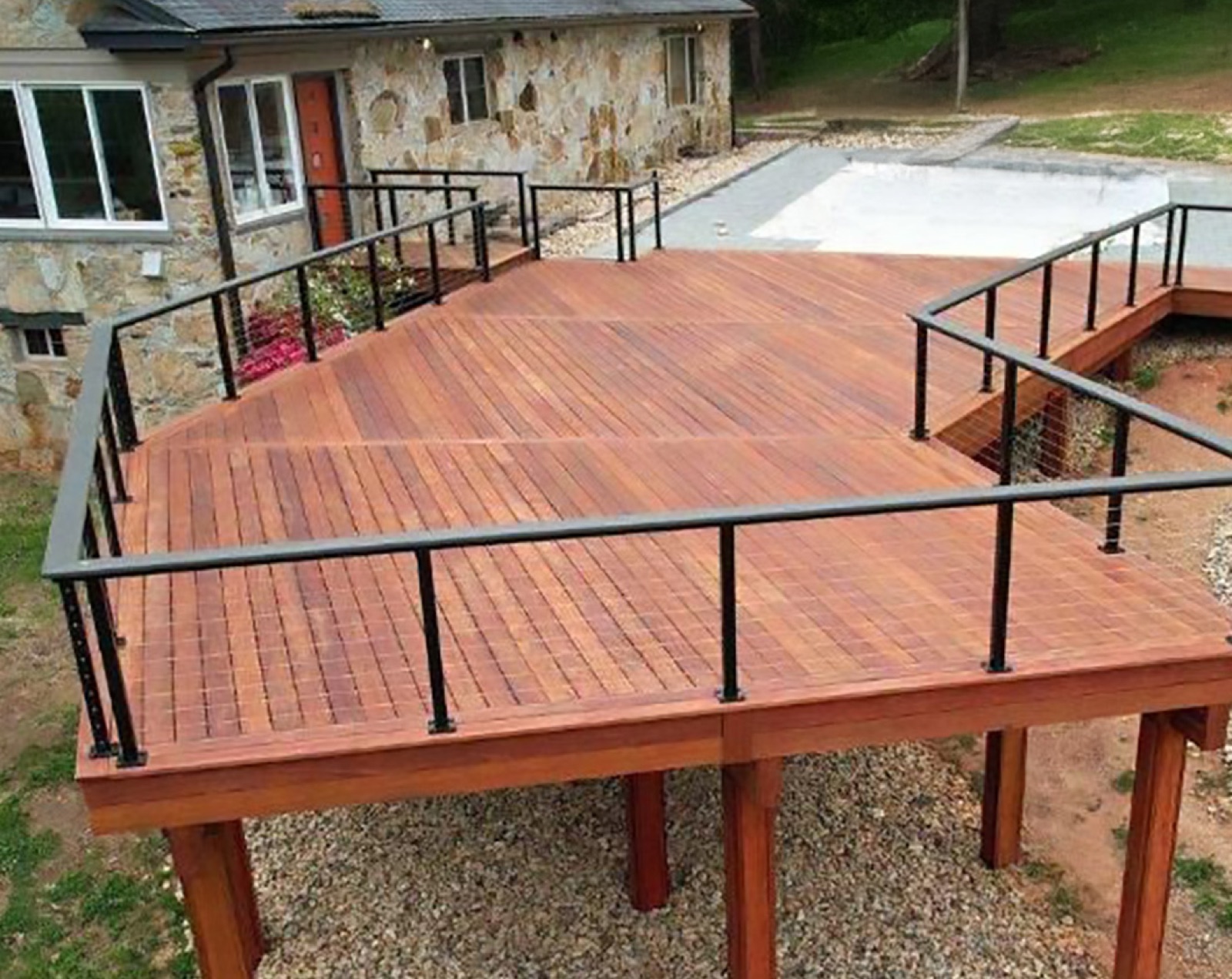
Choose between Cumaru and Garapa by how the deck gets used zone by zone, not by picking one species for the whole slab of square footage. Cumaru earns its place where the surface takes punishment. Garapa earns its place where the surface takes people. On an oceanfront house those are two different parts of the same deck, and the specifier who separates them gets a better result than the one who runs a single species from the house wall to the dune walkover.
Hardness charts push everyone toward Cumaru. That is a reasonable default and it is not wrong. But a light board that stays cooler under bare feet has real value in a lounging area, and a 3,540 lbf Janka rating does nothing for a client who burns the soles of her feet crossing the pool deck in August. The trade decision is about matching wear to material across a plan, then letting the frame, the fastener metallurgy and the drainage details carry the rest of the load. Both species will outlast a well-built frame by a wide margin. Both will disappoint on a bad one, and they will disappoint in exactly the same ways.
Map the Deck Into Wear Zones Before Anyone Talks About Species
A coastal residential deck is four or five distinct service environments sharing one elevation, and each one loads the board surface differently. Walk the plan and mark them. The path from the beach access or the outdoor shower carries wet feet and tracked sand every day of the season. Stair treads and the top landing take concentrated foot traffic and the highest slip liability. The dining zone drags chair legs. The lounging zone sits in unshaded sun and holds bare feet for hours. The perimeter band, the picture frame and the fascia catch wind-driven spray and take almost no traffic at all.
Once those zones are drawn, the species question resolves quickly. Traffic lanes and stairs want density and abrasion resistance. Lounge and pool-surround areas want a lighter surface color and a board that does not become a griddle. Perimeter and trim details want whatever keeps the field looking deliberate. Nothing about this requires exotic detailing. It requires the deck plan to exist as a plan before the material order gets built.
| Species | Janka (lbf) | Density (kg/m3) | EN 350 durability | Behavior under tracked sand and daily traffic | Wear zone where it fits best |
|---|---|---|---|---|---|
| Cumaru | ~3,540 | ~1,070 | Class 1 to 2 | Holds a crisp surface under grit; finish film wears before the wood does | Stair treads, beach-path lanes, dining zone, outdoor shower runoff |
| Garapa | ~1,700 | ~830 | Class 2 | Takes visible scuff in heavy lanes; pale surface hides sand haze well | Lounging and sunbathing areas, pool surrounds, shaded bay-side decks |
| Ipe (Tabebuia spp.) | ~3,680 | ~1,050 | Class 1 | Hardest wearing of the group; darkest and hottest in full sun | Whole-deck default where maximum wear life outranks surface heat |
| Jatoba | ~2,690 | ~910 | Class 2 | Strong abrasion resistance; color shifts noticeably under coastal UV | Covered porches and shaded traffic lanes rather than open sun |
| Red Balau | ~1,700 to 2,000 | ~800 to 900 | Class 2 | Similar traffic behavior to Garapa with a warmer red-brown tone | Residential fields and 5/4 work where color is the driver |
| Massaranduba | ~3,190 | ~1,150 | Class 1 to 2 | Very dense and prone to more aggressive movement in wet-dry cycling | Comparison reference only |
Tracked Sand Is an Abrasive and It Rewrites the Hardness Comparison
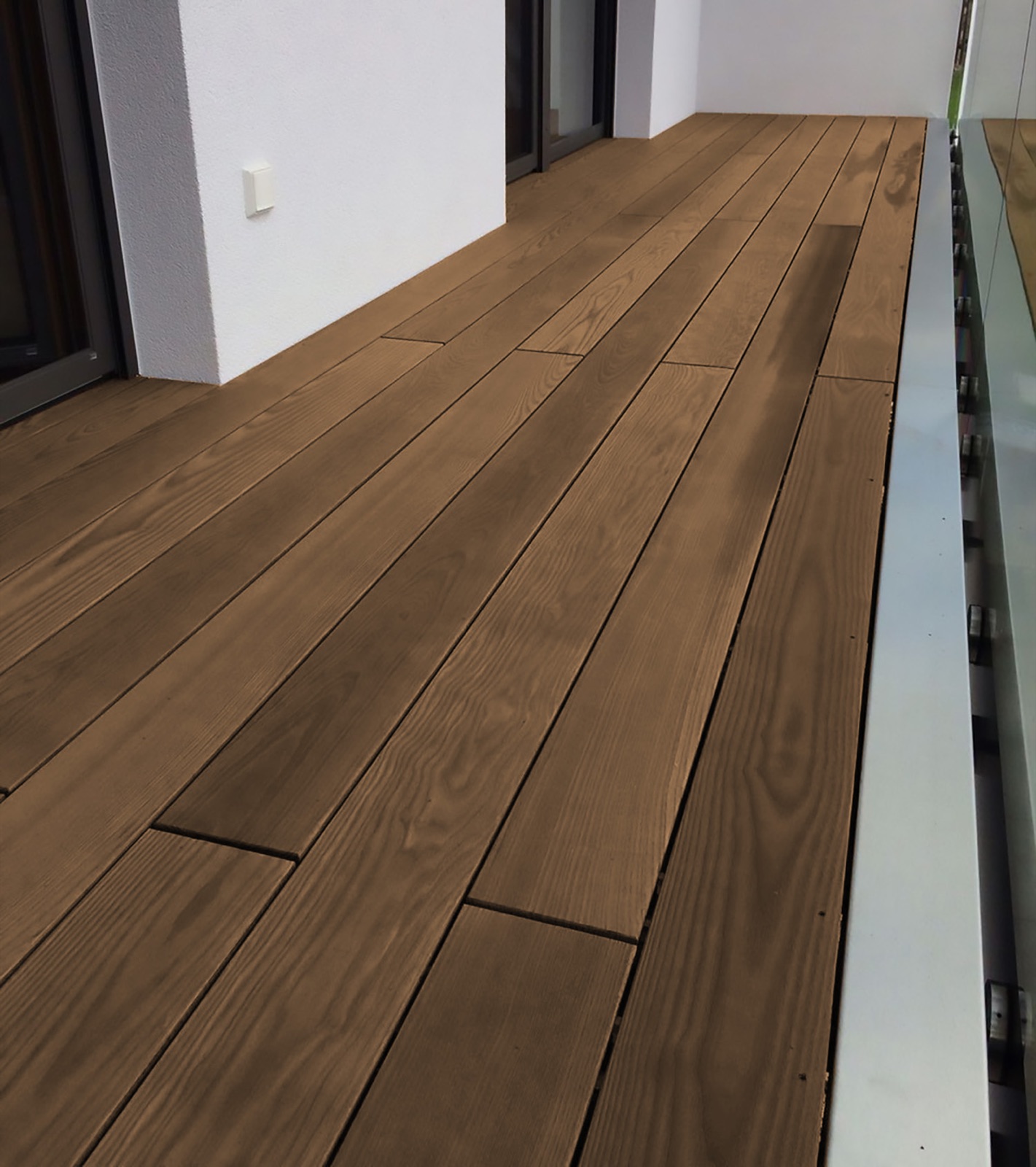
Quartz beach sand sits around 7 on the Mohs scale, which means every barefoot trip up from the water drags a mineral harder than any wood across the deck surface. This is the coastal variable that indoor-style hardness comparisons miss entirely. On an inland deck the Janka gap between Cumaru and Garapa mostly shows up as dent resistance under dropped objects and furniture legs. On a beach house it shows up as a wear lane.
Watch a three-season-old oceanfront deck and the pattern is obvious. There is a visible track from the stairs to the slider where the finish is gone and the surface has gone slightly fuzzy. Garapa develops that lane faster. The wood is not failing and the boards are not compromised, but the oil film breaks down sooner in the grit path and the deck starts to look two-toned before the owner expects it. Cumaru holds the same lane longer. Neither species resists the abrasion indefinitely, and the practical mitigation is a mat or a rinse station at the top of the stairs plus more frequent refresh coats in the lane itself.
Species assignment solves part of this for free. Run Cumaru in the grit path and the stairs, run Garapa in the zones that sand never really reaches, and the deck ages more evenly than a single-species field would. The USDA Forest Products Laboratory Wood Handbook covers the mechanical property differences that drive this, and the density gap between the two species tracks the abrasion behavior closely.
Wet Zones, Bare Feet and Surface Temperature
Surface temperature and wet traction matter more on a coastal residential deck than on any other deck type, and they favor Garapa in exactly the places where hardness is least needed. A pale honey-colored board absorbs less solar radiation than a dark brown one. That difference is real, it is felt through the skin within a second of contact, and it is the single most common complaint on unshaded southern-exposure decks. Garapa runs cooler than Cumaru in the same sun. It also weathers to a soft silver-gray that hides dried salt spray, while Cumaru gray tends to read as dusty until it is washed.
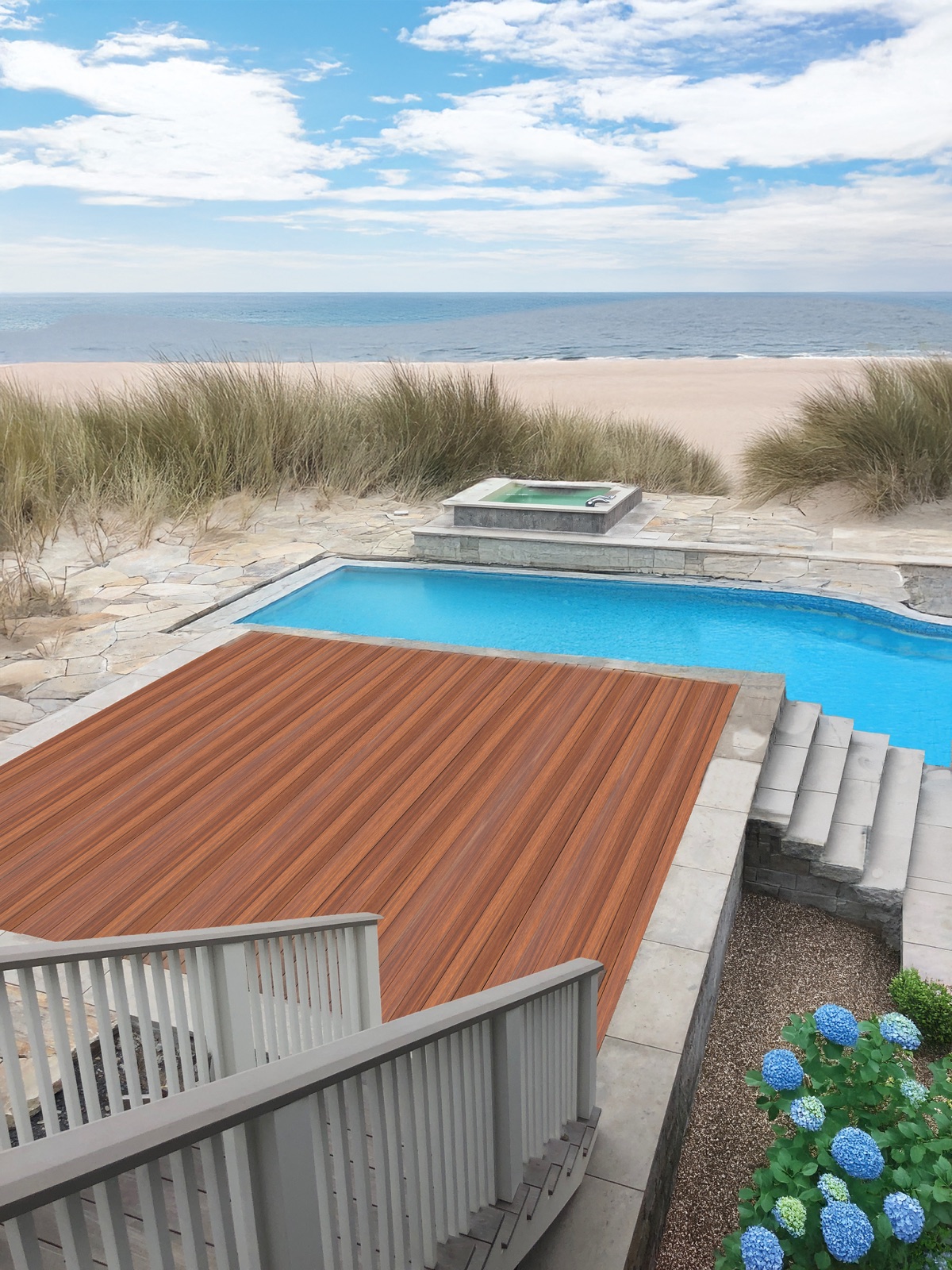
Pool surrounds add chemistry. Salt-chlorinated pools throw a dilute brine onto the deck with every splash-out, and that brine dries into crystals that stay on the surface until it rains. Neither Cumaru nor Garapa is damaged by it, but the salt accelerates corrosion at every fastener head and it sits in the surface checks. Rinse the deck. On the traction side, both species get slick when wet and smooth-surface tropical decking is not a high-traction product by nature. Where the deck doubles as a pool edge, specify a fine-textured or brushed face rather than a glass-smooth one, and keep the board layout running with the direction of travel so water sheets off instead of pooling across the grain.
Outdoor showers deserve their own note. The three or four boards under a shower head see standing water daily through the summer, and that zone should get the denser species plus a widened gap and a clear path for water to leave. Do not build a shower pan effect out of decking.
Stairs, Landings and the Loads the Zone Plan Hands to the Frame
Stair treads concentrate every failure mode a coastal deck has, and the heavy features scattered across the plan concentrate everything the frame has to answer for. Treads take the most traffic per square foot, they take the most tracked sand, they are wet the longest because they drain slowly, and they carry the highest liability if traction goes. Run Cumaru there. If the field is Garapa, a Cumaru tread reads as an intentional accent rather than a compromise, especially when the riser and stringer detailing carries the same darker tone.
Landings behave like treads. So does the threshold band immediately outside a slider, where sand collects against the door track and never gets swept far enough away. Fascia and picture-frame boards are the opposite case. They take spray and sun but almost no wear, which makes them a legitimate place to use the lighter species for visual relief. Keep the framing under a picture frame doubled or blocked so the mitered perimeter has continuous bearing. A picture frame floating over a single joist edge will telegraph movement within a season.
Guard and stair geometry answers to code, not to species. The International Code Council residential provisions and the American Wood Council prescriptive deck guidance both govern rise, run, guard height and connection details, and coastal jurisdictions frequently amend them upward for wind.
Dead load belongs in the same conversation. Tropical hardwood decking is roughly twice the weight of a softwood deck surface, and on an elevated coastal deck with cantilevers and uplift that difference belongs in the framing calculation. A dressed 5/4 Cumaru surface runs about 5.5 pounds per square foot on its own. Garapa runs closer to 4.4. Cedar or pressure-treated pine sits near 2.5. Those are not enormous numbers in isolation, but they stack with a wet snow or wind load and they matter on long spans and outboard cantilevers.
Frame for the material. Joists at 16 inches on center is the working standard for dense hardwood decking laid perpendicular, and a diagonal layout tightens that to 12 inches on center. A 5/4x6 board covers about 2.1 linear feet per square foot of deck, which is the number to use when converting a plan takeoff into board footage. Hot tubs, fire features, planters and outdoor kitchens are separate structural problems entirely and should sit on independently designed framing or on the slab below, never on a deck frame sized for occupancy load alone.
Uplift is the coastal condition that gets underestimated. In a high-wind zone the connection schedule matters more than the deck board, and every fastener in the load path has to be rated for the exposure. Hidden clip systems in particular need to be evaluated for uplift, not just for looks.
Fasteners and Profiles Follow the Zone Plan
Every fastener within reach of salt air on either species should be 316 stainless, and the profile choice decides whether hidden fastening is even available. Electro-galvanized fasteners have no place on a coastal deck. Hot-dip galvanized survives inland but corrodes in chloride, and both Cumaru and Garapa are tannin-rich enough to produce black iron staining around any corroding head. That staining shows on a pale Garapa surface far worse than it does on Cumaru, which is another reason the lighter species belongs in the low-fastener-density zones.
Profile rules are simple and they do not bend. Shiplap takes visible fasteners. Only tongue and groove works with a hidden fastener system, and side-grooved decking works with clips designed for that groove. Where decking carries back grooves, the grooves face down so water drains rather than collecting. Material lands on joists or furring strips with air on both faces. Mixing aluminum clip hardware with stainless screws sets up a galvanic pair, so follow the clip manufacturer's metallurgy schedule instead of substituting whatever is in the gang box.
"The calls we get about coastal decks almost never start with the wood. They start with a fastener that rusted, or a deck that was screwed down tight to a ledger with no air behind it. When a customer asks me Cumaru or Garapa, my first question is what the frame looks like and what hardware they plan to buy, because I have seen both species look perfect at year ten and I have seen both look tired at year three on the same beach."
Drilling and Layout Are Site Work, Not Mill Work
Never order decking pre-drilled or pre-countersunk, and no mill should be putting fastener holes in boards before they ship. Hole layout has to happen against the frame as it was actually built. Joists move during construction. Field cuts change board lengths. Butt joints land where the run requires them. Any factory hole pattern is wrong the moment the first board gets trimmed.
On-site technique for dense tropical hardwood is well established. Pilot every hole. Use two fasteners per board per joist, hold about 3/4 inch of edge distance, and run full-depth pilots near board ends where splitting risk is highest. Land butt joints on doubled bearing or on sistered blocking so both board ends get full support and both get their own fasteners. A self-centering combination bit that drills, countersinks and counterbores in one pass is the tool that makes this practical at production speed. Crews that skip the pilot on Cumaru learn quickly why the step exists.
Surface Checking, Cutek and the Delivery Window
Surface checking in dense tropical decking cannot be prevented, and any supplier who promises otherwise is selling something. Checking is the wood releasing tension as the surface heats and dries faster than the core. Small surface checks are normal. They do not weaken the board, and on a properly seasoned tropical deck they are evidence that the material dried the way it should have.
The mitigation that actually moves the needle is factory coating. J. Gibson McIlvain factory coats tropical decking with Cutek, a penetrating oil wood stabilizer, and that treatment significantly reduces checking by slowing the moisture gradient between surface and core. Site practice handles the rest. Take delivery of material at 12 to 16 percent moisture content, seal every field cut end immediately, sticker and cover the bundles rather than leaving them banded in the sun on a driveway, and give the deck air movement under the boards from day one. Those steps keep checks small. They do not eliminate them, and the spec should say so in writing before the client ever sees the deck.
Coastal humidity swings widen the target on gapping. A board delivered dry into a July oceanfront environment will pick up moisture and grow. A board installed in February will shrink less than the installer expects. Set gaps against measured moisture content at installation, not against a number copied off a chart.
Running Both Species on One Deck Without It Looking Accidental
Two species on one deck works when the transition follows a structural or geometric line, and it looks like a mistake when it follows nothing. Change species at a picture frame, at a stair landing, at a level change, or at a framed border that separates the dining zone from the lounging zone. Keep board widths consistent across the transition. Keep the finish schedule identical so both species age under the same oil regime, and expect the two to arrive at their weathered tones on different timelines.
Procurement is where this plan either holds together or falls apart, and a mixed-species order needs to arrive as one coordinated shipment with a clean tally. J. Gibson McIlvain mills and ships Cumaru and Garapa decking nationwide, including regular deliveries to coastal California, and a mixed order gets built to the zone plan rather than to a generic square-foot number. On documentation, FSC chain of custody is available where a project requires certified material, and when using a CITES-listed species, documentation is required and travels with the shipment under the CITES permit framework. Neither Cumaru nor Garapa is a species that carries a warranty, and no solid unmodified wood does. Call 800-638-9100 with the deck plan and the zone breakdown, and the order gets built around it.
Where a Modified Board or Cedar Changes the Answer
When the client will not maintain the deck and will not accept a silvered surface, the correct answer stops being a tropical hardwood at all. Thermally modified and acetylated products behave differently. Thermory and Abodo Vulcan thermally modified decking, along with Accoya, hold dimension exceptionally well in coastal humidity swings, and unlike solid unmodified wood they carry manufacturer warranties. The constraint to design around is length. Modified woods top out around 16 feet because of kiln size, with metric lengths landing just under that, so a long unbroken run needs a butt joint plan from the start.
Western Red Cedar remains a legitimate coastal choice and performs well, particularly on railings, soffits and porch ceilings where the weight savings help. Know which grade is being specified. Clear vertical grain cedar gives a uniform, knot-free face for painted or clear-finished work. Select tight knot cedar carries sound knots and reads as a rustic surface, which is the right look on plenty of beach houses. They are different products serving different looks and they should never be swapped on a submittal without the architect knowing.
Where the deck faces the harshest possible exposure and the client wants the longest wear life available, Ipe remains the benchmark, with a Janka near 3,680 lbf, EN 350 Class 1 durability and an ASTM E84 Class A fire rating, meaning a flame spread index of 25 or less under the ASTM E84 test method. Species characteristics for both Cumaru and Garapa are documented at the Wood Database, and structural detailing references for exterior wood assemblies are available through WoodWorks and Building Science Corporation.
How J. Gibson McIlvain Would Specify This
Write the spec as a zone assignment with one material standard, not as a single species line item. The submittal that survives a coastal job looks like this.
Call the lounging and pool-surround zones Garapa, 5/4x6 nominal, kiln dried to 12 to 16 percent, factory coated with Cutek before shipment. Call the traffic lanes, stair treads, landings, threshold bands and outdoor shower zones Cumaru at the same thickness, the same moisture spec and the same factory coating, with the transition falling on a framed border that has doubled bearing beneath it. Where the client wants one species across the whole deck and the longest wear life available, substitute Ipe for both zones and accept the surface temperature that comes with it.
Frame the deck with joists at 16 inches on center for a perpendicular layout and 12 inches on center for a diagonal, sized for a deck surface dead load of roughly 5.5 pounds per square foot plus the applicable live and wind loads, and carry hot tubs and heavy features on independent structure. Specify 316 stainless fasteners throughout with no exceptions within a mile of salt water, and follow the clip manufacturer's metallurgy schedule wherever hidden fastening is used. Note the profile rules on the drawing. Tongue and groove or side-grooved decking where hidden fastening is required, shiplap only where visible fasteners are acceptable, back grooves facing down.
Add the installation notes that keep a coastal deck out of trouble. Pilot every fastener hole on site, two fasteners per board per joist, 3/4 inch edge distance, full pilots at board ends, butt joints on doubled bearing, end sealer on every field cut, boards stickered and covered on delivery, and gaps set to measured moisture content at the time of installation. State plainly that small surface checking is normal in dense tropical decking and is not a defect.
Send the deck plan, the elevation and the exposure to J. Gibson McIlvain at 800-638-9100 or through mcilvain.com and the order comes back built to that zone plan, milled to the specified thickness, coated, tallied and staged for a jobsite delivery that works with barrier-island access. Grading questions on any domestic material in the package answer to NHLA rules, and fire and wind detailing questions belong with the design professional of record.
Frequently Asked Questions
Does tracked beach sand really wear a tropical hardwood deck?
It wears the finish long before it wears the wood. Quartz beach sand is harder than any decking species, and it acts as an abrasive every time someone walks up from the water. The result is a visible traffic lane where the oil film has broken down and the surface looks slightly dulled compared to the rest of the deck. Garapa shows that lane sooner than Cumaru does. Neither board is damaged structurally, but the lane needs refresh coats more often than the field, and a mat or rinse station at the top of the stairs meaningfully slows the process.
Which species should go on the stair treads at a beach house?
Cumaru, even when the field decking is Garapa. Treads take more traffic per square foot than any other part of the deck, they hold water longest, they collect the most sand, and they carry the highest liability if traction degrades. A darker tread against a lighter field reads as an intentional design decision rather than a substitution, particularly when the risers and stringer trim carry the same tone. Stair rise, run and guard details answer to the adopted residential code, not to the species choice.
Can I run Cumaru and Garapa on the same deck without it looking like a patch job?
Yes, if the transition follows a line the eye already reads as intentional. Change species at a picture frame, a framed border, a level change or a landing edge. Keep board width and thickness consistent across the transition, put doubled bearing under the border, and use the same finish schedule on both species so they age under the same oil regime. The two will reach their weathered tones on different timelines, which is worth explaining to the client before the deck is built rather than after.
How much dead load does tropical hardwood decking add compared to softwood?
Roughly double. A dressed 5/4 Cumaru deck surface runs about 5.5 pounds per square foot, Garapa about 4.4, and cedar or pressure-treated pine closer to 2.5. On a modest ground-level deck that difference is absorbed easily. On an elevated coastal deck with cantilevers, long spans and wind uplift in the load path, it belongs in the framing calculation and in the connection schedule that the design professional signs.
Do Cumaru and Garapa need different fasteners?
Both need 316 stainless within reach of salt air, and neither tolerates electro-galvanized hardware. Both species are tannin-rich enough to produce black staining around any corroding fastener head, and that staining is far more visible against a pale Garapa surface than against Cumaru. Where hidden clips are used, follow the clip manufacturer's metallurgy schedule rather than mixing aluminum hardware with stainless screws, which sets up a galvanic pair.
Should I order decking pre-drilled to save site labor?
No, and no mill should offer it. Fastener layout has to be established against the frame as actually built. Joists shift during construction, field cuts change board lengths, and butt joints land where the run dictates, so any factory hole pattern is wrong from the first trimmed board. Do the drilling on site with a self-centering combination bit, pilot every hole, use two fasteners per board per joist at about 3/4 inch edge distance, and run full pilots near board ends.
Is Garapa suitable around a salt-water pool?
Yes. Neither species is damaged by dilute pool brine, and Garapa's lighter color and cooler surface make it a good fit for a pool surround where bare feet are on the deck constantly. The brine does accelerate corrosion at fastener heads and it collects in surface checks, so rinsing matters more than it does on an inland deck. Specify a fine-textured or brushed face where the deck functions as a pool edge, since smooth tropical decking is slick when wet.
What thickness is right for a coastal residential deck in these species?
Nominal 5/4 over joists at 16 inches on center is the working standard for both Cumaru and Garapa on residential work, tightened to 12 inches on center for a diagonal layout. A 5/4x6 board covers about 2.1 linear feet per square foot of deck for takeoff purposes. Commercial boardwalk, pier and plaza decks are a different specification entirely and get 2x thickness to control deflection, which limits those jobs to species available consistently in 2x.
Sources and Standards Referenced
- Wood Handbook: Wood as an Engineering Material (FPL-GTR-190), USDA Forest Products Laboratory
- Codes and Standards, American Wood Council
- ASTM E84 Standard Test Method for Surface Burning Characteristics of Building Materials
- Forest Stewardship Council
- CITES Convention on International Trade in Endangered Species of Wild Fauna and Flora
- Cumaru, The Wood Database
- BSD-013: Rain Control in Buildings, Building Science Corporation
- International Code Council
- WoodWorks Wood Products Council
- National Hardwood Lumber Association