Keeping Cumaru Brown Is a Program, Not a Purchase
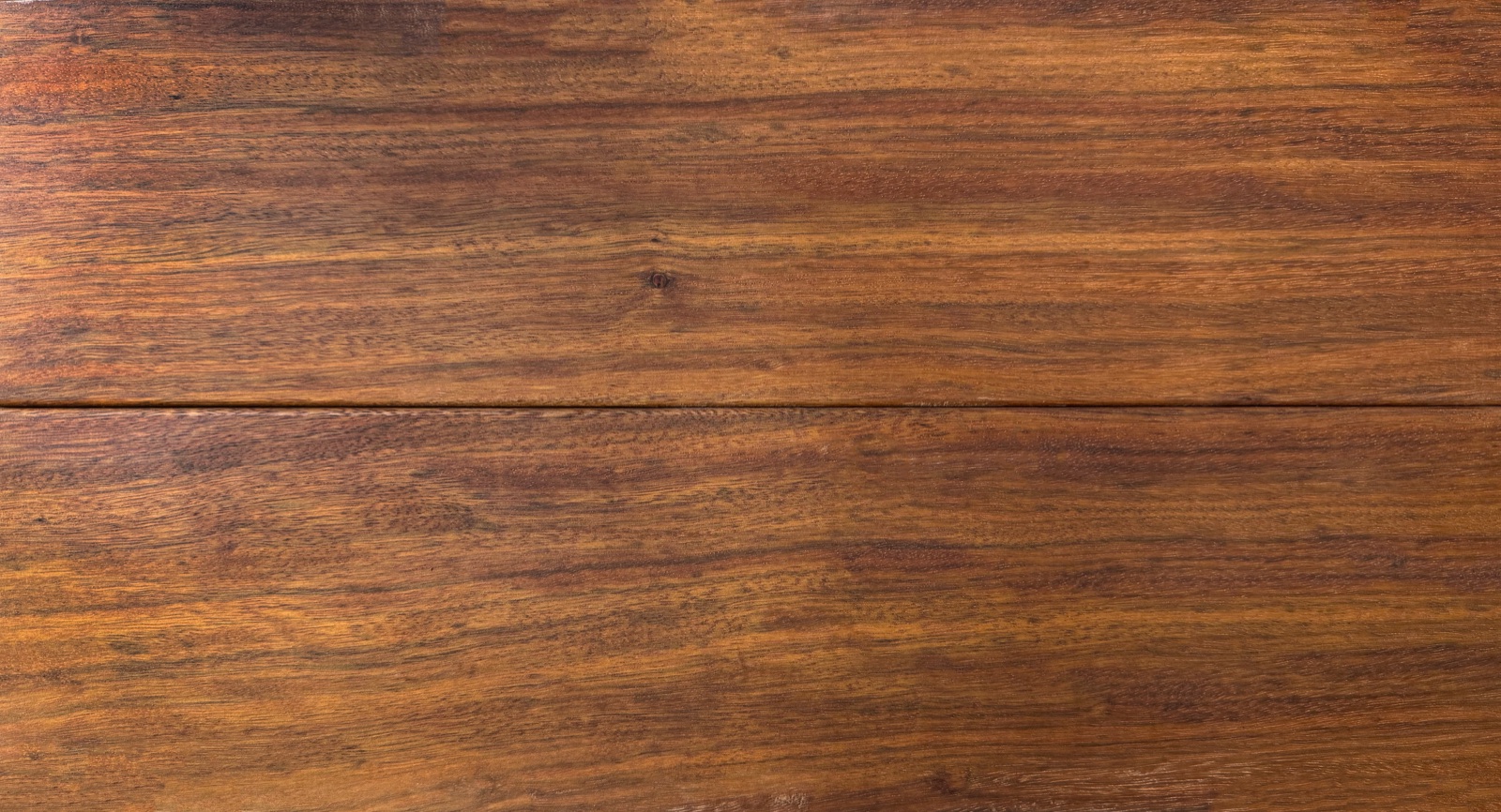
Cumaru holds its cinnamon-brown color only when the owner commits to a repeating cycle of washing, brightening and thin pigmented oil coats, and it goes silver the season that cycle stops. No can of finish changes that arithmetic. Cumaru sits near the top of the density chart for commercial decking, around 1,070 kg/m3 with a Janka hardness close to 3,540 lbf, and that density is the reason finishes behave differently on it than on cedar or treated pine. The wood accepts very little oil. What it does accept lives in the top fraction of a millimeter of the board, exactly where sunlight works on it every day.
This article lays out the whole program. The chemistry behind graying. What the factory coating buys you and what it does not. The wash, brighten, oil sequence in field detail. How to read a deck surface so you recoat on evidence rather than a calendar guess. And where the program changes for commercial boardwalks, coastal exposure and owners who decide silver is the look they want.
Sunlight Destroys Lignin Faster Than Water Destroys Wood
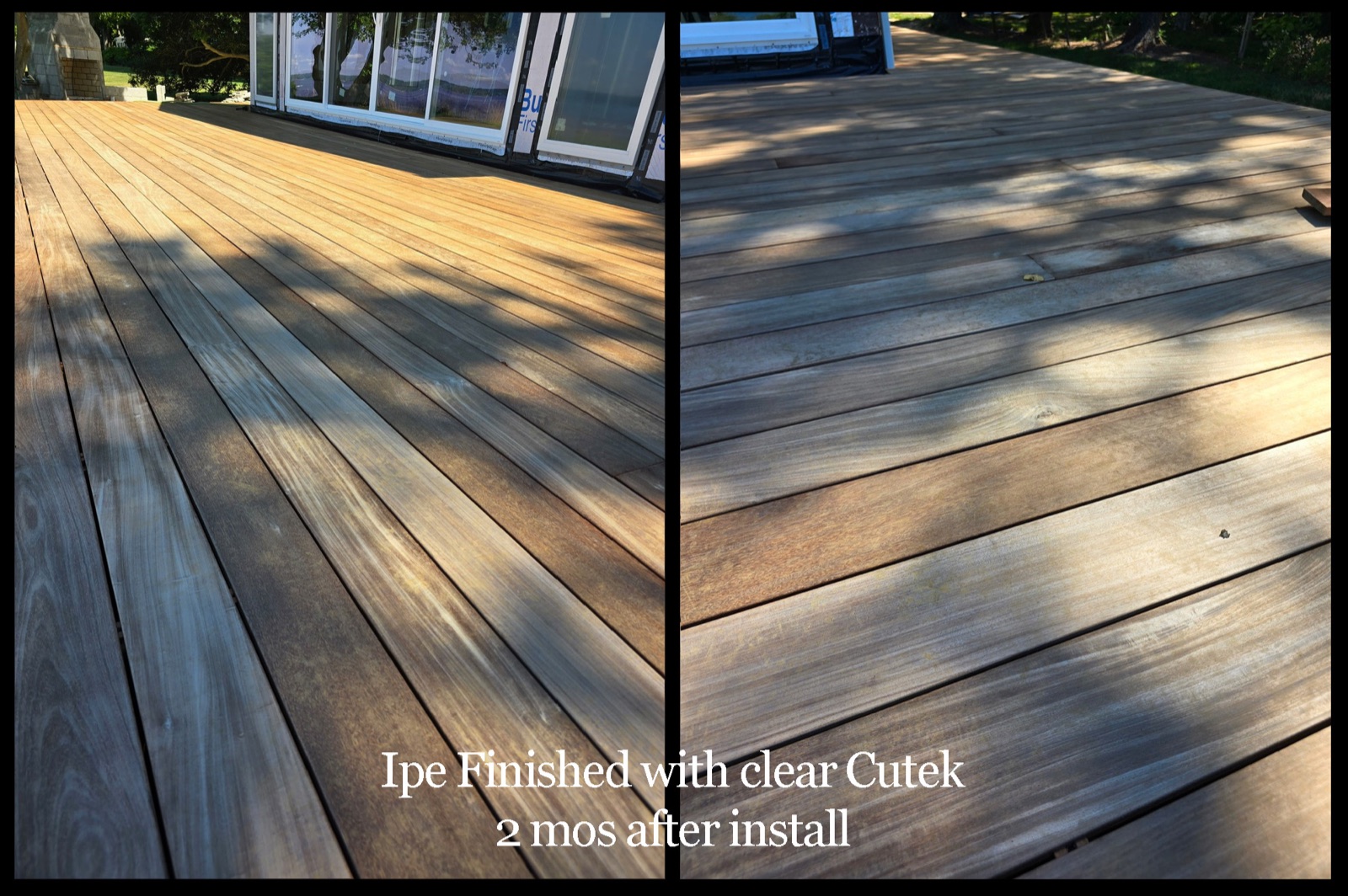
Graying is ultraviolet destruction of lignin in the top few thousandths of an inch of the board, and pigment is the only finish ingredient that meaningfully slows it down. Lignin is the natural polymer that binds wood fiber together and gives Cumaru its warm color. UV radiation breaks it apart at the surface. Rain then rinses the degraded material away and leaves behind a thin mat of loose gray cellulose. Mildew moves into that mat, which is why weathered decks drift from bright silver toward a dingier gray in damp climates. The USDA Forest Products Laboratory covers this mechanism in depth in the finishing chapter of the Wood Handbook, and its conclusion has not changed in decades. Unpigmented clear finishes let UV pass straight through and fail within months on horizontal surfaces.
Pigment particles absorb and scatter UV before it reaches the lignin. That is the entire trick. A lightly pigmented penetrating oil in a tone close to fresh Cumaru shields the surface while still reading as natural wood. The heavier the pigment load, the longer the UV protection lasts, which is why semi-transparent products outlast so-called clear sealers on every exposure test ever run. None of this is decay. A gray Cumaru board is still structurally sound. The fight is cosmetic, and it is winnable, but only on a schedule.
Year Zero Starts at the Mill, Not on the Jobsite
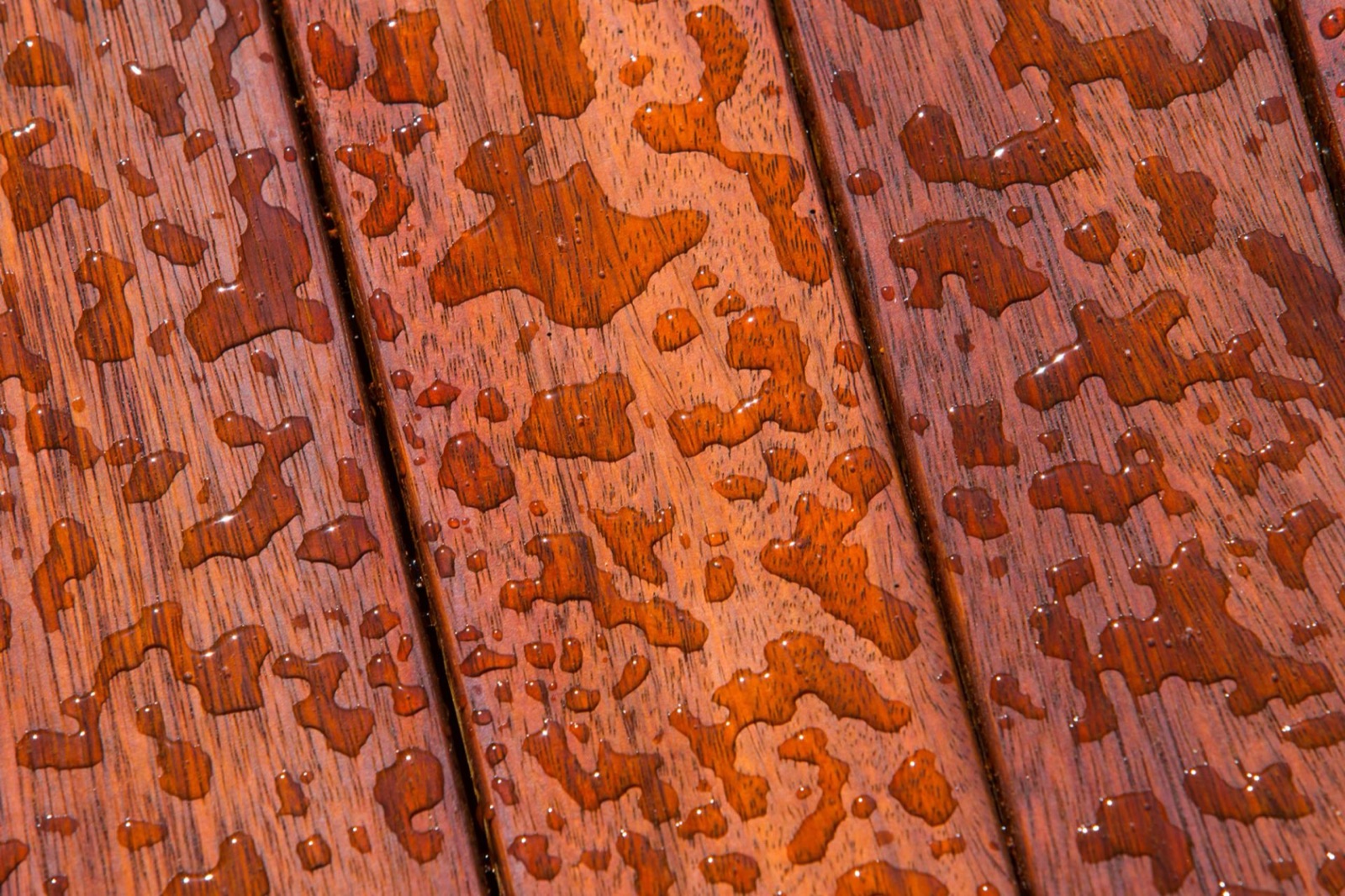
The maintenance clock starts before the first board is fastened down, with a factory-applied penetrating stabilizer and a proper acclimation window on site. J. Gibson McIlvain supplies Cumaru decking nationwide with a factory coat of Cutek, a penetrating oil wood stabilizer, already on the boards when they arrive. That coat slows the violent moisture swings a fresh surface goes through in its first weeks outdoors and significantly reduces surface checking. It is not a permanent color system. Think of it as the primer for the maintenance program you are about to run.
Boards should arrive in the in-service moisture range of 12 to 16 percent, and a pin meter reading on delivery takes thirty seconds and settles later arguments. Sticker the material on site, out of direct sun, with air moving through the stack. After installation, let the deck see several weeks of weather before the first field-applied maintenance coat. That interval lets surface extractives rise and wash off, and it gives the wood a chance to open up enough to take oil. Data on the species, including its density, movement and durability numbers, all points the same direction. This is slow-moving, oily, tight-grained material, and it rewards patience at year zero.
We put Cutek on every tropical decking order before it leaves our yard. I tell customers the first maintenance coat is the one that decides the next ten years. Get the deck clean, get it dry, and put the oil on thin. The decks that look rough at year five are almost never the wood's fault.
The Wash, Brighten, Oil Sequence in Field Detail
Every maintenance coat that lasts was applied over a surface that got a percarbonate wash, an oxalic acid brightener, a full rinse and real drying time before oil touched it. Skip a step and the coat fails early. The sequence runs like this.
Start with a sodium percarbonate deck cleaner mixed per the label. It releases hydrogen peroxide in solution, lifts the loose gray fiber and kills surface mildew. Keep the deck wet with it for ten to fifteen minutes, scrub along the grain with a stiff synthetic brush on a pole, then rinse hard. Percarbonate is alkaline, and alkaline residue darkens tannin-rich wood, so the second step matters just as much. An oxalic acid brightener dissolves tannin bleed and iron staining, pulls the surface back toward its natural pH and restores the fresh color. Apply it, let it work a few minutes, rinse until the runoff is clean.
Now wait. Two to three rain-free days, longer in humid weather, until a moisture meter says the surface is back in its normal range. Then oil. Work thin with a pad applicator or brush, three or four boards at a time running full length so lap marks never form. On wood this dense the board takes what it takes and refuses the rest, so come back within twenty to thirty minutes and wipe off everything that has not absorbed. One thin coat is the goal. A puddled second coat does not add protection. It sits on top, stays tacky, collects dirt and dries to shiny patches. Lay oil-soaked rags flat outdoors or drop them in a water bucket, since piled rags can self-heat and ignite.
Recoat on Evidence, Not on the Calendar
The deck tells you when it needs oil through the water-drop test, sheen loss and color drift, and reading those signals beats any fixed schedule. Flick water onto the traffic lanes. If it beads and stands, the oil is still working and you close the can. If it soaks flat within a minute or so, the recoat window is open. Color gives the second signal. Compare a walkway board against one that lives under a planter or bench, and when the difference jumps out at arm's length the surface is asking for pigment.
Penetrating oils hand you an advantage here that film finishes never will. You can spot recoat. Stair treads, the grill zone and the path to the door fade first, and hitting only those areas in a spring touch-up is legitimate practice because a penetrating oil leaves no film edge to telegraph. Full-field recoats then land somewhere between twelve and thirty months depending on exposure, and the water test tells you which end of that range your deck lives at. Owners who oil by the calendar either waste product on wood that will not take it or wait too long and buy themselves a full restoration wash.
Five Finish Strategies, Ranked by How They Fail
Pick a finish for Cumaru by its failure mode, not its day-one appearance, because every exterior finish fails and the only question is how much work the failure creates. A pigmented penetrating oil fails by fading, which costs you a wash and a thin coat. A film builder fails by cracking and peeling on wood this dense, which costs you a stripping job on a 3,540 lbf surface that fights every pass of the sander. That asymmetry should drive the decision more than any brochure photo.
| Strategy | How it fails on Cumaru | Recoat prep | Interval, full sun horizontal | Best fit |
|---|---|---|---|---|
| Pigmented penetrating oil | Gradual fade, no film to peel | Wash, brighten, dry | 12 to 18 months | Default choice for color retention |
| Hardening drying-oil blend | Wears through in traffic lanes, can gloss up where overapplied | Wash, scuff worn zones | 12 to 24 months | Covered porches, lower UV dose |
| Water-based semi-transparent | Surface film flakes as dense grain rejects penetration | Aggressive sanding or stripping | 24 months, then escalating failure | Rarely justified on this species |
| Film-forming varnish or solid stain | Cracks, peels, traps moisture beneath the film | Full mechanical strip | Not recommended | Not suited to dense tropical decking |
| No finish, wash program only | Uniform silver, mildew if washing lapses | Percarbonate wash, brighten as needed | Annual wash | Owners who want the weathered look |
The last row deserves respect. Washed silver Cumaru is a deliberate, low-labor strategy used on thousands of waterfront homes, and the annual cleaning still matters because the gray fiber mat feeds mildew when it goes unmanaged.
Sun, Shade and Salt Each Rewrite the Schedule
A south-facing coastal Cumaru deck can need oil every year while a covered north-side porch floor of the same material coasts for three, and the difference is exposure, not product quality. Horizontal surfaces in full sun take the maximum UV dose, so their pigment burns off first. Shade flips the problem. A shaded deck holds color far longer but sits damp longer after every rain, so mildew pressure replaces fade as the maintenance driver, and the percarbonate wash becomes the critical annual task even in years with no recoat.
Salt air adds two more variables. Salt crystals are mildly abrasive underfoot and they pull moisture from the air, so oceanfront decks cycle wetter and wear faster. A freshwater rinse a few times a season helps more than most owners expect. Fastener metallurgy matters here too. Repeated wash and recoat cycles keep coastal hardware wet, and 316 stainless steel screws are the grade that shrugs that off. Under the deck, leave the framing bays open enough for cross ventilation, since boards that can dry from both faces move less, check less and hold finish longer than boards over a sealed, stagnant cavity.
Commercial Boardwalks Play by Different Rules
Public boardwalk, pier and plaza decks are specified at 2x thickness to control deflection, and most facility owners run them silver with a wash program instead of an oil program. No professional goes first with a thinner board on a public job, even where 5/4 strength math pencils out. That thickness rule quietly filters the species list, since only Ipe, Cumaru and Jatoba can be sourced consistently in 2x decking dimensions. Red Balau and Garapa are fine decking woods, and they belong in residential and engineer-approved 5/4 work, not on a municipal pier.
Oiling a commercial deck is an operations question before it is a finish question. Fresh oil is slick until it absorbs, so a recoat means a closure window and signage, and many owners simply skip color and standardize on an annual percarbonate wash. Slip resistance and surface condition also sit inside accessibility obligations for public routes, where the U.S. Access Board guidelines govern. Fire and structural review pull in their own standards. Ipe carries a Class A flame spread rating under ASTM E84, meaning an index of 25 or less, and load questions on the framing run through the American Wood Council's codes and standards. For projects weighing Cumaru against Ipe at 2x thickness, J. Gibson McIlvain holds a vast Ipe inventory across all standard and custom dimensions, detailed on its Ipe decking page, so the choice can ride on color and budget priorities rather than availability.
Six Mistakes That Age a Cumaru Deck Faster Than Weather Does
More Cumaru decks are damaged by maintenance done wrong than by maintenance skipped. Six errors come up again and again on service calls.
First, pressure washing at close range. A zero-degree tip furs up the grain and carves the soft earlywood even on a species this hard. Keep a wide fan tip a foot off the surface at modest pressure, or better, scrub by hand. Second, sanding finer than 80 grit. A burnished surface closes up and rejects oil, so restoration sanding stops at 60 to 80 grit. Third, heavy coats. Unabsorbed oil is the source of nearly every tacky, blotchy, dirt-collecting Cumaru surface in the field. Fourth, oiling damp wood. Oil over trapped moisture feeds mildew from below and the coat fails in gray blooms. Fifth, skipping the brightener after an alkaline wash, which locks in a darkened, blotchy cast that owners then blame on the product. Sixth, forgetting end sealer on fresh field cuts during repairs. End grain pumps moisture in and out at many times the rate of face grain, and unsealed cuts are where new checks start.
What the Oil Program Cannot Promise
No maintenance program prevents surface checking in dense tropical decking, and any sales pitch claiming otherwise should end the conversation. Checking is the wood relieving tension as its surface heats and dries faster than its core. It does not weaken the board. Small surface checks are normal and are, if anything, evidence of properly seasoned material finishing its adjustment outdoors. The real mitigation happens upstream, in the factory Cutek coat that slows surface moisture loss and significantly reduces checking, and in site practice such as verified moisture at delivery, sealed end cuts and ventilated framing that keeps the checks that do appear small. Oil also cannot stop seasonal movement across a board's width, and it cannot make gray a moral failure. A washed, maintained silver deck is a finished deck. The program in this article is for owners who want the brown, and it delivers that, on schedule, for as long as the schedule is kept.
How J. Gibson McIlvain Would Specify This
A Cumaru deck that stays maintainable is specified as a system, from board thickness and framing through the factory coating and the closeout maintenance schedule. Here is how the spec reads in practice. Residential decks run 1x6 or 5/4x6 Cumaru over joists at 16 inches on center, with a 5/4x6 board covering about 2.1 linear feet per square foot for takeoff math. Commercial boardwalks and piers move to 2x6. Every tropical decking order ships with the Cutek factory coat, and the spec should name a compatible pigmented penetrating oil for the field program along with the wash, brighten, dry, thin-coat sequence written into the closeout documents so the owner inherits a schedule, not a mystery. Coastal work gets 316 stainless fasteners. Under-deck ventilation gets drawn, not assumed.
Sourcing language belongs in the spec too. FSC-certified material is available for projects pursuing chain-of-custody goals under the Forest Stewardship Council program, including projects chasing credits through the U.S. Green Building Council. When a project uses a CITES-listed species, the CITES documentation travels with the shipment, and an importer that handles those permits in house removes the risk from the contractor. J. Gibson McIlvain stocks Cumaru, Ipe, Garapa and Jatoba decking and ships contractor-volume packages nationwide, with regular deliveries to California, from a company that has been buying lumber on its own standards since 1798. For a takeoff review or a quote on a Cumaru package with the factory Cutek coat, call 800-638-9100 or start at mcilvain.com.
Frequently Asked Questions
Can I pressure wash a Cumaru deck without damaging it?
Yes, within limits. Use a wide fan tip, keep the wand about a foot off the surface, hold the pressure modest, and always move with the grain. A narrow tip held close will fur up the grain even on wood this hard, and those raised fibers gray almost immediately. A stiff synthetic brush, a percarbonate cleaner, and a garden hose accomplish the same cleaning with no risk, which is why many pros skip the machine entirely.
Why does my Cumaru deck look darker and blotchy after cleaning?
That is alkaline residue from the percarbonate cleaner reacting with the tannins in the wood. Cumaru is tannin-rich, and any alkaline wash left unrinsed or unneutralized darkens the surface. Follow every percarbonate wash with an oxalic acid brightener, let it work a few minutes, and rinse until the runoff runs clear. The brightener returns the surface to its natural pH and restores the fresh color before oil goes on.
Does the factory Cutek coating count as the first maintenance coat?
No. The factory Cutek coat is a penetrating oil stabilizer that slows moisture swings during the deck's first weeks outdoors and significantly reduces surface checking. Treat it as a primer for the maintenance program. After the deck has weathered for several weeks and dried back to its in-service moisture range, wash it, brighten it, and apply the first thin field coat of a compatible penetrating oil.
How do I know when it is time to re-oil instead of following a fixed schedule?
Use the water-drop test. Flick water onto the traffic lanes, and if it beads and stands, the oil is still working. If it soaks in flat within a minute, the recoat window is open. Color drift is the second signal, so compare a walkway board against one shaded by a bench or planter. Full-field recoats land anywhere from twelve to thirty months depending on exposure, and the surface itself tells you which end of the range applies.
Can I spot-treat just the worn traffic lanes instead of re-oiling the whole deck?
Yes, and it is good practice with penetrating oils. Stair treads, grill zones, and door paths fade first because they take the most abrasion and UV. A penetrating oil leaves no film, so a spot recoat has no edge to telegraph, and after a few weeks of weathering the touch-up blends with the field. Clean and brighten the spot area first just as you would for a full recoat.
What grit should I use when sanding a grayed Cumaru deck back to color?
Stop at 60 to 80 grit. The gray layer is only a few thousandths of an inch deep, so a light pass with a random-orbit or pole sander removes it. Sanding finer than 80 grit burnishes a surface this dense, closes the grain, and causes the wood to reject oil, which leads to a blotchy coat. Vacuum the dust out of the board gaps before oiling.
Do commercial Cumaru boardwalks get oiled or left to weather?
Most facility owners run commercial decks silver with an annual percarbonate wash program rather than an oil program. Fresh oil is slick until it absorbs, so every recoat means a closure window and signage, and public walking surfaces also carry accessibility and slip-resistance obligations. Commercial boardwalks and piers are specified in 2x thickness to control deflection, and Cumaru is one of the few species reliably available in those dimensions.
Sources and Standards Referenced
- Wood Handbook, Chapter 16, Finishing of Wood. USDA Forest Products Laboratory
- Cumaru, The Wood Database
- ASTM E84, Standard Test Method for Surface Burning Characteristics of Building Materials
- Codes and Standards, American Wood Council
- Forest Stewardship Council
- CITES, Convention on International Trade in Endangered Species
- U.S. Access Board