What a Lit Coffer Asks of the Millwork
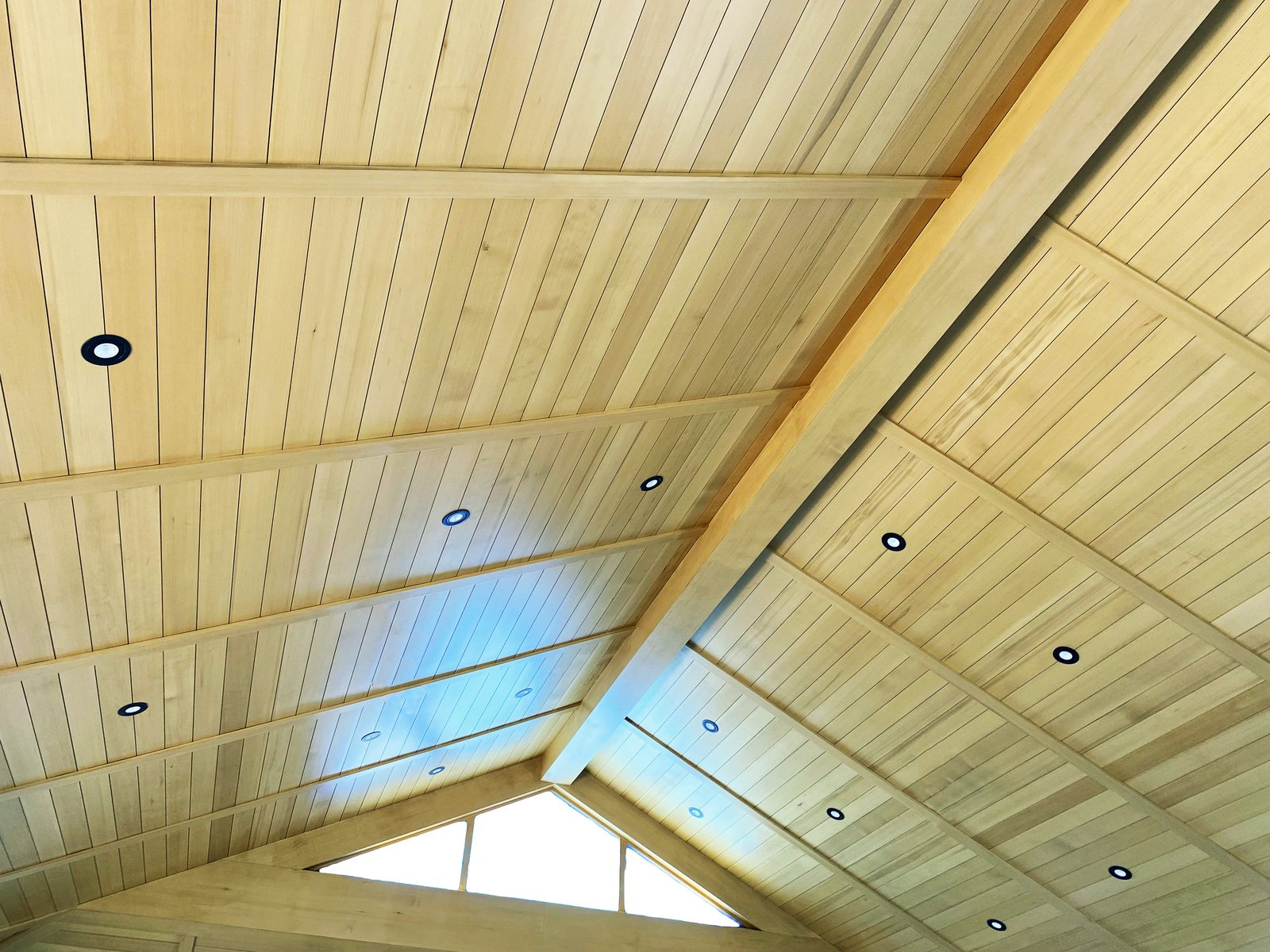
Concealed lighting turns a coffered ceiling into a hollow wood structure with a service life, not a decorative grid stuck to drywall. The beams carry channel, cable and sometimes a driver. The reveals have to hold a light line straight enough that a grazing beam does not advertise every joint in the run. And the trim that closes the assembly has to come back off in eight years when somebody replaces a failed tape section.
Three dimensions decide most of the outcome. The clear inside width and height of the beam cavity. The depth of the cove lip that shields the emitter from a standing sightline. The setback between that emitter and the surface it washes. Put those on the shop drawing and the millwork can be built to them.
Leave them to the field and the trim gets scribed, trimmed and caulked until the light line reads as a compromise. ICD, the architectural millwork division of J. Gibson McIlvain, builds coffer and tray assemblies around those three numbers rather than around a stock beam size, which is the practical difference between true custom work and a wrap that happens to fit. You can see how that process runs at ICD.
Box Beam Joinery When the Beam Is a Chase
A coffer beam that hides lighting is a box beam with a corner that gets grazed by light, which makes the joinery choice visible in a way it never is in a dark ceiling. Three joints are on the table and they trade off differently once a light source sits inside them.
Butt joints give the most minimal profile, the fastest turnaround and the easiest assembly on site. They also leave visible seams and visible end grain, and they are the weakest of the three. In a beam with a cove reveal along its lower corner, raking light will find that seam and hold a shadow line on it for the life of the ceiling.
Dado joints are strong and still assemble easily on site, which matters when a carpenter is working overhead off a rolling scaffold. Seams and end grain still show. For a painted coffer in a room lit from the fixtures below rather than from the beam itself, that is often the right economy.
Lock miter joints show no visible seams and are the strongest of the three. That is the default for a stained hardwood beam with an integral light reveal, because the corner reads as a single piece of wood and there is no glue line for a grazing beam to pick out. ICD mills lock miter box beams to a specified inside cavity so the channel, the cable and the installer's fingers all have somewhere to go.
Sizing the Wiring Chase Inside the Beam
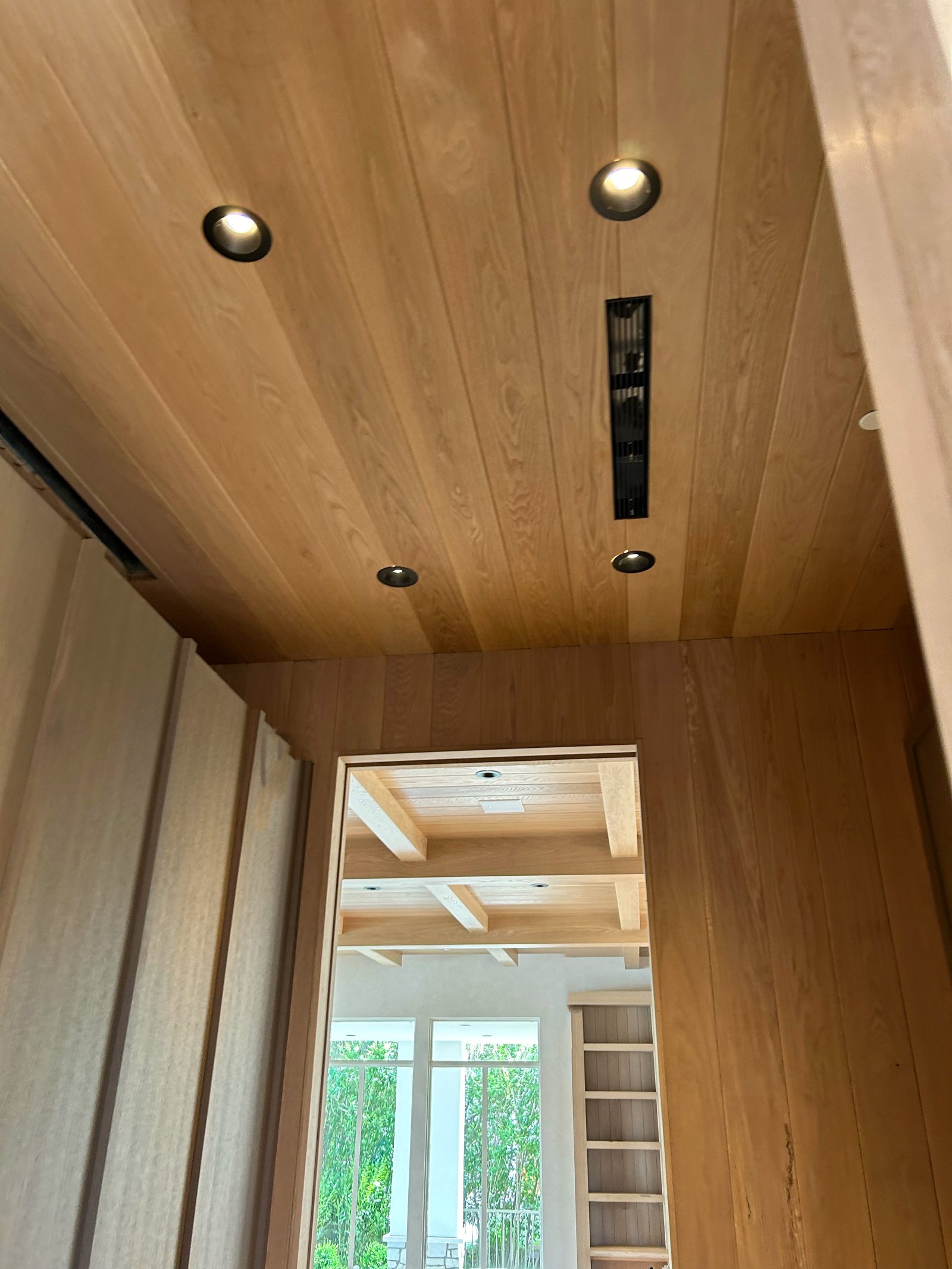
Size the cavity from the inside out, starting with the largest object that has to pass through it, not from the outside face dimension the architect drew. A beam shown as 8 inches by 10 inches on the reflected ceiling plan does not have an 8 inch by 10 inch hole in it. Stock milled from 4/4 leaves roughly 3/4 inch of wall on each face, so the clear cavity gives up an inch and a half in each direction before anything else is subtracted.
From there, subtract the framing or blocking the carpenter needs inside the shell to fasten it, the depth of the extrusion or channel, and a working allowance for the cable bend radius at every turn and junction. Low voltage runs do not like tight radii any more than conduit does. Where a driver is meant to live inside the beam rather than above the ceiling plane, add its footprint plus the airspace it needs to shed heat, and expect that beam to be the one with a removable panel.
The electrical scope belongs to the electrician working to NFPA 70, the National Electrical Code, and to whatever the local jurisdiction has adopted from the International Code Council family of codes. Read what applies at NFPA. J. Gibson McIlvain supplies and mills the wood assembly. It does not install it and it does not wire it, so the cavity dimension has to come off the drawings before the knives run.
One more subtraction gets missed constantly. If the coffer field is a panel set into the beam grid, the panel needs a groove to float in, and that groove eats into the same wall thickness the chase is trying to use. Draw the section full size. The conflicts show up immediately.
Cove Reveals, Lip Depth and the Scallop Problem
Scalloping is a geometry failure, not a fixture failure, and the millwork controls two of the three variables that cause it. Individual emitters throw individual pools of light. Whether a viewer reads those pools as a smooth wash or as a row of dots depends on emitter spacing, on how far the source sits from the surface it lights, and on how high the lip rises in front of it.
Raise the lip and you hide the source from more of the room, but you also narrow the aperture and push the wash further up the wall or ceiling. Drop the lip and the light spreads wider and the source becomes visible from a low seated sightline in a dining room or a study. The usable band between those two failures is smaller than most reflected ceiling plans admit, which is why the cove profile should be drawn in section against the actual seated and standing eye heights for the room.
Setback matters as much. A source sitting an inch off the surface it washes will show every emitter. Give it more room and the pools overlap before they land. In a tray ceiling perimeter, that usually means building the cove trough wider than instinct suggests and accepting a deeper reveal shadow at the top of the wall.
ICD grinds the cove and fillet profiles to the drawn section rather than substituting the nearest library match, and the profile library at J. Gibson McIlvain holds thousands of ground knives with new ones cut every week. A cove that has to clear a specific channel by a specific dimension is a knife problem, and knife problems are solved in a week, not designed around.
| Lighting detail | What the shop supplies | Dimension that governs it | Service access |
|---|---|---|---|
| Perimeter cove trough at a tray ceiling | Cove shelf, fillet and a ground cove profile matched to the wall trim | Lip height against seated and standing sightlines, plus trough width | Open from below once the fillet is removed |
| Reveal slot at the lower beam corner | Lock miter box beam with a rabbeted stop that returns the light | Slot width and the setback from emitter to washed face | Stop is screwed, not glued, so it releases |
| Downlight in the coffer field | Floating panel or applied field with cut sizes located on the shop drawing | Panel thickness and the clearance above for housings | Through the fixture aperture only |
| Uplight on the beam top shelf | Beam with a shelf return and a closed top to stop light leak | Shelf width and the gap between beam top and ceiling plane | Requires a removable top panel or side stop |
| Driver housed inside the beam | Box beam with a removable access panel milled from the same lot | Driver footprint plus airspace for heat, inside a lock miter shell | Panel comes off with a driver bit |
Removable Trim and Real Service Access
Every concealed light source in a wood ceiling needs one piece of trim that was designed to come off, and deciding which piece that is belongs on the shop drawing. The usual answer is the cove fillet or the reveal stop. It is a small, straight, repeatable piece, it carries no structural load, and it can be fastened with screws through a face that is never in the sightline.
What kills serviceability is glue and caulk. A fillet bedded in adhesive and then caulked to the beam is a demolition job, and demolition at a light line means a patch and a repaint across a stained hardwood face that will never match. The shop can mill the fillet with a slip tongue so it registers positively without adhesive, which gives the carpenter a piece that seats the same way every time.
Keep the access piece out of the longest continuous run. A 16 ft fillet that has to flex out of a groove will break. Break the run at a beam intersection so the removable section is short enough to handle overhead by one person.
J. Gibson McIlvain records the knife and the lot behind a job, and it has been doing that as a seventh generation family business in continuous operation since 1798. When a fillet gets damaged during a service call years later, the shop can grind to the same profile and match to the same species and cut rather than starting a sample chase.
Species That Behave Under Grazing Light
Grazing light is the harshest test a wood surface faces, and it changes which species and which cut belong in a coffered ceiling. Light raking across a face at a shallow angle exaggerates grain relief, telegraphed joints, sanding scratch and any cup or twist in a long run. A species that looks calm under downlight can look busy under a cove wash.
The millwork palette here is Sapele, Iroko, Afrormosia, Teak and Utile. Sapele runs about 1,410 lbf on the Janka scale, machines cleanly and takes a ground profile with crisp arrises, which is what a cove needs. Its ribbon figure on quartered stock is beautiful under a wash and also unforgiving, so a beam face and the fillet in front of it should come from the same lot rather than from two deliveries.
Utile reads close to Sapele with a slightly calmer stripe, which makes it a good match where a client wants the color without the shimmer. Iroko and Afrormosia carry a warmer, more open character and both hold long, straight runs well. Teak belongs where a client wants the color and the oil content is being managed deliberately in the finish schedule.
Domestic species hold their place in this work. White Oak at roughly 1,360 lbf, Hard Maple at roughly 1,450 lbf and Cherry at roughly 950 lbf all belong in a coffered ceiling depending on the room. Specify rift and quartered White Oak where a wide painted or panelized coffer field has to stay flat, since quartersawn and rift stock moves less across its width than plainsawn.
The tropical decking species are a different conversation. Ipe, botanically Tabebuia spp, along with Cumaru, Garapa, Jatoba and Red Balau, are extremely hard and carry high oil content, which makes them difficult to glue. A box beam is a glued assembly, so a millwork shop reaches for Sapele, Iroko, Afrormosia, Teak or Utile instead and leaves the decking species to decks. J. Gibson McIlvain holds over seven million board feet of exotic and domestic lumber at its Maryland yard, which is what makes it possible to pull a full ceiling from matched stock instead of assembling it from whatever arrived that month.
Moisture, Heat and Movement Around a Fixture
Interior millwork gets milled to an in-service moisture content near 6 to 8 percent, and a lit coffer is drier and warmer than the rest of the room it hangs in. Drivers and transformers shed heat. A closed beam cavity holds it. Over a heating season the wood immediately around that cavity can sit a point or two below the rest of the ceiling, and a point of moisture content is a real dimensional change across a wide face.
Design the assembly so that change has somewhere to go. Panels float in their grooves with no glue at the edges. Beam to ceiling junctions get covered by a trim leg wide enough to absorb seasonal movement rather than butted tight and caulked. The reference on how wood moves with ambient conditions is the Wood Handbook from the USDA Forest Products Laboratory, and the building science behind the interior conditions driving it is laid out at Building Science Corporation.
Covered exterior ceilings, a loggia or a deep porch, are a separate specification. Exterior work is milled near 12 to 16 percent rather than 6 to 8 percent, and the species and finish schedule change with it. Do not carry an interior coffer detail outside without rerunning both.
No warranty exists on solid unmodified wood, and no honest supplier offers one. It is an organic material responding to its environment. Warranties live only on modified products such as Accoya, roughly 1,600 lbf with acetylation giving dramatically reduced shrinkage and swelling, which is a consideration for exterior porch ceiling work rather than for a stained interior coffer.
Priming, Paint and Mixed Finish Ceilings
A painted coffer field with stained hardwood beams is the most common request in this work, and it is also the one most often ruined by finishing the two elements on the same schedule. The painted field wants primer and a flat surface. The stained beam wants its grain. Running them through the same process produces a beam with filled pores and a field with grain raise showing through the topcoat.
J. Gibson McIlvain primes wood in three levels, in both oil-based and water-based systems, so the painted components can be specified to the level the project actually needs. Open-grained and oily species absorb a great deal of finish, so a primer coat evens out the eventual painted surface. Sanding or buffing after priming knocks back grain raising while keeping the moulded detail crisp, which matters on a cove where a rounded arris would blur the light line.
Exterior primed trim carries a fungicide additive, which is the specification for a covered porch coffer and not for an interior ceiling. Getting primed components delivered means the installer is hanging parts that are already sealed on all faces, including the back face that will never be reachable again once the beam is up.
For stained beams, seal before the lighting goes in, not after. A cove reveal that gets its finish coat with the channel already mounted collects overspray on the emitter face and nobody notices until the circuit is energized at punch list.
What the Shop Delivers and What the Site Owns
J. Gibson McIlvain supplies and mills, and the line between that and the work on site should be drawn before the first shop drawing, not argued about at delivery. The shop produces the beams, the fields, the cove and fillet profiles, the removable access pieces, the panels and the returns, milled to the dimensions on the approved drawing and packaged for the job.
Field measurement, layout, blocking, fastening, wiring and final adjustment belong to the buyer's own carpenter and electrician. That is not a hedge. It is how the dimensional responsibility stays clean, because the shop builds exactly what the drawing says and the installer owns the fit of that to a ceiling plane that was framed by somebody else.
Practically, this means the general contractor or architect has to commit to the reflected ceiling plan and the section details before production. Cavity dimensions, lip heights and reveal widths are milled in. They are not adjustable with a block plane once a lock miter beam is glued up.
"The jobs that go smoothly are the ones where somebody drew the section through the cove at full scale and sent it to us with the fixture cut sheet attached. We will grind the knife to whatever that section says. What we cannot do is guess at a cavity dimension and have it be right."
Norm Moton, Director of Sales, J. Gibson McIlvain
Sequencing, Packaging and Getting It to the Job
A coffered ceiling arrives as a kit of long, finished, easily damaged parts, and how it gets packed and released to the site decides how much of it survives to installation. Long cove stock and pre-finished beam faces do not tolerate being stacked on a job trailer for a month.
J. Gibson McIlvain runs its own fleet of trucks and keeps a section of the mill dedicated to packaging, which is what allows finished millwork to reach a site in the condition it left in. It also stores finished millwork for inventory control, so a ceiling package can be produced in one run and released in phases as the trades clear the space. That matters on a job where the drywall is not closed in but the shop time was booked.
The company ships nationwide and regularly to California, and packaging becomes more important the further a finished cove profile has to travel. Call 800-638-9100 to talk through a ceiling package, or start with the millwork services page.
Sequencing note worth putting in the schedule. The beams go up before the lighting is final only if the access pieces exist. Confirm the removable trim is in the package and identified before the first beam leaves the ground.
How J. Gibson McIlvain Would Specify This
Specify the cavity, the lip and the setback as dimensions, name the species and the cut, identify the removable piece, and let everything else follow from those four decisions. That is the shape of a coffer and tray package that gets built right the first time.
Start with the section. Draw the cove or reveal full size with the actual channel and emitter in it, dimension the clear cavity after wall thickness and blocking are subtracted, and check the lip height against a seated eye level as well as a standing one. Attach the fixture cut sheet to the shop drawing set.
Beams get lock miter joinery wherever a light source grazes the corner, dado joinery where the beam is painted and lit from below, and butt joinery only where speed and a minimal profile outrank everything else. ICD builds the shells to the drawn cavity and mills the access panel from the same lot as the face it sits in, so the grain and color carry across the seam.
Species comes from the millwork palette. Sapele, Utile, Iroko, Afrormosia or Teak for stained beams, rift and quartered White Oak where a wide field must stay flat, Hard Maple or Cherry where the room calls for them. Interior components leave at 6 to 8 percent, covered exterior components at 12 to 16 percent. Where a CITES-listed species is part of the package, documentation and chain of custody travel with the material, and J. Gibson McIlvain is an FSC certified importer and miller, which is what makes a sourcing requirement in the specification answerable with paperwork instead of assurances. The relevant references are CITES and FSC, and hardwood grading questions run back to the National Hardwood Lumber Association.
Finish gets split. Painted fields go through priming at the specified level in an oil-based or water-based system, sanded after priming, while stained beams are sealed on a separate schedule and never share a spray booth pass with the painted components. Architectural woodwork quality expectations can be cited from AWI, and structural and code references for the wood itself sit with the American Wood Council.
Then name the removable piece on the drawing, break it at beam intersections so no single section exceeds a length one person can flex out overhead, and keep adhesive off it. ICD builds the coffer and tray assemblies, J. Gibson McIlvain mills the linear trim that ties them into the room, and both come off one order from one yard. Call 800-638-9100 or reach the architectural millwork division with the drawings in hand.
Frequently Asked Questions
How deep does a box beam have to be to hide an LED channel and its driver?
Work the subtraction rather than the face dimension. A beam drawn at 8 inches by 10 inches and milled from 4/4 stock loses roughly 3/4 inch of wall per face, so the clear cavity is already about an inch and a half smaller in each direction. Subtract the internal blocking the carpenter fastens to, the depth of the channel or extrusion, and a working allowance for cable bend radius at every junction. If a driver is going to live inside the beam instead of above the ceiling plane, add its footprint plus airspace for heat and plan that beam with a removable access panel. ICD mills the shell to a stated inside cavity, so give the shop the cavity number, not just the outside profile.
What causes scalloping in a cove reveal, and can the millwork fix it?
Scalloping comes from three variables. Emitter spacing, which belongs to the fixture, and two that the millwork controls, namely how far the source sits back from the surface it washes and how high the lip rises in front of it. A source an inch off the washed face will show individual pools. More setback lets those pools overlap before they land. Raising the lip hides the source from more of the room but narrows the aperture and throws the wash higher. Draw the cove in section against the real seated and standing eye heights for that room, then have the knife ground to that section.
Which species should I specify for coffer beams that carry concealed lighting?
The millwork palette is Sapele, Iroko, Afrormosia, Teak and Utile. Sapele at roughly 1,410 lbf machines cleanly and holds a crisp profile, and Utile reads similar with a calmer stripe. For domestic work, rift and quartered White Oak at roughly 1,360 lbf is the choice where a wide field must stay flat, with Hard Maple at roughly 1,450 lbf and Cherry at roughly 950 lbf depending on the room. The tropical decking species, Ipe, botanically Tabebuia spp, along with Cumaru, Garapa, Jatoba and Red Balau, are extremely hard and high in oil, which makes them difficult to glue, and a box beam is a glued assembly.
Can the trim covering a light channel be made removable for service?
Yes, and it should be named on the shop drawing rather than decided in the field. The cove fillet or the reveal stop is normally the piece, since it carries no load and can be screwed through a face that never shows. Mill it with a slip tongue so it registers positively without adhesive, and break the run at beam intersections so no removable section is longer than one person can flex out overhead. Glue and caulk at that joint turn a routine lamp replacement into a patch and repaint on a stained hardwood face.
Does J. Gibson McIlvain install the ceiling or come out to measure?
No. J. Gibson McIlvain supplies and mills. The shop produces the beams, fields, cove and fillet profiles, access pieces, panels and returns to the approved drawing, primes what needs priming, packages the run and ships it. Field measurement, layout, blocking, fastening, wiring and final fit belong to the buyer's carpenter and electrician, with the electrical scope run to NFPA 70 and whatever the local jurisdiction has adopted. That boundary is why the cavity and reveal dimensions have to be settled on paper before production.
How should a mixed ceiling with painted fields and stained beams be finished?
Split the schedule. Painted components go through priming at the specified level, in an oil-based or water-based system, and get sanded or buffed afterward so grain raise is knocked back while the moulded detail stays crisp. Open-grained and oily species absorb a great deal of finish, so a primer coat evens out the eventual painted surface. Stained beams run on their own schedule and should be sealed before the lighting hardware goes in, since a finish pass over a mounted channel puts overspray on the emitter face.
Can the same coffer detail be used on a covered porch or loggia ceiling?
Only with the specification rerun. Interior millwork is milled to an in-service moisture content near 6 to 8 percent, while exterior and covered exterior work sits near 12 to 16 percent, and the finish changes as well since exterior primed trim carries a fungicide additive. Solid unmodified wood carries no warranty from anyone, because it is an organic material responding to its environment. Warranties exist only on modified products such as Accoya, roughly 1,600 lbf, where acetylation gives dramatically reduced shrinkage and swelling.
Sources and Standards Referenced
- USDA Forest Products Laboratory
- American Wood Council, Codes and Standards
- NFPA Codes and Standards, including NFPA 70 National Electrical Code
- International Code Council
- Architectural Woodwork Institute
- Building Science Corporation
- National Hardwood Lumber Association
- The Wood Database, Sapele
- CITES
- Forest Stewardship Council