Why the Roof Decides Before the Wood Does
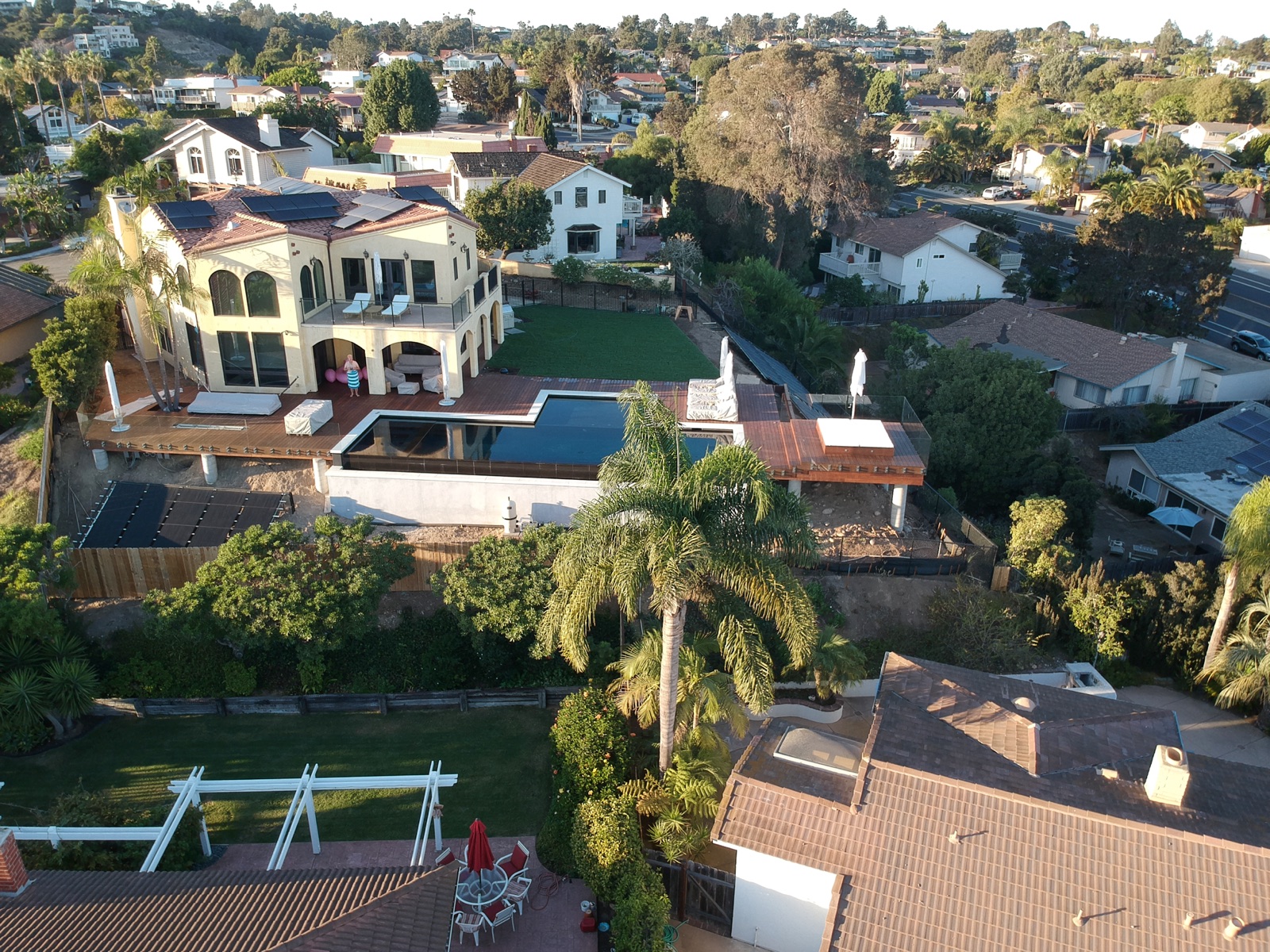
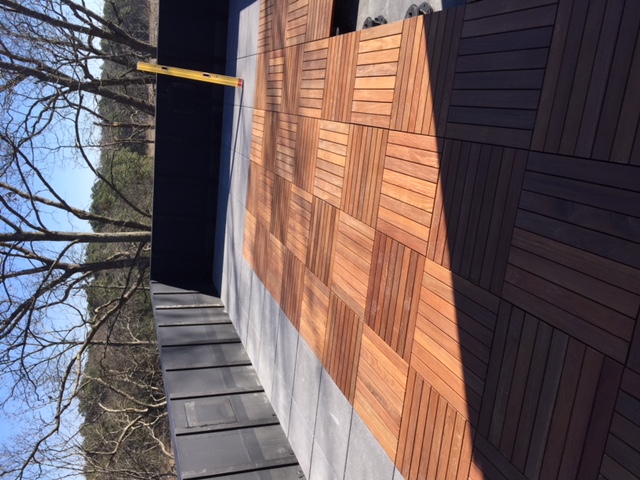
The right decking for a multi-family rooftop terrace in a northeast coastal city is 2x Ipe on a removable pedestal and sleeper system, detailed so the whole walking surface can be lifted and relaid when the roof membrane reaches the end of its service life. The second half of that sentence matters as much as the species. A quality single-ply or hot-applied membrane is good for twenty to twenty five years. Ipe decking on the same roof will still be sound at forty. If the deck is fastened to anything that penetrates or bonds to the roof assembly, membrane replacement turns into deck demolition and the ownership pays for its terrace twice.
Treat the species call as an asset decision, then. The buyer here is rarely a homeowner. It is a developer, a condominium board, or a property manager answering to one, and the questions that matter run past Janka numbers. Can the surface come up in sections for a leak investigation? Will board two hundred, ordered in year twelve, match board one? Does the material meet fire code without treatment? Ipe, milled to commercial thickness and set on an accessible pedestal grid, answers all three better than anything else on the market. Cumaru runs a close second. Everything else on the tropical list belongs in a supporting role on this particular roof, and the rest of this article explains why, section by section.
The 2x Thickness Rule for Amenity Decks
A shared amenity terrace on a multi-family building is a commercial deck, and commercial decks get specified at 2x thickness, which cuts the species list to Ipe, Cumaru and Jatoba before any other property gets weighed. The rule exists to control deflection under crowd loading. A rooftop lounge fills up on a July evening with more people per square foot than any residential deck ever sees, and 2x stock over sleepers at 16 inches on center stays stiff underfoot in a way 5/4 material does not. There is also a professional-liability reality behind the rule. Even where the strength math on a 5/4 board works out on paper, no architect or engineer wants to be the first name on a public-use deck specified thinner than the standard of practice.
The filter is supply, not merit. Only Ipe, Cumaru and Jatoba can be sourced consistently in true 2x decking thickness. Red Balau and Garapa are honest performers, and both earn their keep in residential decks and in engineer-approved 5/4 applications, but neither belongs on the walking surface of a commercial rooftop because the 2x stock simply is not there in dependable volume. Massaranduba shows up in overseas boardwalk literature at heavy thicknesses. It appears later in this article strictly as a comparison species, since it is not part of a J. Gibson McIlvain decking program.
Coastal Northeast Exposure Is a Compound Problem
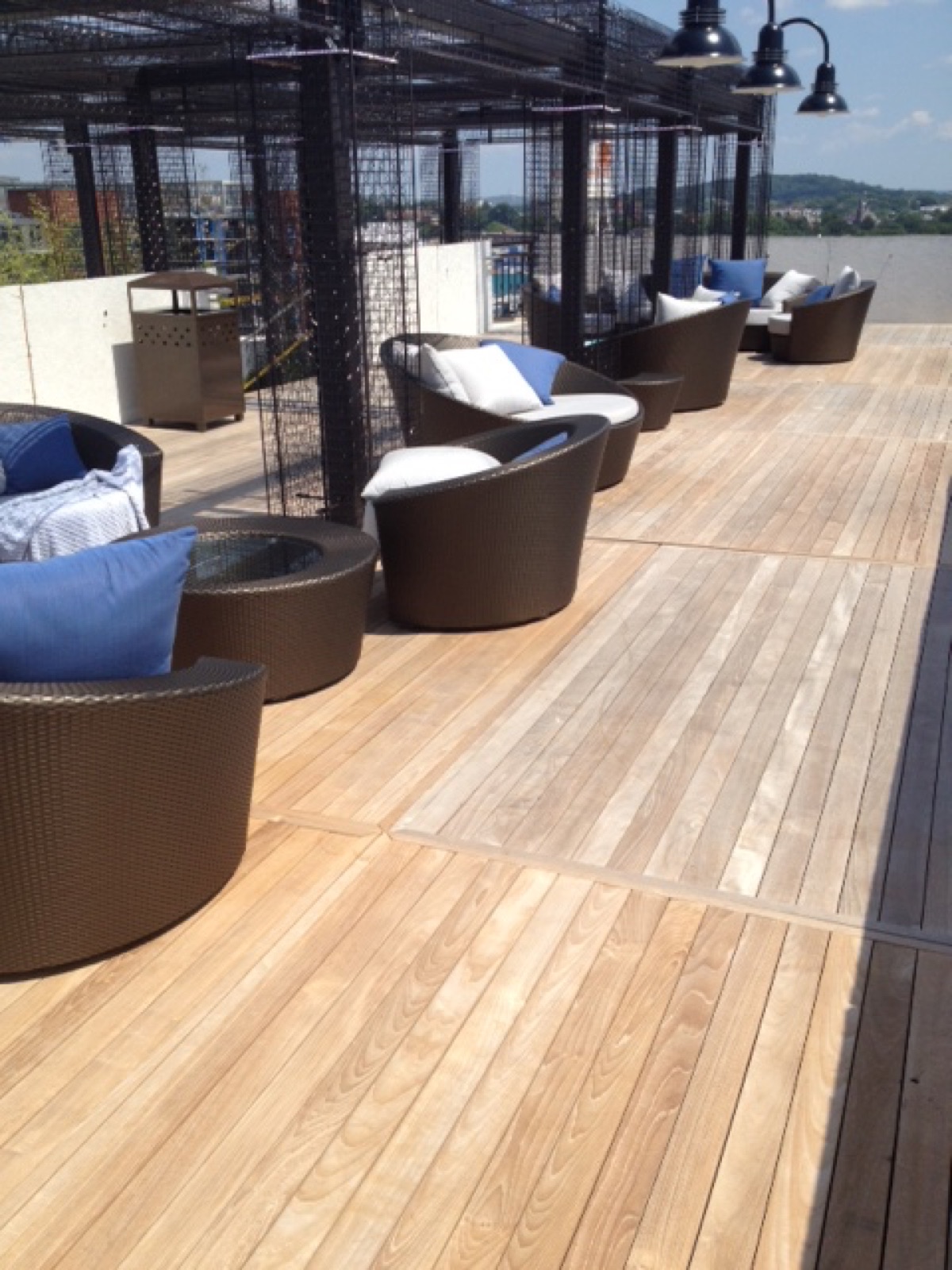
Salt air, wind-driven rain, sixty or more freeze-thaw cycles a winter and unshaded summer UV hit a rooftop harder than any ground-level deck in the same zip code. There is no tree canopy eight stories up. There is no shaded side. The deck bakes, soaks, freezes and dries in cycles that would tear a soft species apart within a decade. Dense tropical heartwood shrugs this off. Ipe runs about 1,050 kilograms per cubic meter, carries an EN 350 Class 1 natural durability rating, and has decades of documented service on ocean piers and municipal boardwalks in exactly this climate. The Wood Database entry for Ipe is a fair independent summary of the numbers, and the USDA Forest Products Laboratory publishes the underlying science on moisture movement and decay resistance in its Wood Handbook.
Moisture management still has to be designed, not assumed. Decking should arrive at an in-service moisture content of 12 to 16 percent so the boards move as little as possible after installation. The pedestal grid must leave a ventilated cavity under the boards, since a deck that can dry from both faces stays flat and a deck ventilated from one face cups. The building-physics logic behind drying-path design is laid out well in the research library at Building Science Corporation. Salt is the last compounding factor, and it mostly attacks the metal rather than the wood, which is why every screw and clip on a coastal roof should be 316 stainless rather than 305 or coated carbon steel.
Fire and Code Items a Rooftop Plan Reviewer Will Flag
Ipe achieves a Class A flame spread rating under ASTM E84 with no treatment at all, and that single fact settles most rooftop code conversations before they begin. Class A means a flame-spread index of 25 or less under the ASTM E84 tunnel test, the same band as many noncombustible finishes. On an occupied roof in a dense city, where the fire marshal reviews everything from grill placement to egress width, a naturally Class A walking surface removes a whole category of objection. Cumaru and Jatoba are dense enough to perform well in fire exposure, but Ipe is the species with the widely cited Class A pedigree, and on a submittal that citation does work.
Fire is not the only code thread. Occupancy of a roof terrace pulls in guard height, egress path and live-load requirements under the International Building Code, which is searchable at ICC's code library. If any portion of the terrace sits on an accessible route, board gaps are limited to a half inch, with elongated openings run perpendicular to travel, per the guidance published by the U.S. Access Board. Gap width, board width and drainage interact, so lock these decisions down at drawing stage rather than on the roof.
The Candidates Judged on Rooftop Service Criteria
Ranked on the criteria a rooftop actually imposes, commercial thickness availability, mass, durability class and long-term appearance, the field separates fast. Showroom color is the least useful axis, since every one of these species drifts toward gray on an open roof unless an oiling program holds its color. The table below compares them on the axes that decide a multi-family rooftop spec.
| Species | Janka hardness (lbf) | Consistent 2x availability | Natural durability | Weathered look on an open roof | Rooftop role |
|---|---|---|---|---|---|
| Ipe (Tabebuia spp.) | ~3,680 | Yes | EN 350 Class 1 | Olive brown aging to an even silver | First choice for the walking surface |
| Cumaru | ~3,540 | Yes | Very durable | Reddish brown aging to silver with more grain texture | Strong alternate walking surface |
| Jatoba | ~2,690 | Yes | Durable | Salmon to deep russet, then silver | Walking surface where its color is wanted |
| Red Balau | ~1,700 to 2,000 | No | Durable | Uniform red brown aging to gray | Residential and engineer-approved 5/4 work, vertical elements |
| Garapa | ~1,700 | No | Durable | Golden tone aging to pale gray | Residential 5/4 decks, benches, screens |
| Massaranduba (comparison only) | ~3,190 | Limited | Very durable | Deep red aging to gray, prone to movement when drying is uneven | Comparison benchmark, not part of a J. Gibson McIlvain package |
Read the second and third columns together and the conclusion writes itself. The three species that clear the commercial-thickness bar are the three that also sit at the top of the hardness and durability columns. That overlap is not a coincidence. Decades of municipal boardwalk and pier work created steady demand for heavy stock in exactly these species, and the supply chain organized around them.
Checking, Cutek and What to Tell the Residents
No supplier can promise that a roof full of dense tropical decking will never show a surface check, and a supplier who does promise that should worry you. Checking is the wood relieving tension as its surface heats and dries faster than its core, and a rooftop, with full sun and constant wind, is the most check-prone exposure there is. The checks are cosmetic. They do not weaken the board, and small surface checks are normal in properly seasoned dense hardwood, even a sign that the material was dried correctly.
What a good supplier does instead is reduce the driver. J. Gibson McIlvain factory coats its tropical decking with Cutek, a penetrating oil wood stabilizer that slows the surface moisture swings responsible for checking and cuts its extent significantly. Site practice does the rest. Verify moisture content at delivery, seal every fresh end cut with wax end sealer the day it is made, and keep the ventilation cavity open under the boards. Those steps keep checks small. They do not eliminate them, and the honest move on a multi-family job is a one-page memo to the board, before installation, explaining what normal weathering and normal checking look like. It prevents a year-one complaint cycle that has nothing to do with product quality.
Wind Uplift and the Floating Deck Problem
A deck that merely rests on pedestals is a wind problem waiting for its first nor'easter. Coastal northeast cities see design wind speeds that generate serious uplift and lateral pressure at roof level, and the corner and perimeter zones inside the parapet see the worst of it. Dense hardwood helps, since a 2x6 Ipe field carries real mass, but mass is not a design. The sleeper grid should be interlocked into a diaphragm, panelized where the layout allows, and restrained at the perimeter with details the structural engineer signs off against the wind provisions referenced by the American Wood Council and ASCE 7.
This is also where board-to-sleeper fastening earns its keep. Two screws per board per sleeper turns the walking surface and the grid into a single unit that behaves predictably in gusts, where clip-only floating systems can chatter and walk. Corner and edge panels deserve extra restraint or added ballast detailing. None of this is exotic engineering. It just has to be drawn before the package is ordered, because uplift details change sleeper spacing, panel sizes and the fastener count on the order.
Getting the Package Onto the Roof
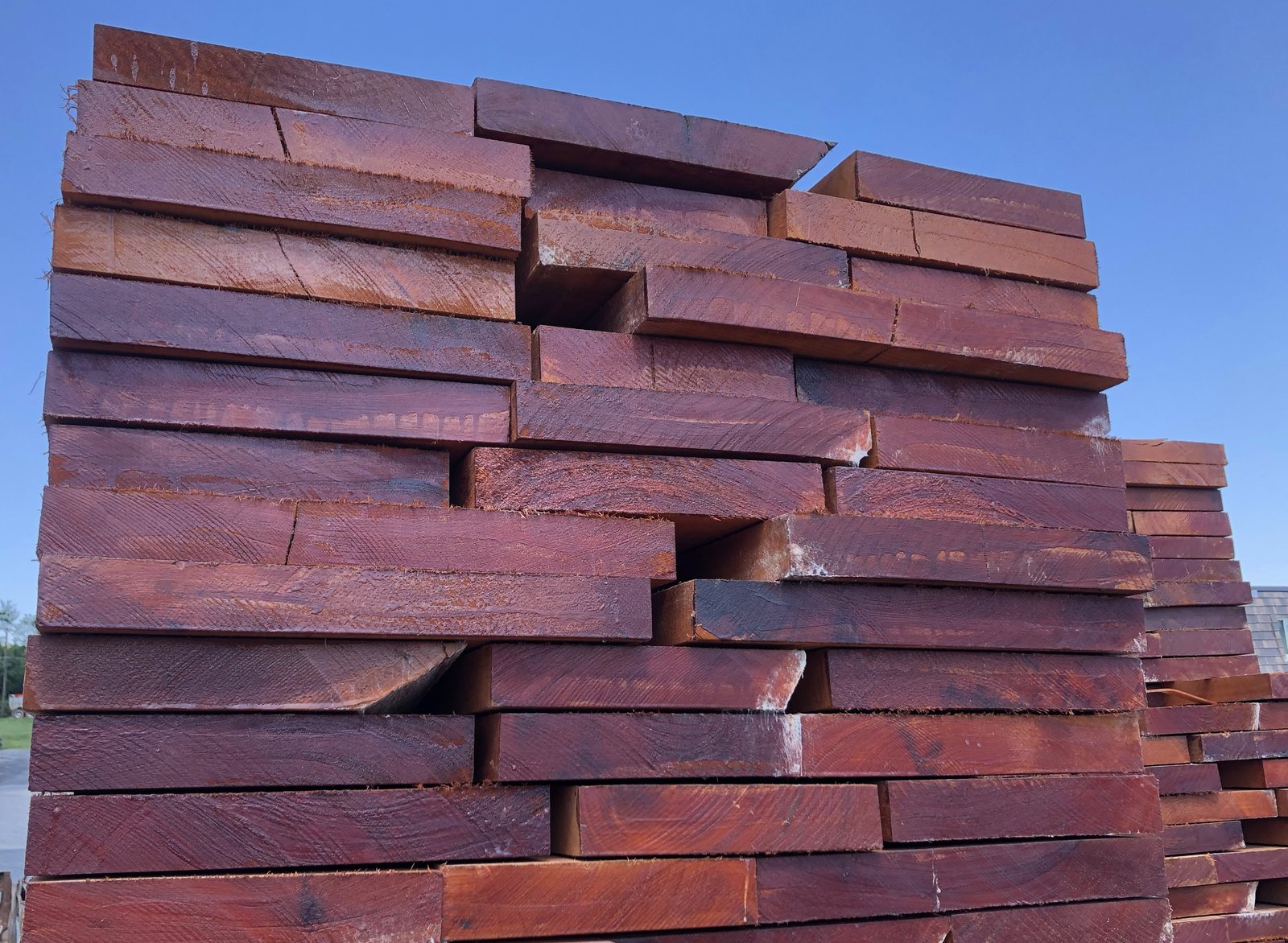
Craning a decking package onto an occupied building is a scheduling problem you solve at time of order, not on delivery morning. Ipe at roughly 1,050 kilograms per cubic meter works out to about 65 pounds per cubic foot, so a bundle of 2x6 stock is a genuine pick, and a city crane day comes with street permits, flaggers and a window measured in hours. The material order has to be built around that reality. Lengths should follow the cut list so long boards land where the long sight lines run, bundles should be organized by installation zone, and a phased job should ship in phases rather than burying phase three under phase one on a crowded roof.
On a rooftop job the order of operations is everything. We build the load so each crane pick matches the installer's staging plan, long stock separated, attic stock bundled and labeled for the building engineer to store. A package that shows up as one anonymous cube costs a crew half a day on the roof, and roof days are the most expensive days on the schedule.
Norm Moton, Director of Sales, J. Gibson McIlvain
Order attic stock while the original production run is on the table. Three to five percent of the field area, in representative lengths, stored dry by building management, means a future repair matches in milling and stock even if the color needs a season to blend. J. Gibson McIlvain ships packages like this nationwide from its own yard and mill, with regular deliveries as far as California, so a coastal rooftop in Boston and a sister property in San Diego can run the same spec from the same source.
Site Drilling and Fastening Practice on Sleepers
Fastener holes get drilled on the roof against the frame as built, never at the mill. Sleeper layout shifts around drains, curbs and penetrations, and every field cut moves board ends relative to bearing, so any factory hole pattern would be wrong by the second course. On-site technique is settled practice. Pilot every hole with a self-centering combination bit that drills and countersinks in one pass. Set two fasteners per board at every sleeper crossing, hold about three quarters of an inch of edge distance, and drill full pilots near board ends where splitting risk peaks. Land butt joints on doubled bearing so both board ends sit on solid support. In salt air, every one of those fasteners is 316 stainless.
Vertical work follows its own fastening logic. Parapet cladding, privacy screens and mechanical surrounds go over furring strips that create a drained, ventilated cavity. A shiplap profile takes visible face fasteners and looks right doing it. Only a tongue and groove profile works with hidden fasteners, and any grooved back profile is installed grooves down so water drains out of the assembly instead of sitting in it. This is the place for Garapa or Red Balau at 1x, or for Thermory and Abodo Vulcan where a modified-wood warranty is wanted on the vertical surfaces, keeping in mind that modified stock tops out just under 16 feet because of the treatment kiln size.
The Maintenance Vote the Board Should Take First
An ownership group has exactly two honest maintenance paths, a scheduled oiling program that holds the brown color or a managed weathering to an even silver, and it should vote on that before the first board is ordered. On a full-sun roof, holding color means a penetrating oil refresh roughly every year, which is a real line item in a condo budget and a real access-scheduling exercise on an amenity space. Letting the deck silver costs a light cleaning once or twice a year and nothing more, and the EN 350 Class 1 heartwood underneath performs identically either way. Neither path involves a warranty, since solid unmodified hardwood is sold on its track record rather than on paper coverage. Warranty language belongs only to modified products such as Accoya, Thermory and Abodo Vulcan, which is one reason those materials show up on benches and screen walls where a manufacturer-backed document is worth having.
Whichever way the vote goes, write it into the building's maintenance manual with product names, application rates and the recoat trigger. Rooftop amenity decks fail politically before they fail physically. A surface half the residents expected to stay chocolate brown and the other half expected to silver evenly is a board-meeting problem no species can solve.
How J. Gibson McIlvain Would Specify This
The working spec for this roof is 2x6 Ipe, factory coated with Cutek, on pedestal-set sleepers at 16 inches on center, fastened with 316 stainless steel, with lengths ordered to the cut list and attic stock in the first production run. Fill in the detail lines like this. Decking arrives at 12 to 16 percent moisture content, verified with a meter at delivery. Board gaps hold at a quarter inch for drainage, tightening to code-compliant openings on accessible routes. End cuts get wax sealer same day. The sleeper grid is engineered for uplift with interlocked panels and perimeter restraint, and it preserves lift-out access at drains and membrane seams. Vertical elements run Garapa or Red Balau over furring, or Thermory paired with Abodo Vulcan at lengths just under 16 feet where a warranty on the vertical package matters.
Paper matters on a project like this. When a CITES-listed species appears anywhere in a package, export and import documentation is required, and a supplier importing in its own name should hand over that chain without being chased. The framework is published by CITES, and legality documentation under the Lacey Act rides with every import. FSC-certified material is available on request for projects pursuing certification, with chain-of-custody standards described at FSC International, and responsibly sourced wood can contribute to credits under LEED.
J. Gibson McIlvain stocks Ipe decking in a vast inventory across every standard and custom dimension, including the 2x6 and 2x4 commercial stock this roof calls for, and mills Cumaru, Jatoba, Garapa and Red Balau to order from the same yard. Direct importing, in-house milling and nationwide freight mean one supplier carries the spec from submittal to crane day. Start with the Ipe decking program at mcilvain.com, then call 800-638-9100 with the terrace drawings and the cut list, and a lumber specialist will build the package, the load plan and the attic stock around your roof.
Frequently Asked Questions
Why does a rooftop amenity deck need 2x decking when 5/4 spans the same joist spacing on paper?
Deflection and standard of practice. A shared terrace sees crowd loading no residential deck sees, and 2x stock over sleepers at 16 inches on center stays stiff under that load. Beyond the math, commercial and public decks are specified at 2x thickness industry-wide, and no design professional wants to be the first to go thinner on a public-use surface. The rule also filters species, since only Ipe, Cumaru and Jatoba are consistently available in true 2x decking thickness. Red Balau and Garapa stay in residential and engineer-approved 5/4 work.
Can the hardwood deck be removed later for roof membrane replacement?
It should be designed for exactly that. A pedestal and sleeper system with no penetrations into the roof assembly lets crews lift the deck in panels, replace or repair the membrane, and relay the same boards. Ipe outlasts most membranes by a wide margin, so a removable detail is the difference between reusing a forty-year deck and demolishing it in year twenty-two.
Should the decking come pre-drilled from the mill?
No, and no competent mill offers that. Fastener holes are drilled on the roof against the sleeper grid as actually built, because layout shifts at drains and curbs and every field cut moves board ends relative to bearing. Any factory hole pattern would be wrong within a few courses. On site, crews pilot every hole with a self-centering combination bit, set two fasteners per board per sleeper, hold about three quarters of an inch of edge distance, and land butt joints on doubled bearing.
Will the factory Cutek coating stop the boards from checking?
It reduces checking significantly, and nothing eliminates it. Surface checking is dense hardwood relieving tension as the surface dries faster than the core, and a full-sun, windy rooftop is the most check-prone exposure there is. The checks are cosmetic and do not weaken the board. Factory-applied Cutek slows the surface moisture swings that drive checking, and same-day end sealing plus under-board ventilation keeps checks small. Any supplier promising zero checking on tropical decking is overpromising.
How much attic stock should a building order, and when?
Three to five percent of the field area, in representative lengths, ordered with the original production run. Boards from the same run match in milling profile and stock, so a future repair blends after one season of weathering. Have building management store it flat, dry and stickered. Ordering attic stock years later means a separate production run and a longer color-blending period.
How does the material get to the roof of an occupied building?
By crane or material hoist on a permitted street closure, which makes load planning part of the material order. Ipe weighs about 65 pounds per cubic foot, so bundles are genuine crane picks. The package should ship organized by installation zone with long stock separated and attic stock labeled, so each pick matches the installer's staging plan and the crane window is not wasted re-sorting lumber on a parapet-bound roof.
Does J. Gibson McIlvain supply rooftop deck packages outside the East Coast?
Yes. J. Gibson McIlvain ships nationwide from its own yard and mill, with regular freight to California, and supports commercial and contractor-volume orders rather than walk-in retail. A multi-property owner can run the same rooftop spec in Boston and San Diego from a single source. Call 800-638-9100 to start a package.
Sources and Standards Referenced
- Wood Handbook: Wood as an Engineering Material, USDA Forest Products Laboratory
- Ipe, The Wood Database
- 2021 International Building Code, ICC Digital Codes
- ADA Accessibility Guidelines, U.S. Access Board
- Codes and Standards, American Wood Council
- Building Science Corporation Research Library
- CITES, Convention on International Trade in Endangered Species
- Forest Stewardship Council International