
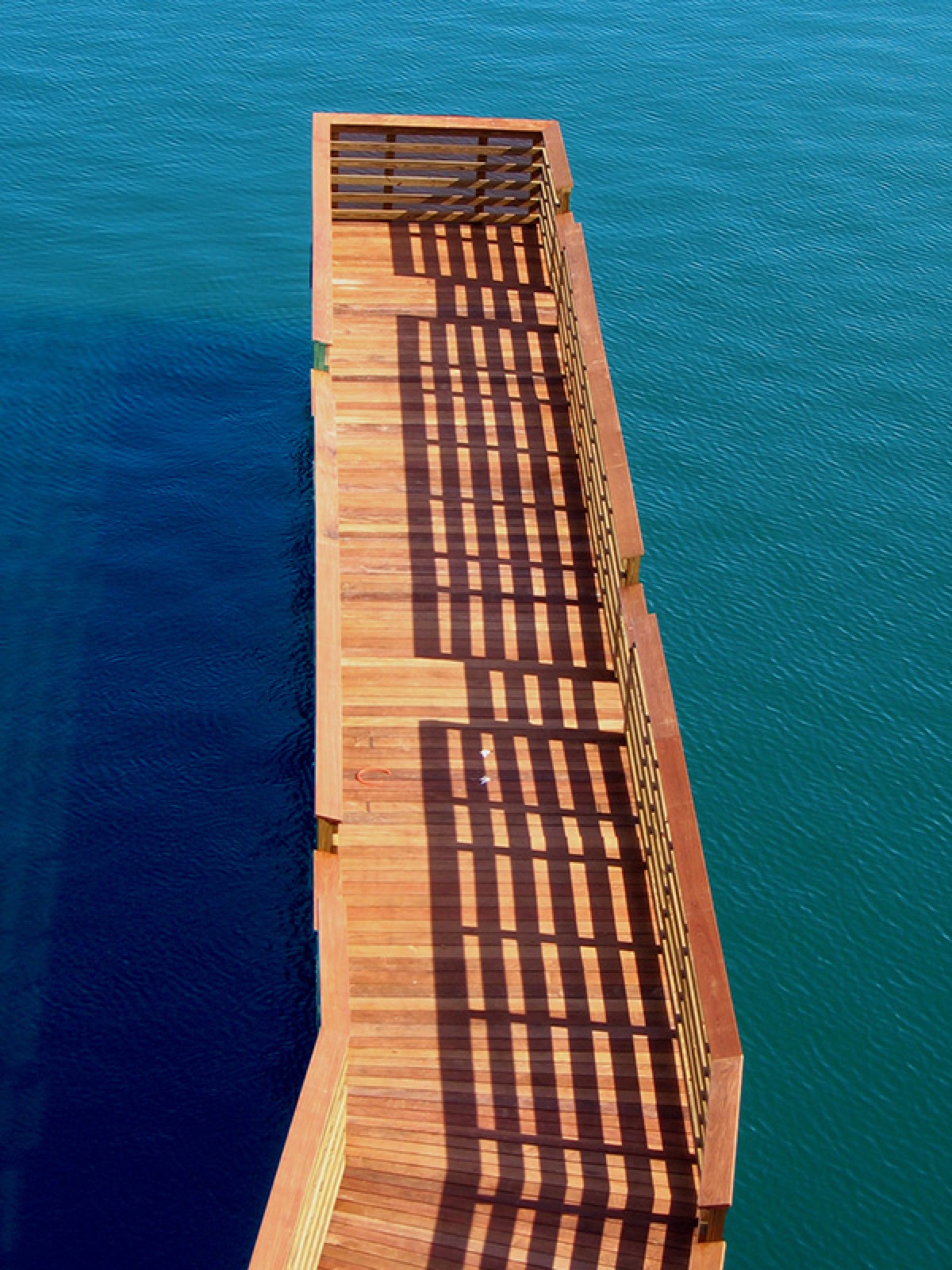
Service life on a humid coastal deck is decided by three properties acting together, natural decay resistance, dimensional stability, and fastener compatibility, not by hardness alone.
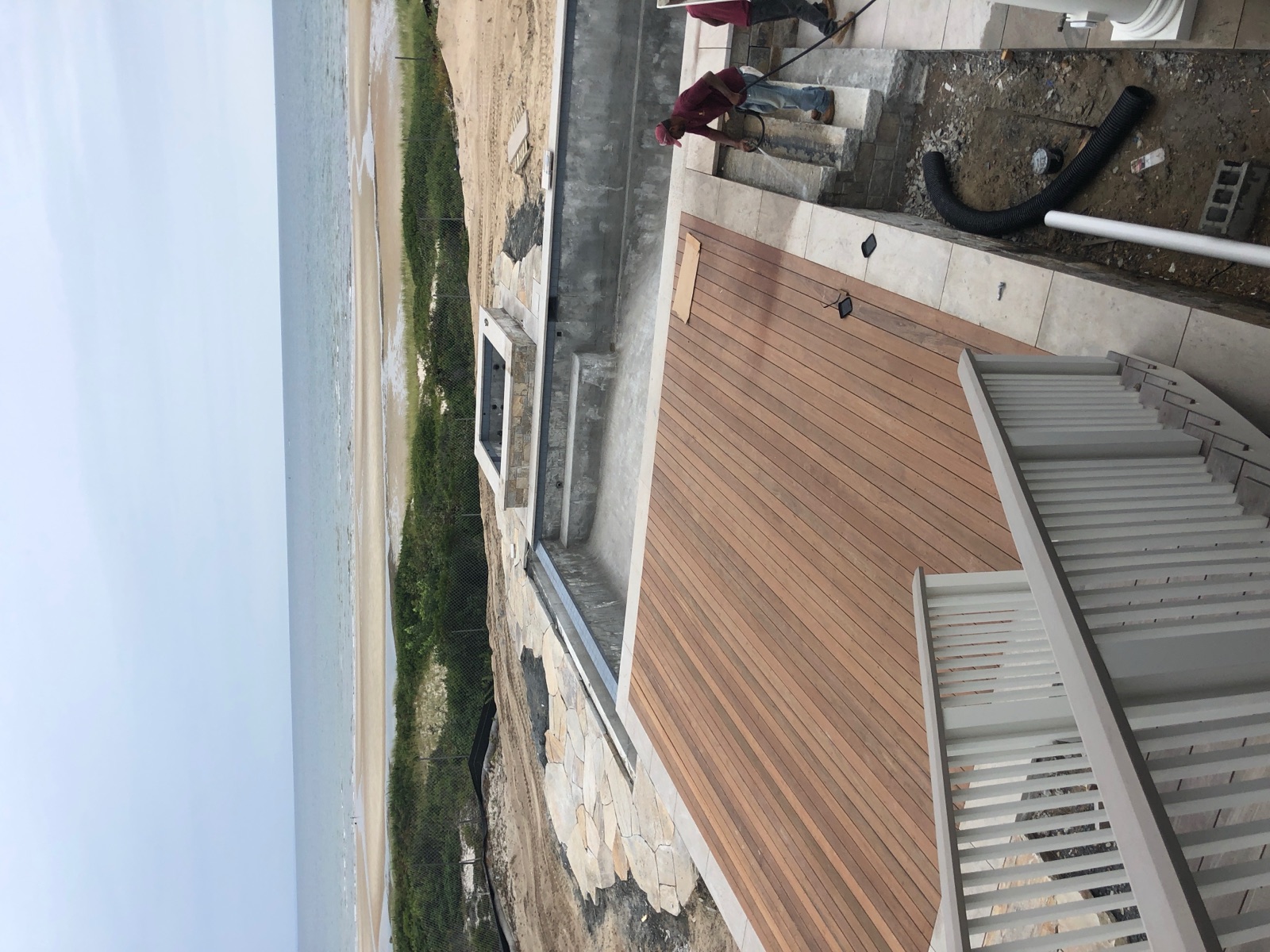
Ask which decking species lasts longest on the coast and most answers stop at a Janka number. That misses how boards actually fail near salt water. A deck built twelve feet from a tidal marsh lives in high humidity most of the year, takes wind-driven rain from odd angles, and dries slowly because the surrounding air rarely gets thirsty enough to pull moisture back out. Under those conditions the wood that wins is the one that resists fungal attack, holds its dimension through repeated wet and dry swings, and does not react with the metal holding it down. Ipe leads on all three counts. Change the detailing, though, and the ranking moves, so treat species selection as the first decision, not the only one.
The failure clock on a coastal deck runs faster than inland projects because three stresses stack. Salt draws and holds moisture at the wood surface. Persistent humidity keeps the fiber saturation point within reach of decay fungi. And chloride in the air attacks any fastener that is not fully corrosion rated. A species that answers all three keeps a deck in service for decades. Miss one and even a hard, dense board fails early.
A coastal deck almost never fails from foot traffic; it fails from fungal decay, from cyclic movement that opens checks and loosens fasteners, and from corroding metal that stains and splits the wood around it.
Walk any failed beach deck and the story reads the same three ways. First, decay. Wood-destroying fungi need moisture above roughly the fiber saturation point, oxygen, and a food source. Coastal humidity keeps surface moisture high for long stretches, and the USDA Forest Products Laboratory documents how decay rate climbs sharply once wood stays damp in that range. The Forest Products Laboratory Wood Handbook treats natural durability as a heartwood property, which is why the extractive chemistry of the species matters more than its density.
Second, movement. Every wet and dry cycle swells and shrinks the board. That cyclic stress opens surface checks, and checks funnel water into the wood where it does not dry, which invites the decay that started the whole conversation. A species with low dimensional movement rides out those cycles with far less checking.
Third, fasteners. Chloride-laden coastal air corrodes ordinary galvanized and even 304 stainless over time. As a fastener corrodes it swells, splits the wood at the hole, and leaves black iron stain bleeding across the surface. The board can be sound and the connection still fails. That is why coastal decking is a systems problem, not a shopping list with one hero species on it.
The reason Ipe outlasts nearly everything outdoors has little to do with how hard it is and everything to do with the toxic extractives packed into its heartwood.
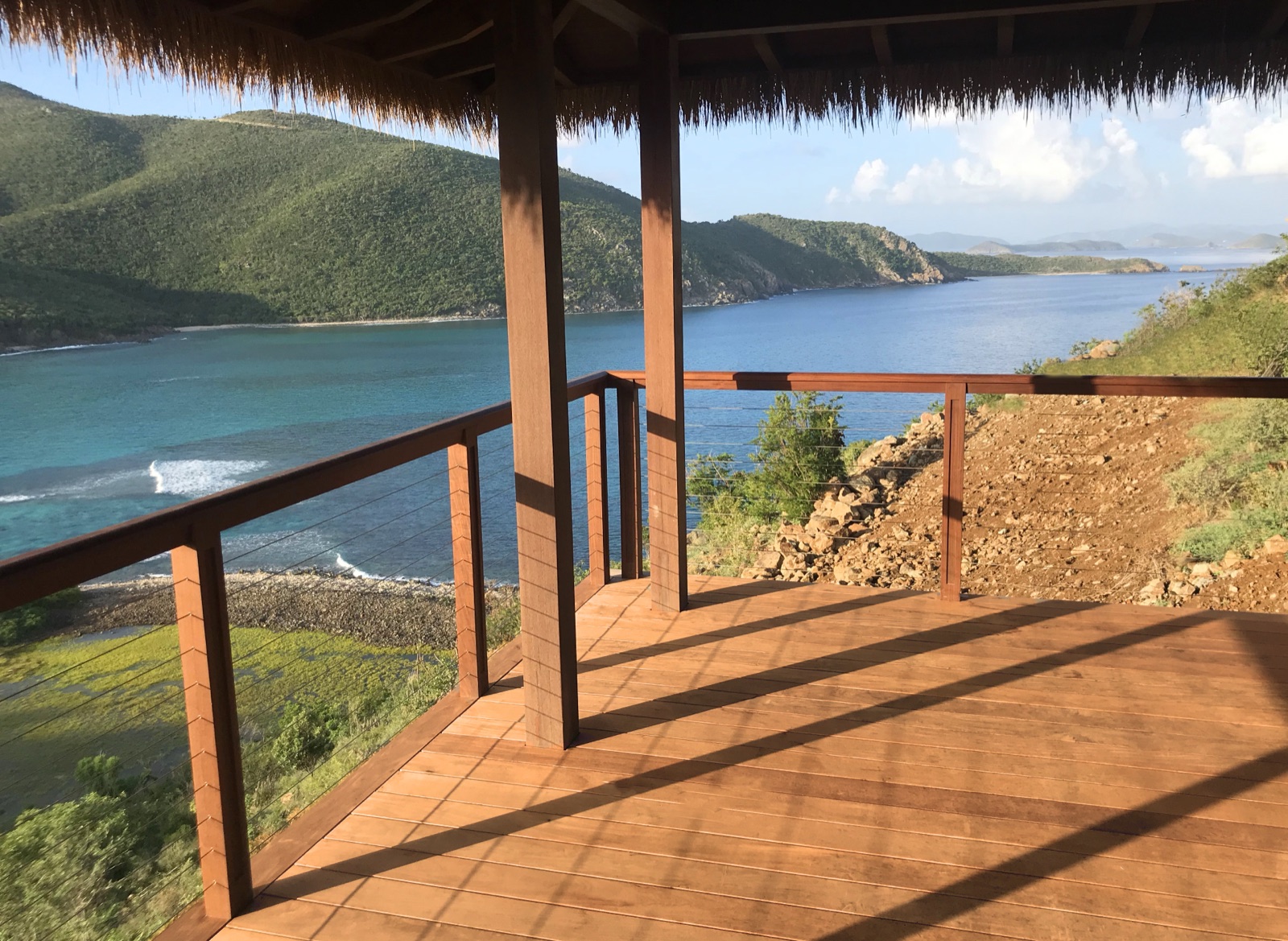
Natural durability is chemistry, not toughness. As heartwood forms, the tree deposits extractives, phenolic and other compounds that are toxic or unpalatable to fungi and insects. Those extractives are what the European durability standard measures. EN 350 sorts species into durability classes from 1, very durable, through 5, not durable, based on how heartwood resists decay in ground contact tests. Ipe sits in Class 1. That classification, not its Janka reading, is the honest predictor of coastal service life.
Hardness and durability correlate loosely because both track density, but they are separate properties. A wood can be hard and still rot if its extractives are weak. Ipe happens to be both very hard, around 3,680 lbf on the Janka scale, and very durable, but it is the durability doing the long-term work. The Wood Database entry for Ipe lists the species under the genus Tabebuia and documents both the extractive-driven durability and the silica content that dulls tooling. Silica, incidentally, adds a second line of defense by making the surface less hospitable, though it is the phenolic extractives that carry the decay resistance.
This is why a hardness-first spec goes wrong on the coast. Buyers fixate on the number that predicts dent resistance from dropped furniture and ignore the class that predicts whether the deck is still there in thirty years. Read durability class first. Read Janka second.
A species that barely moves between wet and dry seasons will hold its fasteners and resist checking far better than a harder wood that swells and shrinks with every tide cycle.
Dimensional stability comes from two things, how much the wood shrinks in total and the ratio between its tangential and radial shrinkage. A high tangential-to-radial ratio means the board distorts unevenly as it dries, which drives cupping and checking. Dense tropical hardwoods move less in absolute terms and tend to behave more predictably, which is part of why they survive coastal cycling.
Getting the wood to the right moisture content before it goes down matters as much as the species. Decking should reach the site near its in-service equilibrium, roughly 12 to 16 percent for exterior coastal work, so it does most of its shrinking before it is fastened rather than after. Boards installed wet shrink in place, open gaps, and pull against their fasteners. The building science community treats managing moisture across seasonal swings as the core of durable exterior detailing, and Building Science Corporation has published extensively on how assemblies fail when they cannot dry. A deck is an exposed assembly with the same rules.
The practical takeaway is that stability buys longevity quietly. You never see it work. You only see the checks and cupping it prevented on the deck next door.
Ranked by the properties that actually govern coastal life, the dense tropical hardwoods separate cleanly from the softer options, and the modified woods form their own category with a different durability mechanism entirely.
| Species | Density (kg/m3) | EN 350 durability class | Primary durability mechanism | Coastal movement behavior |
|---|---|---|---|---|
| Ipe (Tabebuia spp.) | ~1,050 | Class 1, very durable | Dense phenolic extractives plus silica | Very stable, minimal checking |
| Cumaru | ~1,070 | Class 1 to 2 | Oily extractives, high density | Stable, some movement, will check if wet-installed |
| Massaranduba (comparison only) | ~1,150 | Class 1 to 2 | Dense heartwood extractives | Heavier movement than Ipe |
| Jatoba | ~910 | Class 2 to 3 | Moderate extractives | Moderate movement, better roofed than fully exposed |
| Red Balau | ~850 to 950 | Class 2 | Heartwood extractives, medium density | Stable enough for exposed coastal use |
| Garapa | ~830 | Class 2 to 3 | Lighter extractive load | Moves more, cooler underfoot, lighter color |
| Western Red Cedar (CVG) | ~370 | Class 2 to 3 (thujaplicins) | Fungicidal thujaplicin extractives | Very stable, low density, low fastener stress |
| Acetylated / thermally modified | varies | Class 1 by modification | Cell-wall chemistry altered, not extractive-based | Very stable, carries a warranty |
Massaranduba appears here only as a reference point for how the dense South American hardwoods stack up. It is a legitimate comparison species, but the boards a coastal project should actually specify from J. Gibson McIlvain are Ipe, Cumaru, Red Balau, Jatoba and Garapa.
Ipe sets the coastal benchmark because it combines Class 1 durability, low movement, and enough density to shrug off abuse, and J. Gibson McIlvain holds it in a vast inventory across every dimension.
No other commercially available decking wood matches Ipe on all the axes that matter near salt water at once. Its extractives put it in EN 350 Class 1. Its density near 1,050 kg/m3 resists denting and cupping. It carries an ASTM E84 Class A flame-spread rating, meaning a flame-spread index of 25 or less, which matters where wildfire-urban interface or code drives the fire class. The ASTM E84 method is the reference test behind that rating. Ipe also stays dimensionally quiet through the wet and dry cycling that defines coastal exposure, so it checks less and holds fasteners longer than most alternatives.
Left unfinished, Ipe silvers to a driftwood gray and keeps performing. Oiled with a UV-inhibiting penetrating finish, it holds its warm brown, though coastal sun means reapplication on a schedule. Either way the structural longevity is the same. J. Gibson McIlvain carries Ipe decking in standard 5/4x6 and in wider and thicker custom sizes, and ships it nationwide to coastal projects from Cape Cod to California. You can see current profiles on the J. Gibson McIlvain Ipe decking page.
Cumaru is the closest coastal substitute for Ipe, while Red Balau, Jatoba and Garapa each trade some durability for a different working advantage.
Cumaru nearly matches Ipe on density, around 1,070 kg/m3, and its oily extractives give it strong decay resistance in the Class 1 to 2 range. It moves a little more than Ipe and will check if installed wet, so moisture content discipline is not optional. On a beach house deck built with proper spacing and stable material, Cumaru delivers a long service life and a warmer, more varied grain.
Red Balau earns its place as a mid-density hardwood with Class 2 durability that handles exposed coastal decks well and machines more easily than Ipe. Jatoba is dense and handsome but sits a class lower on durability, so it rewards a roofed porch or covered deck over full weather exposure. Garapa is the lightest of this group, a golden wood that runs noticeably cooler underfoot, at the cost of a lighter extractive load and more seasonal movement. For a shaded coastal walkway where barefoot comfort ranks high, Garapa can be the right call even though it will not outlast Ipe board for board.
"Buyers call asking for the hardest wood, and I steer the conversation back to durability class and movement almost every time," says Norm Moton, Director of Sales at J. Gibson McIlvain. "I have watched Cumaru decks on the water outlast poorly detailed Ipe decks because the Cumaru went down dry and the Ipe did not. The species gives you the ceiling. The install decides whether you reach it."
Modified woods resist decay through a different mechanism entirely, altered cell-wall chemistry rather than natural extractives, and they carry warranties that solid tropical hardwood cannot.
Acetylated wood such as Accoya and thermally modified boards such as Thermory and Abodo Vulcan reach their durability by changing the wood itself. Acetylation reduces the wood's ability to absorb water at the molecular level, which starves decay fungi of the moisture they need and delivers Class 1 durability plus very low movement. Thermal modification bakes the wood at high temperature, breaking down the sugars that fungi feed on and driving down water uptake. Both approaches come with manufacturer warranties, an option you do not get with any solid unmodified hardwood.
The tradeoff for a large coastal deck is length. Modified woods top out around 16 feet, and the metric-length products land just under 16 feet, because the modification kilns are only so long. On a big oceanfront frame that means more end joints than you would design with tropical hardwood, which J. Gibson McIlvain supplies in longer lengths. Modified boards also read lighter and more uniform in color, which some designs want. J. Gibson McIlvain carries both Thermory and Abodo Vulcan alongside Accoya, so the choice between a warrantied modified board and a naturally durable tropical hardwood can be made on the merits of the project rather than on what happens to be in stock.
Cedar is a legitimate coastal default when its grade is specified correctly, since its thujaplicin extractives give real decay resistance and its low density puts almost no stress on fasteners.
Western Red Cedar does not get the respect it deserves in coastal conversations. Its natural durability comes from thujaplicins, fungicidal compounds in the heartwood, which is why cedar has roofed and clad buildings near water for generations. It is dimensionally stable and light, so it moves little and pulls gently on its fasteners. What it lacks is density, so it dents and wears faster than a tropical hardwood underfoot.
Grade is the whole game with cedar. Clear vertical grain, CVG, gives you tight, straight, edge-grain boards that cup less and weather evenly, and it is the grade to specify for a refined exposed deck. Select tight knot, STK, is a sound, more economical grade with small fixed knots that suits a rustic look and covered applications. Neither grade is wrong. They are different products for different jobs, and calling for the right one prevents most of the disappointment people wrongly blame on cedar itself. For a covered coastal porch or a design that wants a softwood look, CVG cedar earns its keep.
Ventilation, drainage, end-grain sealing and the right stainless fasteners add more years to a coastal deck than any single upgrade in species.
The deck that lasts forty years and the one that fails in eight are often the same species. The difference is detailing. Start with the substructure. Set joists at 16 inches on center for dense hardwood decking so boards cannot deflect and work their fasteners loose. Get air moving underneath. A deck that cannot dry from below stays wet on its underside, and that is where decay starts out of sight. The American Wood Council publishes the structural provisions behind residential deck framing, and adequate ground clearance and cross-ventilation belong in every coastal design.
Seal the end grain. Cut ends drink water far faster than faces, and an end-grain sealer on every fresh cut slows the checking that starts at board ends. Face the grooves down on grooved profiles so water drains rather than pools in the channel. Match the fastener to the exposure. Use 316 stainless for coastal and marine work, not galvanized and not 304, because 316 resists chloride pitting that eats lesser metals and leaves iron stain. Remember that shiplap and square-edge boards take visible fasteners on the face, and only tongue-and-groove profiles accept a true hidden-fastener system, with the boards riding on furring strips or joists either way.
Certification and documentation round out a coastal spec. J. Gibson McIlvain is FSC-certified, and responsible sourcing matters both for LEED credit under the U.S. Green Building Council programs and for legal import compliance. When a project calls for a species that appears on a protected list, documentation is required, and a CITES-listed species must travel with the correct permits. A supplier that handles that paperwork keeps the project legal and the schedule intact.
How J. Gibson McIlvain Would Specify This
For a fully exposed oceanfront deck, specify Ipe in the longest lengths the run allows, delivered at 12 to 16 percent moisture content, on joists at 16 inches on center with open ventilation below. Fasten with 316 stainless, seal every cut end, and run grooves down if using a hidden-fastener tongue-and-groove profile. That combination is the coastal benchmark and the assembly least likely to need attention in your lifetime.
Where budget favors a tropical hardwood one step down, Cumaru or Red Balau delivers most of Ipe's coastal life if the material goes down dry and the detailing holds. For a covered coastal porch, CVG cedar or Jatoba both make sense, since the roof removes the worst of the exposure. Where a warranty is a contract requirement or the design wants uniform color, a modified board such as Accoya, Thermory or Abodo Vulcan answers the durability question through altered chemistry, with the understanding that lengths stop around 16 feet.
The through-line is simple. Pick the species for its durability class and stability first, then build the assembly that lets that species reach its ceiling. J. Gibson McIlvain mills and ships decking to coastal projects nationwide, including regularly to California, and a decking specialist can match species, profile and fastener to your exposure. Call 800-638-9100 to spec it correctly the first time.
Frequently Asked Questions
What actually kills a coastal deck first, the wood or the fasteners?
Often the fasteners. Chloride in coastal air corrodes galvanized and even 304 stainless over time. As the fastener corrodes it swells, splits the wood at the hole, and bleeds iron stain across the surface, so a perfectly sound board can still fail at the connection. Specify 316 stainless for coastal and marine work to remove that failure mode.
Does a wood's Janka hardness predict how long it lasts outdoors?
No. Janka measures dent resistance, not decay resistance. Longevity is driven by heartwood extractives, captured in the EN 350 durability class, and by dimensional stability. Hardness and durability correlate loosely because both track density, but a hard wood with weak extractives can still rot. Read durability class first and Janka second.
Will Ipe check or split in humid salt air?
Ipe is one of the most dimensionally stable decking woods and checks far less than most alternatives, but any wood checks if installed wet. Get Ipe to the site near its in-service moisture content, roughly 12 to 16 percent, seal every cut end, and it will ride out coastal wet and dry cycling with minimal surface checking.
How much does end-grain sealing really extend coastal deck life?
A meaningful amount. Cut ends absorb water far faster than board faces, and unsealed ends are where checking and decay usually start. An end-grain sealer applied to every fresh cut slows that water uptake and is one of the cheapest, highest-return steps in a coastal install.
Can I mix modified wood and tropical hardwood on the same coastal project?
Yes, and it can be a smart move. Use tropical hardwood such as Ipe or Cumaru where you need long lengths and maximum natural durability, and use a warrantied modified board such as Accoya, Thermory or Abodo Vulcan where uniform color or a manufacturer warranty is required. Just remember modified boards top out around 16 feet, so plan joint layout accordingly.
Is cedar a mistake for a coastal deck?
Not at all, provided you specify the right grade. Western Red Cedar's thujaplicin extractives give real decay resistance, and its low density puts little stress on fasteners. Choose clear vertical grain, CVG, for a refined exposed deck and select tight knot, STK, for rustic or covered applications. Cedar dents faster than tropical hardwood underfoot but performs well where its grade fits the job.
Why does ground clearance and ventilation matter so much near the water?
Decay starts on the underside of boards that stay wet and cannot dry. Coastal humidity keeps surface moisture high, so airflow beneath the deck is what lets the assembly dry between wettings. Adequate ground clearance and cross-ventilation, combined with joists at 16 inches on center, extend service life more than most people expect.
Sources and Standards Referenced
- USDA Forest Products Laboratory, Wood Handbook (durability and decay of wood)
- The Wood Database, Ipe (Tabebuia spp.) species profile
- American Wood Council, Codes and Standards
- ASTM International, standards including E84 surface burning characteristics
- Building Science Corporation, moisture and durability resources
- Forest Stewardship Council
- CITES, Convention on International Trade in Endangered Species
- J. Gibson McIlvain Ipe Decking


