What a Sample Promises on Your Behalf
A presentation sample is a specification document the client reads with their hands, and it binds the delivered material to whatever that one piece showed. The specifying architect carries this risk more than anyone else on the team. You bring the sample into the meeting, you set it on the table, and the owner builds a picture of the finished room out of a piece of wood the size of a paperback. Nothing in the written spec competes with that picture ten months later.
So decide early which piece of wood never leaves your office. That piece is the retained control sample, labeled with species, cut, grade, finish system and date, kept in a drawer and not released to anyone. It is the one object in the whole exchange that can settle an argument on the day the truck arrives, and it has to be cut from the same material the client took home, not from a second board that looked close.
The instinct runs the other way. Everyone wants to show the best piece in the bundle, the one with the ribbon stripe standing up under the light, and that instinct is what produces a rejection at delivery. The client does not remember the conversation about variation. The client remembers the board.
Show the Range, Not the Best Board
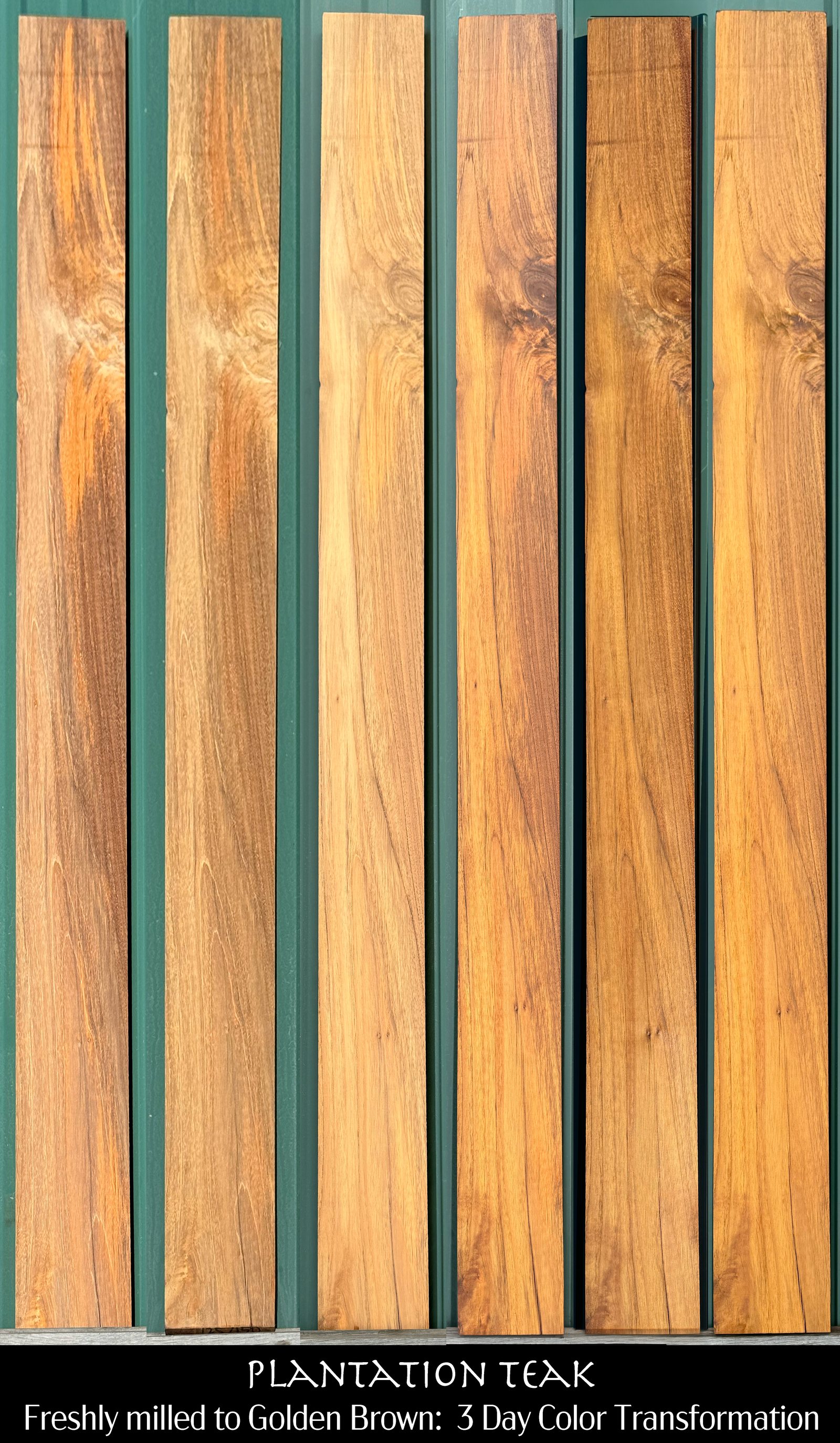
A sample set built from one exceptional board sets a floor that no production lot can hold. A range set does the opposite. Three pieces at minimum, one at the light end of what the species is giving right now, one at the dark end, one somewhere in the middle, all from the same material the order will come from.
A range set looks less impressive in the room. That is the point of it. An owner who has held the pale piece and the dark piece has already absorbed the idea that the species has a span, and the delivery that lands inside that span reads as normal rather than as a mistake. An owner who held one perfect board has absorbed a different idea, and every departure from it looks like somebody substituted material.
Sapele swings hard between lifts, and the ribbon figure on a quartersawn face catches light at one angle and vanishes at another, which a single flat photograph in a submittal will never convey. Cherry runs light at the mill and does not stay there. Walnut carries sapwood that a client will call a flaw unless they saw it on the sample first. J. Gibson McIlvain pulls range samples from the same lift the order will ship from, light end and dark end both, which is the only version of a range set that means anything.
Grade Describes Yield, Not Appearance
The client is approving a look, and the grade line in your spec is controlling something the client never saw. Grading under the National Hardwood Lumber Association rules measures the yield of clear cuttings a board gives up, not how the face reads in a conference room. Those are different questions, and a sample answers only one of them.
This matters most when the spec calls a lower grade on purpose. Short cabinet parts and stile and rail stock come out of smaller clear cuttings, and a grade chosen for that yield is the correct call, not a compromise. The problem starts when the sample was cut from a long clear FAS board and the delivered material is sized and graded for short parts. Both are right. They do not look the same on a cart.
A small sample also cannot carry a grade at all. Grade is a property of a board at a stated size, so a 6 inch square chip has no grade, only an appearance. Write the grade in the note, make it part of what the sample is accompanied by, and keep the client from reading a grade into a piece of wood that cannot express one.
Finish the Sample on the Sample Stock
A coating applied to a substitute species tells a client nothing about the species being specified. This is the most common shortcut and the most expensive one. A finisher has poplar on the bench, the schedule is tight, the stain goes on poplar, and the client approves a color that the specified species will never produce.
Pore structure drives the result. Open-grained and oily species absorb a great deal of finish, which means the same stain reads darker, muddier or blotchier depending on what it lands on, and a sample that skips this step is testing the coating rather than the assembly. Grain raising is part of it too. Sanding or buffing after a priming coat knocks the raised grain back while keeping moulded detail crisp, and a client who has only seen a flat sanded chip has no idea what that surface looks like on a profile.
Painted work deserves its own sample for the same reason. J. Gibson McIlvain primes in three levels, in oil based and water based systems, so a sample can be primed the same way the delivered trim will be primed rather than finished by a different hand in a different shop. Show the primed face. A client who approves raw stock and then sees primed trim on site will believe the species changed.
Color Keeps Moving After the Signature
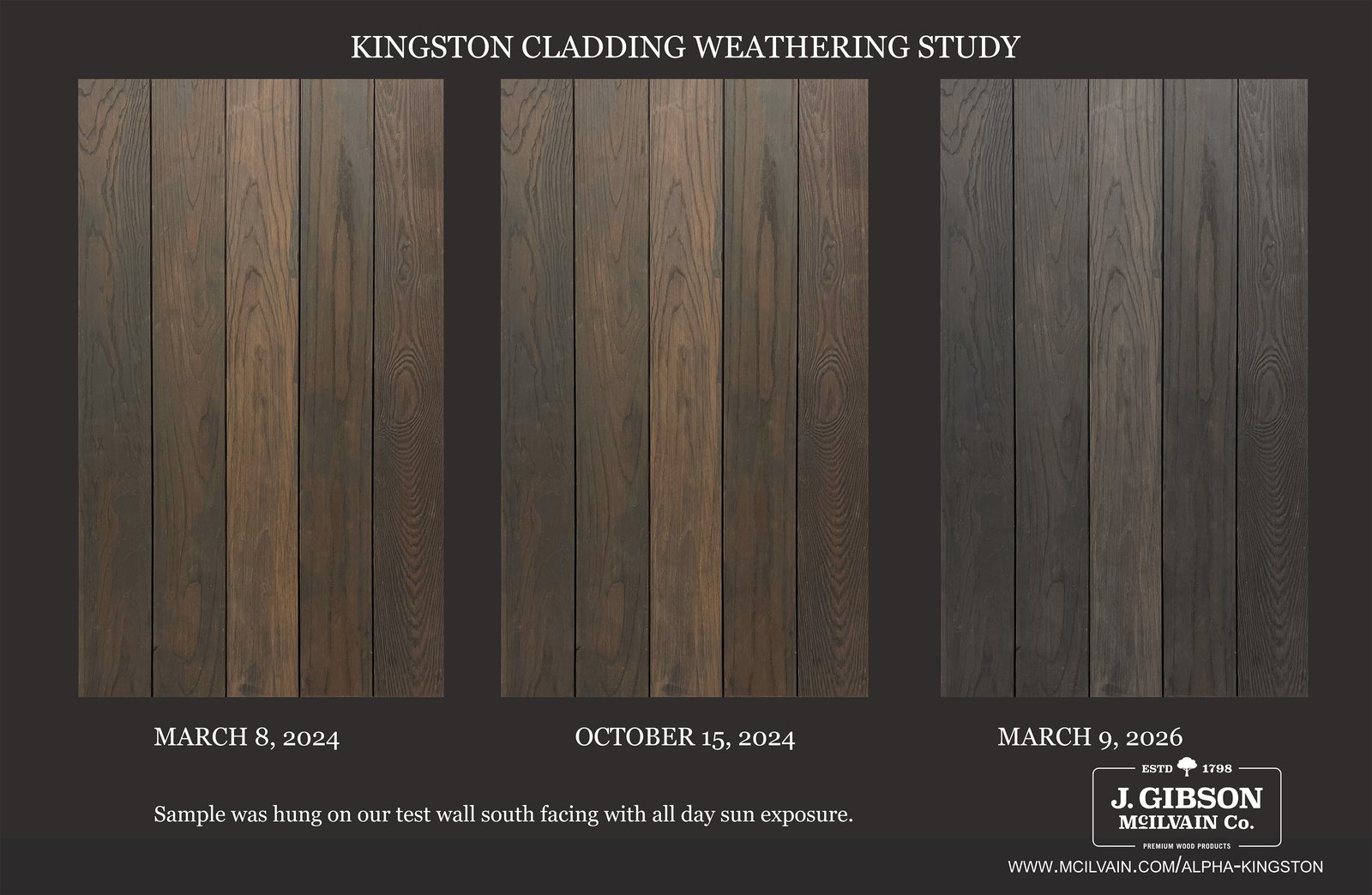
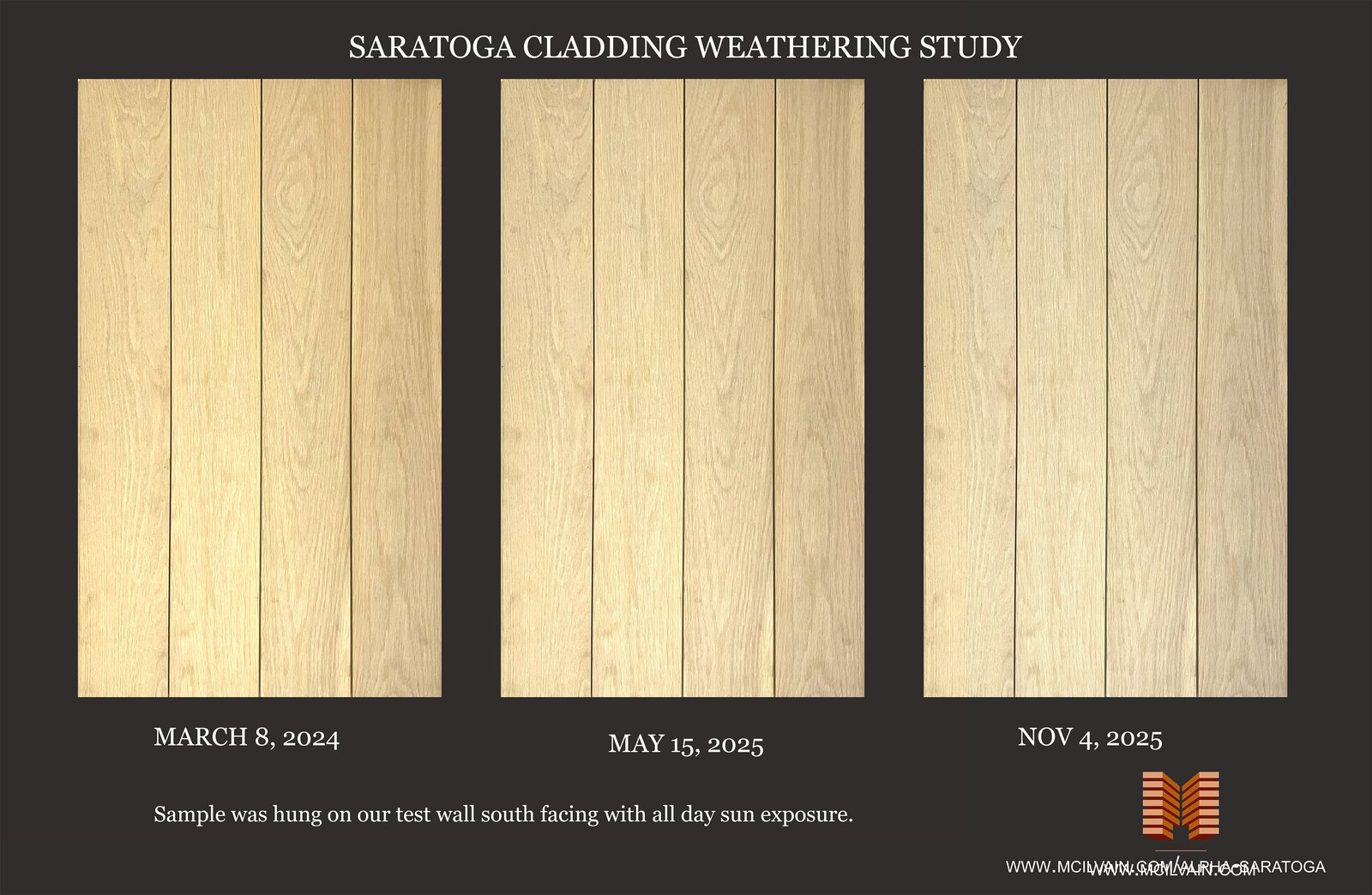
No sample shows what the wood will look like in a year, and no supplier can promise otherwise. Cherry darkens quickly and dramatically under light. Sapele deepens toward red. Walnut moves the other way and lightens. American Black Walnut that was steamed behaves differently again. The Wood Handbook from the USDA Forest Service covers the mechanics of why, and the Wood Database entry for a given species is a reasonable place to check aging behavior before you put a sample in front of anyone.
Say this out loud in the presentation, not in a footnote. The sample on the table is the material on the day it was cut, and the room in eighteen months is a different room. Clients accept this when they hear it early and treat it as a bait and switch when they discover it alone.
There is a hard limit underneath all of this. Warranties exist on modified wood products and on nothing else. It is not possible to warranty solid unmodified wood, which is an organic material responding to light, humidity and whatever the building does to it.
The Note That Travels With the Sample
A sample without a written note commits the project to everything the client noticed and nothing you intended. The note is short. Four lines, attached to the sample itself rather than filed separately, stating species and botanical name, cut, grade, finish system, and the date the material was pulled.
Then the two sentences that do the real work. One says what the sample demonstrates, which might be color range, or profile geometry, or how a given stain lands on this species. The other says what it does not commit, which might be figure, sapwood placement, exact board width, or the absence of mineral streak. The Architectural Woodwork Institute quality standards are useful here as a reference point for what a finish sample is understood to represent in the trade.
Put the same two sentences on the submittal transmittal, word for word. When a returned markup comes back with an approval stamp, the stamp now lands on a defined claim rather than on a photograph and a memory. Your retained control sample carries a copy of that note taped to its back.
When the Approved Sample Cannot Be Held in Quantity
Approval happens on one date and release happens on another, and the lot that produced the sample is not standing still in between. This is the situation that generates the angry phone call, and it is usually created by an honest sequence of small decisions rather than by anyone cutting a corner.
The exposure is largest where the approved thing is rare. A heavy ribbon figure across wide quartersawn faces, consistent color across a run of long lengths, a run of wide boards with no sapwood. Those exist. They do not exist in unlimited quantity at the moment your release calls for them, and no supplier anywhere can promise that a specific figure or a specific color band will still be available in volume on a date six months out. Anyone who does promise it is quoting the sample, not the inventory.
What can be done is structural. J. Gibson McIlvain holds over seven million board feet of exotic and domestic lumber at its Maryland yard, which is the difference between a species being on allocation and a species being on the floor when the submittal clears. J. Gibson McIlvain also stores finished material for inventory control, so a reserved pack can sit against a phased release schedule instead of being released and then chased.
When the client falls in love with something that cannot be repeated, say so in the meeting. Offer a second approved option in the same note. An owner told in week three that a figure is a limited pull will usually accept a defined range; the same owner told in week thirty will not.
One distinction belongs before the formats, because getting it wrong is what produces most of the rejected deliveries. A selection presentation and an approval sample are two different meetings doing two different jobs, and the same physical board should not be asked to serve both.
A selection presentation is a comparison. Three species on a table, or two finish systems on one species, with the client choosing a direction. What it settles is which way the project goes. What it must not settle is what the delivered material will look like, because the boards in a comparison set are chosen to show difference between options rather than to represent the spread inside any one of them. A client who picks a species off a comparison board has chosen a species, not an appearance.
An approval sample comes after that and does the opposite job. It shows the spread inside the one option already chosen, it carries the finish that will actually be used, and it is the object the delivery gets measured against. Running the two meetings as one is how a project ends up holding a supplier to a single handsome board that was never offered as a standard.
J. Gibson McIlvain supplies both, and the useful habit is to say which one is being sent when it is requested. A sample pulled to show a species reads differently from a sample pulled to show a range, and the label on the envelope decides which argument happens at delivery.
Matching Sample Type to What It Commits
Each format of sample makes a different promise, and choosing the wrong format is a decision about liability rather than about presentation quality. Read the table below against the specific question your client is being asked to settle. A color approval and a profile approval are not the same meeting and should not use the same object.
| Sample format | What it communicates | What it commits | Where it fails |
|---|---|---|---|
| Single finished display board | One fully resolved appearance | The entire order to that appearance | Normal lot variation reads as a substitution at delivery |
| Range set, light and dark ends | The span the species is actually producing | Delivery anywhere inside the shown span | Clients fix on the end they liked unless the note is explicit |
| Unfinished stock sample | Grain, cut and pore structure | Species and cut only | Says nothing about color under a coating |
| Finish sample on a substitute species | The coating color in isolation | Nothing usable | Absorption and pore structure differ from the specified species |
| Sample pulled from a reserved pack | What is physically on the floor now | That pack, for as long as it is held | Needs a release schedule or the pack moves |
| Milled profile sample in the specified species | Profile geometry and how the species holds an arris | The profile and the species behavior | Not a color approval unless it is finished |
| Retained control sample | Nothing to the client, by design | Nothing | Useless if it was never labeled or never kept |
A Cedar Sample Needs the Grade Call Stated
Two cedar samples can be the same species and represent two entirely different products. Clear vertical grain, CVG, gives tight straight grain with no knots and stays flat in the ways a painted exterior surface needs. Select tight knot, STK, carries the knotty face a lot of clients specifically want, and it is the correct choice for plenty of exposed work.
Neither is a lesser material. The failure is handing over a CVG sample while the budget and the order were built around STK, or the reverse, and letting the grade call ride unstated on the back of a species name. Write CVG or STK into the note on the sample, every time. The Western Red Cedar Lumber Association publishes the grade descriptions, which is worth putting in front of a client who is choosing between them for the first time.
Keeping the Record After Approval
The approval is only as good as the object you kept, and a phone photograph is not that object. Camera white balance shifts wood color by more than the variation most arguments are about. A photograph in a submittal file is a reference. It is not evidence of what anyone approved.
Label the retained control sample the day it is approved, with the date, the project, the approving party and the note. Keep it indoors and conditioned rather than in a truck or a trailer, since interior millwork is milled to an in-service moisture content near 6 to 8 percent and a control sample bouncing around a job site is no longer representative of anything. When the delivery is compared, it gets compared to that piece under daylight, not under a fluorescent fixture in a back hallway.
"I would rather send a client three boards that argue with each other than one board that makes a promise the pack cannot keep. When we pull a range, we are showing them the species, not the best piece in the pile."
Norm Moton, Director of Sales, J. Gibson McIlvain
Quartersawn and rift stock moves less across its width than plainsawn, so where a painted or panelized surface has to stay flat, the cut is part of what the sample is demonstrating and belongs in the note alongside the species. A client comparing two samples of the same species in two different cuts is comparing two different performance expectations, whether or not anyone told them so.
How J. Gibson McIlvain Would Specify This
Specify a range set in the actual species, finished on the actual stock, with a written note stating what it demonstrates and what it does not commit, and keep a labeled control sample of your own. Then tie the submittal to a release schedule so the material behind the approval is still there when the job calls for it.
J. Gibson McIlvain mills, grades and records the material it ships, and the pack behind an approved sample can be identified and held rather than reconstructed later from a description. J. Gibson McIlvain ships nationwide, California included, so an approval given in one office and a release called from another site still refer to the same recorded material. Where the work moves past linear stock into true custom casework and built-in cabinetry, ICD, the company's architectural millwork division, builds it around the specific space rather than around standard modules, and its working process starts from the same approved material record.
Send the species, the cut, the grade, the finish system and the quantities, and ask for a range set rather than a presentation board. Details on millwork services are on the company site, and the sales desk can be reached at 800-638-9100 to pull samples against a specific submittal date. Reference material on moulding and millwork standards is published by the Wood Moulding and Millwork Producers Association, and Building Science Corporation is a useful source on the moisture conditions that decide how a finished surface behaves once it is in the wall.
Frequently Asked Questions
How many pieces should a range sample set include?
Three is the working minimum for a species with visible variation. One piece at the light end of what the species is currently producing, one at the dark end, and one mid range, all cut from the same material the order will come from. Add a fourth where the client is also deciding between cuts, since a quartersawn face and a plainsawn face of the same species read as two different woods to anyone who has not seen both. For a tightly uniform species a two piece set can be enough, but the set still has to show a span rather than a single resolved look.
Can a supplier guarantee the delivered material will match the approved sample?
No. A sample taken from a reserved pack can be matched to that pack, and the pack can be identified and held against a release schedule. Nobody can guarantee that a specific figure, a specific color band or an unusual width will still be available in volume on a date months out, and nobody can warranty solid unmodified wood against the color change that happens after installation. Warranties exist on modified wood products and on nothing else. The honest answer is a defined range plus a reserved lot, not a promise of identity.
Should the finish sample be made by my finisher or by the supplier?
Whoever makes it, the finish has to go on the specified species, not on a convenient substitute. Open-grained and oily species absorb a great deal of finish, so the same stain or the same primer behaves differently on poplar than it does on Sapele, Iroko, Afrormosia, Teak or Utile. For painted exterior trim, show the primed face rather than raw stock, since that is what will arrive on site. J. Gibson McIlvain can prime sample stock the same way the delivered material will be primed, which removes one variable from the comparison.
What should the written note attached to a sample actually say?
Species and botanical name, cut, grade, finish system and the date the material was pulled. Then one sentence stating what the sample demonstrates and one stating what it does not commit. Figure, sapwood placement, exact board width and mineral streak usually belong in the second sentence. Put identical wording on the submittal transmittal so the approval stamp lands on a defined claim rather than on a memory of a board.
Does a small sample carry a grade?
No. Grade under the National Hardwood Lumber Association rules describes the yield of clear cuttings a board of a stated size produces, so a 6 inch square chip has no grade at all, only an appearance. This is why the grade belongs in the written note. A client who approves a chip cut from a long clear board and then receives material graded for short parts is comparing two correct things that do not look alike on a cart.
What happens if the client approves a sample that cannot be held in quantity?
Raise it in the meeting where the approval happens, not after release. Offer a defined range the material can hold, plus a second approved option recorded in the same note, and get both initialed. Where the approved appearance is genuinely available, tie it to a reserved pack and a phased release schedule so it is held rather than chased later. An owner told early that a figure is a limited pull will usually accept a range. The same owner told at delivery will not.
Does a cedar sample need anything beyond the species name?
It needs the grade call. Clear vertical grain, CVG, and select tight knot, STK, are both legitimate choices, and they look nothing alike. A sample handed over without CVG or STK written on it lets the client approve one product while the order carries the other. Note the grade on the sample and on the transmittal.
Sources and Standards Referenced
- National Hardwood Lumber Association
- Wood Handbook: Wood as an Engineering Material, USDA Forest Service
- Architectural Woodwork Institute
- The Wood Database: Sapele
- Western Red Cedar Lumber Association
- Wood Moulding and Millwork Producers Association
- Building Science Corporation
- J. Gibson McIlvain Millwork Services