What a Check Actually Is
A check is wood relieving a stress it cannot carry, and in a large exposed timber that stress almost always starts with the outside drying faster than the inside. The shell of a heavy section comes into equilibrium with the room in a matter of weeks. The core takes far longer, sometimes years in a section over 8 inches thick. While the shell wants to shrink and the wetter core under it holds its dimension, the shell is pulled into tension across the grain, and wood is weakest in tension perpendicular to the grain. Something gives. What gives is a check that runs along the grain on whichever face dried hardest.
That ordinary surface check is not a structural failure. It follows the grain rather than crossing it, so bending capacity is largely untouched, which is why the Forest Products Laboratory Wood Handbook treats seasoning checks and strength-reducing defects as separate categories. Architects still get calls about them. A check that opens a quarter inch on a feature beam over a dining table reads as a failure to the owner even when the engineer is unbothered.
The splits worth real attention are different animals. An end split that migrates several feet down the length, a through split that opens from face to pith and keeps going, a ring shake that separates along a growth ring, all of these mean the piece was wrong for the job or dried wrong. Knowing which one you are looking at decides whether you fill it, hide it, live with it or reject the stick.
Moisture Gradients, Not Moisture Numbers
A pin meter reading taken on the face of a thick timber describes the outer quarter inch and says nothing about the middle. That gap between shell and core is the gradient, and the gradient is what splits wood. Two beams can both read 10 percent at the surface. One is uniform through the section and stable. The other is 10 percent at the face and 22 percent at the heart, and it is going to move for the next several heating seasons no matter how carefully it was installed.
Kiln schedules for heavy stock exist to manage that gradient rather than to hit a number quickly. Drying too fast sets the shell before the core releases its water, which locks compression into the middle and tension into the outer layers. Resaw a case-hardened timber and it pinches the blade or springs open. Conditioning and equalizing steps at the end of a schedule relieve most of that, which is one reason heavy sections are air dried first and finished slowly.
There is a practical limit to all of it. Wood dries roughly with the square of its thickness, so a true 10x10 does not take twice as long as a 5x5, it takes something closer to four times as long. That physics, not stubbornness, is why a specifier asking for a fully dry one-piece 10x10 in a tropical hardwood is asking for a rare thing, and why hollow and laminated sections carry so much of this work.
Radial and Tangential Movement in One Stick
Wood shrinks roughly twice as much around the growth rings as it does across them, and that single imbalance explains checking, cupping and the classic pie-slice split at the end of a timber. Tangential shrinkage, measured along the growth ring, runs higher than radial shrinkage, measured across the rings toward the pith. The ratio between them, the T/R ratio, predicts how badly a piece will distort as it gives up water.
Picture a round cross section. The circumference wants to get shorter faster than the radius does. The geometry cannot close, so the ring opens somewhere, and it opens at the weakest point, which is a ray or an existing surface check. That is why a boxed heart timber, one with the pith inside it, nearly always develops one dominant split.
Sawing pattern follows from the same numbers. Quartersawn and rift stock moves less across its width than plainsawn, which is why it gets specified anywhere a painted or panelized face has to stay flat. On an exposed beam the same choice buys a straighter face over the seasons, and it costs yield, so it belongs in the specification early rather than as a change order.
How Millwork Species Compare on Movement
Sapele, Iroko, Afrormosia, Teak and Utile are the palette for large exposed timber work, and the reason is movement behavior rather than hardness. All five machine cleanly, glue predictably and hold a moulded arris. Iroko and Teak sit at the stable end of the range. Sapele and Utile move more but stay manageable, and both come in the long lengths and wide, clear stock that a beam program needs.
The tropical decking species sit in a different category. Ipe, botanically Tabebuia spp, along with Cumaru, Garapa, Jatoba and Red Balau, are extremely hard and carry high oil content, which makes them difficult to glue. A millwork shop reaches for Sapele, Iroko, Afrormosia, Teak or Utile instead, because a laminated or hollow beam lives or dies on its glue lines. Those decking species belong on a deck, where the fasteners do the work.
Shrinkage values below are the standard green to oven-dry percentages published by the Wood Database. Nobody dries a timber to oven-dry. The figures matter as a comparison between species, not as a prediction of what a beam does between January and July.
| Species | Radial / tangential shrinkage | T/R ratio | What it means in a large exposed section |
|---|---|---|---|
| Sapele | 5.2 percent / 7.2 percent | 1.4 | Even movement front to back, so checks stay shallow and distributed rather than concentrating in one split. Janka roughly 1,410 lbf. Long lengths and wide clear stock are available, which suits laminated and hollow sections. |
| Iroko | 3.3 percent / 4.8 percent | 1.5 | Low total movement and good exterior durability. A strong choice for exposed rafter tails, pergola members and gate stiles that see weather and sun on one face only. |
| Afrormosia | 3.2 percent / 6.2 percent | 1.9 | Low radial movement with a higher ratio, so flatsawn faces distort more than quartered ones. Specify rift or quartered for wide exposed faces. CITES documentation travels with the material. |
| Teak | 2.6 percent / 5.3 percent | 2.0 | The lowest volumetric movement in the group and the most forgiving in wet exposure. Natural oils call for surface preparation before glue-up on laminated work. |
| Utile | 4.9 percent / 6.9 percent | 1.4 | Behaves close to Sapele with an even ratio. Comes out of very large trees, which is what makes wide, long, clear components possible. |
| Accoya | Dramatically reduced by acetylation | Not the governing factor | Janka roughly 1,600 lbf. Acetylation cuts shrinking and swelling sharply, so checking risk drops. Kiln size caps length at around 16 ft, with most stock sold on metric lengths just under that. |
| White Oak | 5.6 percent / 10.5 percent | 1.9 | Domestic reference point. High tangential movement and Janka roughly 1,360 lbf. Flatsawn wide faces cup and check readily, so quartered or rift stock is the sane specification for exposed work. |
The Boxed Heart Problem and the Relief Kerf
A one-piece timber that contains the pith will split, and the only real decision is where. Free of heart center stock, sawn so the pith falls outside the piece, avoids the problem but eats a much larger log and limits the sections available. On big sections the pith is often unavoidable, and the traditional answer is to control the outcome rather than hope.
A relief kerf, a saw cut run down the length of one face into the neighborhood of the center, gives the drying stress a place to go. The timber relieves itself into the kerf instead of opening a split on a face the owner will see. Orient the kerf to the hidden face, the one against the ceiling or the wall. It is an old technique, still the right one, and it only works when someone decides which face is hidden before the beam is milled.
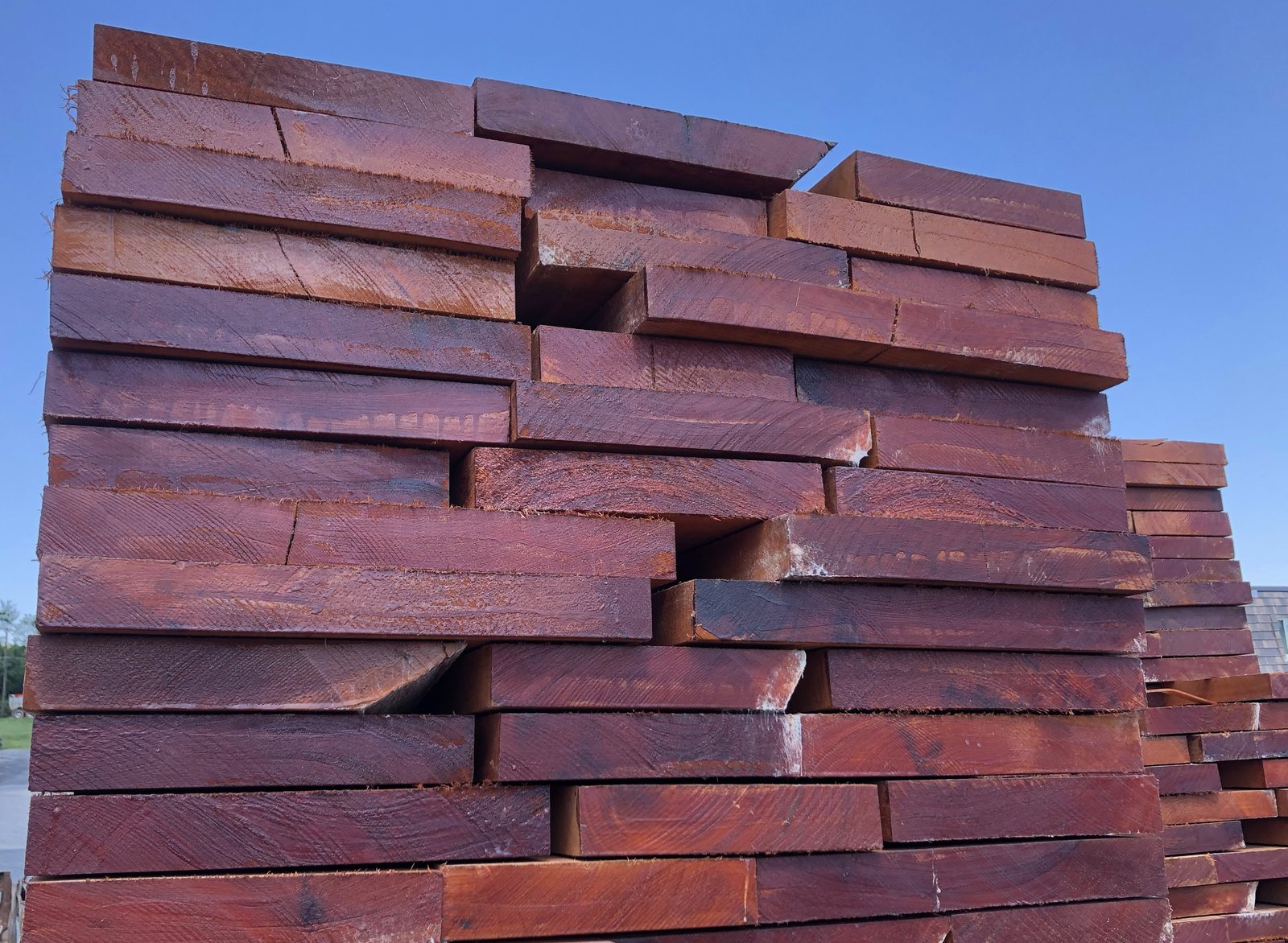
Pith also carries juvenile wood, which shrinks more along the grain than mature wood does and tends to twist. On a long exposed member that longitudinal difference shows up as bow and crook, not as a check. Keeping the pith out of a critical piece is worth the yield loss, and it takes a deep enough pile of stock to sort from. J. Gibson McIlvain holds over seven million board feet of exotic and domestic lumber at its Maryland yard, which is what makes that kind of selection possible instead of theoretical.
Hollow Box Beams as Movement Control
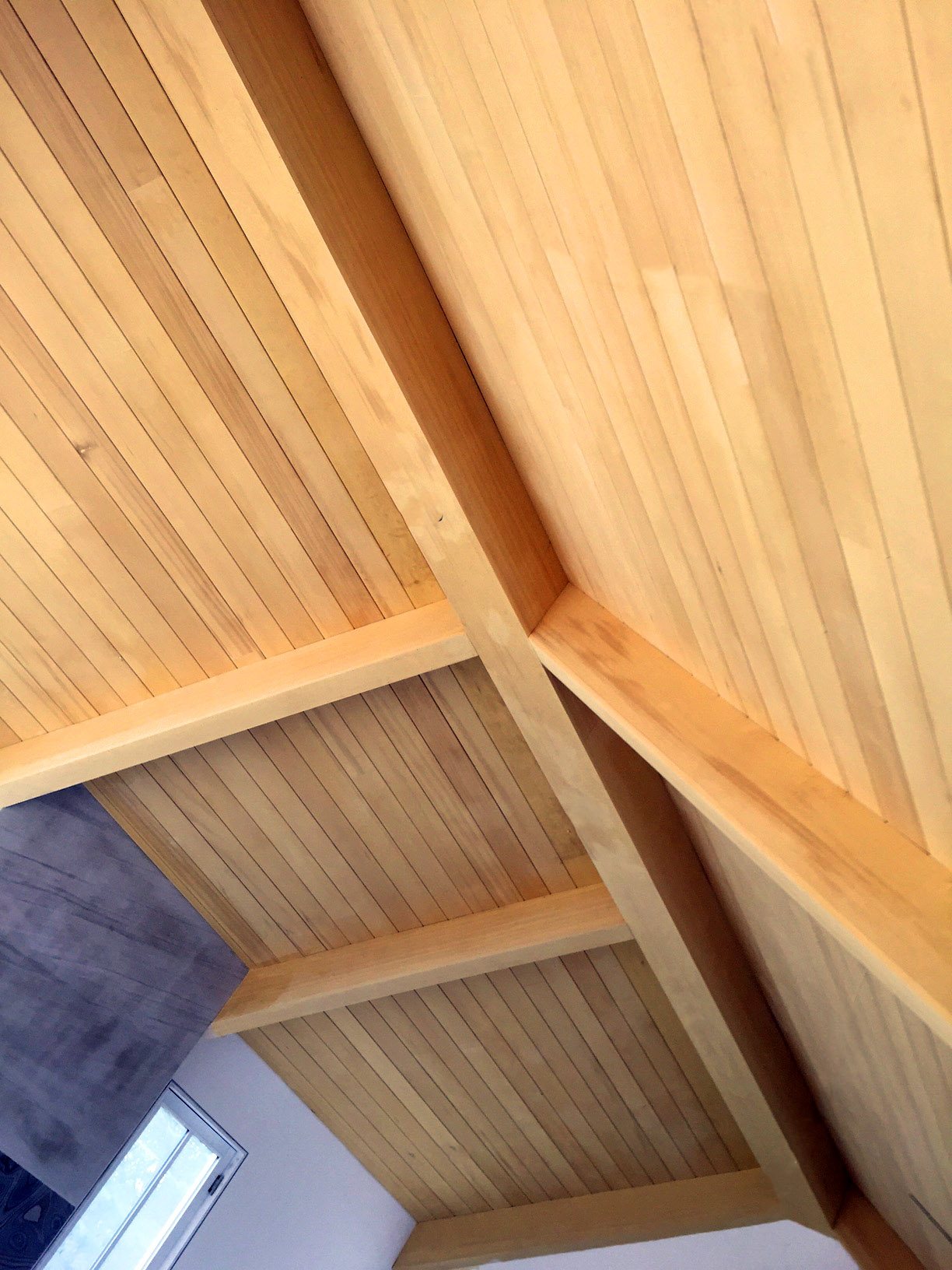
The most reliable way to stop a large exposed timber from checking is to stop using a large solid section. A hollow box beam assembled from boards of moderate thickness dries evenly before it is ever glued up, carries no pith, and has no wet core waiting to drive a split. ICD, the architectural millwork division of J. Gibson McIlvain, builds box beams to the exact section a drawing calls for rather than to a catalog size.
The joinery choice at the corners is a real one with real trade-offs. Butt joints give the most minimal profile, the fastest turnaround and the easiest on-site assembly, and they leave visible seams and visible end grain and are the weakest of the three. Dado joints are strong and still easy to assemble on site, and they still show seams and end grain. Lock miter joints show no visible seams and are the strongest, which is why they are the default where the beam is a finished architectural element rather than a cover over structure.
Hollow sections also solve problems that have nothing to do with wood movement. They pass over steel, over an LVL, over conduit and sprinkler lines. They hang at a fraction of the weight of solid stock. On a coffered ceiling with two dozen intersections, the accumulated weight saving changes how the whole assembly gets supported.
Laminated Sections and Where the Movement Goes
A laminated timber moves less than a solid one of the same dimension because the movement is divided among laminations that were each dried through before assembly. Thinner pieces dry evenly. Assemble them face to face with alternating orientation and the residual tendencies partly cancel, which is the same logic behind balanced panel construction.
Two things govern whether that works. The laminations need to arrive at glue-up at the same moisture content, because a stack assembled with a two or three point spread between pieces builds a stress into the beam on day one. And the exposed face wants to be continuous or matched, since a glue line on a visible corner reads as a seam under a raking light no matter how tight it is.
Oily species deserve a mention here. Teak and the more resinous stock need fresh machining and prompt assembly for the adhesive to bond, a working constraint that guidance from the Wood Moulding and Millwork Producers Association and the quality standards published by the Architectural Woodwork Institute both speak to in their material and fabrication sections.
Moisture Targets, Delivery and the Job Site
Interior millwork is milled to an in-service moisture content near 6 to 8 percent and exterior work near 12 to 16 percent, and a beam delivered at the wrong target for its environment is the most common cause of movement complaints. Those are not arbitrary numbers. They approximate the equilibrium moisture content the wood will settle at once the building is running, and the work of Building Science Corporation on materials and moisture explains why hitting equilibrium beats hitting any particular reading.
The failure pattern repeats across the country. Beams arrive correctly milled, then sit in an unconditioned shell through a humid summer or next to a temporary heater in February. By install day the material has moved and nobody has touched it. J. Gibson McIlvain mills to the in-service target, stores finished millwork at the yard for inventory control, and holds delivery until the building can actually receive it.
Getting it there intact is the other half. J. Gibson McIlvain runs its own fleet of trucks and keeps a section of the mill dedicated to packaging, and ships nationwide, regularly to California. Finished beam faces are protected for transit rather than shrink-wrapped tight over damp material, which traps moisture against a face and creates the exact gradient the kiln schedule spent weeks removing.
Priming, Sealing and Slowing the Gradient
Finish does not stop wood from moving, it slows how fast the surface responds, and on a large timber that slowdown is the difference between a season of gentle adjustment and a check. End grain takes on and gives up moisture many times faster than face grain, which is why an unsealed end is where splits start. Sealing all six faces, ends included, evens the exchange rate across the piece.
Open-grained and oily species absorb a great deal of finish, so a primer coat evens out the eventual painted surface. J. Gibson McIlvain primes in three levels in both oil-based and water-based systems, and exterior primed trim carries a fungicide additive. Sanding or buffing after priming knocks back grain raising while keeping moulded detail crisp, which matters where a beam meets a run of profiled trim and the two have to read as one surface.
None of this is a warranty. Solid unmodified wood is an organic material responding to its environment and cannot be warrantied, a point worth making in writing to an owner before the first heating season rather than after it. Warranties live on modified products. Thermory and Abodo Vulcan are both carried, along with Accoya, and all three top out around 16 ft because of kiln size, with most stock sold on metric lengths just under that. Thermally modified Ash is not available wider than 8 inches, so a wide modified component means Accoya or Abodo Vulcan.
Detailing That Lets a Timber Move
Every connection on an exposed timber either allows movement or fights it, and the ones that fight it produce the splits that get blamed on the wood. A beam fastened rigidly at both ends across its width has nowhere to go. Slotted holes, single-point fixing with the remaining fasteners free to slide, and concealed cleats that let a hollow section float all do the same job, which is to let dimension change happen without loading the fibers in tension.
Trim details buy forgiveness cheaply. A scribe molding at a beam-to-ceiling intersection covers a seasonal gap that would otherwise open and close in plain view. A reveal does the same thing by declaring the gap intentional. Both work better than caulk, which fails in tension and then looks worse than the movement it was hiding.
"The beams that come back to us with problems are almost never the ones where somebody called before the drawings were finished. When I know the species, the span, the exposure and whether the face is hidden or not, I can tell you whether that should be solid, laminated or hollow, and we mill it that way the first time."
Norm Moton, Director of Sales, J. Gibson McIlvain
J. Gibson McIlvain supplies and mills. It does not install, and it does not field measure, so the fastening pattern, the shimming and the sequence on the lift belong to the buyer's own installer or fabricator. What the shop controls is what shows up. Correct moisture content, the pith placed or excluded on purpose, the kerf on the hidden face, the joinery specified, the ends sealed.
How J. Gibson McIlvain Would Specify This
The specification that prevents checking is written before the log is cut, not after the beam is hung. Start with exposure and section. Interior beam under a conditioned roof, exterior member in full weather, covered porch in between, each one gets a different moisture target and often a different construction. Then decide whether the piece has to be solid at all. Most exposed beams do not.
For a visible interior beam over about 6 by 8 inches, specify a hollow box section in Sapele or Utile with lock miter corners, milled to 6 to 8 percent, with the exposed faces from matched stock. For an exterior pergola member, rafter tail or gate stile, specify Iroko or Afrormosia at 12 to 16 percent, free of heart center where the section allows, all six faces sealed. Where the design wants a wide modified component with a warranty behind it, that is Accoya or Abodo Vulcan, under 16 ft.
Where a CITES-listed species is involved, documentation and chain of custody travel with the material. J. Gibson McIlvain is an FSC certified importer and miller, which is what lets a sourcing requirement in a specification be answered with paperwork rather than assurances. On restoration work where a historic district requires like-for-like replacement, the Secretary of the Interior's Standards govern the match, and J. Gibson McIlvain grinds new knives every week against a profile library holding thousands of them, so a timber's chamfer, bead or stop chamfer can be reproduced rather than approximated.
Seventh generation and family run since 1798, J. Gibson McIlvain keeps the knife and the record on file, which is what makes phase two of a project match phase one three years later. Linear trimwork, finished cladding and primed trim come off the millwork shop at the lumber yard. True custom work planned around a specific space, including exterior millwork, rafter tails, pergolas, gates, radius work and box beams, comes through ICD, the architectural millwork division, so a single order can carry both.
Bring the drawings early. Call 800-638-9100 or start with the J. Gibson McIlvain millwork service to get species, section and construction settled while they are still cheap to change. Sourcing requirements can be checked against FSC and CITES documentation at the same time.
Frequently Asked Questions
Does a check in an exposed beam mean the timber has failed structurally?
A seasoning check that runs along the grain on one face is a drying stress relief, not a break in the load path, and the Forest Products Laboratory treats seasoning checks separately from strength-reducing defects. The splits that deserve a second look are the ones that keep growing, a through split running face to pith along most of the length, an end split migrating several feet in, or a separation following a growth ring. Any of those should be reviewed by the project engineer before the piece is hung. Cosmetically, none of it gets fixed at install. It gets fixed at the specification.
Why does a solid timber split down one face while a hollow box beam does not?
A heavy solid section dries from the outside in, so the shell shrinks while the wet core holds its dimension, and the outer fibers go into tension until a check opens. A hollow beam is built from boards of moderate thickness that were dried all the way through before assembly, so there is no wet core to drive a split and no pith inside the piece. ICD, the architectural millwork division of J. Gibson McIlvain, builds box beams to the exact section a drawing calls for, in butt, dado or lock miter joinery, with lock miter chosen where no seam should be visible.
What moisture content should a large exposed beam arrive at?
Interior millwork is milled to an in-service moisture content near 6 to 8 percent and exterior work near 12 to 16 percent. The point is to arrive close to the equilibrium the wood will reach once the building is conditioned, because a piece delivered at the wrong target moves after install regardless of how it was detailed. J. Gibson McIlvain mills to the in-service target and stores finished millwork at the yard for inventory control, so delivery can be held until the building will not undo the kiln schedule.
Is a relief kerf a legitimate detail or a shortcut?
It is a legitimate and old technique for one-piece timbers that contain the pith. A saw cut run the length of one face toward the center gives the drying stress somewhere to go, so the timber relieves into the kerf instead of opening a split on a visible face. The kerf goes on the hidden face, against the ceiling or the wall, which means somebody has to decide which face is hidden before the beam is milled rather than on the lift.
Which species move least for large exposed timber work?
Within the millwork palette, Teak and Iroko show the lowest total movement, Afrormosia has low radial movement with a higher tangential to radial ratio, and Sapele and Utile move more while staying even front to back and offering the long, wide, clear stock a beam program needs. Where movement has to be reduced further and a warranty is wanted, Accoya is acetylated for dramatically reduced shrinking and swelling, runs roughly 1,600 lbf Janka, and tops out near 16 ft because of kiln size. Tropical decking species are very hard and very oily, which makes them difficult to glue, so a millwork shop does not build laminated or hollow beams from them.
Can a solid wood beam be warrantied against checking?
No. Solid unmodified wood is an organic material that responds to its environment, and no supplier can warranty that response. Warranties exist only on modified products such as Accoya, Thermory and Abodo Vulcan. The way to manage the risk on solid stock is species selection, pith placement, correct moisture content, sealed end grain and a detail that lets the piece move. Note that thermally modified Ash is not available wider than 8 inches, so a wide modified component means Accoya or Abodo Vulcan.
Does J. Gibson McIlvain install the beams it mills?
No. J. Gibson McIlvain supplies and mills, and does not install or field measure. The shop controls species, section, moisture content, joinery, kerf placement, priming and packaging, then ships nationwide on its own fleet, regularly to California. Fastening, shimming and sequencing on site belong to the buyer's own installer or fabricator. Call 800-638-9100 to get the material side settled before the drawings are final.
Sources and Standards Referenced
- Wood Handbook: Wood as an Engineering Material (FPL-GTR-190), USDA Forest Products Laboratory
- Sapele: properties, shrinkage and T/R ratio, The Wood Database
- Teak: properties, shrinkage and T/R ratio, The Wood Database
- BSD-138: Moisture and Materials, Building Science Corporation
- Architectural Woodwork Institute standards and resources
- Wood Moulding and Millwork Producers Association
- The Secretary of the Interior's Standards for the Treatment of Historic Properties, National Park Service
- CITES, Convention on International Trade in Endangered Species of Wild Fauna and Flora
- Forest Stewardship Council