What a Deck Teak Order Actually Contains
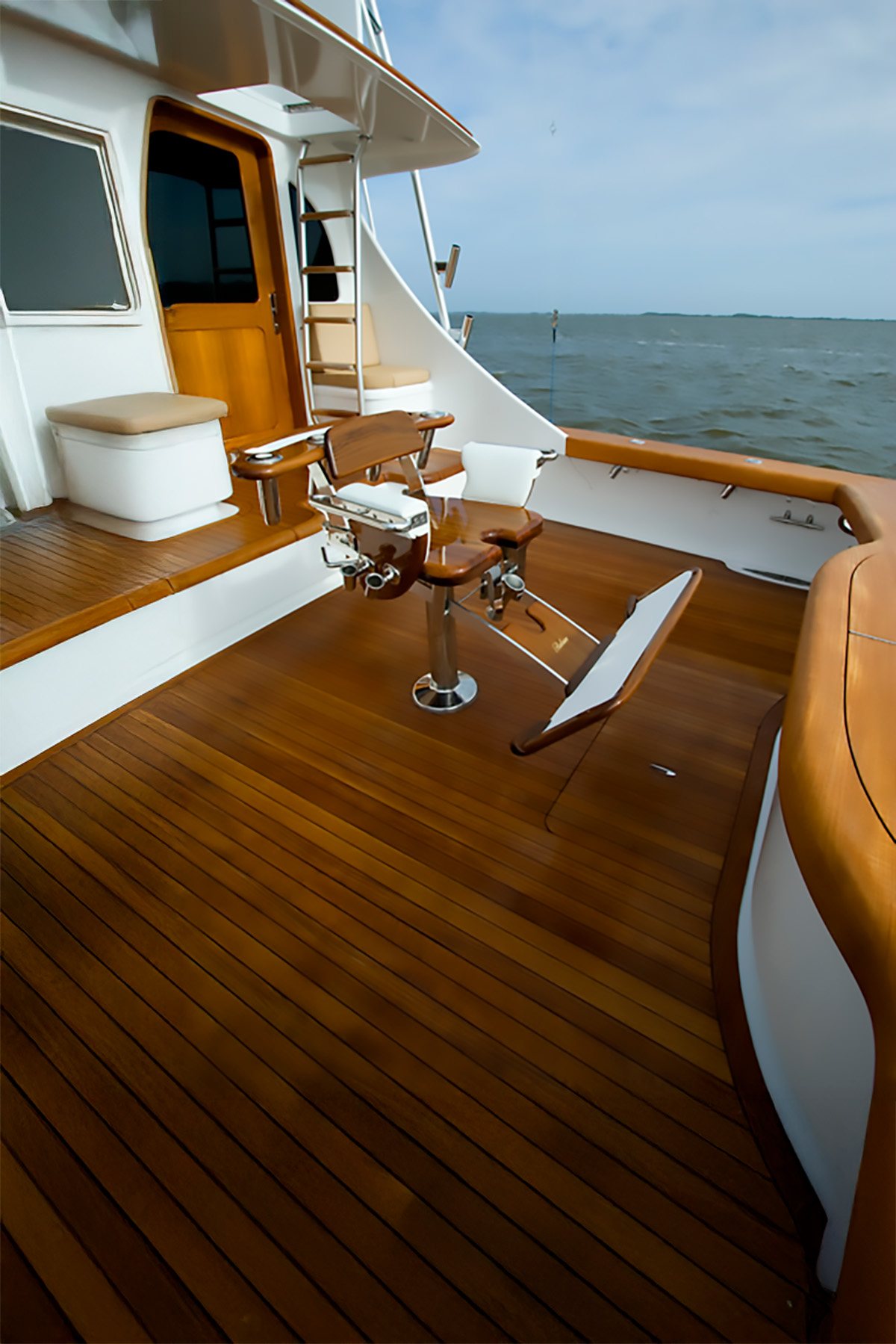
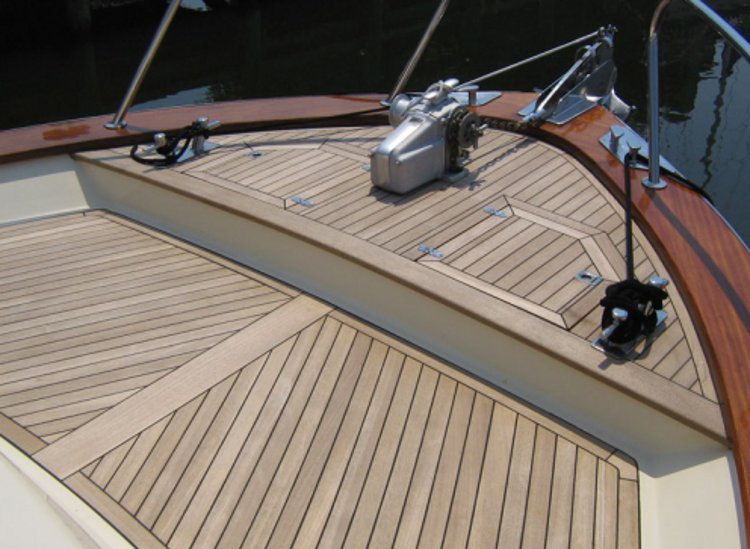
A yacht deck is not one lumber order, it is five material problems that arrive on the same truck. The plank field wants narrow, vertical grain stock in repeatable lengths. The margin board wants the longest clear boards in the lot. The kingplank wants width and color consistency straight down the centerline. Bungs want offcuts of the same boards the fasteners pass through. Cabin joinery, which almost always rides along on the same purchase order, wants a different drying target than anything out on deck.
Buyers who write the deck as a single line item get caught the same way every time. Footage bought on volume alone yields plenty of plank stock and nothing long enough for a covering board. A second buy made three months later matches on species and misses on color. Bungs cut from a different pack read as spots across a finished deck, and no amount of weathering ever pulls them back into line.
J. Gibson McIlvain holds over seven million board feet of exotic and domestic lumber at its Maryland yard, which is why one pull can cover a plank field, its margins and the offcuts the bungs come out of without the order splitting across two packs. On a deck, inventory depth is not a talking point. It is the difference between one lot and three.
Turning the Deck Drawing Into a Takeoff
A deck takeoff is a length schedule first and a footage number second. Square footage tells you almost nothing about whether a lot can be bought. Two decks of identical area, one straight laid and one sprung to follow the sheer, consume different lumber entirely. The sprung deck needs every plank cut from stock longer than the straight line distance it covers, because the plank follows a curve and the curve eats length.
Start with the plank field. Fix the finished plank width and the seam width, then count planks across the beam at the widest station. Finished deck plank widths in the marine trade commonly run between 1-3/4 and 2-1/2 inches, with seam width set by the caulking system the yard has chosen. Thickness depends on how the deck is built. A deck laid over a structural substrate runs thin, often in the 3/8 to 1/2 inch range, while a traditional deck laid over beams is thicker and is fastened and bunged rather than bonded alone.
Then schedule the long parts separately. The margin board and the kingplank are not plank field stock and should never be bought out of the same footage allowance. Add the nibbed ends, add the waste a sprung deck burns at every plank end, and add kerf and machining allowance on every piece. A takeoff that does not carry a separate minimum length for each component will come up short on exactly the pieces that are hardest to replace. Count the bungs off the fastener schedule rather than off the deck area, since bung stock is easy to add at order time and painful to chase later.
| Component | Grain orientation | What the takeoff must state | In-service moisture target |
|---|---|---|---|
| Plank field | Quartersawn, vertical grain on the wear face | Finished width, seam width, thickness, minimum length, total count | Near 12 to 16 percent |
| Margin or covering board | Quartersawn, grain running with the curve | Longest single piece required, finished width, thickness before springing | Near 12 to 16 percent |
| Kingplank | Quartersawn, matched color along the run | Overall length, finished width, whether it is one piece or scarfed | Near 12 to 16 percent |
| Nibbed plank ends | Same stock as the plank field | Added length allowance per plank, nib angle from the drawing | Near 12 to 16 percent |
| Bungs | Grain oriented with the plank below | Diameter, count from the fastener schedule, same lot as the planks | Near 12 to 16 percent |
| Bright cabin joinery on the same order | Quartersawn or rift where a panel must stay flat | Part sizes, thickness in quarters, machining allowance | Near 6 to 8 percent |
Vertical Grain Is the Plank Field Spec

Deck planking is a quartersawn call, and a plainsawn board of the same width is the wrong material no matter how clean it looks. Quartersawn and rift stock moves less across its width than plainsawn, and the Forest Products Laboratory publishes the tangential and radial shrinkage data behind that difference. It is the whole reason a laid deck holds its seams through a season of wet and dry cycles. On the wear face, quartersawn teak shows tight parallel grain lines. Plainsawn shows cathedral figure that wears unevenly, raises grain under traffic and cups away from the fastener line.
The practical test on the yard floor is ring angle at the end of the board. Rings running close to perpendicular to the face give you the flat, even wear surface a deck needs. Rings running shallow give you a board that will telegraph every ring boundary within a few years of scrubbing. A plank field spec that says only clear teak will get boards that are clear and still wrong.
Teak earns its place here on properties rather than tradition. It holds dimension, resists decay without coating, and tolerates the repeated wetting that destroys most hardwoods, which is why marine specifications keep coming back to it. Hardness figures and shrinkage values for the species are published at The Wood Database, and reaching for the published number beats trusting memory on a job where the planks get sanded flush after they are laid.
J. Gibson McIlvain pulls and grades teak against the grain orientation the drawing names before anything gets cut to width, which matters because ring angle disappears as a buying criterion the moment a board has been ripped into plank stock. Specify it at the order, not at the saw.
Margin Boards Need Length Before They Need Width
The margin board is the single hardest piece in a deck package to buy, and it is almost always the piece nobody schedules. It runs the perimeter, it takes the nibbed ends of every plank in the field, and on a sprung deck it has to be cut out of stock wide enough to contain the curve rather than bent into it. So the controlling number is not width. It is the longest single piece the drawing will accept without a scarf.
This is where grade language starts doing real work. Under the National Hardwood Lumber Association rules that govern North American hardwood, a board is graded by the yield of clear face cuttings it produces rather than by appearance alone. FAS is the top grade and requires a minimum board of 6 inches wide by 8 ft long yielding 83 and 1/3 percent clear face cuttings. FAS One Face, written F1F, meets FAS on the better face, and Selects meet FAS on the better face at a smaller minimum size.
No. 1 Common requires 66 and 2/3 percent on a minimum board of 3 inches by 4 ft, and No. 2A Common requires 50 percent. None of that describes a defective board. A No. 1 Common board simply yields smaller clear cuttings, which makes it the economical grade for short parts and exactly the wrong grade for a long clear run. A margin board is the longest clear run on the boat.
Thickness rides on the same order in quarters of an inch of rough thickness. 4/4 is nominal 1 inch rough, 8/4 is 2 inches, 16/4 is 4 inches, and every surfaced dimension comes off those rough numbers. Margin boards usually want 8/4 or heavier so the shop has material to work with when the piece gets sprung and faired, and a package that orders margins in the same thickness as the plank field has quietly removed that option.
The Kingplank and the Nibbed Ends
The kingplank is a color matching problem disguised as a width problem. It runs the centerline, it is the first thing anyone standing on deck looks down, and it sits between two mirrored fields of planking that draw the eye to any shift in tone along its length. Width and length are the easy part. Getting one continuous run of teak that holds the same color from stem to companionway is the part that depends entirely on how deep the lot was when the boards were pulled.
Nibbed ends are the detail that ties the field to the perimeter. Each plank terminates into the margin board or the kingplank at an angle rather than dying into a straight butt, which keeps a feather thin point of end grain from being left at the seam where it would fail first. The nib angle comes off the drawing, and it adds length to every plank in the field. That added length belongs in the takeoff, not in the waste factor.
Where a kingplank is too long to come out of one board, the joinery shop scarfs it, and the scarf wants stock from the same lot on both sides of the joint. J. Gibson McIlvain records the lot a deck package came out of, so a later phase or a repair pulled a year on can be matched against the same material rather than against a species name on an old invoice.
Bungs Come Out of the Same Lot
Bungs are the smallest components in the package and the fastest way to ruin the look of a finished deck. A bung sits proud of the plank, gets sanded flush and then reads as part of the surface forever. Cut it from a different pack of teak and it shows as a row of pale or dark dots marching down the plank line. Cut it with the grain running across the plank instead of with it, and it shows as a cross grain fleck in an otherwise continuous surface.
The fix is an ordering decision, not a shop decision. Buy bung stock as part of the deck package, from the same boards, and buy more than the fastener count calls for. The yard's joiner cuts the bungs with a plug cutter out of offcuts and orients each one with the plank below it, which is only possible if the offcuts came off the same material in the first place. Reserve a few spare planks on the same line. A deck that gets a damaged plank replaced out of a fresh buy announces the repair, and one replaced out of reserved stock from the original lot does not.
Grade Language the Order Can Carry
The specification a yacht deck order actually travels on is dimensional and physical, not a single grade letter. The National Hardwood Lumber Association rules describe North American hardwood, and imported teak is commonly quoted on export grade language instead, so a purchase order carrying nothing but a grade name leaves the important calls open. Write the calls out. Thickness in quarters, width range, minimum length by component, grain orientation on the wear face, moisture target, and how much machining allowance is to be left on.
Add the documentation requirement in the same breath. J. Gibson McIlvain is an FSC certified importer and miller, so a deck package can ship with sourcing documentation attached to the material rather than reconstructed afterward out of old emails. On a vessel built to a specification with sourcing requirements, that paperwork is part of the deliverable. The certification scheme itself is set out at FSC.
For the bright joinery riding along on the same order, the quality language most yards and architects already recognize comes from the Architectural Woodwork Institute standards, which define what premium, custom and economy grade work mean in terms a shop can quote and a client can inspect. Borrowing that vocabulary for the cabin side of the package keeps the deck spec from having to do two jobs at once.
"A deck order lives or dies on the length call. We can find plank stock in almost any teak pack on the yard, but if nobody tells us the margin board has to come out in one 22 ft piece, we are reading that off the drawing after the lumber has already been cut. Tell us the longest piece first and the rest of the order falls into place."
Norm Moton, Director of Sales, J. Gibson McIlvain
Two Moisture Targets in One Package
A deck order that carries cabin joinery is an order with two different moisture specifications, and sending both out at one number guarantees trouble at one end. Kiln dried hardwood for interior use lands near 6 to 8 percent moisture content. Exterior work runs near 12 to 16 percent. A deck plank dried to interior numbers arrives too dry for its service environment and will want to swell against its seams. Interior joinery dried to exterior numbers shrinks after it is installed and opens its joints.
Air dried stock settles near the local equilibrium moisture content and is not a substitute where an interior tolerance matters. For a cabin panel that has to stay flat in a heated, dehumidified space, the only way to hit the target is kiln dried material specified to it. J. Gibson McIlvain stocks kiln dried teak and selects to the in-service moisture content the drawing names, which is the practical mechanism for getting both halves of one order right. Stock that has ridden in a cold truck is not at its reading temperature when it arrives either, so let the package acclimate in the space it will be worked in before anyone cuts to final dimension.
Movement after delivery is a function of the environment the wood sits in, and the relationships between relative humidity, equilibrium moisture content and dimensional change are laid out plainly in the material at Building Science Corporation. Measurement method matters too. Meter readings, oven dry tests and the conditions they are taken under are standardized, and the governing test methods are published by ASTM. A number without a method behind it is a number two parties can argue about later.
When the Drawing Is Not Teak
The honest alternates for marine work are joinery species, not the hard tropical decking species. Iroko has decades of use in marine joinery and exterior work and is the closest working substitute in both stability and decay resistance. Afrormosia machines and finishes cleanly and holds a crisp edge. Utile, sold as Sipo, covers wide panel and long trim parts. Those three plus Teak and Sapele are the working palette for milled, glued and machined marine components.
Sapele deserves a specific note on coated exterior parts. For painted exterior trim it is preferred over Genuine Mahogany, because it holds paint better and comes in a wider range of sizes and longer lengths. Sapele runs roughly 1,410 lbf on the Janka scale against roughly 800 lbf for Genuine Mahogany, and it is not milled 1x8 for exterior use, since that width is too wide to stay stable in service. Where a coated part cups, the cause is installation and back ventilation rather than the species on the drawing.
Coating absorption is the other variable on those parts. Open-grained and oily species absorb a great deal of finish, so a primer coat evens out the eventual painted surface, and sanding or buffing after priming knocks back grain raising while keeping moulded detail crisp. A coated caprail or a painted cabin side takes more finish than a first time buyer budgets for.
The tropical decking species belong in a different conversation. Ipe, botanically Tabebuia spp, along with Cumaru, Garapa, Jatoba and Red Balau, are extremely hard and carry high oil content, which makes them difficult to glue. They are decking stock for a dock, a pier or a shoreside platform. A bonded deck panel or a glued margin is not where they go, and a millwork shop reaches for Sapele, Iroko, Afrormosia, Teak or Utile instead.
For shoreside trim around a boathouse or a dock structure, Western Red Cedar is a legitimate default and the grade call matters more than the species call. CVG, clear vertical grain, gives you the stable, straight grained material a coated run wants. STK, select tight knot, gives you a knotty character grade that behaves differently under a finish. Both are real choices, and the drawing should say which one it means.
Modified products are worth knowing for that same shoreside work. Accoya runs roughly 1,600 lbf, and acetylation gives it dramatically reduced shrinkage and swelling, documented at Accoya. Thermory and Abodo Vulcan are both carried, and thermal modification is described at Thermory. All of them top out around 16 ft, most sold on metric lengths just under 16 ft, because of kiln size, and thermally modified Ash is not available wider than 8 inches, so a wide board in a modified product means Accoya or Abodo Vulcan. Warranties exist on modified products and on nothing else. It is not possible to warranty solid unmodified wood, an organic material responding to its environment.
Getting the Package to the Yard
A deck package is at more risk between the lumber yard and the joinery shop than at any other point before it is laid. Thin plank stock racks and bows if it is stacked loose. Long margin boards take a set when they are supported in the wrong places. A pack that gets rained on and then wrapped tight arrives at a moisture content nobody specified. Delivery is part of the specification, not a logistics afterthought.
J. Gibson McIlvain delivers nationwide on its own fleet of trucks, regularly to California, which means a deck package for a West Coast refit moves on a date the yard can plan a joinery crew around rather than on whatever a freight broker assigns that week. Staged release matters on a long refit. The plank field is wanted when the substrate is ready, and the bright joinery is wanted months later.
Be clear about the split in scope. J. Gibson McIlvain mills on moulders, straight line and gang rip saws, band resaws and trimming saws, so stock can arrive ripped and resawn close to section with machining allowance left on. The deck layout, the springing of the margin, the nibbing, the fastening, the bunging and the caulking are the boatyard's joinery work, done to the vessel in front of them. Nobody should be quoting that off a drawing from a thousand miles away.
ICD, the company's architectural millwork division, builds true custom millwork planned around a specific space, which is the route for a boathouse interior, a dock cabana or a clubhouse going up alongside the boat program. Its working process is described at ICD.
How J. Gibson McIlvain Would Specify This
A deck teak order should go out as one package with a length schedule, a grain call, two moisture targets and reserved stock for bungs and repairs. Start with the longest single piece the drawing requires, usually the margin board or the kingplank, because that number decides which lots can be bought at all. Everything else in the package gets easier once that piece is settled.
Write the plank field as quartersawn with vertical grain on the wear face, at a stated finished width and thickness, with a minimum length per plank that already includes the nib allowance. Write the margin board at 8/4 or heavier with the longest piece called out explicitly. Write the kingplank with a color match requirement along its run. Write bung stock and spare planks as line items from the same lot, above the fastener count.
Put the moisture targets in writing twice, near 12 to 16 percent for everything on deck and near 6 to 8 percent for the bright joinery below. Name the machining allowance to be left on. Name the documentation the specification requires. Then have the material graded, pulled, ripped and resawn against that package before it ships, so the boatyard's joiner is fitting a deck instead of sorting lumber.
J. Gibson McIlvain mills and supplies teak deck packages on exactly those terms, and the mill services page sets out what the shop runs. Bring the deck drawing and the length schedule to the conversation and call 800-638-9100. Whether a lot can cover the margin boards in one piece is a question that takes a phone call, not a week.
Frequently Asked Questions
Where do I buy teak lumber for a yacht deck?
From a yard that holds enough teak in one place to pull the plank field, the margin boards, the kingplank and the bung stock out of a single lot, and that will grade to a vertical grain requirement rather than to a grade letter alone. The questions worth asking before you buy are simple. Can the longest piece on the drawing come out in one length. Can bung stock and spare planks come off the same boards. Can the deck material be selected to an exterior moisture target while the cabin joinery on the same order is selected to an interior one. J. Gibson McIlvain mills and supplies teak deck packages on those terms, and the fastest way to find out whether a lot covers your margin boards is to call 800-638-9100 with the drawing and the length schedule in hand.
What grade should a teak deck specification call for?
Grade alone will not get you a deck. The National Hardwood Lumber Association rules grade a board by the yield of clear face cuttings it produces, so FAS requires a minimum board of 6 inches wide by 8 ft long yielding 83 and 1/3 percent clear face cuttings, while No. 1 Common requires 66 and 2/3 percent on a minimum board of 3 inches by 4 ft. Those rules describe North American hardwood, and imported teak is commonly quoted on export grade language instead. So write the physical calls on the order. Thickness in quarters, width range, minimum length by component, vertical grain on the wear face, moisture target and machining allowance.
Does the margin board have to come out of one piece?
Not always, but the drawing has to say. A sprung margin cut from one wide board is the cleanest result because there is no scarf to fair out and no joint to telegraph later. Where the length is not available, the joinery shop scarfs it, and the scarf wants stock from the same lot on both sides of the joint so color and grain carry across. Order margin boards at 8/4 or heavier either way, so there is material to work with once the piece is sprung and faired.
What moisture content should deck teak be delivered at?
Exterior work runs near 12 to 16 percent moisture content, and interior joinery runs near 6 to 8 percent. A deck order that carries cabin parts needs both numbers written on it. Air dried stock settles near the local equilibrium moisture content and is not a substitute where an interior tolerance matters, so the cabin side of the package should be specified as kiln dried to the interior target. Let the material acclimate in the space it will be worked in before anyone cuts to final dimension.
Can Ipe or another tropical hardwood replace teak on a deck?
The tropical decking species are a different tool. Ipe, botanically Tabebuia spp, along with Cumaru, Garapa, Jatoba and Red Balau, are extremely hard and carry high oil content, which makes them difficult to glue. That is fine on a dock or a pier where the boards are mechanically fastened, and a problem in a bonded deck panel or a glued margin. Where teak is not the answer on a boat, the working alternates are joinery species, Iroko first, then Afrormosia, Utile sold as Sipo, and Sapele on coated parts.
Why do bungs have to come from the same boards as the planks?
A bung gets sanded flush and then reads as part of the deck surface for the life of the deck. Cut from a different pack, it shows as a pale or dark dot, and the eye finds the whole row of them. Cut with the grain running across the plank rather than with it, it shows as a cross grain fleck. Both faults are ordering problems rather than workmanship problems, which is why bung stock belongs on the original order, above the fastener count, out of the same lot as the planks.